

Apollo Email Finder: What the 91% Accuracy Claim Actually Means
You exported 2,000 "verified" contacts from Apollo's email finder last Tuesday. By Wednesday morning, 18% had hard bounced. By Friday, a quarter of the replies were some version of "I left that company eight months ago." Toss in the wrong-ICP contacts and the catch-all dead ends, and you're looking at maybe 900 usable leads from a list of 2,000. That's not a hypothetical - it's a pattern reported consistently on r/coldemail.
Let's break down what Apollo.io's email finder actually delivers, where the 91% accuracy claim falls apart, and what to do about it.
Quick Verdict
Keep Apollo for what it's great at - filters, sequencing, workflow automation. The email finder is the weakest link.
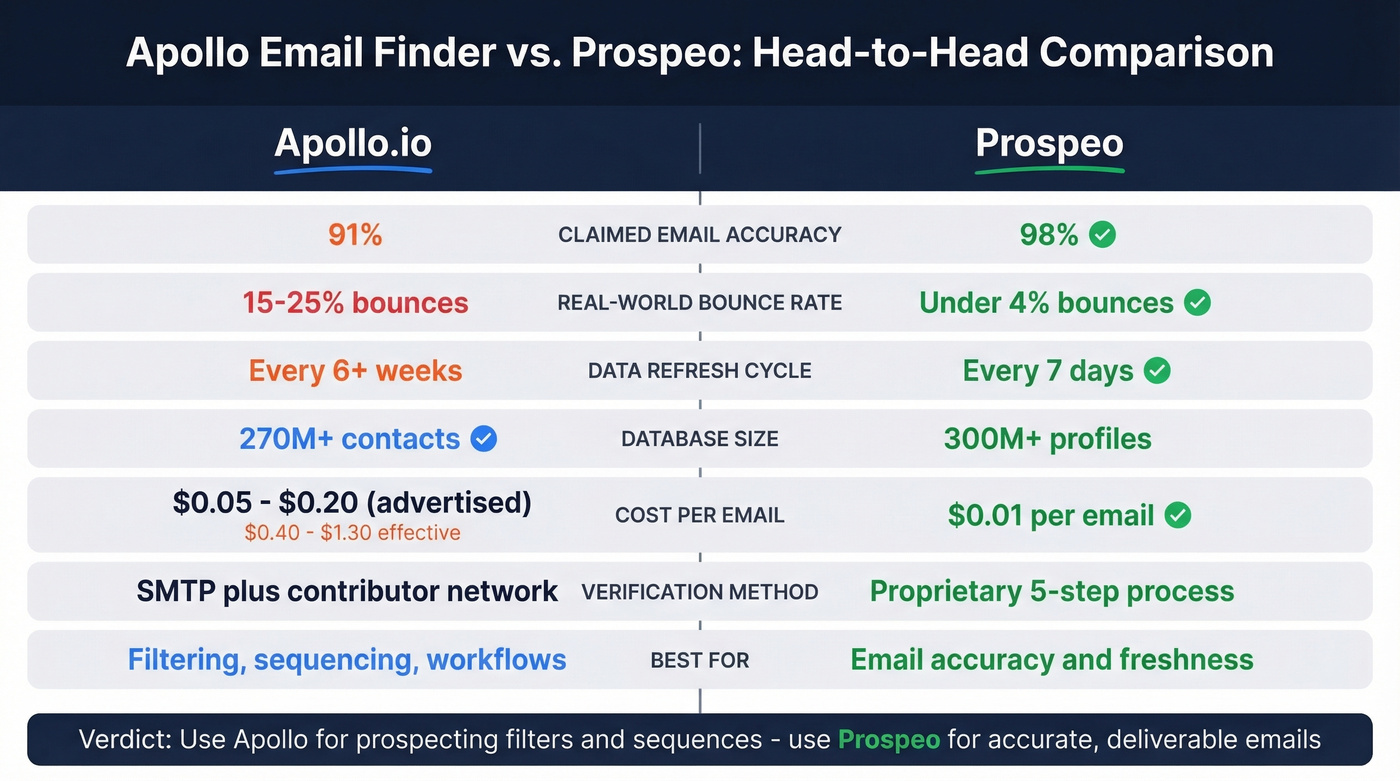
Always run exports through a second verifier before sending. Apollo's "verified" badge isn't a quality guarantee. Practitioners report 15-25% bounce rates on day one. If email accuracy is the priority, pair Apollo's filtering with a dedicated verification tool. We've seen teams cut bounce rates in half just by adding that second step.
What Apollo's Email Search Actually Does
Apollo's database covers 270M+ contacts. The platform carries a 4.7/5 rating on G2 across 9,475 reviews - genuinely impressive and earned. But most of that goodwill comes from Apollo's filtering, sequencing, and all-in-one workflow capabilities, not from the email lookup specifically.
The core experience: you set search filters (title, industry, company size, location, tech stack), Apollo returns matching contacts with email addresses, and you export them or push them into a sequence. The Chrome extension activates on company websites and professional profiles, cross-referencing Apollo's database to surface contact info on the fly. CRM integrations with Salesforce, HubSpot, and Pipedrive let you push contacts directly into your pipeline, and the tech stack filter is particularly useful - you can target companies running specific software, which narrows ICP targeting significantly.
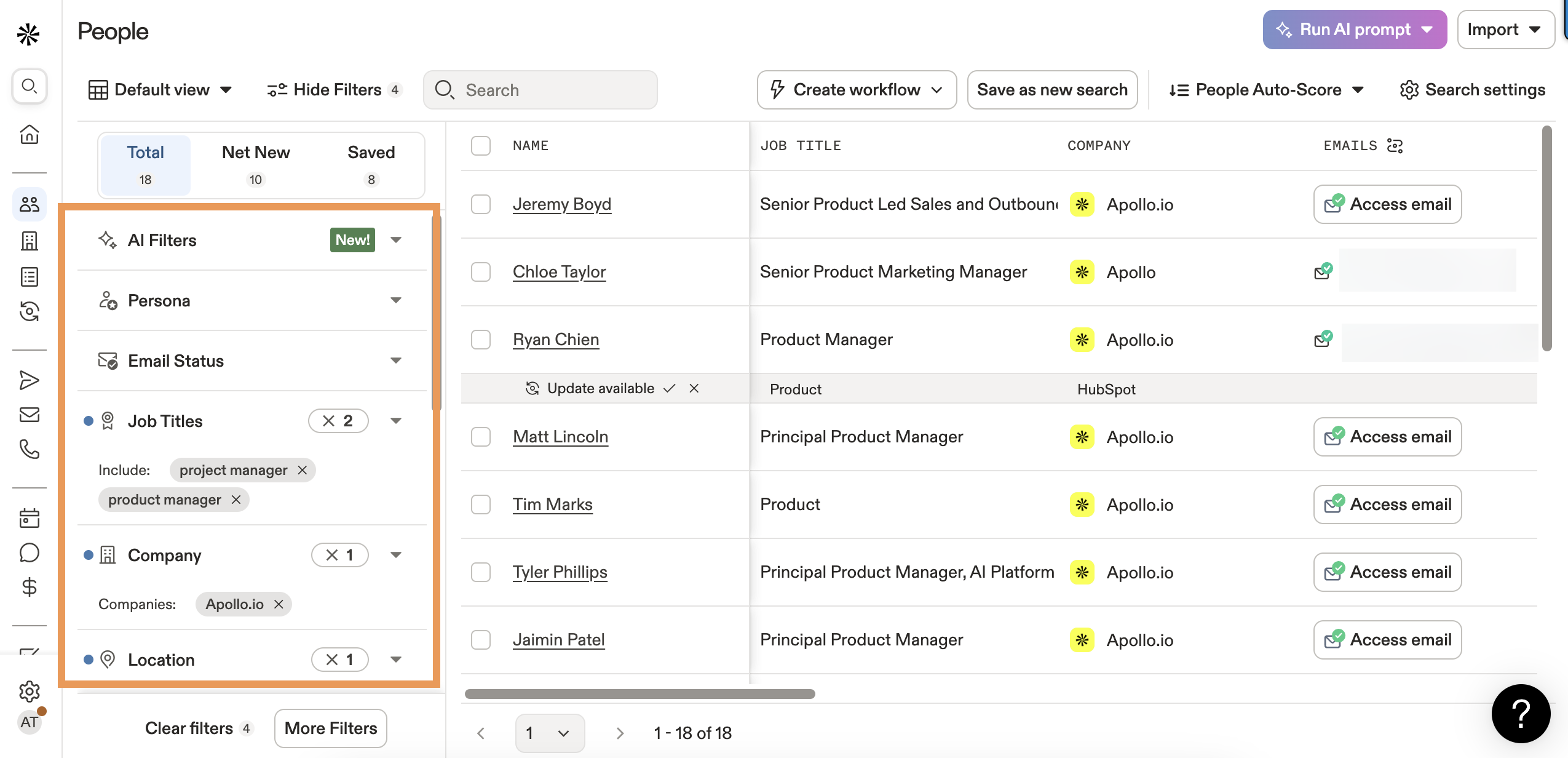
The filtering is genuinely best-in-class for the price point. Users on G2 consistently praise the search capabilities and lead gen efficiency. Where things fall apart is what happens after you build your list.
How Apollo Verifies Emails
Apollo describes a multi-component verification process that goes beyond basic SMTP validation. Most third-party verifiers rely on SMTP tickling - pinging a mail server to ask "does this address exist?" Apollo does that too, but layers on additional signals from its contributor network.
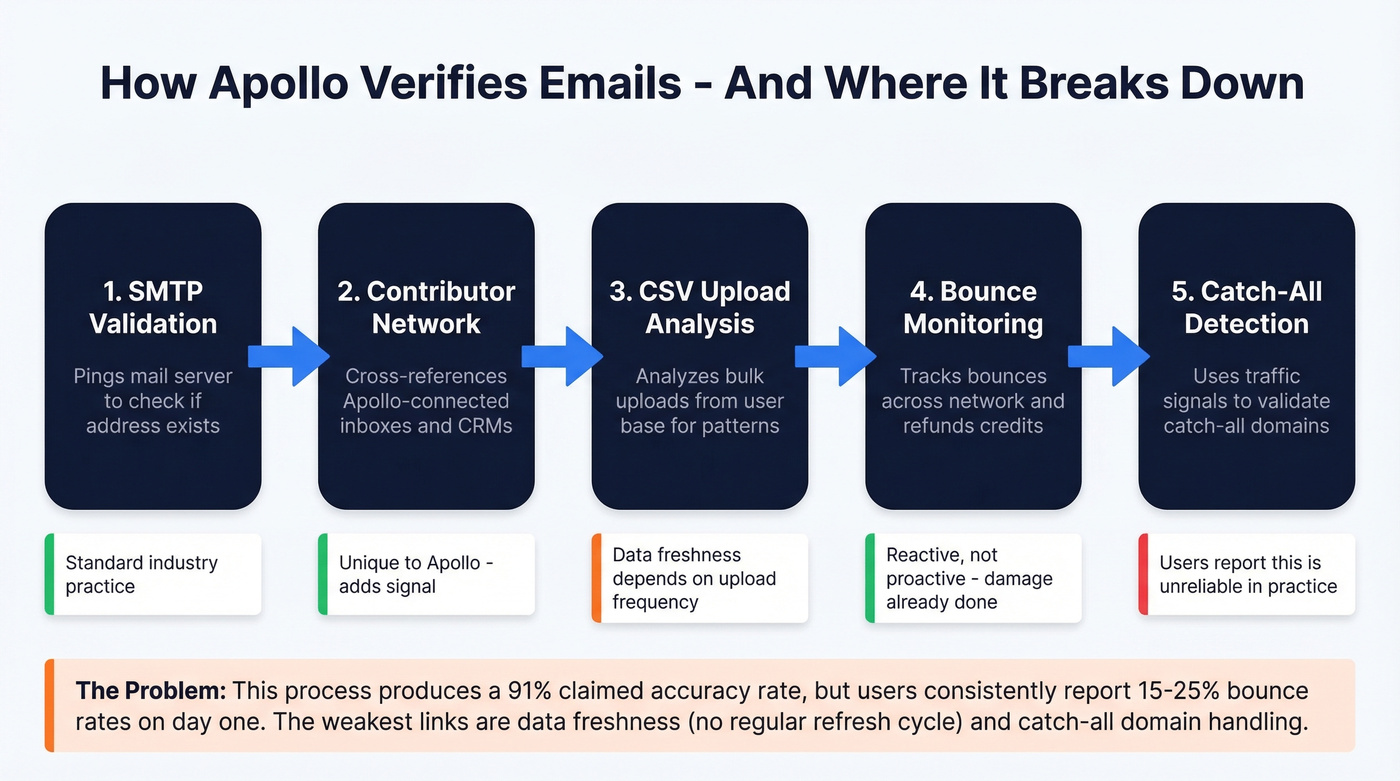
Their verification includes SMTP validation, cross-referencing against Apollo-connected inboxes and CRMs, analyzing CSV uploads from its user base, monitoring bounce rates across its network, and using email traffic evidence to handle catch-all domains. When Apollo detects a bounce, it propagates that information across all customers and automatically refunds the credit. Apollo also uses third-party vendors like ZeroBounce via waterfall enrichment to supplement its own checks.
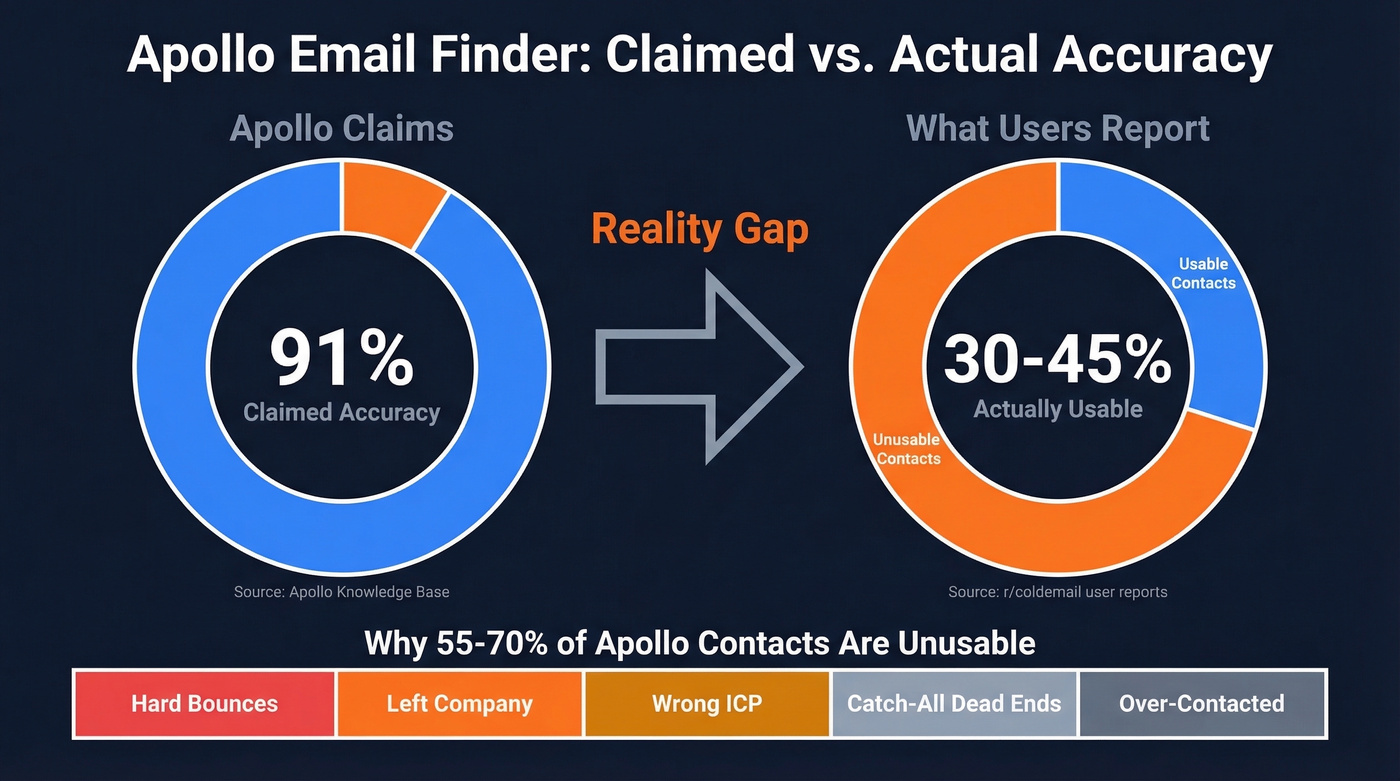
Apollo claims this produces a 91% accuracy rate. On a 10,000-contact campaign, 91% accuracy means roughly 900 contacts would be inaccurate. That's not a rounding error - that's enough to tank your sender reputation with most ESPs.
And 91% is the claim. What practitioners actually report is worse.
The catch-all domain handling deserves scrutiny. Apollo says it can differentiate valid from invalid emails on catch-all domains using network traffic signals that standalone verifiers can't access. In theory, meaningful. In practice, the bounce rate data from real users suggests catch-all detection isn't as reliable as it sounds.

Tired of 15-25% bounce rates from Apollo exports? Prospeo's proprietary 5-step verification delivers 98% email accuracy - no second-pass verifier needed. Every record refreshes every 7 days, not every 6 weeks, so you stop emailing people who left the company months ago.
Get 98% accurate emails at $0.01 each - no catch-all guesswork.
What Users Actually Report
The gap between Apollo's 91% claim and real-world results is the central problem. Reddit threads on r/coldemail paint a consistent picture: 55-70% of database-sourced leads are typically unusable before second-pass verification, and Apollo users report similar patterns. That includes hard bounces, left-company replies, wrong ICP, catch-all dead ends, and over-contacted prospects.
One agency user reported that 80-90% of profiles from Apollo lists appeared abandoned - no profile pictures, inactive for months. If the underlying profile data is stale, the email addresses attached to those profiles are almost certainly stale too.

G2 reviews echo this. While the aggregate rating is strong, the most common cons include "Inaccurate Data" and "data accuracy varies by region." European and APAC coverage gets hit hardest - multiple reviewers flag EMEA data as significantly less reliable than US records - but even domestic data isn't immune.
Here's my frustration with Apollo: it's one of the best all-in-one outbound platforms for the money, but the "verified" label creates a false sense of security that actively damages sender reputations. If your deal sizes sit below $15K, the domain reputation damage from high bounce rates can cost you more than the platform saves you.
Apollo Email Finder Pricing
Apollo's sticker price and actual cost are two different numbers.
| Plan | Annual Billing | Monthly Billing | Mobile Credits/mo | Export Credits/mo |
|---|---|---|---|---|
| Free | $0 | $0 | 5 | 10 |
| Basic | $49/user/mo | $59/user/mo | 75 | 1,000 |
| Professional | $79/user/mo | $99/user/mo | 100 | 2,000 |
| Organization | $119/user/mo | $149/user/mo | 200 | 4,000 |
Credits expire monthly. Overages cost $0.20 per credit with a 250-credit minimum purchase. Phone numbers cost 8x more than emails in credit terms, which adds up fast if you're pulling direct dials.
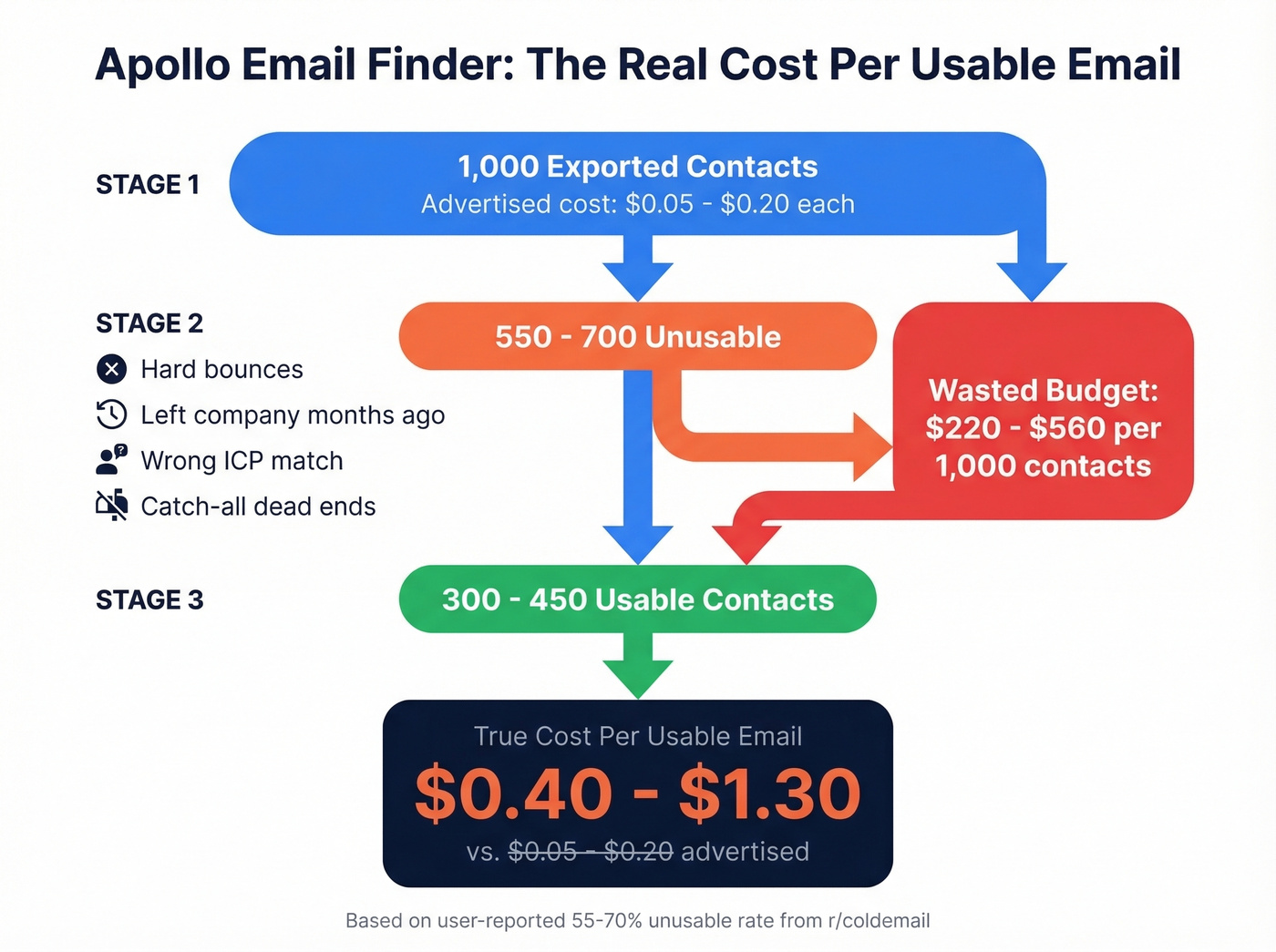
For heavy outbound teams, expect to budget $150-$400/user/month once you factor in overages and add-ons. That's 2-3x the advertised price. Now the cost-per-usable-lead math: if 55-70% of your exported contacts are unusable (stale, bounced, wrong ICP), your effective cost per usable email isn't $0.05-$0.20. It's $0.40-$1.30. One r/coldemail user estimated $220-$560 wasted per 1,000 contacts when factoring in unusable records. That changes the ROI calculation dramatically, especially when you add the domain reputation damage from sending to bad addresses. The Organization plan's 4,000 export credits sound generous until you realize you'll get 1,200-1,800 usable contacts from them.
Chrome Extension & Recent Changes
Apollo's Chrome extension is one of the platform's strongest features. It activates on company websites and professional profiles, cross-references Apollo's database, and surfaces contact info with one click. You can push contacts directly to your CRM without leaving the page. The free plan gives you roughly 600 email credits per year, 60 mobile credits per year, and 120 export credits per year, plus a 250/day send cap.
But Apollo has been tightening the platform. In late 2025, users reported that Apollo removed the ability to upload email permutations to discover valid emails and earn free credits. Uploads for phone numbers and profile URLs were also blocked. Earlier that year, Apollo's company page on a major professional network was removed over data policy concerns - another signal of the platform navigating compliance pressures.
If you were relying on upload workarounds to stretch your free plan, those doors are closed. Apollo is clearly pushing users toward paid tiers and protecting its data moat, which means the free plan is less useful than it was six months ago.
Best Alternatives to Apollo's Email Finder
Apollo's contact finder is the most overrated feature on the platform. The filtering and sequencing? Excellent. The email data? Well-documented accuracy gap. Here are the proven alternatives with track records to back up their claims.
| Tool | Starting Price | Best For | Verification Approach |
|---|---|---|---|
| Prospeo | Free (~$0.01/email) | Email accuracy & freshness | Proprietary 5-step, 7-day refresh |
| Hunter.io | $24/mo | Domain-based search | Verification-focused |
| Cognism | ~$1,000-3,000/mo | European data & compliance | 16-step process |
| Snov.io | $30/mo | International prospecting | Multi-step with drip campaigns |
| Lusha | $36/mo | Quick contact lookups | Credit-based lookups |
Prospeo
Prospeo is the accuracy-first alternative - built for teams whose domain reputation can't afford Apollo's bounce rates. The database covers 300M+ professional profiles with 143M+ verified emails and 125M+ verified mobile numbers, and email accuracy sits at 98% powered by proprietary infrastructure that doesn't rely on third-party email providers. The Chrome extension has 40,000+ users and works across company websites and professional profiles, with native integrations for Salesforce, HubSpot, Smartlead, Instantly, and Lemlist.
What makes the accuracy claim credible is the 7-day data refresh cycle. Stale data is the number one accuracy killer, and a weekly refresh eliminates it at the source. Meritt tripled pipeline from $100K to $300K per week after switching, with bounce rates dropping from 35% to under 4%. Paid plans run about $0.01 per email with no contracts or annual commitments. For teams burned by Apollo's bounce rates, this is the obvious next step.
Hunter.io
Hunter takes a different approach - domain-based rather than database-based. You enter a company domain, Hunter returns the email addresses associated with it. Starting at $24/mo for 500 searches with a free tier offering 25 searches per month, it's one of the most affordable paid options on this list. Users on r/coldemail and r/agency consistently praise the accuracy of returned results.
Use this if you're targeting specific companies and want high-confidence emails. Skip this if you need to build large prospect lists from scratch - the domain-by-domain workflow doesn't scale for high-volume outbound.
Cognism
Cognism runs a 16-step email verification process and it shows in European data quality. Seat-based pricing with unrestricted views and exports eliminates the credit anxiety that plagues Apollo users. DNC checks cover 15 countries versus Apollo's UK and US only, making it the clear choice for GDPR-sensitive outreach. Custom pricing typically runs $1,000-3,000/mo for small teams.
Where Cognism wins over Apollo: EMEA coverage, compliance infrastructure, and verification depth. Where Apollo still wins: US database breadth and the all-in-one sequencing platform at a lower price point.
Snov.io
Snov.io starts at $30/mo for 1,000 searches with a free tier available. The database has decent coverage outside North America, and the built-in drip campaign tool means you can find and sequence contacts without leaving the platform. Good entry point for teams testing cold email internationally without committing to a larger platform.
Lusha
Lusha starts at $36/mo with a free tier offering limited credits. The database is smaller but focused on direct dials and quick contact lookups. Best for individual sales reps who need a phone number in 30 seconds, not for teams building large export lists. Accuracy varies by segment - strong in tech and SaaS, weaker in traditional industries.
At Apollo's real cost of $0.40-$1.30 per usable email, you're overpaying 40-130x. Prospeo charges $0.01 per verified email with a 98% accuracy rate, 7-day data refresh, and spam-trap removal built in. Teams using Prospeo book 35% more meetings than Apollo users.
Stop paying for bounces. Start paying for meetings.
FAQ
Is Apollo's email finder really 91% accurate?
Apollo claims 91%, but practitioners consistently report 15-25% bounce rates on "verified" exports. The gap stems from stale employment data and unreliable catch-all domain handling. Always run a second verification pass before sending - tools like Prospeo or ZeroBounce can cut bounces to under 5%.
How many free email credits does Apollo give?
Apollo's free plan provides roughly 600 email credits per year (~50/month), 60 mobile credits, and 120 export credits. A 250/day send cap applies. As of 2026, workarounds like uploading email permutations for free credits have been removed.
Why do Apollo "verified" emails still bounce?
When contacts change jobs or companies use catch-all domains, SMTP validation can't detect the change until after the bounce. Apollo's contributor network helps but can't keep pace with average job turnover of 18-24 months. Addresses are labeled verified based on the last check, not real-time status.
What's the best alternative for email accuracy?
Prospeo delivers 98% verified email accuracy with a 7-day data refresh cycle - sub-4% bounce rates in practice versus Apollo's 15-25%. Hunter.io is another strong option for domain-based lookups. For European data specifically, Cognism's 16-step verification process leads the market.
Can I use Apollo's email finder with my CRM?
Yes. Apollo integrates natively with Salesforce, HubSpot, and Pipedrive. You can find contacts from search or the Chrome extension and push them directly into your CRM. Verify emails before they hit your database to protect deliverability.