

The 10 Best Sales Enablement Tools in 2026 - With Pricing Nobody Else Publishes
A RevOps lead we know ran a three-tool bake-off last quarter. The platform with the slickest demo and the biggest Gartner badge took 11 weeks to implement and still couldn't tell reps which case study to send a CFO. The cheapest tool in the trial had better adoption in week two.
The demo rarely predicts the outcome. And most "best of" lists don't help either - they regurgitate feature matrices without telling you what anything costs. We've spent the last several months tracking actual contract data, Vendr benchmarks, and community pricing threads to build a list that's actually useful.
The 2026 Enablement Shakeup
The sales enablement market looks nothing like it did 18 months ago. Vendors are consolidating fast, Gartner has formalized the category under its Revenue Enablement Platforms coverage, and the market is projected to hit $8.79B by 2029. That's a lot of vendor dollars chasing your budget.
For buyers, consolidation means fewer independent options, higher switching costs, and sales teams caught between platforms whose product lines are evolving in real time. You're not just picking software - you're betting on which platform will keep improving in the areas you care about.
Every vendor is shipping AI features right now. Seismic's Aura Copilot, AI-powered content recommendations, AI practice scenarios - the list goes on. Here's the thing: most of what's shipping today is glorified search with a chatbot wrapper. Don't pay extra for any AI add-on yet. Give it 12 months.
The good news? The category has matured enough that you can build a stack that genuinely moves pipeline. The tools work. The question is which combination works for your team size, budget, and existing tech.
Recommended Stacks by Team Size
Here's the shortcut.
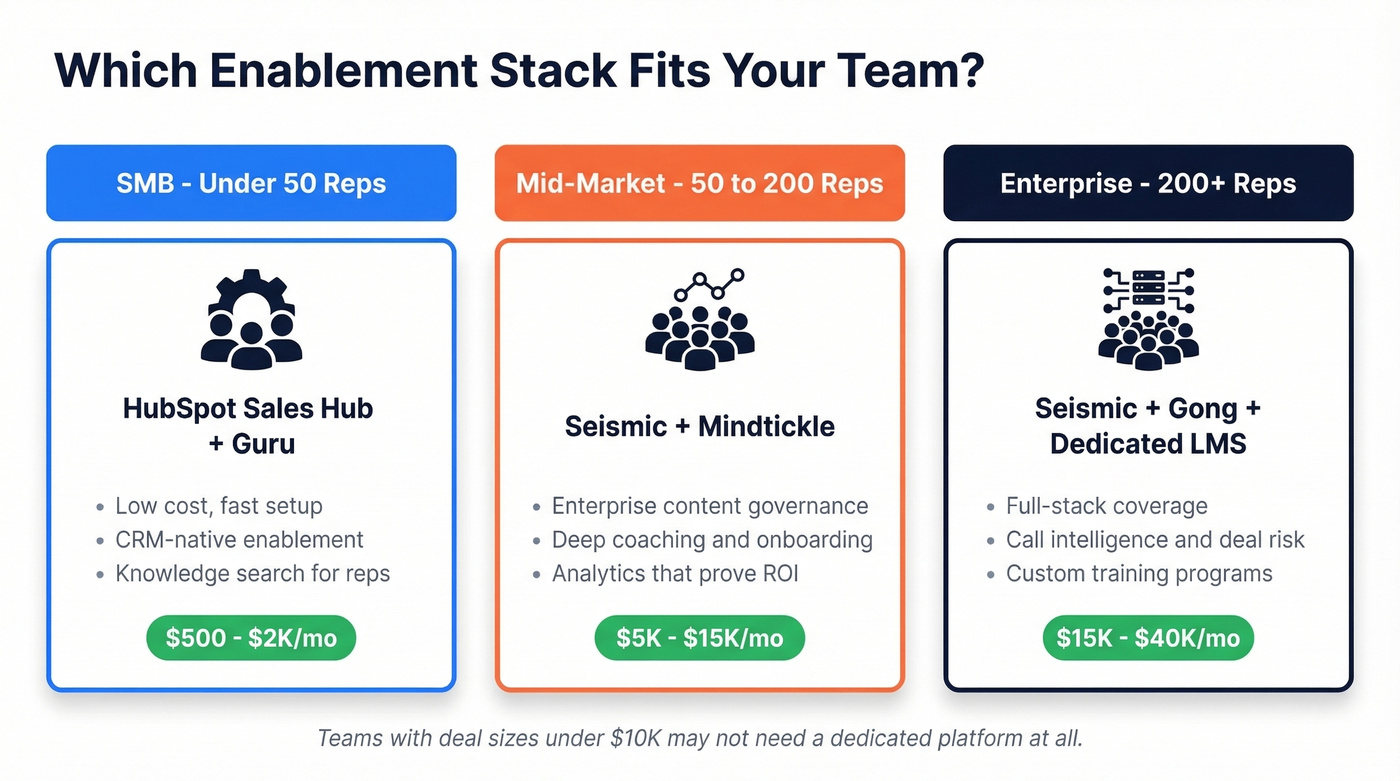
| Team Size | Recommended Stack | Why | Monthly Cost |
|---|---|---|---|
| SMB (<50 reps) | HubSpot Sales Hub + Guru | Low cost, fast setup | $500-$2K/mo |
| Mid-market (50-200) | Seismic + Mindtickle | Content + coaching depth | $5K-$15K/mo |
| Enterprise (200+) | Seismic + Gong + dedicated LMS | Full-stack with call analysis | $15K-$40K/mo |
Let's be honest: most teams with deal sizes under $10K don't need a dedicated enablement platform at all. A well-organized Google Drive, a Loom library, and weekly call reviews will get you 80% of the way there. The tools on this list earn their keep when you have enough reps that consistency becomes impossible without software.
What Enablement Software Actually Does
Sales enablement software centralizes content, coaching, training, and insights to improve seller productivity and accelerate revenue. Organizations with a dedicated enablement strategy achieve 49% higher win rates on forecasted deals and cut onboarding time by 40-50%.
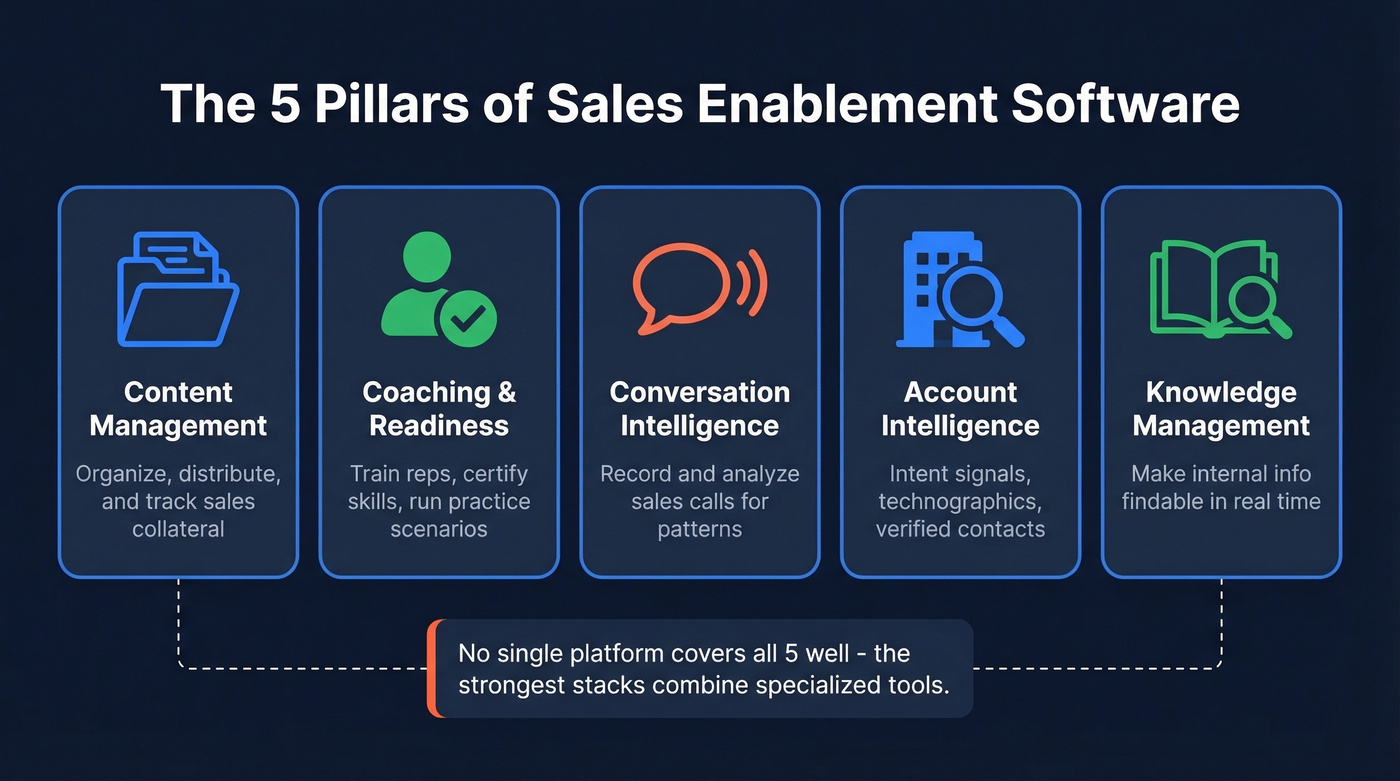
In practice, the category breaks into five buckets:
- Content management - organizing, distributing, and tracking sales collateral
- Coaching and readiness - training reps, certifying skills, running practice scenarios
- Conversation intelligence - recording and analyzing sales calls for patterns
- Account intelligence - enriching accounts with intent signals, technographics, and verified contacts
- Knowledge management - making internal information findable in real time
Most "all-in-one" platforms try to cover two or three of these. None cover all five well. The strongest enablement stacks combine specialized tools rather than relying on a single vendor.
The 10 Top Enablement Platforms for 2026
Seismic - Enterprise Content & Automation
Use this if: You have 100+ reps, a content library that's gotten out of control, and the budget for a proper implementation.
Skip this if: You're under 50 reps or need something live within two weeks.
Seismic is the category's 800-pound gorilla for content management, automation, and distribution - plus training capabilities from its earlier Lessonly acquisition. It offers 100+ integrations and is built for complex enterprise content governance. Highspot, its closest rival in the enterprise tier, is often chosen for content analytics and coaching workflows that support methodologies like Challenger and Sandler.

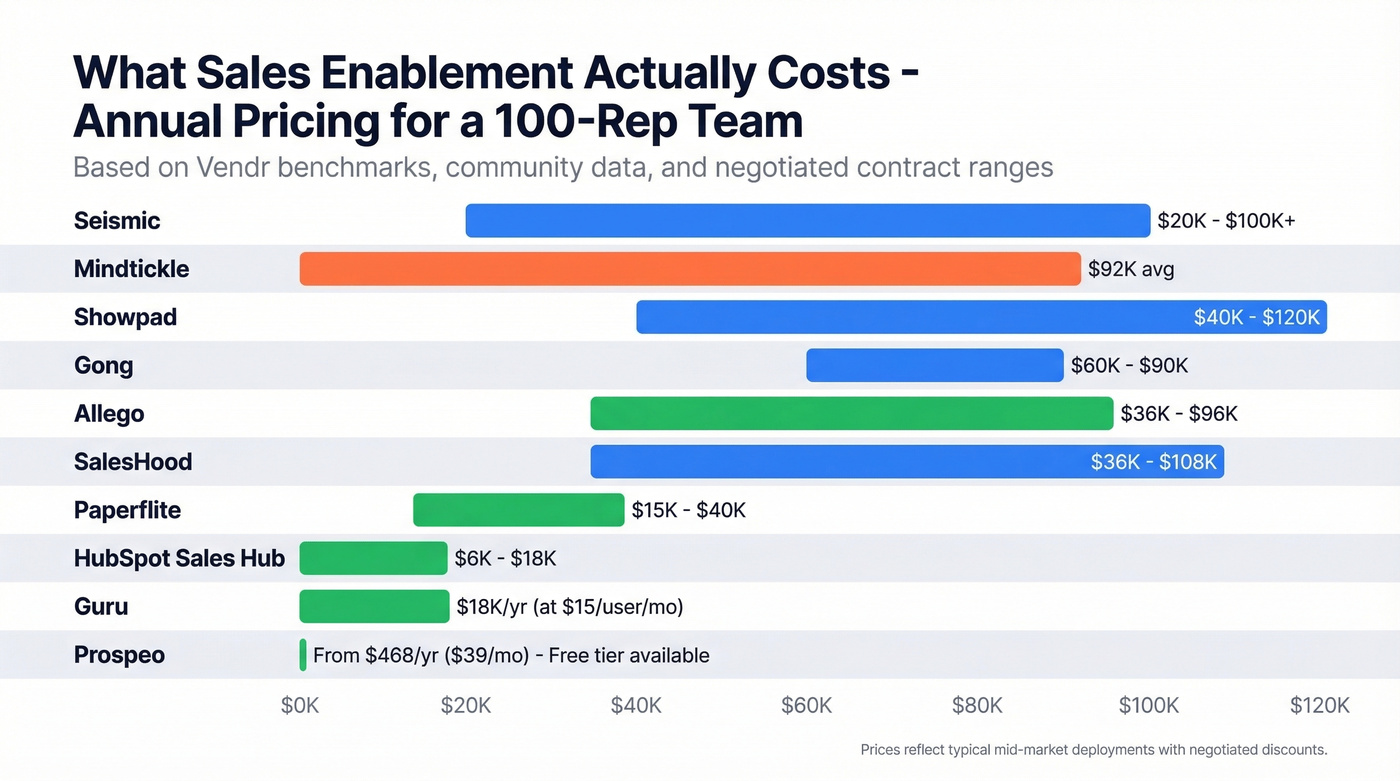
Now the money. Professional Edition lists at ~$630/user/year; Enterprise Premier at ~$494/user/year with volume commitments. But volume discounts of 32-68% are standard. A 100-seat Professional deployment might land around $42K/year after negotiation. The Salesforce connector adds ~$69/user/year on top. Seismic Learning runs ~$362/seat/year list, with discounts of 39-73% at scale. And the Aura Copilot AI add-on ranges from free pilot to $50+/user/month - negotiate this before it becomes a permanent line item.
Pricing signal: $20K-$60K/year mid-market; $100K+ enterprise. Annual contracts, paid upfront. No free tier.
Prospeo - Account Intelligence & Contact Verification
Use this if: Your reps waste hours finding contact info, your bounce rates are embarrassing, or you need verified mobiles that people actually answer.
Prospeo covers 300M+ professional profiles with 143M+ verified emails and 125M+ verified mobile numbers. The 98% email accuracy rate comes from a proprietary 5-step verification process with catch-all handling, spam-trap removal, and honeypot filtering. Mobile numbers hit a 30% pickup rate across all regions - a number that matters when your reps are dialing 50 times a day and connecting on three.

The key differentiator from data modules bolted onto enablement platforms is a 7-day data refresh cycle versus the 6-week industry average. Stale data is the silent killer of outbound. When Snyk rolled out Prospeo across 50 AEs, bounce rates dropped from 35-40% to under 5%, and AE-sourced pipeline jumped 180%.
The platform includes 30+ search filters - buyer intent powered by 15,000 Bombora topics, technographics, job changes, headcount growth, funding signals - plus native integrations with Salesforce, HubSpot, Smartlead, Instantly, and Lemlist. The Chrome extension has 40K+ users and works on any website or CRM in one click.
Pricing: Free tier (75 emails + 100 Chrome credits/month). Paid plans from ~$39/mo. Credits run about $0.01 per email. No contracts, cancel anytime.
HubSpot Sales Hub - SMB Enablement Done Right
Use this if: You're under 50 reps, already run HubSpot CRM, and want enablement features without a second vendor.
Skip this if: You need advanced content management, coaching workflows, or conversation intelligence beyond basics.
HubSpot Sales Hub is the path of least resistance for small teams. With 13,564 G2 reviews and a 4.4/5 rating, it's one of the most-reviewed tools in the category. Reps praise the ease of use and automation - sequences, meeting scheduling, deal tracking all work out of the box.
The pricing is transparent, which is refreshing: Free tools available, Starter at $15/user/month, Professional at $90/user/month, Enterprise at $150/user/month. But the features that actually matter for enablement - playbooks, coaching playlists, conversation intelligence - are locked behind Professional and Enterprise tiers. G2 reviews from SMB buyers consistently flag this: you'll start on Starter, realize the good stuff costs 6x more, and either upgrade or outgrow it.
Pricing: Free-$150/user/mo.
Mindtickle - Sales Coaching & Readiness
Use this if: You have 100+ reps and coaching/onboarding is your primary enablement gap.
Skip this if: Your team is under 50 reps - the math just doesn't work.
Mindtickle is the specialist's choice for sales readiness. It handles onboarding programs, skill assessments, role-play practice, and ongoing coaching workflows better than any generalist platform. The price tag, though, is real. Vendr's benchmark across 34 deals puts the average annual contract at $92,184, with some contracts reaching $430,000. Average negotiated savings run 17.68%, so push hard. At $92K/year, you need at least 100 reps to make the per-seat economics reasonable.
Pricing: ~$92K/year average. Custom quotes only. Annual contracts.
Showpad - Sales-Marketing Alignment
Showpad has doubled down on buyer experience. MeetingIQ adds conversation monitoring, and the video capabilities are genuinely strong. But Showpad isn't a coaching platform - if training is your gap, look at Mindtickle or Allego instead. Where Showpad wins is getting marketing and sales onto the same content library with analytics that show which assets actually influence deals.
Pricing: ~$40K-$120K/year depending on deployment size. Custom quotes required. Annual contracts.
Gong - Call Data That Changes Coaching
Gong doesn't manage content or run training programs. What it does is record, transcribe, and analyze every sales conversation, then surface patterns that humans miss. The deal intelligence layer tells managers which deals are at risk based on what reps actually said - not what they logged in Salesforce.
One VP of Sales told us Gong changed more rep behavior in 90 days than two years of quarterly training sessions. It's increasingly core to enablement stacks even though it started as a standalone category.
Pricing: ~$100-$150/user/month with annual contracts required. A 50-rep deployment lands around $60K-$90K/year.
Allego - Mindtickle's Main Rival
If Mindtickle's $92K average contract makes you flinch, Allego delivers similar coaching depth for meaningfully less. For a 100-person team, expect $36K-$96K/year - roughly 40-60% of Mindtickle's price at the low end. The trade-off: Mindtickle's analytics and reporting are deeper. Allego's peer learning and video practice are more intuitive. For teams that value rep-to-rep knowledge sharing over top-down certification programs, Allego is the better fit.
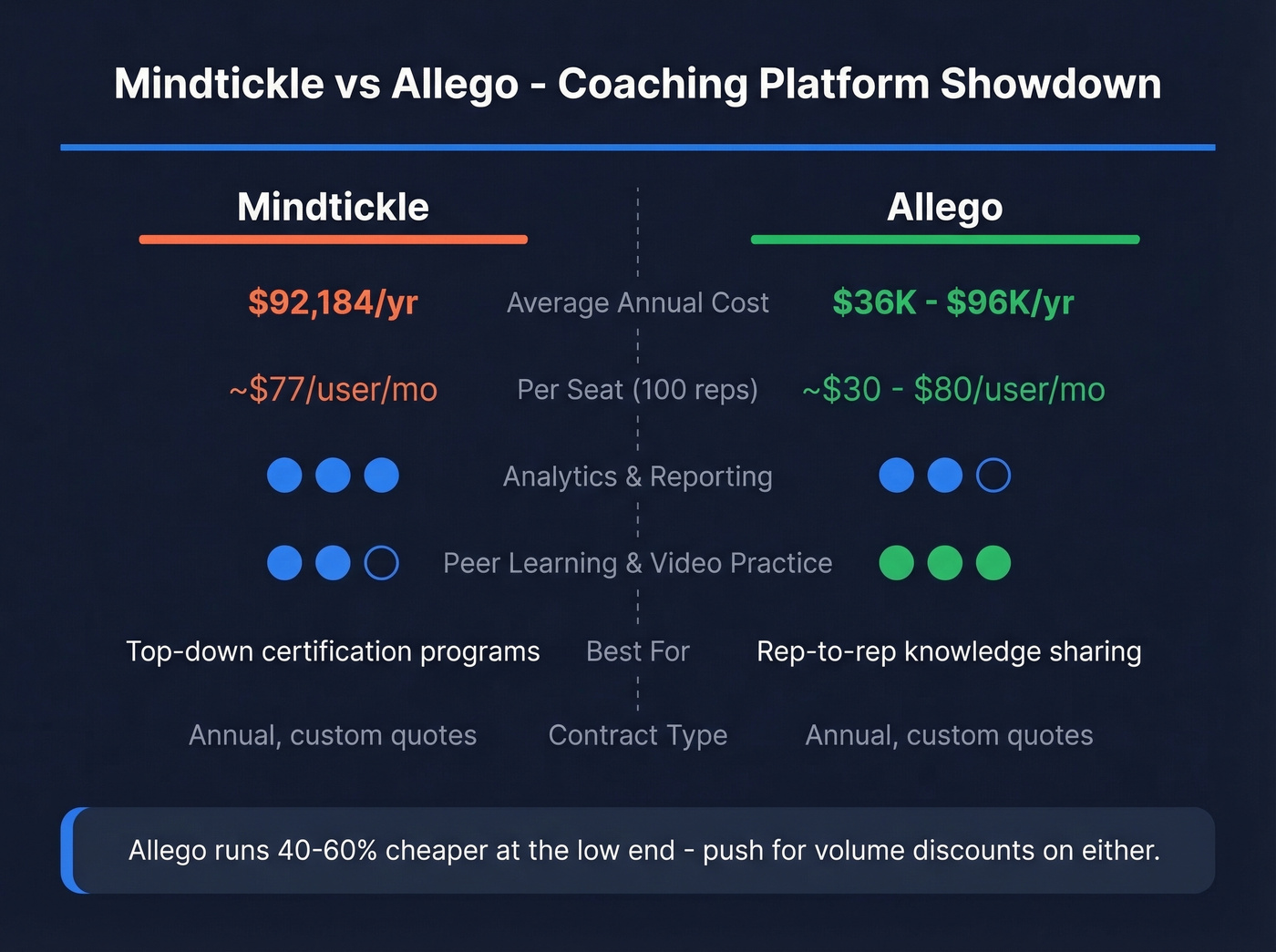
Pricing: ~$30-$80/user/month. Custom quotes. Annual contracts.
Guru - $15/User Knowledge Search
Guru's AI-powered search turns your internal knowledge base into something reps actually use. It's the "single source of truth" tool that complements a content platform like Seismic or Showpad. For a 50-person team, that's $750/month - a fraction of what you'd spend on any other tool on this list.
If your reps can't find answers to basic product questions without Slacking three people, Guru is the highest-ROI purchase you'll make this quarter. Free trial available.
Pricing: ~$15/user/mo.
Paperflite - Underrated Content Sharing
A PMM on r/ProductMarketing chose Paperflite after "way too many demos," citing native Salesforce integration, microsites for sharing content with prospects, and a cleaner UI than Highspot. It's the scrappy alternative for teams that want content management without the enterprise overhead.
Pricing: ~$15K-$40K/year depending on team size.
SalesHood - Guided Selling for Mid-Market
SalesHood focuses on guided selling and coaching for mid-market teams. Worth a look if you want structured selling playbooks without Seismic-level complexity or cost. The guided selling workflows are more prescriptive than Mindtickle's - better for teams that want to enforce a methodology rather than just train on one.
Pricing: ~$30-$90/user/month. Custom quotes.
Honorable mentions: Dock (Leader on G2's category page), Aligned (Highest Performer), and DealHub.io (Easiest to Use) are all gaining traction and worth evaluating if the tools above don't fit.

Most enablement tools optimize how reps sell. None fix who reps reach. Prospeo's 7-day data refresh, 98% email accuracy, and 125M+ verified mobiles give your reps the account intelligence layer that Seismic and HubSpot can't provide.
Snyk's 50 AEs cut bounce rates to under 5% and grew pipeline 180%.
Full Pricing Comparison
Most enablement vendors hide pricing behind "request a demo." Here's what you'll actually pay, based on Vendr benchmarks, published pricing, and community data.
| Tool | Best For | Starting Price | Enterprise Cost | Terms |
|---|---|---|---|---|
| Seismic | Content & automation | ~$20K/yr | $100K+/yr | No free tier, annual |
| Prospeo | Data & verification | ~$39/mo | Custom | Free tier, no contract |
| HubSpot Sales Hub | SMB enablement | Free | $150/user/mo | Free tier, flexible |
| Mindtickle | Coaching & readiness | ~$92K/yr avg | Up to $430K | No free tier, annual |
| Showpad | Sales-marketing align | ~$40K/yr | $120K+/yr | No free tier, annual |
| Gong | Conversation intel | ~$100/user/mo | ~$150/user/mo | No free tier, annual |
| Allego | Video coaching | ~$36K/yr (100 seats) | ~$96K/yr | No free tier, annual |
| Guru | Knowledge mgmt | ~$15/user/mo | Custom | Free trial, flexible |
| Paperflite | Content sharing | ~$15K/yr | ~$40K/yr | No free tier, annual |
| SalesHood | Guided selling | ~$36K/yr (100 seats) | ~$108K/yr | No free tier, annual |
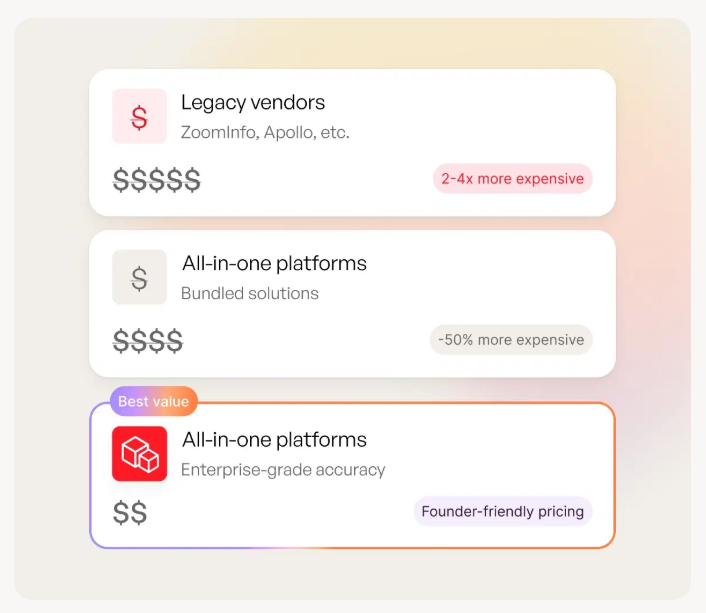
The contrast is stark. Seismic, Mindtickle, and Showpad all require five-figure annual commitments and a sales conversation before you see a price. Guru and HubSpot let you start small and scale. For most teams, the right move is to start with the low-commitment options, prove the workflow, then upgrade - rather than signing a $50K contract based on a 45-minute demo.
The Data Layer Everyone Ignores
Your enablement platform manages content and coaching beautifully. But who's managing contact accuracy?
We've seen teams invest $80K in Seismic, build perfect content libraries, train reps on every objection - and then watch 30% of their outbound emails bounce because the contact data feeding their sequences is six weeks stale. All that enablement investment, wasted on emails that never arrive.

When Meritt paired a dedicated data platform with their enablement stack, pipeline tripled from $100K to $300K per week. Bounce rates dropped from 35% to under 4%, and connect rates jumped to 20-25%. The enablement stack didn't change. The data feeding it did.
Before you sign a five-figure enablement contract, test whether stale contacts - not stale content - are your actual bottleneck. A 7-day data refresh cycle means reps aren't emailing people who changed jobs last month. Verified emails and direct dials mean the contacts in your sequences are real, reachable humans.
You can spend $40K/year on content management and coaching - but if your reps are dialing dead numbers and bouncing emails, none of it moves pipeline. Prospeo delivers 300M+ profiles with 30+ filters including buyer intent, technographics, and funding signals starting at $0.01/email.
Stop enabling reps to sell to the wrong contacts. Fix the data first.
How to Evaluate Without Losing Your Mind
The consensus on r/sales is that "every tool sounds the same" during demos. That's because vendors optimize for demos, not for your workflow. Five things that cut through the noise:
Ask for per-user pricing before the demo. If they won't give you a range, they're planning to anchor high after you're emotionally invested. Every tool on this list except HubSpot plays this game.
Request a sandbox, not a guided walkthrough. A guided demo shows you the 20% of features that work perfectly. A sandbox shows you the 80% your reps will actually live in. No sandbox access? That's a signal.
Ask about implementation timeline and cost separately. Seismic typically lands around $20K-$60K/year mid-market, but implementation can add $15K-$45K. Content migration adds $8K-$25K. Custom integrations run $5K-$15K each. These numbers don't appear in the initial quote unless you ask.
Check CRM integration depth. "Integrates with Salesforce" can mean a native bi-directional sync or a one-way CSV export. The difference matters enormously for adoption.
Buy for workflow improvement, not attribution magic. No enablement platform can reliably attribute content to revenue in a six-month deal with ten stakeholders. If a vendor promises that, walk away.
Common Implementation Mistakes
Three pitfalls we see repeatedly:
No defined strategy. Teams buy the platform before defining what "enabled" looks like. Without clear goals, success metrics, and ownership, the tool becomes expensive shelfware within six months. Define your enablement charter before you sign anything. If you're building the function from scratch, a dedicated Sales Enablement Manager can make or break adoption.
Content chaos. Outdated materials, no version control, inconsistent brand voice, reps who can't find the right deck for a specific buyer persona. A centralized content hub with permissions and regular refresh cycles isn't optional - it's the whole point. Underused marketing content costs enterprises roughly $2.3M annually in missed opportunities.
Inadequate training. The platform is live, but reps still can't handle objections, demo effectively, or sell virtually. The tool doesn't fix the skill gap - it just makes it more visible. Pair your content platform with genuine coaching from Mindtickle, Allego, or even Gong's call analysis to close the loop.
FAQ
What's the difference between sales enablement and revenue enablement?
Revenue enablement covers sales, customer success, and marketing alignment under one umbrella; sales enablement focuses specifically on seller productivity and content delivery. Gartner now defines revenue enablement platforms as uniting enablement functions across sales, CS, marketing, partners, and presales - and the tooling overlaps heavily.
How much do enablement platforms typically cost?
Most mid-market deals land between $20K-$60K/year, with enterprise deployments exceeding $100K. Free tiers exist from HubSpot and Prospeo, and you should budget 15-25% extra for first-year implementation, content migration, and custom integrations.
Can small teams justify a dedicated enablement platform?
Rarely under 50 reps. Start with HubSpot Sales Hub + Guru for under $2K/month total - you'll get content management and knowledge search without a five-figure annual commitment. Scale up once rep count makes consistency impossible without software.
Do I need a separate tool for prospecting data?
Yes. Enablement platforms manage content and coaching, not contact accuracy. A dedicated data tool with verified emails, direct dials, and a weekly refresh cycle fills this gap. Test whether stale contacts - not stale content - are your real pipeline bottleneck before spending big on enablement software.