

Best Time to Send Sales Emails - What the Data Actually Says
Most send-time advice is built on marketing email data - open rates from newsletters, click-through rates on promotional blasts. That's useless for cold outreach. A MailerLite analysis of 2.14M campaigns found Friday had the highest open rate. Try sending a cold sales email on Friday afternoon and watch your reply rate crater.
The best time to send sales emails matters because the platform-wide average reply rate sits at 3.43% in 2026, and roughly 17% of cold emails never reach the inbox. When you're working with margins that thin, send timing is one of the few levers you can actually pull.
The Quick Version
- Send Tue-Thu, 9-11 AM in the recipient's timezone
- C-suite? Go earlier - 8:00-9:15 AM
- ICs? Push to early afternoon - 1:30-3:30 PM
- Follow up after 2-3 days, then space out to 4, 7, 14 days
- Verify your list first - timing optimization is pointless if your emails bounce
Best Days and Windows
Across sales-outreach benchmarks and large practitioner datasets, the optimal send window keeps landing in the same zone: midweek mornings in the recipient's local timezone, with an early-afternoon backup.
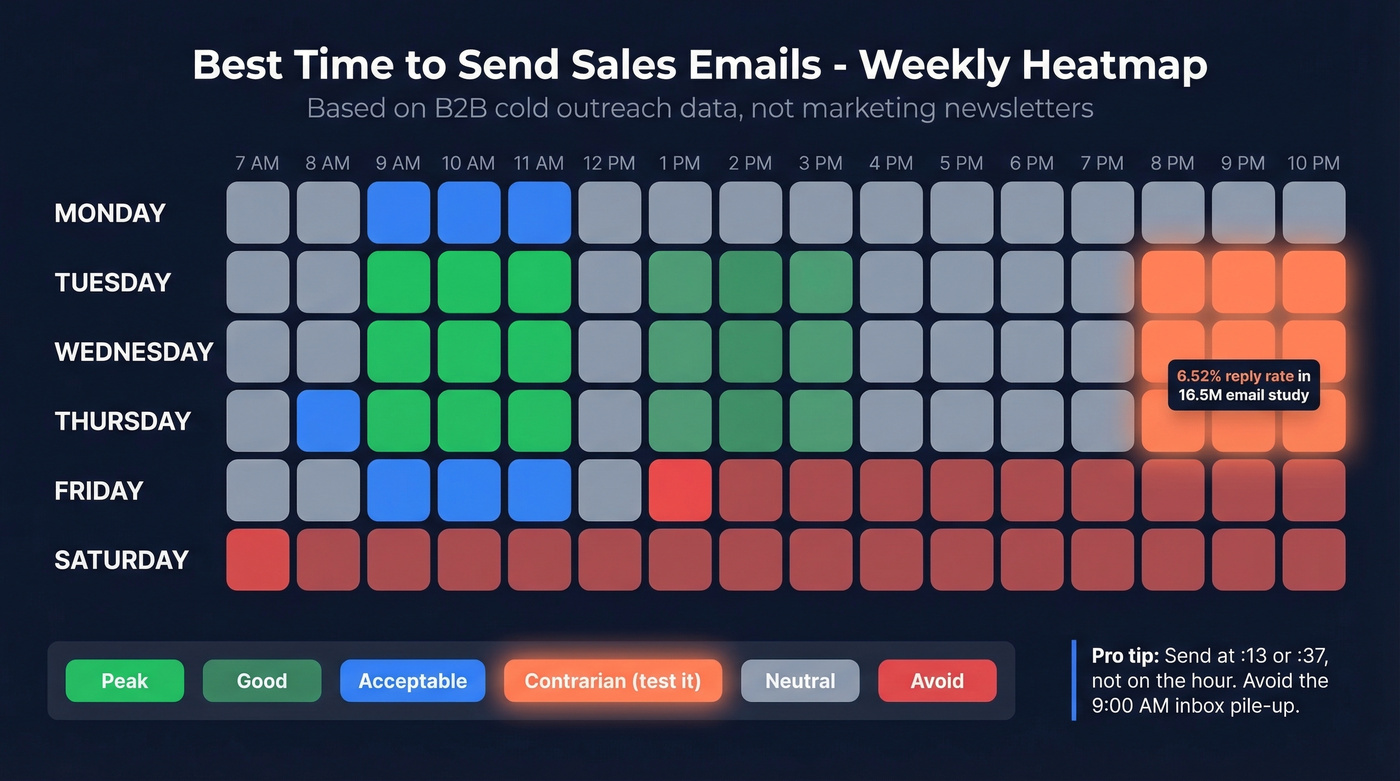
| Day | Best Windows | Notes |
|---|---|---|
| Monday | Launch new sequences | Lower reply rates as a standalone send day |
| Tuesday | 9-11 AM, 1-3 PM | Peak day, but also the most crowded |
| Wednesday | 9-11 AM, 1-3 PM | Peak follow-up engagement |
| Thursday | 9-11 AM, 1-3 PM | Strong; C-suite responds well early AM |
| Friday | AM only, if at all | Drops hard after noon |
| Weekend | Skip | Test Saturday AM for founders if you're feeling bold |
One tactical detail most guides skip: don't send at the top of the hour. Everyone's sequences fire at 9:00 or 10:00 AM, creating an inbox pile-up. Send at :37 or :13 instead.
Always send in the recipient's timezone. A discussion on r/coldemail confirmed timezone-based sending improves response rates, though mixing regions in one campaign can slow daily throughput.
The Contrarian Play: Evening Sends
Here's the thing - a Belkins dataset of 16.5M B2B cold emails found the 8-11 PM window produced a 6.52% reply rate. That's nearly double the platform average. Executives clear their inbox at night with fewer competing messages, and your email sits right on top. Worth an A/B test for founder and C-suite personas.
A quick note on send-time optimization tools: platforms like Customer.io claim +23% opens from per-subscriber timing, but they're built for marketing emails and optimize for opens, not replies. Different game entirely.
Timing by Buyer Role
Not every buyer checks email at the same time. We've found that adjusting your send window based on seniority can meaningfully shift reply rates, and the data backs this up across multiple studies.
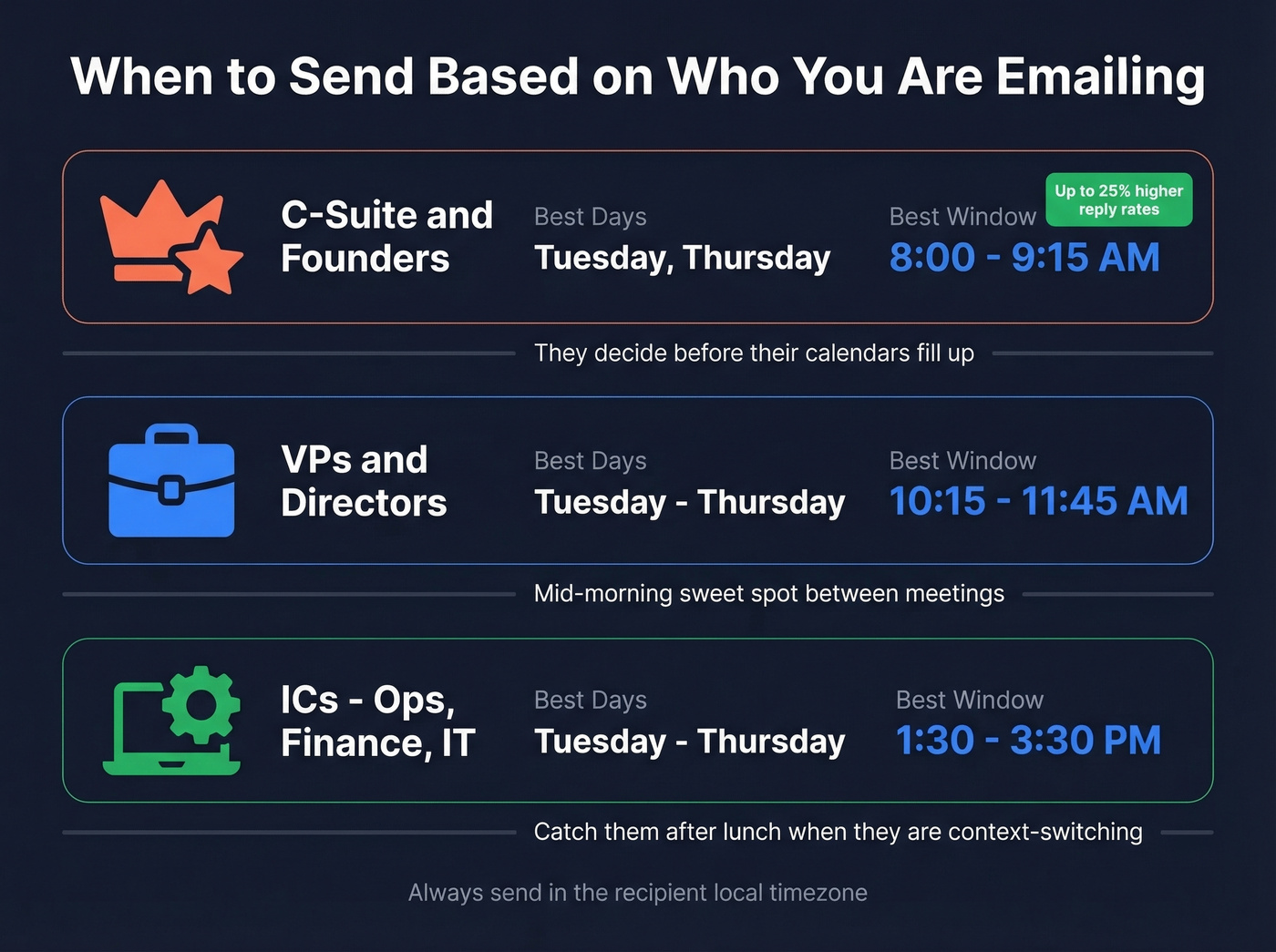
| Buyer Role | Best Days | Best Times |
|---|---|---|
| C-suite / Founders | Tue, Thu | 08:00-09:15 |
| VP / Directors | Tue-Thu | 10:15-11:45 |
| ICs (Ops, Finance, IT) | Tue-Thu | 13:30-15:30 |
Early morning C-level sends can produce up to 25% higher reply rates. These buyers decide before their calendars fill up. ICs are heads-down in the morning - catch them after lunch when they're context-switching between tasks and more likely to scan new messages.

You just segmented your sends by buyer role. Now make sure those emails actually reach them. Prospeo's 300M+ profiles come with 98% verified accuracy and role-based filters - so your 8 AM C-suite send hits a real inbox, not a dead address.
Perfect timing meets perfect data. That's how you double reply rates.
Follow-Up Timing That Works
Estimates range from 42% to 55% of all campaign replies coming from follow-ups, yet nearly half of reps never send a second message. That's pipeline left on the table.
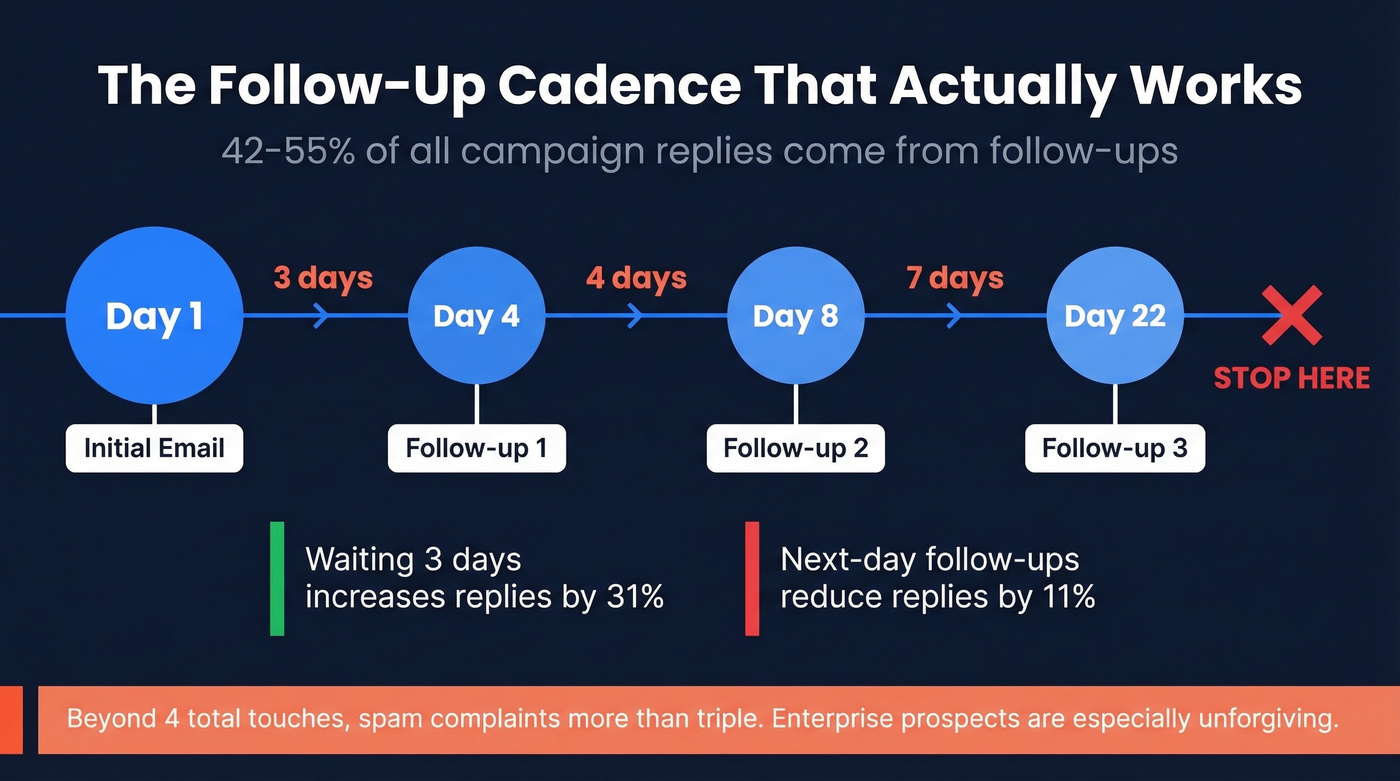
Spacing matters more than volume. Next-day follow-ups reduce replies by 11%, while waiting three days increases them by 31%. Here's the graduated cadence that works:
- Initial email - wait 3 days
- Follow-up 1 - wait 4 days
- Follow-up 2 - wait 7 days
- Follow-up 3 - wait 14 days
Stop at three to four total touches. With 4+ emails in a sequence, unsubscribe and spam complaint rates more than triple - and enterprise prospects are especially unforgiving. We've seen teams burn domain reputation trying to squeeze a fifth or sixth touch out of a sequence that should've ended at four.
Deliverability Practices That Protect Your Timing
Timing your emails perfectly doesn't matter if they land in spam. The infrastructure checklist:
- Cap at 30 cold emails per mailbox per day
- Space sends 2-5 minutes apart per mailbox
- Randomize send times within your target window
- Run 2-3 mailboxes per domain to distribute volume
- Keep bounce rate below 1% - never let it exceed 3%
The Real Multiplier: List Quality
Look - if your bounce rate is above 3%, don't touch your send schedule. Fix your data first. Timing is third on the priority list. List quality is first, copy is second.
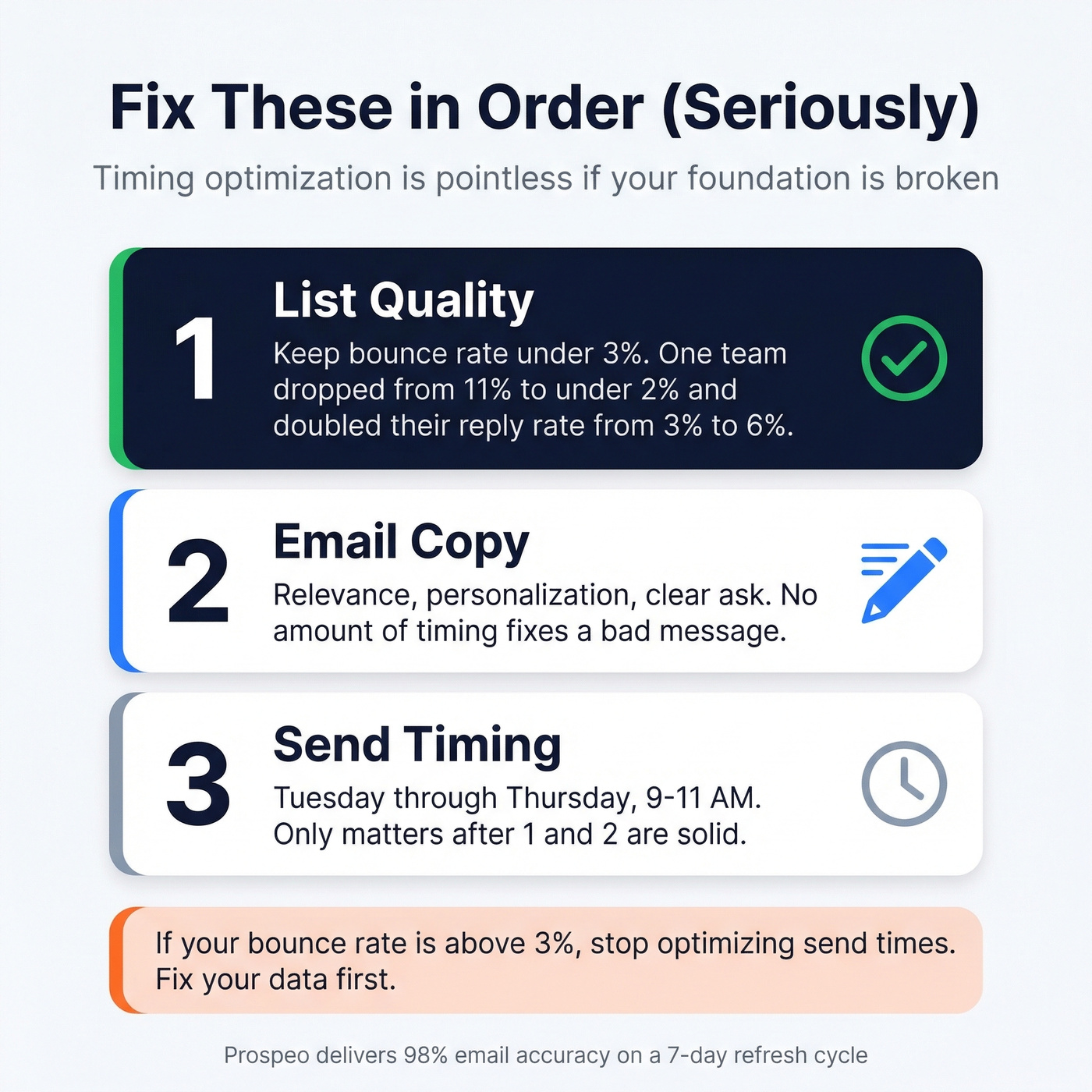
A case study on r/Entrepreneur proved this. The poster expanded from 3 to 7 domains, capped each at 26 emails/day, and rebuilt list quality. Bounce rate dropped from 11% to under 2%. Reply rate doubled from 3% to 6%. We've watched teams obsess over send windows while 11% of their list bounces - fix the foundation first.
Prospeo's 5-step verification process with catch-all handling and spam-trap removal delivers 98% email accuracy on a 7-day data refresh cycle. The free tier covers 75 emails per month plus 100 Chrome extension credits - enough to audit whether your current list is the bottleneck before you invest time in timing experiments.
Every bounce wrecks your sender reputation and makes your timing experiments worthless. Prospeo refreshes all data every 7 days - not 6 weeks - so the emails you're scheduling for Tuesday at 9:37 AM actually land. At ~$0.01/email, fixing your list costs less than one wasted send cycle.
Fix your bounce rate first. Timing optimization comes after.
FAQ
Does Monday work for cold emails?
Monday works for launching sequences, but Tuesday through Thursday consistently produce higher reply rates. Lean toward midweek mornings - specifically the 9-11 AM window - for the strongest cold outreach engagement.
How many follow-ups should I send?
Three to four maximum. Beyond that, unsubscribe and spam complaint rates more than triple. Space them at 3, 4, 7, and 14 days for the best balance of persistence and professionalism.
Should I send in the prospect's timezone?
Yes, always. A perfectly timed 10 AM send means nothing if it arrives at 7 AM in the prospect's local time. Segment campaigns by region to keep volume consistent without sacrificing localization.
How do I know if bad data is hurting my timing tests?
If your bounce rate exceeds 3%, send-time A/B tests aren't reliable because bounced emails skew every metric. Audit a sample of your list with a verification tool before investing in timing experiments.
Do evening sends actually work for sales emails?
For C-suite and founder personas, the 8-11 PM window produced a 6.52% reply rate in a 16.5M-email study - nearly double the average. Run a small A/B test before committing volume to off-hours sends.