

Break Up Email Subject Lines: What Works, What Backfires, and What the Data Says
Four follow-ups in, your prospect has gone dark. You're hunting for break up email subject lines hoping a clever one-liner saves the deal. Here's the thing: most breakup email advice is copy-paste garbage - recycled lists with zero data behind them. Let's fix that.
The Short Version
- Best all-purpose breakup subject line: "Permission to close your file?" - the most widely cited line in sales, built on loss aversion
- Send it on Day 21-25 of your sequence
- If you're sending breakup emails regularly, the problem is upstream - bad data, wrong contact, weak first email
When to Send a Breakup Email
Timing matters more than the subject line itself.
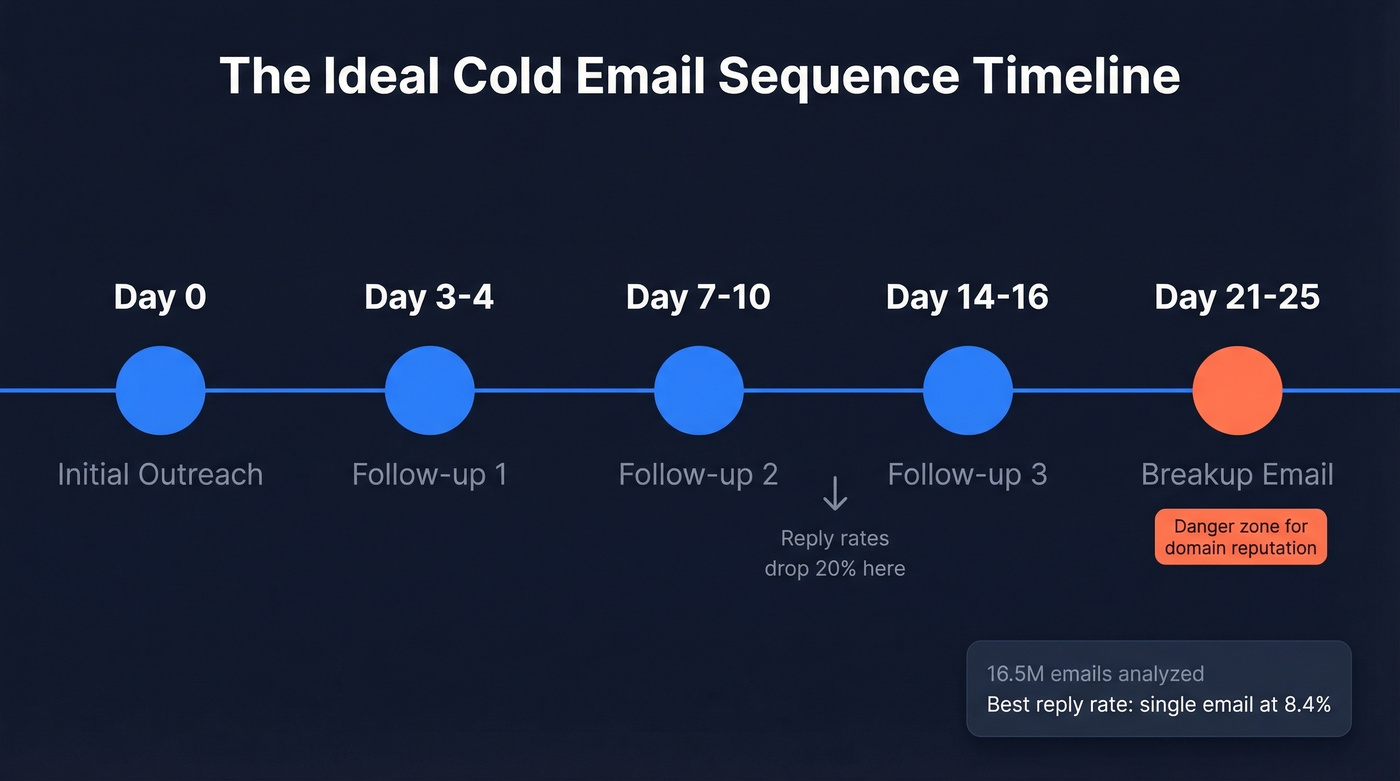
- Day 0: Initial outreach
- Day 3-4: Follow-up 1
- Day 7-10: Follow-up 2
- Day 14-16: Follow-up 3
- Day 21-25: Breakup email
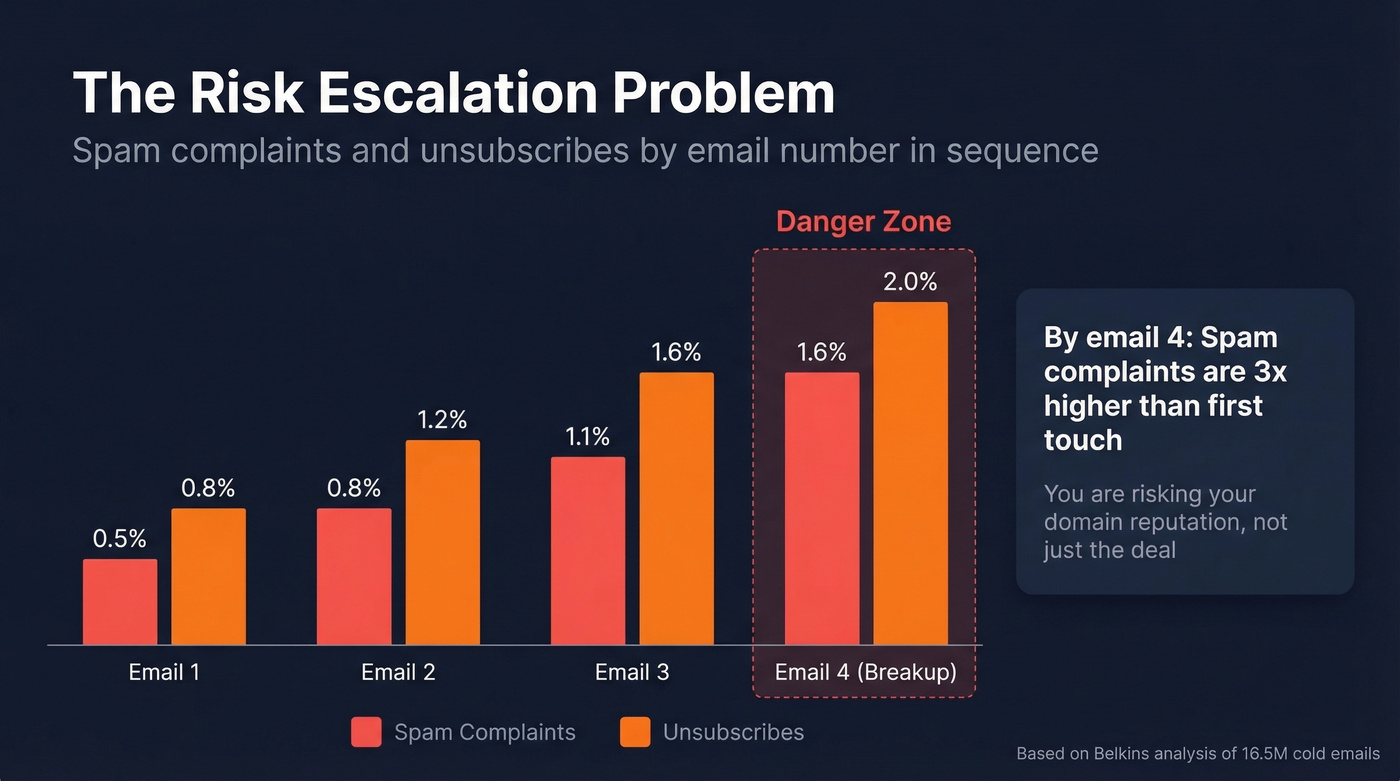
Belkins' analysis of 16.5 million cold emails across 93 business domains found that single-email campaigns had the highest reply rate at 8.4%. Each additional follow-up shows diminishing returns - a third email drops reply rates by up to 20%, and by the fourth email, spam complaints hit 1.6% while unsubscribes reach 2%. If you're selling into enterprises, your breakup email is really email #4 or #5, and you're already in the danger zone for domain reputation.
20 Sales Breakup Subject Lines by Category
Aim for roughly 40-50 characters. Many mobile clients truncate around 33-43 characters, so if your prospect can't read the full line, the psychology doesn't land.
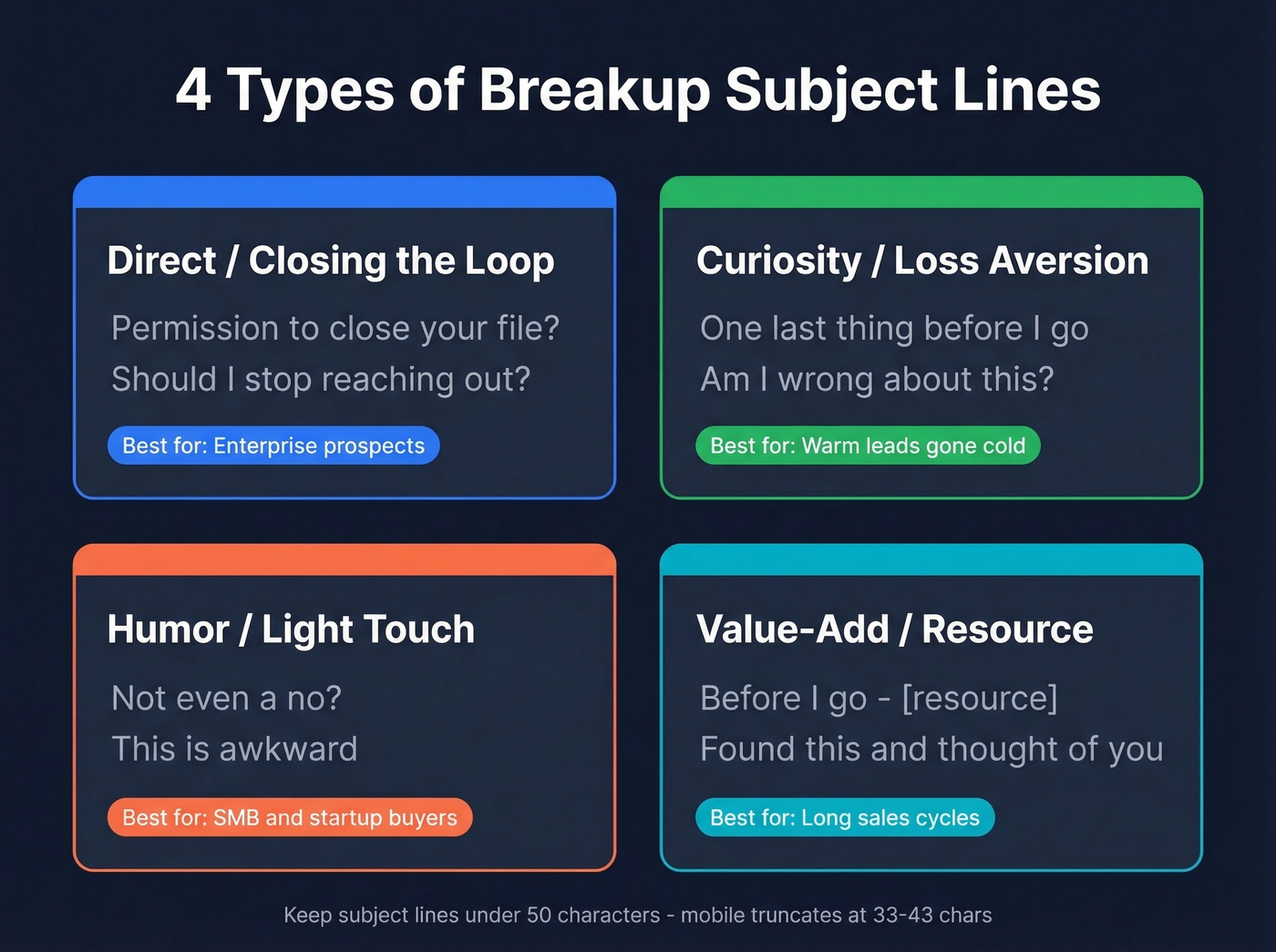
Direct / Closing the Loop
- "Permission to close your file?" - The famous one. Bryan Kreuzberger cites a 76% response rate on HubSpot - self-reported, no methodology, and his original site is now a 404. The loss aversion trigger is still real, though.
- "Closing your file on Friday" - Adds a deadline without being pushy.
- "Should I stop reaching out?" - Direct, respectful, gives them an easy out.
- "Last email from me" - Simple finality. No games.
- "Removing you from my list" - Loss aversion in five words.
Curiosity / Loss Aversion
- "One last thing before I go" - Curiosity gap plus finality.
- "Before I remove you from my list" - Implies action is being taken on their behalf.
- "Quick question before I close this out" - Combines curiosity with closure.
- "Am I wrong about this?" - Challenges their silence without guilt-tripping.
- "Did I miss something?" - Low-pressure, implies you might be at fault.
Humor / Light Touch
- "Not even a 'no'?" - Light, human, disarming.
- "Is this goodbye?" - Playful without being cringey.
- "I'll stop bugging you (promise)" - Self-aware humor.
- "This is awkward" - Pattern interrupt.
- "I get it - timing's off" - Empathetic, no pressure.
Value-Add / Resource-Based
- "Before I go - [resource]" - Leave with value, not guilt.
- "Thought this might change your mind" - Attach a case study or relevant insight.
- "One thing I forgot to mention" - Curiosity plus value.
- "Found this and thought of you" - Personal, resource-forward.
- "Last shot: [specific benefit]" - Direct value prop in the subject line.

Most breakup emails never land because the email address was wrong from the start. Prospeo's 5-step verification and 7-day data refresh keep bounce rates under 4% - so your carefully crafted subject lines actually reach inboxes, not void.
Fix your data before you fix your subject lines.
When Breakup Emails Backfire
Breakup emails can actively lose deals.
One buyer on r/sales described receiving a breakup email as "completely disrespectful, borderline insulting" - and walked from the deal entirely. Another practitioner called the whole tactic "cringey at best and annoying at worst," comparing it to needy dating behavior. The consensus on that subreddit is pretty clear: if your breakup email sounds manipulative, you've torched whatever goodwill you had left.
The data backs up the risk. By the fourth email in a sequence, spam complaints are more than 3x higher than the first touch (0.5% to 1.6%). You're not just risking the deal - you're risking your domain reputation. These closing emails backfire when they guilt-trip, sound entitled, or assume the prospect owes you a response. They don't.
Three Breakup Email Templates
The Direct Close
Subject: Closing your file on Friday
Hi [Name],
I've reached out a few times and haven't heard back, so I'm going to assume the timing isn't right. I'll close out your file this week.
If anything changes, you know where to find me.
Best, [Your name]
Clean, professional, zero guilt. This is the safest option for enterprise prospects.
The Value Exit
Subject: Before I go - [resource]
Hi [Name],
I'm going to stop reaching out, but wanted to leave you with [this case study / report / benchmark] relevant to [their specific challenge].
No response needed. Hope it's useful.
[Your name]
Even if they don't reply, you've built goodwill for a future re-engagement.
The Light Touch
Subject: Not even a 'no'?
Hi [Name],
I've sent a few emails and I'm starting to think I'm talking to myself. Totally fine if now isn't the right time - just let me know and I'll stop cluttering your inbox.
[Your name]
Skip the forced-choice A/B/C/D/E format you've probably seen floating around. It's polarizing and tends to annoy more prospects than it converts.
Subject Line Mistakes That Kill Deliverability
Fake "Re:" or "Fwd:" prefixes violate CAN-SPAM's prohibition on deceptive subject headings and fast-track you to spam folders. ALL CAPS combined with excessive punctuation can increase spam scoring by 40-60%. And going too long means mobile truncation kills your hook before anyone reads it.
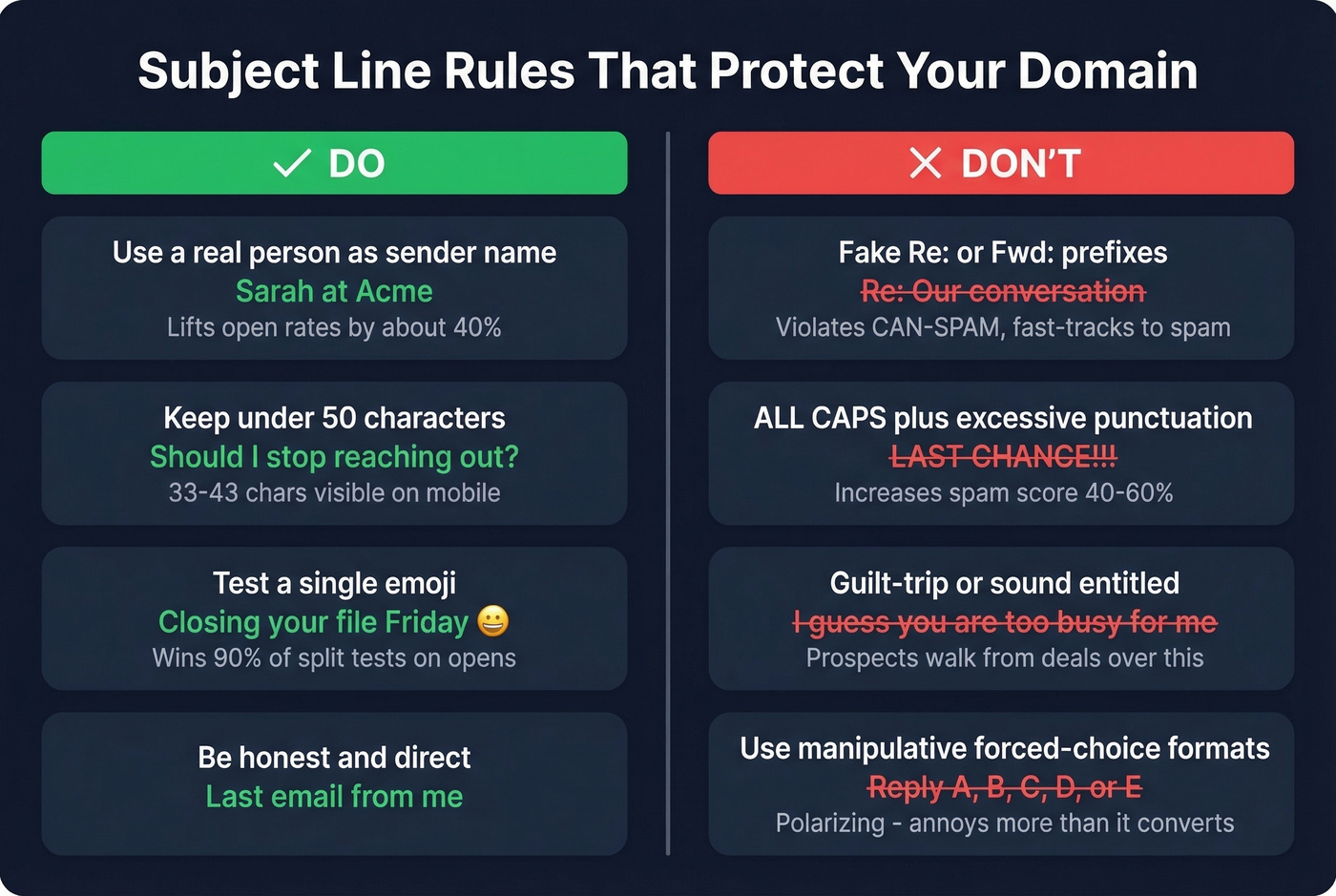
Two things that actually help: a single emoji wins in about 90% of split tests on opens in one large practitioner write-up, though most of that data is ecommerce, not cold sales - test it in your own sequences. Using a person's name as the sender ("Sarah at Acme") can lift open rates by around 40% in that same testing. That sender name tweak matters more than most subject line rewrites, and we've seen it hold up across our own outbound campaigns too.
Before You Break Up, Check Your Data
Look - the best breakup email is the one you don't have to send. If your prospect never responded, the first question isn't "what subject line should I try?" It's "did my email actually reach them?"
We've seen teams agonize over breakup copy when the real problem was a 35% bounce rate. Meritt had exactly this issue - bounce rates sitting at 35% before switching to Prospeo's verified email data, then dropping under 4% after. Before you write off a prospect, verify the email is valid. You might find that half your "unresponsive" list was bouncing silently the whole time.

Meritt cut bounce rates from 35% to under 4% and tripled pipeline to $300K/week with Prospeo's verified contacts. At ~$0.01/email, you stop wasting breakup emails on addresses that never existed.
Send fewer breakup emails by reaching real people the first time.
FAQ
What response rate should I expect from a sales breakup email?
Directionally, 10-30% is realistic. The widely cited 76% figure is self-reported with no published methodology - treat it as aspirational. Your actual rate depends on list quality, prior touchpoints, and whether the email reached the inbox at all.
How many follow-ups should I send before the breakup email?
Three to four, then send the breakup on Day 21-25. Data across 16.5M cold emails shows diminishing returns after three touches, with spam complaints climbing sharply by the fourth.
What if my breakup email gets no response at all?
Switch channels. A message-plus-profile-visit combo on other platforms hits an 11.87% reply rate, better than most email sequences. Also verify your contact data before assuming the prospect isn't interested - a free tool like Prospeo (75 emails/month on the free tier) lets you check whether addresses are valid, so you're not writing off prospects who simply never received your emails.