

Best Bulk Email Verification Software for 2026
You just imported 15,000 leads from a conference list, loaded them into Instantly, and hit send. Three days later your bounce rate is sitting at 8%, your domain reputation is tanking, and Gmail is throttling every inbox on your account. Entirely preventable.
The global inbox placement rate hovers around 83.5% according to the 2026 Email Deliverability Benchmark Report - roughly one in six legitimate emails never reaches the inbox. Gmail's bulk sender rules require keeping spam complaints below 0.3% to avoid deliverability issues, and when you're capped at 15-20 sends per inbox per day in a cold outbound setup, every bounce hurts disproportionately. At scale, even a 2% bounce rate across 10,000 contacts means 200 hard bounces chipping away at your sender reputation.
Here's the thing most verification articles won't tell you: you probably don't need a standalone verifier. If your data source is feeding you garbage, bolting on a verification tool after the fact just adds cost and friction. The smarter play is fixing the source. But if you're working with purchased lists, scraped data, or aging CRM records, verification isn't optional - it's infrastructure.
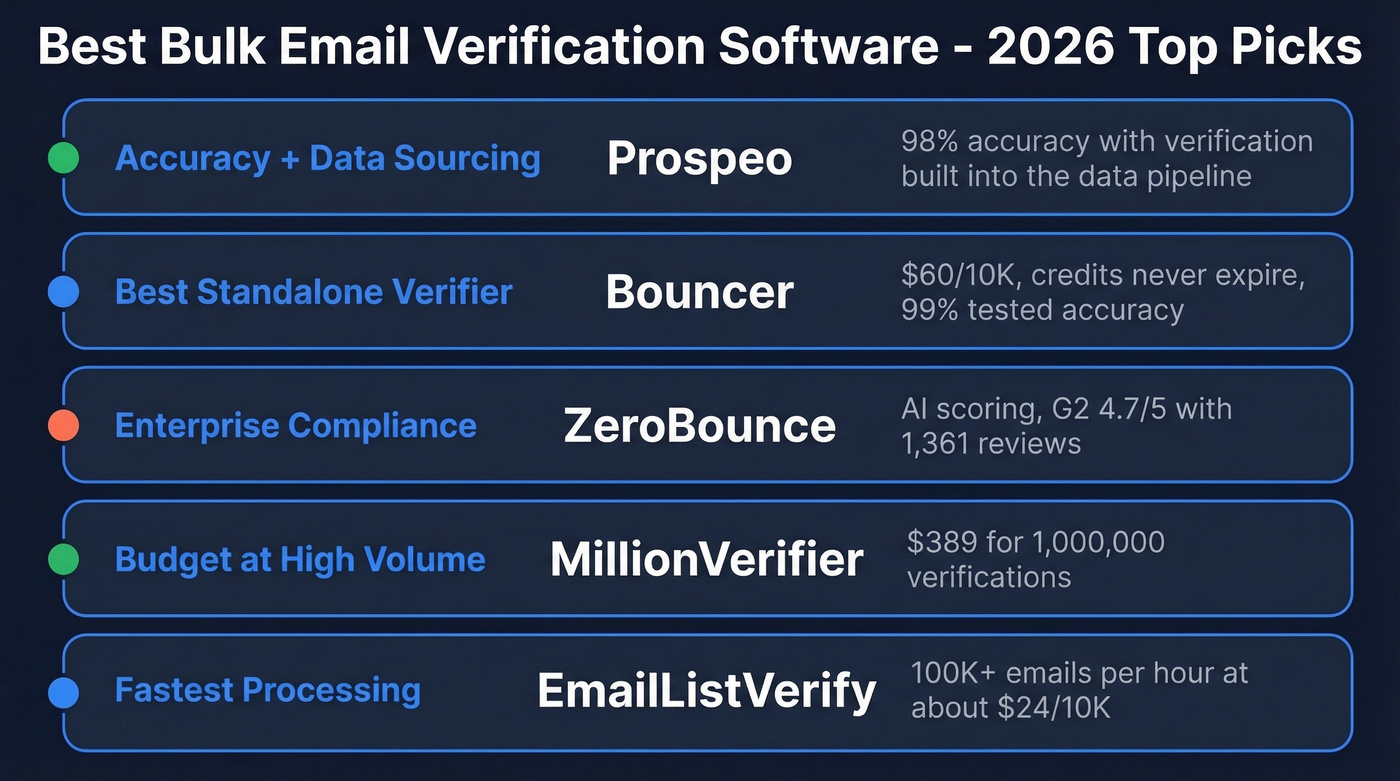
Our Picks (TL;DR)
| Use Case | Pick | Why |
|---|---|---|
| Accuracy + data sourcing | Prospeo | 98% email accuracy with verification built into the data pipeline - no separate tool needed |
| Best standalone verifier | Bouncer | $60/10K, credits never expire, 99% accuracy in Lemlist's published test |
| Enterprise compliance | ZeroBounce | AI scoring, G2 4.7/5 with 1,361 reviews, strong documentation |
| Budget at high volume | MillionVerifier | $389 for 1,000,000 verifications (~$0.00039/email) |
| Fastest processing | EmailListVerify | 100K+ emails/hour at ~$24/10K |
Pricing & Accuracy Comparison
All pricing normalized to 10,000 verifications.
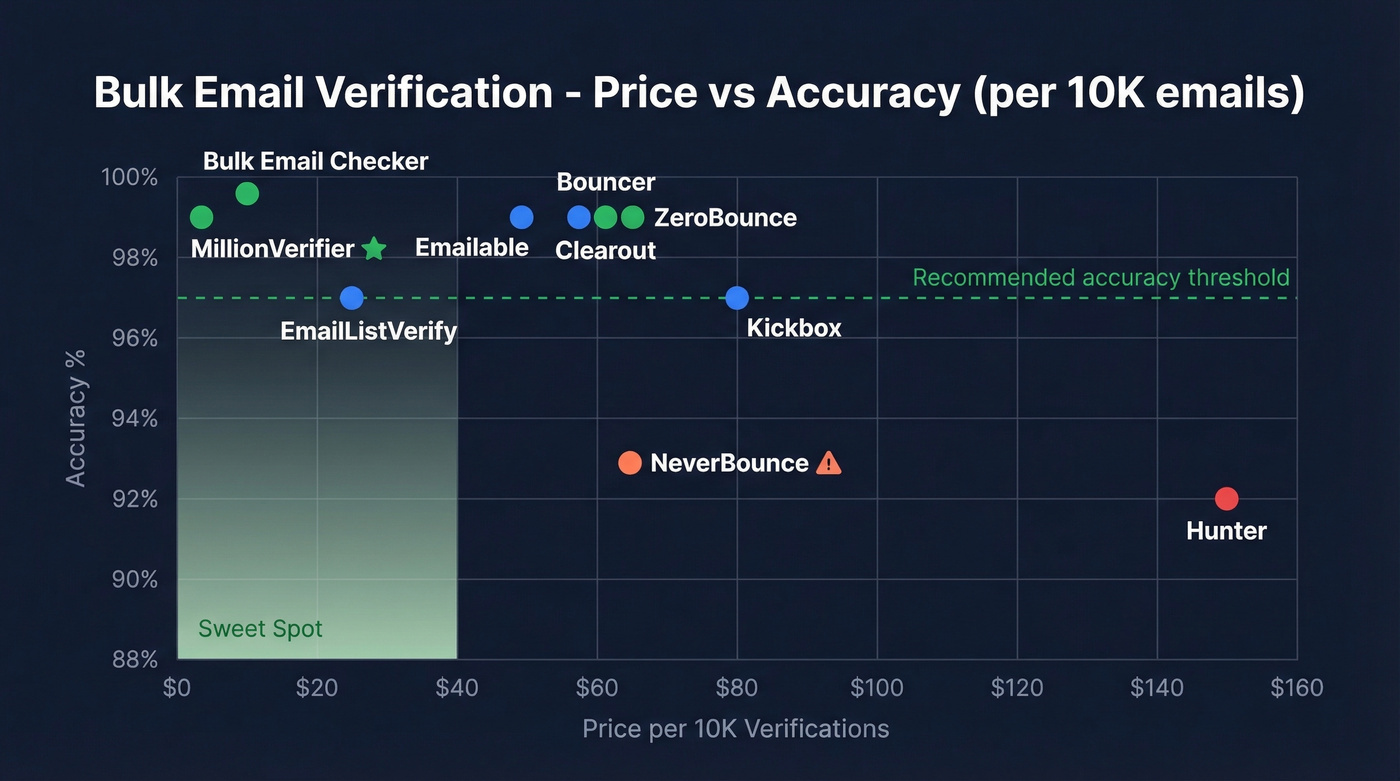
| Tool | 10K Price | Per Email | Free Tier | Accuracy | G2 |
|---|---|---|---|---|---|
| Bouncer | $60 | $0.006 | 100 | 99%* | 4.8 |
| ZeroBounce | ~$64 | $0.0064 | 100/mo | 99%* | 4.7 |
| MillionVerifier | ~$3.89 (at 1M tier) | ~$0.00039 | None | 99%+ (vendor) | - |
| Emailable | $50 | $0.005 | 250 | 99% (vendor) | 4.6 |
| Clearout | $58 | $0.0058 | 100 | 99% (vendor) | 4.6 |
| NeverBounce | $50-80 | $0.005-0.008 | Trial list | 93%* | 4.3 |
| Kickbox | ~$80 | $0.008 | 100 | 97% (vendor) | 4.5 |
| EmailListVerify | ~$24 | $0.0024 | 100 | 97% (vendor) | 4.5 |
| Hunter | ~$149 | $0.015 | 50 | 90-95%* | 4.4 |
| Bulk Email Checker | ~$10 | $0.001 | 10/day | 99.7% (vendor) | - |
* Lemlist published test
Billing & Feature Breakdown
| Tool | Credits Expire? | Charge Unknowns? | Catch-All? | Speed |
|---|---|---|---|---|
| Prospeo | No | No | Yes | Standard |
| Bouncer | No | No | Partial | Standard |
| ZeroBounce | No | No | Partial | Standard |
| MillionVerifier | No | No | - | Standard |
| Emailable | No | No | Partial | Standard |
| Clearout | No | No | Yes | Standard |
| NeverBounce | Yes (12 mo) | No | No | Standard |
| Kickbox | No | No | No | Standard |
| EmailListVerify | No | No | No | 100K+/hr |
| Hunter | No | No | No | Standard |
| Bulk Email Checker | No | No | No | Standard |
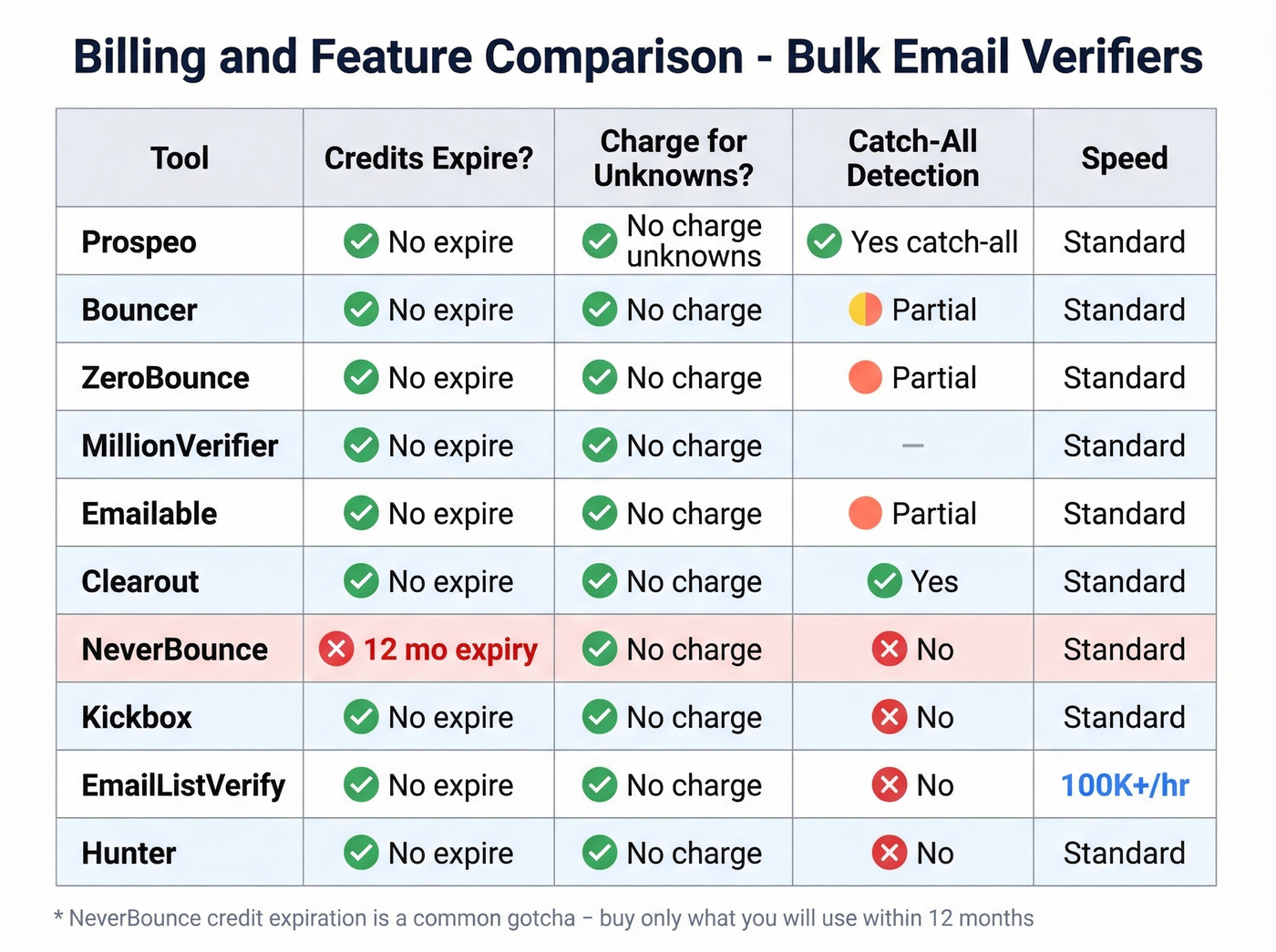
NeverBounce's 12-month credit expiration is a real gotcha - more on that below.
Top Bulk Email Verifiers Reviewed
Prospeo
Use this if: You're sourcing and verifying leads in the same workflow.
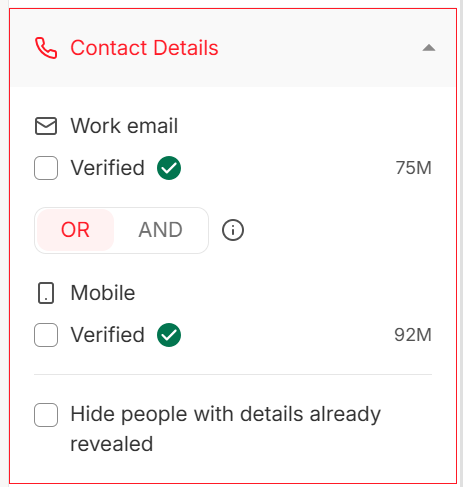
Prospeo's 300M+ profile database runs a 5-step verification process - syntax, MX, SMTP, catch-all resolution, and spam-trap/honeypot filtering - before you ever export a contact. That means verification is built into the data pipeline, not bolted on after. We've watched teams burn weeks wiring together separate finding and verification tools when the whole point is to eliminate that gap.
The production numbers back it up. Stack Optimize runs all client outbound through Prospeo and reports bounce rates under 3% with zero domain flags across every account. Snyk's 50-person AE team dropped from 35-40% bounce to under 5% after switching - that's the difference between pre-verified data and "verify it yourself later."
The proprietary email infrastructure doesn't rely on third-party providers, which is why the 98% accuracy holds up in production, not just in controlled tests. Data refreshes every 7 days versus the 6-week industry average, so you're not emailing people who changed jobs two months ago. Native integrations cover HubSpot, Salesforce, Instantly, Smartlead, Lemlist, Clay, Zapier, and Make. Pricing runs ~$0.01/email with 75 free verifications per month. No contracts, no sales calls.
Skip this if: You already have a clean data source and just need a standalone verification pass on an existing list.
Bouncer
Use this if: You need a dedicated verifier that won't nickel-and-dime you.

Bouncer charges $60 for 10,000 credits, credits never expire, and you don't get charged for duplicates or unknown results. That last part matters more than you'd think - some tools eat credits on unresolvable addresses, which quietly inflates your effective cost per verified email.
In Lemlist's published accuracy test (1,000 emails: 800 known-good, 200 known-bounce), Bouncer hit 99%. Top of the pack alongside ZeroBounce. The Deliverability Kit add-on ($25-250/mo) layers on inbox placement monitoring and blacklist checks, which is useful if you're running high-volume outbound and want early warning on reputation issues.
Skip this if: You want email finding and verification in one tool. Bouncer is verification-only.
ZeroBounce
ZeroBounce carries the deepest review pool in this category: G2 4.7/5 across 1,361 reviews. That matters less for individual buyers and more for enterprise procurement teams who need a vendor their legal department won't push back on.
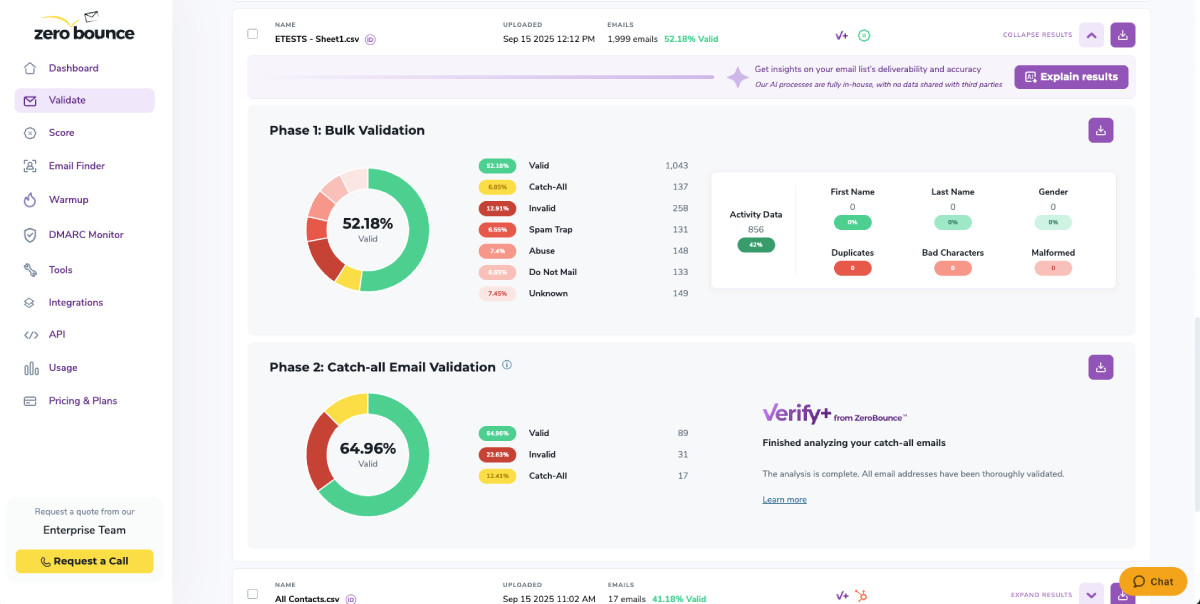
The 100 free monthly verifications (business domain required) let you test without commitment. Credits never expire, unknowns are free, and the 99% accuracy in Lemlist's test matches Bouncer. ZeroBounce also bundles an email finder, though it costs 20 credits per successful query - expensive if finding is your primary use case.
The recurring G2 complaint themes are "expensive" and occasional "inaccuracy" flags. At ~$64/10K it's above Bouncer and well above budget options. But for teams that need compliance documentation and AI-based email scoring, it's the safest enterprise bet in this space.
Skip this if: You're price-sensitive and running cold email. The premium buys enterprise features you won't use.
MillionVerifier
MillionVerifier is a staple in cold email stacks, and the reason is simple: $389 for 1,000,000 verifications. That's roughly $0.00039/email at scale. The consensus on r/coldemail is that MillionVerifier is the go-to budget option for teams cleaning massive lists, and in our experience the accuracy holds up well enough for outbound use cases. No free tier, but at these prices the barrier is negligible.
Emailable
Emailable sits in the comfortable middle ground at $50/10K with 250 free credits to start. Modern interface, straightforward API, and pricing that doesn't require a spreadsheet to understand. A solid pick if you want something between budget and premium without overthinking it.
Clearout
Clearout charges $58/10K and carries a G2 rating of 4.6/5 across 507 reviews. The differentiator is Form Guard - real-time verification on web forms that catches bad addresses at the point of entry. If your bounce problem starts with dirty signups rather than dirty lists, Clearout attacks the root cause instead of the symptom.
NeverBounce
NeverBounce prices competitively at $8/1,000 pay-as-you-go or $49/mo for up to 10,000 verifications. But here's the warning you won't find on most comparison pages: credits expire after 12 months. Buy a bulk pack for a one-time clean, don't use everything within a year, and those credits vanish.
Accuracy is also a concern. In Lemlist's published test, NeverBounce scored 93% - the lowest among the top-tier tools tested. For teams with consistent monthly verification volume, the subscription model works fine. For burst buyers who clean a list once or twice a year, the expiration policy makes this a bad deal.
Kickbox
Kickbox runs ~$80/10K with 100 free credits and strong API documentation. The Sendex reputation scoring gives you a deliverability signal beyond simple valid/invalid, which developers and marketing ops teams appreciate. It's built more for programmatic use cases - real-time verification on signup forms, API-driven workflows - than for SDRs uploading CSVs. If you're building verification into a product or marketing stack via API, Kickbox deserves a look.
EmailListVerify
Budget leader at ~$24/10K with 100 free verifications and credits that never expire. Processing speeds exceed 100,000 emails per hour. If you're cleaning large lists on a tight budget and don't need catch-all resolution, EmailListVerify is hard to beat on the combination of speed and price.
Hunter
Hunter charges ~$149/10K, which is expensive for verification alone - more than double what Bouncer charges. The value is that it bundles email finding with verification. If you're already using Hunter's email finder, verification is a natural add-on. As a standalone verifier, the pricing doesn't compete.
Bulk Email Checker
The cheapest option on this list at $9.95/10K with 10 free verifications per day. Limited integrations and a bare-bones ecosystem, but if you need raw verification at rock-bottom pricing and nothing else, it gets the job done.

Why verify separately when you can source pre-verified? Prospeo's 5-step verification - syntax, MX, SMTP, catch-all, and spam-trap filtering - runs before you ever export a contact. 98% accuracy, 7-day data refresh, $0.01/email.
Eliminate the verification step entirely. Start with clean data.
How Email Verification Works
Every tool on this list follows the same basic pipeline, with varying levels of sophistication at each step.
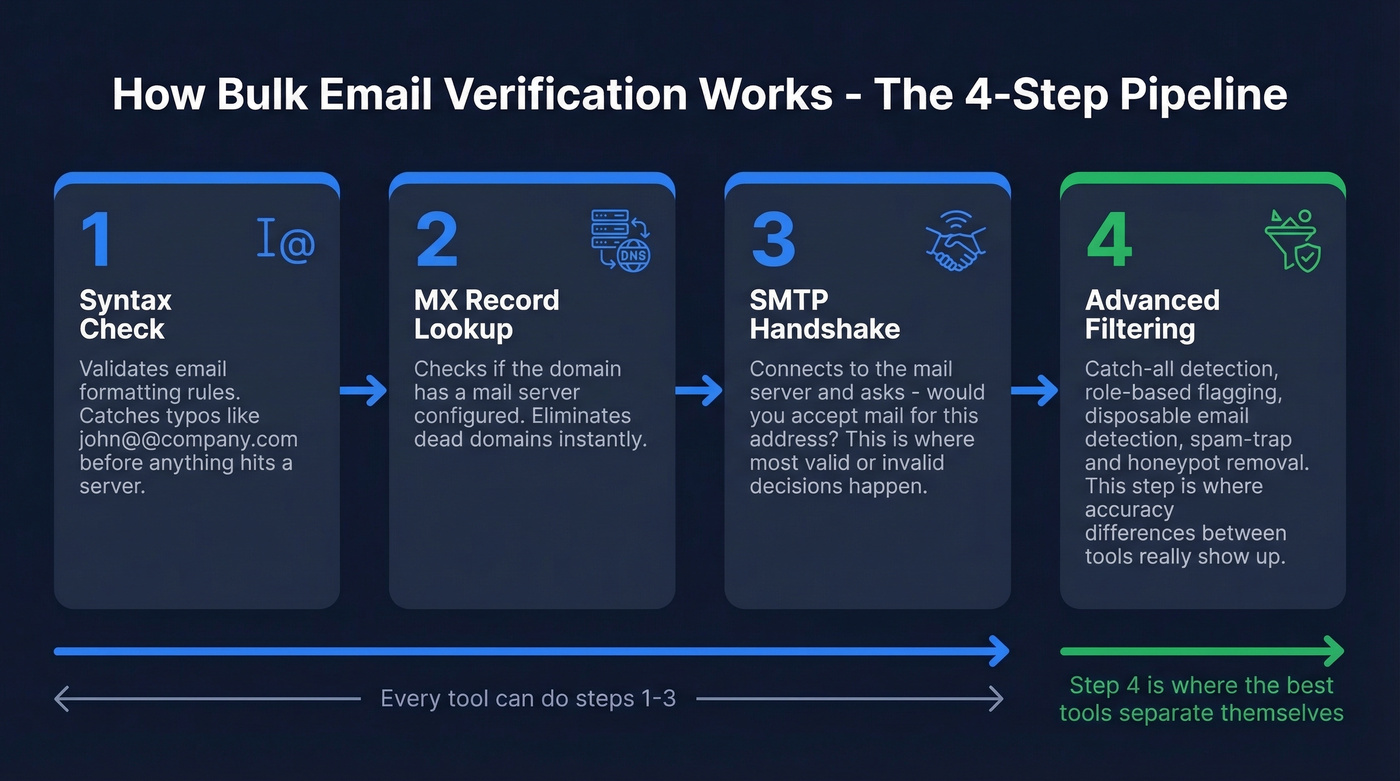
Syntax check - does the email follow valid formatting rules? Catches typos like "john@@company.com" before anything hits a server. MX record lookup - does the domain actually have a mail server configured? This eliminates dead domains instantly. SMTP handshake - the tool connects to the mail server and asks "would you accept mail for this address?" without actually sending anything. This is where most valid/invalid decisions happen. Advanced filtering - catch-all detection, role-based address flagging (info@, support@), disposable email detection, spam-trap identification, and honeypot removal.

The accuracy gap between tools comes almost entirely from that last step. Any verifier can do syntax and MX checks. The SMTP handshake is standardized. But how a tool handles catch-all domains, greylisting responses, and spam traps is where the 93%-vs-99% accuracy spread lives.
Why Catch-All Handling Matters
Most verification articles gloss over this, but catch-all domains are the single biggest source of "risky" or "unknown" results in any verification run.
A catch-all server accepts mail for any address - john@company.com, asdfgh@company.com, literally anything. Standard SMTP verification can't distinguish real addresses from fake ones on these domains, which means your tool either returns "unknown" for all of them (risking bounces if you send, wasting money if you don't) or it has a way to resolve them further. Industry data from Listmint suggests standard catch-all validity sits around ~55%, while advanced resolution approaches reach ~84% - recovering 50%+ more usable emails.
The tools split into two camps. Bouncer, ZeroBounce, Kickbox, and NeverBounce largely punt on catch-alls, returning "accept-all" or "risky" labels and leaving the decision to you. Clearout handles them reasonably well. Prospeo's 5-step verification includes catch-all resolution as a default step, recovering contacts that other tools would mark as unverifiable. That's a meaningful difference when you're paying per lead.
Billing Gotchas Nobody Tells You
Credit expiration. NeverBounce credits expire after 12 months. Bouncer, ZeroBounce, and most others let credits sit indefinitely. If you're a burst buyer - cleaning a list once or twice a year - expiration policies silently eat your budget.
Charges for unknowns. Some tools consume a credit every time they attempt verification, even when the result is "unknown." Bouncer and ZeroBounce explicitly don't charge for unknowns. Always check before buying a bulk pack. A 20% unknown rate on a 50,000-email list means 10,000 wasted credits if your tool charges for them.
Overage risk. One company using Mailgun/Sinch for validation reported 10 million unexplained verifications on Christmas Day and received an invoice over $30,000. Whether that was a bug, a security issue, or misconfiguration doesn't matter - the invoice was real. If your tool charges per-verification via API, set hard usage caps.
The "cheapest sticker price" trap. Look, a tool that charges $20/10K but expires credits, charges for unknowns, and can't handle catch-alls will cost you more than a $60/10K tool that does none of those things. Always calculate effective cost per usable result, not cost per verification attempt.
How to Choose the Right Verifier
The modern cold email stack runs in layers: data sourcing, enrichment, verification, inbox provisioning, sending tool, SMTP infrastructure. Where verification sits in that chain determines which tool makes sense.
Cold email teams at scale: If you're sourcing from one tool and verifying with another, you're paying twice and adding friction that slows your pipeline. A unified data-and-verification workflow eliminates that gap. Pair with Bouncer as a secondary check if you're running extremely high volume and want belt-and-suspenders confidence.
Enterprise marketing teams: ZeroBounce. The compliance documentation, AI scoring, and G2 review depth give your legal and procurement teams what they need.
Budget-conscious / high-volume list cleaning: MillionVerifier for raw volume, EmailListVerify if you want speed at a still-low price point. We've seen teams clean millions of records through MillionVerifier without issues - it does one thing and does it well.
Hot take: If your average deal size is under $5K, you almost certainly don't need a premium verification service. MillionVerifier at ~$0.00039/email catches most of what ZeroBounce catches at ~$0.0064/email. Save the budget for better data sourcing - that's where the real ROI lives.
Stack Optimize runs all client outbound through Prospeo: bounce rates under 3%, zero domain flags. Snyk's 50-AE team dropped from 35-40% bounce to under 5%. That's what pre-verified data does - no standalone verifier required.
Stop paying twice - once for leads, again to verify them.
FAQ
What's the difference between email verification and email validation?
Functionally, nothing. "Verification" checks whether an email is deliverable; "validation" checks formatting and syntax. Every tool on this list does both. The terms are interchangeable - don't let vendors upsell you on a distinction that doesn't exist.
How often should I re-verify my email list?
Every 30-90 days for active lists. Tools with shorter data refresh cycles reduce the need for frequent standalone re-verification, since contacts are validated closer to the point of export.
What's a good bounce rate after verification?
Under 2% is the target; under 1% is excellent. Reddit's cold email community treats anything above 1.5% as a red flag. If you're above 3% post-verification, your tool likely can't handle catch-all domains or your list has decayed beyond what a single pass can fix. Re-source those contacts.
Can I verify emails without sending them?
Yes. Every tool here uses SMTP handshake verification, which connects to the recipient's mail server and checks deliverability without sending an actual email. No messages are delivered, no inbox is touched, and the recipient never knows the check happened.
What's a good free option for small lists?
Prospeo offers 75 free verified emails per month with full 5-step verification including catch-all handling. Bouncer gives 100 free credits, and ZeroBounce provides 100/month. For lists under 1,000 contacts, these free tiers handle the job without a paid plan.