


CloudCall Pricing, Reviews, Pros & Cons: 2026 Verdict
You're either staring at a CloudCall renewal wondering if the price is justified, or you're evaluating it for the first time and can't figure out why opinions swing between glowing and brutal. Here's the full picture - what it actually costs, what users love and hate, and whether it deserves a spot in your stack.
30-Second Verdict
CloudCall is worth it if you're a Bullhorn-centric recruiting team willing to pay for Pro or Advanced. Skip it if you're not deeply tied to a supported ATS, or if call reliability is non-negotiable. CloudCall advertises 99.99% uptime on AWS-hosted infrastructure, but Trustpilot reviewers tell a different story.
CloudCall Pricing Breakdown
CloudCall runs three tiers on its o1 platform, with a 5-user seat minimum on every plan. That means your smallest Starter commitment is $900/year (5 seats x $15 x 12) when billed annually.
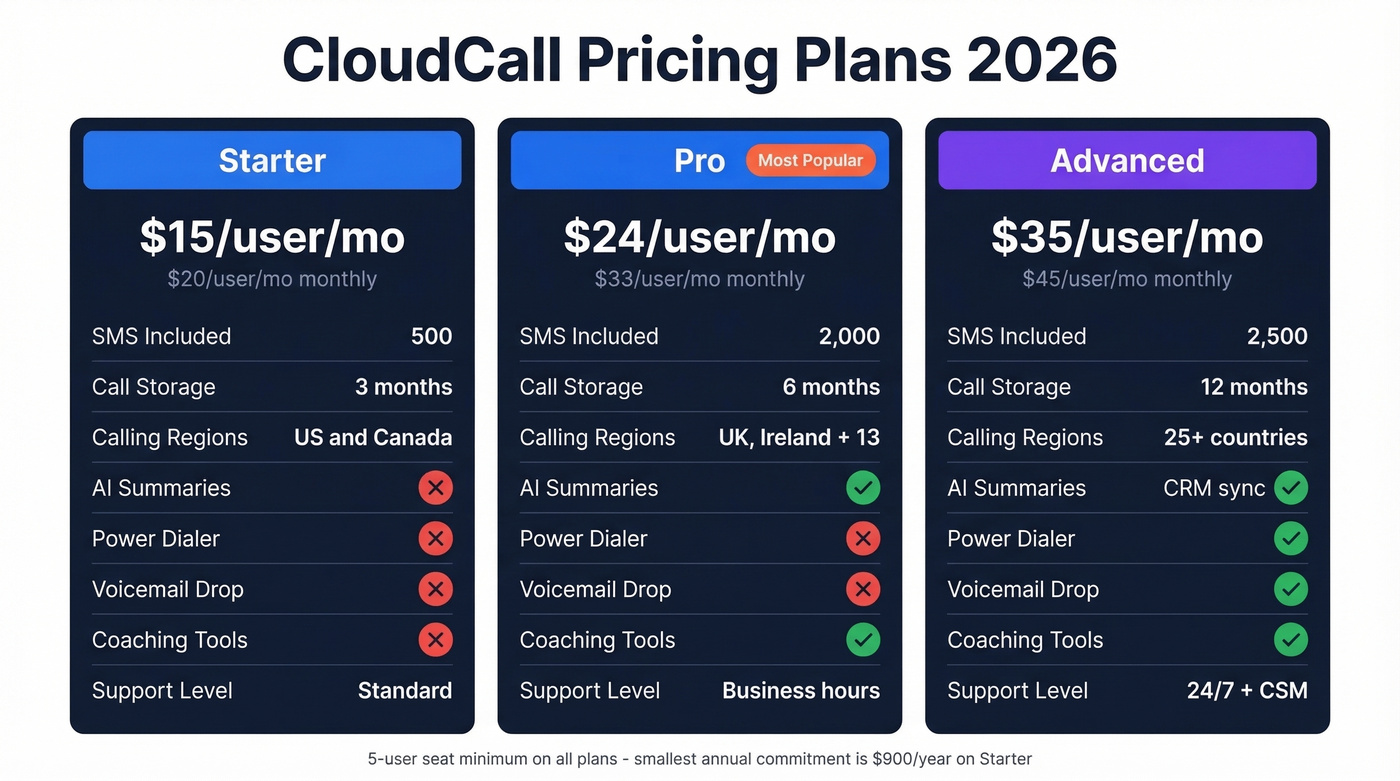
| Starter | Pro | Advanced | |
|---|---|---|---|
| Annual price | $15/user/mo | $24/user/mo | $35/user/mo |
| Monthly price | $20/user/mo | $33/user/mo | $45/user/mo |
| SMS (annual/monthly) | 500 / 250 | 2,000 / 500 | 2,500 / 750 |
| Call storage | 3 months | 6 months | 12 months |
| Calling regions | US & Canada | UK, Ireland + 13 | 25+ countries |
| AI summaries | No | Yes | Yes (CRM sync) |
| Power dialer | No | No | Yes |
| Voicemail drop | No | No | Yes |
| Coaching tools | No | Yes | Yes |
| Support | Standard | Business hours | 24/7 + CSM |
Recruiter VoIP tools typically run $15-$65/user/month, putting CloudCall in the lower-to-mid range before add-ons. And the add-ons matter. The 25 Countries International Voice Pro Add-On costs $14/user/mo billed annually ($18/user/mo monthly), and the 200 Countries Global Voice Add-On is $30/user/mo billed annually ($33/user/mo monthly). Need more SMS? An extra 2,000 US & Canada texts runs $16.99/user/mo.
Let's do the math on a real scenario: a 10-person team on Pro with the 25-country international calling add-on pays $380/month total billed annually. Move to Advanced with global voice, and you're looking at $650/month total. That adds up fast.
Pros
Deep ATS/CRM integration is the headline feature. Bullhorn, Salesforce, Vincere, JobDiva, and Tracker are all supported with native integrations - inbound screen pops that auto-open records, click-to-call, and in-call notes/logging. This isn't surface-level. It's workflow-level, and it's the reason most staffing teams choose CloudCall over generic dialers.
Coaching tools on Pro and above let managers monitor, whisper, and barge into live calls without the candidate hearing. Staffing teams consistently call this out as a differentiator, and we've seen it mentioned in nearly every positive G2 review.
Ease of use is the dominant positive theme across review platforms. Reps get productive quickly, which matters when you're onboarding contract recruiters who need to hit the phones on day one.
AI call summaries on Pro and Advanced save recruiters from manual note-taking. Advanced can sync summaries directly into the CRM on supported platforms.

CloudCall's coaching tools are great - when reps actually connect. 125M+ verified mobile numbers with a 30% pickup rate means your team spends shifts talking, not listening to disconnected tones. At ~$0.01 per email and 10 credits per mobile, fixing your contact data costs less than one CloudCall add-on.
Stop paying for a power dialer that dials dead lines.
Cons
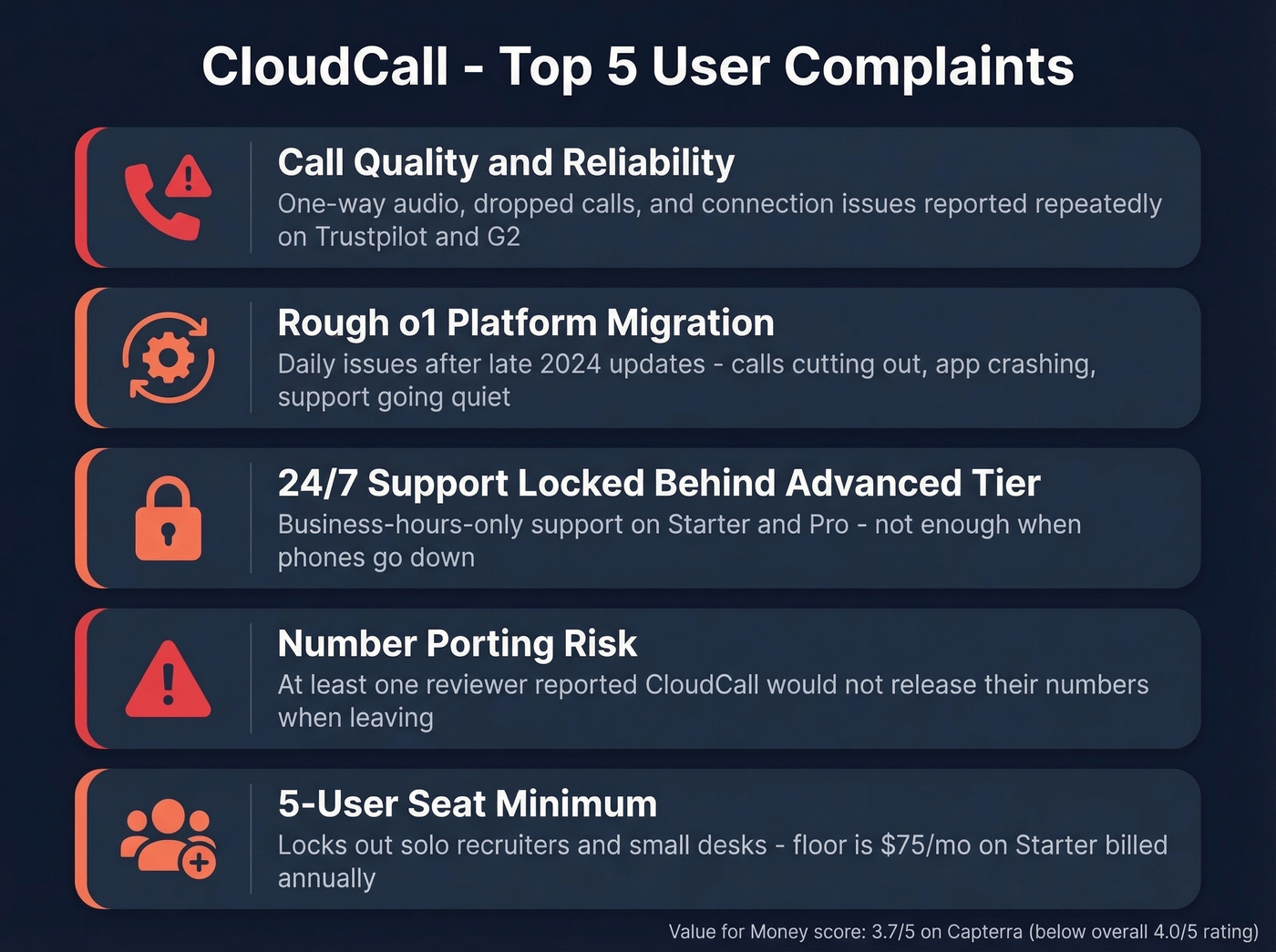
Here's the thing: call quality and reliability are the top complaint across every review platform we checked. One-way audio, dropped calls, and connection issues appear repeatedly on Trustpilot and G2. For a product advertising 99.99% uptime, that gap between promise and reality is a fundamental problem.
The o1 migration was rough. CloudCall built o1 to eliminate third-party plugin dependencies and consolidate onto AWS - the vision is sound, but after late-2024 updates, reviewers describe stretches of daily issues: calls cutting out, the app crashing, and support going quiet. The mobile app drew particular frustration.
24/7 support is locked behind the Advanced tier. We've seen this pattern across VoIP products, and it's always frustrating. When your phones go down, business-hours support doesn't cut it.
Number porting risk. One Capterra reviewer reported CloudCall wouldn't release their numbers when they tried to leave. That's a red flag worth investigating before you sign.
5-user seat minimum locks out solo recruiters and small desks. Your floor is $75/mo on Starter billed annually.
Capterra's value-for-money score sits around 3.7/5, below its overall 4.0/5 rating. Users feel the gap between what they pay and what they get.
Reviews Across 4 Platforms
| Platform | Rating | Review Count |
|---|---|---|
| G2 | 3.9/5 | 74 |
| Capterra | 4.0/5 | 40 |
| GetApp | 4.0/5 | 40 |
| Trustpilot | 2.6/5 | 62 |
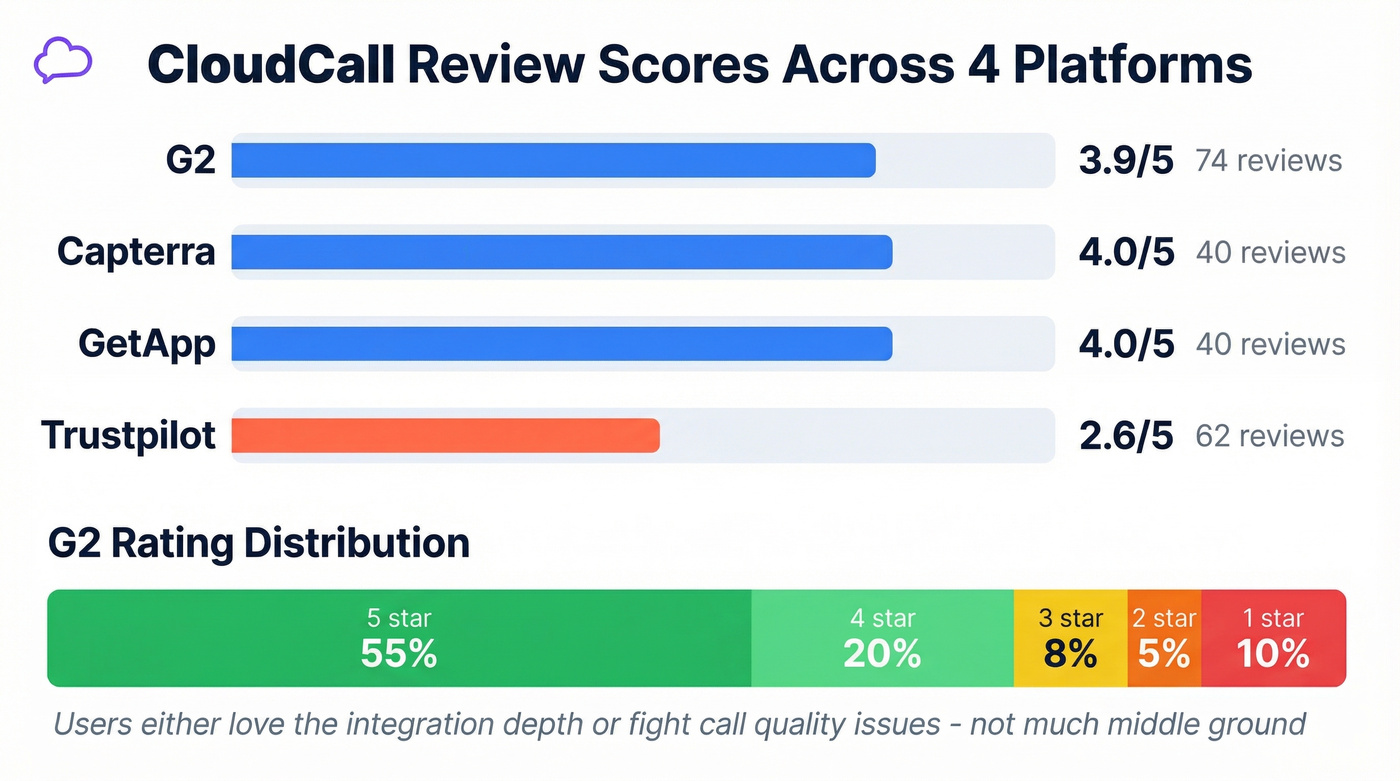
The G2 distribution tells the story: 55% five-star, 20% four-star, 8% three-star, 5% two-star, and 10% one-star. People either love the integration depth or they're fighting call quality issues. There isn't much middle ground.
CloudCall has pointed to weekly product releases and major infrastructure updates through 2025 and into 2026. But in our experience, platforms that are "still stabilizing" a year-plus after a major migration need another 6-12 months before you can trust them for mission-critical calling.
Should You Buy CloudCall?
Use CloudCall if you're a Bullhorn shop running a recruiting desk of 5+ users and the ATS integration is genuinely your top priority. Pro or Advanced are the only tiers worth considering - Starter is too stripped down.
Skip CloudCall if you need rock-solid call quality, you want broad CRM support beyond the staffing world, or your team is under 5 users. In those cases, look at the alternatives below.
Here's our hot take: CloudCall's real competitor isn't another dialer - it's bad data. We've watched teams agonize over $35/user/month dialer features while their reps burn hours calling disconnected numbers. Before upgrading your dialer, run your CRM contacts through Prospeo to verify emails and mobiles. With 98% email accuracy, a 7-day data refresh cycle, and roughly $0.01 per email with no contracts, fixing your data delivers a faster ROI than any feature tier upgrade.
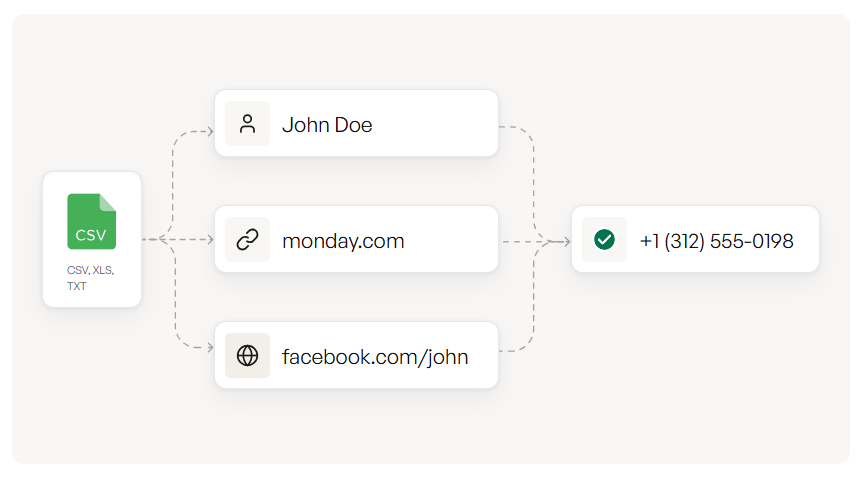
Before you debate Starter vs. Pro vs. Advanced, ask a harder question: how many of your CRM contacts still have valid numbers? Prospeo's 7-day data refresh cycle catches job changes and disconnected lines that 6-week-refresh competitors miss. 98% email accuracy, 92% API match rate, no contracts.
Enrich your CRM contacts before your next dialing session.
Alternatives Worth a Look
| Tool | Starting Price | Best For |
|---|---|---|
| RingCentral | $20/user/mo | Broad CRM support |
| Dialpad | ~$15/user/mo | AI included on all plans |
| Aircall | ~$30/user/mo | Sales-focused teams |
| 3CX | Free-~$15/user/mo | Budget / self-hosted |
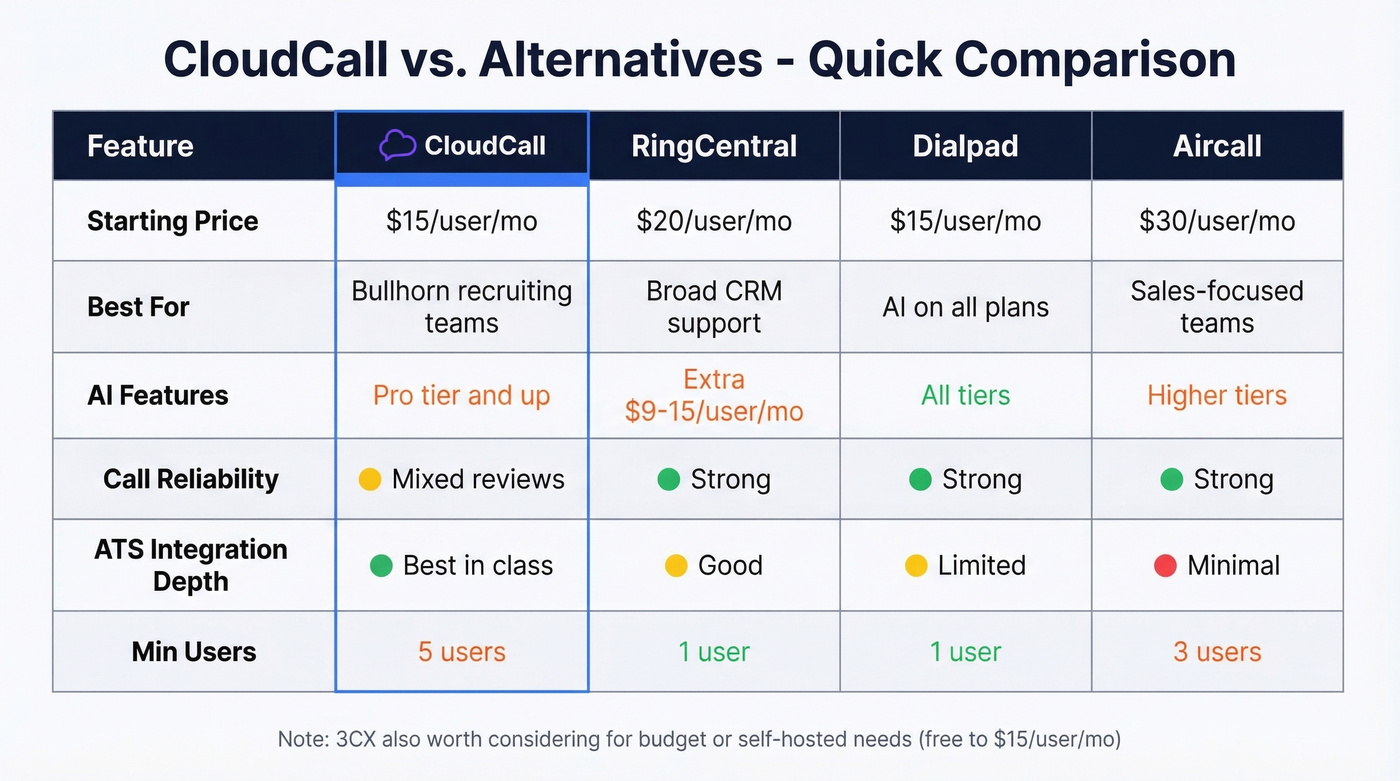
RingCentral is the most common recommendation from departing CloudCall users - similar pricing, broader integrations, and a more mature platform. Its AI features run an extra $9-$15/user/mo, so factor that into total cost. The consensus on r/VOIP is that RingCentral's reliability is a clear step up, even if the interface feels more corporate.
Dialpad matches CloudCall's Starter price but includes AI transcription and coaching at every tier, which makes it a strong pick if you don't need Bullhorn-specific integration. If you're comparing options, see our breakdown of Dialpad alternatives.
Aircall is pricier but purpose-built for sales teams. If your use case is outbound sales rather than recruiting, it's worth the premium - especially if you're building a repeatable cold calling system.
3CX is the wildcard for teams that want to self-host and keep costs near zero. You'll trade polish for savings.
FAQ
Does CloudCall offer a free trial?
CloudCall is typically sold via demo, though some listings mention a free trial. With the 5-user seat minimum, the smallest annual Starter commitment is $900/year - make sure the demo covers your specific ATS integration before signing.
What CRMs does CloudCall integrate with?
Bullhorn, Salesforce, Vincere, JobDiva, and Tracker are the primary supported platforms. The integration depth - screen pops, in-call notes, click-to-call - is the main reason staffing teams choose it over general-purpose VoIP tools.
Is CloudCall's o1 platform stable in 2026?
It's improving but not bulletproof. CloudCall has shipped weekly releases and major infrastructure updates since the late-2024 turbulence, yet Trustpilot reviews from early 2026 still mention intermittent call quality issues. Check their public status page before committing.
How can I improve call outcomes without switching dialers?
Verify your contact data before it hits the dialer. CRM enrichment tools that return 50+ data points per contact at a 92% match rate make a real difference - teams using verified mobiles see around a 30% pickup rate compared to single-digit rates on stale lists. Often the cheapest performance upgrade is cleaner data, not a pricier dialer.