

How to Search Company Public Records in the U.S.
You're about to wire $50K to a new vendor and someone on the finance team asks: "Did we actually verify this company in public records?" If you're coming from the UK, where Companies House feels like a cheat code, the U.S. system is going to frustrate you. There's no single national search box.
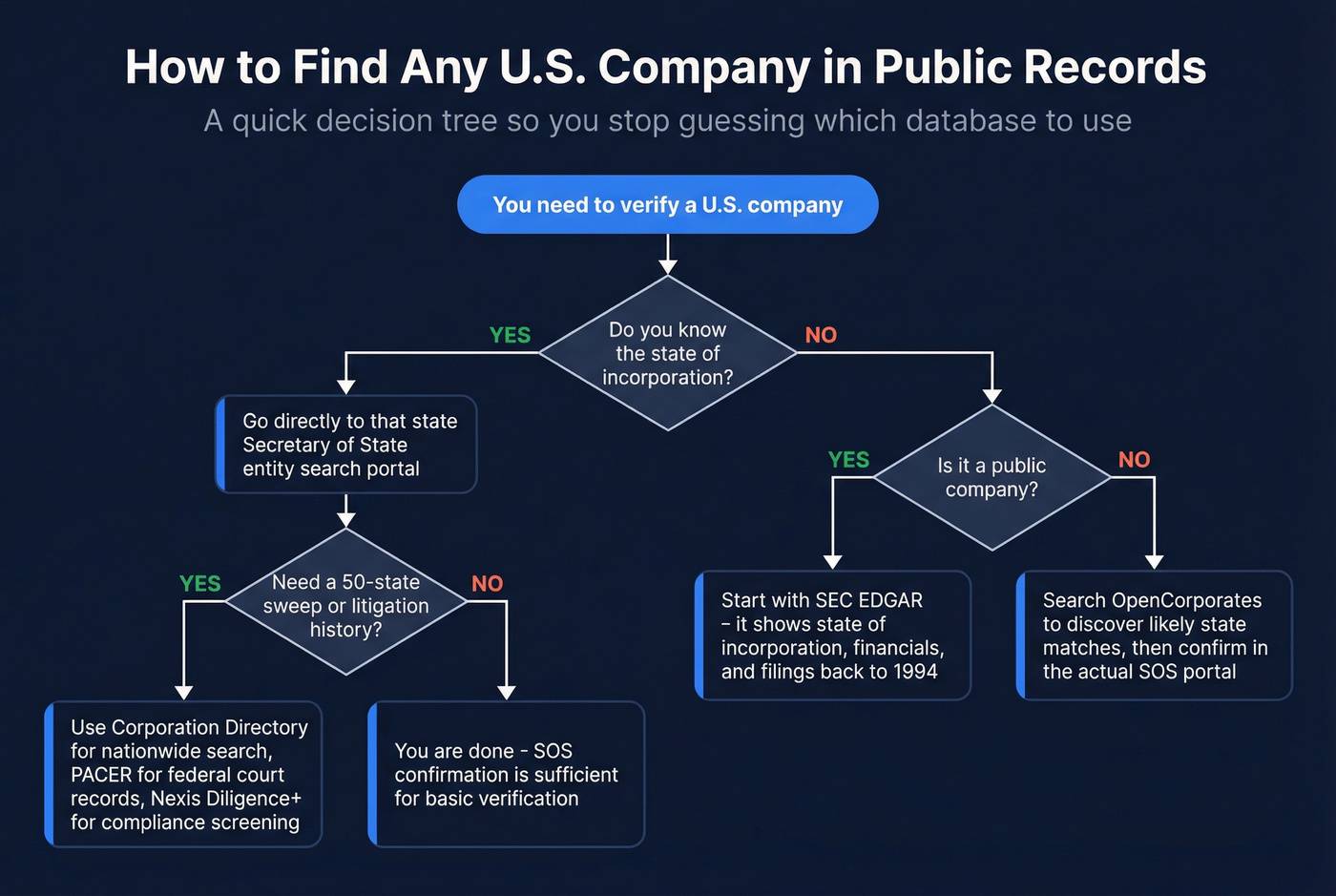
Business registrations live at the state level, and the state of incorporation often isn't where the company operates. A SaaS company with offices in San Francisco might be incorporated in Delaware - where over 1 million businesses are registered and more than 66% of Fortune 500 companies file. We've walked through this process hundreds of times, and here's the fastest way to verify a U.S. company without guessing the state.
Quick workflow:
- Know the incorporation state? Use that state's Secretary of State entity search.
- Public company? Start with SEC EDGAR - it also reveals the state of incorporation.
- Don't know the state? Use OpenCorporates to discover likely matches, then confirm in the SOS.
- Need a 50-state sweep fast? Use Corporation Directory.
- Need lawsuits, bankruptcy, or negative news? PACER for courts for courts, Nexis Diligence+ for screening.
What's Actually Public in Corporate Records
Before you search, it helps to know what "public records" usually means in a business context:
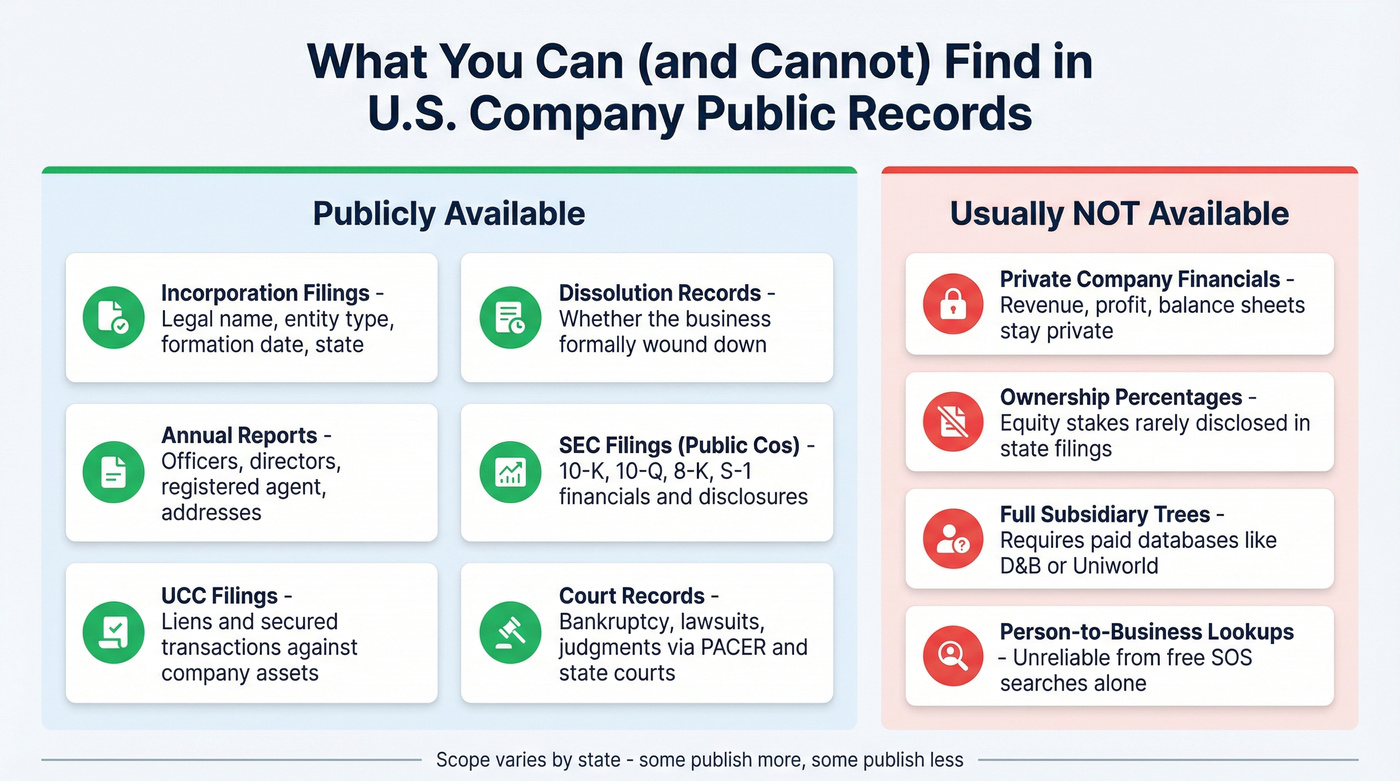
- Incorporation filings / Articles of Incorporation - confirms the entity exists, its legal name, entity type, and formation date.
- Annual reports / Statements of Information - periodic updates that list officers/directors, registered agent, and business addresses.
- UCC filings - secured transaction records that reveal liens against a company's assets.
- Dissolution / cancellation filings - shows whether a business formally wound down.
- SEC filings (10-K, 10-Q, 8-K, S-1) - financials and disclosures for public companies.
- Court records - bankruptcy filings, lawsuits, and judgments across federal and state systems.
Some states also publish related registries for charities, notaries, professional licenses, and state trademarks. The scope varies wildly from one state to the next.
How to Search Company Public Records for Free
State Secretary of State portals
Every state maintains a business entity search through its Secretary of State office or an equivalent agency. These official registries are the primary source for formation records. A typical result shows the legal name, entity type, status (active/suspended/dissolved), formation date, and registered agent.
How to search efficiently: start with the exact legal name. If results are messy, use the entity or registration number when you have it. Some states also let you search by registered agent name, which is useful when you only have paperwork from a contract or invoice.
Here's the thing, though - every portal behaves differently. Arizona doesn't use its SOS for business searches at all; that's handled by the Arizona Corporation Commission. California has filing images going back to the mid-1990s, while Delaware charges $10 for a status check and $20 for filing history plus franchise tax assessment. DC's portal requires a login, and some older state search tools are picky about browsers. We've had searches fail in Internet Explorer-era portals that worked fine once we switched to Chrome.
Many states also let you order a Certificate of Good Standing or Certificate of Status, usually for a fee. This is what banks, procurement teams, and enterprise customers actually ask for when they want proof the entity is active and compliant.
If you do this often, keep a clean directory of official state search links handy. This all-50-states directory from LLC University is a practical shortcut.
For background on why it's state-based in the first place, the U.S. Department of Commerce has a straightforward overview of how incorporation works at the federal level.
SEC EDGAR for public companies
For publicly traded companies, SEC EDGAR is free and thorough. Search by company name, ticker, or CIK (the SEC's filer ID). Filter by form type - type "10-K" for annual reports - and narrow by date range.
EDGAR is also a fast way to pull basic company identifiers in one place: state of incorporation, business address, phone number, SIC code, and fiscal year end all appear alongside filings. Its full-text search covers filings from the last four years and supports boolean operators. Filings themselves go back to 1994. If you need older annual reports, you're in library territory - Mergent Archives and ProQuest are the common options.
OpenCorporates (when you don't know the state)
When you don't know where a company is incorporated, OpenCorporates is the quickest way to stop guessing. It aggregates legal entity data across 140+ jurisdictions into a single searchable interface, so you can search once and get likely matches.
One caveat: OpenCorporates often lags official registries on the newest filings. Treat it as discovery, then confirm the details in the actual SOS portal before you rely on anything for a business decision.
Business entity search vs. public records request
Let's be clear about a distinction that trips people up constantly. A business entity search isn't the same thing as a public records request (FOIA at the federal level, or state laws like CPRA in California). If you need older images, certified copies, or documents not posted online, you order them through the business filings or corporations division - not a general "public records request" inbox. Sending the wrong request to the wrong office is the easiest way to lose weeks.
For a library-style guide to researching private companies and what's realistically findable, the Library of Congress business research guide is a solid starting point.
Vendor Vetting Checklist
If you're verifying a vendor - not writing a research paper - use this sequence:
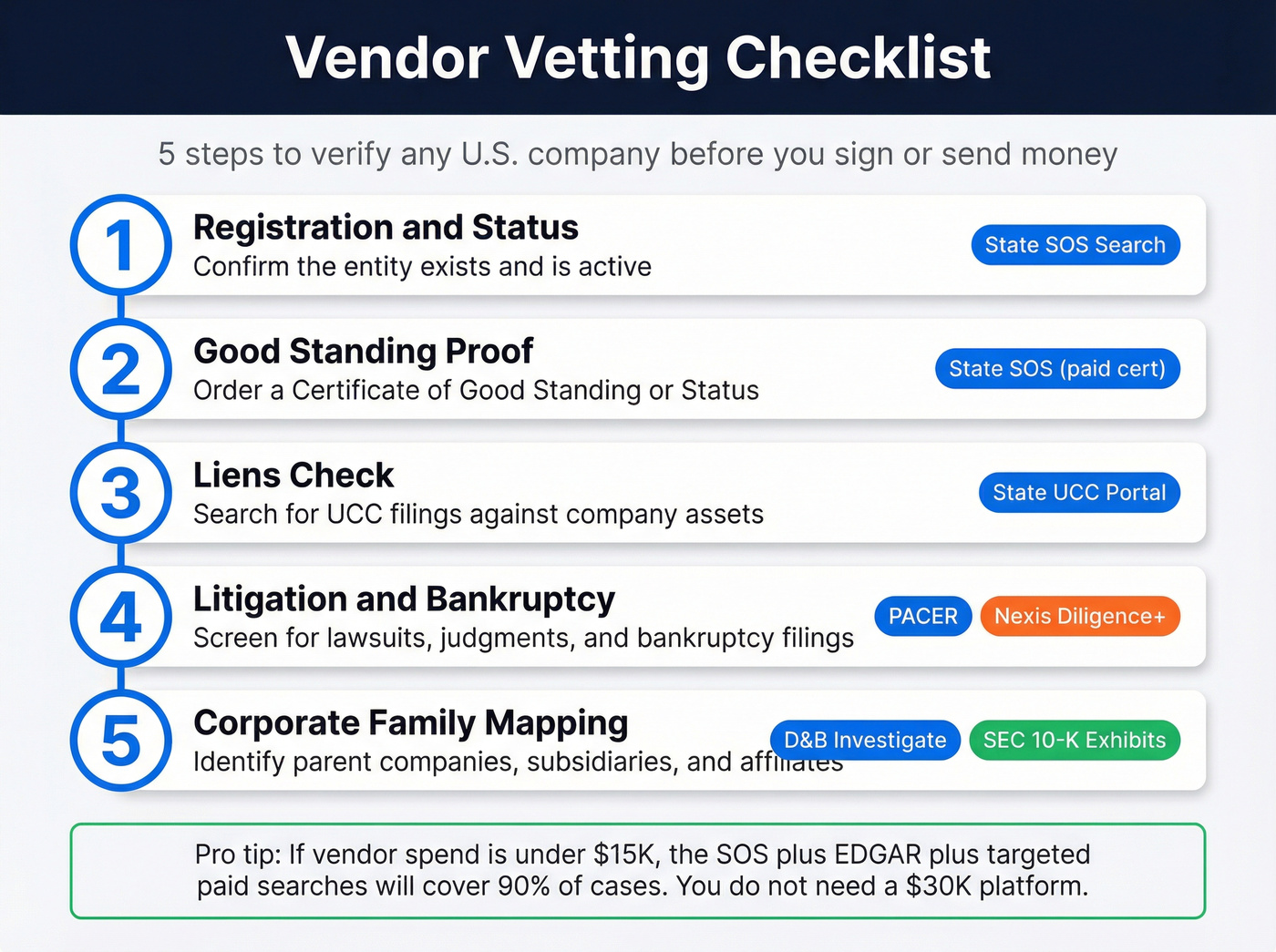
- Registration + status - State SOS entity search
- Good standing proof - Order a Certificate of Good Standing/Status from the SOS
- Liens - UCC search at the state level, often via SOS or a dedicated UCC portal
- Litigation/bankruptcy - PACER for federal cases; Nexis Diligence+ for broader screening
- Corporate family - D&B Investigate or Uniworld for parent/subsidiary mapping; for public companies, check SEC exhibits and "subsidiaries" lists in 10-Ks
Look, if your typical vendor spend is under $15K, you don't need a $30K/year platform to do basic legitimacy checks. The SOS plus EDGAR plus targeted paid searches when you hit a real risk flag will cover 90% of cases.

Public records confirm a company is real. But you still need to reach the right person. Prospeo gives you 98% accurate emails and 125M+ verified mobile numbers for decision-makers at any company - with 30+ filters including firmographics, funding, and headcount growth.
Stop at verification. Start at conversation.
When Free Records Aren't Enough
Free sources work great for one-off verification. They fall apart when you need to search across all states, screen at scale, or map corporate families. That's where paid tools earn their keep.
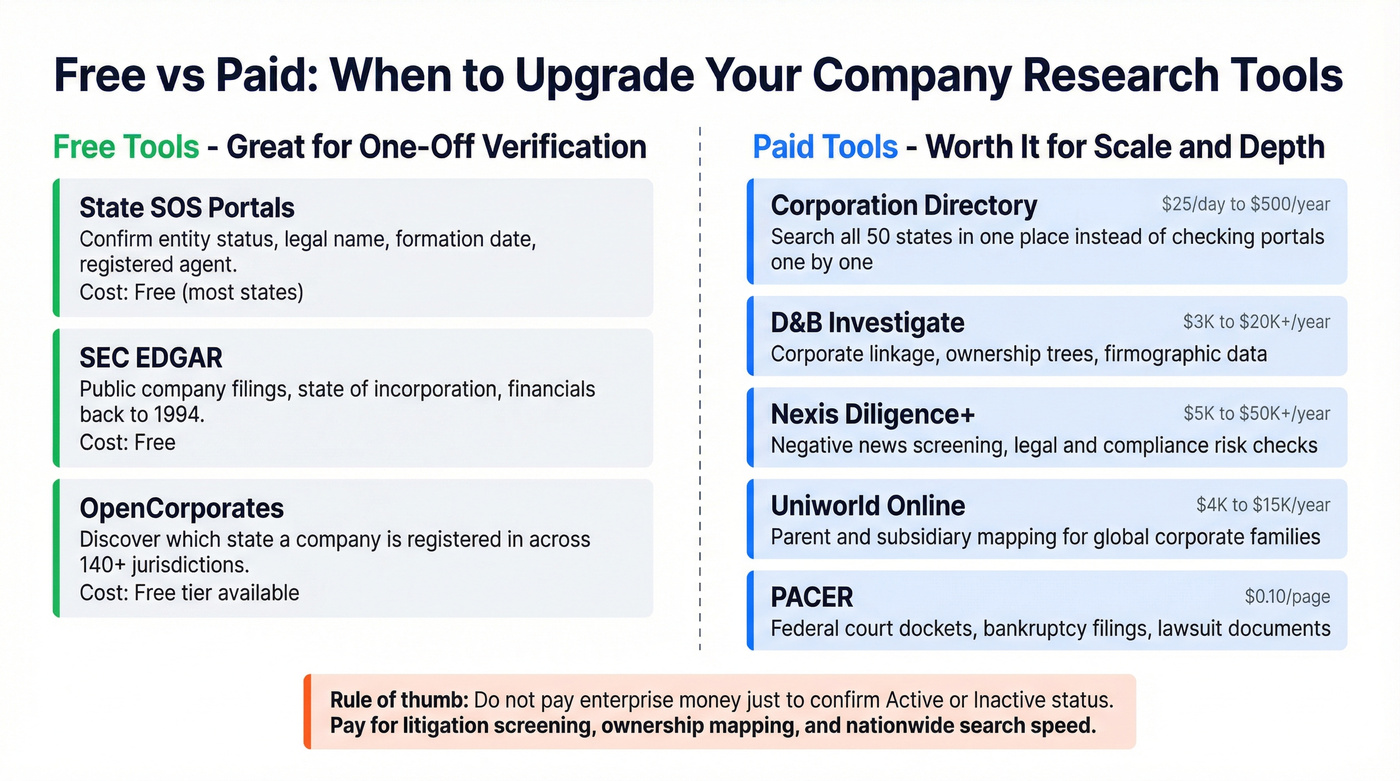
| Tool | Best For | Typical Price |
|---|---|---|
| Corporation Directory | 50-state SOS search in one place | $25/day - $500/year |
| D&B Investigate | Corporate linkage, ownership, firmographics | ~$3,000-$20,000+/year |
| Nexis Diligence+ | Negative news + legal/compliance screening | ~$5,000-$50,000+/year |
| Uniworld Online | Parent/subsidiary mapping | ~$4,000-$15,000/year |
| PACER | Federal court dockets and documents | $0.10/page (with caps) |
If you're paying enterprise money just to confirm an entity exists, you're burning budget. Paid tools are worth it for negative news screening, litigation history, ownership mapping, and fast nationwide search - not for pulling a basic "Active/Inactive" status you can get from the SOS for free.
What You Can't Find (and Why)
Private companies don't file with the SEC, so detailed financials are almost never public. For many private entities, the SOS record is intentionally minimal: name, status, registered agent, and maybe an address. That's it.
Two exceptions show up often. If a private company gets acquired by a public company, deal details and risk disclosures often appear in the acquirer's SEC filings. And if a company used to be public, its older filings remain accessible on EDGAR indefinitely.
A few questions that come up constantly - especially in Reddit threads where someone from outside the U.S. is trying to figure out why this is so hard:
"Where's the U.S. Companies House equivalent?" There isn't one. The closest practical substitute is OpenCorporates to discover, SOS to confirm, EDGAR for public companies.
"How do I find subsidiaries after an acquisition?" For public companies, check the 10-K for subsidiary exhibits. For private-company trees, Uniworld and D&B are the fastest route.
"What businesses does this person own?" Person-to-business reverse lookups are unreliable from free SOS searches. You need specialized databases, and even then you'll hit gaps because ownership isn't consistently disclosed in state filings.
One more thing worth flagging: SOS filings can expose personal information depending on the state and entity type. Officer names - and sometimes home addresses - become part of the public record.
From Records to Outreach
You found the company in the state registry. It's active and properly filed. Now you need to reach the VP of Procurement - and the SOS listing gives you a registered agent address, not a real decision-maker.
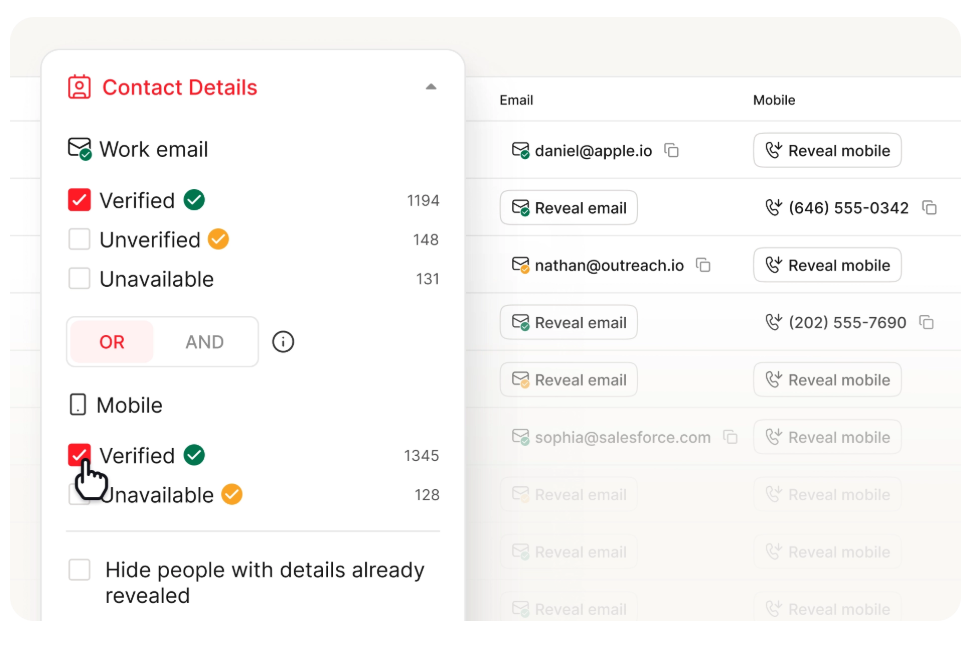
That's where company public records end and outbound begins. Prospeo gives you verified contact data tied to real roles: 143M+ verified emails, 125M+ verified mobile numbers, and 300M+ professional profiles, all refreshed on a 7-day cycle. Email accuracy sits at 98%, and there's a free tier with no contract.
You just spent 20 minutes confirming a vendor exists across three state portals. Now imagine enriching your entire prospect list with 50+ data points per contact - verified emails, direct dials, tech stack, and intent signals - in minutes, not hours. That's what 15,000+ companies use Prospeo for.
Turn company research into pipeline at $0.01 per verified email.
FAQ
Is there a federal database for U.S. business records?
No. The U.S. has no centralized federal registry for company formation records - companies register at the state level through a Secretary of State or equivalent agency. SEC EDGAR is federal but covers public companies only. Unlike countries with a single national registry, the U.S. distributes this function across 50 separate state portals.
How do I look up a company if I don't know the state?
Use OpenCorporates to identify likely jurisdictions and entity matches, then confirm the exact record in the relevant state's SOS portal. For repeated searches, Corporation Directory runs a 50-state sweep from a single interface starting at $25/day.
Can I find a private company's financial statements?
Almost never. Private companies aren't required to file financials with the SEC. You can sometimes infer size via paid databases like D&B Investigate, or find financial context in court records and acquisition disclosures - but most private-company financials stay private.
How do I find contact information after verifying an entity?
State registries list registered agents and sometimes officers, but they rarely include direct emails or phone numbers for the people you actually need to reach. Prospeo provides verified emails at 98% accuracy and mobile numbers for decision-makers across 300M+ professional profiles, with a free tier of 75 emails per month.
How current are aggregator sites like OpenCorporates?
Aggregators can lag behind official state registries by days or weeks depending on the jurisdiction. They're excellent for discovery - finding which state a company is registered in - but always confirm critical details directly in the SOS portal before making business or compliance decisions.