

Best Email Search Tools in 2026: Accuracy, Pricing, and What Nobody Tells You
Your outbound team sent 5,000 cold emails last Tuesday. 400 bounced. Gmail started throttling your domain by Thursday, and now even the emails that are valid land in spam. The email search tools you rely on aren't just a convenience - they're the foundation your entire sender reputation sits on. Pick wrong, and you burn money and domains simultaneously.
Why Your Email Finder Choice Matters
Email still returns roughly [36:1 ROI](https://www.litmus.com/resources/email-marketing-roi) according to Litmus. But that number assumes your emails actually arrive. The deliverability math is unforgiving: keep total bounces below 2%, hard bounces under 1%, and spam complaints at or below 0.1%. Cross the [0.3% spam complaint threshold](https://www.suped.com/knowledge/email-deliverability/sender-reputation/how-does-google-penalize-senders-with-spam-rates-over-03) and Gmail will throttle you - not gradually, but fast.
Your finder's accuracy directly controls whether your outbound channel works or self-destructs. A tool returning 80% valid emails sounds fine until you realize that 20% invalid rate on a 5,000-contact campaign means 1,000 bounces. That's a domain-warming nightmare.
One of the biggest complaints in this category is paying full price for bad data - and Saleshandy's benchmark flat-out says 8 out of 10 tools charge full price for emails that bounce. Pricing in this space is messy, too. Prices below are checked against official pricing pages where available; for quote-based enterprise tools, we use widely cited market ranges.
Our Top Picks (TL;DR)
| Tool | Best For | Starting Price | Free Tier |
|---|---|---|---|
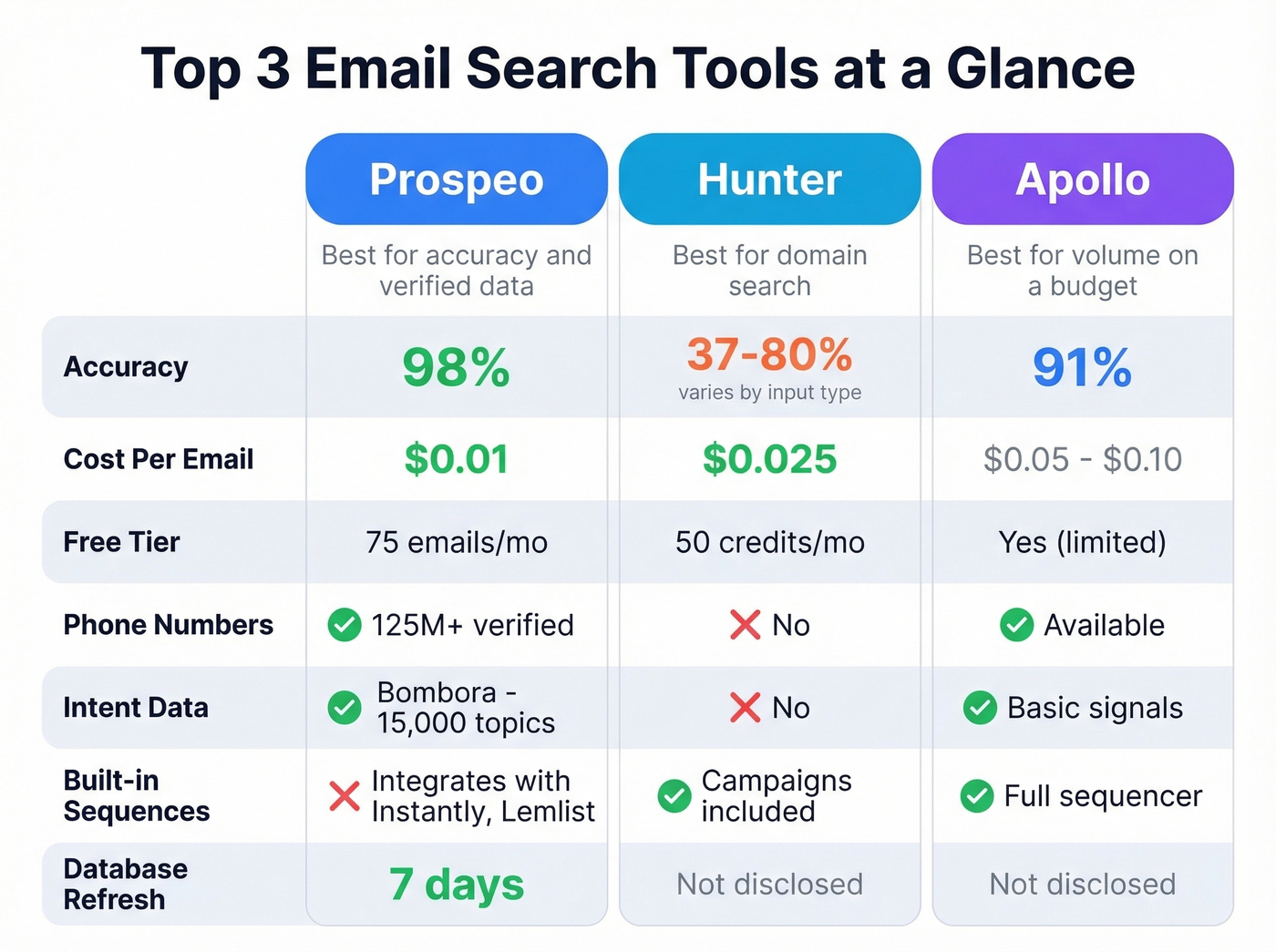
| Prospeo | 98% accuracy + weekly refresh | ~$0.01/email | 75 emails/mo |
| Hunter | Domain search + clear pricing | $49/mo ($34 annual) | 50 credits/mo |
| Apollo | Volume prospecting on a budget | ~$49/user/mo | Yes (limited) |
How Credits Actually Work
Here's the thing: "1 credit" means something completely different at every tool. This is where teams get burned. You sign up for a plan with 5,000 credits thinking you'll get 5,000 emails, then discover that phone numbers cost 10 credits each, verifications eat half a credit, and your credits expire at month-end.
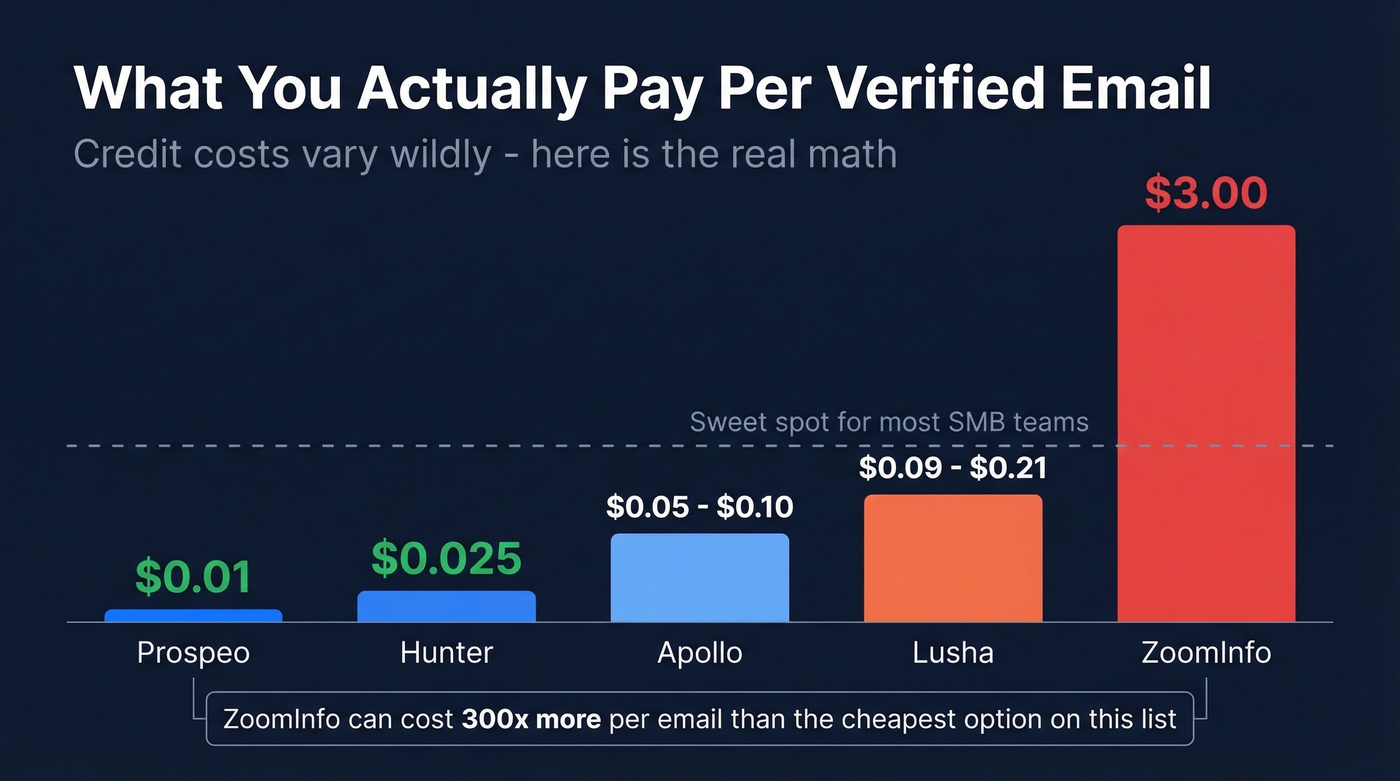
Hunter uses a unified credit pool - 1 credit per email found, 0.5 credits per verification. Clean and predictable. Yearly plans front-load all credits for 12 months, which is genuinely useful for bursty prospecting.
Lusha charges 1 credit per email but 10 credits per phone number. A team pulling both will burn through credits 5-10x faster than expected. Apollo's credits don't roll over - whatever you don't use each billing cycle is gone. ZoomInfo's Professional tier works out to roughly $3.00 per credit when you divide an entry-level annual contract (around $15k/year) by typical included credits (around 5,000).
| Tool | Cost Anchor | Credits/Emails Anchor | Est. Cost/Verified Email |
|---|---|---|---|
| Hunter Starter | $49/mo | 2,000 finds (verifications cost 0.5 credits) | ~$0.025 per find |
| Apollo Basic | ~$49/user/mo | Credit usage varies by workflow | ~$0.05-$0.10 |
| Lusha (annual) | $22.45-$52.45/mo | 1 credit/email; 10 credits/phone | ~$0.09-$0.21 (email-only) |
| ZoomInfo Professional | ~$15,000/yr | ~5,000 credits/yr | ~$3.00 |
The spread is enormous. ZoomInfo can cost hundreds of times more per credit than the cheapest option on this list.
If your average deal size is under $10k, you almost certainly don't need ZoomInfo-level data. A self-serve finder at $0.01-$0.10 per email will get you 90% of the way there.

You just read the credit math - ZoomInfo charges $3.00 per email while most tools charge full price for addresses that bounce. Prospeo delivers 98% verified emails at ~$0.01 each, refreshed every 7 days so you're never emailing stale data. Snyk cut their bounce rate from 35% to under 5% and added 200+ opportunities per month.
Stop burning credits and domains on bad data.
The 12 Best Email Search Tools in 2026
Prospeo
Prospeo searches across 300M+ professional profiles - including 143M+ verified emails and 125M+ verified mobile numbers - using 30+ filters like buyer intent, technographics, job changes, and funding signals. Intent data tracks 15,000 topics via Bombora, so you can filter for companies actively researching solutions in your category. Enrichment returns 50+ data points per contact with a 92% API match rate.

The accuracy number is 98%, backed by a 5-step verification process that includes catch-all handling, spam-trap removal, and honeypot filtering. The database refreshes every 7 days - a gap that matters more than most people realize (more on that below). The Chrome extension has 40,000+ users and works on company websites and professional profiles.
Real results: Snyk's 50-person AE team went from a 35-40% bounce rate to under 5% after switching, generating 200+ new opportunities per month. That's not a marginal improvement - that's a fundamentally different outbound program.
Use it if you care about data quality above all else, need verified emails and mobiles in one platform, or you've been burned by bounces from other providers.
Skip it if you need a built-in email sequencer - Prospeo focuses on data quality and integrates with dedicated sending tools like Smartlead, Instantly, and Lemlist.
Pricing: free tier gives you 75 emails/month. Paid plans work out to roughly $0.01/email. No contracts, no sales calls required.
Every email search tool on this list defines 'accuracy' differently. Prospeo backs its 98% claim with 5-step verification, catch-all handling, spam-trap removal, and a 7-day refresh cycle - while the industry average sits at 6 weeks. 75 free emails per month, no credit card required.
Test the accuracy yourself - 75 verified emails, zero risk.
Hunter.io
Hunter built its reputation on domain search - give it a company domain and it returns every email pattern and address it can find, with confidence scores and public sources listed. That transparency is rare and genuinely useful for validating results.

Several top-ranking "email finder" articles still list Hunter at $24/month. That plan doesn't exist anymore. The actual pricing starts at $49/mo for Starter (or $34/mo annually) with 2,000 credits. Verifications cost 0.5 credits, so you can verify 4,000 emails on a Starter plan. Credit packs expire 3 months after purchase - useful for burst campaigns, but don't hoard them. Free tier: 50 credits/month.
Use it if your workflow starts with a target company list and you want to find every reachable person at each domain. Hunter's domain search is the best in the category for that specific use case.
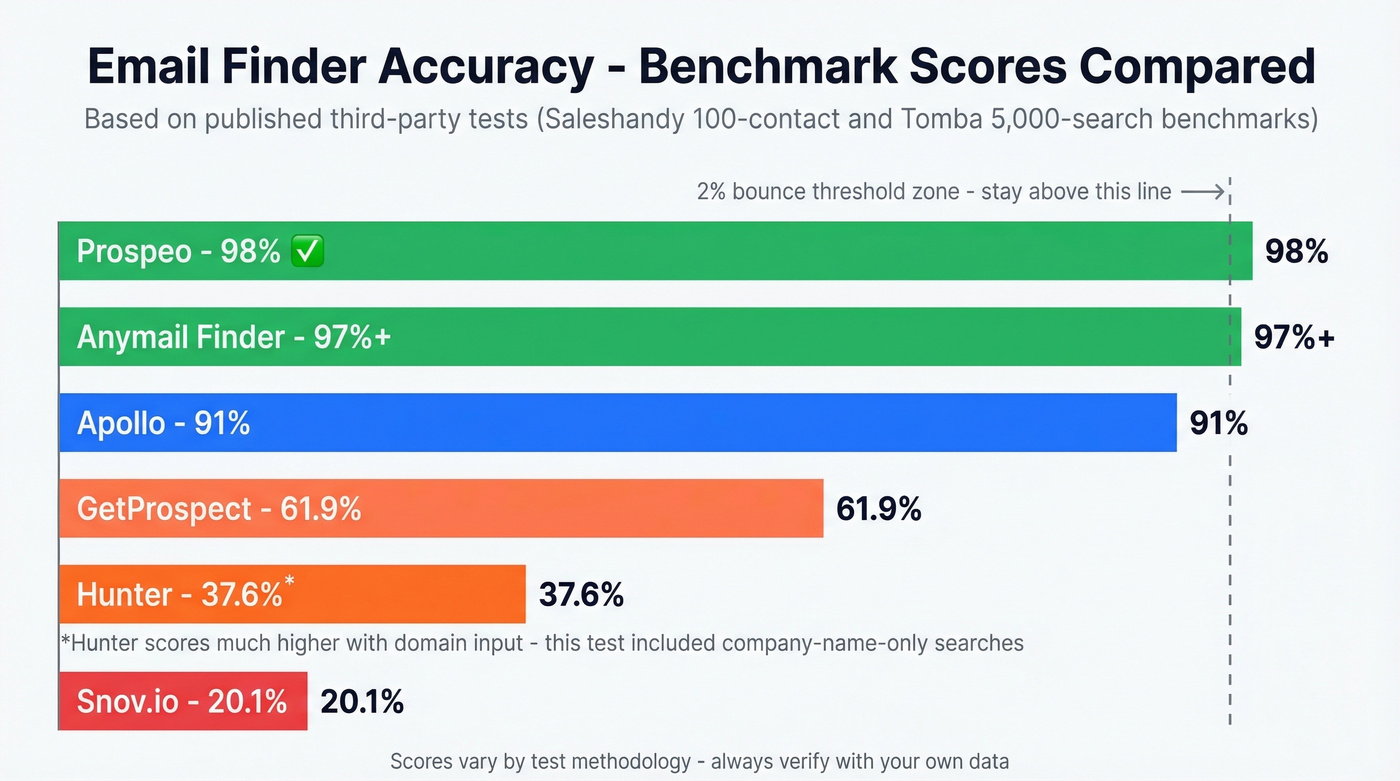
Skip it if you need phone numbers or intent data. Hunter is email-focused, and that's both its strength and its limitation. In a 5,000-search benchmark, Hunter scored 37.6% - but that test included company-name-only searches where Hunter struggles without a domain input. With domains, it's a different story.
Apollo.io
Apollo is the Swiss Army knife of outbound. A massive database, built-in sequences, a dialer, and a generous free plan make it the default starting point for SMB teams that want everything in one place.
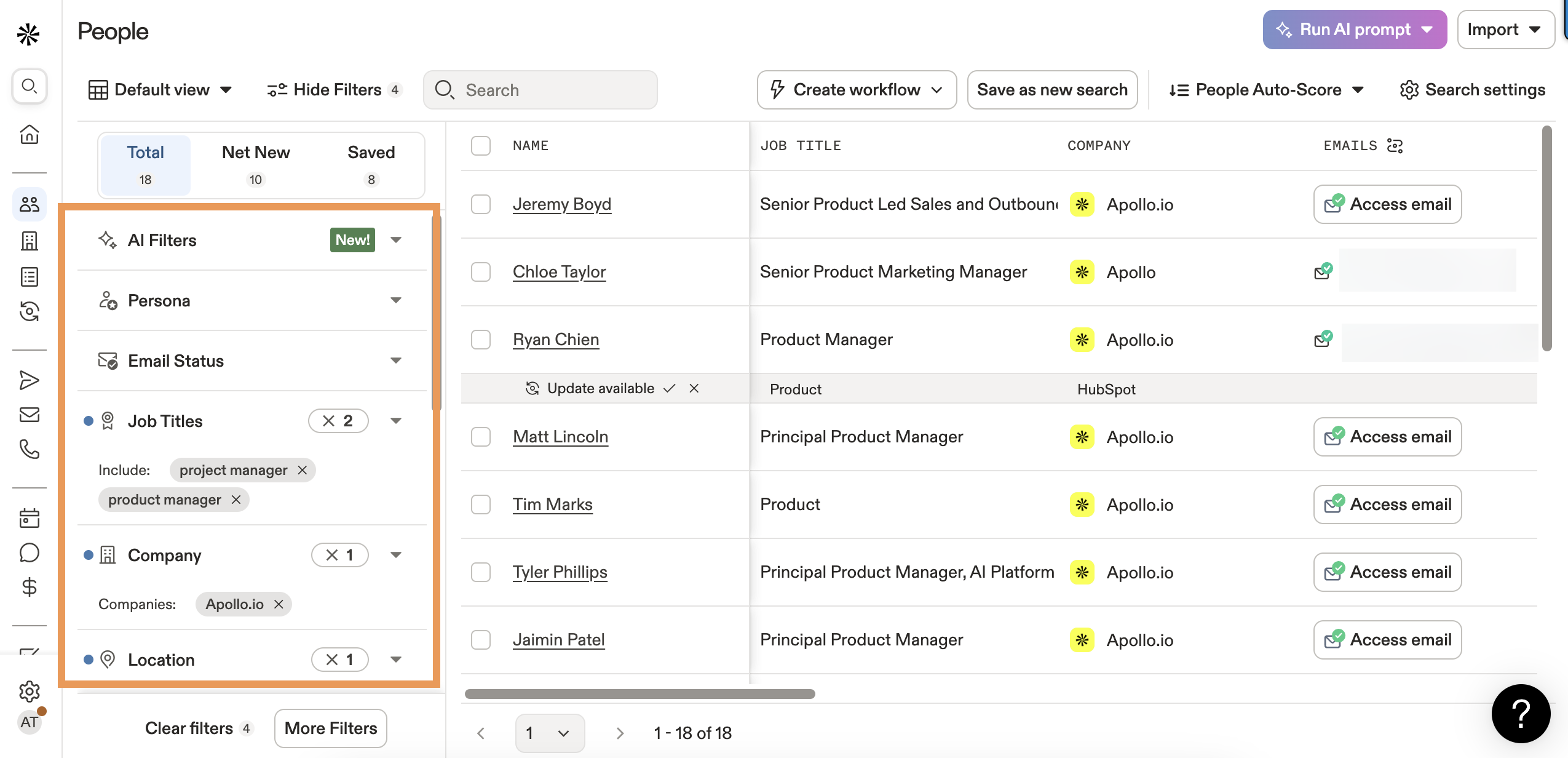
Paid plans typically run ~$49-$119/user/month depending on tier. The free plan includes limited credits and up to 2 sequences - enough to test the waters. Apollo's waterfall enrichment queries multiple data sources per contact, which means credit consumption varies by market and coverage. Credits don't roll over, and teams frequently mention this expiration as a pain point on r/sales and other communities.
Use it if you need volume on a budget and want prospecting + sequencing in one tool.
Skip it if email accuracy is your top priority. Apollo scored 91% in Saleshandy's benchmark - solid but not best-in-class. We've seen teams supplement Apollo's data with a dedicated verification layer to close the gap.
Lusha
Lusha's free tier is generous - up to 70 credits per month with browser extension and CRM integrations included. One credit per email reveal is reasonable. The trap is phone numbers: each one costs 10 credits. A team pulling both will burn through credits 5-10x faster than expected.
On monthly plans, unused credits roll over and accumulate up to 2x your plan limit, which is a nice touch. Expect ~$50-80/mo per user for common paid setups. Best for quick one-off lookups when you already know who you're targeting. Not ideal for bulk prospecting.
Snov.io
Snov.io bundles email finding with built-in drip campaigns, which makes it appealing for solo founders and small teams who want one tool for everything. The free trial includes 50 credits, and plans start at $30/mo for 1,000 credits.
The accuracy concern is real. Snov.io scored 20.1% in the 5,000-search benchmark and 79% in Saleshandy's 100-contact test - the lowest in both. If you're using Snov.io, pair it with a separate verification step before sending. We can't stress that enough.
Anymail Finder
Anymail Finder's model is genuinely different: you only pay for verified emails. If the tool can't verify an address, you don't burn a credit. That 97%+ delivery guarantee is a direct result of this approach - they're filtering out uncertainty before it costs you anything. Plans start at $14/mo with 100 free credits to test. Narrow in scope (no sequences, no intent data), but it does one thing well.
RocketReach
RocketReach is built for one-off lookups, not bulk prospecting. Pricing starts around $50/user/month, with higher tiers landing in the $80-$120 range depending on seats and usage. Per-contact costs are high, which makes it expensive at scale. Best for recruiters and BD reps who need 10-20 contacts per day, not teams running campaigns of thousands.
Saleshandy
Saleshandy plays both sides: email finder and cold email sender in one platform. The finder is free for basic use, and the Lead Starter plan at $49/mo includes 30,000 credits per year. They published their own accuracy benchmark comparing competitors - useful data, though the bias is obvious. The dual-purpose value proposition is real for teams that don't want to manage separate tools.
GetProspect
Free tier with 50 new emails per month, paid plans from $49/mo (or $34/mo billed annually). Scored 61.9% in the 5,000-search benchmark - it struggles significantly without a domain input. Fine for light, domain-based prospecting; unreliable for broader searches.
Skrapp.io
Free plan includes 100 credits per month. Paid plans start around $30/month on annual billing. A solid budget option for email-only workflows, though we haven't seen it appear in major accuracy benchmarks, so test it with your own data before committing.
UpLead
Seven-day free trial, paid plans from $99/user/month. UpLead sits in a higher price tier than the sub-$50 tools, and it's often evaluated when teams want stricter data-quality controls without going fully enterprise.
Cognism
Cognism sits in the enterprise tier alongside ZoomInfo, typically running ~$15,000-$40,000/year depending on seats and data coverage. It's quote-based and built for teams that want an enterprise workflow and compliance posture. For most SMB teams, the price-to-value ratio doesn't compete with self-serve tools.
ZoomInfo
ZoomInfo starts at $15,000+/year for Professional and climbs to $40,000+ for Elite. Add-ons for extra credits (~$3,000 per 5,000), NeverBounce verification (~$3,000), and Global Data ($9,995) push real-world costs toward $50,000 annually. Negotiation discounts of 30-65% are common, so never accept the first quote.
If a tool won't tell you its price, that's a feature - for their sales team, not for you. ZoomInfo is overkill for 90% of teams reading this article.
What Accuracy Benchmarks Reveal
Let's be honest: every accuracy benchmark in this space is published by a vendor with skin in the game. That doesn't make the data useless - it means you should take directional trends seriously while treating exact percentages with healthy skepticism.
Saleshandy's 100-contact test showed Apollo at 91%, ZoomInfo at 95%, Hunter at 90%, Lusha at 93%, and Snov.io at 79%. Tomba's larger 5,000-search benchmark - split between domain searches and company-name-only searches - produced very different numbers: Tomba 80.3%, Anymail Finder 77.5%, Hunter 37.6%, Snov.io 20.1%, GetProspect 61.9%.

The key insight from the larger-sample test: many finder tools collapse when you don't provide a domain. If your workflow involves searching by company name alone, that's a critical filter when choosing a tool. Hunter, which excels at domain search, scored poorly because the test included 2,500 company-name-only queries where it simply wasn't designed to perform.
Data Freshness - The Factor Nobody Talks About
Database size is a vanity metric. A tool with 500M contacts that haven't been refreshed in weeks is worse than one with 300M contacts refreshed weekly.
Look, if you're evaluating email search tools and not asking "how often is this data refreshed," you're optimizing for the wrong thing. A fresh database with 98% accuracy beats a stale database with 95% accuracy every single time. In our experience, data freshness explains more bounce-rate variance than any other single factor.
Enterprise vs. Self-Serve: Two Different Worlds
Enterprise tools - ZoomInfo, Cognism - run $15,000-$50,000/year, require sales conversations, and involve multi-week procurement cycles. You get massive databases, intent data, and platform features. These make sense for 200+ person sales orgs with dedicated RevOps teams to manage the implementation.
Self-serve tools - Hunter, Apollo, Lusha, and others on this list - cost $0-$200/month, let you sign up instantly, and start returning data in minutes. For teams that want enterprise-grade depth without enterprise procurement, Prospeo gives you 300M+ profiles, intent signals, and enrichment on a self-serve model at a fraction of the cost.
FAQ
What is an email search tool?
An email search tool finds verified business email addresses using inputs like a person's name and company domain. Sales teams, recruiters, and marketers use them to build prospect lists for outbound campaigns without manually guessing email formats or scraping websites.
Are email finder tools legal?
Yes, when used for legitimate B2B outreach and in compliance with GDPR and CAN-SPAM. You must honor opt-out requests, include your business address, and avoid purchasing lists from non-compliant sources. Most reputable tools enforce GDPR compliance and provide DPAs.
How accurate are email finder tools really?
Accuracy ranges from 20% to 98% depending on the tool and whether you provide a domain input. Saleshandy's benchmark showed ZoomInfo at 95% and Snov.io at 79%, while Prospeo's 5-step verification process delivers 98%. Always test with your own target list before committing to an annual plan.
Do I need a separate verification tool?
Not if your finder includes built-in verification - and in 2026, integrated verification is table stakes. Running a separate step only makes sense with tools like Snov.io where accuracy rates leave room for improvement. Prospeo, Anymail Finder, and Hunter all verify during the search process.
Test 2-3 email search tools from this list with your actual prospect data. The numbers will tell you which one earns a permanent spot in your stack.