

10 Email Subject Line Formulas That Actually Work (And Why Open Rates Lie)
Your dashboard says 48% open rate. Real engagement? Far lower. The gap comes from Apple Mail Privacy Protection, which accounts for 46% of email clients and pre-fires tracking pixels whether someone reads your email or not.
A study of 80,000+ accounts found MPP inflated open rates by 18 points - blocking IP addresses, timestamps, geolocation, and device data in the process. Any guide to email subject line formulas that optimizes for opens is navigating with a broken compass. These 10 formulas are tagged by use case and measured by what actually matters: replies and clicks.
Cold Email vs. Marketing - Different Games
Cold email goes to people who didn't ask to hear from you. The goal is a reply. Marketing email goes to opted-in subscribers, and the goal is a click toward conversion.
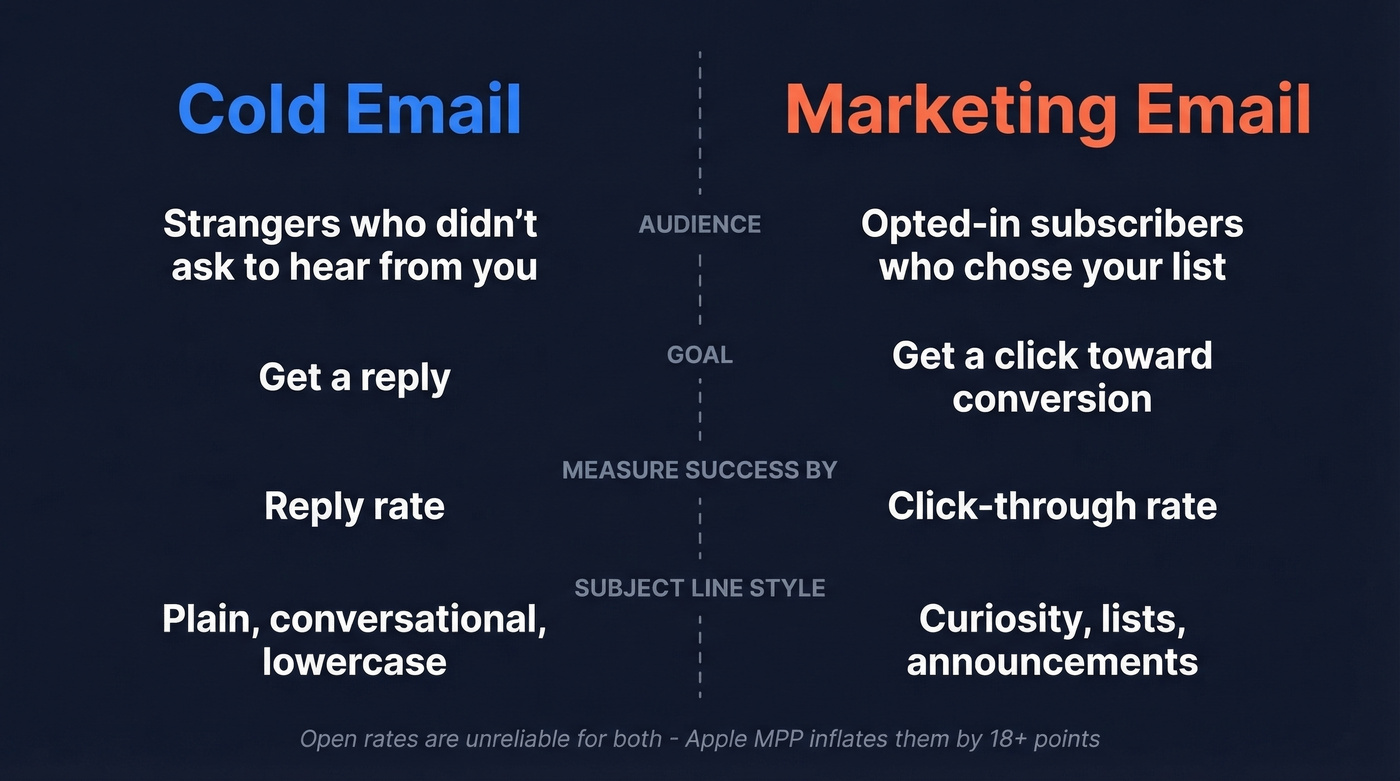
The craft differs sharply between these two contexts. Every formula below is tagged [Cold], [Marketing], or [Both] so you can skip what doesn't apply.
10 Proven Formulas
For context, the 2026 MailerLite benchmark across 3.6M campaigns puts median open rate at 43.46% - but that number is inflated by MPP. Click rate (2.09%) tells the truth. Average cold email open rate has dropped from 36% to 27.7% even before accounting for MPP inflation.
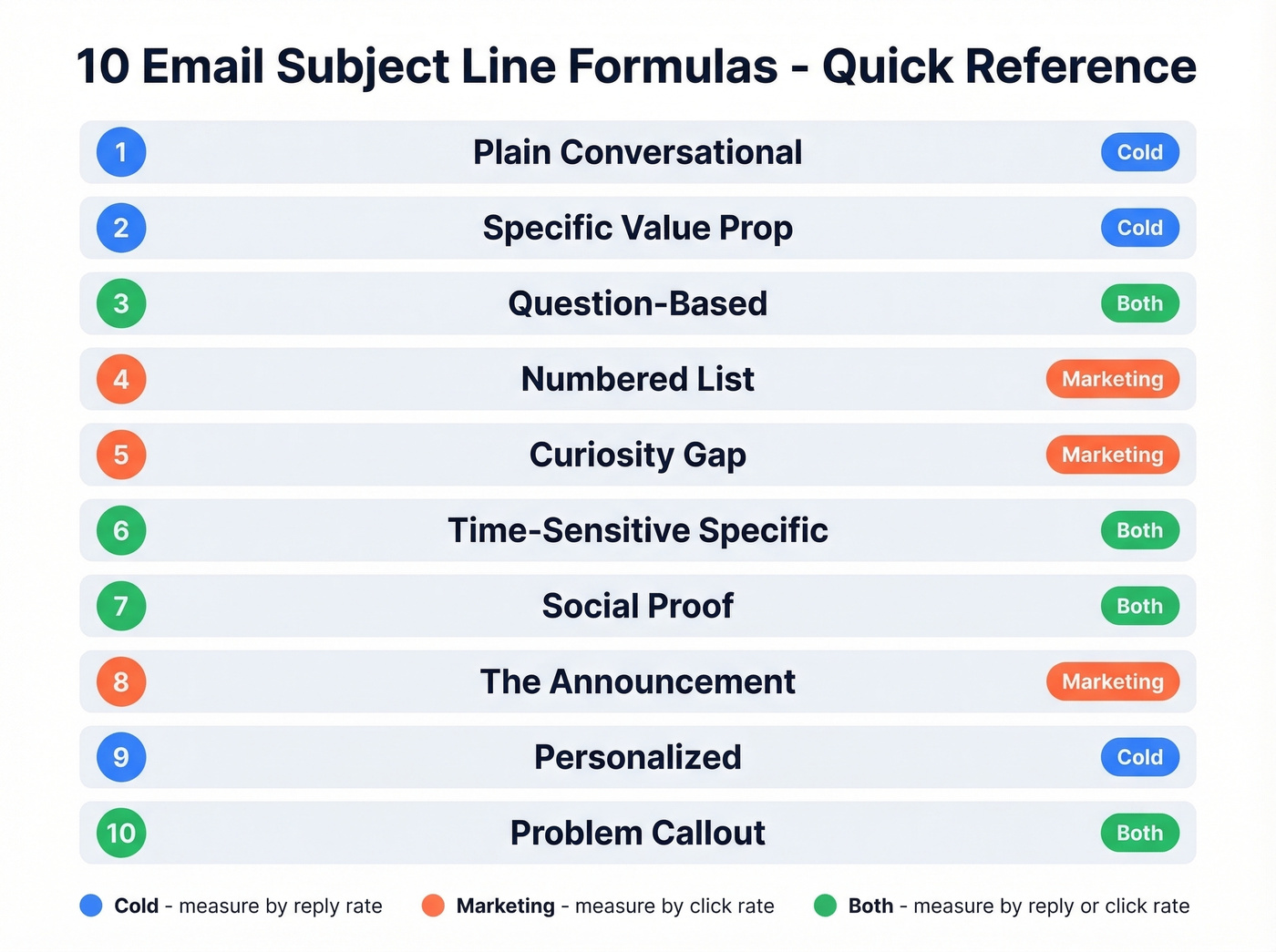
1. The Plain Conversational [Cold]
Write like you're emailing a colleague. No title case, no punctuation tricks. In our testing, this outperforms everything else in cold outbound - and practitioners on r/coldemail consistently agree. Restraint is more persuasive than excitement.
Measure by: reply rate.
- "quick thought on [company]'s Q2 plan"
- "following up on the ops role"
- "that hiring post"
2. The Specific Value Prop [Cold]
Name a concrete outcome with numbers. If you can point to a specific result for a similar company, the reader believes it could happen for them - a clear outcome tied to proof is one of the most reliable promise-based lines you can write.
- "How [Similar Co] cut churn 22% in 6 weeks"
- "[Company]'s team saved 11 hrs/week on lead routing"
3. Question-Based Subject Lines [Both]
Ask a genuine question, not a rhetorical one. George Loewenstein's curiosity gap research explains why: the brain wants to close an open loop. But the question has to be relevant enough that the reader actually wants the answer.
Measure by: reply rate (cold), click rate (marketing).
- "Is your team still manually tagging leads?"
- "What changed in your onboarding flow?"
- "Still using spreadsheets for pipeline?"
4. The Numbered List [Marketing]
Numbers create cognitive ease - the reader knows exactly what they're getting. Odd numbers slightly outperform even ones.
- "5 onboarding emails that reduced churn"
- "3 filters most SDRs miss"
5. The Curiosity Gap [Marketing]
Leave the loop incomplete. Information gap theory in action. It only works when the reader trusts you'll deliver, though. Overuse this and you'll train your list to ignore you.
- "The metric we stopped tracking (and why)"
- "We almost killed this feature"
6. The Time-Sensitive Specific [Both]
Skip this if your urgency is fake. "Last chance!" with no actual deadline is one of the worst-performing patterns in a practitioner analysis of 2,500 subject lines across 12 industries. Real deadlines work. Manufactured ones destroy trust.
- "48 hours left: early pricing for [event]"
- "Pilot spots close Friday - 3 left"
7. The Social Proof [Both]
Name-drop a peer company or a recognizable number. People want to know what others like them are doing, and the more specific the proof, the better it performs.
- "What 1,200 SDRs changed about their outreach"
- "Why [Peer Company] switched CRMs"
8. The Announcement [Marketing]
Genuine news, delivered plainly. No hype words, no exclamation marks. Save this for when you actually have something to announce - novelty only works once.
- "New: intent filters in the dashboard"
- "We just shipped bulk exports"
9. Personalized Subject Lines [Cold]
Before: "[Name], loved your recent post" After: "[Name], your point about PLG pricing in the Series B post was sharp"
The difference is specificity. Generic personalization reads as automated. When you personalize with real context - a prospect's company name, a recent initiative, a specific challenge you noticed - you earn the open. Using the prospect's company name signals this isn't a mass blast, and that signal alone can double reply rates in cold outbound.
10. The Problem Callout [Both]
Name a pain the reader recognizes. This creates a pattern interrupt: instead of scanning past another promotional line, the reader stops because you've described their situation. Vague pain like "struggling with growth?" doesn't land. Specificity does.
- "Bounce rates above 5% tank your domain"
- "Your reps are spending 6 hrs/week on data entry"
- "Half your list isn't seeing your emails"
Formulas That Fail
Not every pattern deserves a test. Some are reliably bad:
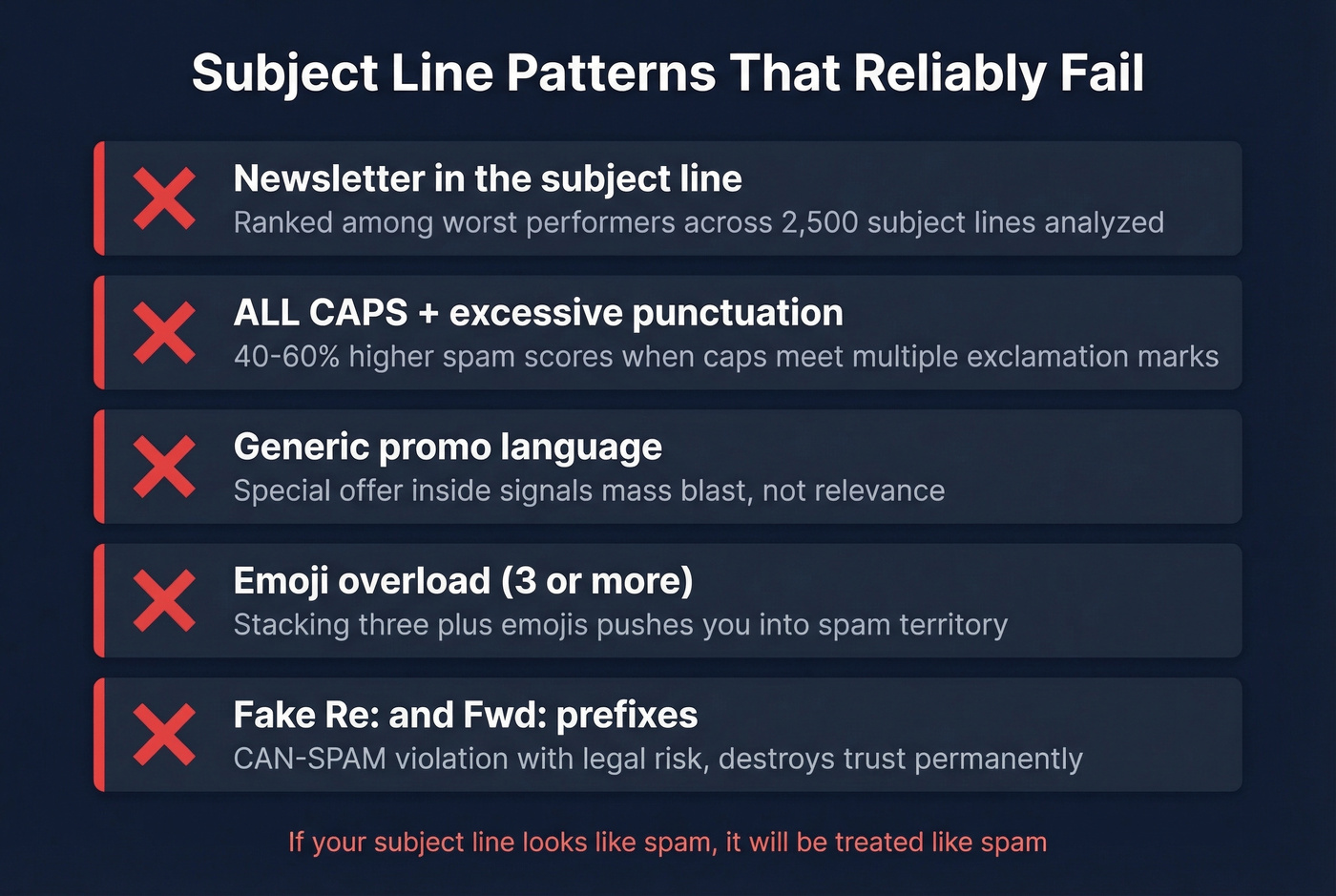
- "Newsletter" in the subject line. Data across 2,500 subject lines ranked this among the worst performers. "Monthly Newsletter - June" gives zero reason to open.
- ALL CAPS + excessive punctuation. Combining caps with multiple exclamation marks produces 40-60% higher spam scores.
- Generic promo language. "Special offer inside" signals mass blast, not relevance.
- Emoji overload (3+). Stacking three or more pushes you into spam territory.
- Fake Re:/Fwd: prefixes. A CAN-SPAM violation. Misleading headers carry legal risk, and recipients who notice will never trust you again.

You just learned 10 subject line formulas that earn replies. But none of them matter if your emails bounce. Prospeo's 5-step verification delivers 98% email accuracy - so every carefully crafted subject line reaches a real inbox.
Stop blaming your copy when the real problem is bad data.
Writing for Mobile
70% of emails open on mobile. That changes the math on everything.
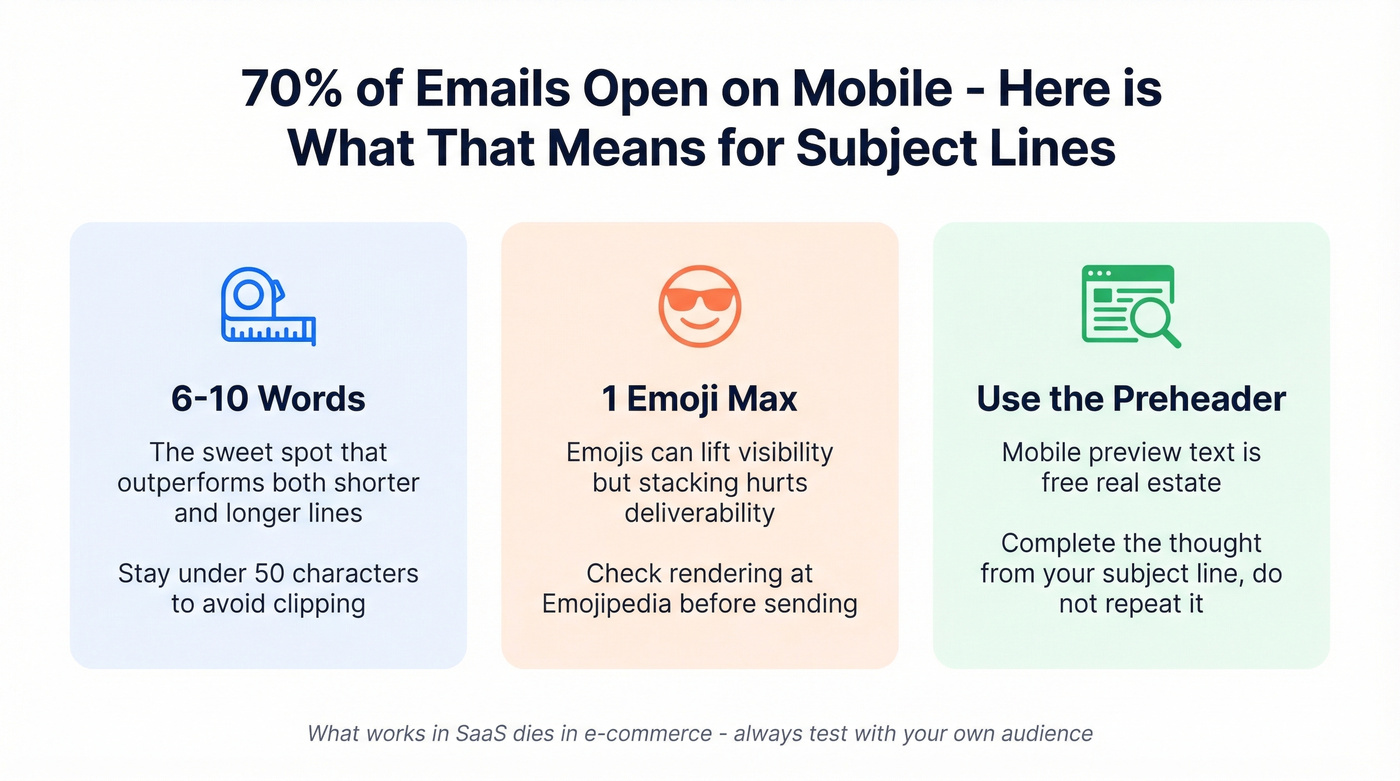
6-10 words outperform both shorter and longer lines across the 2,500-line dataset. Choosing the right words matters more than cramming in extra ones. Keep it under 50 characters so nothing gets clipped on smaller screens - front-load the important words.
One emoji max. Moosend's analysis of 69,315 subject lines found emojis can lift visibility, but stacking hurts deliverability. Check rendering at Emojipedia before you send.
Treat the preheader as your second subject line. Mobile preview text is free real estate - use it to complete the thought, not repeat it. And here's the thing: what works in SaaS dies in e-commerce. Test with your audience, not best practices pulled from someone else's vertical.
How to Test Subject Lines in 2026
Apple MPP makes open-based A/B tests unreliable. When nearly half your list pre-fires tracking pixels regardless of engagement, your "winning" variant might just be the one that hit more Apple Mail users.
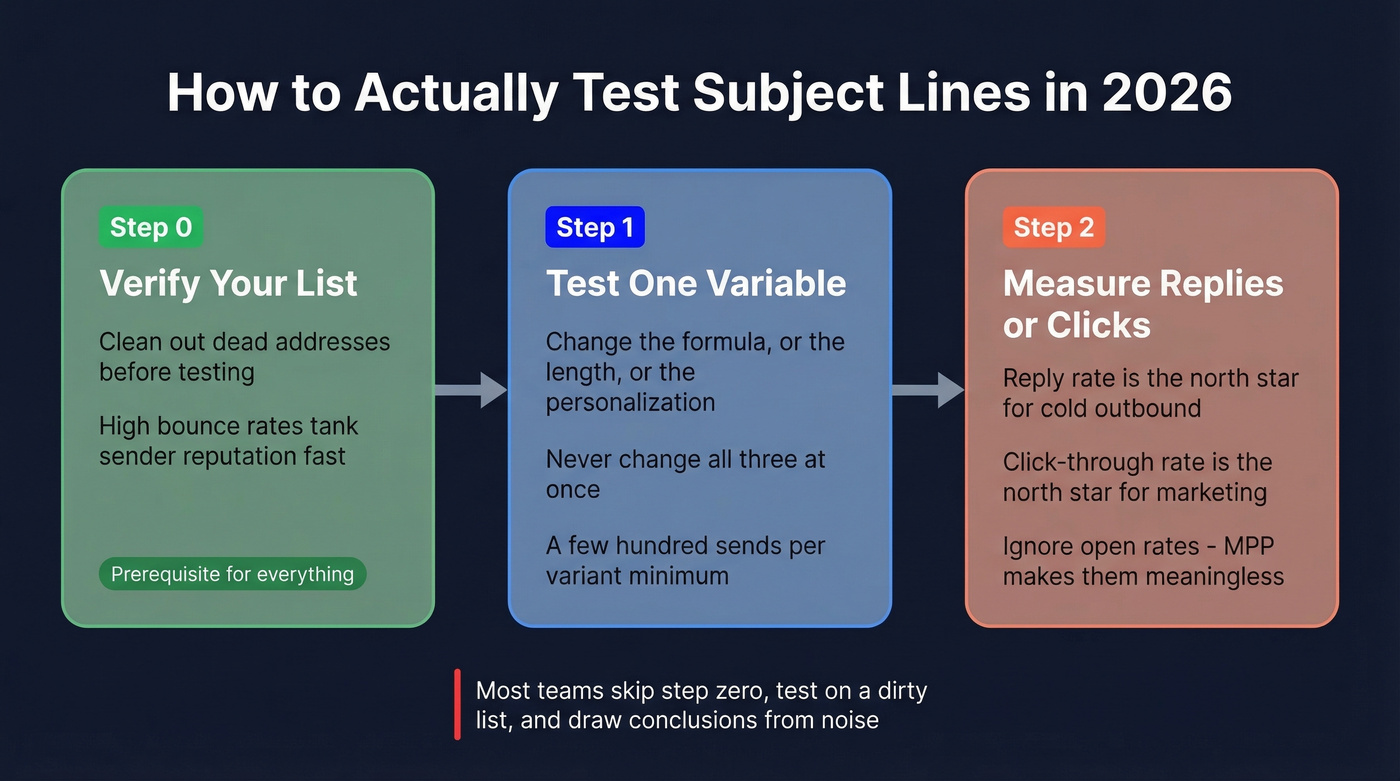
Step zero: verify your list. The best subject line in the world doesn't matter if the email bounces. High bounce rates tank sender reputation fast, and once that reputation drops, even your good emails land in spam. We've seen teams blame their copy when the real problem was 15% of their list hitting dead addresses. Run your list through Prospeo's email verification before testing - 98% accuracy, and the free tier covers 75 emails per month. Clean data is the prerequisite for every test that follows.
Step one: test one variable at a time. Change the formula, or the length, or the personalization - not all three. Try a value-prop line against a curiosity gap variant to see which drives more replies. You need a few hundred sends per variant minimum for the results to mean anything.
Step two: measure replies (cold) or clicks (marketing), not opens. Reply rate is the north star for outbound. Click-through rate is the north star for marketing. Opens are vanity in a post-MPP world.
Let's be honest: most teams skip step zero, run a test on a dirty list, and then draw conclusions from noise. Don't be that team.
Personalized subject lines double reply rates - but only if you have real context. Prospeo gives you 50+ data points per contact, from job changes to tech stack, so you can write subject lines that prove you did your homework.
Turn every subject line formula into a reply with data that's actually specific.
Stop Chasing Opens
Here's my hot take: most teams don't have a subject line problem. They have a list quality problem dressed up as a subject line problem.
Alex Hormozi's value equation applies here - Value = (Dream outcome x Perceived likelihood) / (Time delay x Effort). Your subject line earns the open. Your email body delivers the value. Your list quality determines whether the message arrives at all. These three layers work together, and optimizing one while ignoring the others is a waste of everyone's time.
You don't need 21 templates. You need 3-4 formulas that fit your audience, a testing system that measures real engagement, and a list clean enough to actually reach inboxes. Start there.