


Enablix Pricing, Reviews, Pros and Cons: Is It Worth It?
Your team just outgrew Google Drive. Reps can't find the latest case study, and someone just sent a prospect last quarter's pricing sheet - that's the moment most mid-market teams start shopping for a sales enablement platform. Enablix keeps showing up on the shortlist, but good luck finding a straight answer on what it actually costs.
We cross-referenced multiple pricing directories, analyzed 344 G2 reviews, and dug into published case study data to give you real numbers and a clear recommendation.
Enablix Pricing Breakdown
Enablix's official pricing page says "custom pricing" and pushes you toward a demo. Fortunately, TrustRadius publishes tier-level numbers that align with how Enablix positions its per-user model:
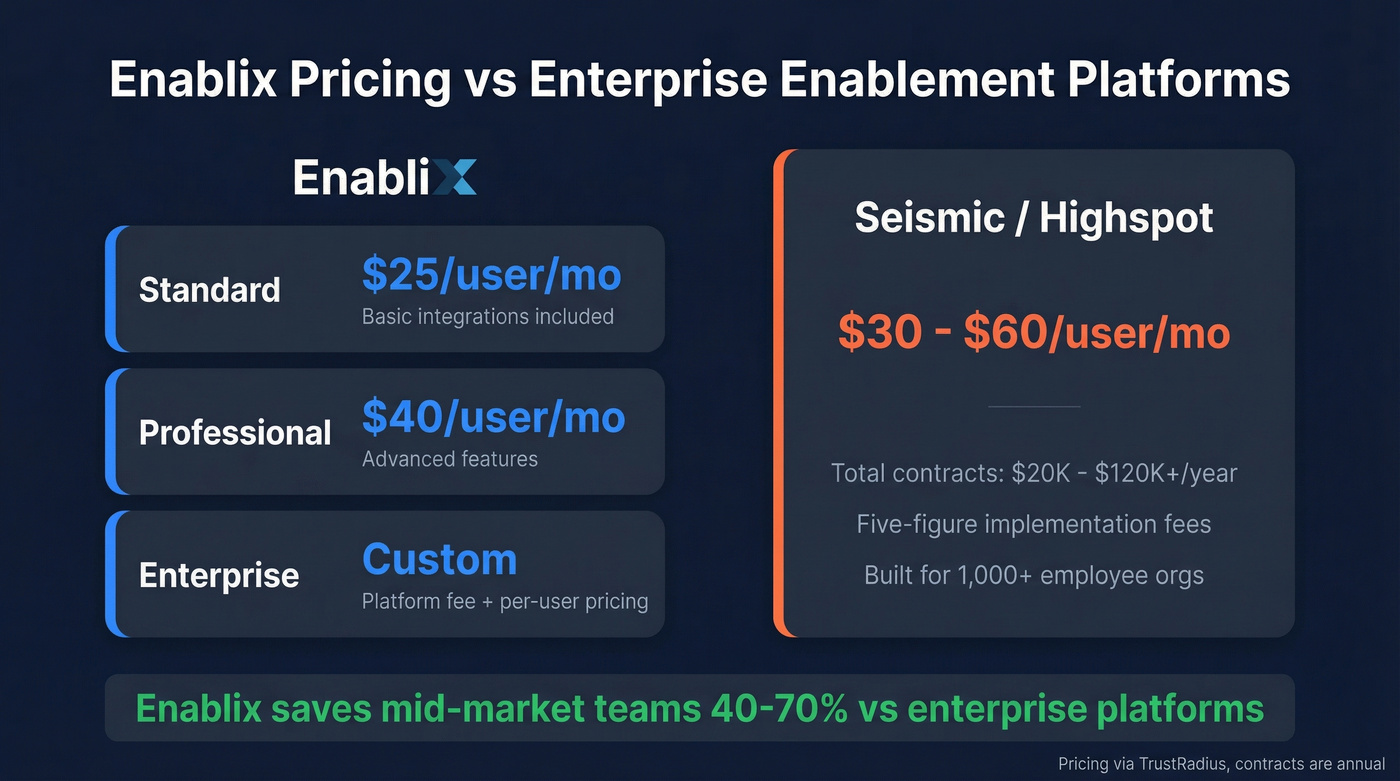
| Tier | Price | Notes |
|---|---|---|
| Standard | $25/user/mo | Listed by TrustRadius |
| Professional | $40/user/mo | Listed by TrustRadius |
| Enterprise | Custom | Platform fee + per-user pricing |
Expect a platform fee on top of per-user pricing - Enablix's site confirms this two-part model. Contracts are annual and there's no free trial; you'll get a tailored demo instead. Basic integrations come included in the platform fee, but specialized integrations can cost extra depending on complexity.
You'll see older directory pricing as low as $19/user/month (SaaSworthy shows a last-updated date in 2020), but that conflicts with the more current TrustRadius tier numbers. Don't bank on it.
For context, enterprise enablement platforms like Seismic and Highspot run $30-$60/user/month with total contracts landing anywhere from $20K to $120K+/year - plus five-figure implementation fees. Enablix is a fraction of that, which is its core value proposition for mid-market buyers.
What Users Say in Reviews
- G2 rating: 4.7/5 from 344 reviews (81% five-star)
- TrustRadius: 10/10 (only 1 review - tiny sample, take it with a grain of salt)
- Avg. implementation: ~1 month
- Fastest "fully integrated" timeline on record: Under 2 weeks (Lightspeed DMS, 500+ assets)
- Sweet spot: Mid-market teams, 51-1,000 employees
- Built for: Product marketers managing sales and marketing content, plus deal rooms and customer portals
Pros - What Users Like
We read through all 344 reviews. A few themes dominate.
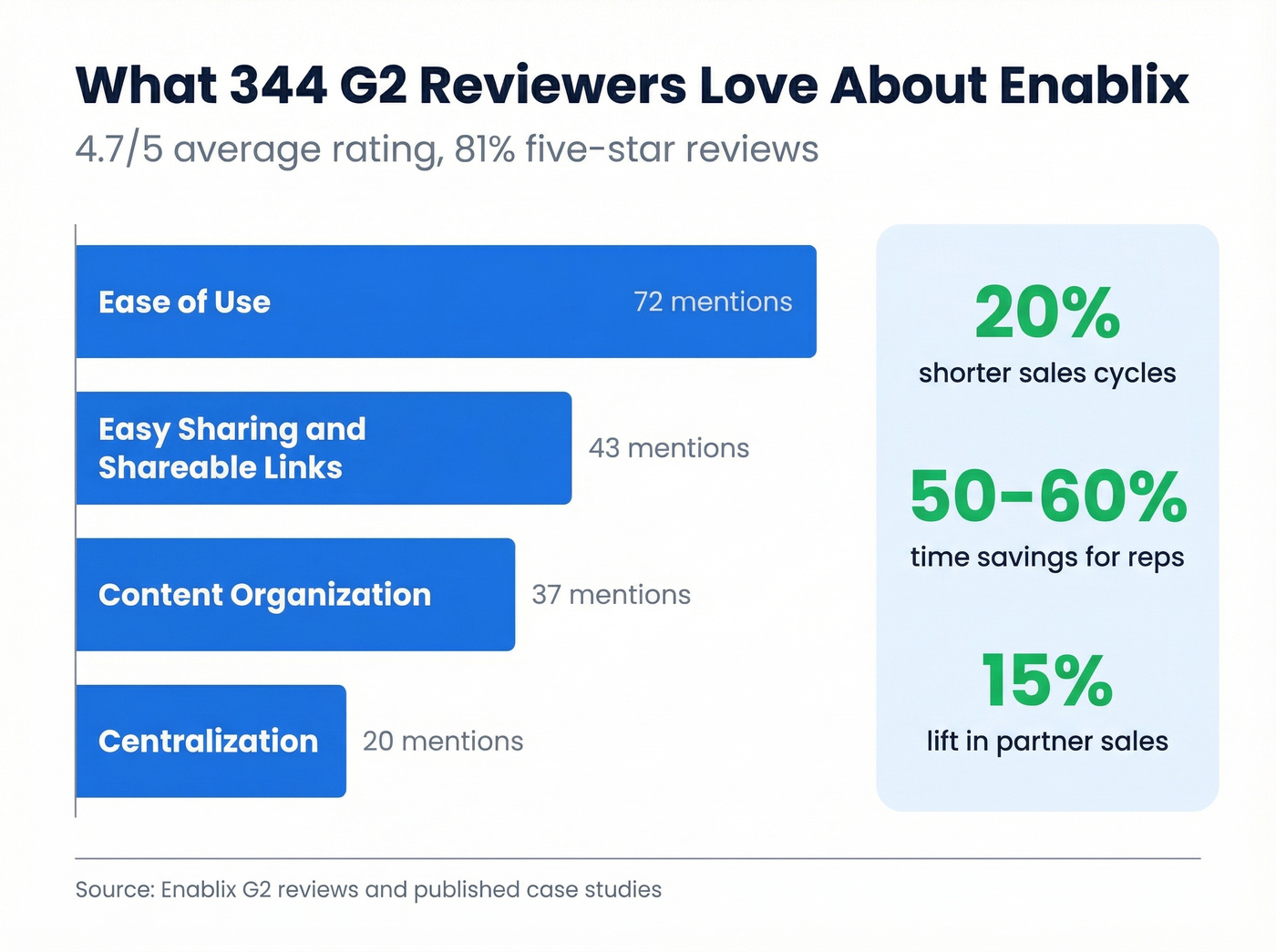
Ease of use (72 mentions) is Enablix's strongest signal by far. The UI is intuitive and there's no heavy admin overhead to get teams onboarded - multiple reviewers called out how quickly new reps got comfortable with the platform, which matters when you're trying to drive adoption across a sales org that's allergic to new tools.
Content organization (37 mentions) comes next. The central library with metadata, tagging, and version control solves the "which deck is current?" problem that plagues every growing sales team.
Easy sharing and shareable links (43 combined mentions) round out the top three. Reps package content into trackable links and deal rooms. Marketing finally sees what's getting opened and what's collecting dust.
Centralization (20 mentions) ties it together. One place for everything. No more hunting through Drive, SharePoint, and Slack threads.
The case study numbers back this up. Lightspeed DMS reported 20% shorter sales cycles and 50-60% time savings for reps after onboarding 500+ assets and getting fully integrated in under two weeks. Dejero saw a 15% lift in partner sales.

Enablix cuts sales cycles by 20% - but only if reps reach the right people. Prospeo delivers 98%-accurate emails refreshed every 7 days, so the content you package in deal rooms actually gets opened. At $0.01 per email, it costs less than a single bounced follow-up.
Stop building perfect deal rooms for contacts that don't exist.
Cons - Where It Falls Short
No tool is perfect. Here's what the review data actually says.
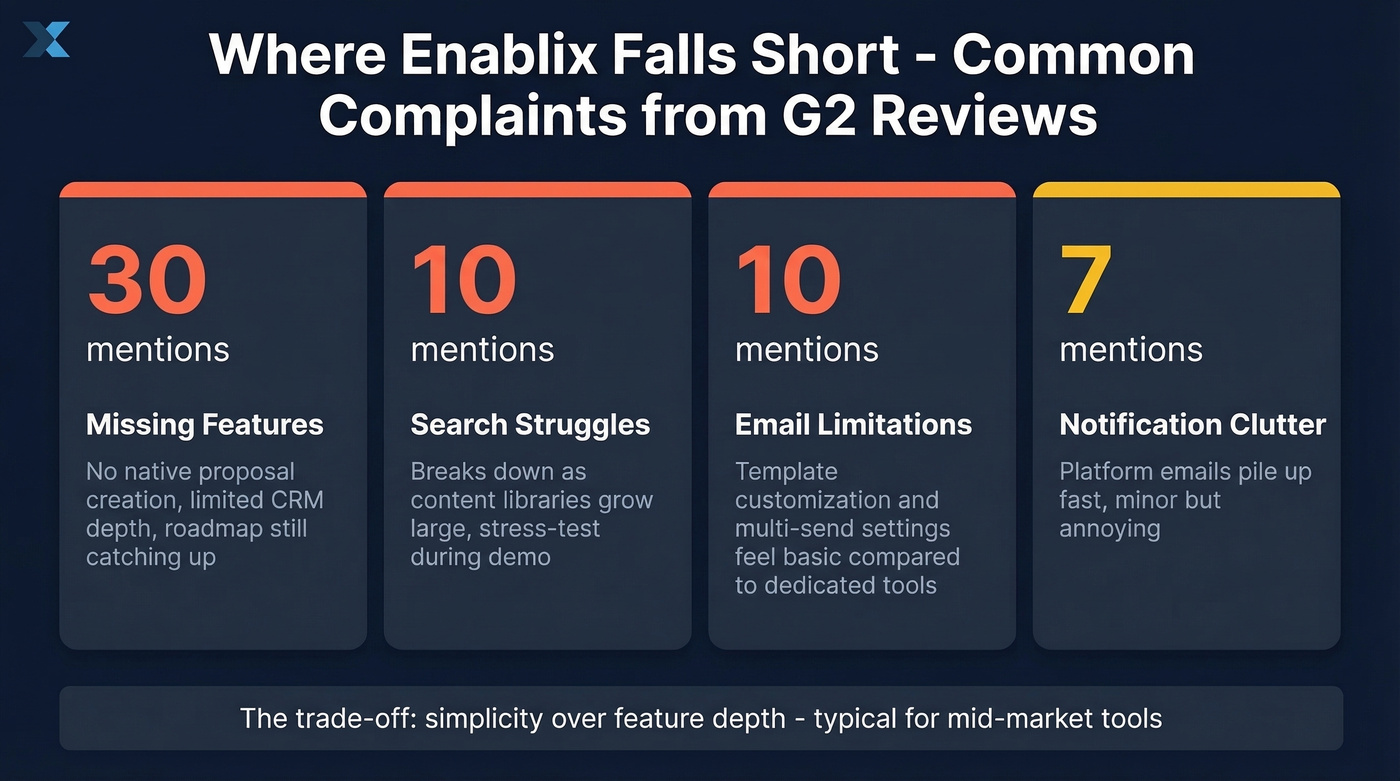
Search functionality (10 mentions) is a recurring complaint once content libraries grow large. If you're planning to house thousands of assets, stress-test search hard during the demo. This one's a real problem for teams scaling fast.
Missing features (30 combined mentions across two G2 buckets) show where the roadmap is still catching up. Users want native proposal creation and deeper CRM integrations. Not dealbreakers, but worth knowing before you sign an annual contract.
Email functionality (10 mentions) feels limited. Template customization and multi-send settings don't match what you'd get from a dedicated outreach tool. If email-heavy workflows are central to your enablement motion, you'll notice the constraints quickly.
Notification clutter (7 mentions) is minor but flagged by multiple reviewers - platform email notifications pile up fast.
These are mid-market tool trade-offs: simplicity over feature depth. Know what you're signing up for.
Who Should Buy Enablix
Use this if you're a mid-market team (50-1,000 employees) that needs content centralization and buyer engagement analytics without paying enterprise prices. Product marketers trying to align sales and marketing content will feel right at home. Teams already on Salesforce get the smoothest integration experience, and practitioners often cite buyer engagement signals and mutual action plans as the features that separate real enablement platforms from shared folders.
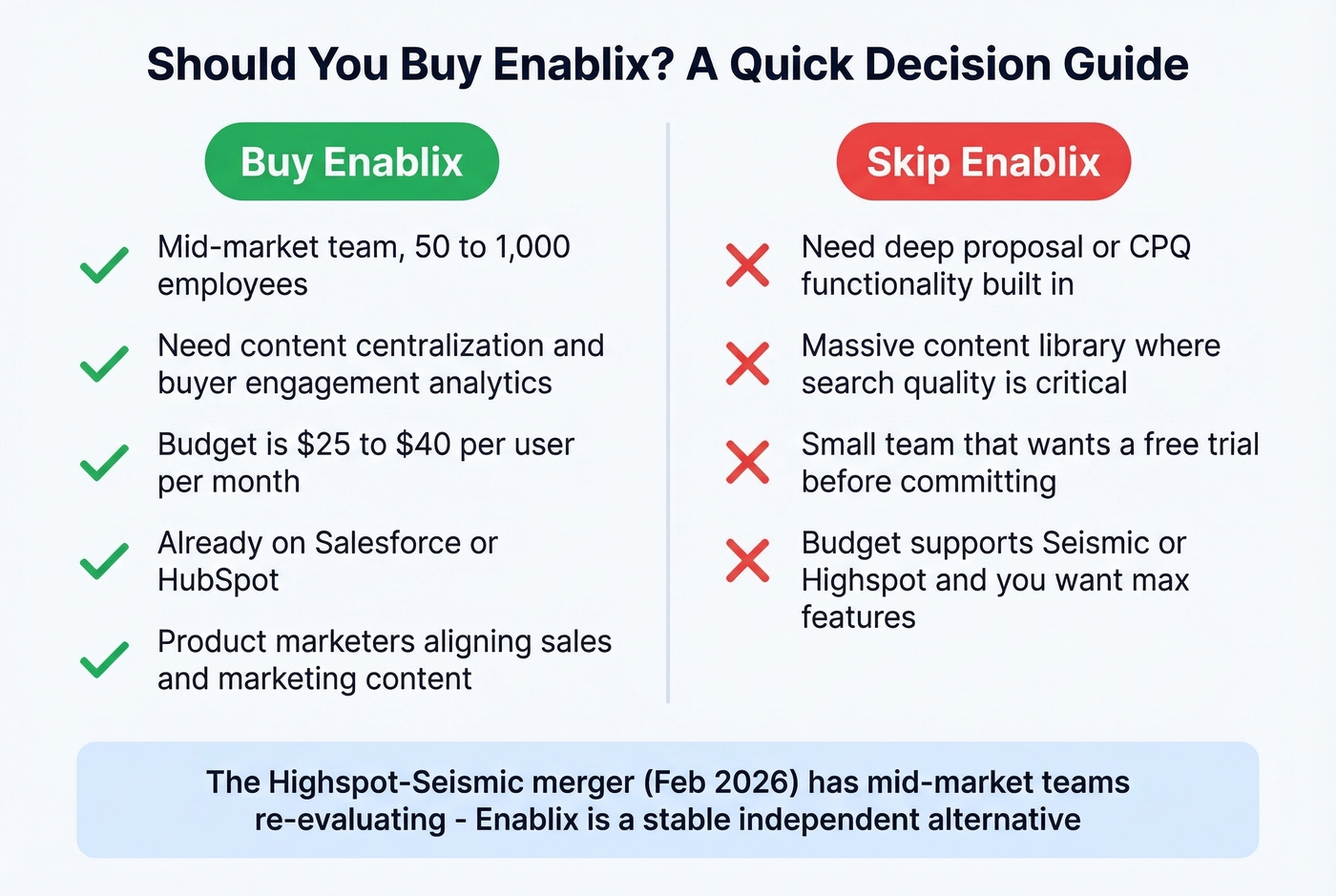
Skip this if:
- You need deep proposal or CPQ functionality baked in
- Your content library is massive and search quality is non-negotiable
- You're a small team that wants a free trial before committing
- Your budget comfortably supports Seismic or Highspot and you want maximum feature depth
The Highspot-Seismic merger announced February 12, 2026 has mid-market teams re-evaluating their options. Enablix is a stable, independent alternative while that integration plays out.
Here's the thing, though - most teams shopping for enablement platforms are solving the wrong problem first. The content isn't the bottleneck. It's the contact data feeding the outreach. If your CRM is full of stale emails, those beautifully packaged deal rooms go unseen. We've watched teams invest months building perfect content workflows only to realize their prospect data was garbage. Prospeo verifies emails at 98% accuracy on a 7-day refresh cycle, with a free tier and no contracts. Pair it with Enablix and your content actually reaches the people it's built for.

Verdict
Enablix belongs on every mid-market enablement shortlist alongside platforms like Showpad. Skip Seismic and Highspot unless your budget is built for enterprise pricing ($20K-$120K+/year) and you have the implementation bandwidth to match.
The pricing opacity is annoying - we shouldn't have to cross-reference three directories to find a number. But the market-reported cost ($25-$40/user/month) is reasonable for what you get: clean content management, trackable deal rooms, and solid buyer engagement analytics without the enterprise bloat.
We pulled pricing from multiple directories, read through hundreds of reviews, and weighed the pros and cons so you don't have to parse G2 widgets repackaged across a dozen sites. Now you know what it costs and whether to buy.
You're evaluating enablement tools to fix content chaos. Smart move. But 35% bounce rates will sabotage even the best-organized content library. Prospeo's 5-step email verification and 7-day refresh cycle keep your CRM clean - no annual contracts, no demo gates.
Fix your contact data before you fix your content workflow.
FAQ
Does Enablix offer a free trial?
No. Enablix provides tailored demos instead of a free trial or freemium plan. Contracts are annual with a platform fee plus per-user pricing starting at $25/user/month. Make the demo count - bring your actual content library and test search, sharing, and CRM sync before signing.
What integrations does Enablix support?
Enablix integrates with Google Workspace, HubSpot Marketing Hub, Loopio, Microsoft Copilot, Microsoft Outlook, Microsoft Teams, Salesforce Platform, Salesforce Sales Cloud, Snowflake, and Totango. Basic integrations are included in the platform fee. Specialized integrations carry additional implementation costs depending on scope.
Is Enablix good for small teams?
Enablix's sweet spot is mid-market (51-1,000 employees). Small teams under 50 will find the annual contract and lack of a free trial prohibitive. If you're in that range, consider Dock, which offers a free tier and scales from $350/month for up to five users.
How do I keep deal room contacts accurate?
Pair your enablement platform with a data provider that refreshes regularly. Prospeo's 7-day refresh cycle and 98% email accuracy ensure the contacts in your deal rooms and outreach sequences stay deliverable - the free tier includes 75 verified emails per month, enough to validate key accounts before scaling up.