


Forager Review (2026): The Addictive Indie That Got Abandoned
It's 2 AM. You just unlocked another island, your inventory is overflowing with gems you don't need yet, and you're telling yourself "one more upgrade." Then you look at the clock. Forager does this to people - it's a dopamine IV drip disguised as a pixel-art crafting game. But most Forager reviews floating around were written in 2019 or 2020, back when the game still had big promises hanging over it.
Here's what's actually left in 2026.
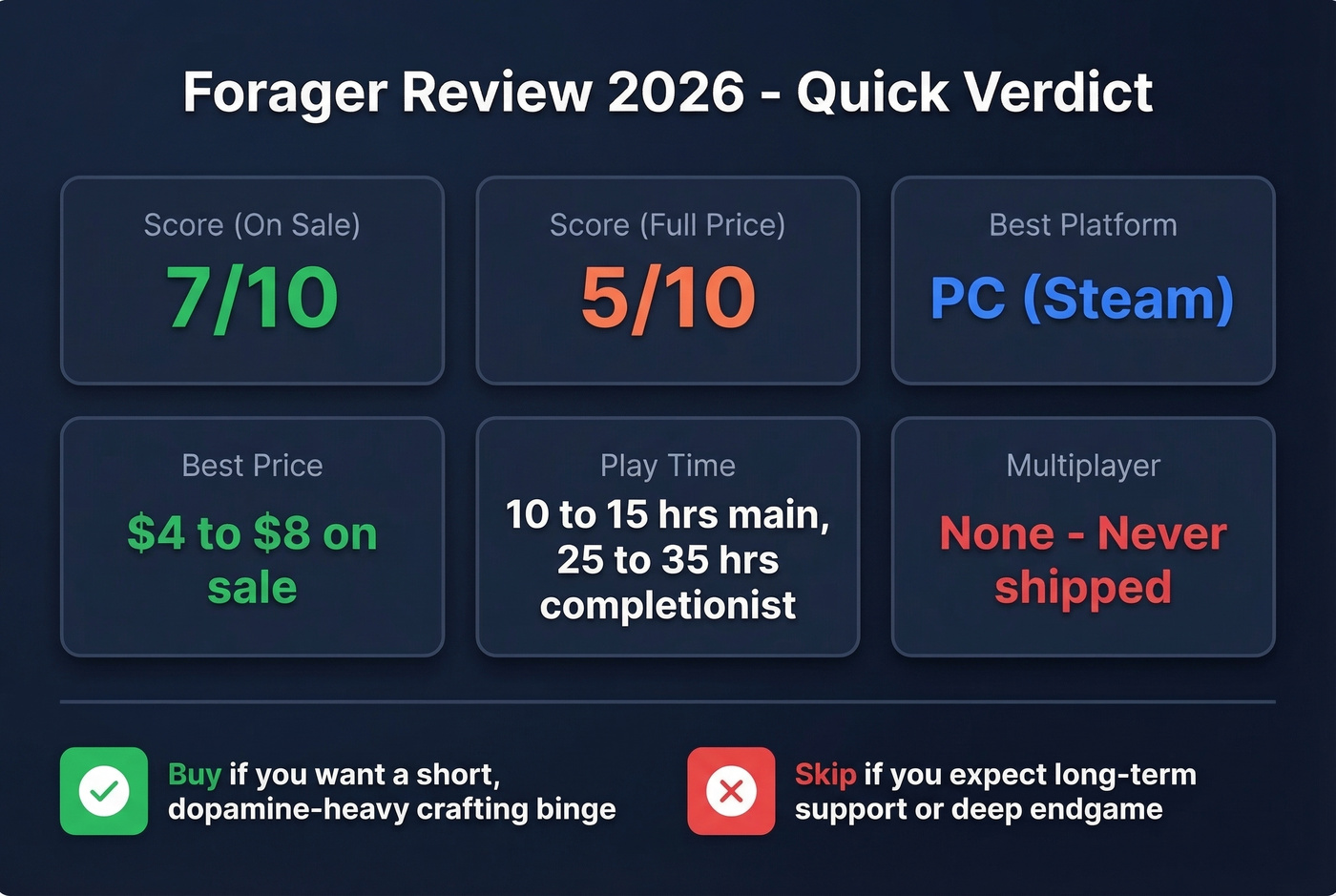
30-Second Verdict
- Score: 7/10 (at sale price) / 5/10 (at full price)
- One-line summary: Brilliantly addictive for 10 hours, then it falls apart - and support never materialized.
- Best platform: PC (Steam)
- Best price: Wait for a sale ($4-8)
- Play time: 10-15 hrs (main) / 25-35 hrs (completionist)
- Buy if: You want a short, dopamine-heavy crafting binge
- Skip if: You expect long-term support, multiplayer, or deep endgame
What Is Forager?
Forager is an incremental crafting game developed by HopFrog and published by Humble Games). It launched on PC in 2019 and is available on PC, PS4, and Nintendo Switch. Don't confuse it with an idle game - there's no offline progression here. You're actively gathering, crafting, and expanding every second you play.
The pitch is simple: you start on a tiny island, mine rocks, chop trees, and craft tools. As you level up, you buy additional islands with coins to expand your map and access new biomes, puzzles, and resources. Think Stardew Valley's crafting loop crossed with Cookie Clicker's "just one more" compulsion. It's a genre mashup that shouldn't work as well as it does - until it doesn't.
Gameplay - The First 10 Hours
We've put about 25 hours into Forager across PC and Switch, and the opening stretch is some of the most satisfying indie gaming we've experienced. You mine a rock, get gold and coal. You smelt the gold into bars. You craft the bars into a new pickaxe. The new pickaxe mines faster. You get more gold. You buy another island. The island has new enemies and dungeons. You clear the dungeon, get a rare item, unlock a new crafting tier. Every action feeds into the next without a single wasted click.
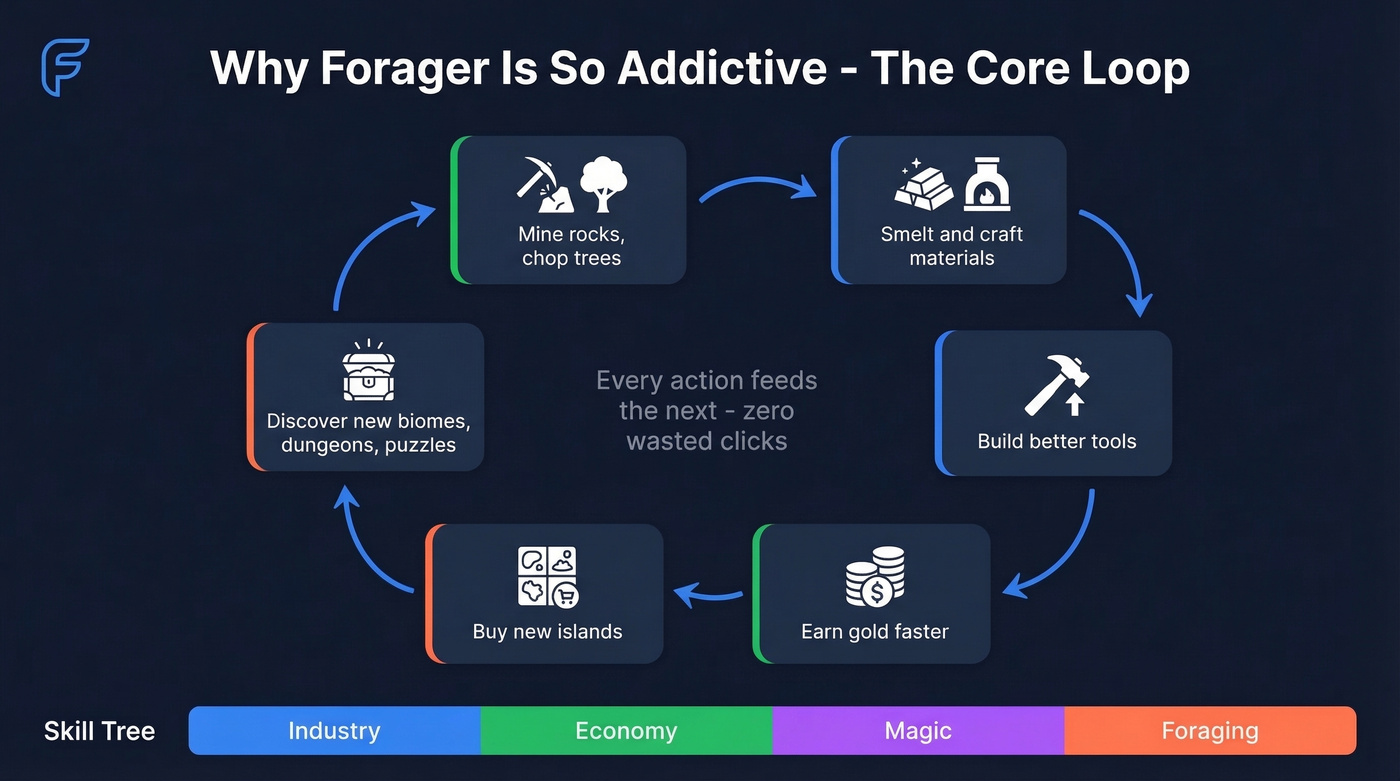
The skill tree branches into four paths - industry, economy, magic, and foraging - and each unlock feels meaningful. The mining rod passively collects resources. Banks generate coins. Droids automate gathering. Each skill point creates a small cascade of new possibilities that kept us glued to the screen for hours we didn't plan on spending.
Island purchasing is the other genius mechanic. Your map starts as a single tile surrounded by locked islands you can see but can't reach, and each island costs gold with prices that escalate fast. Buying one reveals what's on it - maybe a desert biome with new ores, maybe a graveyard with skeleton enemies, maybe a puzzle dungeon where you're converting binary to ASCII. That last one is a surprisingly brainy challenge in a game about hitting rocks.
The museum and bundle system gives completionists a reason to explore every corner. Forager's museum has 8 sections, and the game has 48 islands total to unlock.
Where It Falls Apart
Then you unlock the Market skill.
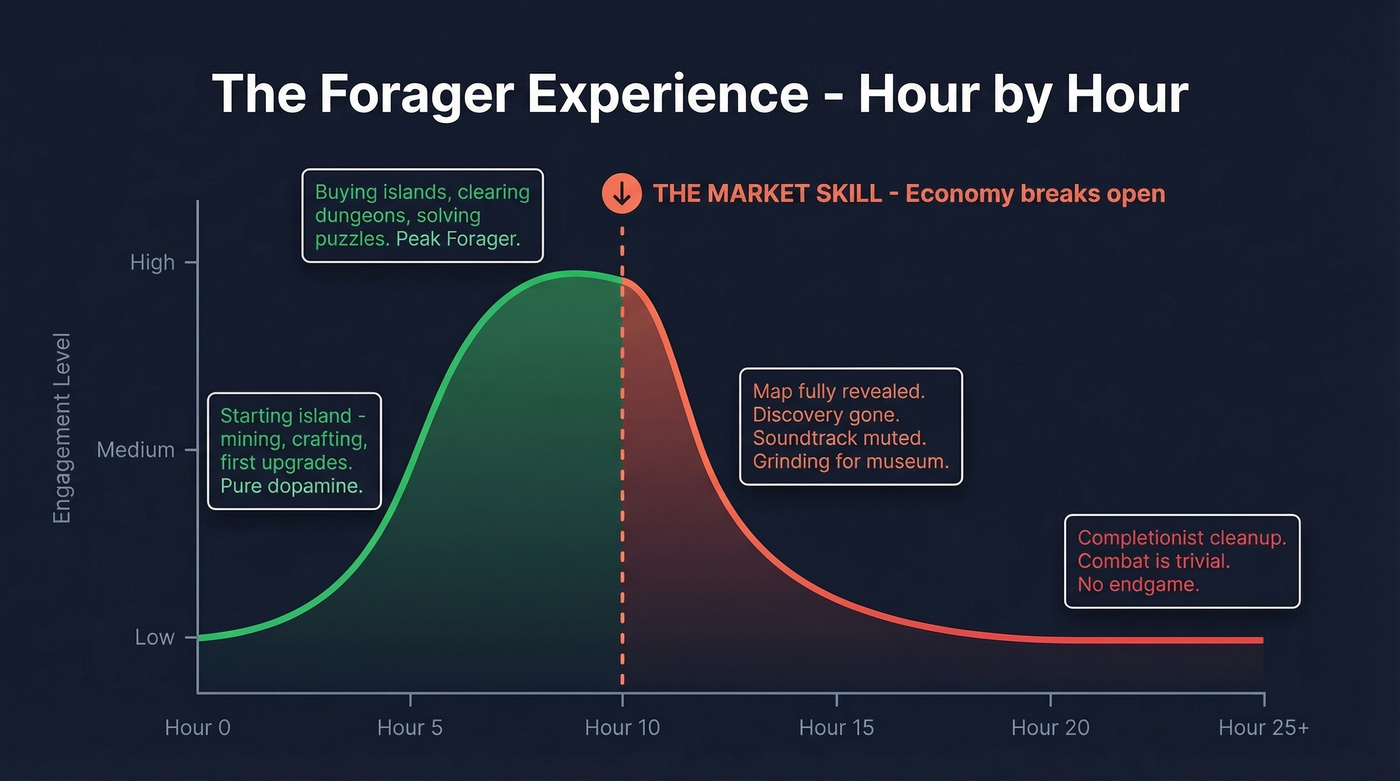
Around the 10-hour mark, the economy breaks wide open. The Market lets you sell items for enough money that you can unlock almost every island easily. The map is fully revealed. The sense of discovery - which was the game's primary motivator - evaporates, and what's left is a grind with no clear destination. You're collecting items for the museum, but the rewards feel incremental rather than exciting. Combat was never the point and it shows: it's shallow, repetitive, and becomes trivial once your weapon scaling takes over.
The sound design accelerates the fatigue. The soundtrack is pleasant for the first few hours, but it loops so aggressively that we ended up muting the game entirely by hour 12. And when you build noisy automation like fish traps, the repetitive sound effects get genuinely grating.

Forager's economy breaks after 10 hours. Your sales pipeline shouldn't. Prospeo gives you 300M+ profiles with 98% email accuracy on a 7-day refresh cycle - no abandoned roadmaps, no broken promises.
Stop grinding for leads. Get verified contacts at $0.01 each.
Is Forager Abandoned?
Yes. Let's be honest about this.
Multiplayer was talked about heavily during the game's rise, and it never arrived. Today, the game is single-player only - no co-op, no online play, nothing. The r/Forager subreddit has largely moved on, with occasional posts from new players discovering the game on sale and asking the same question: "Is this still getting updates?" The answer is no.
If you're coming in during 2026 expecting a living roadmap and ongoing support, don't.
Platform Comparison
Not all versions are created equal. The platform you choose matters more than usual because you're buying the game as-is, bugs and all.
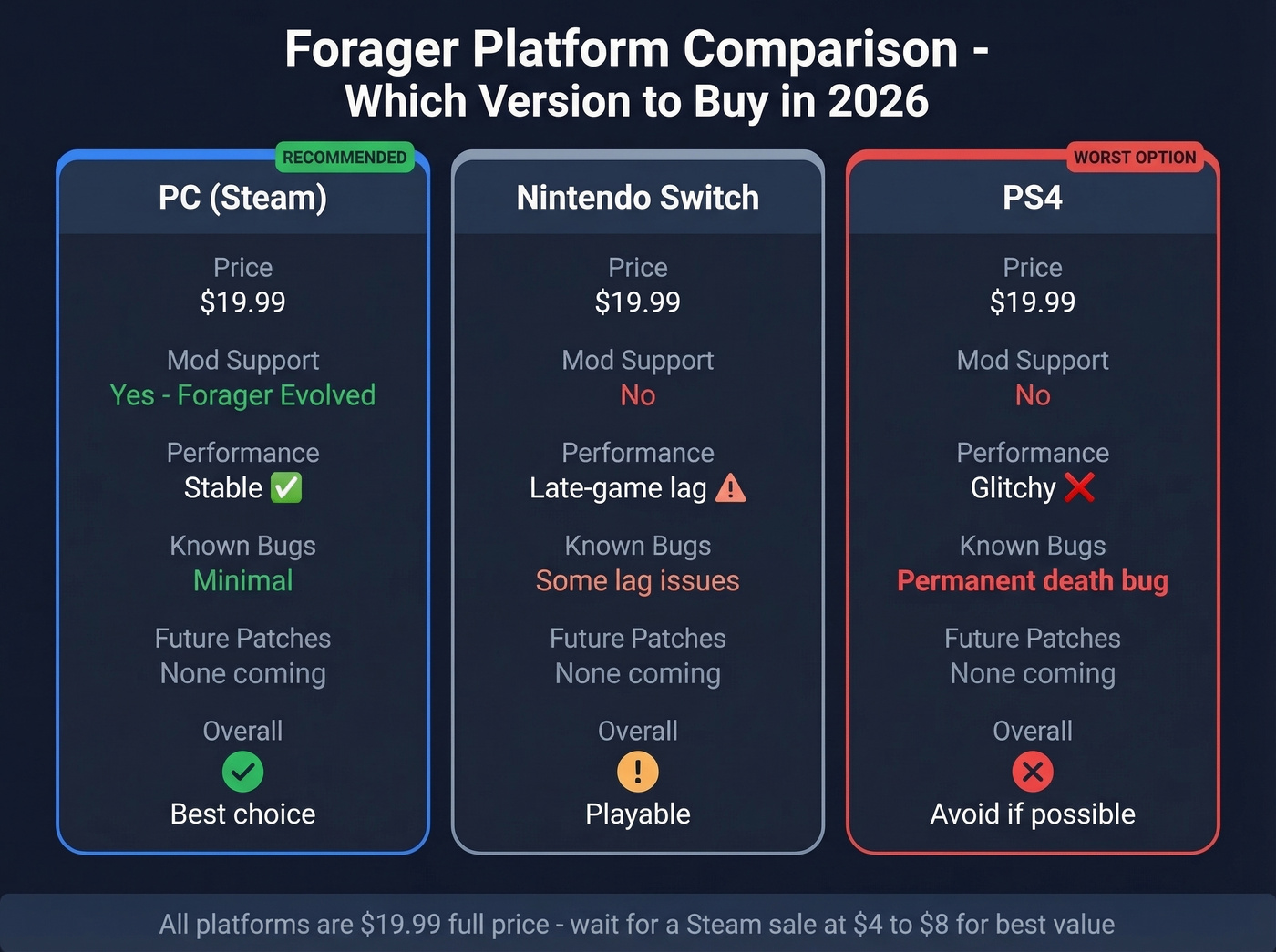
| Platform | Full Price | Notes | Mod Support |
|---|---|---|---|
| PC (Steam) | $19.99 | Best choice if you want mods | Yes (Forager Evolved) |
| Switch | $19.99 | Can run into late-game lag | No |
| PS4 | $19.99 | More glitches than Switch; includes a bug that can make dying permanent | No |
PC is the clear winner. The community-made Forager Evolved mod adds extra content and quality-of-life improvements that the developer never shipped. Console players are out of luck - no mods, no patches, no fixes coming.
Is It Worth Buying in 2026?
This is entirely price-dependent. At $4-8 on a sale, you're paying roughly 50 cents per hour of genuinely fun gameplay. That's excellent value for a crafting binge, even knowing the endgame falls off a cliff.
Skip it at the $19.99 full price. In 2026, too many games in this genre offer more content, better endgames, and active developer support for the same money or less.
Here's the thing: Forager is actually a better game because no one's updating it anymore. You know exactly what you're getting. There's no live-service treadmill, no battle pass, no FOMO. It's a fixed experience - a 10-hour crafting binge with a clear beginning and a messy end. HowLongToBeat pegs the main story at about 11 hours, which tracks with our experience.
What you see is what you get. If you can accept that and find it cheap, the first 10-15 hours are genuinely some of the most addictive indie gaming you'll find.
Better Alternatives in 2026
If the loop appeals to you but the lack of long-term support doesn't, these games deliver more staying power.
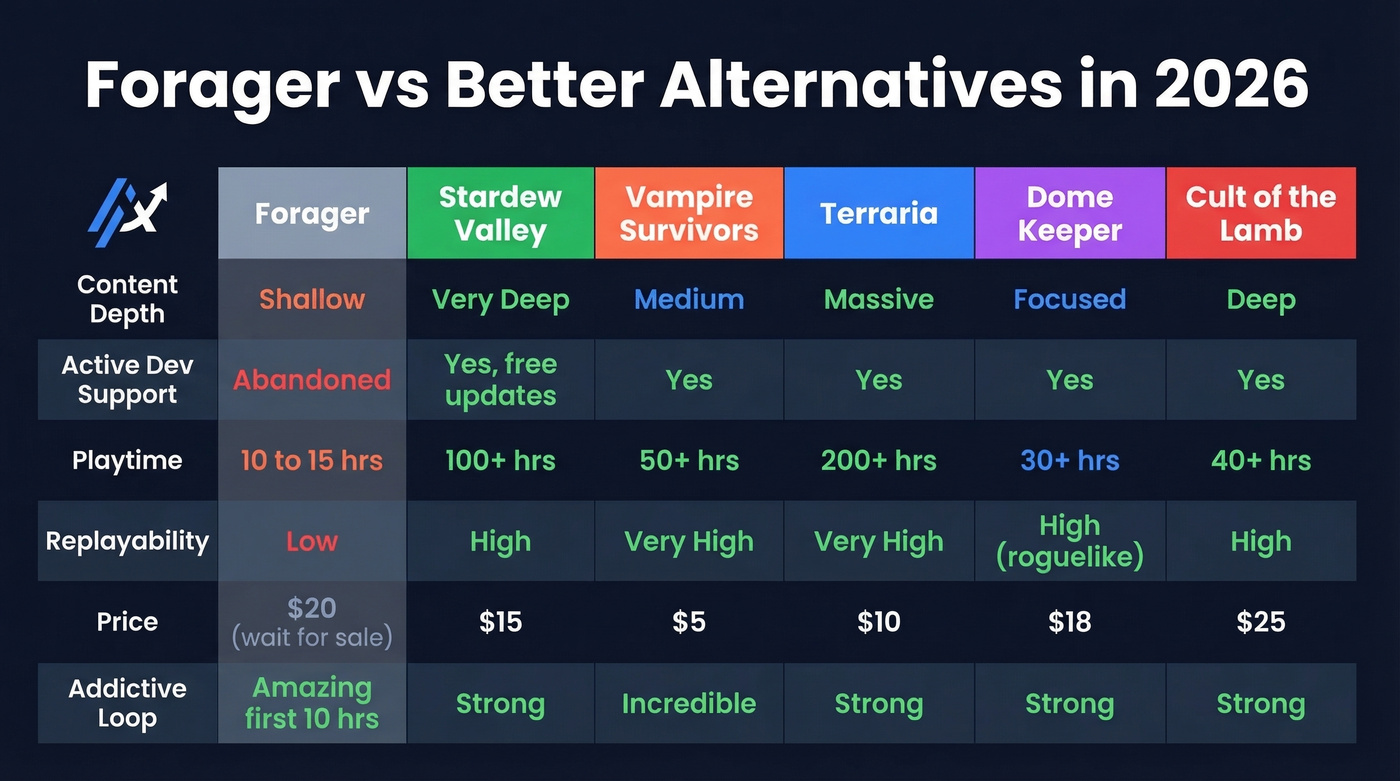
Stardew Valley is the gold standard. Deeper story, richer systems, and a solo developer who's still shipping free content updates years later. This is what Forager promised but never delivered.
Vampire Survivors flips the script - it's not a crafting game at all, but if you're chasing the dopamine-hit addiction specifically, nothing matches its "just one more run" pull. Better long-term value and active updates.
Terraria dwarfs Forager in every dimension. Hundreds of hours of content, an active modding community, and a developer who treated post-launch support as a mission rather than an afterthought. Pick this if you want exploration and crafting at a scale Forager can't touch.
Dome Keeper strips the formula down to mining and resource management with a roguelike structure that adds the replayability Forager never had. Tighter, more focused, deeply satisfying.
Cult of the Lamb pairs base-building with an action-roguelike that has more personality than most AAA games. The island-expansion loop is here, but with actual combat depth backing it up.
FAQ
Does Forager have multiplayer?
No. It's single-player only - multiplayer was promised during development but never shipped. Don't buy it expecting co-op or online play.
Is Forager worth $20 in 2026?
At full price, no. Wait for a Steam sale where it drops to $4-8. At that price you're paying about 50 cents per hour of genuinely addictive gameplay, which is solid value for a short crafting binge.
Are there mods for Forager?
Yes, but only on PC. The community-made Forager Evolved mod adds extra content and quality-of-life improvements. Console versions on Switch and PS4 have no mod support.
What games are similar to Forager?
Stardew Valley, Terraria, Dome Keeper, and Vampire Survivors all scratch a similar itch with significantly more long-term content. Cult of the Lamb is another strong pick if you want base-building paired with action-roguelike combat.
Unlike Forager, Prospeo actually ships what it promises - 143M+ verified emails, 125M+ mobile numbers, and 30+ search filters that never stop getting updates. No stale data, no dead ends.
Find decision-makers faster than you unlock islands in Forager.