

How to Generate Real Estate Leads: The 2026 Playbook
You're 60 days in. Your sphere is tapped. Your broker keeps saying "just call your database," but your database is 47 people - half of whom are family members who rent. You need two closings in the next 90 days, and the internet keeps telling you to "post more on social." That's not a lead strategy. That's a content calendar masquerading as a business plan.
Here's the part that gets buried in every 43-tactic listicle: most agents don't have a lead problem. They have a follow-up problem. Agents collect tactics like baseball cards - 43 ideas with zero systems - and then wonder why nothing converts. This playbook is different. Pick two channels, install a conversion machine, and track five numbers. That's it.
The System on an Index Card
The entire approach fits on an index card:
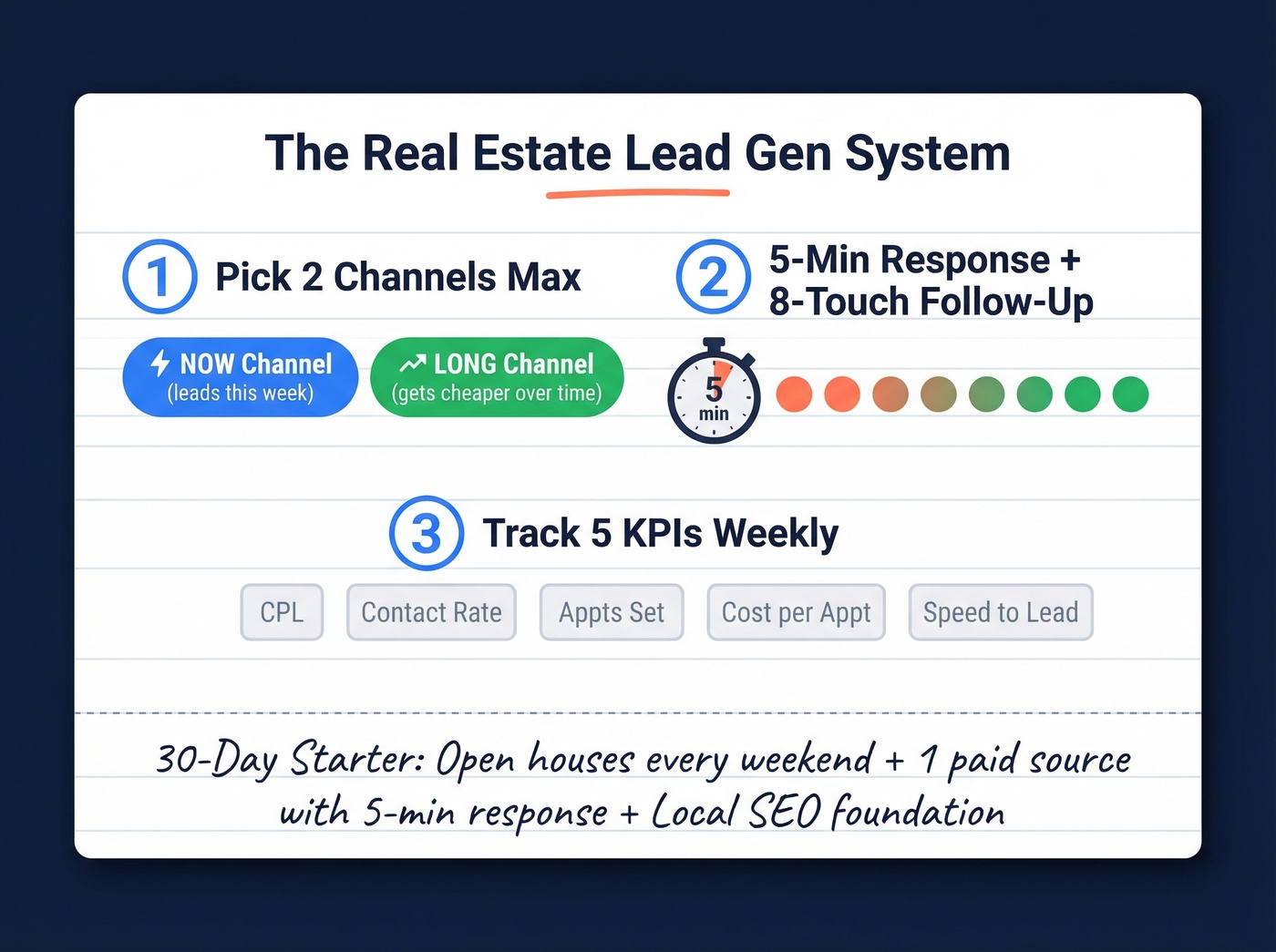
- Pick 2 channels max - one "now" channel that produces leads this week, one that gets cheaper over time.
- Install a 5-minute response + 8-touch follow-up system. This is where 80% of agents lose.
- Track 5 KPIs weekly: CPL, contact rate, appointments set, cost per appointment, speed-to-lead.
Your 30-day starter plan looks like this: open houses every weekend with neighbor outreach at each one, one paid lead source (portal or social ads) with a 5-minute response commitment and an 8x8 follow-up cadence, and a local SEO foundation where you optimize your Google Business Profile, generate reviews, and publish three neighborhood pages.
The long-game channel - SEO - delivers 1,389% ROI over time. But it takes 6-12 months to kick in. That's why you run paid alongside it from day one.
Benchmarks That Set Expectations
Before you spend a dollar, know what "normal" looks like. These numbers come from First Page Sage's real estate marketing benchmarks and Ampifire's CPL analysis:
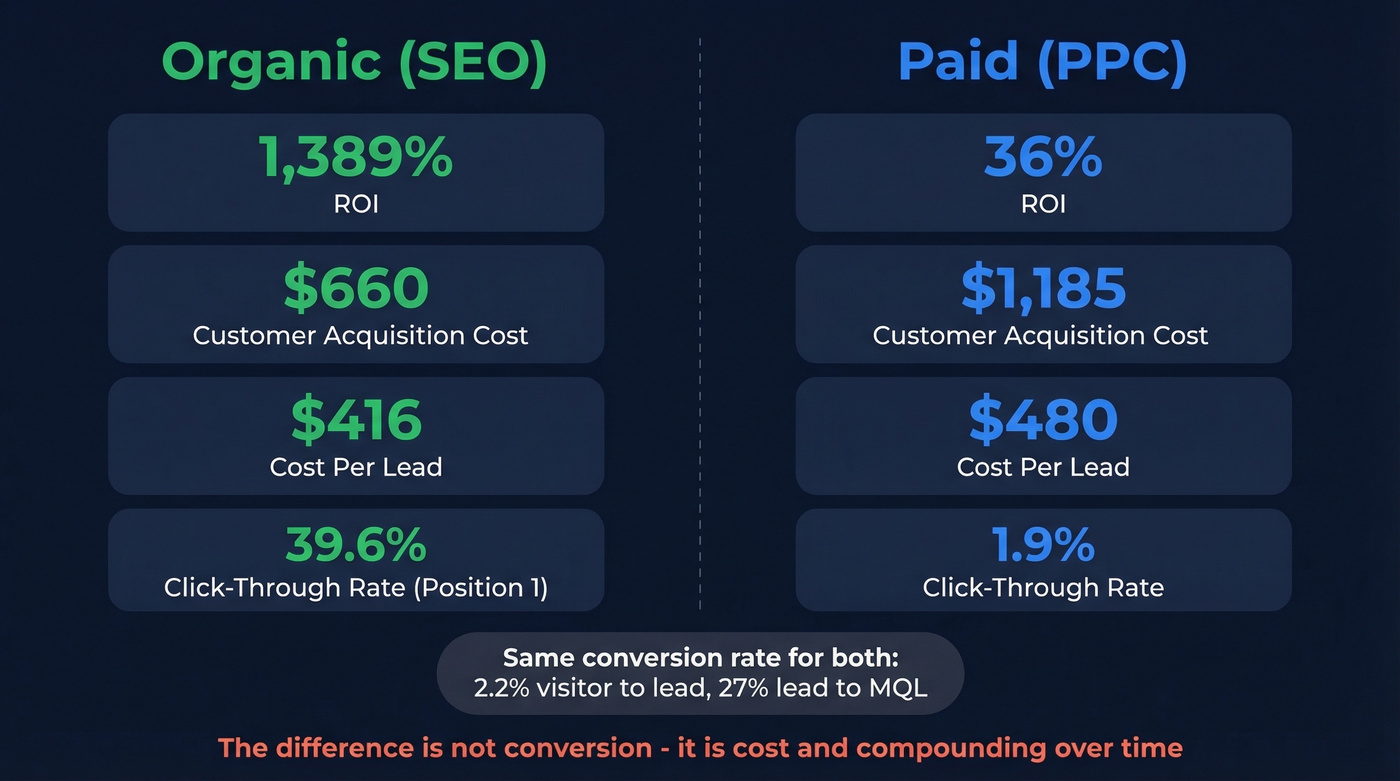
| Metric | Organic | Paid |
|---|---|---|
| ROI | 1,389% (SEO) | 36% (PPC) |
| CAC | $660 | $1,185 |
| CPL | $416 | $480 |
| CTR | 39.6% (position #1) | 1.9% |
| Visitor to Lead | 2.2% | 2.2% |
| Lead to MQL | 27% | 27% |
Conversion rates are similar across channels - the difference shows up in cost and compounding behavior. Social media marketing delivers 182% ROI and webinars hit 430% ROI according to the same benchmarks. Webinars are underused in real estate, and agents who run monthly "first-time buyer Q&A" sessions on Zoom are quietly building pipelines their competitors don't see.
Here's what you'll actually pay per lead by platform:
| Platform | CPL Range |
|---|---|
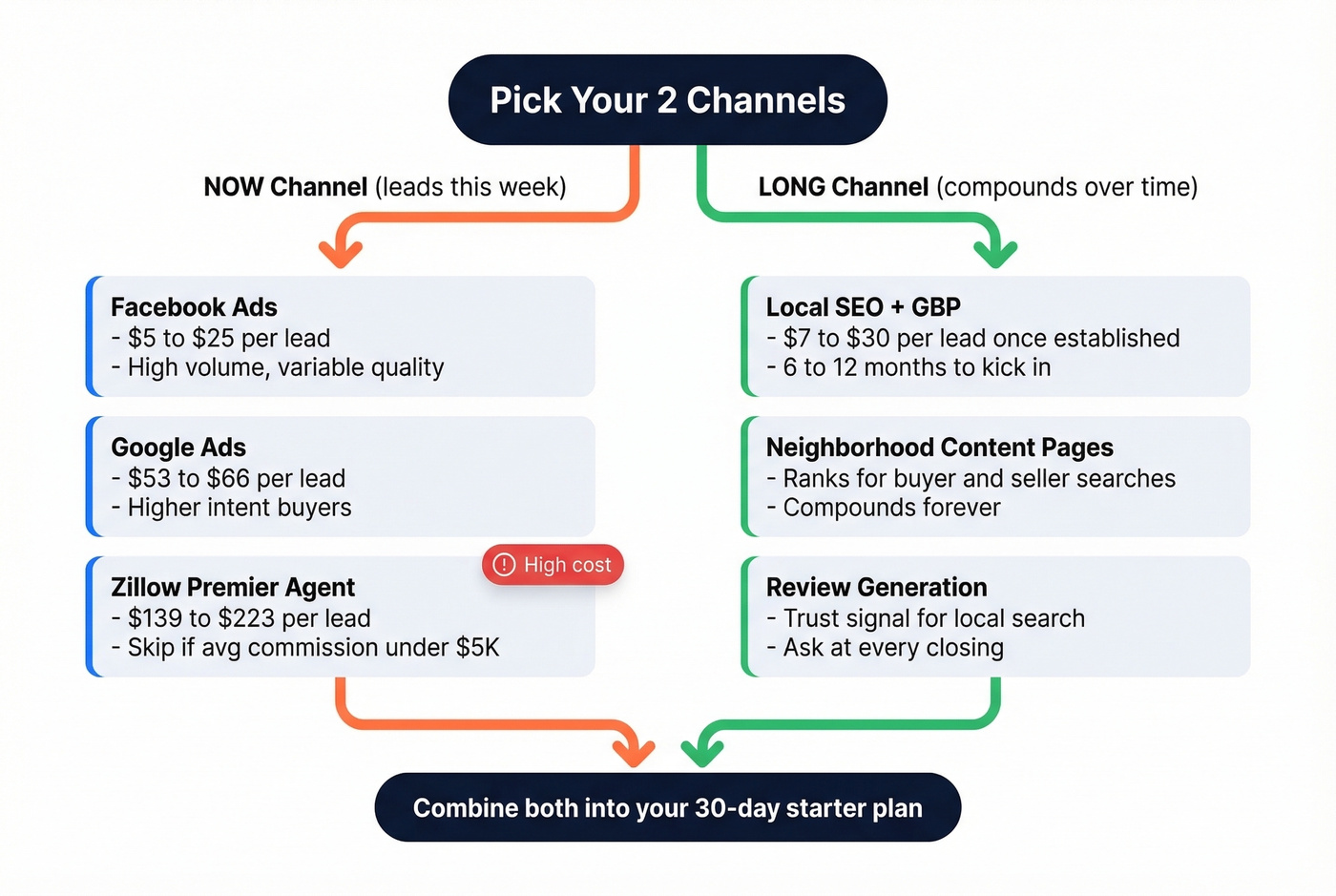
| Facebook Ads | $5-$25 |
| Google Ads | $53-$66 |
| Content Marketing | $7-$30 (once established) |
| Buyer Leads (avg) | $9-$20 |
| Seller Leads (avg) | $26-$30+ |
| Competitive Markets | $200-$350 |
The takeaway isn't that organic is "better." It's that organic gets dramatically cheaper over time while paid stays in roughly the same band unless you improve conversion rates. A content marketing CPL starts around $80-$90 and drops to $7-$30 once you've built a library. Google Ads will cost you $53-$66 per lead when you start, and you keep paying in that range unless you improve the funnel. Run both, but know which one compounds.
Channel Playbooks That Actually Work
Local SEO + Content + Reviews
This is your long-game channel. It won't save you this month, but six months from now it'll be your cheapest lead source by a wide margin.
Start with three moves. First, optimize your Google Business Profile - complete every field, add photos weekly, and respond to every review within 24 hours. Organic position #1 captures 39.6% of clicks versus just 1.9% for PPC ads. Your GBP listing is one of the fastest paths to earning that top spot for local searches.
Second, publish neighborhood pages. Not "about me" pages - actual neighborhood guides with school data, market stats, walkability scores, and recent sales. One page per neighborhood you farm. These rank for "[neighborhood] homes for sale" and "[neighborhood] real estate agent" queries that buyers and sellers actually type. YouTube walkthroughs of neighborhoods and listings also rank in Google's video carousel and compound over time.
Third, generate reviews systematically. Ask every client at closing. Send a follow-up text with a direct link three days later. Reviews are a major trust signal for local search, and most agents leave them to chance. The agents who dominate local SEO treat review generation like a weekly task, not an afterthought.
Paid Ads + Portals
Paid is your speed lever. It's not the efficiency play - organic wins there long-term - but it puts leads in your CRM this week.
Google Ads runs $53-$66 per lead for real estate. Facebook is cheaper at $5-$25, but lead quality varies more. The real question for most agents isn't Google vs. Facebook - it's whether to run ads yourself or buy portal leads.
Zillow Premier Agent operates on a share-of-voice model: you buy a percentage of impressions in specific ZIP codes, with a $50 minimum per ZIP. Average cost per lead runs about $181 overall - $223 in major metros, $139 in smaller markets.
| Zillow Lead Type | What It Means |
|---|---|
| Direct | Buyer contacts you directly |
| Connections | Pre-vetted by Zillow rep |
| Nurture | Assigned via share of voice |
Here's the thing about Zillow: lead quality is mixed. Some are serious buyers. Some are already working with another agent. Some filled out a form six months ago and forgot about it. Which brings us to the part everyone skips.
If your average commission is under $5,000, skip Zillow entirely. The math doesn't work at low price points. Put that money into open houses and local SEO instead.
Open Houses, Partnerships, Community
Open houses remain one of the highest-ROI face-to-face lead channels in real estate. Not because of the buyers who walk through - though some will become clients - but because of the neighbors. Every open house is a farming event disguised as a showing. Knock on 20 doors before each one. Invite neighbors to "preview before it hits the market." Collect contact info at the door.
The second offline lever is referral partnerships, and this is where most agents leave massive opportunity on the table. Lenders, builders, HR and relocation contacts, property managers, attorneys, CPAs - these people talk to your future clients before you do. Hospital and corporate HR departments are especially underused: they handle relocating employees who need agents but often lack formal relocation services.
The Seller Lead Playbook
Every new agent article focuses on buyer leads. But listings are the business. One listing generates buyer leads, builds your brand, and compounds your sphere.
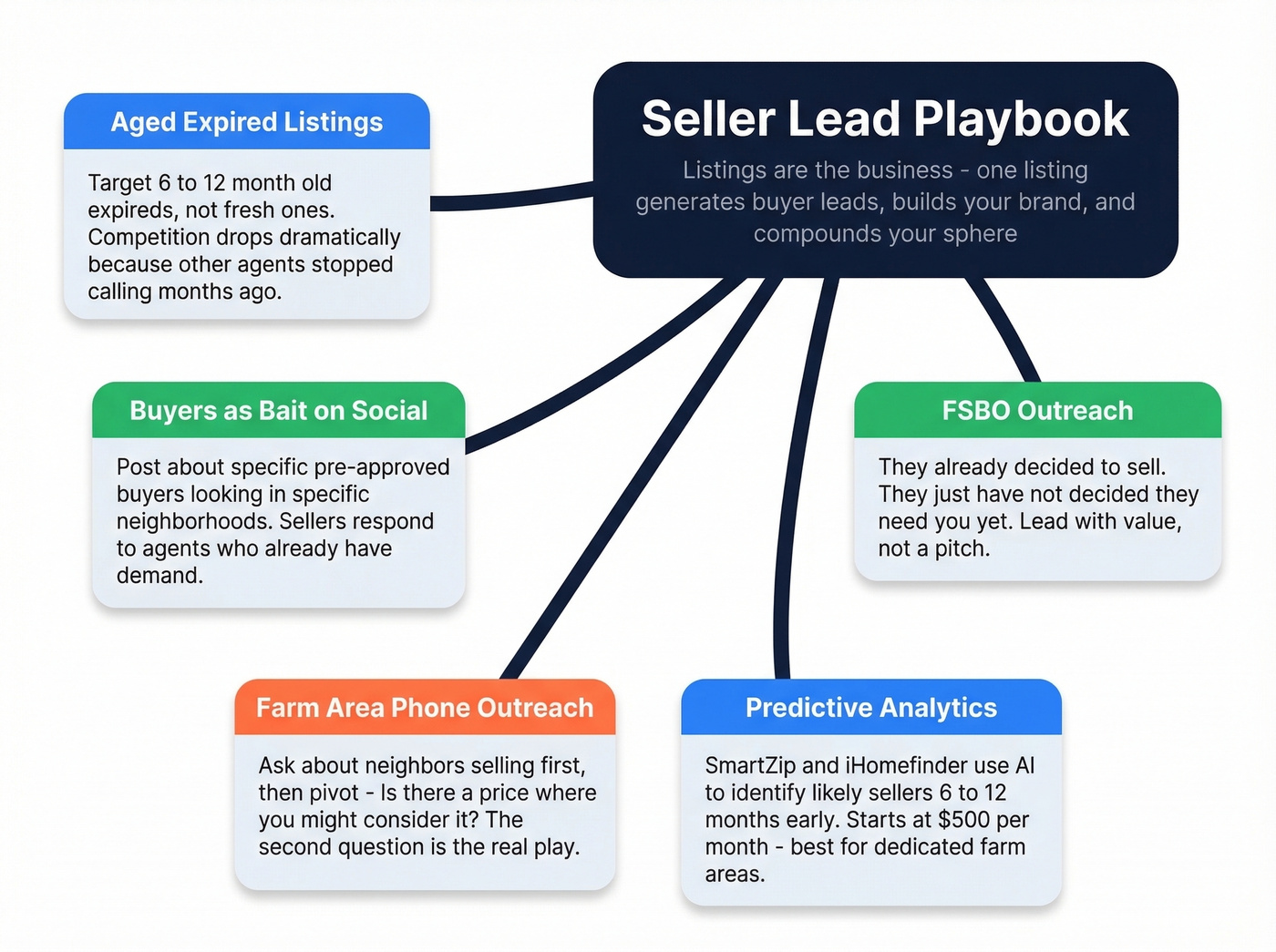
Expired listings are a rising opportunity as markets normalize. The standard play - calling newly expired listings - works, but you're competing with 30 other agents who all called the same morning. The tactical twist from Inman: target 6-12-month-old expireds. These homeowners still want to sell. They've just stopped hearing from agents. Competition drops dramatically.
Use the "buyers as bait" approach on social media. Post something like:
"I have two pre-approved buyers looking for a 4-bed in [school district]. They've lost out on three offers. If you know anyone thinking about selling - even off-market - DM me. My buyers are motivated and flexible on timeline."
This works because it's specific, it's urgent, and it positions you as someone with active demand. Sellers respond to agents who have buyers, not agents who want listings.
For phone outreach, try this soft-close script when calling homeowners in your farm area:
"Have you heard of any neighbors thinking about selling? ... By the way, is there a price where you might consider it?"
That second question is the real play. It opens a conversation without the pressure of a listing pitch.
Predictive analytics tools like SmartZip and iHomefinder use AI to identify homeowners likely to sell 6-12 months in advance. SmartZip starts from $500/mo with an annual contract - not cheap, but if you're farming a specific area, the targeting precision can justify the spend. FSBO outreach rounds out the seller strategy: these homeowners have already decided to sell, they just haven't decided they need you yet.

Your referral partner outreach is only as good as your contact data. Prospeo gives you verified emails for lenders, builders, HR directors, and CPAs - the people who talk to your future clients first. 98% email accuracy means your outreach actually lands.
Stop guessing at email addresses. Start closing referral partners.
The Follow-Up System
Let's be honest: lead platforms love to talk about volume. They don't talk about what happens after the form fill. This is where the money is made or burned - and it's the single biggest factor separating agents who close from agents who churn through platforms blaming "bad leads."
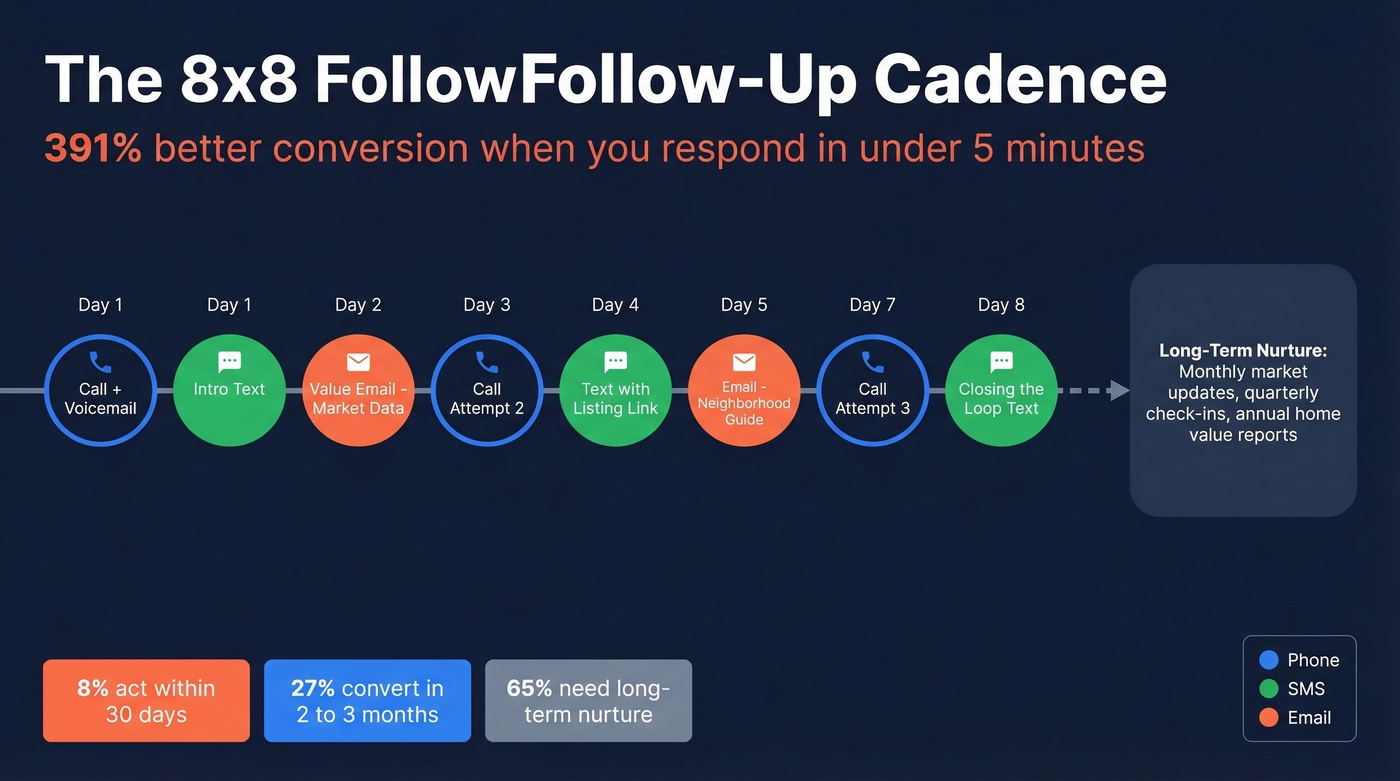
The data is unambiguous. Responding within 5 minutes improves conversion by 391%. That gap is so large that everything else you optimize is a rounding error by comparison. And 50% of sales happen after the 5th contact, which means most agents quit right before the lead would've converted.
Here's the 8x8 cadence we recommend:
| Day | Action | Channel |
|---|---|---|
| Day 1 | Call + voicemail | Phone |
| Day 1 | Intro text | SMS |
| Day 2 | Value email (market data) | |
| Day 3 | Call attempt #2 | Phone |
| Day 4 | Text with listing link | SMS |
| Day 5 | Email (neighborhood guide) | |
| Day 7 | Call attempt #3 | Phone |
| Day 8 | "Closing the loop" text | SMS |
Eight touches. Eight days. After that, move the lead into a long-term nurture track - monthly market updates, quarterly check-ins, annual home value reports.
We've seen agents go from zero closings to two in 90 days just by installing this cadence before buying a single additional lead. The leads were already there. The system wasn't.
Only 8% of leads act within 30 days. Another 27% convert within 2-3 months. The remaining 65% need longer-term nurture. Portal leads convert at roughly 0.5%-2%, driven heavily by speed-to-lead and follow-up consistency. At a 1% conversion rate, you need about 100 leads per closing. The math only works if you actually work the leads.
AI and Automation
You don't need a 14-tool tech stack. Start with two workflows: automated lead capture and automated follow-up triggers.
Connect your lead sources to a CRM that fires an instant notification when a new lead comes in. Set up automated text and email sequences for the first 8 days - your 8x8 cadence - and sync everything with your calendar so hot leads get booked directly into showing or consultation slots. Define simple lead scoring: did they view a listing? Request a showing? Open three emails? Route hot leads to your phone immediately, and let everything else drip through the sequence.
Then build a 14-day nurture track for leads that don't respond to the initial cadence. This is the bridge between "didn't answer my 8 touches" and "long-term monthly drip." It keeps you top-of-mind during the window when most agents have already given up.
Track five metrics weekly: CPL, speed-to-lead, contact rate, appointments set, and cost per appointment.
The tools that handle this well without enterprise complexity:
- Jotform AI Agents - free plan available, Bronze at $39/mo. Good for lead capture forms with built-in AI qualification.
- BatchLeads - $119/mo (Growth plan). Combines property data with skip tracing and outreach.
- Lindy - free tier with 400 credits/mo, Pro at $49.99/mo. AI assistant that can automate follow-up sequences.
The agent who calls in 4 minutes with a warm voice will always beat the agent who sends a perfect AI-generated email in 30 minutes. Use AI to make sure you never miss the 4-minute window - not to replace the conversation.
Mistakes That Kill Your Pipeline
Five patterns we see repeatedly in agents who can't get traction:
Relying on one lead source. Zillow dries up, your business dries up. Always run at least two channels.
No defined target audience. "Everyone who wants to buy or sell" isn't a target market. Pick a neighborhood, a price range, a buyer type. Farm it.
Responding hours after the form fill. Five minutes versus five hours isn't a small difference - it's the difference between a conversation and a voicemail nobody returns. The consensus on r/realtors is brutal about this: agents who complain about "bad portal leads" almost always admit they didn't call back for hours or days.
Inconsistent online presence. Posting for two weeks, then ghosting for a month, then posting again. Algorithms and prospects both punish inconsistency.
Ignoring reviews and local SEO. UnrealCRM's research flags this as one of the most common blind spots. Agents spend $500/mo on ads while sitting on a Google Business Profile with two reviews and no photos. That's like buying a billboard and leaving your phone off.
Lead-Gen Platform Pricing
Before you sign anything, know what you're getting into. Contract traps are real - Market Leader requires a six-month minimum, SmartZip locks you into an annual contract.
| Platform | Starting Price | Notes |
|---|---|---|
| REDX | $60/mo | Expired/FSBO data |
| Market Leader | $189/mo | 6-month minimum |
| Zillow Premier Agent | $50/ZIP min | Share-of-voice model |
| Ylopo | $395/mo | IDX + ads |
| Real Geeks | $399/mo | Website + CRM |
| SmartZip | $500/mo | Annual contract |
| CINC | $899/mo | Full platform |
| Sold.com | $0 | Referral-based |
Market Leader also offers a Teams plan at $329/mo plus per-user charges, and a Network Boost add-on at $300/mo for 30 guaranteed leads.
Source: HousingWire's 2026 lead-gen company roundup.
Buying leads from any of these platforms without a follow-up system installed is lighting money on fire. The platform doesn't close the deal. Your 8x8 cadence does.
FAQ
How many leads do I need to close one deal?
Portal leads convert at roughly 0.5%-2%, so at a 1% rate you need about 100 leads per closing. Speed-to-lead and nurture quality are the biggest levers - agents who respond in under 5 minutes and run a full 8-touch cadence convert at the higher end of that range.
How long before lead-gen efforts pay off?
Paid channels produce leads within days of launching. Organic efforts - SEO, content, reviews - typically compound over 6-12 months before delivering consistent inbound leads. Run both simultaneously so you're not starving while the long-game engine builds.
How can I find leads without a big budget?
Start with free and low-cost channels: open houses every weekend with neighbor door-knocking, a fully optimized Google Business Profile, and systematic review collection. These three activities alone can produce prospects before you spend a dollar on ads. Add $300-$500/month on one paid source once your follow-up system is in place.
What's the most important KPI to track?
Speed-to-lead - the time from form fill to first contact. Responding within 5 minutes versus 30 minutes improves conversion by 391%. Every other metric improves when this one is fast.
How do I find referral partners for real estate leads?
Define your ideal partner profile by role, location, and firm size - think lenders, divorce attorneys, CPAs, and corporate HR managers. Then use a B2B data tool like Prospeo to pull verified emails and phone numbers so your outreach actually reaches decision-makers, not generic info@ addresses. A single strong referral partner can send you two to three warm leads per quarter.
Remember that agent from the opening - 60 days in, 47 contacts, zero closings? Here's what their week looks like with this system installed: two channels running (open houses on weekends, one paid source feeding the CRM), an 8x8 cadence firing automatically on every new lead, five numbers on a dashboard reviewed every Monday morning. They're not scrambling for tactics. They're working a machine. Learning how to generate real estate leads consistently isn't about collecting more ideas - it's about running a system. Two closings in 90 days isn't a fantasy. It's what happens when you stop hoarding tactics and start executing one.
Expired listing outreach fails when you're working bad phone numbers. Prospeo's 125M+ verified mobile numbers with a 30% pickup rate connect you directly to homeowners - not voicemail boxes. At $0.01 per email, it costs less than a single Zillow lead to build an entire farming list.
One Zillow lead costs $181. That's 18,100 verified emails on Prospeo.