

Nooks vs Orum: Which Parallel Dialer Is Worth the Money?
You're comparing Nooks vs Orum because someone just dropped a renewal quote on your desk - $25,000 for five seats on a parallel dialer your reps use as a glorified speed-dial button. The CFO wants to know why connect rates are worse than last quarter. Meanwhile, SDR managers on Reddit are posting horror stories about spam-flagged numbers and contracts they can't escape.
Let's cut through the noise.
30-Second Verdict
Pick Nooks if you want coaching tools, a virtual salesfloor, and the stronger user track record (4.8 vs 4.6 across 1,167 reviews). Pick Orum if you only care about raw dial volume and want a lower entry price - $9K/year vs $25K/year. Skip both if your contact data is unreliable. A parallel dialer amplifies whatever you feed it, and bad numbers mean burned caller IDs and wasted budget.
Feature Comparison
On paper, these two are closer than you'd expect. Both support up to five parallel lines on their core tiers (Nooks AI Dialer and Orum Launch), plus virtual salesfloor workflow and dialer basics - voicemail drop, call workflows, and integrations into the systems your team already uses. The real separation shows up in coaching, analytics, and category breadth.
Nooks leans harder into the coaching layer: AI battle cards, live listen for managers, AI scorecards, and training bots. In head-to-head G2 ratings, Nooks edges Orum on every sub-metric, though the gaps are narrow. Nooks also appears in additional G2 categories like Conversation Intelligence, Sales Coaching, and Lead Intelligence, while Orum shows up more narrowly as a dialer.
Orum counters with its "Hot Numbers" feature and publishes performance benchmarks - a 5.3% connect rate overall and up to 30% on numbers flagged as hot. On the spam-prevention side, Orum gives each rep 10 numbers to rotate, with nightly spam monitoring and Grade A caller IDs. Nooks is built on Twilio for local presence dialing, which means your number strategy and number costs matter more than you'd think.
| Feature | Nooks | Orum (Launch) | Orum (Ascend) |
|---|---|---|---|
| Rating | 4.8/5 (1,167 reviews) | 4.6/5 (781 reviews) | - |
| Parallel Lines | Up to 5 | Up to 5 | Up to 10 |
| Virtual Salesfloor | Yes | Yes | Yes |
| AI Coaching / Battle Cards | Yes | Limited | Limited |
| Live Listen | Yes | No | No |
| Voicemail Drop | Yes | Yes | Yes |
| International Dialing | No | No | Yes |
| CRM Integrations | Varies by plan | Salesforce, HubSpot, Outreach, Apollo, Gong, Salesloft | Same |
| User Rating Metric | Nooks | Orum |
|---|---|---|
| Meets Requirements | 9.4 | 9.1 |
| Ease of Use | 9.3 | 9.2 |
| Ease of Setup | 9.4 | 9.2 |
| Ease of Admin | 9.0 | 8.9 |
| Quality of Support | 9.4 | 9.3 |
| Product Direction | 9.8 | 9.7 |
What Each Actually Costs
Neither tool offers monthly billing. Both lock you into annual contracts.
| Nooks | Orum Launch | Orum Ascend | |
|---|---|---|---|
| Per-User Cost | $4K-$5K/year | $250/mo ($3K/year) | $500-$800/mo |
| Minimum Seats | 5 | 3 | Custom |
| Min. Annual Spend | ~$25,000 | ~$9,000 | Custom (enterprise) |
| Billing | Annual only | Annual only | Annual only |
| Hidden Costs | Twilio numbers $10-$15/mo each | Implementation $1K-$5K+ | - |
At roughly $40K-$50K/year for 10 seats on Nooks, you're paying what a junior SDR costs in salary alone - just for the dialer. Orum Launch is cheaper at $30K for ten reps, but Ascend's 10 parallel lines and international dialing push the bill into enterprise territory fast.
The Nooks hidden cost matters. Twilio phone numbers for local presence dialing run $10-$15/number/month. Add one extra number per rep for a 10-rep team and that's another $1,200-$1,800/year on top.

You're about to spend $25K+ on a parallel dialer. Before you do, ask: how many of those numbers are actually live? Prospeo's 125M+ verified mobile numbers refresh every 7 days and deliver a 30% pickup rate - while the industry average sits around 3-8% connect rates on stale data. At ~$0.01/lead with no annual contract, fixing your data costs less than one month of Nooks.
Fix the inputs before you upgrade the dialer.
What Real Users Say
Reddit sentiment on both tools is rough. Not "minor complaints" rough - "questioning the entire category" rough.
One SDR manager posted their team's weekly numbers with Orum: 1,800 calls, 8 conversations, 1 meeting. That's a 0.44% connect rate across a 3-rep team. Another user described Orum as something that "worked about 80% of the time."
Nooks catches similar heat. A frustrated buyer on r/sales reported that "all of our numbers are spam," connect rates had plummeted, and they were stuck in a second year of contract with no exit. The consensus on r/sales threads is that parallel dialers are only as good as the data you feed them - and most teams don't feed them well.
The spam problem isn't unique to either tool. CIDR's Phone Reputation Statistics Report found that 50% of all call flags originated from consumers marking calls as spam through blocking apps. Industry connect rates for cold outbound sit around 3-8%, and the 1-3 second lag inherent in parallel dialing doesn't help. Some analysts argue parallel dialing is entering the same decline cycle as mass email - gold rush, saturation, crash.
We've watched teams pour $50K+ into dialers only to realize the bottleneck was never dial speed. It was data.
The Upstream Data Problem
Here's the thing: both Nooks and Orum are execution tools. They dial faster. They don't fix what you're dialing.
If 30-40% of your phone numbers are wrong, disconnected, or recycled, you're burning hundreds per user per month dialing dead lines and training carrier algorithms to flag you as spam. We've seen this pattern play out dozens of times - a team buys a shiny parallel dialer, feeds it a stale list from their CRM, and then blames the tool when connect rates crater. The tool isn't the problem. The inputs are.
Prospeo's mobile database covers 125M+ verified numbers with a 30% pickup rate, and emails verify at 98% accuracy on a 7-day refresh cycle. Self-serve, no contracts, roughly $0.01/lead. One customer, Meritt, tripled pipeline from $100K to $300K/week and cut bounce rates from 35% to under 4% after switching their data source.
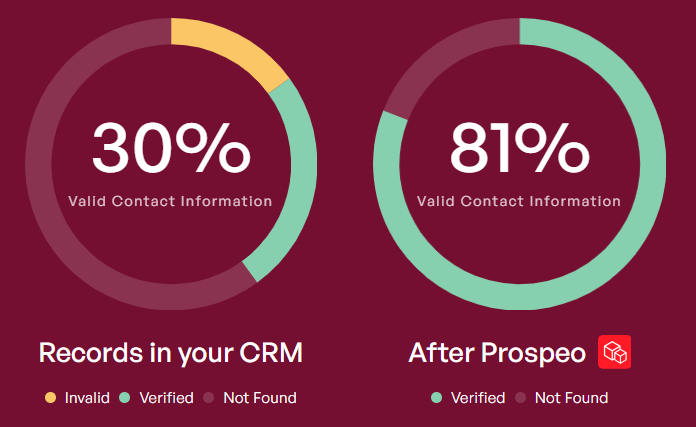
The best parallel dialer in the world can't save a campaign built on stale data. Fix the inputs first.
Meritt tripled pipeline from $100K to $300K/week and cut bounce rates from 35% to under 4% - not by switching dialers, but by switching data sources. Whether you pick Nooks or Orum, 98% email accuracy and 125M+ verified mobiles on a 7-day refresh cycle mean your reps actually reach humans instead of training spam filters.
Stop paying $25K/year to dial disconnected numbers.
The Verdict
Choose Nooks if you're a coaching-heavy org with 5+ reps, budget for $25K+/year, and managers who'll actually use live listen and AI scorecards. The salesfloor culture features justify the premium.
Choose Orum if you're running a pure cold-calling operation, want the lowest entry point ($9K/year), and don't need advanced coaching. Launch gets the job done for smaller teams.
Skip both if your phone data is unverified. No dialer fixes bad numbers. Verify your data first, then pick your dialer. Whichever side of the Nooks vs Orum debate you land on, you'll save more money cleaning your inputs than you'll ever save switching between platforms.
FAQ
How much do Nooks and Orum cost per year?
Nooks runs $4,000-$5,000/user/year with a 5-seat minimum - roughly $25,000/year at the floor. Orum Launch costs $250/user/month with a 3-seat minimum, so $9,000/year minimum. Neither offers monthly billing.
Can I try either dialer before committing?
Both offer demos and short trials, but production contracts are annual with no monthly escape hatch. Demand a 90-day pilot with a written exit clause before signing. We've seen too many teams locked into second-year renewals on tools they've stopped using.
How do I improve connect rates with a parallel dialer?
Verify your phone numbers before they hit the dialer. Clean, verified mobiles produce conversations; stale data produces spam flags. A verified mobile database with a 30% pickup rate will do more for your connect rates than adding parallel lines ever will.
Is there a cheaper alternative to both platforms?
For teams with deal sizes under $20K, a single-line power dialer like PhoneBurner or Kixie at $50-$150/user/month paired with verified mobile data often outperforms a parallel dialer on unverified lists. The math favors data quality over dial speed at lower price points.