


OpenWeb Ninja Pricing, Reviews, and Honest Pros & Cons (2026)
You'd think a company with 30+ APIs would have one pricing page. OpenWeb Ninja doesn't. Pricing is scattered across individual API pages, through RapidAPI, and marketplace profiles - and none of them agree on the exact numbers. We built the consolidated breakdown so you don't have to piece it together yourself.
The 30-Second Verdict
OpenWeb Ninja is the best-value web data API for developers and small teams who need diverse public data across SERP, e-commerce, jobs, and maps without enterprise pricing. On the $25/mo tier (10,000 calls on the Walmart API), that's 10x the volume SerpApi offers at the same price point - 1,000 searches on SerpApi Starter - though the data types differ.
What Is OpenWeb Ninja?
OpenWeb Ninja is a real-time public data API stack with 30+ APIs spanning Google SERP, Maps, e-commerce (Amazon, Walmart), jobs, finance, transportation, and AI-related endpoints. The platform serves 50K+ subscribers and processes over 1T monthly requests, with results typically returned within 1-2 seconds. It's available directly through the company's website and through RapidAPI, with support via email, live chat, and Discord.
Think of it as a managed API layer for structured public web data. It handles the parsing, rotation, and retries so you don't have to.
Pricing Breakdown
There's no consolidated pricing page. Each API has its own tier structure, and while most follow a similar pattern, the specifics vary. Here's the representative breakdown based on the Real-Time Walmart Data API, which mirrors the common tier ladder across many endpoints.
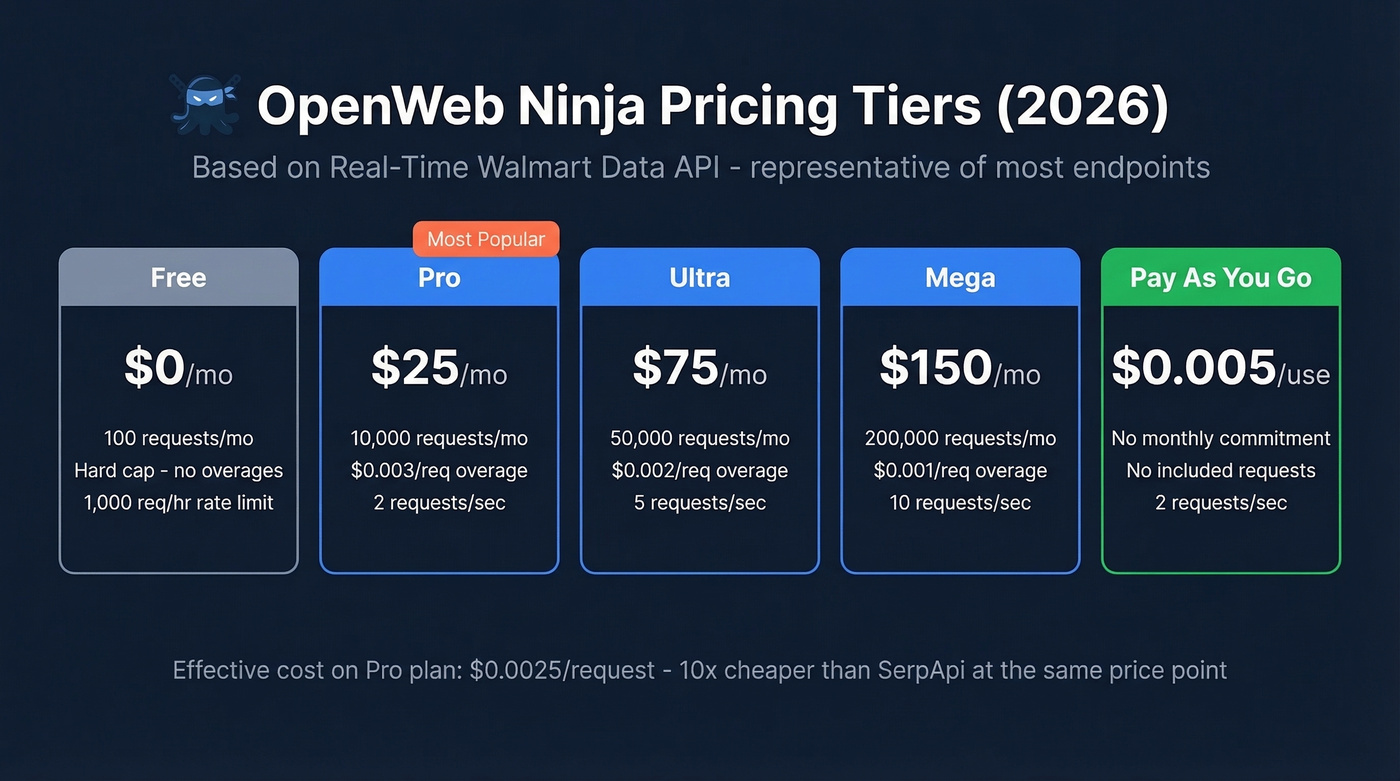
| Plan | Price | Requests/Mo | Overage | Rate Limit |
|---|---|---|---|---|
| Free | $0 | 100 | Hard cap | 1,000/hr |
| Pro | $25/mo | 10,000 | $0.003/req | 2 rps |
| Ultra | $75/mo | 50,000 | $0.002/req | 5 rps |
| Mega | $150/mo | 200,000 | $0.001/req | 10 rps |
| PAYG | $0.005/use | - | - | 2 rps |
The per-API pricing typically follows this Free - $25 - $75 - $150 ladder, with a PAYG option, but rate limits and per-use pricing can vary by endpoint.
Some endpoints also show lower unit pricing on marketplaces. The Amazon data offering on Datarade starts at $2.50 per 1,000 API calls, for instance. On the high end, Datarade lists APIs and datasets ranging up to $1,000 per one-off purchase.
Why the Overage Model Matters
On the Walmart API tiers, you aren't hard-capped at your tier limit (the Free plan excepted). Instead, you pay a declining per-request overage rate as your tier goes up. At Mega, overages cost $0.001 per request - a penny per ten calls.
For teams with variable volume, this is far more forgiving than competitors that cut you off or force an upgrade.
Here's the thing: on the Pro plan, the included 10,000 calls for $25 works out to $0.0025 per request before overages. That's dramatically cheaper than running equivalent "go browse the web and extract it" workflows through premium LLM browsing setups when what you actually need is structured results.

Structured web data is great for price tracking and SERP monitoring. But if your pipeline needs verified B2B contact data - emails and direct dials for decision-makers - that's a different tool entirely. Prospeo delivers 98% email accuracy and 125M+ verified mobile numbers at $0.01/email, with a 7-day data refresh cycle.
Stop scraping for contacts. Start with data that's already verified.
Reviews: What Users Actually Say
What works well
Speed and reliability. G2 reviews highlight low latency with snippets like "really fast" and "works as expected, low latency." Datarade's profile lists 99.95% uptime and 100M+ requests per day.
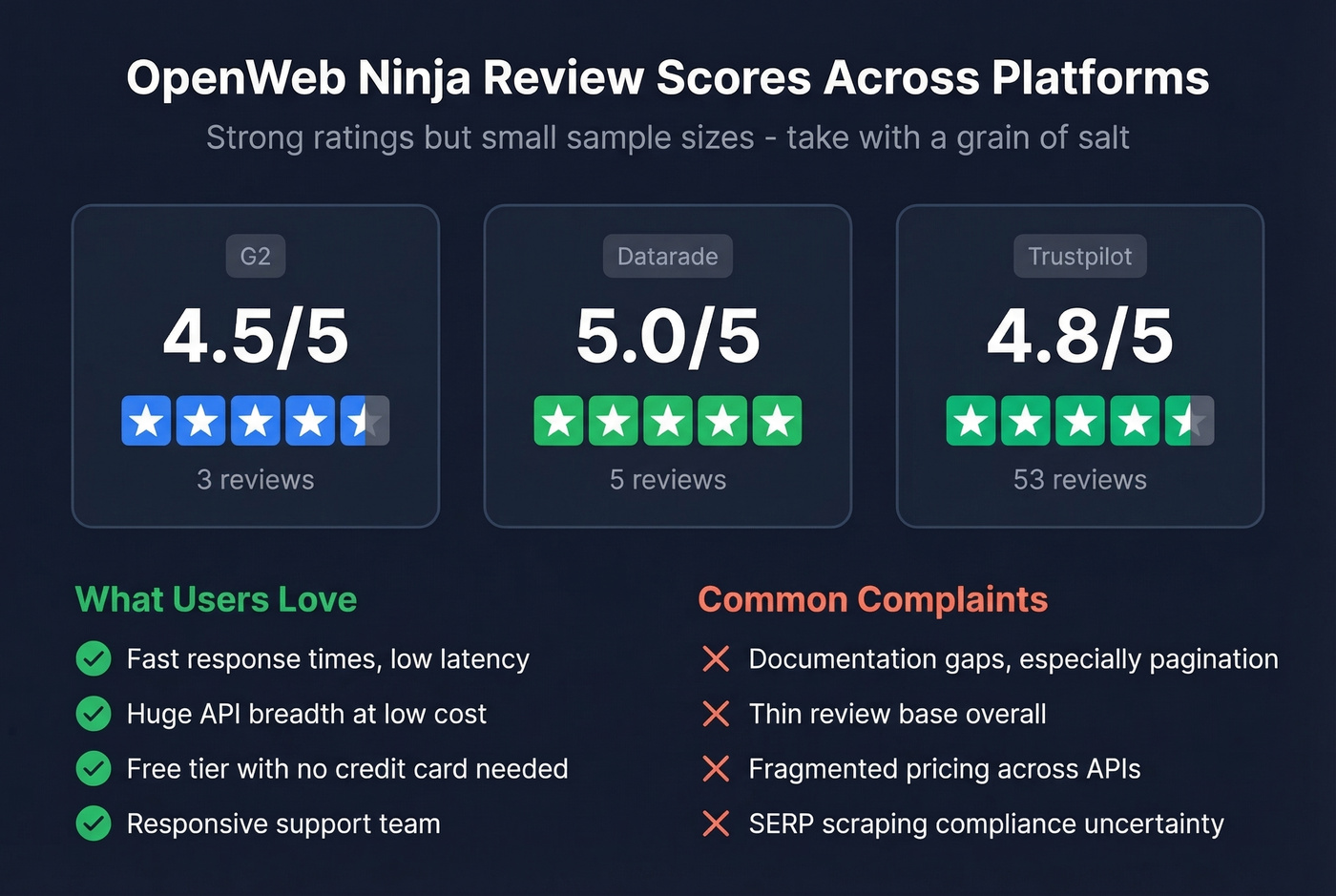
API breadth at low cost. Thirty-plus APIs under one account starting at $25/mo is hard to match. Pull SERP data, Walmart products, Google Maps listings, job postings, and forum discussions without juggling five vendors.
The free tier is real. 100 requests/month, no credit card. Enough to validate an integration before spending anything.
Responsive support. Review snippets on G2 and Datarade emphasize a responsive team and fast turnaround times.
What needs work
Documentation has gaps. A G2 reviewer flagged that pagination parameters in the JSearch API can produce repeating jobs across pages, and that the docs weren't clear enough on how to use num_pages and page to get maximum results. We've seen similar complaints in community threads - when you're debugging at 2am, unclear docs are infuriating.
Thin review base. The platform has 3 G2 reviews (4.5/5), 5 reviews on Datarade (5.0/5), and 53 reviews on Trustpilot (4.8/5). Ratings are strong, but the sample sizes are still small. Take the perfect scores with a grain of salt.
Fragmented pricing. No single page tells you what everything costs. You check each API individually. For teams evaluating multiple endpoints, it's a real pain.
SERP API compliance risk. In late 2025, Google filed a lawsuit against SerpApi over alleged unlawful scraping and circumvention of security measures. That targets SerpApi specifically, but it signals Google is getting more aggressive about SERP data extraction. Anyone evaluating SERP API vendors in 2026 should factor this industry risk in - it's not unique to OpenWeb Ninja, but it's not nothing either.
How It Compares on Price
| Provider | Entry Plan | Requests | Free Tier |
|---|---|---|---|
| OpenWeb Ninja | $25/mo | 10,000 | 100/mo |
| SerpApi | $25/mo | 1,000 | 250/mo |
| ScraperAPI | $49/mo | 100,000 credits | Free trial |
| Oxylabs | $49/mo | ~$1.60/1K results (PAYG) | 2,000-search trial |
| Bright Data | ~$500/mo | Varies | 7-day trial |
| Zyte | $0.13/1K | Pay-as-you-go | - |
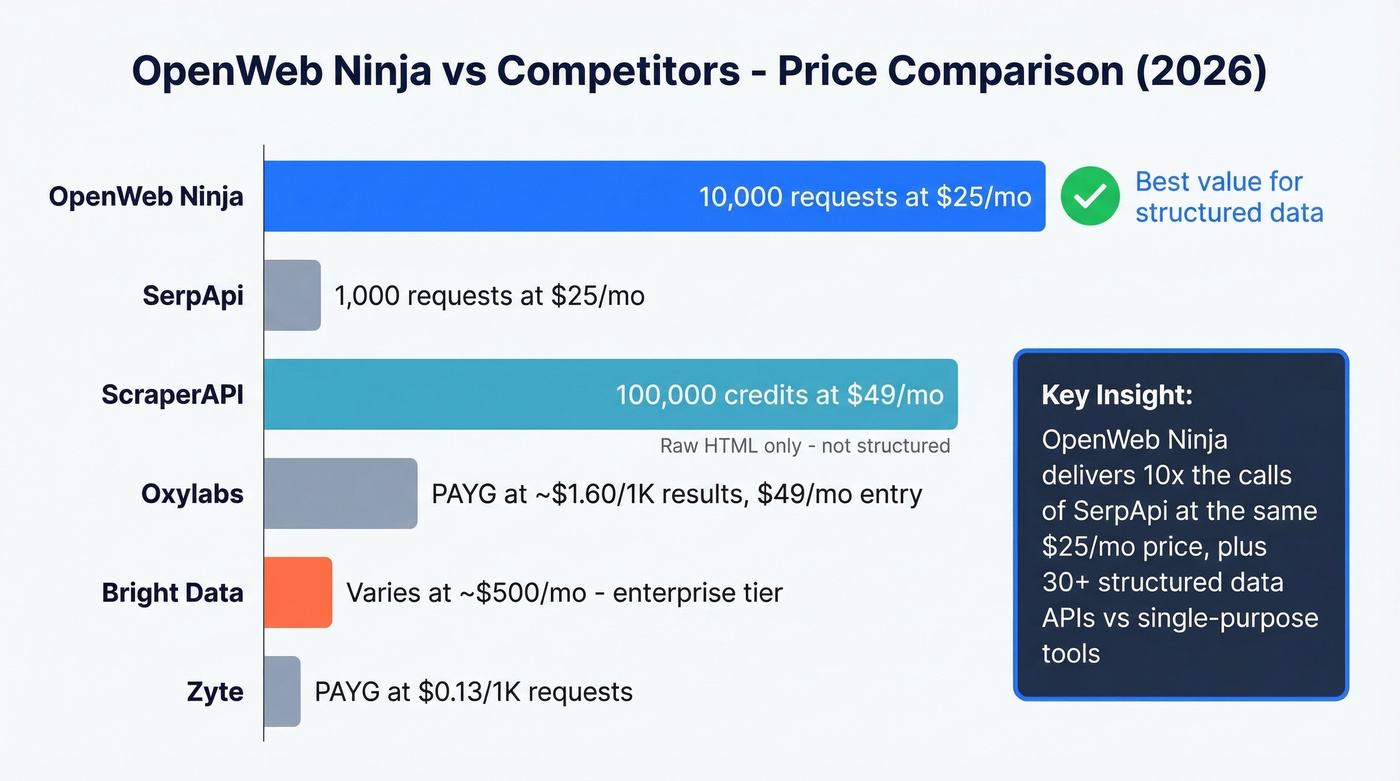
At the $25/mo price point, OpenWeb Ninja delivers 10x the calls SerpApi does. ScraperAPI offers more raw volume at $49/mo, but it's a general scraping tool - you get unstructured HTML, not parsed, structured data across 30+ specialized endpoints. Bright Data starts around $500/mo, which makes sense for enterprise teams but is overkill for a developer building a side project or an early-stage startup validating a data pipeline.
The real value isn't just price per request. It's the breadth of structured data under one subscription. Most competitors specialize in SERP or general scraping. OpenWeb Ninja covers SERP, maps, e-commerce, jobs, forums, and AI endpoints in a single stack.
The web scraping market is projected to grow from roughly $1B in 2025 to $2B by 2030, and tools like this are positioned to capture the long tail of developers who don't need enterprise contracts.
Who Should Use It
Developers and AI teams building data pipelines that need structured public web data at low cost - SERP monitoring, e-commerce price tracking, job board aggregation, local business data. These are the sweet spots. One n8n user on Reddit built a sentiment-arbitrage workflow using the Forums Search API, pulling real-time forum discussions and scoring them against Polymarket odds. That's exactly the kind of creative use case this tool enables.
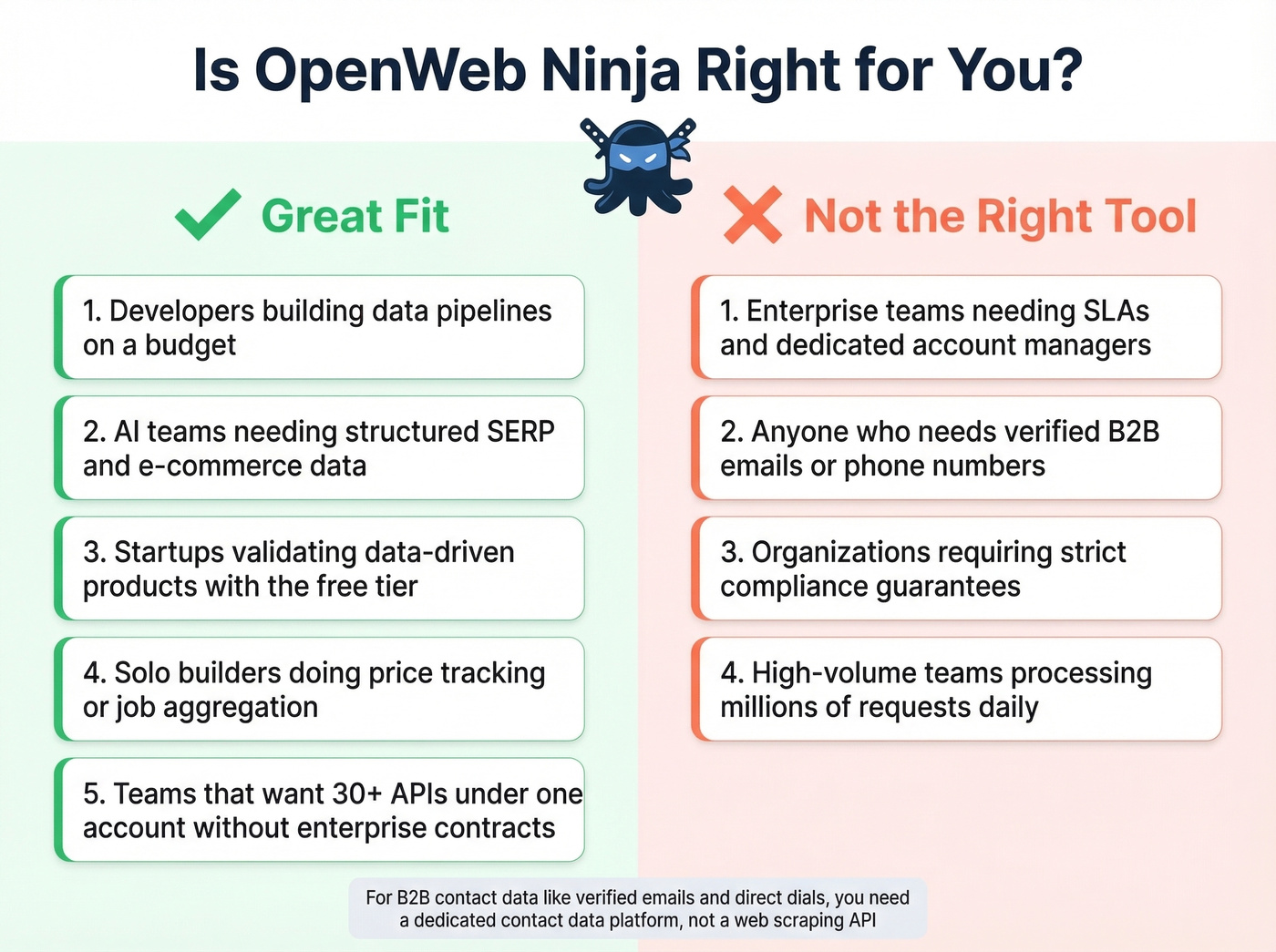
Skip it if you're an enterprise team that needs SLAs, dedicated account management, and compliance guarantees. Bright Data and Oxylabs serve that tier. Also skip it if you need verified B2B contact data like emails and direct dials for decision-makers - that's a completely different tool category, and web scraping APIs won't solve it.
The Verdict
OpenWeb Ninja is the clear value leader for small-to-mid volume web data needs. Start with the free tier, validate your use case, and scale to Pro when you're ready. The documentation gaps and thin review base are real drawbacks, but the speed, breadth, and pricing math are hard to beat at this tier.
Let's be honest - the fragmented pricing situation is annoying, and we'd love to see them consolidate it into one page. But the product underneath is solid for what it does.
OpenWeb Ninja solves public web data at $0.0025/request. For verified B2B contact data, Prospeo solves it at $0.01/email across 300M+ profiles - with 30+ filters for intent, technographics, and job changes. No scraping. No parsing. Just verified contacts ready for outreach.
Find decision-maker emails and mobiles without building a single scraper.
FAQ
Does OpenWeb Ninja have a free tier?
Yes - 100 requests per month, no credit card required. It's enough to test an integration end-to-end before committing to the $25/mo Pro plan. The free tier applies to most APIs individually.
Is OpenWeb Ninja available on RapidAPI?
Yes. Many teams use RapidAPI for quick testing and billing through an existing RapidAPI workflow. Pricing tiers on RapidAPI generally mirror the direct website plans.
Can OpenWeb Ninja find B2B emails or phone numbers?
No. It focuses on public web data like SERPs, e-commerce listings, maps, and job posts. For verified B2B emails and direct dials, you need a dedicated contact data platform.
What do reviewers say about reliability?
G2 reviewers consistently highlight fast response times and low latency. Datarade lists 99.95% uptime. The most specific criticism involves pagination confusion in the JSearch API - a documentation issue, not a reliability one. Trustpilot shows 53 reviews with a 4.8/5 rating overall.