


Relay.app Review 2026: Pricing, Pros, Cons & Alternatives
Half the internet has the wrong price for Relay.app. Capterra lists $9/mo. Lindy's blog lists $38/mo for Professional - and even shows other conflicting numbers in its FAQ. The actual number on Relay's pricing page is $19/mo billed annually.
If you've been comparing automation tools using stale data, you've been making decisions on fiction. Here's what's real: verified Relay.app pricing, reviews from 80 G2 users, and a clear breakdown of the pros and cons so you know where Relay fits and where it doesn't.
30-Second Verdict
Relay.app is excellent for non-technical teams that need human-approval steps baked into AI workflows. The 4.9/5 rating on G2 tracks - the UI is clean, the learning curve is gentle, and human-in-the-loop is a core feature, not a bolt-on.
The tradeoff: 100+ integrations sounds fine until you realize Zapier has 8,000+ and Make has 3,000+. AI credits also burn faster than most teams expect. Skip Relay if you need deep integration coverage or heavy AI processing at scale.
Relay.app Plans & Pricing in 2026
Pulled directly from Relay's pricing page as of early 2026:
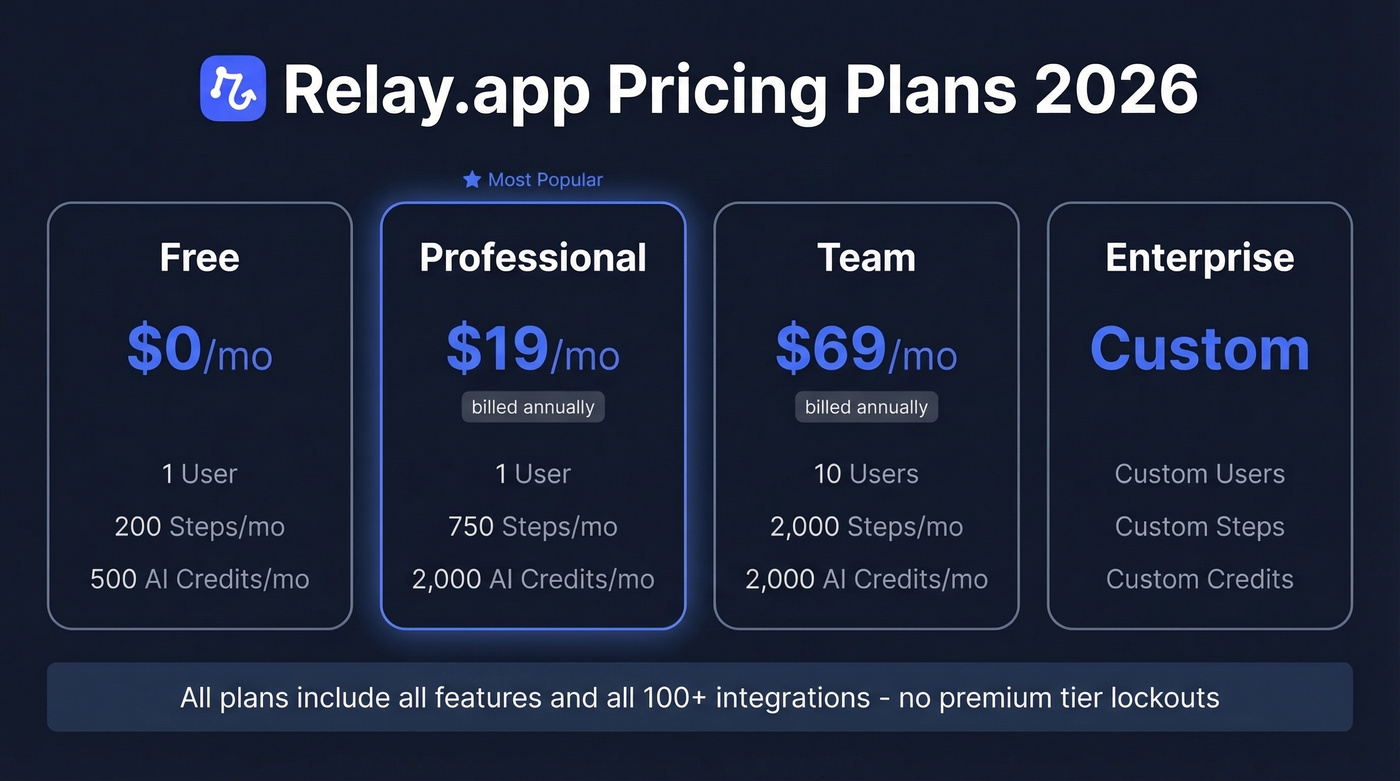
| Plan | Price (Annual) | Users | Steps/Mo | AI Credits/Mo |
|---|---|---|---|---|
| Free | $0 | 1 | 200 | 500 |
| Professional | $19/mo | 1 | 750 | 2,000 |
| Team | $69/mo | 10 | 2,000 | 2,000 |
| Enterprise | Custom | Custom | Custom | Custom |
Every plan includes all features and all 100+ integrations - no premium-tier lockouts. Capterra's listing shows $9/mo, and Lindy's blog lists $38/mo for Professional. Both conflict with Relay's current pricing page, which is the canonical source.
For teams needing more AI horsepower, Relay sells credit bundles: 5,000 credits for $11/mo on annual billing, scaling up to 200,000 credits for $450/mo annually (or $600/mo month-to-month).
How Steps and AI Credits Work
Relay meters usage on two axes: steps and AI credits.
Counts as a step: any app action, any AI step, web scraping, "wait for object to match rule" completion, and human-in-the-loop activations when the initial notification fires.
Doesn't count: triggers, end-run steps, wait-for-time steps, data transforms, path rule evaluations, and iterator evaluations.
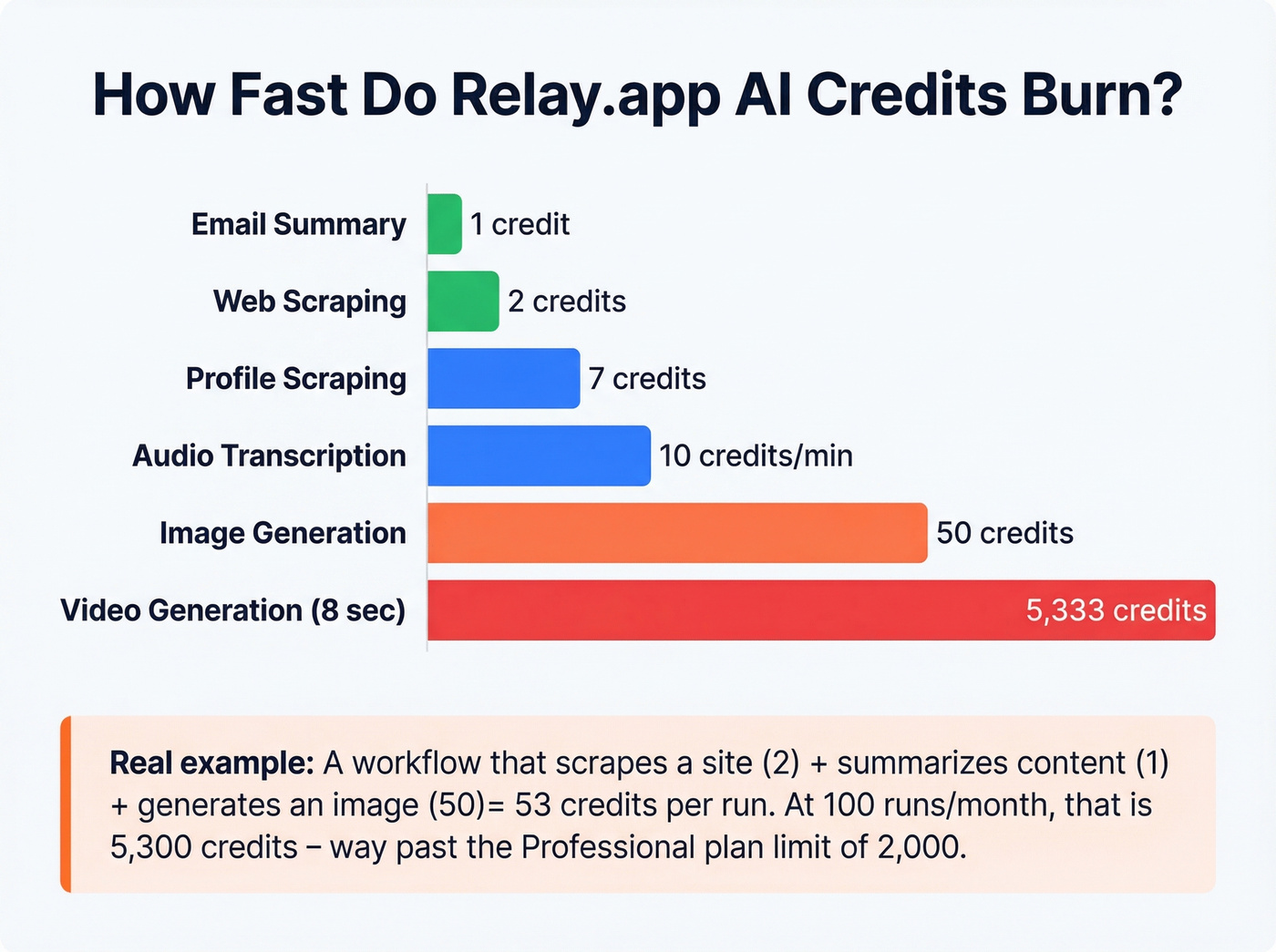
AI credits stack on top of steps - an AI step consumes both. Per Relay's docs, credit costs vary wildly. An email summary runs about 1 credit, web scraping about 2, professional profile scraping about 7, audio transcription about 10 per minute, image generation about 50, and video generation about 5,333 per 8-second clip.
Let's break this down with a real example. Say you build a workflow that scrapes a website (2 credits), summarizes the content (1 credit), and generates an image (50 credits). That's 53 credits per run. Run it 100 times a month and you've consumed 5,300 credits - blowing past the Professional plan's 2,000 monthly allowance immediately. You'd need at least a 5,000-credit add-on ($11/mo annual) to cover the gap.

What Users Actually Love
Across 80 G2 reviews, the praise clusters tightly. Ease of use dominates with 22 mentions - non-technical users consistently say they build workflows without developer help. We've tested dozens of tools that claim "no-code" simplicity, and Relay is one of the few where the reviews genuinely back it up.
Automation features pull 13 mentions, with the AI agent builder and multi-step workflows earning strong marks. Reviewers also highlight the clean, simple UI (8 mentions). No feature bloat, no cluttered dashboards - just a straightforward canvas that does what you'd expect.
The standout differentiator is human-in-the-loop as a built-in capability. Approval steps, manual inputs, and task assignments are woven into the workflow engine, not bolted on after the fact. For teams where a human needs to sign off before an email sends or a record updates, this is the whole reason to pick Relay over the bigger platforms.

Relay handles the workflow automation - but what about the data flowing through it? Prospeo integrates with Zapier, Make, n8n, and Clay to feed your automations 98% accurate emails and verified mobile numbers. No credit guessing games - just $0.01 per email.
Plug verified B2B data into every workflow you build.
What Users Flag as Cons
The cons are fewer but pointed.
Limited integrations top the list with 9 mentions - 100+ apps covers the core stack, but teams with niche SaaS tools hit walls fast. Zapier's 8,000+ ecosystem makes Relay's catalog feel thin by comparison.
Missing features drew 5 mentions. The most specific ask: the inability to duplicate a workflow to a different workspace. That's a dealbreaker for consultants managing multiple clients.
Credit depletion and cost earned 3 mentions. "Credits run out so quick" is a direct G2 quote. Another reviewer called the pricing "pretty steep compared to things like n8n." Here's the thing - the credit issue isn't about the base price. It's the gap between what $19/mo promises and what AI-heavy workflows actually cost. If you're running scraping or transcription at any volume, budget for add-on credits from day one.
G2 is where the real user feedback lives right now; Reddit discussion around Relay is still thin.
Relay.app vs Alternatives
| Tool | Starting Price | Integrations | Best For |
|---|---|---|---|
| Relay.app | $19/mo | 100+ | Approval workflows |
| Zapier | $19.99/mo | 8,000+ | Integration breadth |
| Make | $9/mo | 3,000+ | Budget visual builder |
| n8n | Free (self-hosted) | 400+ | Developer control |
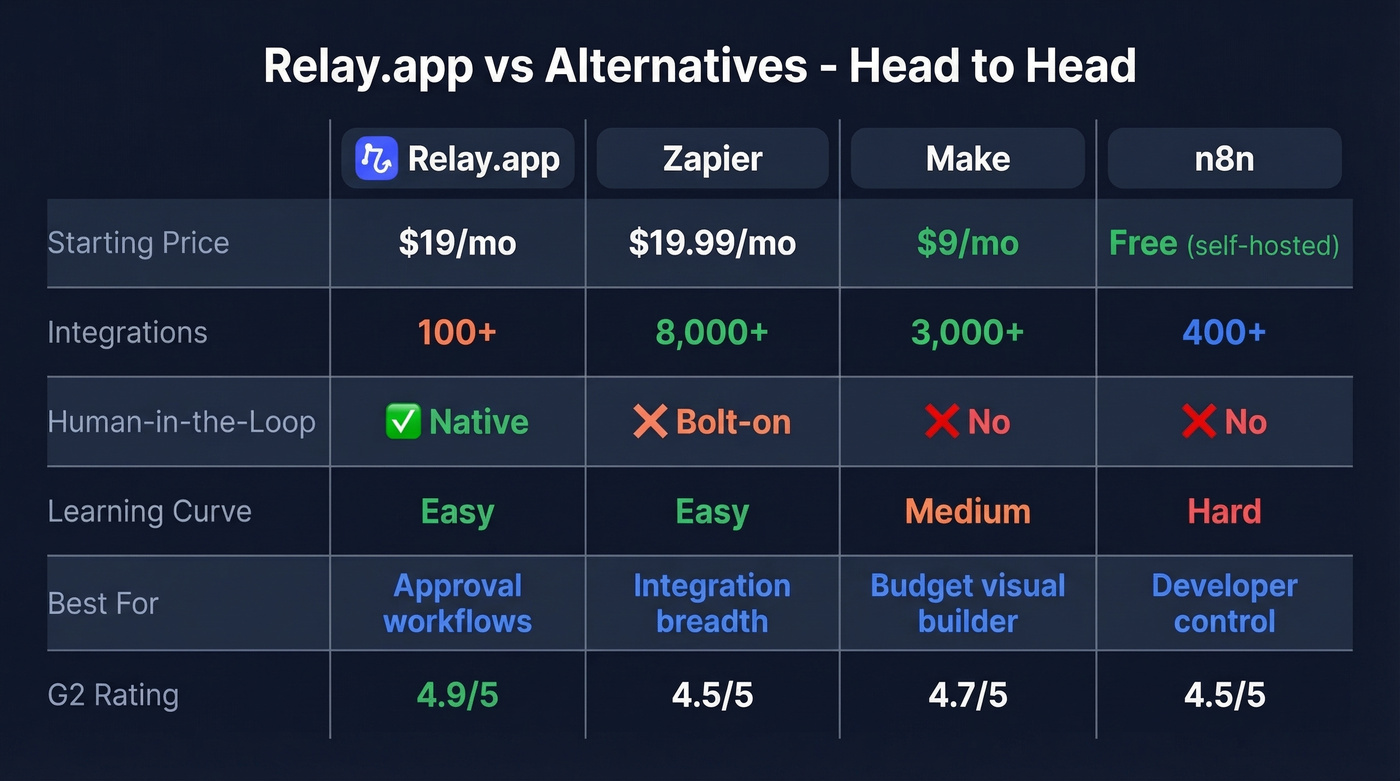
Relay vs Zapier: Use Relay if you need human-in-the-loop approvals as a native feature and your integration needs stay within 100 core apps. Skip it if you need broad coverage - Zapier's 8,000+ apps dwarf Relay's catalog. But watch the bill: one Reddit user reported paying $847/mo for roughly 15,000 tasks because every step in a multi-step zap counts as a separate task. In our experience, Relay's approval workflows feel noticeably smoother than Zapier's equivalent setup.
Relay vs Make: Make's Core plan starts at $9/mo with 10k credits/month and 3,000+ apps - half the price with significantly more execution volume. The tradeoff is a steeper learning curve and no native human-in-the-loop. For teams that don't need approval steps, Make is hard to argue against on value alone.
Relay vs n8n: n8n is free to self-host with 400+ integrations and full infrastructure control. If you've got a developer who wants to own the stack, n8n is hard to beat. But it's a different philosophy entirely - n8n is for builders, Relay is for operators who want to stay out of the terminal.
One thing we keep coming back to: Relay's 4.9-star rating is real, but it's partly a function of a self-selecting user base. The teams who need 500+ integrations or heavy AI processing never adopt Relay in the first place - so they never leave bad reviews. Know which camp you're in before you commit.
Who Should Use Relay.app
Relay is the right pick for non-technical teams running approval workflows across mainstream apps like Gmail, Notion, HubSpot, and Slack, with light-to-moderate AI usage fitting within 2,000-5,000 credits/month.
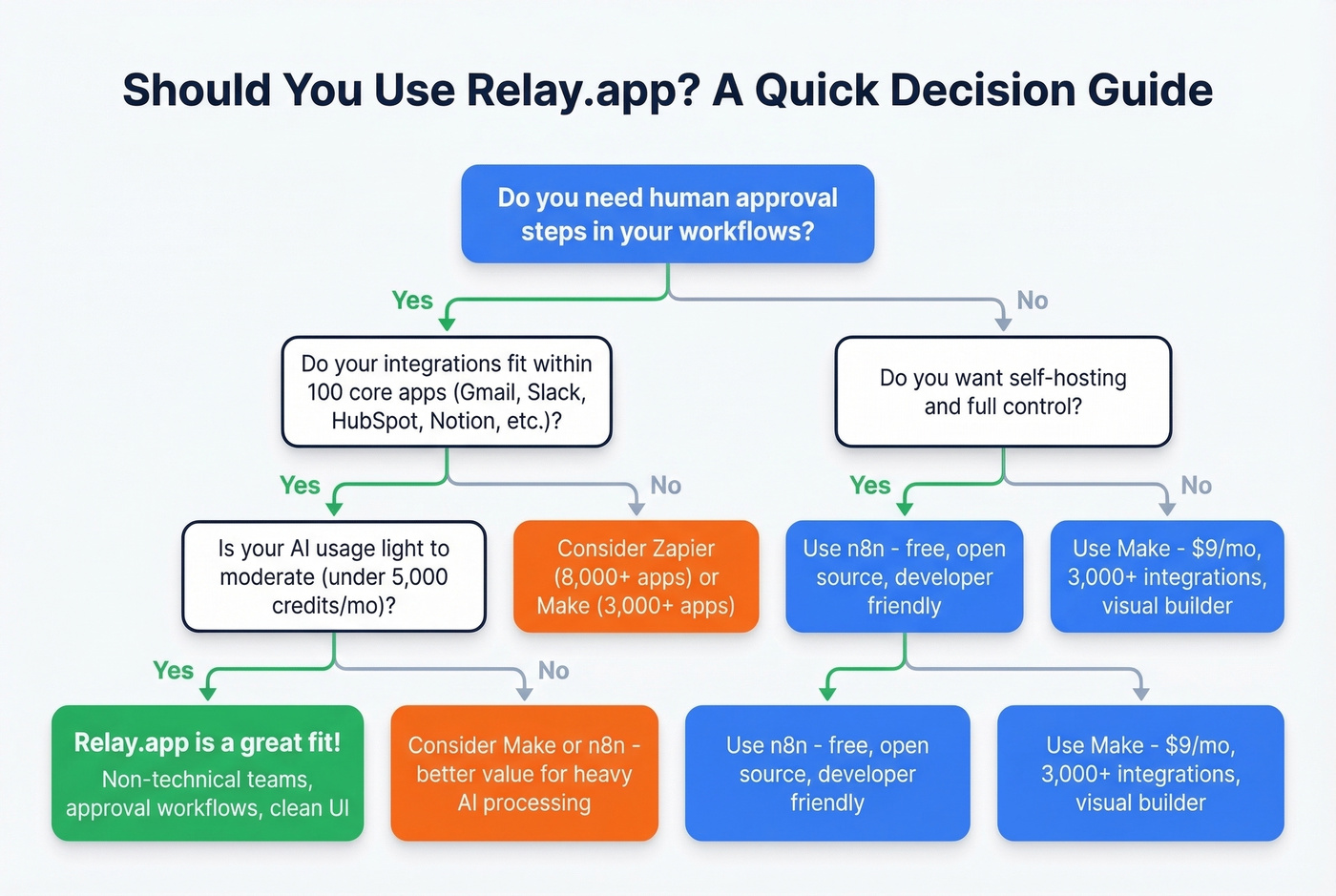
Skip it if you need 500+ integrations, run heavy AI workloads at scale, want self-hosting control, or manage multiple client workspaces that require workflow duplication. Enterprise buyers should also note that HIPAA compliance isn't confirmed - SOC2 and GDPR documentation are available on the Enterprise plan, but verify healthcare-specific requirements directly with Relay's team.
If you're building outbound sales workflows, Relay moves contacts through sequences beautifully but doesn't source them. That's where a tool like Prospeo fits - 98% verified email accuracy and 125M+ verified mobiles at roughly $0.01/lead, connecting to Relay through Zapier or Make.

Comparing automation tools is smart. But the biggest bottleneck isn't which platform runs your workflows - it's whether the contact data inside them is real. Prospeo refreshes 300M+ profiles every 7 days so your outreach actually lands.
Stop automating bounces. Start automating pipeline.
FAQ
Does Relay.app have a free plan?
Yes. The free plan includes 200 steps/mo, 500 AI credits/mo, and 1 user with all features unlocked. It's solid for testing, but most teams running real automations outgrow it within a week.
Why do AI credits run out so fast?
Credit-heavy actions compound quickly. Professional profile scraping costs 7 credits, image generation costs 50, and video generation burns 5,333 credits for a single 8-second clip. A 100-run workflow combining scraping and summarization can exhaust 2,000 credits in days.
Is Relay.app cheaper than Zapier?
At low volume, they're nearly identical - $19/mo vs $19.99/mo. At scale, both get expensive through different mechanisms: Zapier multiplies tasks per step, Relay depletes AI credits. For high-volume workflows on a budget, Make ($9/mo) and n8n (free self-hosted) typically cost less.
How do I source leads for Relay.app workflows?
Relay orchestrates workflows but doesn't include a contact database. Prospeo provides 300M+ professional profiles with 98% email accuracy and connects via Zapier or Make, so verified leads flow directly into your Relay automations at about $0.01 per contact.