

Sales Funnel Content That Actually Converts: The 2026 Practitioner's Guide
Your CMO wants to know why 50 blog posts haven't moved pipeline. Your reps say marketing leads are "not ready." Meanwhile, 69% of buyers have already made their decision before they ever talk to a salesperson. The content is the sales team now - and most companies are building the wrong sales funnel content for the wrong stage.
A well-defined funnel can boost deal success rates by 16%. Yet only 34% of companies actively optimize theirs. Here's the operating manual for joining that minority.
The Short Version
Use a 5-stage funnel, not 12 stages. Overcomplicating kills execution. Awareness, Interest, Trust, Decision, and Action covers every B2B and B2C scenario without creating confusion between steps.
Build MOFU content first. This is the contrarian move, but it's backed by data: 79% of leads never convert due to lack of nurturing. Your trust-building assets - case studies, comparisons, ROI calculators - do more pipeline work than another awareness blog post. Structured lead nurturing generates 50% more sales-ready leads at 33% lower cost.
Measure with position-based attribution, not last-click. Last-click gives all the credit to your demo page and none to the case study that convinced the buyer to book it. U-shaped attribution fixes this.
Funnel Stages That Actually Work
Most funnel diagrams look like they were designed by a committee that couldn't agree on anything. You've seen the 7-stage versions, the 12-step monstrosities, the ones with "delight" as a stage. What does that even mean operationally? The practitioner consensus on r/SaaS is that simpler funnels beat complex ones because teams can actually execute against them.
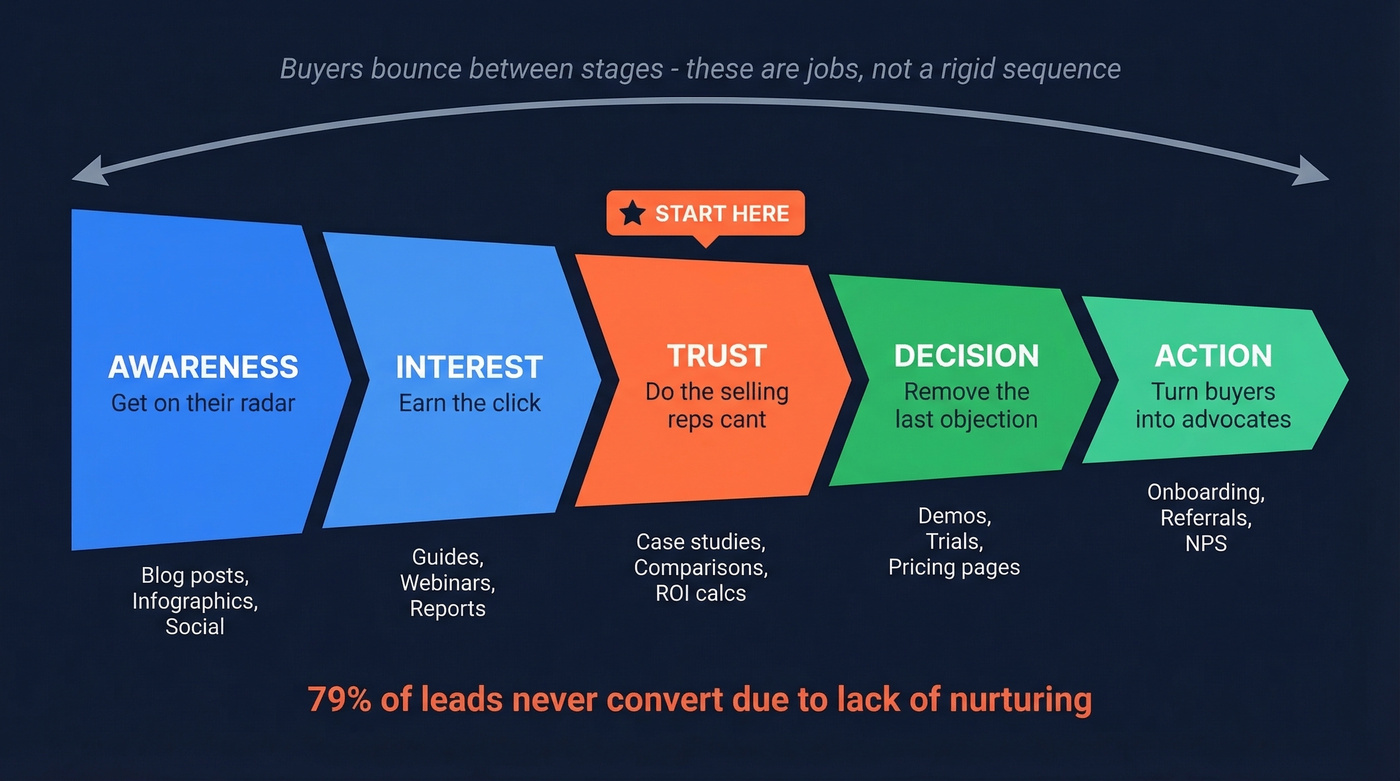
Five stages, each with a clear content job:
Awareness -> Interest -> Trust -> Decision -> Action
Buyers don't move through these linearly - they bounce back and forth. The stages describe the jobs your content needs to do, not a rigid sequence. And here's the critical insight: deals rarely fail at the decision stage. They usually fail earlier. If your TOFU messaging attracts the wrong audience, or your MOFU content doesn't build enough credibility, no amount of BOFU optimization will save you. The funnel breaks upstream, not downstream. That's why teams aligning content and messaging across every stage consistently outperform those treating each stage in isolation.
| Model | Stages | Best For |
|---|---|---|
| 3-stage (TOFU/MOFU/BOFU) | Awareness, Consideration, Decision | Small content teams, early startups |
| 5-stage (Recommended) | Awareness, Interest, Trust, Decision, Action | Most B2B and B2C teams |
| 6-stage (Extended) | + Intent, + Loyalty/Advocacy | Enterprise with 12+ month cycles |
The 3-stage model works if you're a two-person marketing team that needs to ship fast. The 6-stage model Spotify lays out in their funnel guide adds Intent and Loyalty/Advocacy stages that make sense for enterprise orgs with year-long sales cycles. For everyone in between, five stages gives you enough granularity to diagnose problems without creating stages nobody owns.
One historical note for the SEO-minded: this all traces back to AIDA - Attention, Interest, Desire, Action) - from 1898. The framework is 128 years old. The content formats change; the buyer psychology doesn't.
What to Create at Each Stage
"Create content for each stage" isn't a strategy - it's a platitude. Let's get specific.
The counterintuitive starting point: if you're building a content library from scratch, start with the Trust stage, not Awareness. We've seen teams pour months into TOFU blog content that generates traffic but zero pipeline. Trust-stage assets - case studies, comparison guides, ROI calculators - do the selling your reps can't do at scale. Build those first, then work outward.
Awareness - Get on Their Radar
The job here is simple: exist in your buyer's world before they know they have a problem. Blog posts, infographics, short-form video, and social posts are your workhorses. The goal isn't conversion - it's education and reach.
Distribute through SEO, organic social, and paid amplification. Measure traffic and impressions, but don't mistake these for pipeline metrics. Awareness content feeds the funnel; it doesn't close deals.
Interest - Earn the Click
Interest-stage content earns permission. The buyer knows they have a problem and wants to go deeper. Email opt-in guides, webinars, and industry reports give them a reason to hand over contact information.
Channels shift here to email capture, retargeting ads, and gated content on your site. The KPI is opt-ins and MQLs. If your awareness content drives 10,000 visitors but your interest-stage assets capture 50 emails, you've got a conversion problem - not a traffic problem.
Trust - Do the Selling Reps Can't
This is the stage where buyers are doing most of their evaluation without you: 69% of buyers engage with salespeople only after they've already decided. They're comparing you to competitors. They're looking for proof. They're asking "will this actually work for someone like me?"
Case studies, comparison guides, ROI calculators, and expert roundups are your highest-leverage assets here. Video works especially well at this stage - customer testimonial clips, product walkthroughs, behind-the-scenes implementation stories - because prospects trust what they can see over what they read. Each piece should reduce a specific risk: financial risk (ROI calculator), implementation risk (case study), competitive risk (comparison guide).
If you only have budget to build five pieces of content, three of them should live at this stage. That 50% more sales-ready leads at 33% lower cost figure from structured nurturing? That's not a marginal improvement - it's a fundamentally different pipeline.
Decision - Remove the Last Objection
The buyer is almost there. They need the final push: a free trial, a live demo, a testimonial from someone in their industry, a transparent pricing page, or a proposal template that makes internal buy-in easy.
The goal is conversion, and the channels are sales outreach and your website. If your SQL-to-Opportunity rate is below the typical 50-62% range, your BOFU content isn't removing objections effectively. Look at what questions your sales team answers repeatedly on calls - those answers should be content.
Action and Follow-Through
The sale isn't the end of the funnel. Onboarding sequences, loyalty programs, referral incentives, and NPS surveys turn buyers into advocates. Returning customers spend 67% more than new ones. Ignoring post-purchase content is leaving expansion revenue on the table.
The Content Mapping Template
Use this matrix to audit your existing content and identify gaps. Fill in your ICP persona for each row, then check whether you actually have assets at every stage.
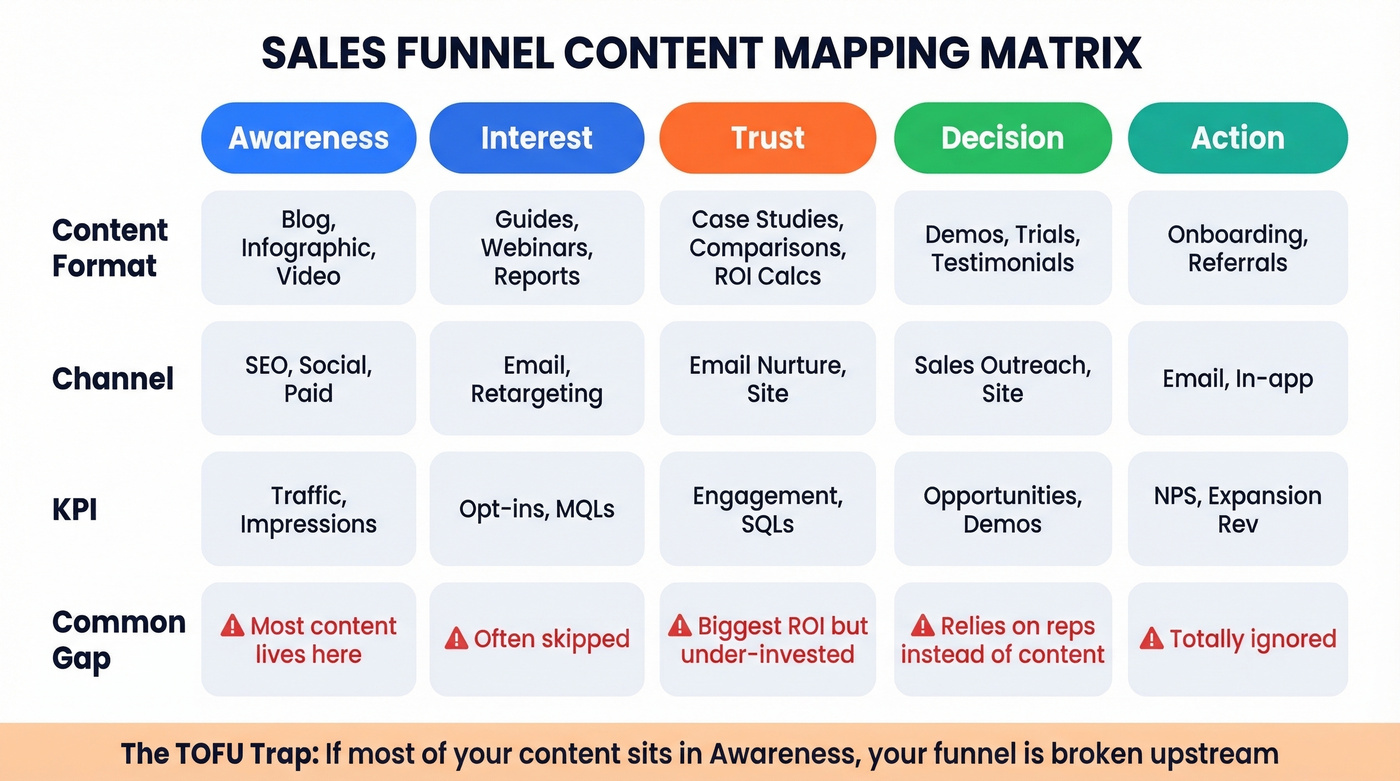
| Awareness | Interest | Trust | Decision | Action | |
|---|---|---|---|---|---|
| ICP Persona | [Role] | [Role] | [Role] | [Role] | [Role] |
| Content Format | Blog, infographic | Guide, webinar | Case study, comparison | Demo, trial, testimonial | Onboarding, referral |
| Channel | SEO, social | Email, retargeting | Email nurture, site | Sales outreach, site | Email, in-app |
| KPI | Traffic, impressions | Opt-ins, MQLs | Engagement, SQLs | Opportunities, demos | NPS, expansion rev |
Most teams who fill this out discover the same thing: the majority of their content sits in the Awareness column. That's the TOFU trap, and it's a funnel performance killer.
A SaaS Example in Practice
A project management SaaS targeting mid-market teams might map their funnel like this. Awareness: a blog post titled "10 Signs Your Team Has Outgrown Spreadsheets." Interest: a gated "Project Management Buyer's Guide" PDF. Trust: a case study showing how Acme Corp cut project delivery time by 40%. Decision: an interactive product demo plus a transparent pricing page with a plan comparison table. Action: a 30-day onboarding email sequence with video walkthroughs and a referral program offering a free month.
One B2B SaaS company following this stage-by-stage approach achieved a 34% increase in conversions within three months. The framework works when you fill every stage, not just the top.
Benchmarks You Can Measure Against
Numbers make funnel problems concrete. If you don't know what "good" looks like at each stage transition, you're optimizing blind.
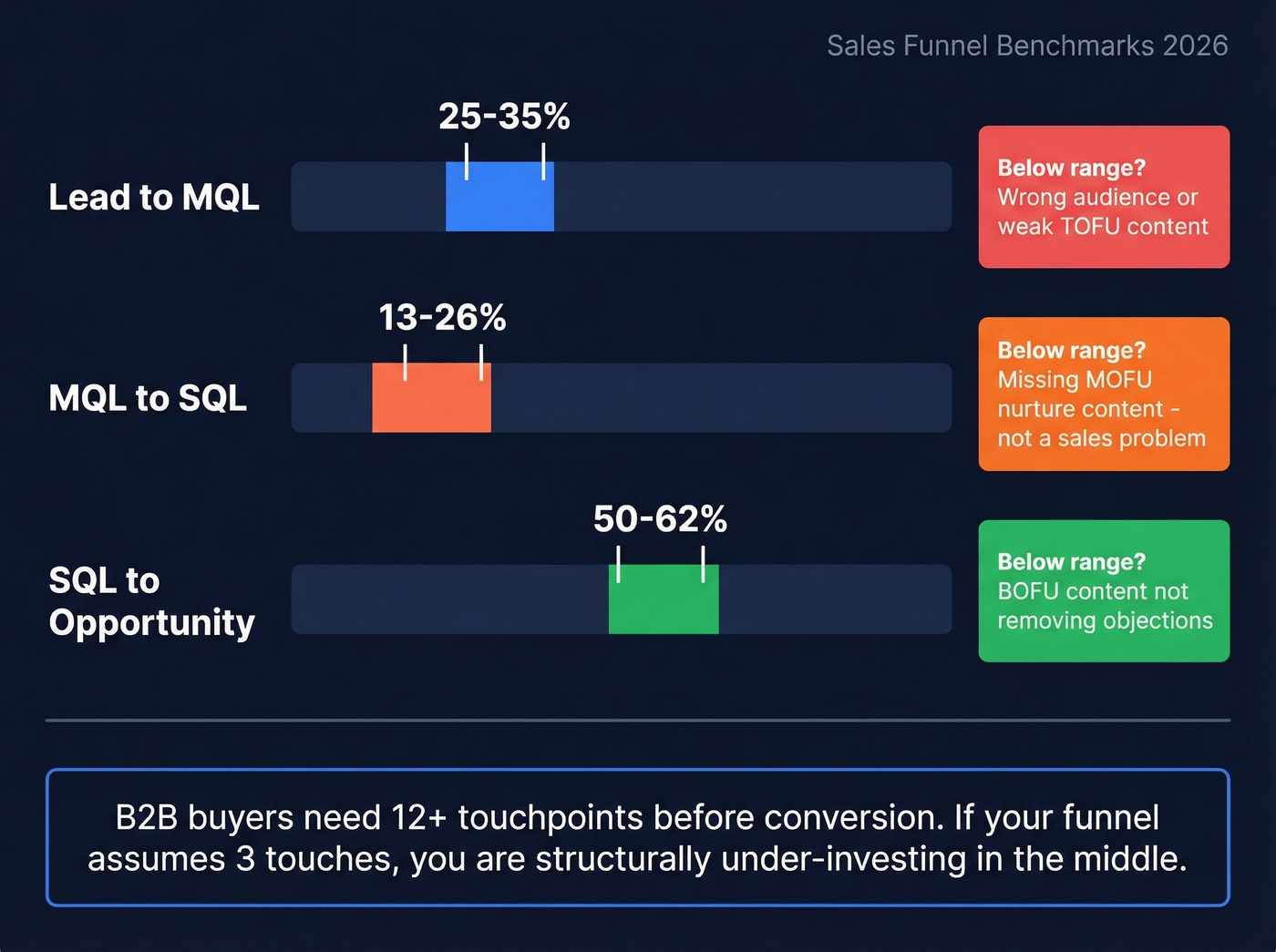
| Stage Transition | Benchmark | What a Gap Means |
|---|---|---|
| Lead to MQL | 25-35% | Weak TOFU content or wrong audience |
| MQL to SQL | 13-26% | Missing MOFU nurture content |
| SQL to Opportunity | 50-62% | BOFU content not removing objections |
If your numbers fall below these ranges, you have a content gap at that stage - not a sales problem. A 10% MQL-to-SQL rate doesn't mean your SDRs need more training. It means your nurture sequence isn't building enough trust before the handoff.
Here's the thing: if your deals close under $15K, you probably don't need a 12-stage funnel or enterprise-grade marketing automation. A five-stage framework with one strong asset per stage will outperform a bloated system that nobody maintains. Complexity is the enemy of execution.
60% of consumers take six or more actions before buying from a new brand. B2B is even more touch-intensive - expect 12+ touchpoints before conversion. If your funnel assumes a three-touch journey, you're structurally under-investing in the middle.

Your MOFU content can't nurture leads you don't have. Prospeo's 30+ search filters - including buyer intent signals across 15,000 topics - let you identify in-market prospects at every funnel stage. 98% email accuracy means your nurture sequences actually land.
Stop creating trust-stage content for an empty pipeline.
B2B vs B2C - What Changes
The funnel stages are the same. The content, channels, and pace are completely different.
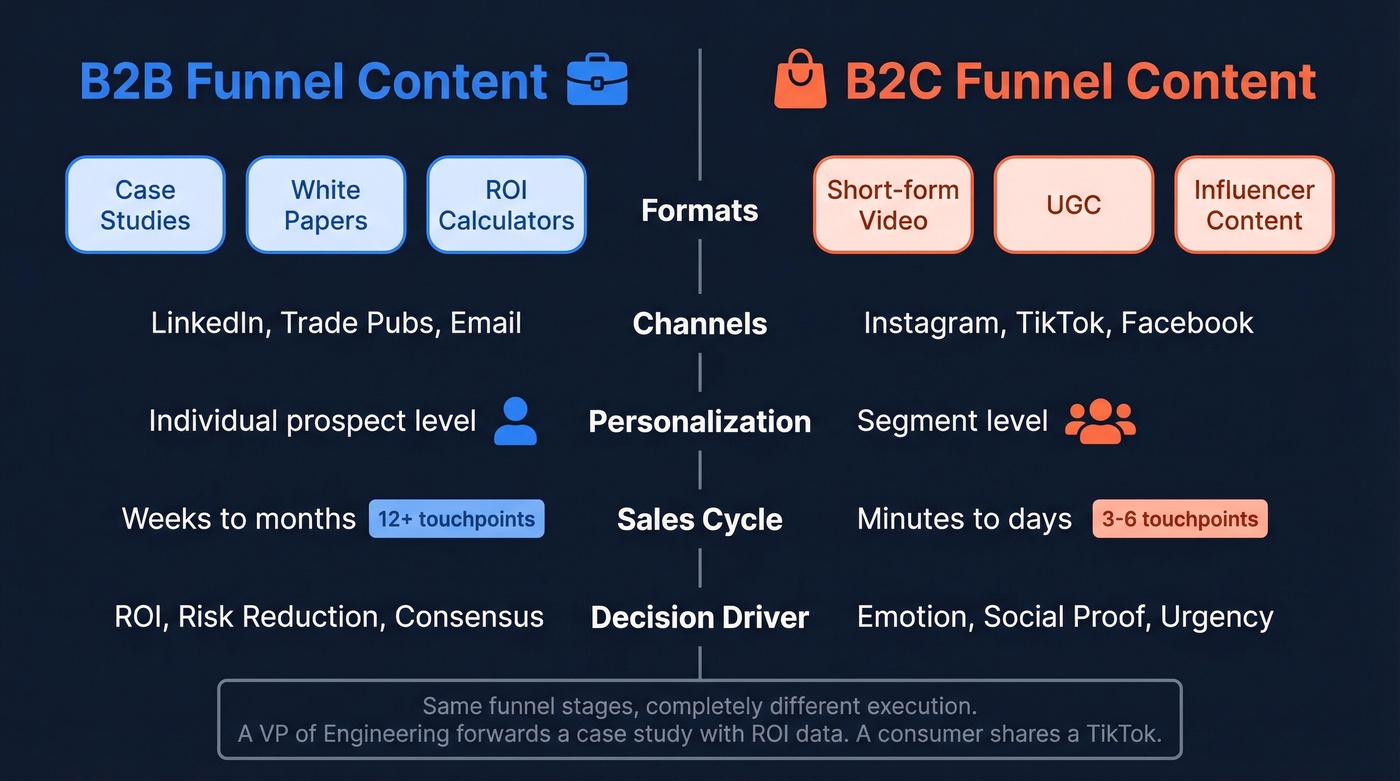
| Dimension | B2B | B2C |
|---|---|---|
| Formats | Case studies, white papers, ROI calcs | Short-form video, UGC, influencer |
| Channels | Professional networks, trade pubs, email | Instagram, TikTok, Facebook |
| Personalization | Individual prospect level | Segment level |
| Sales cycle | Weeks to months, 12+ touchpoints | Minutes to days |
| Decision driver | ROI, risk reduction, consensus | Emotion, social proof |
B2B content needs to do more heavy lifting because the buying committee is larger and the stakes are higher. A VP of Engineering doesn't share a TikTok with their procurement team. They forward a case study with quantified ROI. B2B content earns trust through hard numbers and specific implementation details; B2C content earns attention through entertainment and emotional connection.
The personalization difference matters for execution. B2B teams can justify building a custom case study for a single enterprise prospect. B2C teams personalize by segment - "first-time buyers in the 25-34 demo" - not by individual. Your content production workflow should reflect this: B2B needs fewer, deeper assets; B2C needs higher volume at lower depth.
Mistakes That Kill Funnel Performance
We've audited enough content programs to see the same five patterns destroy pipeline.
The TOFU Trap. The most common failure mode. Teams produce tons of awareness content and wonder why traffic doesn't convert. One agency documented the problem perfectly: 1,900 visitors in 28 days, almost none converting, because virtually all content targeted the awareness stage. The fix isn't more content - it's content at the right stage.
Stage Bloat. More stages don't mean more conversions. They mean more handoff points where leads get confused or lost. If your funnel has more than six stages, you've created a process diagram, not a buying journey. Simplify ruthlessly.
Vanity Metrics. Tracking impressions and page views instead of MQLs and pipeline contribution is comfortable because the numbers are always big. But big numbers that don't connect to revenue aren't metrics - they're decoration.
No Attribution. If you can't attribute funnel content to pipeline, you don't have a content strategy - you have a blog. The skepticism on r/PPC about full-funnel strategies is largely driven by teams that can't prove their awareness spend moves the needle. Attribution solves this.
Forgetting Post-Purchase. Returning customers spend 67% more. Onboarding sequences, referral programs, and expansion content aren't optional - they're the highest-ROI content you can build. Yet most teams treat the funnel as ending at "closed-won."
How to Measure Funnel Content Performance
Attribution is where funnel strategy either becomes real or stays theoretical. The model you choose determines which content gets credit - and therefore which content gets budget.
| Model | How It Works | Best For |
|---|---|---|
| First-touch | 100% credit to first interaction | Understanding awareness drivers |
| Last-touch | 100% credit to final interaction | Short cycles, direct response |
| Linear | Equal credit across all touchpoints | Simple multi-touch visibility |
| Time-decay | More credit to recent touchpoints | Long cycles, late-stage urgency |
| Position-based (U-shaped) | 40% first, 40% last, 20% middle | Recommended B2B default |
For most B2B teams, position-based attribution is the right default. It gives proper credit to the content that first attracted the buyer and the content that closed them, while still acknowledging the nurture assets in between.
Linear attribution sounds fair but treats a casual blog visit the same as a pricing page deep-dive. Last-touch ignores everything that built the relationship. First-touch ignores everything that closed it. Practitioners on r/FacebookAds consistently ask for ROAS comparisons between full-funnel and direct-to-conversion approaches - and the honest answer is that incrementality testing is the only way to get a real number for your business.
If your awareness content isn't moving people to the next stage, you're subsidizing platform ad revenue, not building pipeline. Run geo-holdout tests or pause specific campaigns for two weeks and measure the downstream impact. That's how you prove - or disprove - that your TOFU spend is working.
On the technical side, server-side tracking through Conversion APIs like Meta CAPI, Google Enhanced Conversions, and TikTok Events API is becoming essential as browser-side cookies degrade. If your attribution still relies entirely on pixel-based tracking, your data is getting less reliable every quarter.
AI-Powered Funnel Content in 2026
Sales reps spend 72% of their time on manual tasks that AI can automate. AI doesn't just help you create content faster - it helps you serve the right content to the right person at the right stage, automatically.
TOFU - Intent Clustering
AI identifies trending topics in your market and clusters audience segments by search behavior and engagement patterns. Instead of publishing one blog post and hoping it resonates with everyone, AI-driven distribution serves personalized content recommendations based on where each visitor sits in their research journey. The one-size-fits-all editorial calendar is dying.
MOFU - Smart Scoring and Nurture
AI lead scoring based on behavioral signals - content consumed, pages visited, email engagement, time on site - replaces the crude "downloaded a white paper = MQL" threshold. Automated nurture sequences adapt cadence and content based on score changes in real time. Layer intent data on top and the system gets powerful: tools like Prospeo track 15,000 buyer intent topics via Bombora, letting you trigger MOFU content to accounts actively researching your category - not just accounts that happened to visit your blog.
BOFU - Dynamic Conversion
Dynamic landing pages that change headlines, CTAs, and social proof by visitor segment aren't experimental anymore - they're table stakes for high-performing teams. Predictive next-best-offer models serve the right case study or demo invite based on the prospect's industry, company size, and engagement history.
One framework worth watching is HubSpot's Loop Marketing model, which treats the funnel as a continuous cycle through Express, Tailor, Amplify, and Evolve rather than a linear path. It's not yet an industry standard, but the core idea - that AI enables personalization at scale and iteration in days rather than quarters - is directionally right.
Data Quality - The Invisible Funnel Killer
You can build the perfect stage-by-stage content strategy - smart attribution, AI-powered nurture, the works - and still watch it fail if your contact data is bad. Your BOFU nurture sequence is only as effective as the email addresses it's sent to. If 35% of your list bounces, your case studies and demo invites never reach decision-makers. Worse, high bounce rates tank your sender reputation, which means even your valid emails start landing in spam.
This is where we've seen the biggest gap between teams that think they have a content problem and teams that actually have a data problem. Meritt tripled their pipeline from $100K to $300K per week after switching to Prospeo, with bounce rates dropping from 35% to under 4%. That's not a content change - it's an infrastructure change. Prospeo's 98% email accuracy across 143M+ verified emails and a 7-day data refresh cycle catches bad addresses before they damage your deliverability.
Your funnel content can't convert if it never arrives.
You just read that 79% of leads never convert due to lack of nurturing. The fix isn't just better content - it's reaching the right people with verified contact data. Prospeo enriches your CRM with 50+ data points per contact at a 92% match rate, so every funnel stage has real prospects to work.
Enrich your funnel with contacts that actually convert.
FAQ
What's the difference between a sales funnel and a marketing funnel?
A marketing funnel attracts and nurtures leads through content; a sales funnel qualifies, proposes, and closes. In practice, most teams benefit from treating them as one unified funnel. Separate frameworks create handoff gaps where leads stall between MQL and SQL.
How much content do I need per stage?
Most teams over-invest in TOFU. A practical starting ratio: 40% MOFU (trust-building), 30% TOFU (awareness), 20% BOFU (conversion), 10% post-purchase. Adjust based on where your conversion benchmarks show gaps - if MQL-to-SQL is weak, double down on MOFU.
How do I know which funnel stage a lead is in?
Track behavioral signals: pages visited, content downloaded, emails opened, and time on site. Assign scores to each action and map thresholds to stages. CRM tools like HubSpot and Salesforce automate this with lead scoring workflows that update in real time.
Does funnel content work for small teams?
Yes - start with one strong asset per stage: a blog post for awareness, a case study for trust, and a demo page for decision. You don't need 50 pieces. You need the right piece at each stage with verified contact data to deliver it.
How long before funnel content shows results?
Expect 60-90 days for TOFU content to gain organic traction and 30-60 days for MOFU/BOFU assets to impact pipeline, assuming active distribution via email, retargeting, and sales outreach. Give your attribution framework at least one full sales cycle before drawing conclusions.