

Sales Gamification: What Works, What Backfires, and How to Start
Your VP of Sales came back from a conference last month. Now they want "gamification by next quarter." They saw a demo with TV leaderboards, confetti animations, and a fantasy-football-style draft for SDRs. It looked incredible. What they didn't see: the three companies at that same conference who tried sales gamification, watched engagement crater by Week 3, and quietly turned it off.
Here's the thing - what actually works looks nothing like that demo.
What You Need (Quick Version)
Gamifying sales activities works when you target the right actions. That's the entire secret. Start without software - a spreadsheet and a Slack channel handle teams under 25 reps just fine. If you buy a tool, expect $5-$40/user/month, and enterprise tools are often billed annually. The biggest mistake we see: rewarding outcomes (closed deals) instead of behaviors (dials, meetings booked, pipeline created). Outcomes reward your best reps for being your best reps. Behaviors build the habits that create more best reps.
What Sales Gamification Actually Is
The global gamification market was valued at $19.42B in 2025 and is projected to hit $92.5B by 2030 - a 26% CAGR. That's not a fad. But most of that growth sits in consumer apps, e-learning, and loyalty programs. The sales-specific slice is narrower: applying game mechanics like leaderboards, points, contests, and real-time feedback loops to sales activities to drive consistent behavior.
What it isn't: slapping a leaderboard on your Salesforce dashboard. That's decoration. Real gamification for sales teams designs incentive structures around specific actions, publishes transparent scoring rules, rotates challenges to prevent fatigue, and ties recognition to effort - not just results.
Does It Actually Work?
Yes, with a massive asterisk.
A field study in the Italian Journal of Marketing found that gamifying different actions produces wildly different outcomes. Gamifying likes and shares increased purchase frequency and spending. Gamifying wish-list additions decreased both. The takeaway is uncomfortable: gamification can reduce revenue if you incentivize the wrong behaviors.
When the design is right, the evidence is real. The Insurance Surgery saw a 50% increase in outbound calls after implementing Plecto dashboards. Acrisure reported 45% year-over-year revenue growth after rolling out SalesScreen. Attention.com cites around a 10% sales performance improvement across gamified teams. None of these results came from just turning on software - they came from designing programs around the right metrics, with clear rules, tiered rewards, and ongoing iteration.
We've watched teams spend $15K on gamification platforms and get zero lift because nobody spent a single afternoon on program design. The tool is the delivery mechanism. The design is what works.
Six Ways Gamification Backfires
It's Week 3. The initial excitement has faded. Your top two reps are dominating the leaderboard, the middle of the pack has stopped checking scores, and someone in Slack just asked "wait, how are points even calculated?" A 300-rep org on Reddit flagged the same trajectory: impact diminishes as the novelty wears off. That's not a bug - it's what happens when you don't rotate mechanics.
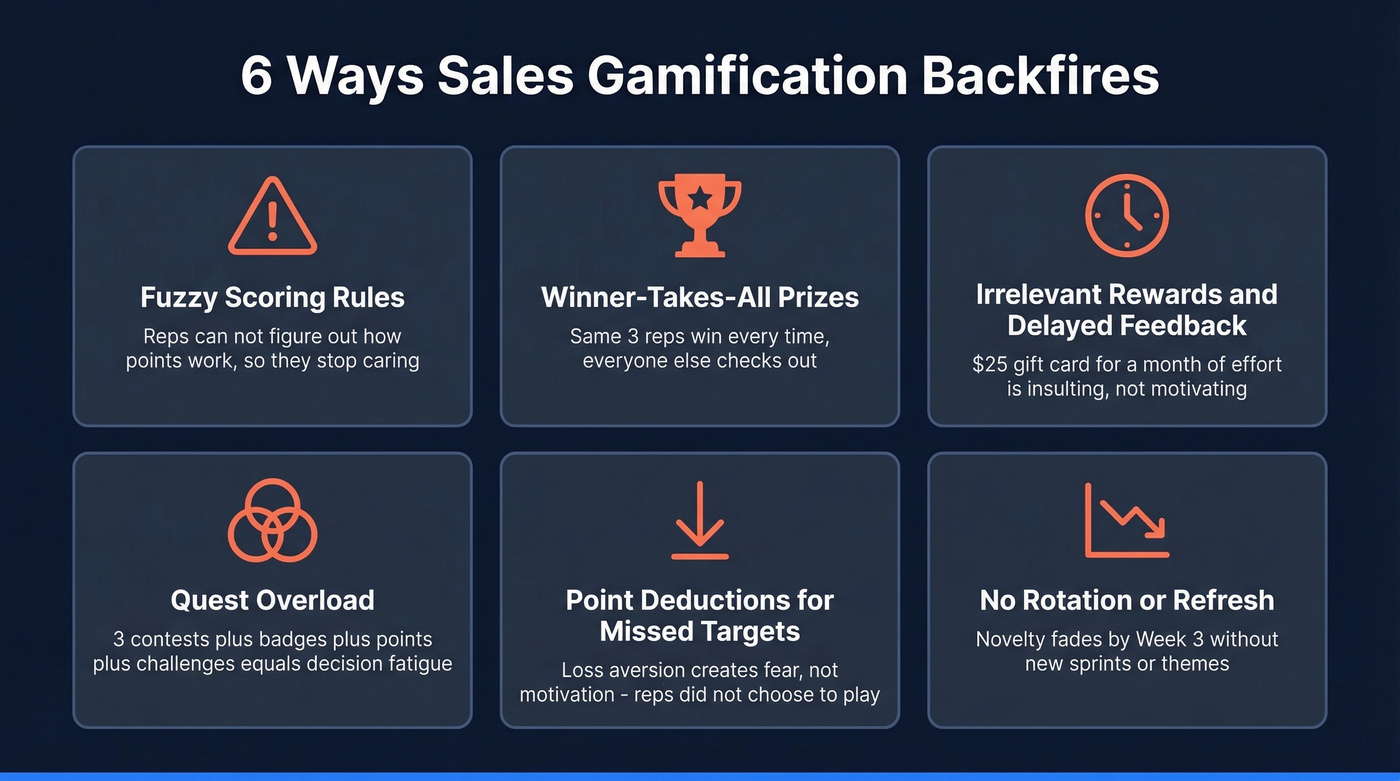
Fuzzy scoring rules destroy trust faster than anything else. When reps can't figure out how points are calculated, they stop caring. Zappos learned this with badges - users couldn't parse what badges meant or how to earn them, and engagement dropped. Publish your scoring matrix before the sprint starts. Freeze rules for the duration.
Winner-takes-all prizes create a spectator sport. If the same three reps win every contest, everyone else mentally checks out. Foursquare's "mayor" mechanic had the same problem - power users locked up status and it became effectively unwinnable for everyone else. The fix: tiered rewards (top 3, top 10, most improved) and "rookie of the sprint" categories.
Irrelevant rewards and delayed feedback are two sides of the same coin - both signal that leadership doesn't take the program seriously. A $25 gift card for a month of effort isn't motivating; it's insulting. And a leaderboard that updates once a day, or worse, shows data errors, kills faith in the entire system. Survey your team quarterly on rewards. Integrate your CRM in near-real-time, or at minimum push scheduled "pulse" updates.
Quest overload - three simultaneous contests, a points system, a badge track, and a weekly challenge - isn't gamification. It's decision fatigue. Run one primary sprint plus one optional side challenge. That's it.
Point deductions for missed targets. Some platforms actively recommend this, framing it as "loss aversion." We disagree. Loss aversion works in games where players chose to play. Sales reps didn't choose gamification; their manager did. Displaying "bottom performers" on the TV dashboard creates fear, not motivation. Additive scoring only. Coach underperformance privately.

You read it above: gamifying bad data is a leaderboard that lies. If more than 5% of your emails bounce, no contest or confetti animation will save your pipeline. Prospeo delivers 98% email accuracy with a 7-day refresh cycle - so every dial, every meeting booked on your leaderboard is real.
Audit your contact data before you gamify a single metric.
What to Gamify (and What Not To)
The Italian Journal of Marketing study is one of the clearest pieces of evidence here: the specific actions you gamify determine whether revenue goes up or down.
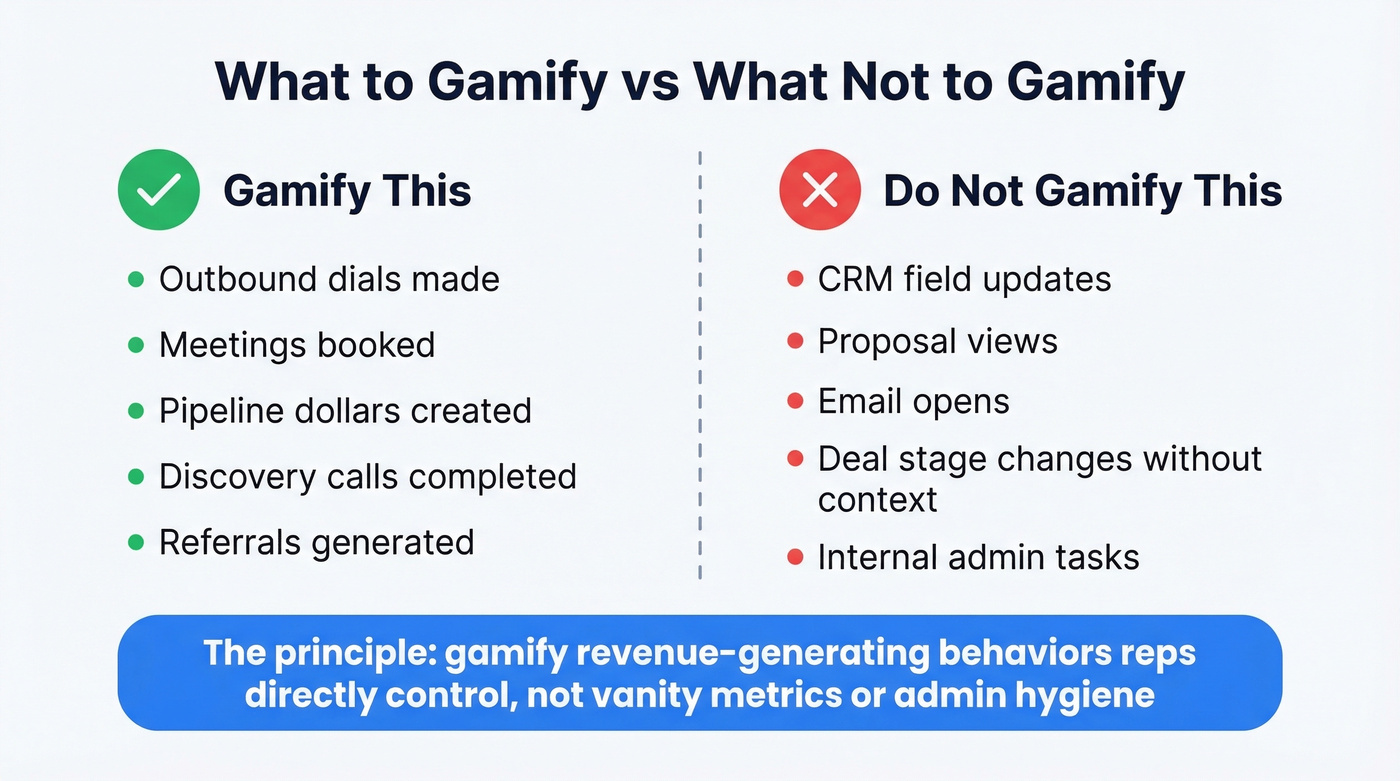
| Gamify This | Don't Gamify This |
|---|---|
| Outbound dials made | CRM field updates |
| Meetings booked | Proposal views |
| Pipeline $ created | Email opens |
| Discovery calls completed | Deal stage changes (without context) |
| Referrals generated | Internal admin tasks |
The principle: gamify revenue-generating behaviors that reps directly control. Don't gamify vanity metrics or administrative hygiene. When you reward CRM data entry, you get reps who are great at filling out fields and mediocre at selling. When you reward dials and meetings, you get reps who pick up the phone.
Let's be honest - if your average deal size is under $10K, you probably don't need dedicated software. A shared spreadsheet, a Slack channel, and a manager who actually recognizes effort will outperform any $20/user/month platform. Gamification tools earn their keep at scale: 25+ reps, multiple teams, distributed offices. Below that, you're paying for confetti animations.
The Rollout Playbook
Don't buy software on Day 1.
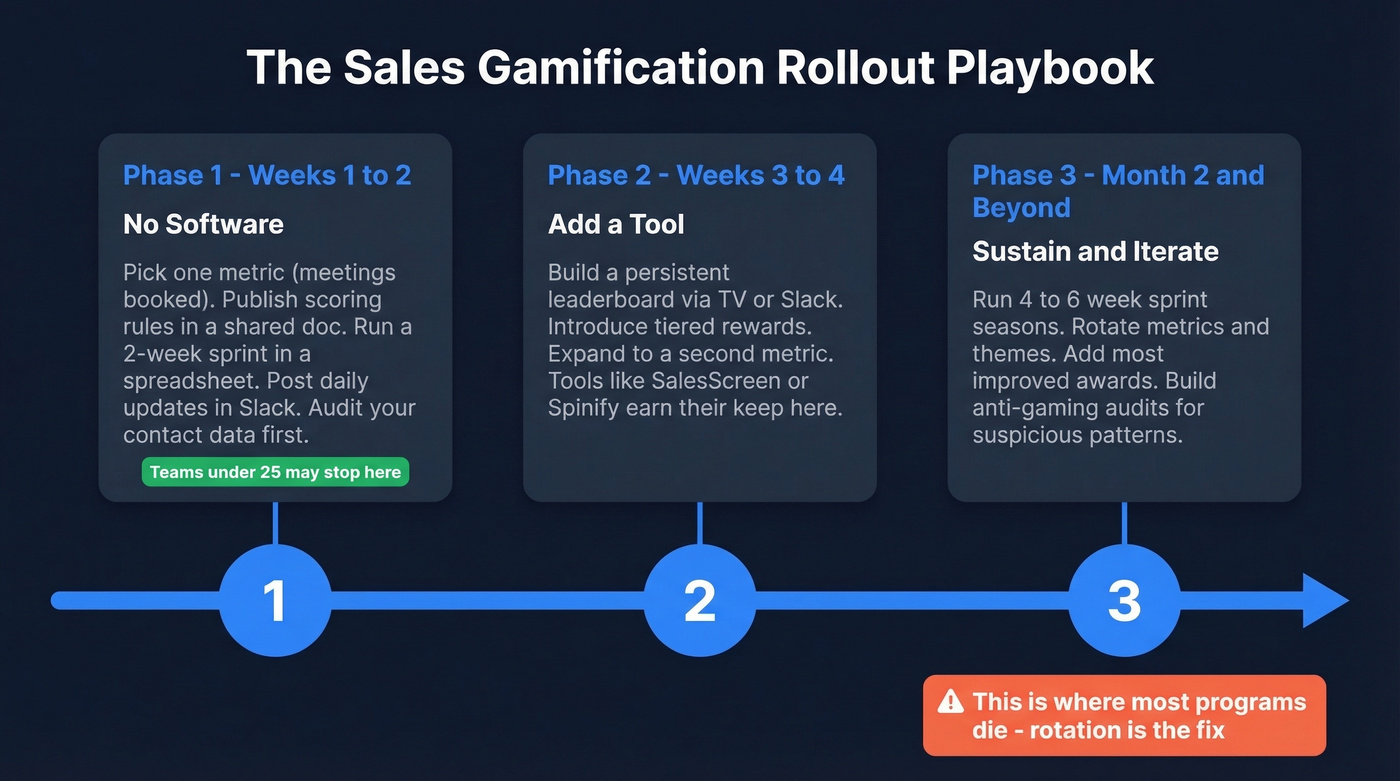
Phase 1: Weeks 1-2 (No Software)
Pick one metric - meetings booked is the safest starting point. Publish scoring rules in a shared doc. Run a two-week sprint tracked in a spreadsheet with daily Slack updates. Step zero: audit your contact data. If more than 5% of your emails bounce, fix your data before you gamify anything. A leaderboard built on bad data is a leaderboard that lies.
For teams under 25, this might be all you ever need.
Phase 2: Weeks 3-4 (Add a Tool)
Phase 1 worked. Your team is checking scores. Now invest in software. Build a persistent leaderboard via TV dashboard or Slack integration, introduce tiered rewards, and expand to a second metric. This is where tools like SalesScreen or Spinify earn their keep.
Phase 3: Month 2+ (Sustain and Iterate)
This is where most programs die. The fix: seasons. Run 4-6 week sprints with different themes, rotate metrics, and introduce "most improved" awards. Build in anti-gaming audits - if a rep's dial count spikes but their connect rate drops, they're gaming the system.
For remote and hybrid teams, use multi-surface access (TV + mobile + Slack) and async-friendly recognition like daily winner emails. Behavior-based KPIs level the playing field regardless of location.
Best Software for Sales Gamification in 2026
When a 300-rep distributed org asked Reddit for recommendations, the shortlist was Ambition, Spinify, SalesScreen, and Hoopla - which tracks with what we've seen. Managers on r/managers want real-world examples because they're skeptical of G2 rankings alone. Fair enough.
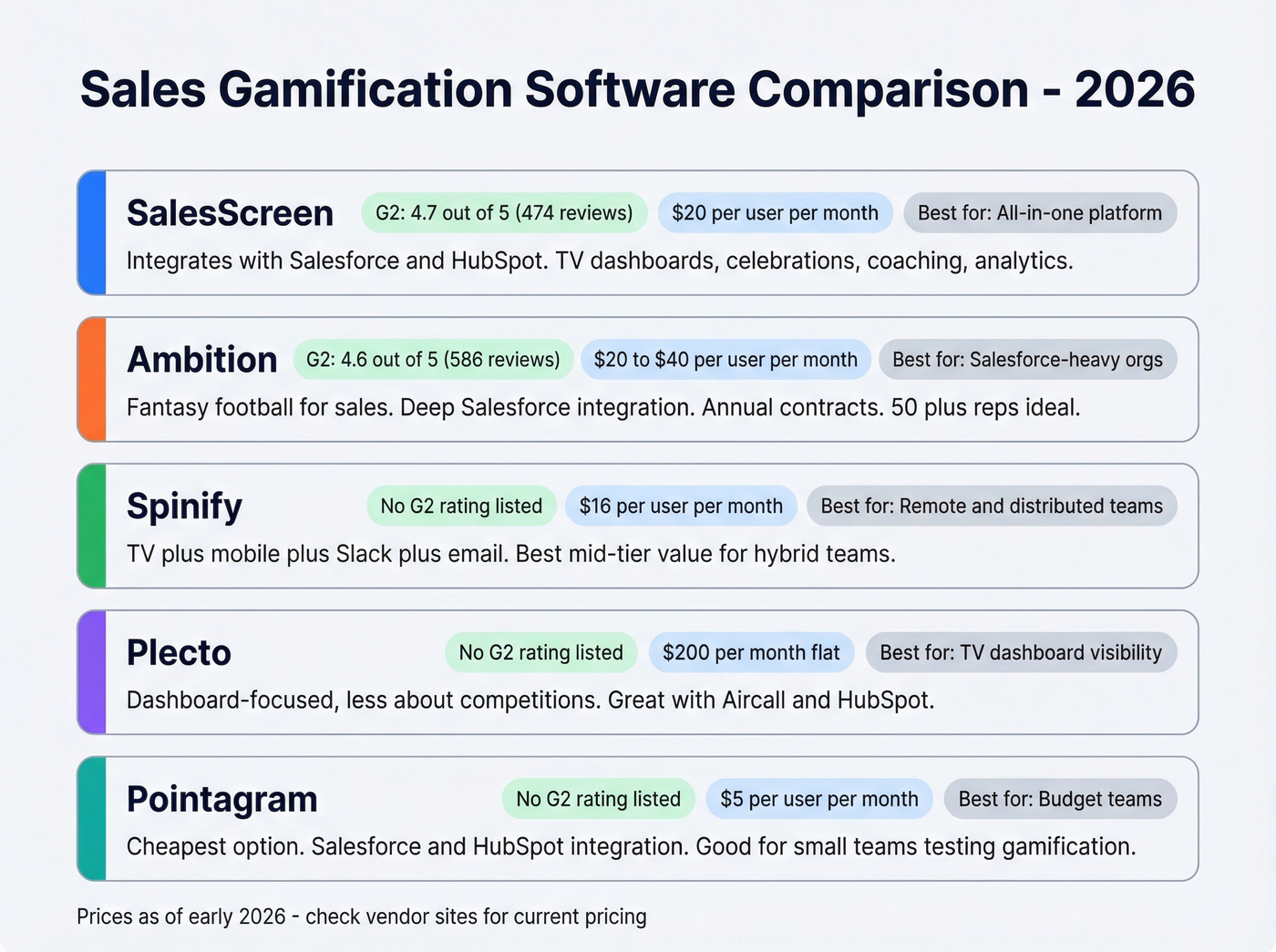
| Tool | G2 Rating | Starting Price | Best For | Key Integration |
|---|---|---|---|---|
| SalesScreen | 4.7/5 (474) | $20/user/mo | All-in-one platform | Salesforce, HubSpot |
| Ambition | 4.6/5 (586) | ~$20-40/user/mo | Salesforce-heavy orgs | Salesforce, Outreach |
| Spinify | - | $16/user/mo | Remote/distributed | Salesforce, Slack |
| Plecto | - | $200/mo flat | TV dashboards | Aircall, HubSpot |
| Pointagram | - | $5/user/mo | Budget teams | Salesforce, HubSpot |
| SmartWinnr | G2 "Easiest to Use" | $15/user/mo | Mobile-first coaching | Salesforce |
| Everstage | - | ~$15-30/user/mo | Commission visibility | Salesforce, HubSpot |
| Centrical | - | ~$20-40/user/mo | Enterprise coaching | Annual contracts |
SalesScreen
The G2 Leader with a 4.7/5 rating across 474 reviews. SalesScreen covers the full stack: TV leaderboards, competitions, celebrations (yes, the confetti), coaching tools, and analytics. At $20/user/month, it's competitively priced. They market a 30% KPI increase within the first six months, and the visual layer is genuinely where it shines - polished TV dashboards, solid mobile experience, and celebration animations that actually drive floor energy. G2 users consistently praise ease of use and motivation impact, though data management issues and customization limitations come up in reviews. Skip this if you're a 5-person team - the ROI doesn't justify the setup.
Ambition
Think fantasy football for sales teams. Managers draft teams, set scoring rules, and run gamified competition sprints that feel more like a league than a corporate initiative. With 586 G2 reviews and a 4.6/5 rating, Ambition has the deepest user base in the category. The catch: expect $20-40/user/month with annual contracts. That's enterprise pricing for what's fundamentally a motivational layer. The Salesforce integration is deep but takes real effort to configure. Best for Salesforce-heavy orgs with 50+ reps who want coaching baked into the same platform.

Spinify
Your distributed team has a problem no leaderboard on a single office TV can solve. Remote reps feel invisible while in-office reps get spontaneous recognition. Spinify was built for this - TV leaderboards, a Salesforce tab, mobile app, daily winner emails, and Slack integration mean no rep falls off the radar regardless of location. At $16/user/month, it's the best value in the mid-tier. If your team is split across offices and home, Spinify should be on your shortlist.
Plecto
A different approach entirely: $200/month flat rate, dashboard-focused, less about competitions and more about real-time visibility. The Insurance Surgery case study - 50% more outbound calls after implementing Plecto with Aircall - is one of the most concrete results in the category. Best for teams that want always-on TV dashboards without per-seat pricing eating into the budget.
Pointagram
The budget pick at $5/user/month. If you're testing whether gamification works before committing to a $20/user platform, Pointagram lets you run the experiment cheaply. Don't expect SalesScreen's polish, but the core mechanics - points, badges, leaderboards - are all there.
Quick Mentions
SmartWinnr ($15/user/month) earns G2's "Easiest to Use" badge. Mobile-first with coaching baked in - solid for field sales teams living on their phones.
Everstage ($15-30/user/month) takes a different angle: commission transparency as gamification. Real-time earnings visibility turns every deal into a visible score.
Centrical ($20-40/user/month) is the enterprise play - coaching, gamification, and performance management in one platform. Expect annual contracts and a longer implementation cycle.
Hoopla (by Raydiant) - custom pricing, TV-focused celebrations. Was on the Reddit shortlist but has been acquired and repositioned toward digital signage. Worth evaluating if you're already in the Raydiant ecosystem.
The Data Problem Nobody Mentions
Look - no gamification vendor will tell you this: your leaderboard is only as accurate as your CRM data. If reps are dialing dead numbers, those "dials made" don't mean anything. If your email list bounces 15%, your "emails sent" metric is fiction. You're gamifying noise.
This connects directly to the trust problem from earlier. When reps see leaderboard positions that don't match reality because the underlying data is garbage, the entire program loses credibility. I've seen a team pull the plug on a $12K annual gamification contract not because the tool was bad, but because their contact data was so stale that the leaderboard rankings felt random.
Before you spend a dollar on gamification software, run your contact list through an email verification tool. Prospeo checks emails at 98% accuracy on a 7-day refresh cycle, and there's a free tier of 75 emails per month to audit whether your CRM data is worth gamifying. If more than 5% of your emails bounce or your phone numbers are disconnected, fix that first. No leaderboard can compensate for bad data.
Your reps are competing on meetings booked and pipeline created. That only works if they're reaching real decision-makers. Prospeo gives your team 300M+ verified contacts, 125M+ direct dials, and 30+ filters to target the right buyers - at $0.01 per email.
Give your sales team data worth competing over.
FAQ
What team size do you need for sales gamification?
Basic contests work with as few as 5 reps using a spreadsheet and Slack. Dedicated software ROI kicks in around 25+ reps, where manual tracking breaks down and multi-team competition becomes possible.
How much does gamification software cost?
Budget tools start at $5/user/month (Pointagram). Mid-range runs $16-20/user/month (Spinify, SalesScreen). Enterprise platforms like Ambition and Centrical typically land at $20-40/user/month with annual contracts.
Does gamification work for remote sales teams?
Yes, but only with behavior-based KPIs - calls made, meetings booked, pipeline created - rather than outcomes that favor in-office visibility. Use multi-surface tools (TV + mobile + Slack) and async recognition like daily winner emails to keep distributed reps engaged.
What are proven sales gamification examples?
The Insurance Surgery saw a 50% increase in outbound calls after implementing Plecto dashboards, and Acrisure reported 45% year-over-year revenue growth with SalesScreen. Both programs gamified specific, controllable behaviors - not just closed-won deals.
How do you prevent leaderboard data from being inaccurate?
Audit your contact database before launching any contest. Verify a sample of emails and phone numbers, and if more than 5% bounce, clean your data first. Gamifying bad metrics erodes rep trust fast, and once that trust is gone, no amount of confetti animations will bring it back.