

ScrapingBee Pricing, Reviews, Pros and Cons for 2026
$49 a month for unlimited scraping sounds great - until you realize JS rendering costs 5 credits per request, premium proxies push it to 25, and stealth hits 75. That $49 plan with 150K credits? It could be 2,000 real requests. Here's an honest look at what ScrapingBee actually costs, where it performs, and where it falls short.
What Is ScrapingBee?
ScrapingBee is an API-based web scraping service that handles headless browsers, proxy rotation, and CAPTCHA solving so developers don't have to manage that infrastructure themselves. Founded in 2019, the company scaled to $5M ARR and 2,500+ customers with just six people. In January 2026, Oxylabs acquired ScrapingBee in an eight-figure deal.
The web scraping market hit $1.03B in 2025 and is growing at 14.2% annually - ScrapingBee sits squarely in that growth, though the acquisition raises questions about what changes are coming and how fast.
30-Second Verdict
ScrapingBee is easy to set up and has excellent documentation. But the headline pricing misleads once credit multipliers kick in.
Scrapeway's benchmark shows a 31% overall success rate across 13 popular targets, with 0% on linkedin.com, walmart.com, twitter.com, stockx.com, zillow.com, and realtor.com. It's a solid pick for simple, low-volume scraping of moderately protected sites. If you're targeting heavily guarded pages at scale, the credit math and success rates will hurt.
Pricing Breakdown
Plan Tiers
All prices exclude VAT. The free tier gives you 1,000 credits with no credit card required - enough to test basic workflows before committing.
| Plan | Price | Credits | Concurrency |
|---|---|---|---|
| [Freelance | $49/mo | 150K](https://www.scrapingbee.com/pricing/) | 5 |
| Startup | $99/mo | 1M | 50 |
| Business | $249/mo | 3M | 100 |
| Business+ | $599/mo | 8M | 200 |
Custom plans are available above 41M credits/month.
How Credits Actually Work
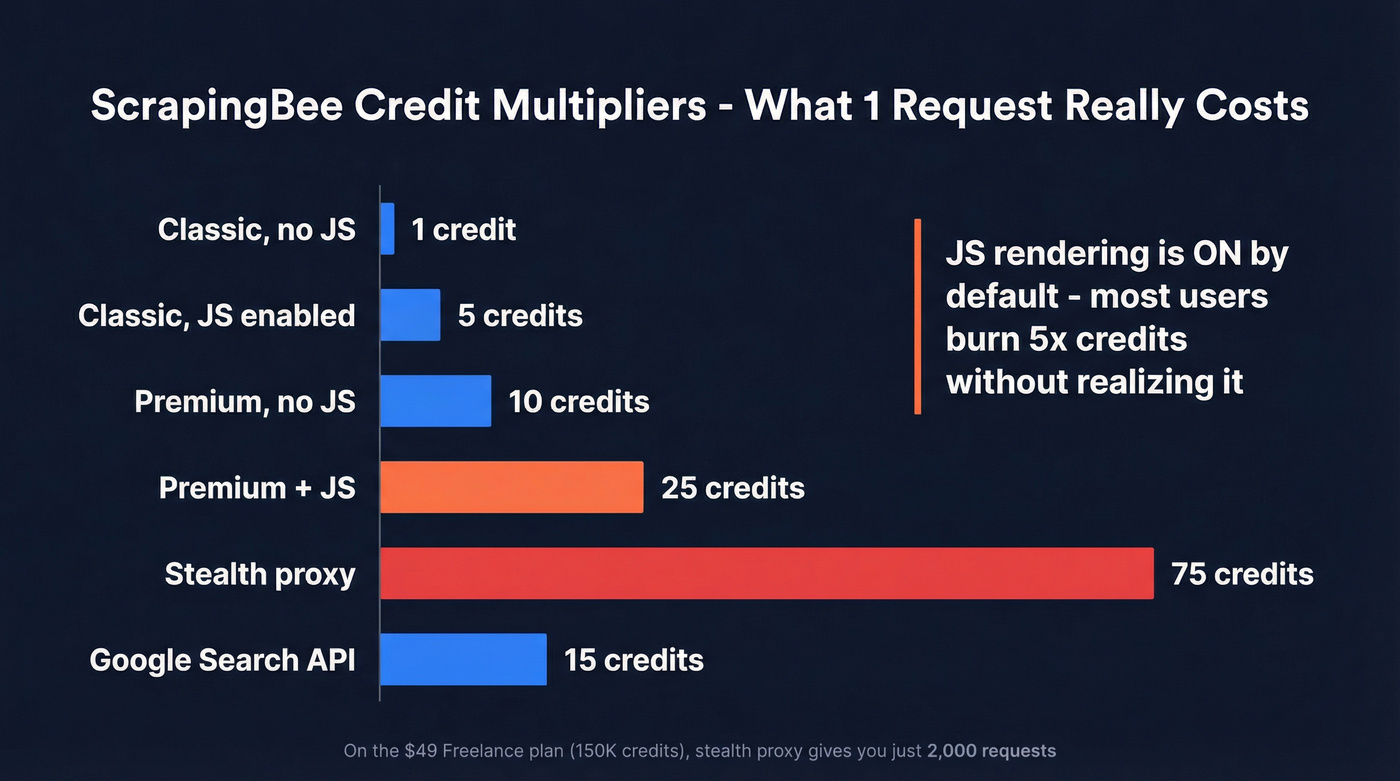
One credit doesn't equal one request. The actual cost depends on your proxy type, whether JavaScript rendering is enabled, and whether you're using AI extraction.
| Configuration | Credits/Request |
|---|---|
| Classic, no JS | 1 |
| Classic, JS enabled | 5 |
| Premium, no JS | 10 |
| Premium, JS enabled | 25 |
| Stealth proxy | 75 |
| AI query add-on | +5 per request |
| Google Search API call | 15 |
Here's the thing: JS rendering is enabled by default. Most users burn 5 credits per request from day one without realizing it.
What 10,000 Pages Actually Costs
We ran the numbers that the pricing page doesn't spell out:
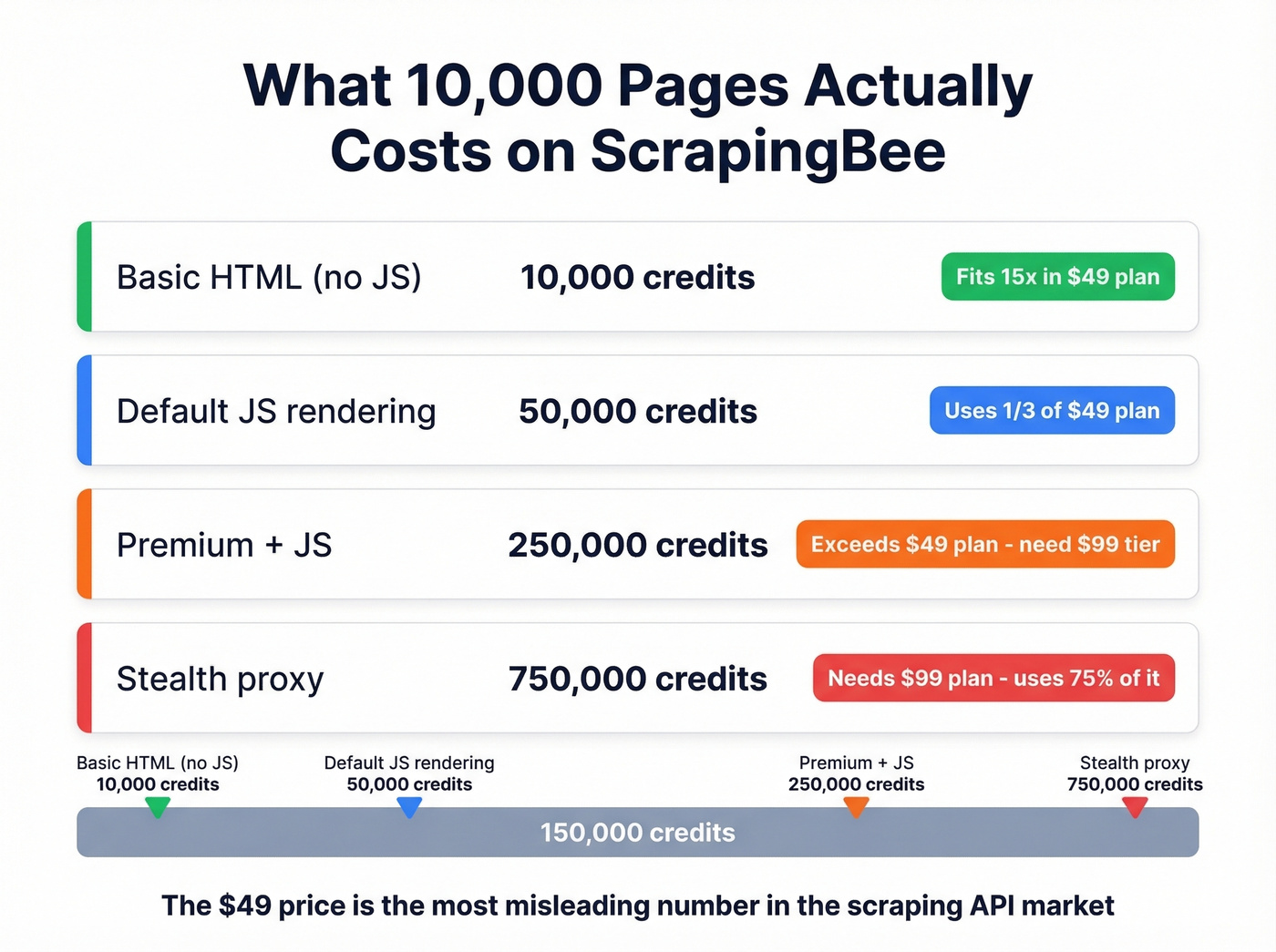
- Basic HTML (no JS): 10,000 x 1 = 10,000 credits. Your $49 plan covers this 15 times over.
- Default JS rendering: 10,000 x 5 = 50,000 credits. One-third of your Freelance plan on a single job.
- Premium + JS: 10,000 x 25 = 250,000 credits. You've blown past the $49 plan entirely.
- Stealth proxy: 10,000 x 75 = 750,000 credits. The $49 plan won't touch it. The $99 tier covers it, but you've used 75% of your monthly allotment on one run.
The Freelance plan buys 150,000 basic HTML requests OR just 2,000 stealth requests. That gap is the whole story.
The $49 entry price is the most misleading number in the scraping API market. Most real-world jobs require JS rendering at minimum, which means your effective starting price is closer to $49 for ~30K JS-rendered requests - not 150K.
Pros Worth Knowing
ScrapingBee's setup speed is its biggest strength. We were making API calls within minutes, and the documentation is among the best in the scraping API space - clear examples, well-organized, no guesswork.
Support was already responsive pre-acquisition; after joining Oxylabs, the team more than doubled and now covers multiple time zones. The 4.9/5 on Capterra across 137 reviews reflects this - users consistently praise the API design and how quickly they can get a proof-of-concept running.
Response times clock in at 2.8s average, well below the 8.7s industry average. The AI extraction feature, which lets you describe what you want in plain English instead of writing CSS selectors, costs +5 credits per request but saves real development time on unstructured pages. For teams without dedicated scraping engineers, that trade-off makes sense.

Scraping LinkedIn for contact data? ScrapingBee's benchmark shows 0% success on linkedin.com. Prospeo gives you 300M+ professional profiles with 98% verified emails and 125M+ mobile numbers - no scraping infrastructure, no credit multipliers, no failed requests.
Skip the scraper. Get the data directly for $0.01 per email.
Cons That Matter
Credit burn at scale is brutal. JS rendering (the default) costs 5x. Premium proxies cost 25x. Stealth costs 75x. The consensus on r/webscraping echoes this frustration: "confusing credit-based pricing" that's "deceptively affordable until the bills pile up."
Credits are often charged even when requests get blocked - you're paying for failures. They don't roll over either, so there's no banking for burst usage.
But the success rate numbers are the real problem. Across 13 popular scraping targets, Scrapeway shows ScrapingBee hit just 31% - roughly half the 58.2% industry average. linkedin.com, walmart.com, zillow.com, twitter.com, stockx.com, and realtor.com all returned 0% success. If you need data from heavily protected sites, this tool simply won't get you there.
Benchmark Performance
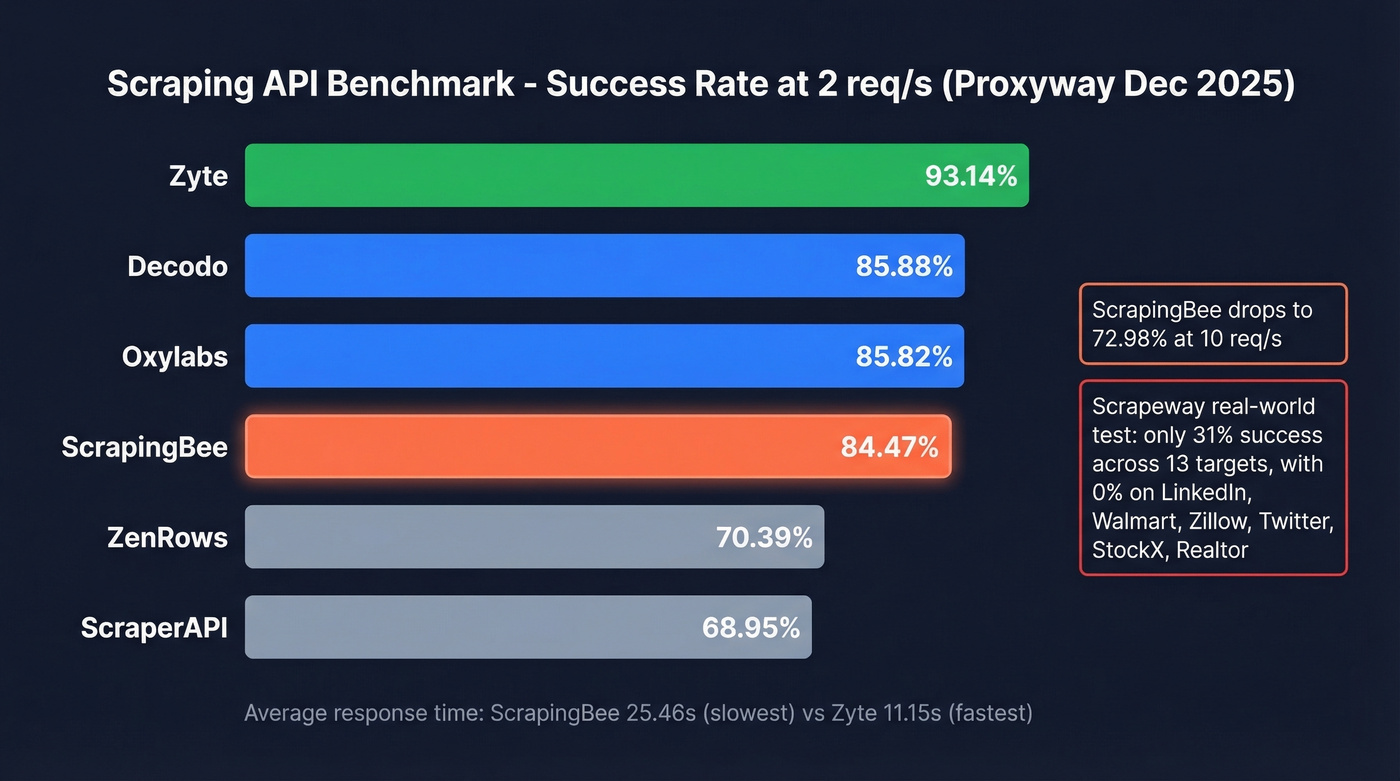
Proxyway's December 2025 benchmark tested 12 providers across 15 well-protected websites, 6,000 pages each:
| Provider | Success (2 req/s) | Avg Response | Cost/1K Range |
|---|---|---|---|
| Zyte | 93.14% | 11.15s | $0.06-$8.16 |
| Decodo | 85.88% | 15.22s | $0.14-$1.20 |
| Oxylabs | 85.82% | 16.76s | $0.37-$1.15 |
| ScrapingBee | 84.47% | 25.46s | $0.08-$6.23 |
| ZenRows | 70.39% | 19.10s | $0.08-$2.08 |
| ScraperAPI | 68.95% | 13.92s | $0.10-$7.13 |
ScrapingBee's 84.47% at 2 req/s looks respectable, but it drops to 72.98% at 10 req/s, and the 25.46s average response time is the slowest in this group. The Scrapeway data paints a harsher picture: 31% overall success across real-world targets with six major sites at 0%.
Two different benchmarks, two very different stories. Our take: the Proxyway numbers reflect controlled conditions, while Scrapeway's reflect what you'll actually hit in production.
After the Oxylabs Acquisition
The January 2026 acquisition brought concrete changes. Google Search API calls dropped from 25 to 15 credits - a meaningful cut for SERP scraping. No price increase hit existing subscriptions. The first wave of infrastructure-driven performance improvements is expected around June 2026. ScrapingBee operates as a separate brand, so don't expect a sudden Oxylabs rebrand.
Whether Oxylabs' proxy infrastructure will fix the success rate problems on hard targets remains to be seen. We'll update this piece when those improvements ship.
Who Should (and Shouldn't) Use It
Use it if you're scraping simple-to-moderate sites at low volume, you value clean docs and fast setup, or you're running basic HTML extraction where 1-credit requests keep costs sane.
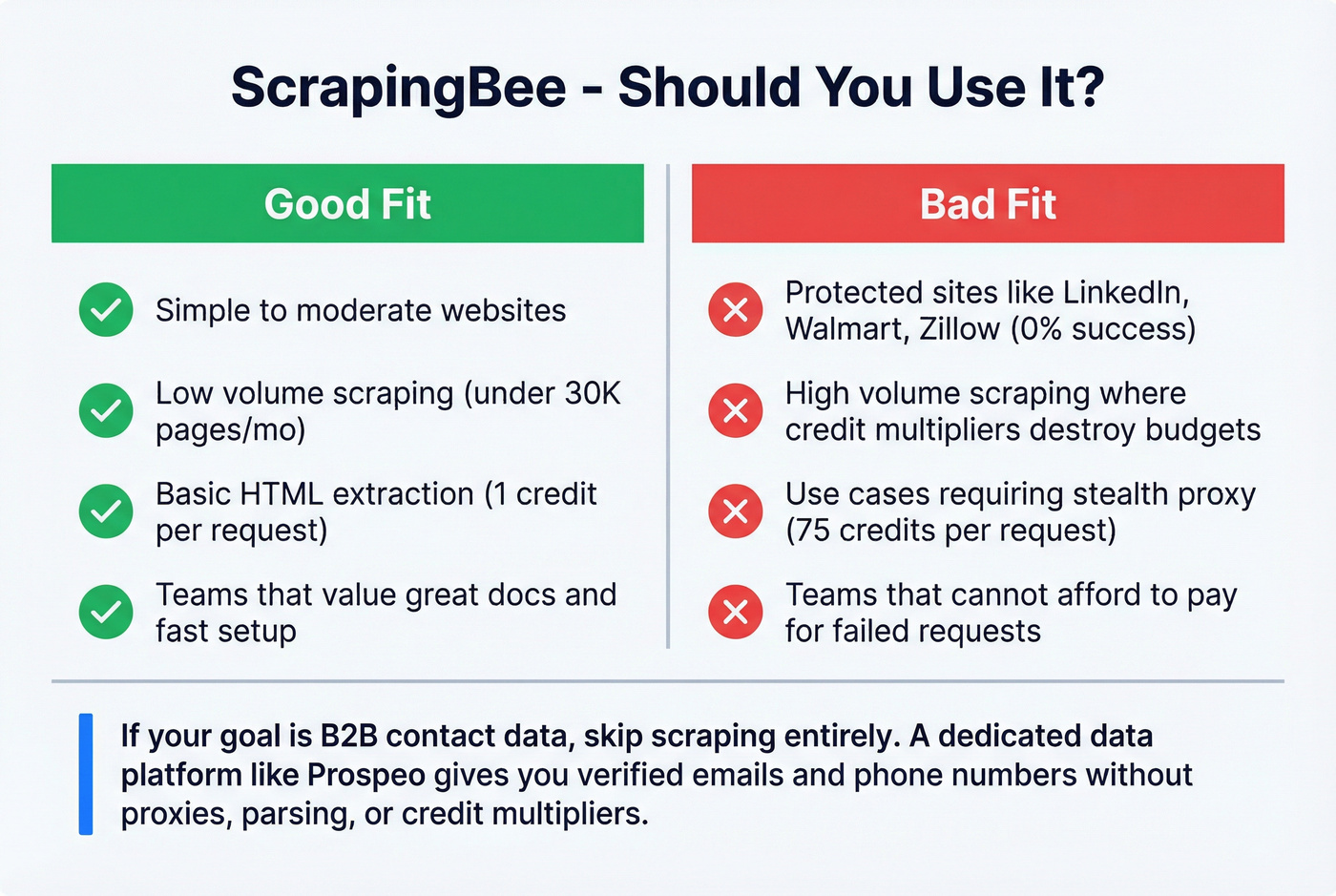
Skip it if you're targeting protected sites like linkedin.com, walmart.com, or zillow.com - all 0% success in Scrapeway's benchmark. Same goes for anyone scraping at scale where credit multipliers destroy your budget, or if paying for failed requests isn't something you're willing to accept.
Alternatives Worth Considering
Zyte - Best for Raw Performance
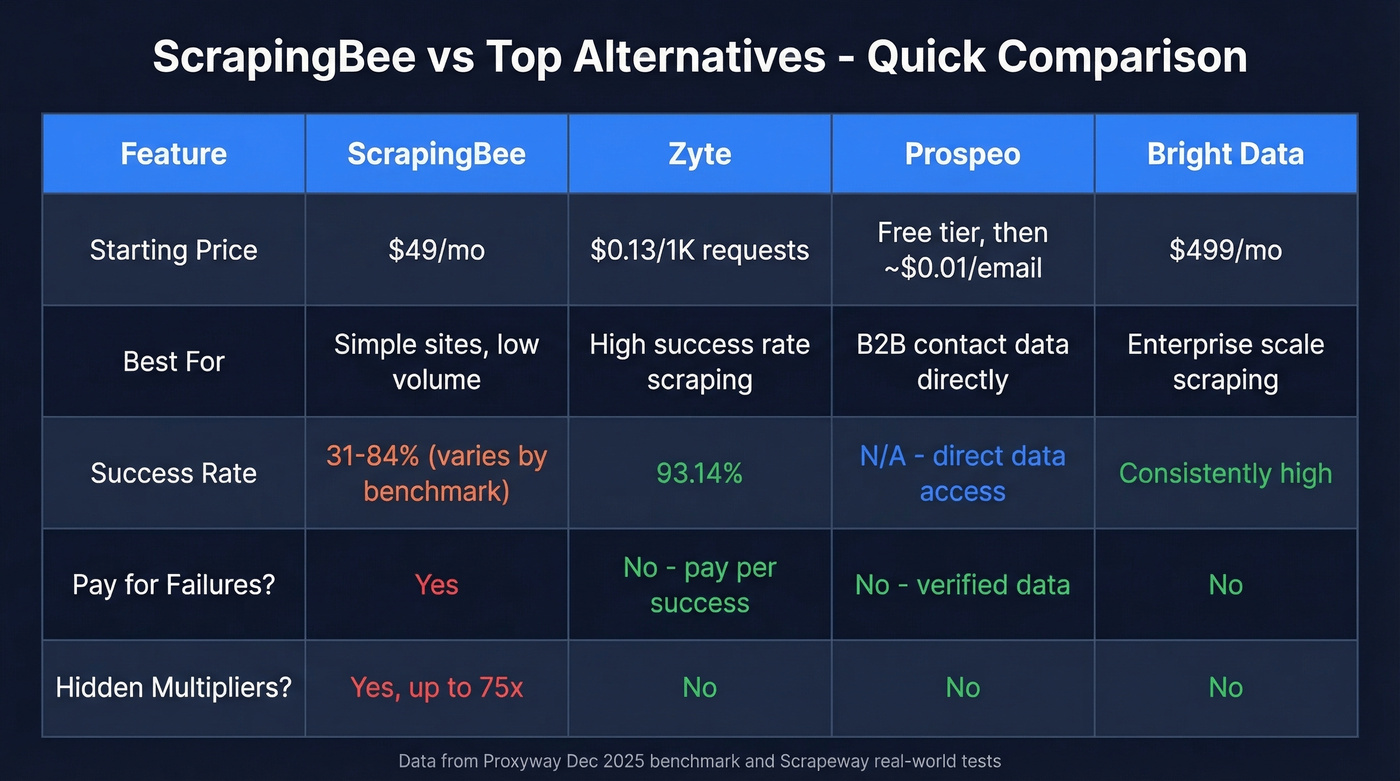
Zyte is the performance leader: 93.14% success rate in the Proxyway benchmark, the highest of any provider tested. The pricing model is fundamentally different - $0.13 per 1K HTTP requests, $1.00 per 1K browser renders, and you only pay for successful requests. If you can't afford to burn credits on failures, Zyte is the strongest option right now.
Prospeo - When You Don't Need Raw HTML
Let's be honest: a lot of people researching scraping APIs are really just trying to build B2B prospect lists. If that's you, scraping is the hard way. Prospeo gives you 143M+ verified emails and 125M+ mobile numbers through a search interface with 30+ filters - 98% email accuracy, a 7-day data refresh cycle, and a free tier to test. Different category entirely, but for anyone who landed here trying to find contact data, it's the faster path by a wide margin. If you want the broader landscape, see our ScrapingBee alternatives breakdown.
ScraperAPI - Lateral Move
Same price, worse results. $49/mo entry point, 100K credits, similar multiplier structure. Benchmarks show 68.95% success and lower reliability overall. It's not an upgrade.
Bright Data - Enterprise Scale
Starts at $499/mo with 72M+ residential IPs. Overkill for most teams, but if you need guaranteed success on hard targets at high volume, Bright Data is the option that consistently delivers.
Credit multipliers turn a $49 plan into $249 fast. Prospeo's pricing is transparent: ~$0.01 per verified email, 10 credits per mobile number, no hidden multipliers. 15,000+ companies already switched to data that connects on the first try.
Stop paying 75 credits for data you can get in one click.
FAQ
Does ScrapingBee have a free plan?
Yes - 1,000 free credits with no credit card required. That's enough for 200 JS-rendered requests or 1,000 basic HTML requests. Sufficient to test the API, but not enough to evaluate performance at realistic scale.
Why do my credits run out so fast?
Credit multipliers. JS rendering costs 5 credits per request and it's enabled by default. Premium proxies cost 25, stealth costs 75. Your 150K-credit Freelance plan might only cover 2,000-30,000 real requests depending on your settings. Disable JS rendering on requests that don't need it - that's the single biggest lever.
Is ScrapingBee worth it after the Oxylabs acquisition?
For low-volume scraping of moderately protected sites, yes - especially with the Google API credit reduction. For high-volume or hard-target scraping, benchmark Zyte first. Post-acquisition improvements haven't shipped yet, so judge it on current performance, not promises.
What if I just need B2B contact data, not raw HTML?
Skip scraping APIs entirely. Prospeo provides 143M+ verified emails and 125M+ mobile numbers with 98% accuracy - no proxies, no parsing, no credit multipliers. The free tier includes 75 emails per month, and paid plans start at roughly $0.01 per lead. If your end goal is prospect lists, a dedicated data platform saves weeks of engineering time.