

ScrapingBee vs ScraperAPI: Honest Comparison (2026)
Both tools charge $49/mo at the entry level. Both hit ~92.7% success rates in independent benchmarks. So why does ScrapingBee cost less than half per thousand requests? And why might ScraperAPI still be the better pick for your stack?
Let's break it down.
30-Second Verdict
ScrapingBee wins on cost-per-request ($3.90 vs $8.49 per 1K) and response speed (11.7s vs 15.7s average). It's the better pick for JS-heavy scraping where you need screenshots and custom browser control.
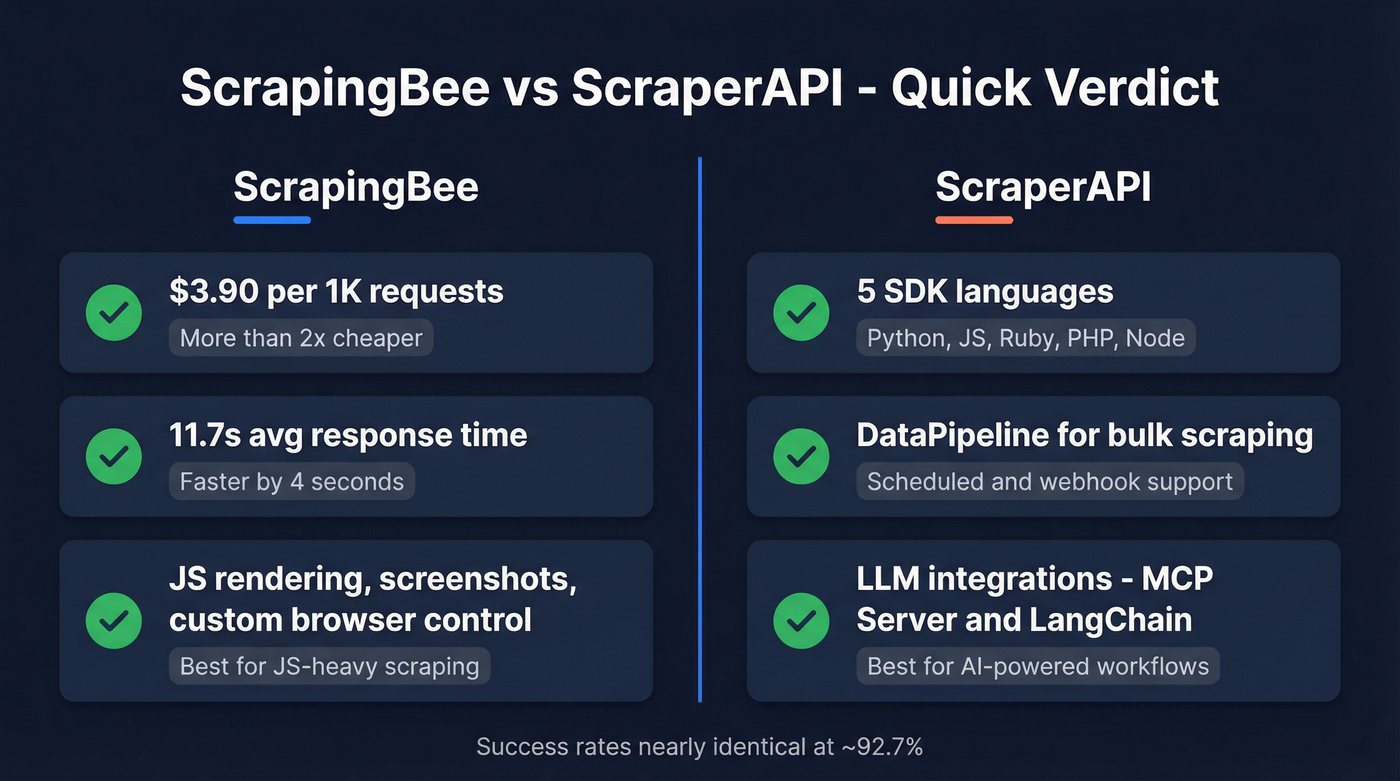
ScraperAPI wins on SDK breadth (5 languages vs 2), bulk pipelines via DataPipeline, and LLM integrations through its MCP Server and LangChain support. If you're building AI-powered scraping workflows, it's the more future-proof choice.
Quick Feature Comparison
| Feature | ScrapingBee | ScraperAPI |
|---|---|---|
| Rating | 4.8/5 (Exafol aggregate) | 4.4/5 (G2, 16 reviews) |
| Starting price | $49/mo | $49/mo |
| Free tier | 1,000 free API calls | 1,000 credits/mo + 7-day trial |
| SDK support | Python, Node | Python, JS, Ruby, PHP, Node |
| Best for | JS rendering, screenshots | Bulk pipelines, LLM workflows |
| Key strength | Cost efficiency | Integration breadth |
Those ratings come from different platforms - Exafol aggregates multiple sources while G2 reflects verified user reviews - so treat them as directional, not directly comparable.
Pricing Breakdown
Both tools start at $49/mo, but the similarity ends there. The real cost depends on what kind of requests you're making and how many credits each one burns. Proxyway's 2025 report found that variable pricing models can cost up to 100x more at premium configurations. Read the fine print.
ScrapingBee Tiers
| Plan | Price | Credits | Concurrency |
|---|---|---|---|
| Freelance | $49/mo | 250K | 10 |
| Startup | $99/mo | 1M | 50 |
| Business | $249/mo | 3M | 100 |
| Business+ | $599/mo | 8M | 200 |
JavaScript rendering, rotating proxies, geotargeting, and screenshots are available across all plans. Higher tiers mainly scale usage and add more support options.
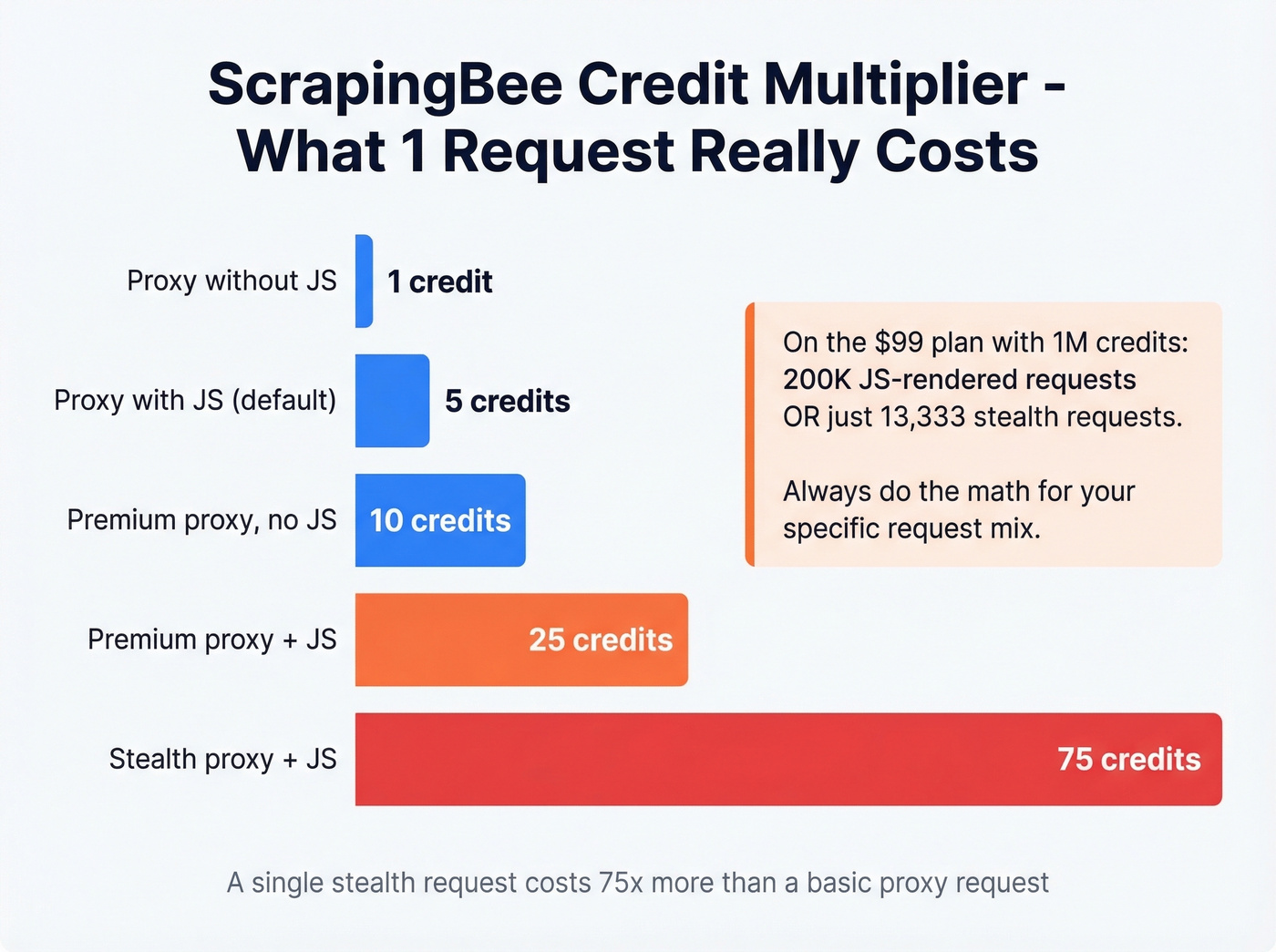
Here's the thing most people miss: ScrapingBee uses a credit multiplier system where a single request can cost far more than 1 credit depending on the proxy mode and whether you render JavaScript.
| Request Type | Credits |
|---|---|
| Proxy without JS | 1 |
| Proxy with JS (default) | 5 |
| Premium proxy, no JS | 10 |
| Premium proxy + JS | 25 |
| Stealth proxy + JS | 75 |
On the $99 plan, 1M credits gets you 200K JS-rendered requests - or just 13,333 stealth requests. Always do the math for your exact request mix before you pick a tier.
ScraperAPI Tiers
| Plan | Price | Est. Credits | Est. Concurrency |
|---|---|---|---|
| Hobby | $49/mo | ~100K | ~20 |
| Startup | $149/mo | ~500K | ~50 |
| Business | $299/mo | ~1M | ~100 |
| Scaling | $475/mo | ~3M | ~200 |
| Enterprise | Custom | Custom | Custom |
ScraperAPI's plan structure scales credits and concurrency as you move up, with custom options at the enterprise level.
Watch out: ScraperAPI's auto-upgrade billing rolled out in late 2025 and fully replaced the old system in January 2026. If you exceed your plan's credits, you'll automatically bump to the next tier unless you set a monthly spending cap. Set one immediately.
In independent benchmark testing, ScrapingBee averaged $3.90 per 1K requests versus ScraperAPI's $8.49 - more than double. That delta adds up fast at scale.
Feature-by-Feature Breakdown
| Feature | ScrapingBee | ScraperAPI |
|---|---|---|
| SDK languages | Python, Node | Python, JS, Ruby, PHP, Node |
| Proxy types | Datacenter, residential, stealth | Datacenter, residential, mobile |
| Geolocation | Most countries (all plans) | 2-13 countries (tier-dependent) |
| Webhooks | No | Yes |
| Custom JS execution | Yes | No |
| Browser control | Yes (up to 40s) | No |
| Screenshots | Yes | No |
| Session duration | 5 min | 15 min |
| Bulk/scheduled scraping | No | Yes (DataPipeline) |
| LLM integrations | No | Yes (MCP Server, LangChain) |
| Max request size | Not public | 50MB |
| Recommended timeout | Not public | 70 seconds |
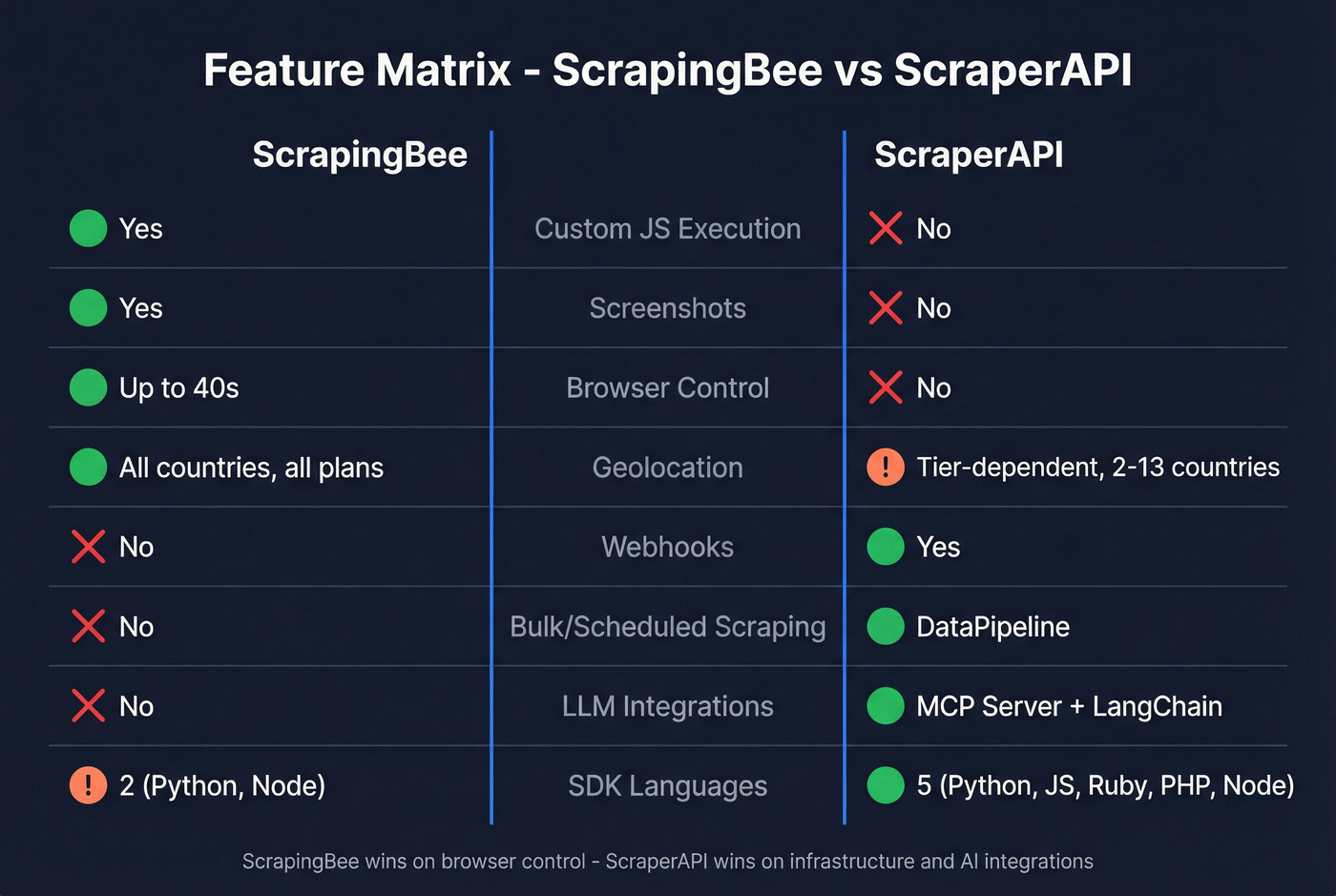
The feature gaps tell a clear story. ScrapingBee gives you more control over the browser - custom JS, screenshots, broader geolocation on every plan. ScraperAPI gives you more infrastructure - webhooks, bulk scheduling through DataPipeline, and the ability to plug scraping directly into LLM workflows via its MCP Server. Different priorities for different workflows.
That 50MB request size limit on ScraperAPI matters if you're scraping media-heavy pages or large JSON responses. And their 70-second timeout recommendation for protected targets means your pipeline needs to handle slow responses gracefully.
Our take: ScraperAPI's LLM integrations are the most interesting development in this space right now. If you're building agents that need to scrape and reason over web data, ScraperAPI is the only one of these two with a real answer for that. ScrapingBee is still building for last year's use cases. That said, most teams scraping today aren't building AI agents - they're extracting product prices and job listings. Don't pay for a future you don't need yet.

Scraping APIs get you raw HTML. You still need to parse it, clean it, and find contact data - all while burning credits on JS rendering. Prospeo gives you 143M+ verified emails and 125M+ mobile numbers directly, at $0.01/email with 98% accuracy.
Stop scraping for leads. Start finding them in seconds.
Performance Benchmarks
| Metric | ScrapingBee | ScraperAPI |
|---|---|---|
| Avg success rate | 92.69% | 92.70% |
| Avg response time | 11.7s | 15.7s |
| Avg cost per 1K | $3.90 | $8.49 |
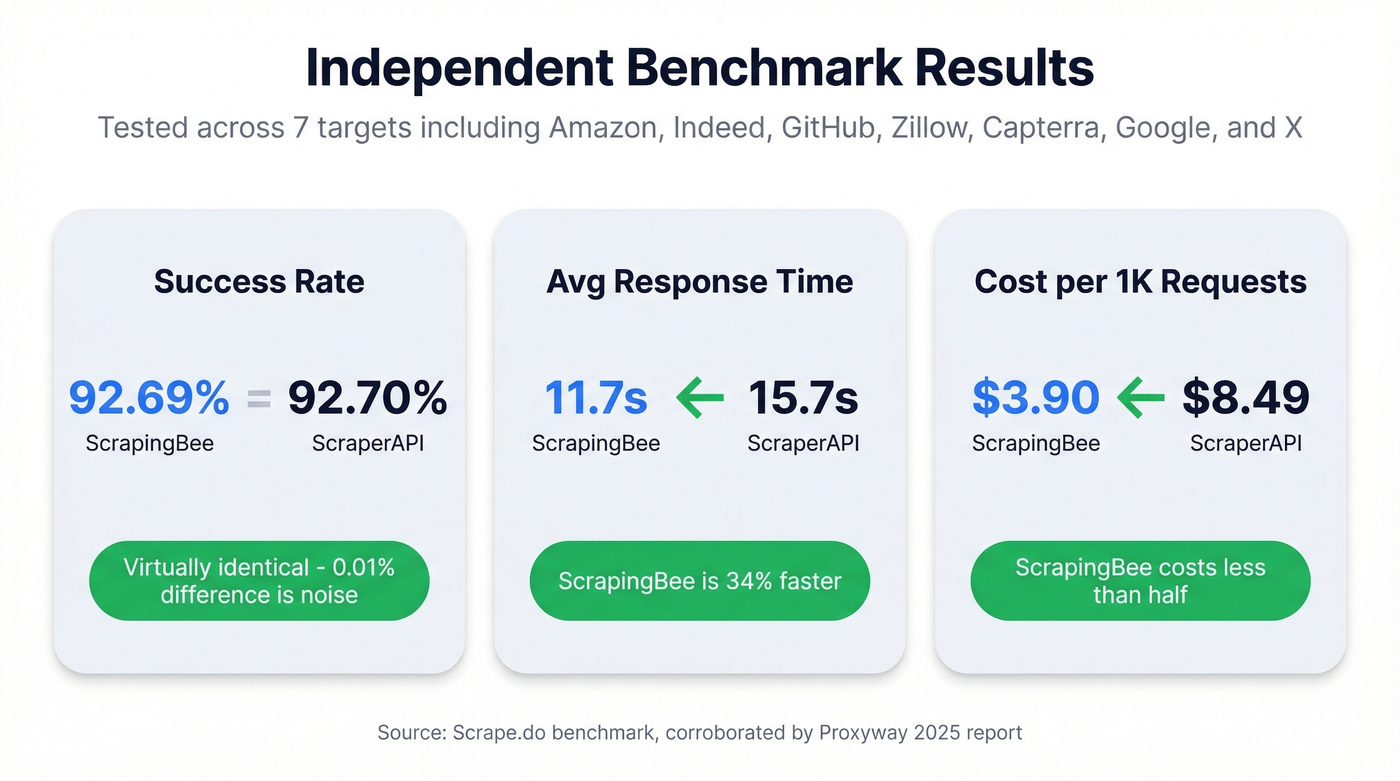
These numbers come from Scrape.do's benchmark across 7 challenging targets including Amazon, Indeed, GitHub, Zillow, Capterra, Google, and X. Success rates are functionally identical - a 0.01% difference is noise.
We've seen benchmark results vary by testing window, though. A July 2025 Scrapeway benchmark showed notably different success rates for both tools, reinforcing that no single benchmark tells the whole story. Proxyway's 2025 report tested 11 APIs against 15 protected websites using ~6,000 unique URLs per target at 2 and 10 requests per second from a US server with a 600-second timeout - conditions that stress-test real-world reliability. Their findings align: ScrapingBee landed in the 80%+ success tier alongside Zyte, Decodo, and Oxylabs, while ScraperAPI was flagged as one of the fastest responders. Proxyway also identified Shein, G2, and Hyatt as the hardest targets across all APIs tested - useful to know if those are on your scraping list.
Both tools are reliable. Don't pick based on success rate. Pick based on features, cost, and how each fits your pipeline.
What Users Actually Say
ScraperAPI earns praise on G2 for easy integration - developers drop in a single API call and let it handle proxies and CAPTCHAs automatically. The complaints center on pricing that escalates quickly at high volume, rate-limiting issues on certain targets, and a billing system that multiple reviewers call confusing.
ScrapingBee users consistently highlight strong JS rendering out of the box and competitive cost-per-request. The downsides mirror ScraperAPI's: increasing failures on heavily protected sites and a credit multiplier system that makes it easy to burn through credits faster than expected.
One r/webscraping thread highlighted failures with both tools on protected sites and described ScrapFly working more reliably for that specific setup. Neither tool is bulletproof against aggressive anti-bot measures - if you're scraping sites with Cloudflare Turnstile or advanced fingerprinting, expect to test multiple providers regardless.
When to Choose Which
Choose ScrapingBee if you're scraping JS-heavy sites built on React, Vue, or Angular and cost efficiency matters. It delivers more requests per dollar, offers screenshots and custom JS execution, provides broader geolocation coverage on every plan, and works well if your team lives in Python or Node.
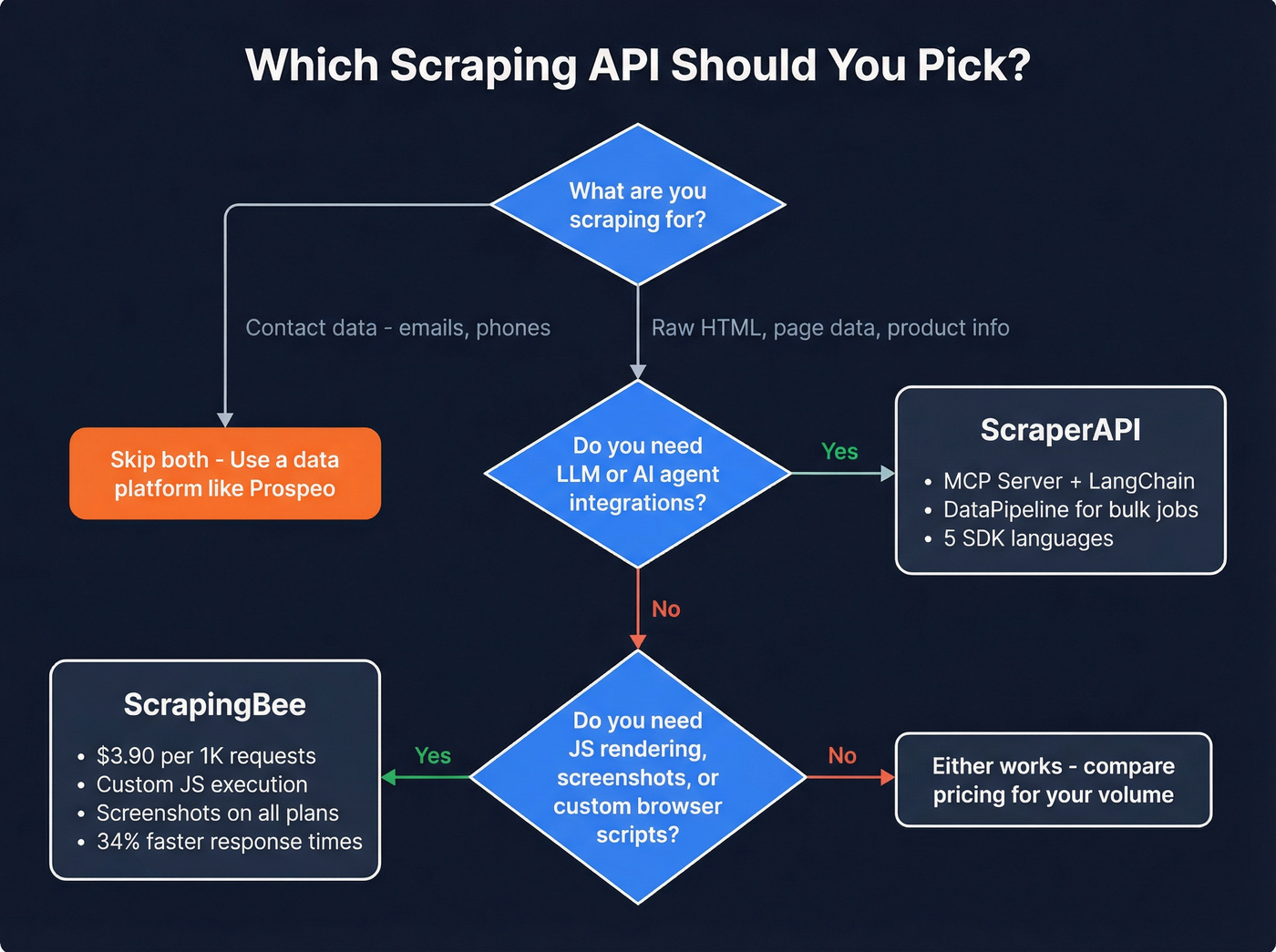
Choose ScraperAPI if your team works in Ruby, PHP, or other languages beyond Python and Node, you need bulk or scheduled scraping via DataPipeline, you're building AI/LLM workflows that benefit from native MCP Server or LangChain integration, webhook support is a requirement, or you need longer session persistence at 15 minutes versus ScrapingBee's 5.
What If Neither Is Right?
For a pure scraping alternative, ScrapFly comes up often among developers for protected targets, with paid plans starting around $30/mo. Apify offers a broader platform with pre-built actors for common scraping tasks at $49-499/mo depending on usage.
But here's what we see constantly: a huge chunk of people comparing scraping APIs are really trying to extract business contact data - emails, phone numbers, job titles. If that's you, you don't need a scraping API at all. You need a data platform.

Prospeo gives you 143M+ verified emails and 125M+ mobile numbers across 300M+ professional profiles - searchable with 30+ filters, exportable via API or Chrome extension, and refreshed every 7 days versus the 6-week industry average. Email accuracy runs 98%. No code, no proxies, no credit multipliers. It starts free with 75 emails/month, and paid plans begin around $39/mo.
At $3.90-$8.49 per 1K scraping requests, you're paying for proxy rotation and CAPTCHA solving just to extract contact info from LinkedIn and company sites. Prospeo's database delivers verified emails and direct dials with 30+ filters - no scraping infrastructure required.
Cut the scraping stack. Get the data you actually need for $0.01/lead.
FAQ
Is ScrapingBee cheaper than ScraperAPI?
At benchmark level, yes - ScrapingBee averages $3.90 per 1K requests versus ScraperAPI's $8.49. But effective cost depends on request type. ScrapingBee's stealth proxy burns 75 credits per request, which can flip the math at high volumes. Always calculate your real credit consumption before comparing plans.
Which has a better success rate?
They're virtually identical at ~92.7% in independent benchmarks, though results vary by testing window and target site. Don't pick based on success rate - pick based on SDK support, features, and cost per request for your specific use case.
Can either handle heavily protected sites?
Both struggle with aggressive anti-bot measures like Cloudflare Turnstile and advanced fingerprinting. ScrapingBee's stealth proxy mode helps but costs 75 credits per request. ScraperAPI recommends a 70-second timeout for protected targets. Test both on your specific targets before committing to an annual plan.
What if I just need business emails, not raw HTML?
Skip scraping APIs entirely. Prospeo provides 143M+ verified emails and 125M+ mobile numbers through a searchable database, Chrome extension, or API - no scraping code needed. It starts free with 75 emails/month, with paid plans from ~$39/mo. For teams that just need contact data, it's faster and cheaper than building a scraping pipeline.