

Subject Lines for Reaching Out Emails: What 36M+ Emails Prove Works
You've rewritten the body three times, tweaked the CTA, agonized over the PS line - but you've been staring at the subject line for ten minutes. That's because the subject line is the pitch. A Belkins study of 5.5M+ emails and Hunter's analysis of 31M more give us hard numbers on what actually gets opened. You don't need 100 templates. You need three proven patterns - short and specific, personalized reference, and question-based - plus clean data backing every outreach subject line you write.
The Quick Version
- Keep the core message under 33 characters. That's the universal safe zone across major mobile clients.
- Aim for 2-4 words. This length hits 46% open rates - the highest of any bracket.
- Personalize with two variables, not just first name. Two custom attributes lift opens to 40.2% vs. 35.4% with one.
- Verify your list before sending. The best subject line in the world doesn't matter if the email bounces.
What 36M+ Emails Reveal
Belkins analyzed 5.5M+ cold emails sent throughout 2024 and published their findings in early 2025. Personalized subject lines hit a 46% open rate versus 35% without - and reply rates jumped from 3% to 7%. That's doubling your replies just by changing a few words above the fold.

Hunter's report, covering 31M emails sent in 2025, backs this up with a 30% average open rate and 4.5% reply rate overall. The finding worth memorizing: subject lines with two custom attributes pulled 40.2% opens versus 35.4% with just one variable. Questions also hit 46% opens, and most question-format subject lines naturally fall in the 2-4 word range, which explains the overlap.
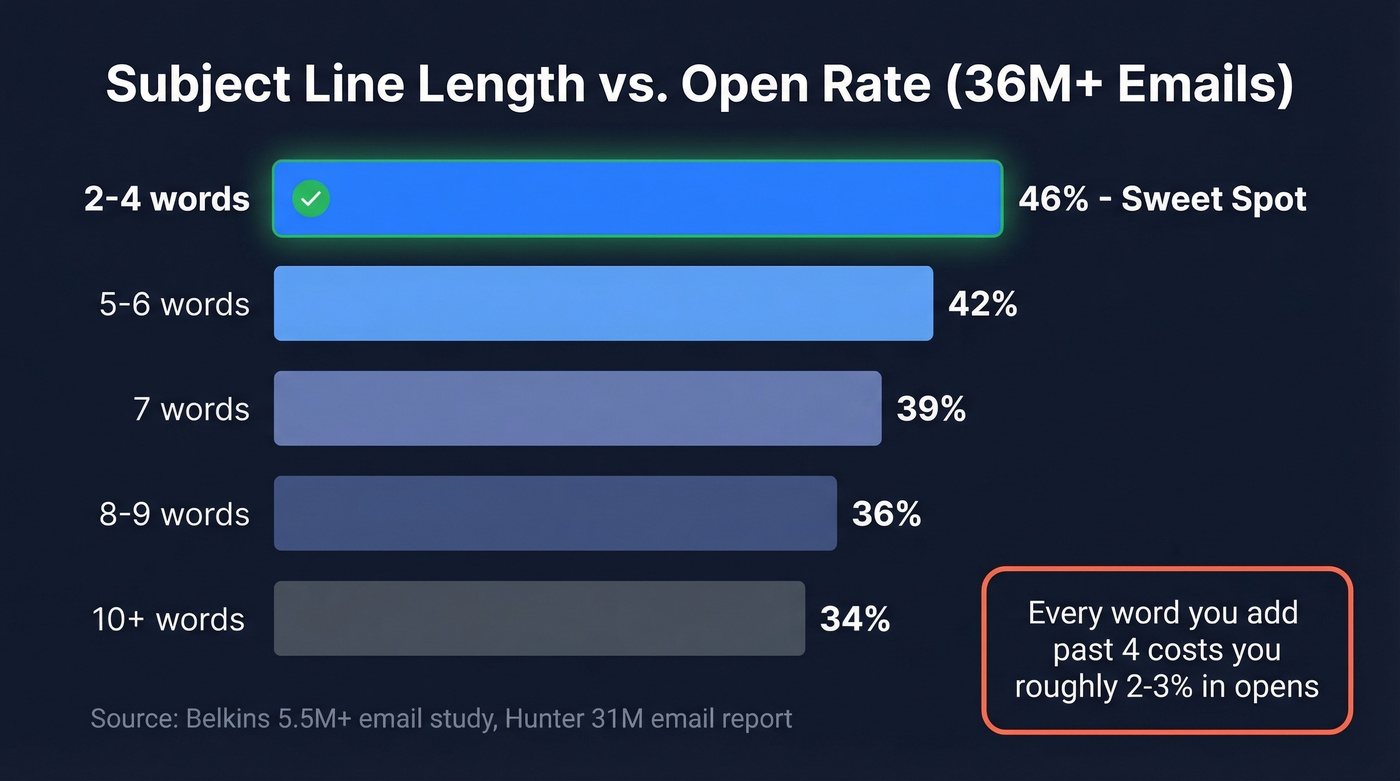
The length data is equally clear. Two to four words produced the highest opens at 46%. Cross seven words, opens drop to 39%. At ten, you're at 34%. Shorter isn't a style preference - it's a measurable advantage. We've seen the same pattern hold across industries in our own campaigns.
Character Limits by Device
Every guide says "keep it short," but nobody tells you what short actually means on a Pixel versus an iPhone. EmailToolTester ran hands-on tests across major devices.
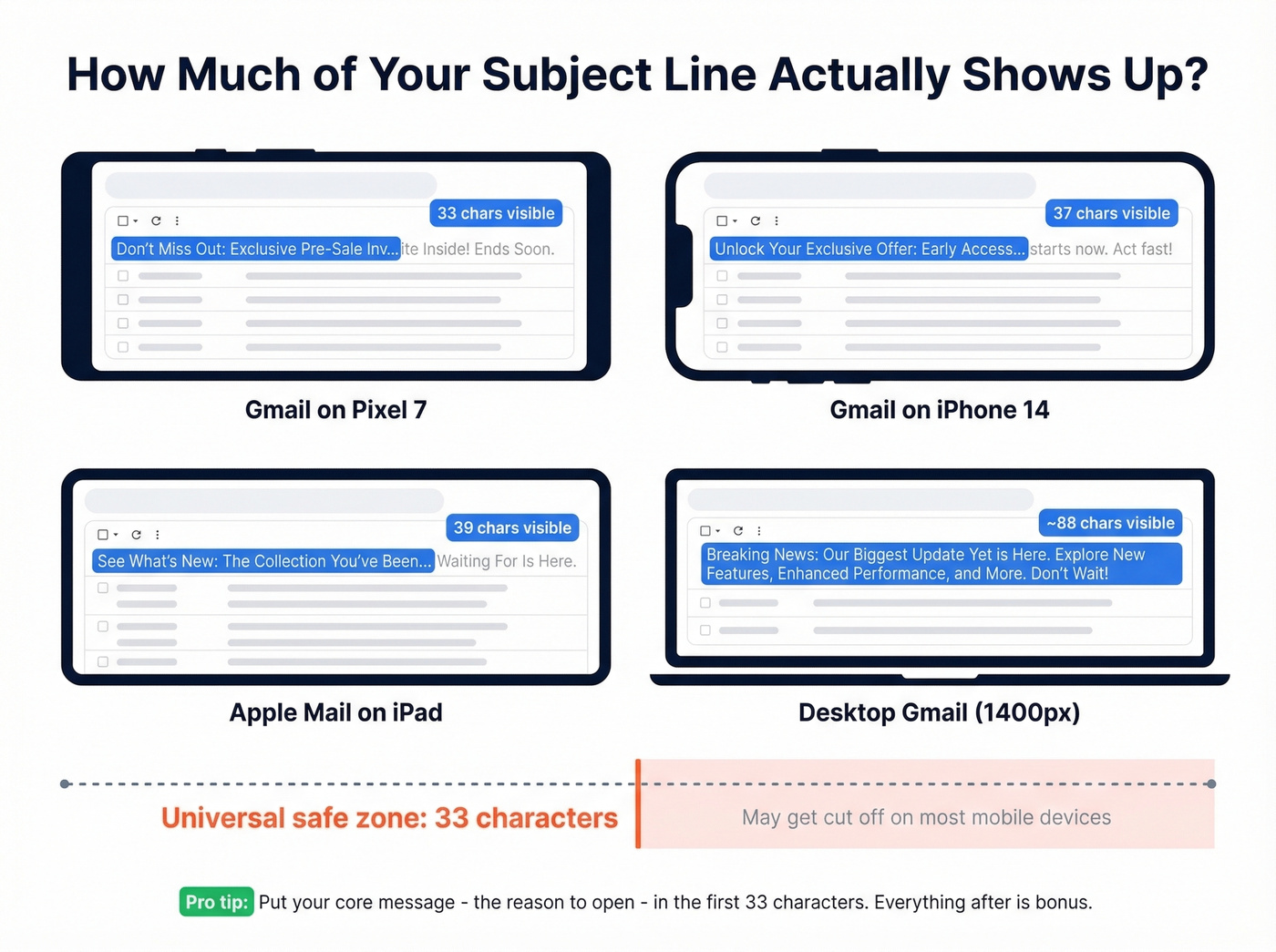
| Device / Client | Visible Chars | Preheader Visible |
|---|---|---|
| Gmail app (Pixel 7) | 33 | 37 |
| Gmail app (iPhone 14) | 37 | 39 |
| Gmail app (Samsung S22 Ultra) | 36 | 40 |
| Apple Mail (iPhone 14) | 48 | 99 |
| Apple Mail (iPad 10th) | 39 | 75 |
| Desktop Gmail (~1400px) | ~88 | Varies |
33 characters is your universal safe limit. Put the core message - the reason someone should open - in those first 33 characters. Everything after is bonus context that won't display on most Android devices. Twilio SendGrid's data confirms it: best-performing subject lines ran 2-4 words, which almost always falls under 33 characters.

A 46% open rate means nothing if 35% of your list bounces. Prospeo's 5-step email verification delivers 98% accuracy - the same data that took Meritt's bounce rate from 35% to under 4% while tripling their pipeline.
Nail the subject line, then send it to emails that actually exist.
25 Outreach Subject Lines That Work
Cold Outreach to a Stranger
- "Disruptive Start-Ups Needed" - 53.7% read rate, 6.52% response
- "Quick question about [Company]"
- "[First Name], one idea for [pain point]"
- "Saw [Company]'s Q4 numbers"
- "Collaborating with [Company Name]" - 47.84% read rate, 5.24% response
Networking or Informational
- "Coffee chat about [industry topic]?"
- "Fellow [role] - quick ask"
- "Your [talk/post] on [topic]"
- "[Mutual interest] connection"
Warm Intro or Mutual Connection
- "[Mutual contact] suggested I reach out"
- "Following up on [event name]"
- "[First Name]'s Invitation" - 55.39% read rate, 10.18% response
- "[Mutual contact] + [your company]"
- "Great meeting you at [event]"
Follow-Up After No Response
The 31M-email dataset shows sending 3 emails instead of 1 increases total replies by 106%. Space them 3-5 days apart.
- "Bumping this up"
- "Did this land?"
- "Still relevant, [First Name]?"
- "Closing the loop on [topic]"
- "Last note on [specific value prop]"
Offering Something Useful
- "Data Science and Analytics at [Company]" - 43.8% read rate, 3.59% response
- "[Industry] benchmark you'll want"
- "Free [resource] for [Company]'s team"
- "Built this for [role]s like you"
- "[Number]% improvement for [Company]'s [metric]"
- "Hot weather, hot candidates!!" - 35.36% read rate, 5.54% response
Those examples work because they follow a pattern - and the pattern starts with knowing more than someone's first name.
Personalization Beyond First Name
Here's the thing: first name tokens are table stakes. Everyone does them. The real lift comes from stacking a second variable, and the 31M-email dataset proves it with a 40.2% vs. 35.4% open rate gap.
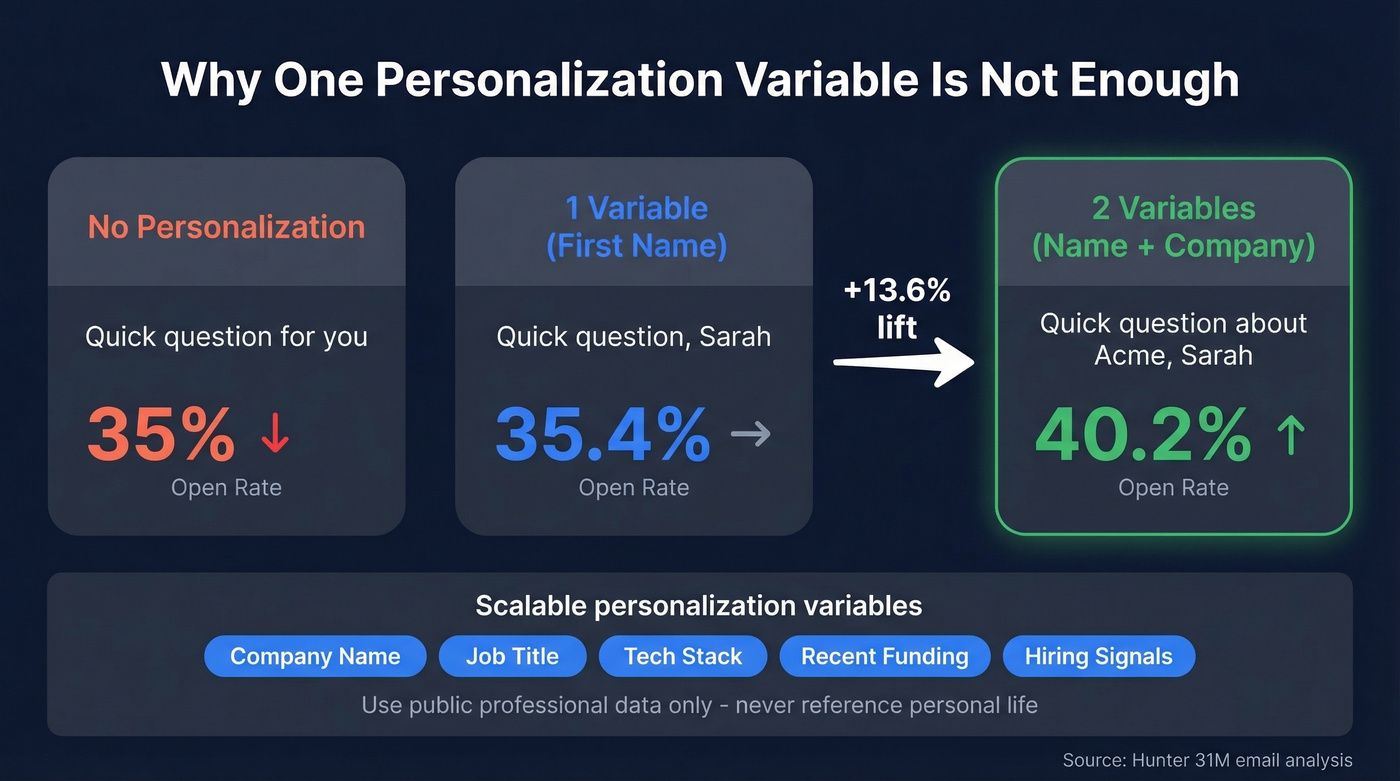
The line between relevant and creepy is simple. Use public professional data: company name, job title, recent funding, tech stack, hiring signals. Never reference personal life or anything that makes someone wonder how you found it.
Variables that scale without manual research: company name paired with a trigger like a funding round or product launch, job title or department, tech stack ("your HubSpot setup"), and location when it's relevant to the offer. A/B test one variable at a time - subject line length or personalization type, not both - with at least 100 sends per variant before drawing conclusions.
Spam Triggers to Avoid
Spam filters evaluate three signal categories: content, reputation, and engagement. ZoomInfo's deliverability team breaks this down well. No single word guarantees the spam folder, but combining trigger language with a weak sender reputation tanks inbox placement fast.
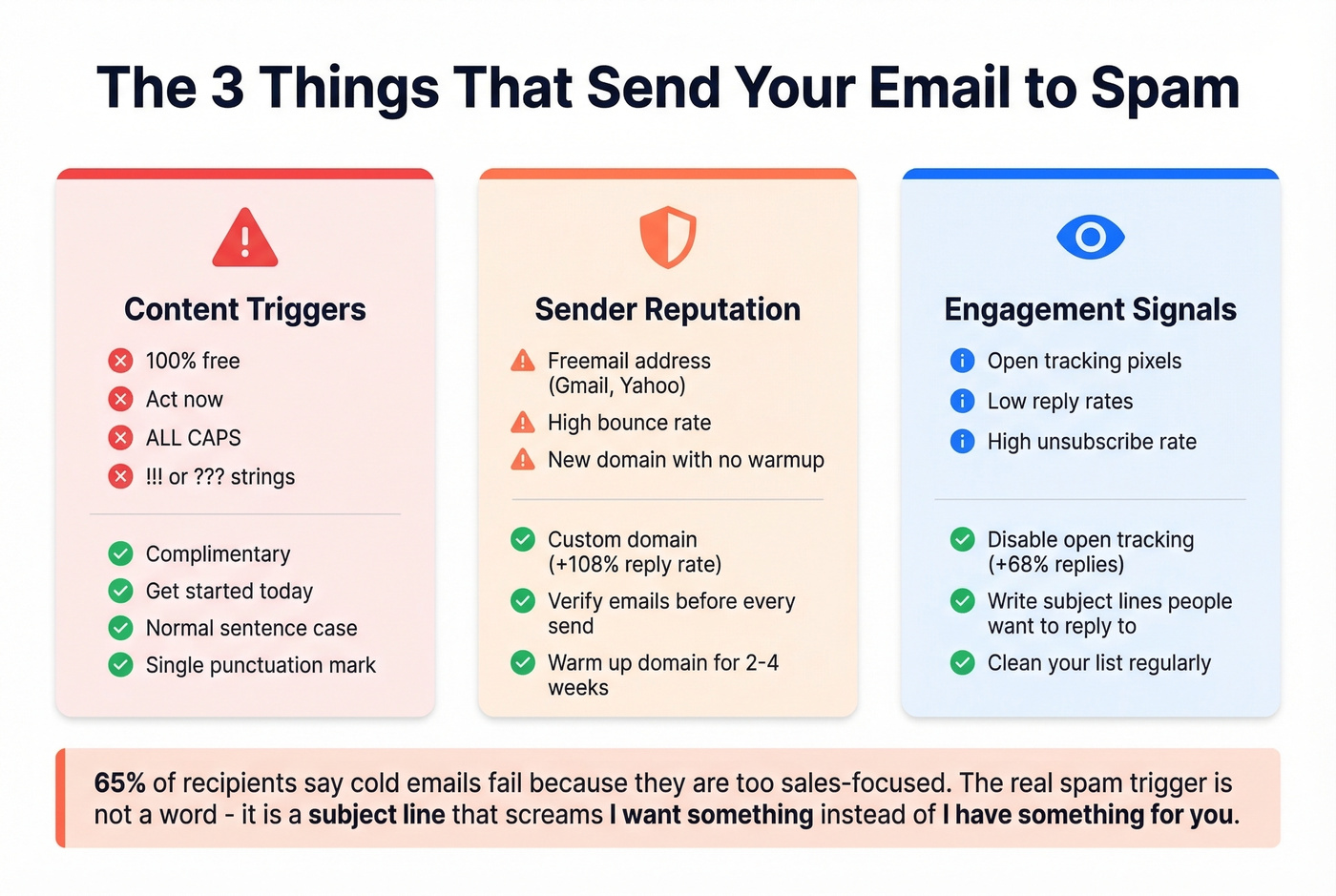
| Spam Trigger | Safer Alternative |
|---|---|
| "100% free" | "Complimentary" |
| "Act now" | "Get started today" |
| "ALL CAPS SUBJECT" | Normal sentence case |
| "!!!" or "???" strings | Single punctuation |
| "$$$" or emoji strings | Remove entirely |
65% of recipients say cold emails fail because they're too sales-focused. That's the real spam trigger - not a single word, but a subject line that screams "I want something from you" instead of "I have something for you."
Two operational details that matter more than word choice: send from a custom domain (the 31M-email dataset shows custom domains get +108% higher reply rates than freemail addresses), and consider disabling open tracking, which the same data links to a +68% reply rate lift. We've seen open tracking removal alone move campaigns from the Promotions tab to Primary.
Let's be honest about something the "10x your outreach" crowd won't say: if your average deal is under $8K, you don't need a 15-step sequence with AI-generated subject lines. You need five tight emails with honest subject lines sent to verified addresses. Complexity is where most outreach campaigns go to die.
Before You Hit Send
The best subject line for a reaching out email is worthless if it bounces. Bounces don't just waste that send - they damage your domain reputation, which triggers the exact spam filters you just learned to avoid. We've watched bounce rates tank a domain's reputation in as few as two campaigns, and recovery takes weeks.

Prospeo runs every email through a 5-step verification process with catch-all handling, spam-trap removal, and honeypot filtering - delivering 98% email accuracy on a 7-day refresh cycle. The free tier gives you 75 verified emails per month plus 100 Chrome extension credits, enough to test whether your new subject lines actually land.
Skip verification tools if you're sending fewer than 10 emails a week to people you already know. But the moment you're doing any kind of cold outreach at scale, sending to unverified addresses is like optimizing a landing page that 404s.
Stacking two personalization variables lifts opens to 40.2% - but you need real data to personalize with. Prospeo returns 50+ data points per contact: company, title, tech stack, funding, and hiring signals. All refreshed every 7 days.
Stop guessing at personalization. Start with data that's actually current.
FAQ
What's the ideal subject line length?
Two to four words, under 33 characters. The 5.5M-email dataset hit 46% opens at that length, and device tests confirm 33 characters displays fully across major mobile clients including Gmail on Android and iOS.
Should I use emojis in outreach subject lines?
Skip them for B2B cold outreach. Rendering varies across clients - what looks clever in Gmail shows as a blank square in Outlook. A clear, specific subject line consistently outperforms a clever one with decorative emojis.
How many follow-ups should I send?
Send at least three emails total. The 31M-email dataset shows 3 messages increase replies by 106% versus a single email. Space them 3-5 days apart and vary the angle - don't just write "checking in" three times.
How do I verify emails before sending outreach?
Use a dedicated verification tool before every campaign. Prospeo's free tier lets you verify 75 emails per month at 98% accuracy with catch-all handling and spam-trap removal - enough to validate a test list without spending a dollar. Other options include Hunter and NeverBounce.