

Time Blocking for Sales Reps: The Data-Backed System That Protects Your Selling Hours
It's 10:30am on a Tuesday. You blocked 9-11 for cold calls. Instead, you've spent 45 minutes hunting for a pitch deck, answered six Slack messages, and manually updated three CRM records. You've made 12 dials instead of 40. The prospecting block is gone, and it's not coming back.
That's the daily reality that makes time blocking for sales reps not just useful, but essential. Sales reps spend 60% of their time on non-selling tasks - chasing approvals, doing data entry, prepping for meetings that could've been emails. Structured calendar blocking is the fix, but most reps try it once, over-schedule every minute, and abandon it within a week.
We've seen this cycle play out across dozens of teams. Here's a system that survives real sales days - complete with role-specific templates for SDRs, AEs, and Account Managers.
The Quick Version
If you only take three things from this article:
- Protect your morning blocks. 8am-3pm are the golden hours for sales work. Guard them like revenue.
- Batch by category, not by task. A "Prospecting" block beats scheduling "call John, email Sarah, research Acme" individually. Category blocks survive chaos; micro-schedules don't.
- Verify your contact data before call blocks. A 2-hour prospecting block with 40% wrong numbers produces the same result as a 1-hour block with clean data. Bulk-verify your list the day before so your morning starts with conversations, not voicemail.
The 4-Layer Sales Calendar System
Armand Farrokh from 30 Minutes to President's Club built a framework that maps to how sales days actually work. Instead of scheduling individual tasks, you organize your calendar into four layers, filled in order of priority.
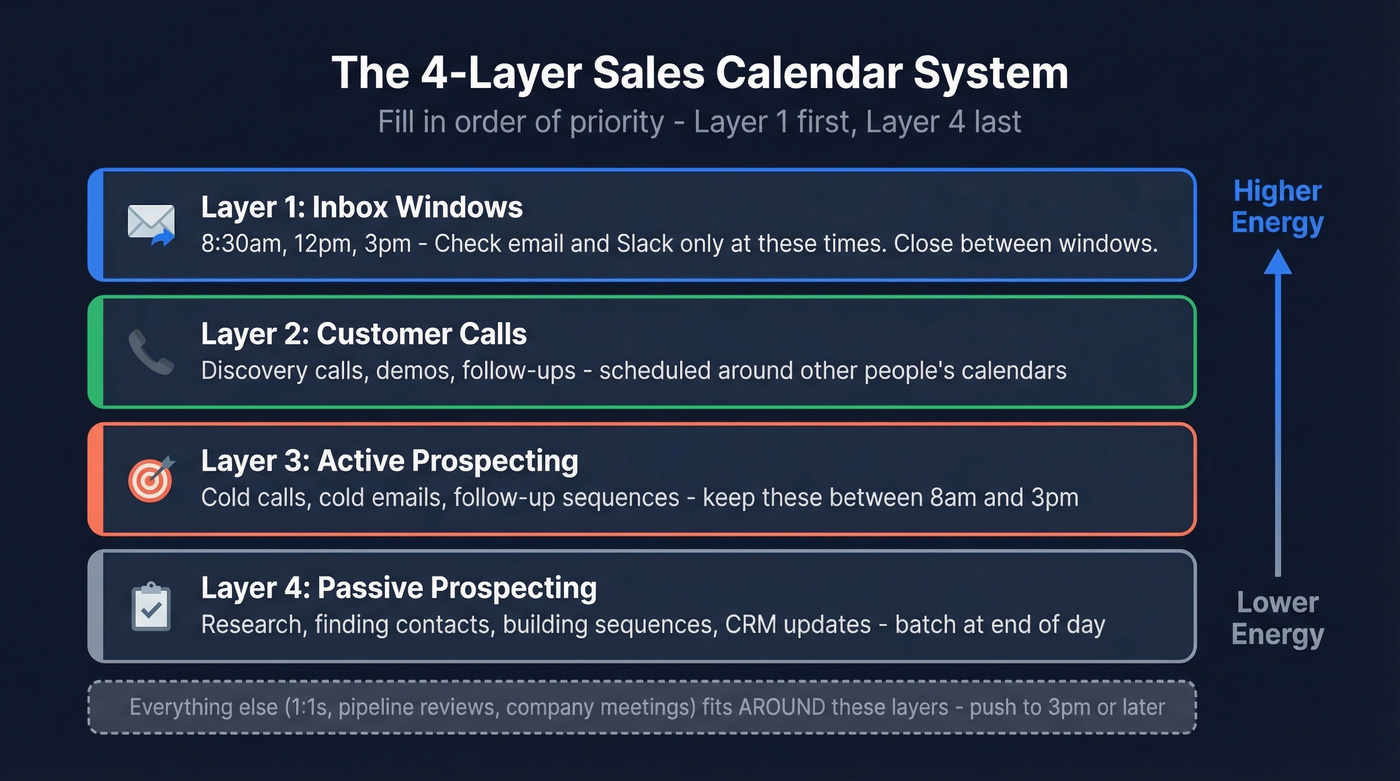
Layer 1: Inbox windows. Check email and Slack at 8:30am, 12pm, and 3pm. Close them between windows. The "8-12-3" rule sounds simple, but it eliminates the ambient distraction that kills deep work.
Layer 2: Customer calls. The average seller has about 2 hours of live customer calls daily - discovery calls, demos, follow-ups. These get scheduled next because they involve other people's calendars and can't easily move.
Layer 3: Active prospecting. Cold calls, cold emails, and follow-up sequences. Farrokh recommends keeping 8am-3pm reserved for layers 2 and 3. Do cold calls first thing, then cold emails, with a spillover block in the early afternoon.
Layer 4: Passive prospecting. Research, finding contacts, building sequences, updating CRM - all batched at the end of the day. It's important work, but it doesn't require the same energy as live conversations. Find 25 accounts Monday, pull contacts Tuesday, sequence Wednesday.
Everything else - 1:1s, pipeline reviews, company meetings - fits around these four layers, not the other way around. Push internal meetings to 3pm or later whenever possible. One r/productivity thread captured this well: a user reported their calendar was "completely full" from scheduling hundreds of micro-tasks, and switching to category blocks fixed it overnight. Category blocks in 60-90 minute chunks survive the unpredictability of a sales day. Individual task slots don't.
Weekly Rhythm: Which Days Deserve Your Best Blocks
Not all days are created equal. ZoomInfo analyzed more than 1.4 million outbound calls and the data is clear: Tuesday and Wednesday account for 44% of all demos booked. Monday has the highest call-to-demo efficiency rate at 1.19%. Friday performs worst across every metric.
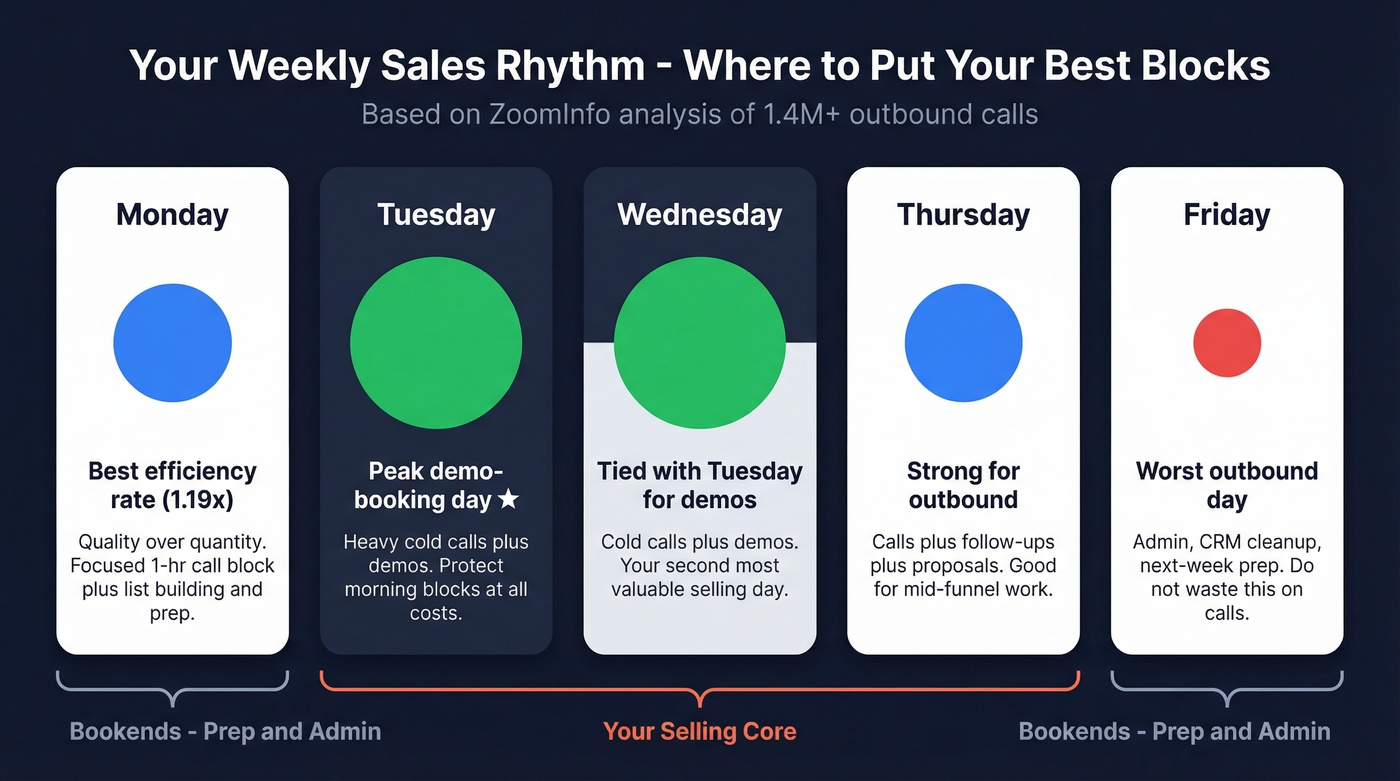
Here's the thing: don't waste Friday on cold calls. It's not a willpower issue. The data says prospects aren't picking up.
[Calendly's "bookends approach" ] maps well here - use Monday and Friday to frame your selling core of Tuesday through Thursday.
| Day | Primary Focus | Why |
|---|---|---|
| Monday | Focused call block (1 hr) + list building + prep | Best efficiency rate but lower volume - quality over quantity, then prep for Tuesday |
| Tuesday | Cold calls + demos | Peak demo-booking day |
| Wednesday | Cold calls + demos | Tied with Tuesday for demo volume |
| Thursday | Calls + follow-ups + proposals | Strong for outbound; good for mid-funnel |
| Friday | Admin, CRM cleanup, next-week prep | Worst outbound day - don't waste it on calls |
This rhythm means your heaviest prospecting blocks land on Tuesday and Wednesday mornings. Protect those slots like they're customer meetings - because they're worth more than most customer meetings.
Let's be honest: if your average deal size is under $10k, you probably don't need a complex tech stack or a 14-tool workflow. You need two clean hours of cold calls on Tuesday morning with verified numbers. Everything else is procrastination wearing a productivity costume.

A 2-hour prospecting block with 40% wrong numbers is a 2-hour block wasted. Prospeo's 98% email accuracy and 125M+ verified mobile numbers mean your Tuesday morning call block actually connects you to real buyers - not voicemail boxes and bounced emails.
Bulk-verify tomorrow's call list tonight. Start free with 75 emails.
Role-Specific Templates
Most guides give you one generic schedule. An SDR's day looks nothing like an AE's. Here are three templates built on the 4-layer system - use them as starting points and adjust to your pipeline.
SDR: The Outbound Machine
- 7:30-8:30am - Inbox window #1 + review today's call list
- 8:30-12:00pm - Active prospecting block (cold calls, then cold emails). No Slack, no CRM updates. Dial.
- 12:00-12:30pm - Inbox window #2 + lunch
- 12:30-2:00pm - Follow-up calls + sequence replies
- 2:00-3:00pm - Customer-facing calls (discovery handoffs, warm intros)
- 3:00-3:30pm - Inbox window #3 + 1:1 with manager
- 3:30-5:00pm - Passive prospecting: build tomorrow's call list, verify numbers in bulk so your morning block starts with live conversations, research accounts, update CRM
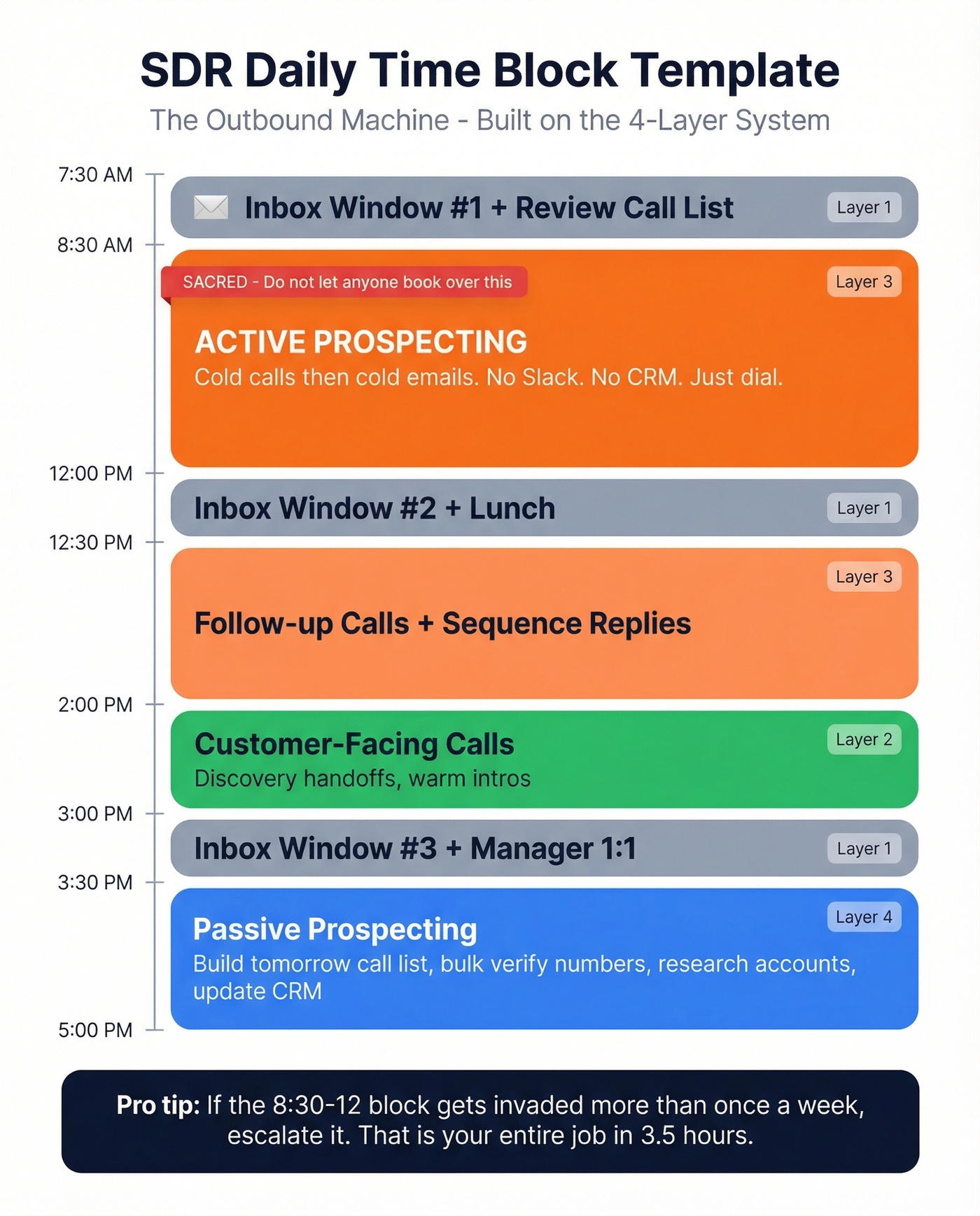
The 8:30-12 block is sacred. If you're an SDR and that block gets invaded more than once a week, escalate it. Seriously. That's your entire job compressed into 3.5 hours.
AE: The Demo-Heavy Calendar
AEs juggle pipeline management with new business. The real challenge is protecting prospecting time when demos fill the calendar. In our experience, the AEs who block even 90 minutes of morning outbound consistently outperform those who "prospect when there's time." There's never time - you make it.
A typical AE day flows like this: inbox scan and meeting prep by 8:30, then a focused prospecting block until 10. Demos stack from 10 to 12:30. After lunch, the afternoon splits between proposal writing, deal progression, and an overflow demo slot. The last hour goes to CRM updates, forecast prep, and planning tomorrow. The key is treating that 8:30-10 prospecting block as immovable - even when a colleague wants to "hop on a quick call."
AM/CSM: The Retention Rhythm
Account Managers and CSMs have a fundamentally different energy distribution - their mornings should go to high-priority renewals and expansion conversations, not cold outbound.
| Time | Block | Notes |
|---|---|---|
| 8:00-8:30am | Inbox + account health review | Triage before calls |
| 8:30-10:30am | Renewal and expansion calls | Highest-priority accounts first |
| 10:30-11:30am | Internal syncs | Product, support, implementation |
| 11:30am-12:00pm | Inbox window #2 | |
| 1:00-3:00pm | Customer calls | QBRs, check-ins, onboarding |
| 3:00-3:30pm | Inbox window #3 | |
| 3:30-5:00pm | CRM updates + success plans | Cross-sell research here too |
Skip the SDR template if you're in this role. The cadence is wrong for retention-focused work, and forcing yourself into an outbound rhythm will just create frustration.
Why Sales Calendar Blocking Fails (and How to Fix It)
We've tested both micro-scheduling and category blocking across multiple teams. Category blocks win every time. Three failure modes account for almost every breakdown.
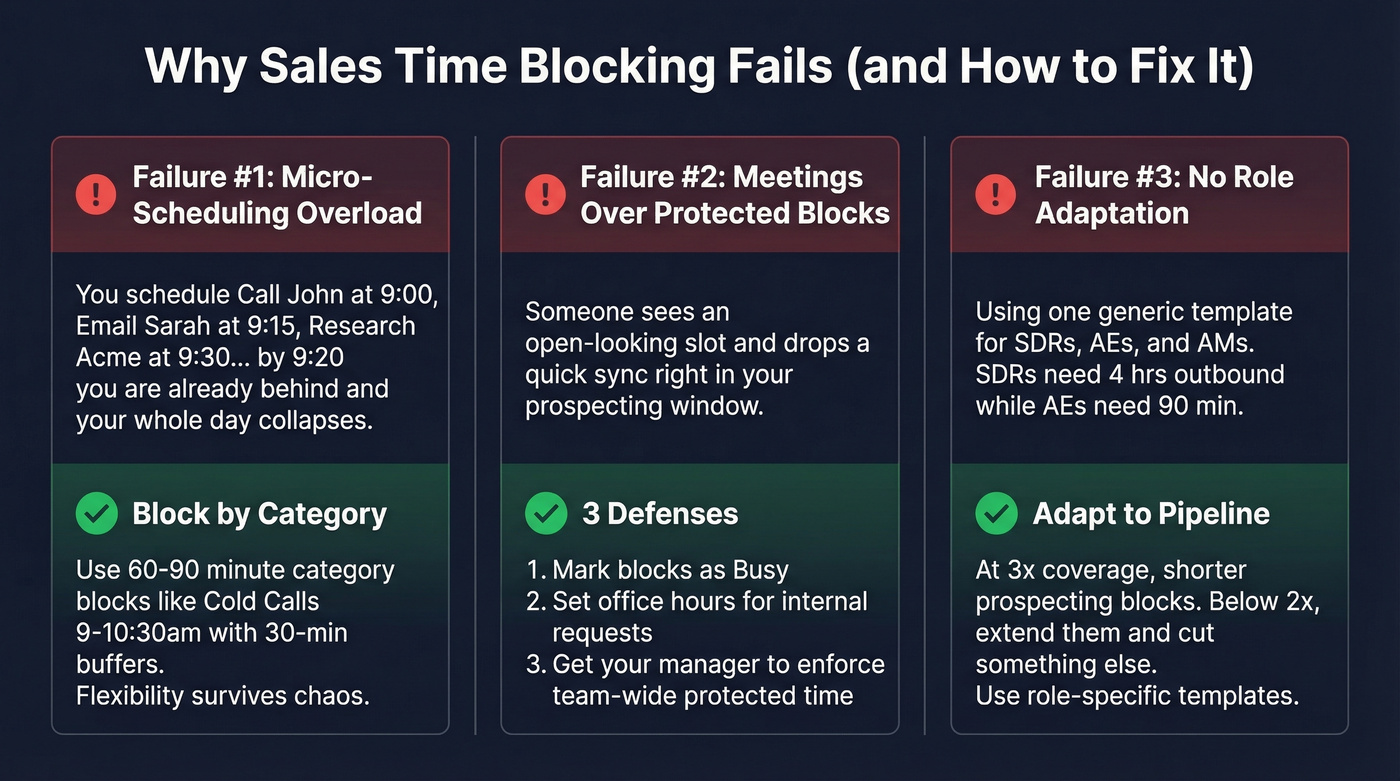
Failure #1: Calendar overload from micro-scheduling. You block "Call John at 9:00, email Sarah at 9:15, research Acme at 9:30" and by 9:20 you're already behind. Block by category in 60-90 minute chunks with 30-minute buffers. A "Cold Calls" block from 9-10:30 gives you flexibility to handle variable call lengths without reshuffling your entire afternoon.
Failure #2: Meetings booked over protected blocks. Someone sees an open-looking slot and drops a "quick sync" right in your prospecting window. Three fixes: mark prospecting blocks as "busy" in your calendar, establish "office hours" for internal requests, and get your manager to enforce protected prospecting time as a team norm. That last one matters most - individual discipline can't survive organizational chaos.
Failure #3: No role adaptation. A generic template doesn't account for the fact that SDRs need 4 hours of outbound while AEs need 90 minutes. Use the templates above as starting points, then adjust based on your pipeline coverage ratio. At 3x coverage, you can afford shorter prospecting blocks. Below 2x, extend them and cut something else.
Bad Data Kills Your Prospecting Block
Look, you can build the perfect calendar system, but if the data inside your prospecting blocks is garbage, you're just efficiently wasting time.
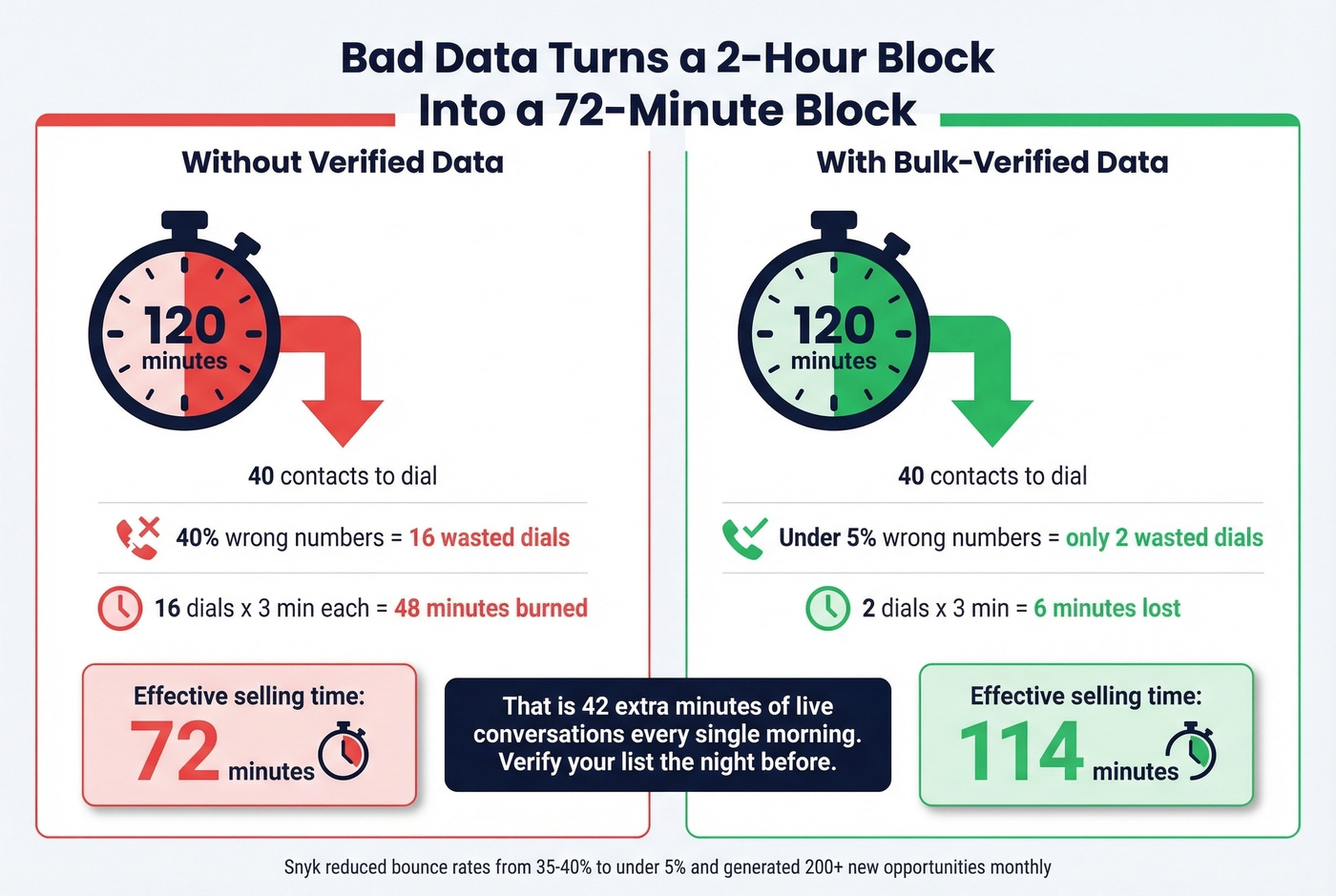
You've protected a 2-hour morning call block - 120 minutes of prime selling time with 40 contacts to dial. If 40% of those numbers are wrong, that's 16 wasted dials. At roughly 3 minutes per failed attempt (ring, voicemail, check notes, move on), you've burned 48 minutes. Your 2-hour block just became a 72-minute block.
This isn't hypothetical. Snyk's sales team was running bounce rates of 35-40% before they fixed their data pipeline. After switching to Prospeo, bounces dropped under 5%, and their 50 AEs started prospecting 4-6 hours per week productively - generating 200+ new opportunities monthly and increasing AE-sourced pipeline by 180%.

Run your list through bulk verification before your call block starts, and you're dialing real people instead of dead numbers. That's the difference between a productive morning and a frustrating one.
You just carved out 3.5 hours of sacred prospecting time. Don't burn it building lists manually. Prospeo's 30+ search filters and bulk verification let you prep tomorrow's entire call list in minutes - so your morning block starts with conversations, not research.
Stop spending your 3:30pm block hunting contacts. Automate it.
Measuring What Matters
Time blocking for sales reps isn't set-and-forget. Track these four metrics weekly:
- Selling time percentage. What share of your week was spent in layers 2-3? Below 40% means your blocks are getting invaded.
- Meetings booked per prospecting hour. More meetings from fewer hours means your blocks and your data are working.
- Pipeline generated per week. If pipeline is flat despite consistent blocks, the problem is targeting or messaging, not scheduling.
- Dials-to-conversation ratio. A declining ratio signals data decay. Refresh your contact lists.
Every Friday, spend 15 minutes on a calendar audit. Which blocks survived? Which got overwritten? Where did you lose time? The reps who sustain structured scheduling are the ones who do this Friday review religiously - it takes 15 minutes and saves hours the following week. Adjust next week's template based on what you find.
If you want a tighter outbound engine, pair this with a repeatable cold calling system and a simple set of sales activities you can measure week over week.
FAQ
How many hours should a sales rep block for prospecting each day?
SDRs should aim for 3-4 hours of dedicated prospecting; AEs need 1-2 hours depending on pipeline coverage. Protect morning blocks - they're your highest-value selling window. Below 2x pipeline coverage, add an afternoon block.
What's the best time of day for cold calls?
8-11am is the strongest window because prospects are often at their desks before meetings stack up. ZoomInfo's 1.4M-call dataset confirms Tuesday through Thursday as the best days. Combine morning blocks with mid-week scheduling for maximum connect rates.
How do I stop people from booking over my prospecting blocks?
Mark blocks as "busy" so scheduling tools won't offer those slots. Set up "office hours" for internal requests, and get your manager to enforce protected prospecting time team-wide. Buffer blocks between categories help absorb overflow without derailing your day.
What tools help sales reps protect their prospecting blocks?
Google Calendar or Outlook handles the blocking itself - no fancy app needed. The bigger lever is data quality: bulk-verifying your contact list before each call block ensures your morning isn't wasted on dead numbers. Pair clean data with a dialer and you'll hit 40+ live conversations per block.