

The 7 Typical Sales Pipeline Stages (With Benchmarks Most Guides Won't Give You)
84% of sales reps missed quota last year. Not because they couldn't sell - because their pipelines lied to them. Deals sat in "Proposal" for weeks with no exit criteria, no buyer commitment, and nobody asking why. The typical sales pipeline stages looked right on paper, but the data underneath was decoration.
What Should a Pipeline Include?
Most B2B pipelines run seven standard stages, from Prospecting through Closed Won/Lost. But stages without exit criteria are just labels.
Use 5-6 stages if your average deal is under $25K and closes in weeks - a simple pipeline built for speed. Go with 7-10 stages if you're selling into buying committees with procurement, legal, and security gates. Every stage needs one rule: what must be true before a deal moves forward.
If you can't answer that for each stage, your pipeline isn't a forecasting tool. It's a wish list.
Pipeline vs. Funnel
A pipeline tracks individual deals through rep-controlled stages. A funnel measures aggregate volume from marketing to close. Pipeline is the deal view; funnel is the volume view. They're related but not interchangeable, and confusing them leads to bad reporting every single quarter.
The 7 Stages Explained
The win probability numbers below are a practical default ladder many teams use in CRMs. Calibrate them to your historical win rates by segment - SMB vs. enterprise, inbound vs. outbound - because defaults alone won't save your forecast.
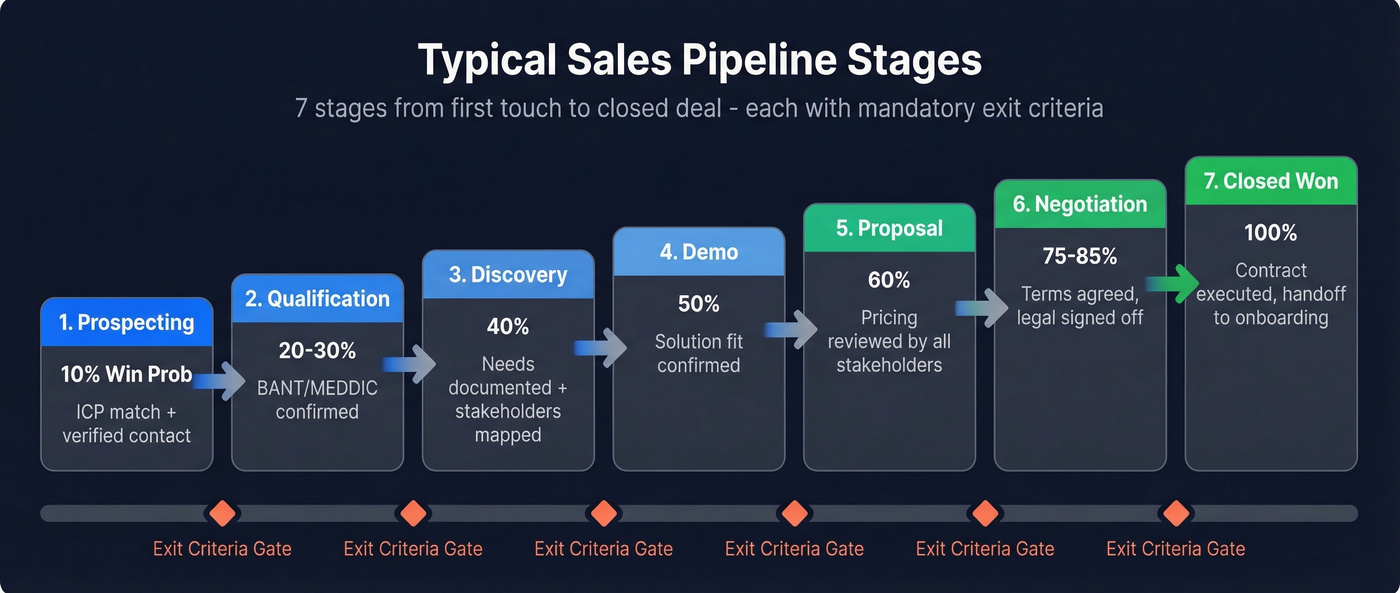
1. Prospecting
You identify and reach out to potential buyers who match your ICP. Win probability sits around 10%. Pipeline health starts here, and if your emails bounce, nothing downstream works. We've seen teams lose entire weeks of outbound because they built lists from stale databases with 20%+ bounce rates. Prospeo's database covers 300M+ professional profiles with 98% email accuracy on a 7-day refresh cycle, which means the contacts feeding your pipeline are real people at real companies - not dead records tanking your deliverability.
Exit criteria: Lead matches ICP, you have verified contact details and enough company context to start meaningful outreach.

2. Qualification
You've made contact. Now determine whether this prospect has the budget, authority, need, and timeline to buy. Win probability: ~20-30%. Use BANT for simpler deals, MEDDIC for enterprise with multiple stakeholders.
Here's a stat that should bother every RevOps leader: 61% of B2B marketers send all leads directly to sales, but only 21% are actually qualified. That gap is where pipeline rot begins.
Exit criteria: Prospect meets your qualification framework and has confirmed a real problem worth solving. Without access to the Economic Buyer, close probability drops below 50% - confirm that contact early.
3. Discovery & Demo
These two stages are where we've seen the most wasted motion. Discovery is deep needs analysis: documenting pain, current workflow, decision process, and success criteria, with win probability around 40%. Demo is showing the product solving the prospect's specific problem - not a generic feature tour - pushing win probability to ~50%.
Here's the thing: reps skip discovery and jump straight to a demo all the time. Then they wonder why the prospect ghosts after a beautiful product walkthrough that solved a problem the buyer never confirmed they had.
Exit criteria (Discovery): Needs documented, clear alignment between challenges and your solution, all decision-makers identified.
Exit criteria (Demo): Prospect confirms solution fit and expresses intent to explore a contract or formal evaluation.
4. Proposal
Pricing, scope, and terms are in the hands of decision-makers. Win probability: ~60%. This is where pipeline value becomes concrete - every deal should have an accurate dollar figure attached, not a placeholder.
Exit criteria: Proposal reviewed by all relevant stakeholders. Objections surfaced, not hidden.
5. Negotiation
Terms, pricing, legal redlines, procurement. Enterprise deals can stall here for months. Win probability: ~75-85%.
Exit criteria: Both parties have agreed on terms. Legal and procurement have signed off. You're waiting on ink, not decisions.
6. Closed Won / Lost
Contract executed and handed to onboarding - or loss reason documented and deal removed from pipeline. No deal should sit in "Closed Lost" without a reason code. That data is how you fix every stage above it. Some teams add a seventh or eighth stage for onboarding and expansion; if your net revenue retention matters, it should be there.

Every pipeline stage above depends on one thing: reaching real buyers. If 20% of your emails bounce at the Prospecting stage, your conversion benchmarks are dead on arrival. Prospeo's 300M+ profiles refresh every 7 days with 98% email accuracy - so the contacts entering your pipeline are verified, not decorative.
Stop feeding your pipeline stale data. Start with contacts that connect.
Conversion Benchmarks by Stage
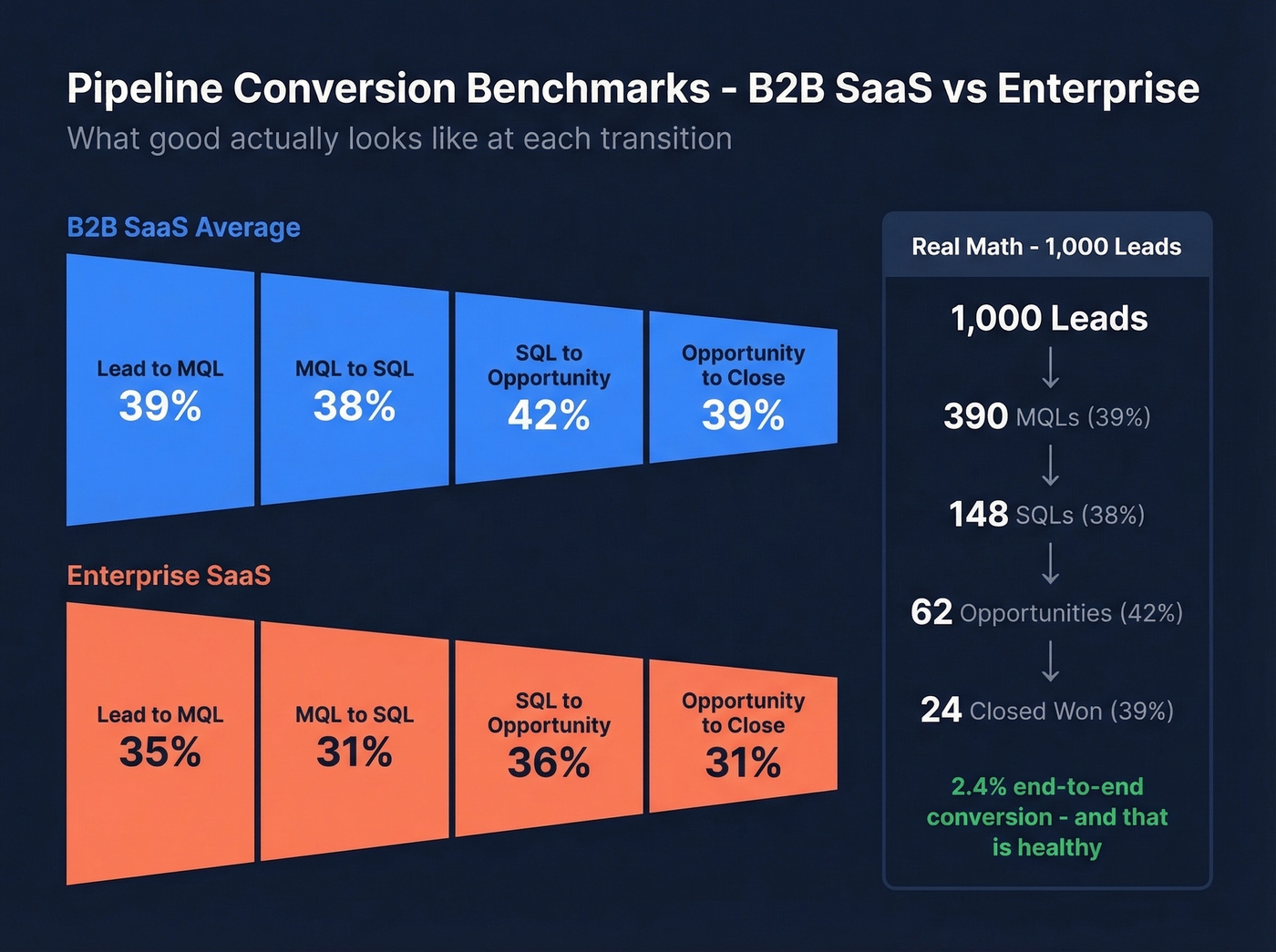
Every guide lists stages. Almost none tell you what "good" looks like. Here are B2B SaaS benchmarks worth pinning to your wall:
| Transition | B2B SaaS Avg | Enterprise SaaS |
|---|---|---|
| Lead → MQL | 39% | ~35% |
| MQL → SQL | 38% | 31% |
| SQL → Opportunity | 42% | 36% |
| SQL → Closed | 37% | ~28% |
| Opportunity → Close | 39% | 31% |
What this looks like in practice: A mid-market SaaS company starts with 1,000 leads. At 39%, 390 become MQLs. At 38%, 148 qualify as SQLs. At 42%, 62 enter pipeline as opportunities. At a 39% close rate, 24 deals close. That's a 2.4% end-to-end conversion, and that's considered healthy. If your enterprise motion is hitting SMB-level close rates, either your qualification is too loose or your pipeline is full of zombie deals.
Customize Stages by Deal Complexity
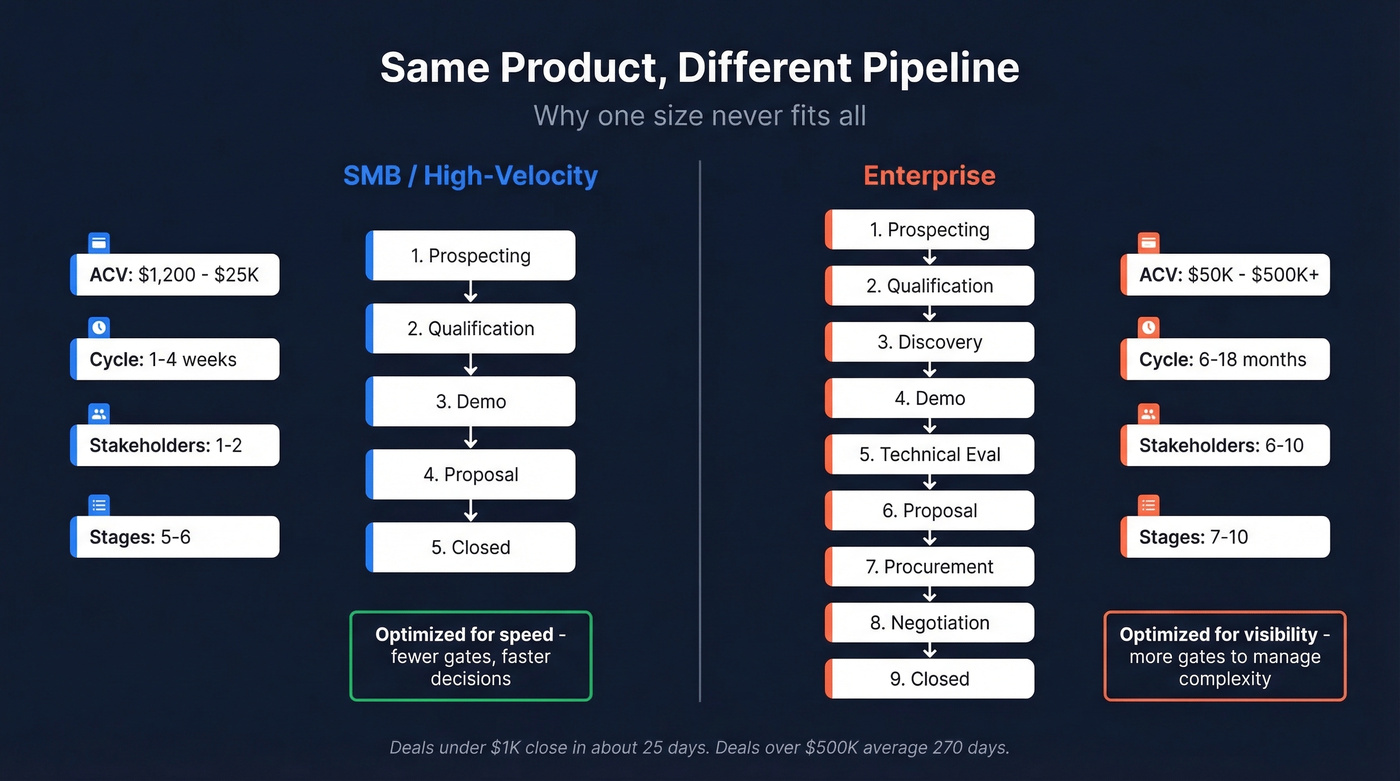
Not every pipeline needs seven stages. The best configuration depends on deal economics:
| Factor | SMB / High-Velocity | Enterprise |
|---|---|---|
| ACV | $1,200-$25K | $50K-$500K+ |
| Cycle length | 1-4 weeks | 6-18 months |
| Stakeholders | 1-2 | 6-10 |
| Stages needed | 5-6 | 7-10 |
Sales cycle data by ACV confirms the spread - deals under $1K close in about 25 days, while deals over $500K average 270 days. Software deals average 90 days total, broken down roughly as 14 days initial contact, 30 days in proposal, 25 in negotiation, and 21 to close. If you're using the same five-stage pipeline for both motions, you're hiding complexity instead of managing it.
Let's be honest: if your average contract value is under $10K, you probably don't need more than five stages. I've watched teams build 12-stage pipelines for $5K deals, and their forecast accuracy was worse than teams running five stages with strict exit criteria. Complexity isn't sophistication.
Pipeline Velocity Formula
(Opportunities x Avg Deal Size x Win Rate) / Cycle Length = Daily Revenue Velocity
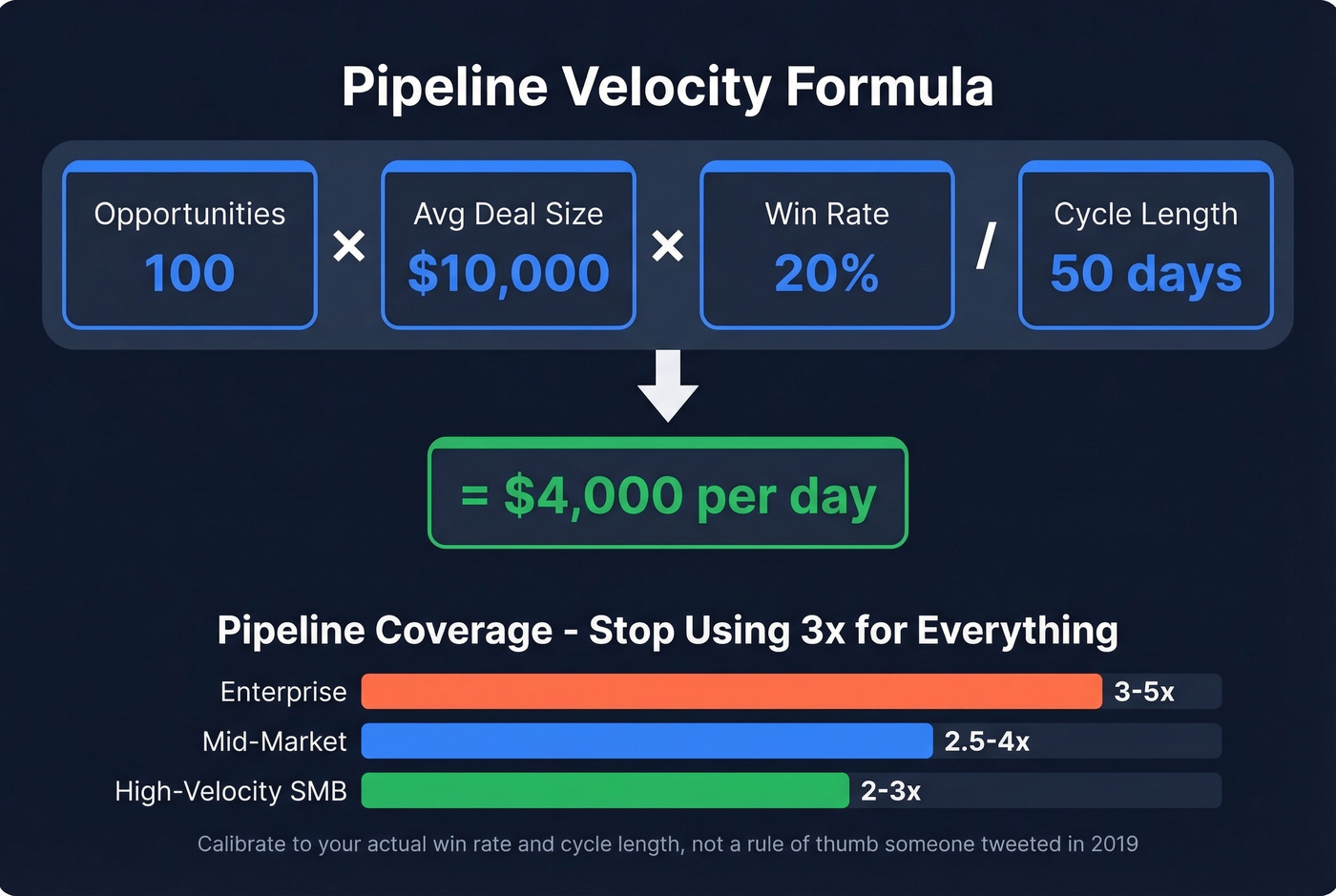
Worked example: (100 x $10,000 x 20%) / 50 days = $4,000/day.
The common "3x coverage" rule as a universal benchmark is a myth. Better benchmarks: enterprise teams need 3-5x, mid-market 2.5-4x, and high-velocity SMB teams need 2-3x. Calibrate to your actual win rate and cycle length, not a rule of thumb someone tweeted in 2019.
Pipeline Management Best Practices
Kill micro-stage bloat. One agency owner on Reddit shared stages like "Never Replied to Book Meeting," "Meh Call," and "Great Call" - then called it overkill. Stages should track buyer milestones, not rep activities.
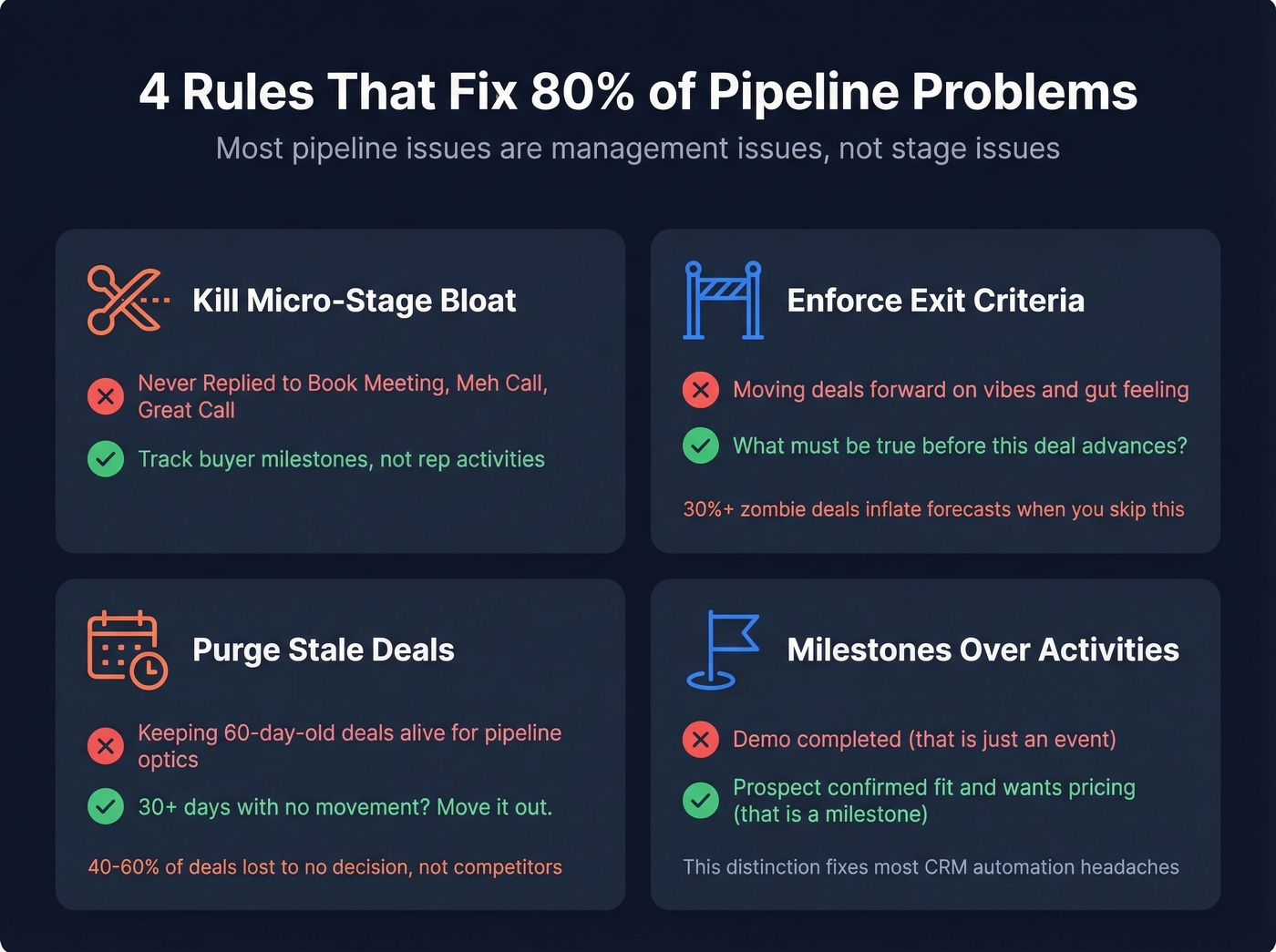
Enforce exit criteria. Deals get moved forward on vibes more often than anyone wants to admit. In our experience, teams that skip exit criteria end up with 30%+ zombie deals inflating every forecast. That's not a pipeline problem - it's a management problem.
Purge stale deals. Deals that haven't moved in 30+ days are probably dead. Keeping them in pipeline creates false confidence. And remember: 40-60% of deals are lost to "no decision," not to a competitor. If a deal hasn't progressed in a month, move it out and free up your reps' attention.
Separate activities from milestones. "Demo completed" is an event. "Prospect confirmed solution fit and wants pricing" is a milestone. This distinction solves the tension between automation-friendly event stages and flexible milestone stages that trips up most HubSpot and Salesforce setups. Skip this nuance if you're running a simple three-stage pipeline for low-ACV deals - it won't matter until you scale.
You just calculated your pipeline velocity. Now ask: what happens when you increase win rate by eliminating bounced emails and wrong numbers? Prospeo gives you 98% accurate emails and 125M+ verified mobiles with a 30% pickup rate - the kind of data that moves deals from Prospecting to Qualification without wasted cycles.
Better data at Stage 1 compounds into more Closed Won deals at Stage 7.
FAQ
How many stages should a B2B pipeline have?
Five to six for SMB deals closing in under four weeks. Seven to eight for mid-market. Nine to ten for enterprise with procurement, legal, and security gates. Past ten, you're tracking activities - condense and use CRM properties for the granular stuff.
What's the difference between a sales pipeline and a sales funnel?
A pipeline tracks individual deals through rep-controlled stages with names, values, and next steps. A funnel measures aggregate volume from marketing awareness to closed revenue. Reps manage pipeline daily; marketing uses funnels for conversion reporting at scale.
How do I keep pipeline data accurate?
Run weekly pipeline reviews with strict exit criteria per stage. Kill deals that haven't moved in 30+ days. And start with clean contact data at the top - verified emails before they enter your CRM mean bad records don't compound into bad forecasts downstream.