


Waterfall Pros and Cons: What the Data Says (2026)
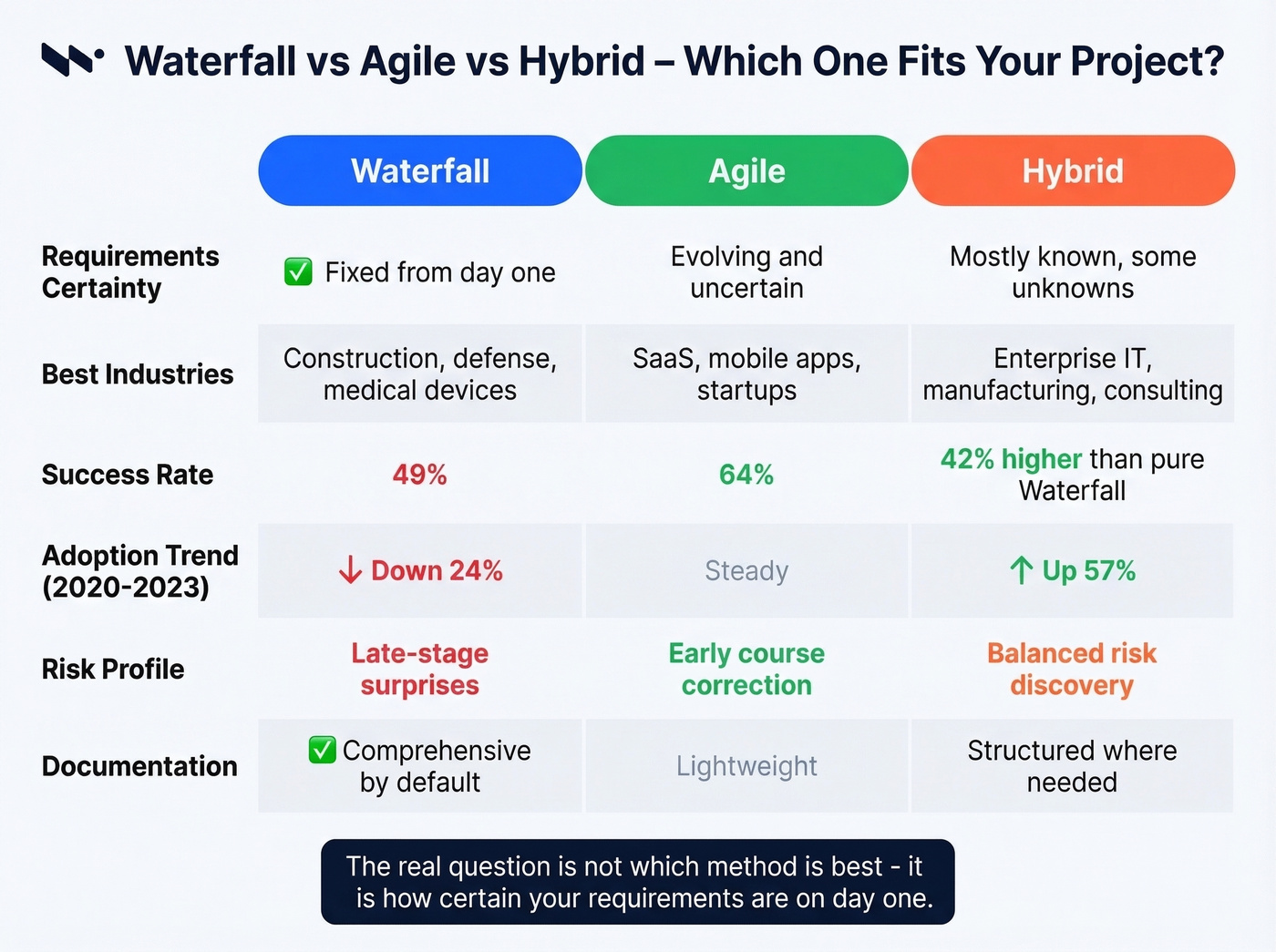
Waterfall and Agile do the same activities - explore, clarify, shape, validate, execute. The difference is timing. Waterfall tries to do it all once, start to finish. Agile loops in smaller cycles. Understanding waterfall pros and cons requires looking at the numbers: Waterfall projects succeed 49% of the time vs. 64% for Agile. That gap isn't because Waterfall is broken. It's because Waterfall punishes uncertainty, and most projects carry more uncertainty than teams admit.
Quick verdict: Waterfall works when requirements are genuinely fixed - construction, compliance, hardware. For anything with meaningful uncertainty, default to Agile or hybrid.
What Waterfall Actually Is
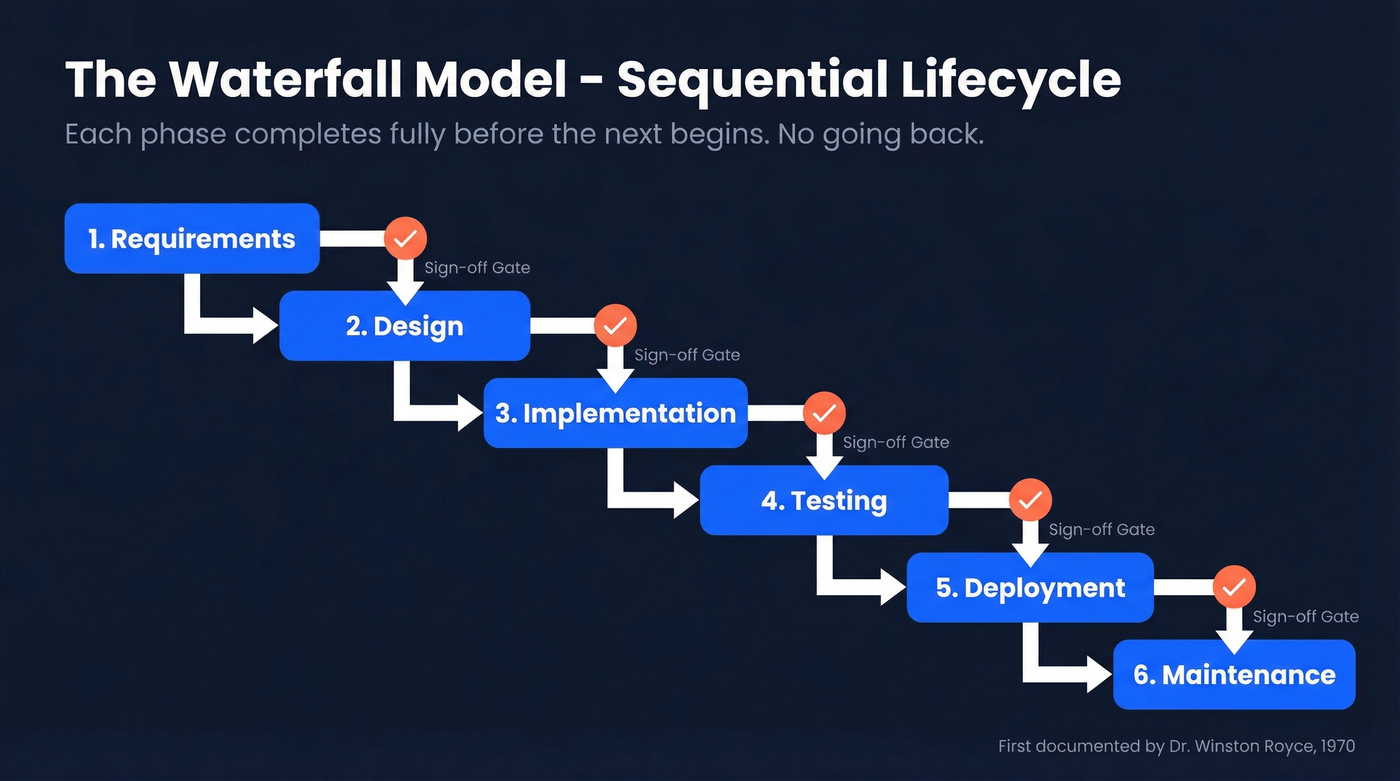
Dr. Winston Royce [documented the model in 1970](https://www.praxisframework.org/files/royce1970.pdf) as a sequential lifecycle. Six phases flow downward: Requirements, Design, Implementation, Testing, Deployment, Maintenance. Each phase completes before the next begins, with sign-offs gating every transition. Despite decades of Agile evangelism, 56% of projects still use traditional Waterfall.
Advantages of the Waterfall Model
Waterfall's strengths are real, and they're strongest where predictability isn't optional. Construction organizations use predictive approaches at a 76% adoption rate - the highest of any sector. When you're building a hospital wing, you can't "iterate" on the foundation after pouring concrete.
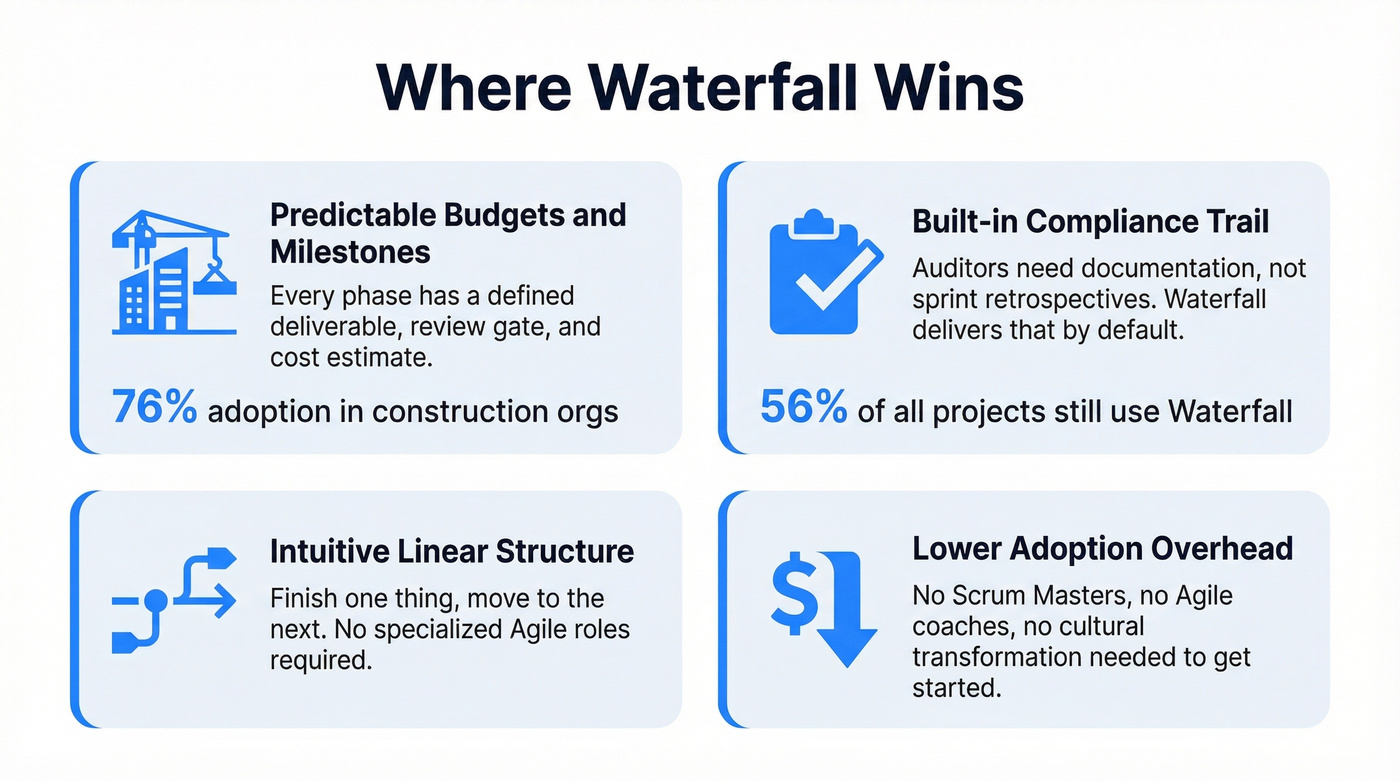
Clear milestones make budget predictability straightforward. Every phase has a defined deliverable, a review gate, and a cost estimate. For compliance-heavy work - defense software, medical devices, government IT - that documentation trail isn't overhead, it's a regulatory requirement. Auditors don't accept "we figured it out during sprint 14."
The linear structure is intuitive. Finish one thing, move to the next. It doesn't demand specialized roles like Scrum Masters or Agile coaches. People also underestimate Agile's hidden costs: the cultural shift, continuous stakeholder engagement, and coaching overhead add up fast, especially for smaller teams without that infrastructure already in place. Waterfall's simplicity has genuine value there.
Disadvantages That Break Projects
Here's the thing: Waterfall's biggest weakness isn't rigidity in the abstract. It's that you don't discover problems until it's catastrophically expensive to fix them.
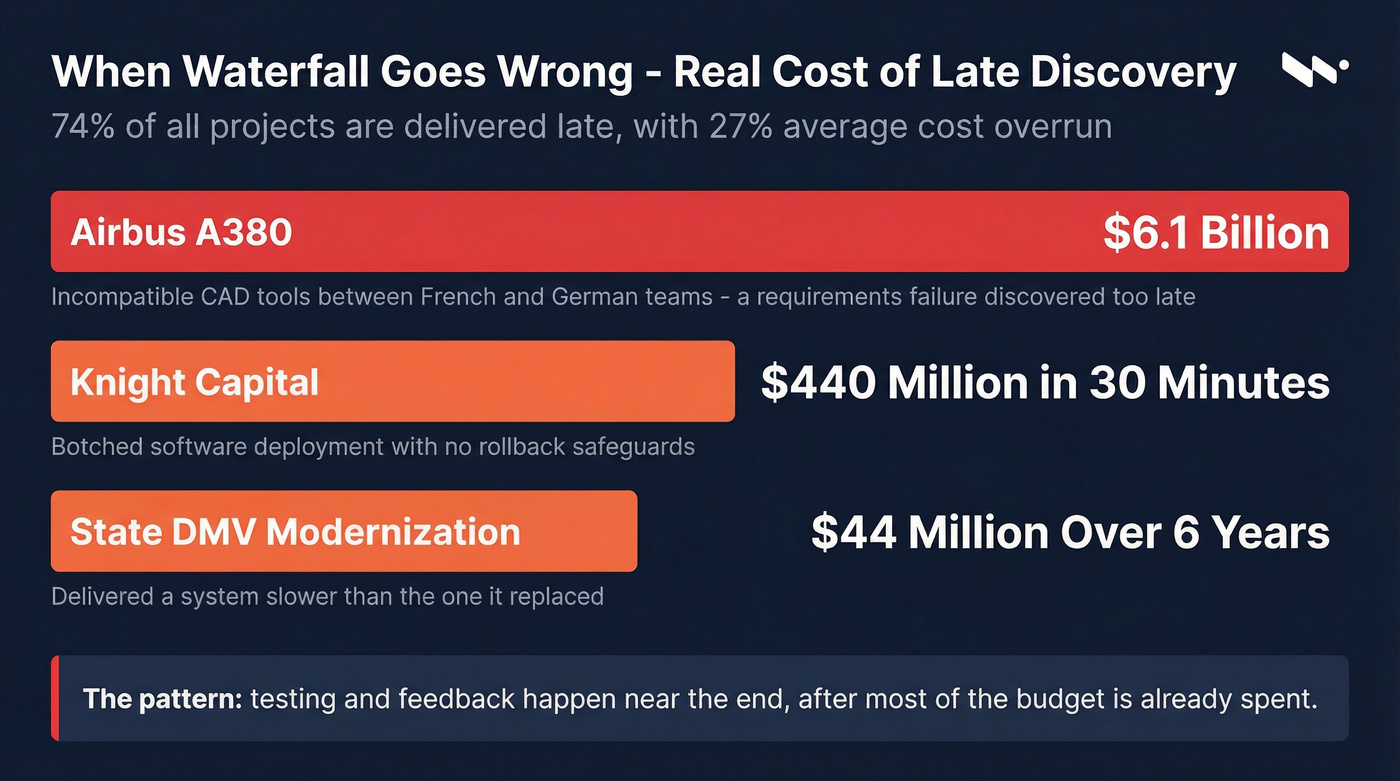
Airbus learned this building the A380. Incompatible CAD tools between French and German teams - a requirements and communication failure - cost $6.1 billion. Knight Capital's botched software deployment, lacking adequate rollback safeguards, lost $440 million in 30 minutes. A state DMV modernization burned through $44 million over six years and delivered a system slower than what it replaced.
Across all project types, 74% are delivered late with an average 27% cost overrun. Waterfall amplifies these numbers because testing and stakeholder feedback happen near the end - after most of the budget is spent. Long timelines also carry technology obsolescence risk: by the time a multi-year project deploys, the tech stack may already be outdated.
In our experience, the teams that struggle most with Waterfall aren't using it wrong. They're using it for the wrong project type. One practitioner on r/agile ran a direct comparison: their Waterfall estimate was "way off," with the deadline pushed back month after month. The Agile follow-up? After one sprint, they knew exactly where they stood. The core insight from Reddit practitioners is precise: the risk isn't locking scope - it's locking scope too early, before you've learned enough to lock correctly.

Waterfall's biggest risk is building on bad inputs. In sales, that means stale contact data rotting across long project phases. Prospeo's 7-day refresh cycle and 98% email accuracy ensure your enrichment data stays current - no late-stage surprises.
Stop inheriting bad data. Validate your inputs before phase two.
When Waterfall Makes Sense in 2026
Use Waterfall when requirements are genuinely fixed, regulatory frameworks demand sequential documentation, the domain has minimal uncertainty, or stakeholders need predictable milestones and fixed budgets.
Skip Waterfall when requirements will evolve based on user feedback, you're building software with meaningful uncertainty, stakeholder alignment is weak, or you can't afford late-stage surprises.
Predictive approaches dropped 24% from 2020 to 2023 while hybrid methods surged 57%. In software, only 10% of teams favor Waterfall vs. 32% for Agile. Pure Waterfall isn't dead, but its territory is shrinking to where it genuinely belongs.
Let's be honest: most teams don't have a methodology problem - they have a requirements-certainty problem. If you can't write down 90% of your requirements on day one and trust they won't change, Waterfall will hurt you regardless of how well you execute it.
Fixing Waterfall's Weaknesses
If you're committed to Waterfall - or stuck with it - these mitigations close the gap:
- Phase-gate reviews with real teeth. Every gate needs explicit go/no-go criteria where killing the project is on the table.
- Interim testing throughout. Don't wait until phase four. Catching a flawed assumption in week three costs a fraction of catching it in month eight.
- Frequent stakeholder touchpoints. Weekly or biweekly, not just kickoff and final review. The "big reveal" at the end is where Waterfall projects die.
- Validate inputs early. Every downstream phase inherits the assumptions of the phase before it. If your inputs are wrong, everything built on them fails - from architectural assumptions to the contact data feeding your outbound campaigns. Late-stage discovery of bad inputs is Waterfall's most expensive failure mode. For sales and marketing projects running on multi-month timelines, tools like Prospeo help here with a 7-day data refresh cycle, so enrichment inputs stay current rather than decaying across phases.
The Hybrid Alternative
Hybrid project management - Waterfall's structured phases for planning, Agile sprints within each phase - is one of the fastest-growing approaches. Adoption jumped from 20% to 31% between 2020 and 2023, and organizations using hybrid see 42% higher success rates than pure Waterfall. Consultants also cite hybrid approaches reducing delivery times by up to 30%.
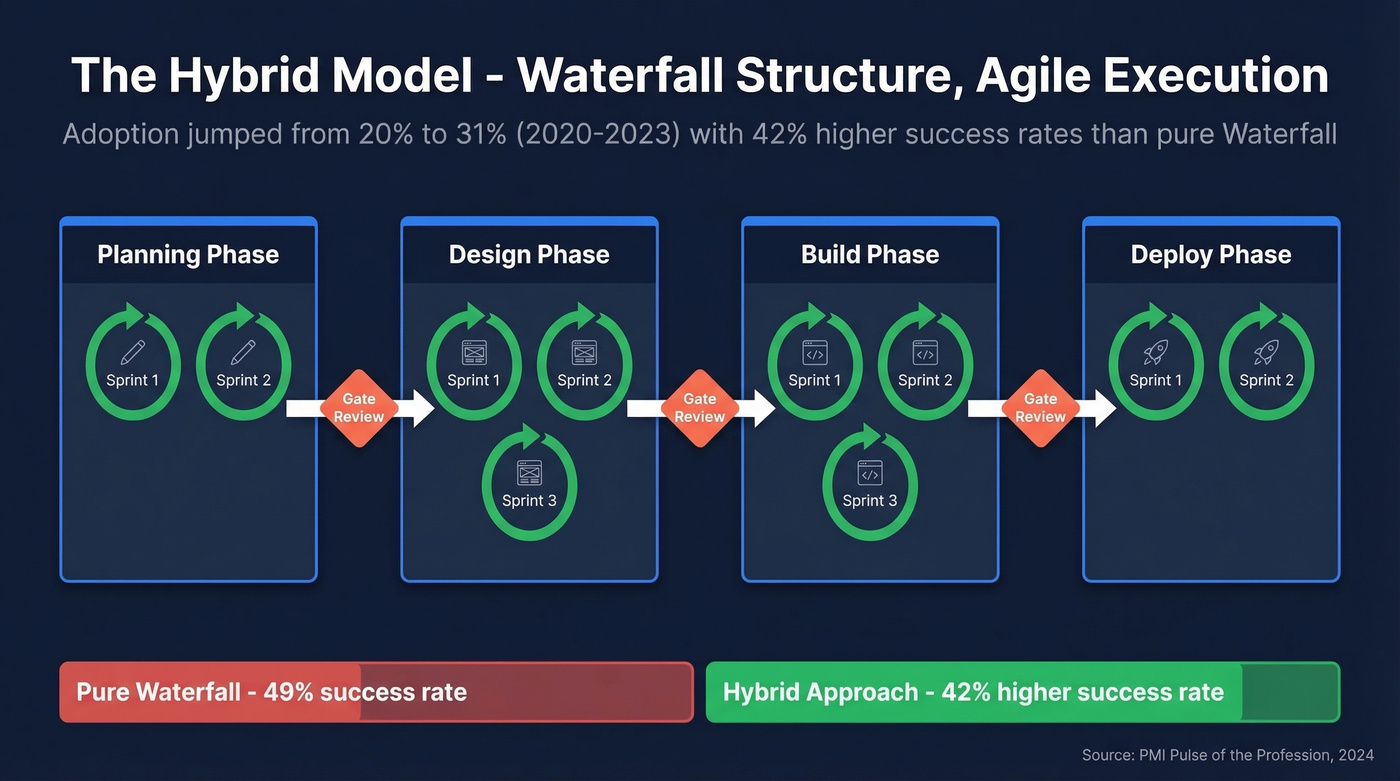
PMI's data suggests teams perform similarly across all three approaches when the method matches the project type - reinforcing that methodology fit matters more than methodology choice. We've seen teams adopt hybrid and immediately reduce the "big surprise at the end" problem that kills pure Waterfall projects.
Bottom Line
Weighing waterfall pros and cons comes down to one question: how certain are your requirements? For genuinely fixed requirements in regulated, physical, or compliance-driven domains, Waterfall remains the right call. For everything else, the data points one direction: Agile or hybrid. Real talk - if you're defaulting to Waterfall because "that's how we've always done it," you're choosing a methodology with a coin-flip success rate when better options exist.
Whether you run Waterfall, Agile, or hybrid, your outbound campaigns depend on accurate contact data. Prospeo enriches leads with 50+ data points at a 92% match rate - for roughly $0.01 per email. No contracts, no phase-gate approvals needed.
Your methodology won't save you from a 35% bounce rate. Clean data will.
FAQ
Is Waterfall still used in 2026?
Yes - 56% of projects still use traditional Waterfall, particularly in construction, defense, healthcare, and manufacturing. That said, pure Waterfall adoption dropped 24% from 2020 to 2023 while hybrid methods surged 57%. The trajectory toward hybrid and Agile is clear.
What's the biggest disadvantage of Waterfall?
Late-stage failure discovery. Testing and stakeholder feedback happen near the end, so teams don't learn their assumptions were wrong until most of the budget is spent. Airbus lost $6.1 billion from exactly this pattern on the A380.
Can you combine Waterfall and Agile?
Yes - hybrid approaches use Waterfall's sequential phases for planning while running Agile sprints within each phase. Organizations using hybrid see 42% higher success rates than pure Waterfall, and adoption jumped from 20% to 31% between 2020 and 2023.
How do bad inputs affect Waterfall projects?
Bad inputs cascade through every downstream phase, compounding cost. In data-driven projects, stale contact records or flawed market assumptions discovered at deployment can invalidate months of work. This is why input validation early in the lifecycle - whether that's project requirements or the prospect data feeding your campaigns - is the single highest-ROI mitigation for Waterfall risk.