

What Is a Sales Stack? 2026 Guide + Real Examples
The average company runs 87 software tools. Only 23% directly impact revenue. Meanwhile, reps spend 21% of their time managing those tools instead of selling - and for most organizations, the result is expensive shelfware with a login page.
A sales stack is the integrated set of tools your sales team uses across the revenue cycle: finding buyers, reaching them, tracking deals, and closing. It's not every tool the company owns. It's the connected set that runs the sales lifecycle. The distinction matters because most stack problems come from treating it as a shopping list instead of an architecture - you buy tools piecemeal, they don't talk to each other, and suddenly your "tech stack" is really just a pile of subscriptions. For reference, 67% of sales pros use between 4 and 10 tools. That's the healthy range.
What You Need (Quick Version)
Most teams need 5-7 tools, not 15. Start with your data layer - verified contacts and enrichment - then add a CRM and a sequencing tool. A small team can cover the full prospect-to-meeting workflow for $200-600/month using free CRM tiers, a tool like Prospeo for verified emails and mobiles, and a sequencer like Instantly or Lemlist.
Why Your Stack Matters
Companies using well-integrated sales intelligence tools see 35% higher close rates and 45% faster sales cycles. And 65% of companies using mobile CRM hit their sales quotas, compared to 22% without one.
The stack isn't overhead. It's infrastructure. But only if you pick the right pieces and actually use them.
The 7 Core Components
Every sales technology stack draws from the same seven categories. You don't need all seven on day one, but knowing what exists means you're making deliberate choices about what to skip.
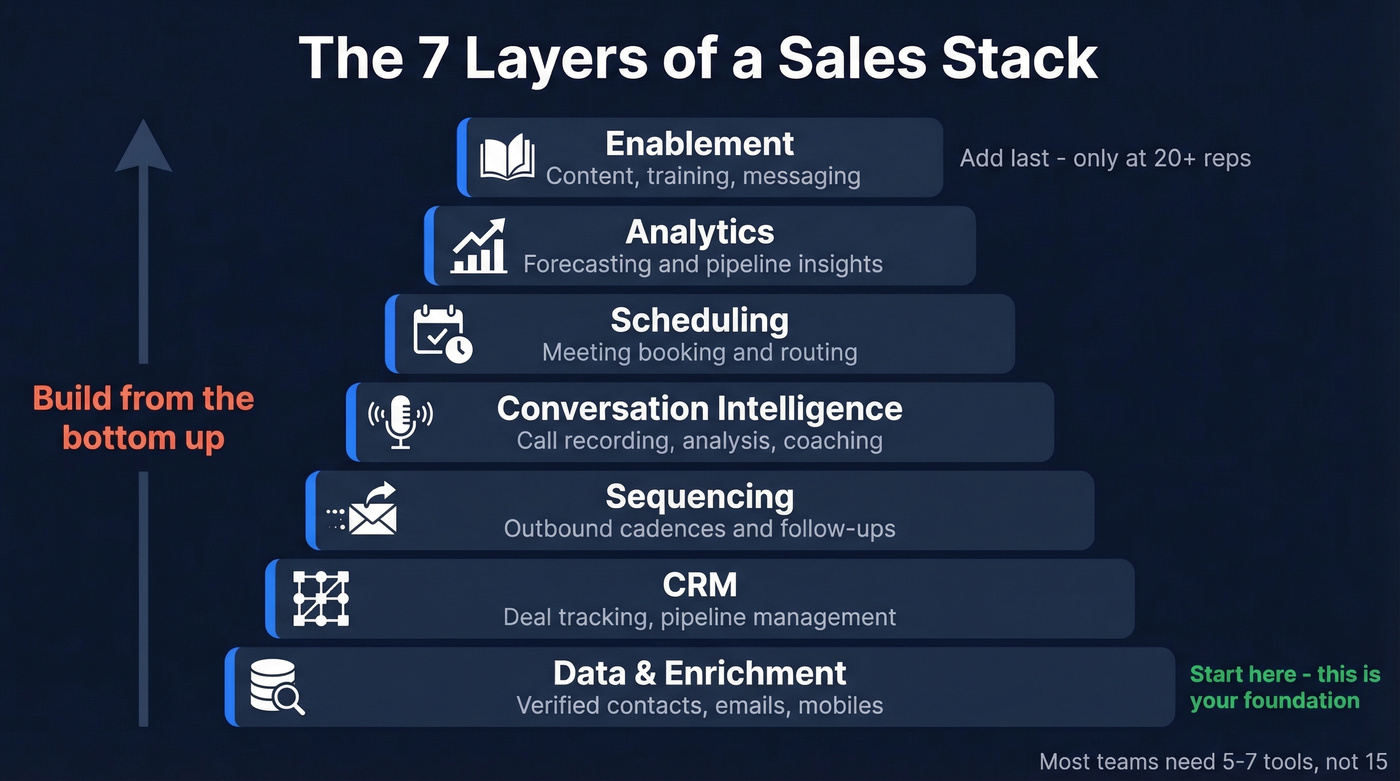
| Category | What It Does | Top Picks | Price Range |
|---|---|---|---|
| CRM | Deal tracking, pipeline | HubSpot, Salesforce | Free-~$165/user/mo |
| Data & Enrichment | Verified contacts | Prospeo, Apollo, ZoomInfo | Free-~$20k+/yr |
| Sequencing | Outbound cadences | Instantly, Outreach | ~$30/mo-$150/user/mo |
| Conversation Intel | Call analysis | Gong, Avoma | ~$40/user/mo-$2.5k+/mo |
| Scheduling | Meeting booking | Calendly, Chili Piper | Free-~$20/user/mo |
| Analytics | Forecasting, pipeline | Clari, InsightSquared | ~$1k-$5k+/mo |
| Enablement | Content, training | Highspot, Guru | ~$20-$45/user/mo |
CRM
Non-negotiable. HubSpot's free CRM handles everything a startup needs. Salesforce is the standard once you're past 20 reps and need custom objects, CPQ, or complex reporting. Don't overthink this choice early - optimize usage before switching platforms.
Data & Enrichment
Here's the thing: most teams build their stack backwards. They start with the CRM or sequencer and bolt on data later. Top outbound teams do the opposite - and they're right. A sequencing tool sending emails to bad addresses is just an expensive way to destroy your domain reputation. We've seen teams fix their data layer first and start booking meetings within the first outbound campaign, while teams that skip this step spend months wondering why their reply rates are in the gutter.
Prospeo covers 300M+ professional profiles with 98% email accuracy and 125M+ verified mobile numbers, refreshing every 7 days versus the 6-week industry average. Teams using Prospeo book 26% more meetings than ZoomInfo users and 35% more than Apollo users. At roughly $0.01 per email with a free tier, it's a fraction of what ZoomInfo charges at ~$20k+/year. Apollo offers a free tier and paid plans from ~$49/user/month with lower email accuracy.

Engagement & Sequencing
Instantly starts at ~$30/month and is the budget pick for cold email at scale. Lemlist starts at ~$39/user/month and adds multichannel personalization. Outreach is typically ~$100-150/user/month as the enterprise standard.
Match the tool to your motion: high-volume cold outbound gets Instantly, strategic multi-touch sequences get Outreach or Salesloft. If you're running fewer than 500 emails a week, Instantly is probably overkill too - a simple mail merge might do the job until you scale.
Conversation Intelligence
Gong is the market leader for call recording, analysis, and coaching - budget ~$1,000-2,500/month for small teams. If Gong's pricing is too steep, Avoma starts around $49/user/month and Attention around $40/user/month.
Skip this category entirely until your team is large enough that managers can't sit in on every call. For a 3-person sales team, Gong is a luxury. For a 30-person team, it's a necessity.
Scheduling, Analytics & Enablement
Calendly handles scheduling for most teams at free to ~$20/user/month. Chili Piper adds intelligent routing for inbound-heavy orgs starting around ~$15-$30/user/month. For analytics, Clari dominates enterprise forecasting - expect $1k-5k/month depending on team size. Enablement tools like Highspot and Guru (roughly $20-45/user/month) matter once you have 20+ reps who need consistent messaging.
Skip these three categories until you've nailed the first four.

The article says it: build your stack data-first. Prospeo gives you 300M+ profiles, 98% email accuracy, and 125M+ verified mobiles - refreshed every 7 days. At ~$0.01/email with a free tier, it's the data layer that makes every other tool in your stack actually work.
Stop building your sales stack backwards. Start with the data.
How to Build Yours in 5 Steps
1. Audit what you already have. A sales director doing this exercise found half of what they were paying for was redundant. Kill overlap before you buy.
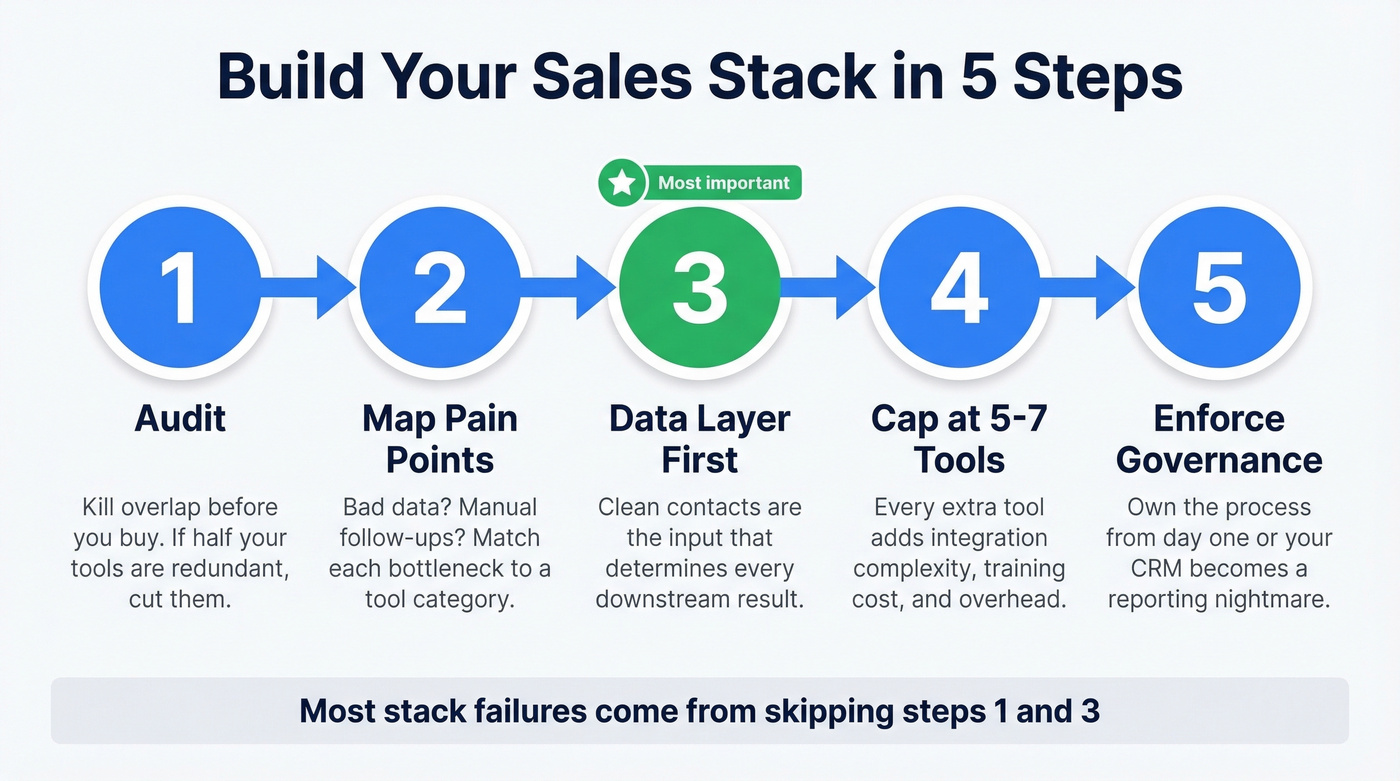
2. Map pain points to categories. Bad data? Manual follow-ups? No call recordings? Each pain point maps to a category above. Fix the biggest bottleneck first.
3. Invest in the data layer first. Clean, verified contact data is the input that determines every downstream outcome. This is the approach top outbound teams take, and it's the single biggest differentiator between stacks that produce pipeline and stacks that burn budget.
4. Cap it at 5-7 core tools. Every tool beyond that adds integration complexity, training overhead, and license cost. If you can't explain why a tool exists in one sentence, you probably don't need it.
5. Enforce governance from day one. Without clear rules on field usage and data entry, a clean CRM turns into a reporting nightmare that RevOps spends years untangling. We've watched this happen at companies with $50k/year CRM contracts - the tool wasn't the problem, the process was.
Example Stacks by Company Size
| Layer | Startup ($200-600/mo) | Mid-Market ($3k-8k/mo) | Enterprise ($15k-40k+/mo) |
|---|---|---|---|
| CRM | HubSpot (free) | Salesforce (~$75-$165/user/mo) | Salesforce (~$165+/user/mo) |
| Data | Prospeo (credit-based; ~$0.01/email) | Apollo or ZoomInfo | ZoomInfo or Cognism |
| Sequencing | Instantly (~$30/mo) | Outreach (~$120/user/mo) | Outreach or Salesloft |
| Conversation Intel | - | Gong (~$1.5k/mo) | Gong (~$2.5k/mo) |
| Scheduling | Calendly (free) | Calendly (~$20/user/mo) | Chili Piper (~$15-$30/user/mo) |
| Analytics | - | - | Clari (~$3k/mo) |
| Enablement | - | - | Highspot (~$35/user/mo) |
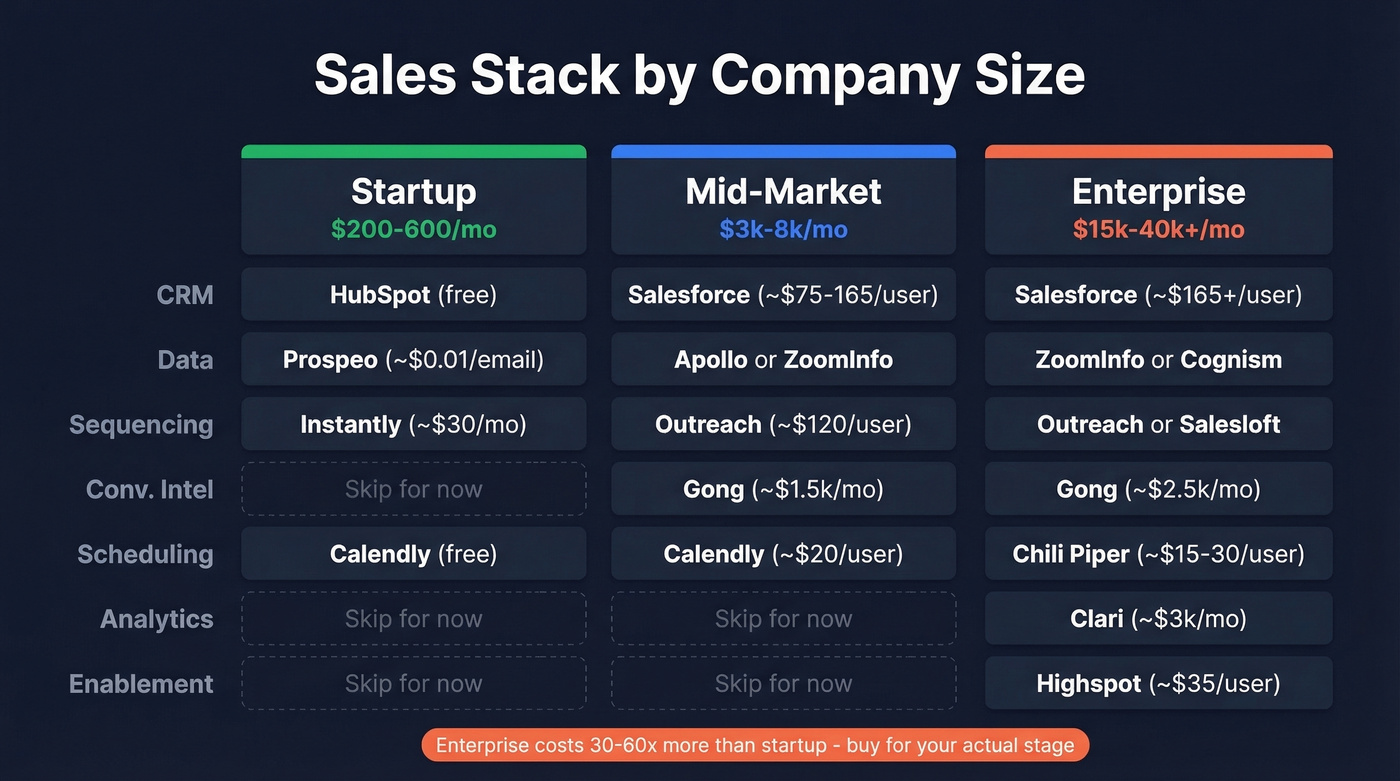
The startup stack is lean and gets you from zero to booked meetings. The mid-market stack adds call intelligence and a more capable sequencer. The enterprise stack layers in forecasting and enablement - but costs 30-60x more.
An enterprise AE on r/techsales described saving 30+ minutes per call by combining Gong with voice dictation tools for post-call notes. That's the kind of efficiency gain that justifies the spend at scale. But make sure you're buying for your actual stage, not the stage you hope to reach.
3 Mistakes That Kill Your Stack
Tool sprawl. Every new tool feels justified in isolation. Then you're paying for three platforms that all do email sequencing slightly differently, and nobody remembers which one is the "real" one. If a tool isn't used daily, cut it.
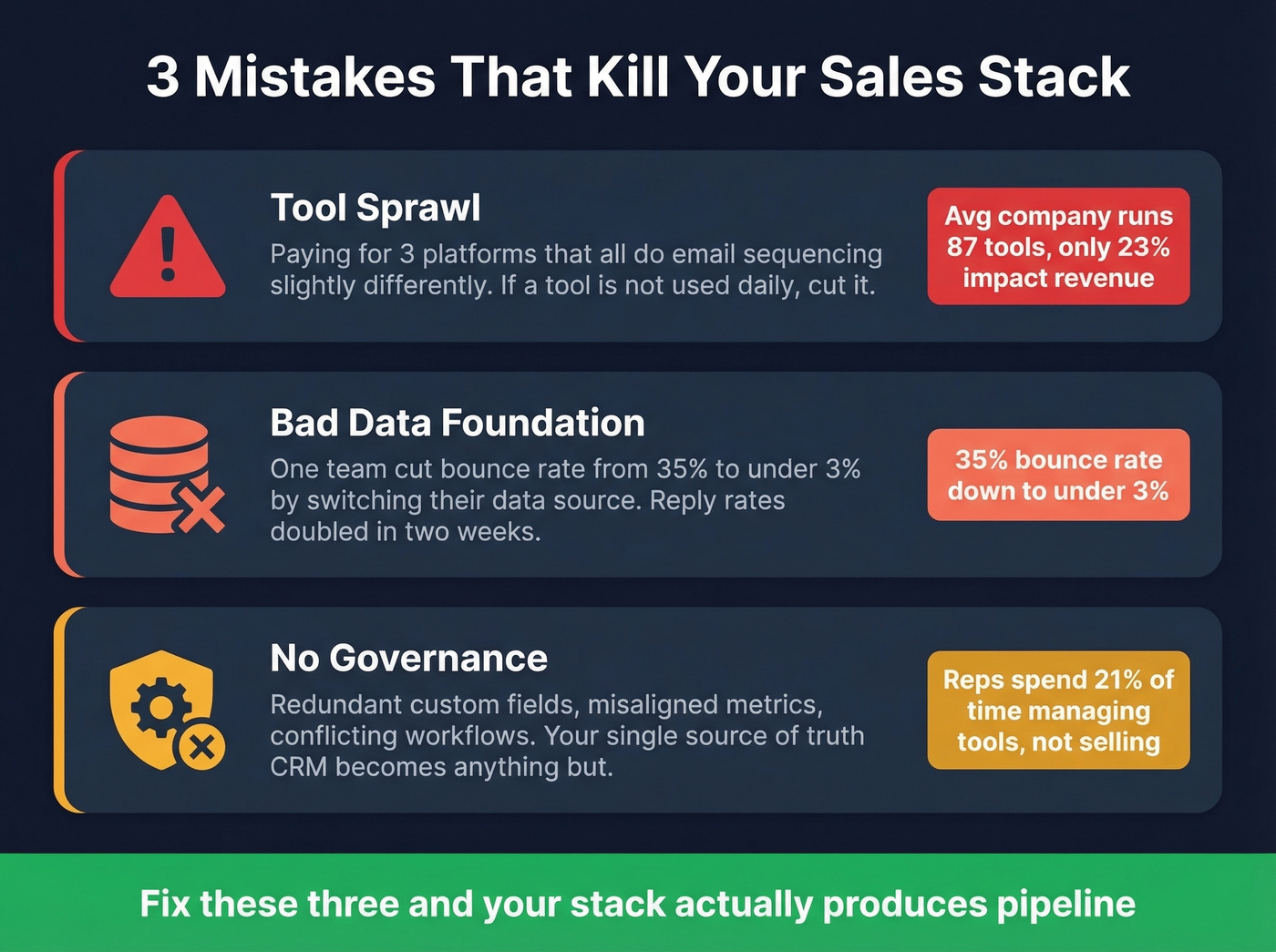
Bad data foundation. We've watched teams invest $2,000/month in Outreach sequences powered by a contact list scraped from who-knows-where. The sequences ran beautifully - straight into spam folders. Your data quality determines your deliverability, your connect rates, and ultimately your pipeline. This isn't abstract: one agency we spoke with cut their bounce rate from 35% to under 3% just by switching their data source, and their reply rates doubled within two weeks.
No governance. The most common stack failure isn't picking the wrong tools. It's giving reps too much flexibility with too little enforcement. Redundant custom fields, misaligned metrics, conflicting workflows - and suddenly your "single source of truth" CRM is anything but. Let's be honest: nobody wants to be the process police, but someone has to own this or the whole system falls apart.
Teams using Prospeo book 26% more meetings than ZoomInfo users and 35% more than Apollo users - at 90% lower cost. No contracts, no sales calls. Just verified contacts that feed your CRM, sequencer, and every downstream tool in your stack.
The best sales stack starts at $0.01 per verified email.
FAQ
How many tools should be in a sales stack?
Five to seven core tools is the sweet spot for most revenue teams. 67% of sales pros use between 4 and 10. More than that usually means overlap - audit for redundancy before adding anything new.
What's the most important component?
Your data layer. Every tool downstream - CRM, sequencing, analytics - is only as good as the contact data feeding it. Bad emails mean bounced sequences, burned domains, and wasted rep time.
How much does a full stack cost?
Startups can build a functional stack for $200-600/month using free CRM tiers and credit-based data tools. Mid-market teams typically spend $3,000-8,000/month. Enterprise stacks with full analytics and enablement run $15,000-40,000+/month.