

What Is the Formula for Determining Run Rate?
Run rate is the most misused metric in startup finance. Your CEO just told the board you're a "$5 million business" based on last month's revenue times 12 - but last month included a one-time $80k contract. So what's the actual formula for determining run rate, when does each variant work, and when will it get you in trouble?
Three Formulas, One Concept
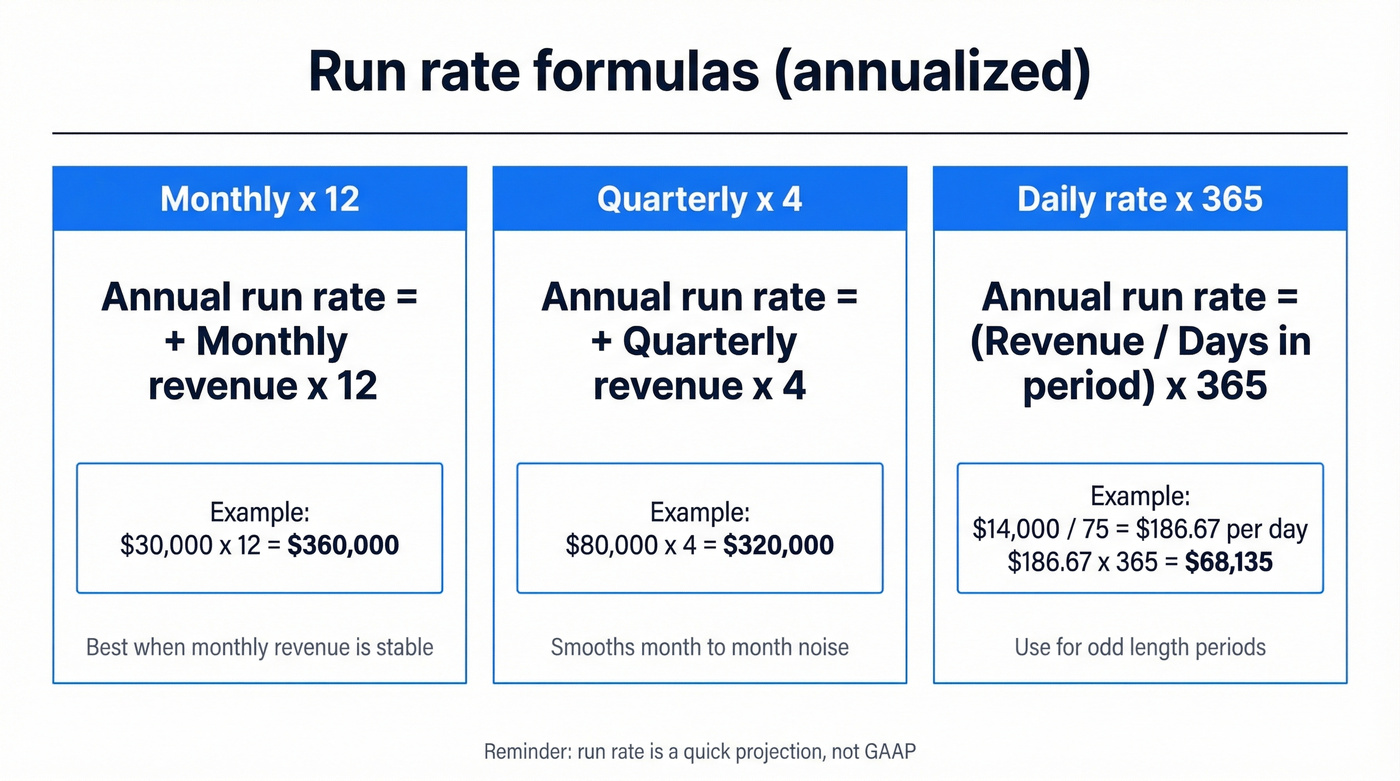
- Monthly x 12 - $30k/month = $360k annual run rate
- Quarterly x 4 - $80k/quarter = $320k annual run rate
- (Revenue / Days in Period) x 365 - $14,000 over 75 days = $68,135
The daily-rate method is the most flexible. Use it when your period doesn't fit clean months or quarters.
What Is Run Rate?
Run rate is an annualized projection of financial performance based on a shorter period. Companies use it to estimate where they'll land at year-end if current performance holds steady. It's a quick-and-dirty forecasting tool, not a GAAP-accepted metric - and that distinction matters more than most people realize.
How to Calculate Run Rate
Monthly x 12
Take your most recent month's revenue and multiply by twelve.
Example: $30,000 in June becomes $30,000 x 12 = $360,000 annual run rate.
Works well when monthly revenue is stable. Falls apart the moment you have a spike or a slow month.
Quarterly x 4
This smooths out monthly volatility by using a three-month window.
Example: $80,000 in Q2 becomes $80,000 x 4 = $320,000 annual run rate.
Notice the same company could show $360k or $320k depending on which period you pick. That's not a rounding error - it's a fundamental sensitivity baked into the formula itself. DocuSign's Q1 2021 revenue of $469.1M implied a $1.876B run rate using this method, while actual annual revenue came in at $2.1B. The run rate was conservative because revenue grew after Q1.
Daily Rate x 365
The fallback for odd-length periods. Divide total revenue by the number of days, then multiply by 365.
Example: $14,000 earned over 75 days = $14,000 / 75 = $186.67/day = $186.67 x 365 = $68,135 annual run rate.
Chargebee recommends this approach for partial-quarter or mid-year calculations. In our experience, the quarterly method is the safest default for board reporting, but the daily method rescues you when your data doesn't fit neat calendar boundaries.
Why the Base Period Matters
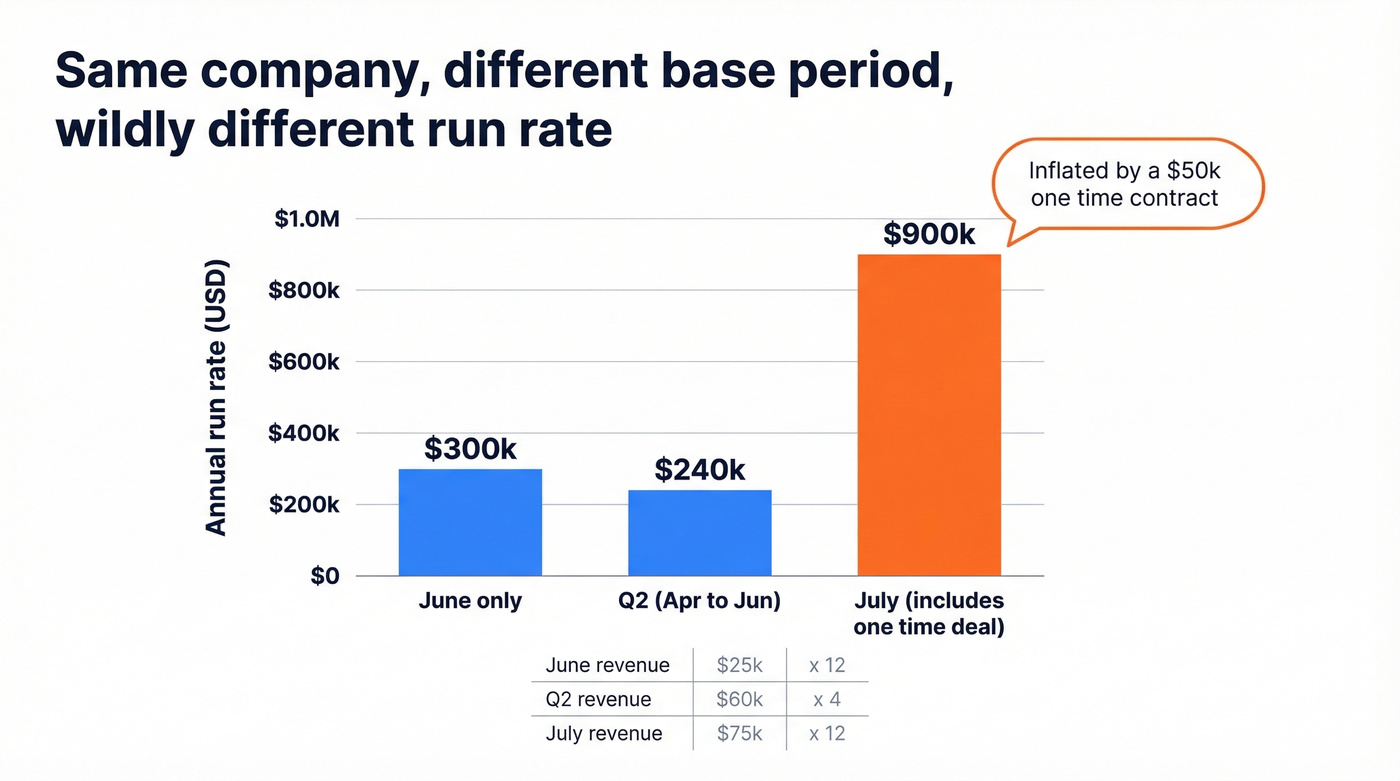
Same company, three different base periods, three wildly different run rates:
| Base Period | Revenue | Method | Run Rate |
|---|---|---|---|
| June only | $25k | x 12 | $300k |
| Q2 (Apr-Jun) | $60k | x 4 | $240k |
| July (w/ one-time deal) | $75k | x 12 | $900k |
That July figure includes a $50k one-time contract on top of $25k in normal revenue. We've seen founders accidentally triple their annualized projection by extrapolating from a month with a one-time deal. If you're presenting that to a board, you're cherry-picking whether you mean to or not.
Let's be honest: the base period argument never ends. Ask any FP&A analyst.

Your run rate is only as good as the pipeline feeding it. One-time deals inflate projections - consistent outbound fills them. Prospeo gives your team 300M+ profiles with 98% email accuracy so every month's revenue is repeatable, not a fluke.
Stop annualizing luck. Start building predictable pipeline.
Run Rate vs. ARR vs. MRR
| Metric | Includes | Best For |
|---|---|---|
| Run Rate | All revenue types | Quick projections |
| ARR | Active subscriptions only | SaaS investor reporting |
| MRR | Normalized monthly subscriptions | Operational tracking |
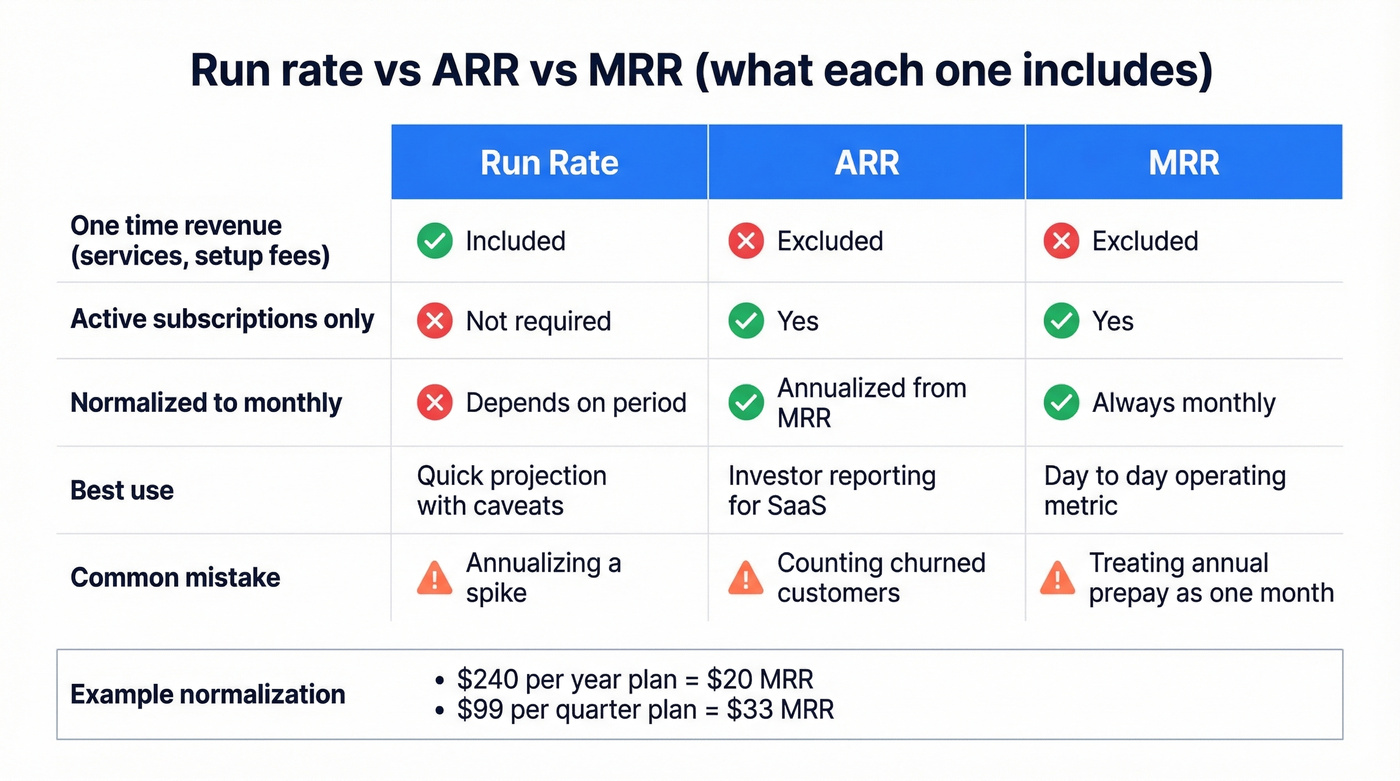
MRR normalizes everything to a monthly figure. A $240/year plan equals $20/month MRR - not $240. A $99/quarter plan equals $33/month MRR. Treating annual prepayments as a single month's MRR is one of the most common mistakes in SaaS finance.
Here's the thing: for SaaS companies, stop using revenue run rate in investor conversations. Use ARR based on true MRR. Run rate inflates the number when a period includes one-time revenue, and savvy investors will call you on it.
Expense Run Rate and Burn Rate
Run rate isn't just for revenue. The expense run rate is arguably more important for startups - it tells you when you die.
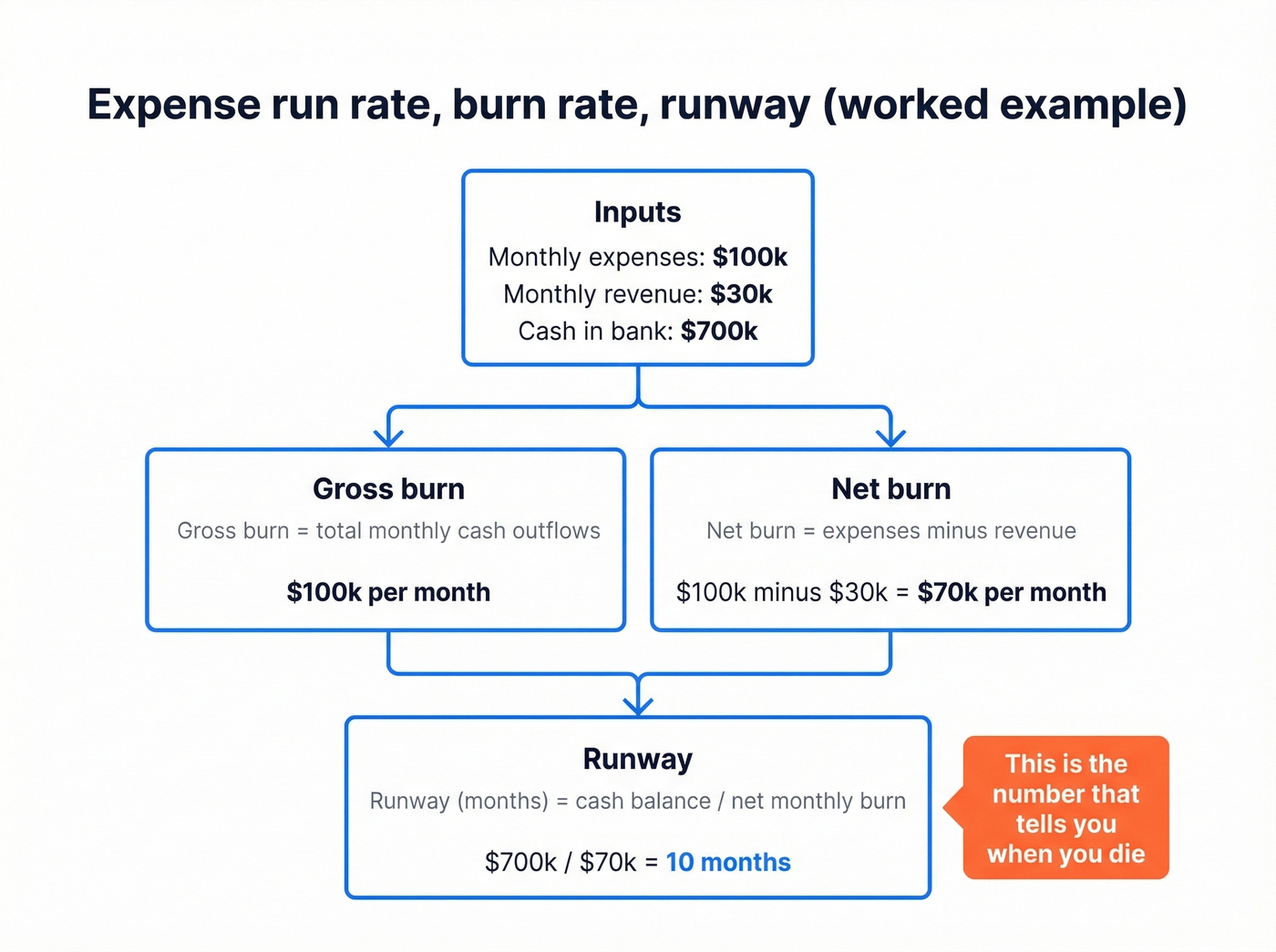
- Gross burn = total monthly cash outflows
- Net burn = expenses minus revenue
- Runway = cash balance / net monthly burn
Worked example: You're a seed-stage founder spending $100k/month and earning $30k. Net burn is $70k. With $700k in the bank, you've got 10 months of runway.
29% of startups fail because they run out of cash. Seed-stage companies typically target 24-30 months of runway buffer, and smart founders start fundraising at 8-10 months remaining - not six. If you're only tracking revenue run rate and ignoring the expense side, you're watching the wrong number.
How to Adjust for Seasonality
Annualizing a single quarter is dangerous for seasonal businesses. Shopify's Q2 2024 revenue was $2.0B, but Q4 2024 hit $2.81B - a swing driven by holiday spending. Annualizing Q4 alone would imply about $11.24B in revenue, far above the Q2-based run rate of $8.0B.
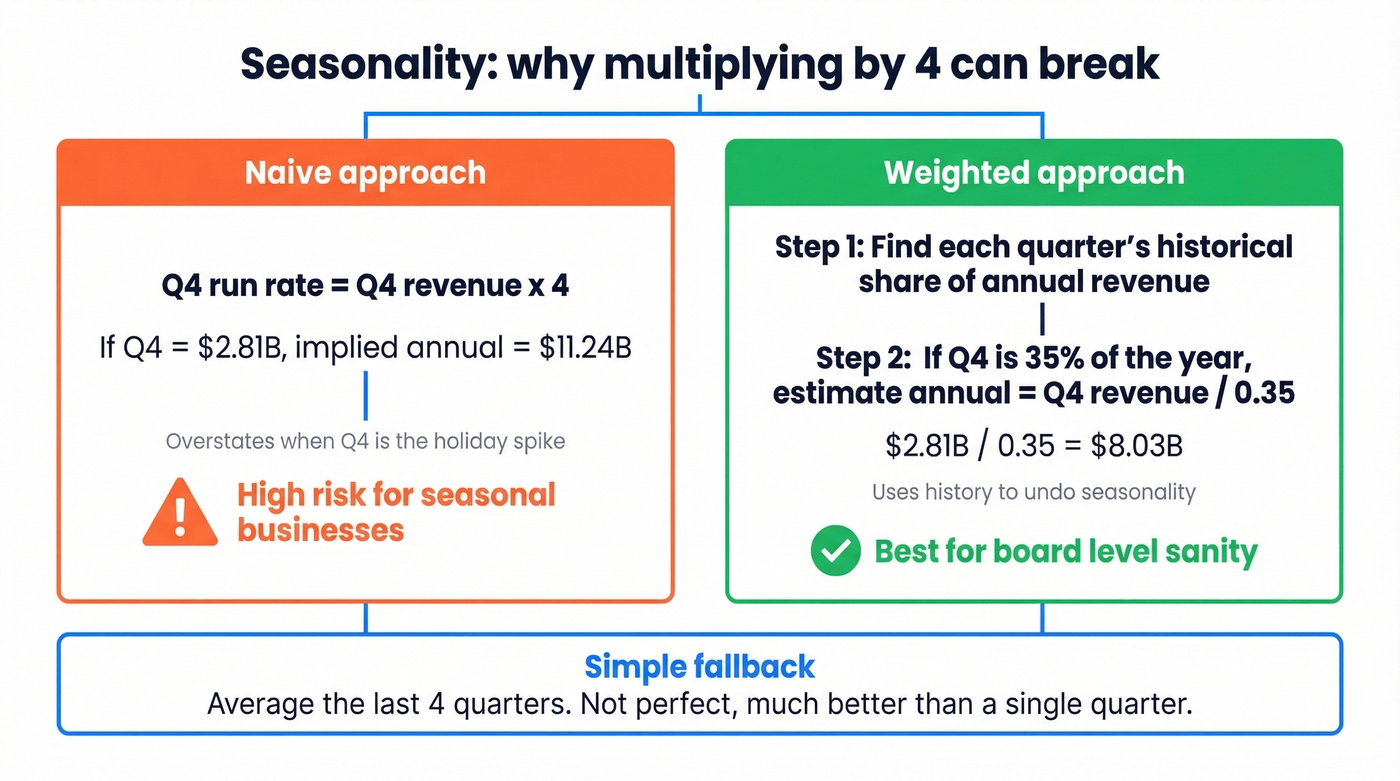
The weighted approach works better. Pull 4+ quarters of historical revenue and calculate each quarter's share of the annual total. If Q4 historically represents 35% of revenue, divide Q4 revenue by 0.35 instead of multiplying by 4. H&R Block is the extreme case - the company operates at a loss through its first three fiscal quarters because tax season concentrates nearly all revenue into a few months. Annualizing any single quarter there would be meaningless.
The simpler alternative: just average four quarters. It won't be perfect, but it's dramatically better than extrapolating from your best 90 days.
When Run Rate Works (and When It Doesn't)
Use it for:
- Early-stage forecasting when you lack a full year of data
- Quick benchmarking against peers
- Pitch decks with clear caveats about the base period
Skip it for:
- Annual budgeting or resource allocation
- Seasonal businesses without the weighted adjustment above
- Any period containing a one-time revenue spike
One stat that makes the limitation concrete: 7% monthly churn compounds to 58% annual customer loss. Run rate ignores this entirely - it assumes today's revenue repeats forever. Hitting your projected number means filling pipeline consistently, and for B2B teams, pipeline starts with accurate prospect data. Prospeo's 98% email accuracy means outbound actually converts instead of bouncing.
If your business has any seasonality at all - and almost every business does - the monthly x 12 formula is actively misleading. Default to the quarterly method or the weighted approach above. The extra five minutes of math saves you from a very awkward board conversation.
Run-Rate EBITDA in M&A
When buyers evaluate an acquisition, they don't just look at last year's EBITDA. They work through layers: reported EBITDA, then normalized EBITDA with one-time items stripped out (lawsuit settlements, office relocations), then TTM EBITDA, then run-rate EBITDA.
Run-rate adjustments annualize mid-year events. If you signed a major customer in month eight, a buyer annualizes that contract's full contribution. If you hired a VP of Sales in Q3, their full-year salary gets baked in. But buyers don't take management's word for it - they require contracts, invoices, and legal agreements as evidence.
7% monthly churn kills your run rate - unless new pipeline outpaces it. Teams using Prospeo book 26% more meetings than ZoomInfo users, at $0.01 per verified email. That's how you turn a run rate projection into actual revenue.
Fill the pipeline that makes your run rate real.
FAQ
How do you determine run rate from quarterly data?
Quarterly revenue x 4 gives you the standard annual run rate. For seasonal businesses, divide by that quarter's historical share of annual revenue instead of multiplying by 4. If you're working with a partial quarter, use the daily method: revenue divided by days in period, times 365.
Is run rate the same as ARR?
No. Run rate annualizes all revenue including one-time sales and services. ARR counts only active recurring subscription revenue. For SaaS companies, ARR is the more honest metric because it excludes revenue that won't repeat - investors increasingly demand it over raw run rate.
Can you calculate run rate for expenses?
Yes. Expense run rate equals monthly cash outflows x 12. Net burn subtracts monthly revenue from expenses. Divide your cash balance by net monthly burn to get runway in months - that's the number that tells you how long you survive before raising or reaching profitability.
What is run rate in cricket?
In cricket, run rate equals runs scored divided by overs bowled - 140 runs off 20 overs gives a run rate of 7.0. If a team's bowled out early, the calculation uses maximum allotted overs rather than overs actually faced, penalizing teams that collapse.