

The 5 P's of Successful Selling: Which Version Actually Works?
Ask five sales trainers for the 5 P's of successful selling and you'll get different answers. That's because there isn't one canonical list - there are at least four competing versions, each built for a different era of selling. Here's how to pick the right framework for 2026 and put it to work this week.
Why So Many Competing Versions Exist
The confusion starts with a naming collision. The marketing world has its own 5 P's - Product, Price, Place, Promotion, People - which has nothing to do with sales execution. Then there's Forrester's forward-looking version, a handful of sales-training variants from the 2010s, and a few thought leaders who've each coined their own.
None of them are wrong. But most were written before the market shifted underneath them.
What You Actually Need
Here's the synthesized framework that holds up when 80% of B2B interactions happen in digital channels and 84% of reps are missing quota:
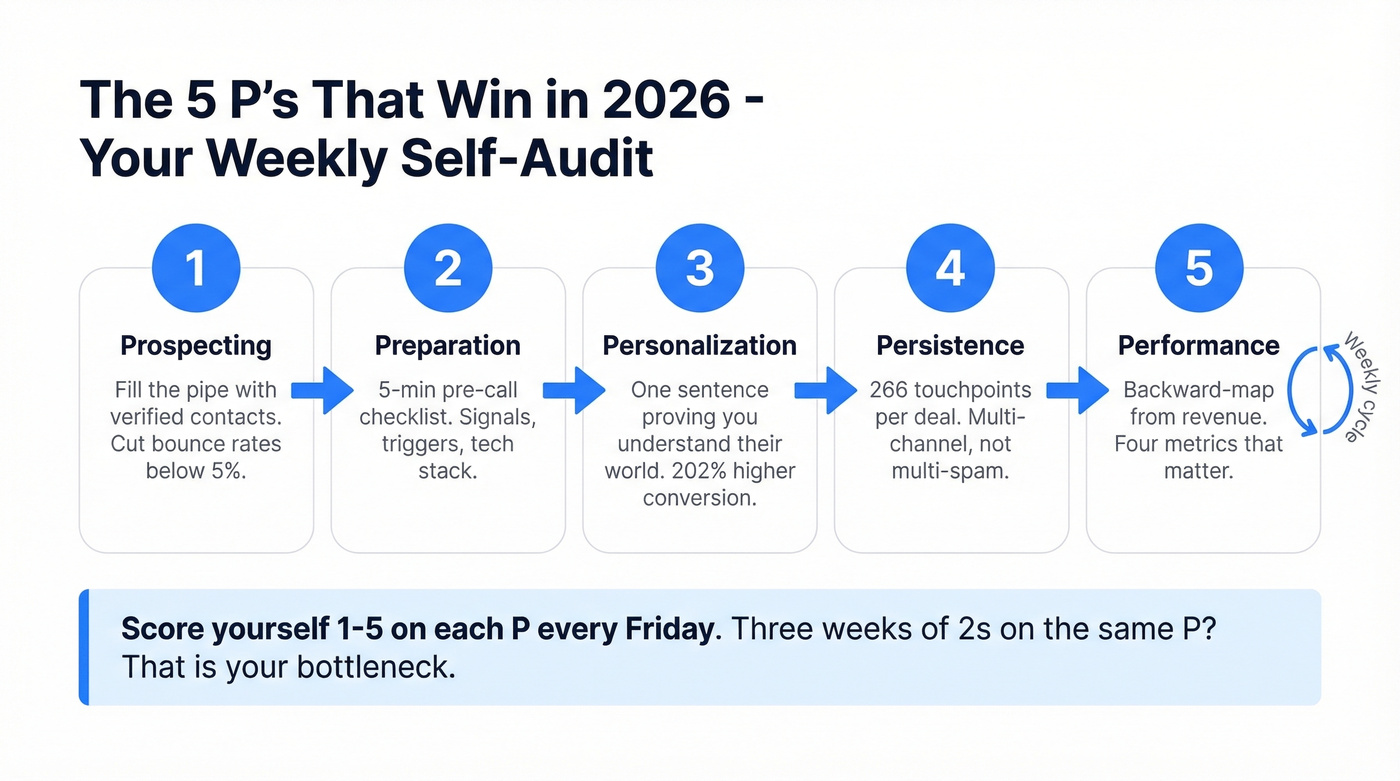
- Prospecting - fill the pipe with the right people
- Preparation - earn the right to their time
- Personalization - relevance beats volume
- Persistence - follow up like a professional, not a spammer
- Performance - measure what actually moves revenue
Use it as a weekly self-audit: score yourself 1-5 on each P every Friday. If you score a 2 on Preparation three Fridays in a row, that's your bottleneck. In our experience, the reps who score themselves honestly improve fastest.
The Competing Frameworks at a Glance
| Framework | The 5 P's | Best For |
|---|---|---|
| Forrester | Purpose-driven, Precise, Personalized, Productive, Profitable | VP-level strategy |
| Classic sales training | Prospecting, Preparation, Presentation, Persistence, Performance | New rep training |
| Center for Sales Strategy | Prospecting, Persistence, Punt, Preparation, Proposal | Behavioral science fans |
| Redpath / planning-first | Preparation, Plan, Process, Production, Performance | Operations leaders |
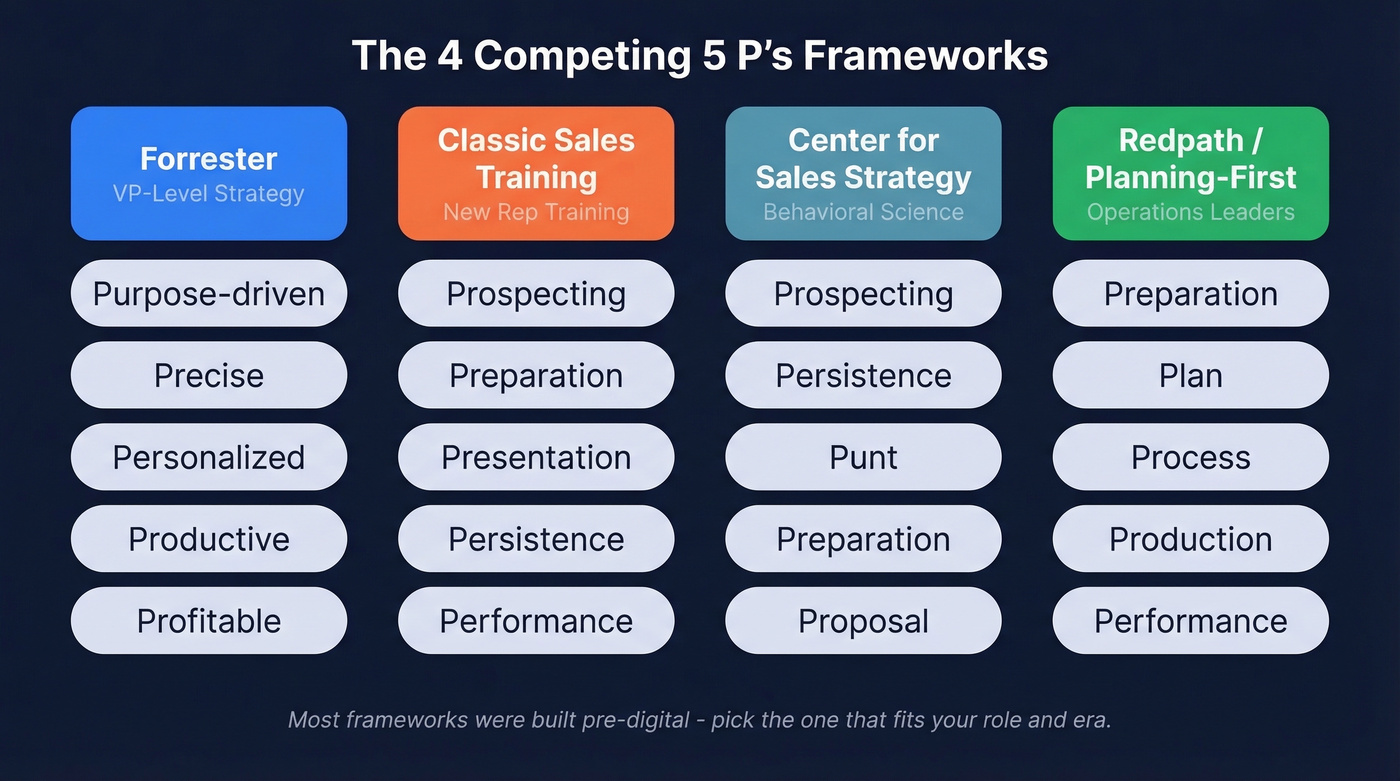
Some variants swap the fifth P for a non-P word entirely, which tells you how loosely these lists are held together. You'll also find unusual entries like "Punt" - permission to drop unresponsive prospects - and "Proximity," a behavioral science angle about staying top-of-mind. Worth knowing, rarely worth building a system around.
Forrester's version is the most intellectually rigorous. It's built around AI adoption, buyer-led journeys, and the uncomfortable stat that the average rep spends only 23% of their time actually selling. It's strategic, not tactical - better for a VP of Sales planning next year than for an SDR planning next Tuesday.
The classic variants lean heavier on presentation skills and pipeline mechanics. They're not bad. They're just pre-digital. When your buyer has already done most of their research before talking to a rep, "Presentation" as a standalone P feels like it belongs in a different decade.
The 5 P's That Win in 2026
Our synthesis - Prospecting, Preparation, Personalization, Persistence, Performance - borrows Forrester's emphasis on precision, keeps the tactical grounding of the classic models, and adds a measurement layer most frameworks skip entirely. These aren't competing with SPIN or Challenger; they're a weekly self-check that works alongside whatever methodology you've already adopted.
Here's the thing: if you only master two, make them Preparation and Persistence. Preparation because 82% of decision-makers say reps show up unprepared. Persistence because modern B2B deals require hundreds of touchpoints, and most reps quit after three.
Prospecting
Start every cadence with verified contact data. 43% of sales professionals say they need higher-quality leads, and the fix isn't yelling at marketing - it's owning your own list quality. A typical multi-channel sequence runs 7-10 touches over three weeks. None of those touches matter if the email bounces or the phone number's dead.
We've seen teams cut bounce rates from 35% to under 5% just by verifying before sequencing. Prospeo handles this at the source - 143M+ verified emails at 98% accuracy, refreshed every seven days. Run your list through verification before you build a single sequence.


Your 5 P's framework falls apart if Prospecting - the first P - runs on bad data. Prospeo gives you 143M+ verified emails at 98% accuracy, 125M+ direct dials, and a 7-day refresh cycle so every sequence starts with contacts that actually connect.
Nail the first P and the other four get easier.
Preparation
76% of top-performing reps do thorough research before reaching out. The other 24% are probably lying. A five-minute prep checklist per account changes everything:
- Company signals: funding round, headcount growth, job postings in your ICP department
- Contact signals: role tenure, recent job change, shared connections
- Tech stack: what they're running, where your solution fits
- Trigger: the specific reason you're reaching out now
This doesn't need to be a 30-minute deep dive. Five minutes with the right data sources - intent signals, technographic filters, job-change alerts - gives you more ammunition than most reps gather in an hour of manual browsing. The bar is low because so few people clear it.

Personalization
Referencing a specific trigger - a funding round, a job posting, a tech migration - that connects your solution to their current reality is what separates outreach from noise. Personalized calls convert at 202% higher rates than generic outreach. That's not a marginal improvement. That's a different sport.
What doesn't work: manipulation tactics disguised as personalization. "I saw you went to Michigan State - Go Spartans!" is flattery, not relevance. One sales leader reported a 20% win-rate increase over two quarters after replacing urgency tricks with data-backed proposals and tailored value maps. The sweet spot is one sentence that proves you understand their world. That's it.
Preparation and Personalization require real signals - intent data, job changes, tech stack, funding rounds. Prospeo's 30+ filters and 15,000 Bombora intent topics give you the trigger-based ammunition that 82% of reps show up without.
Five minutes of prep with the right data beats an hour of guessing.
Persistence
Closing a B2B SaaS deal takes an average of 266 touchpoints and 2,879 impressions. For deals over $100k, those numbers jump to 417 touchpoints and roughly 5,500 impressions. The old "rule of 7" is off by an order of magnitude.
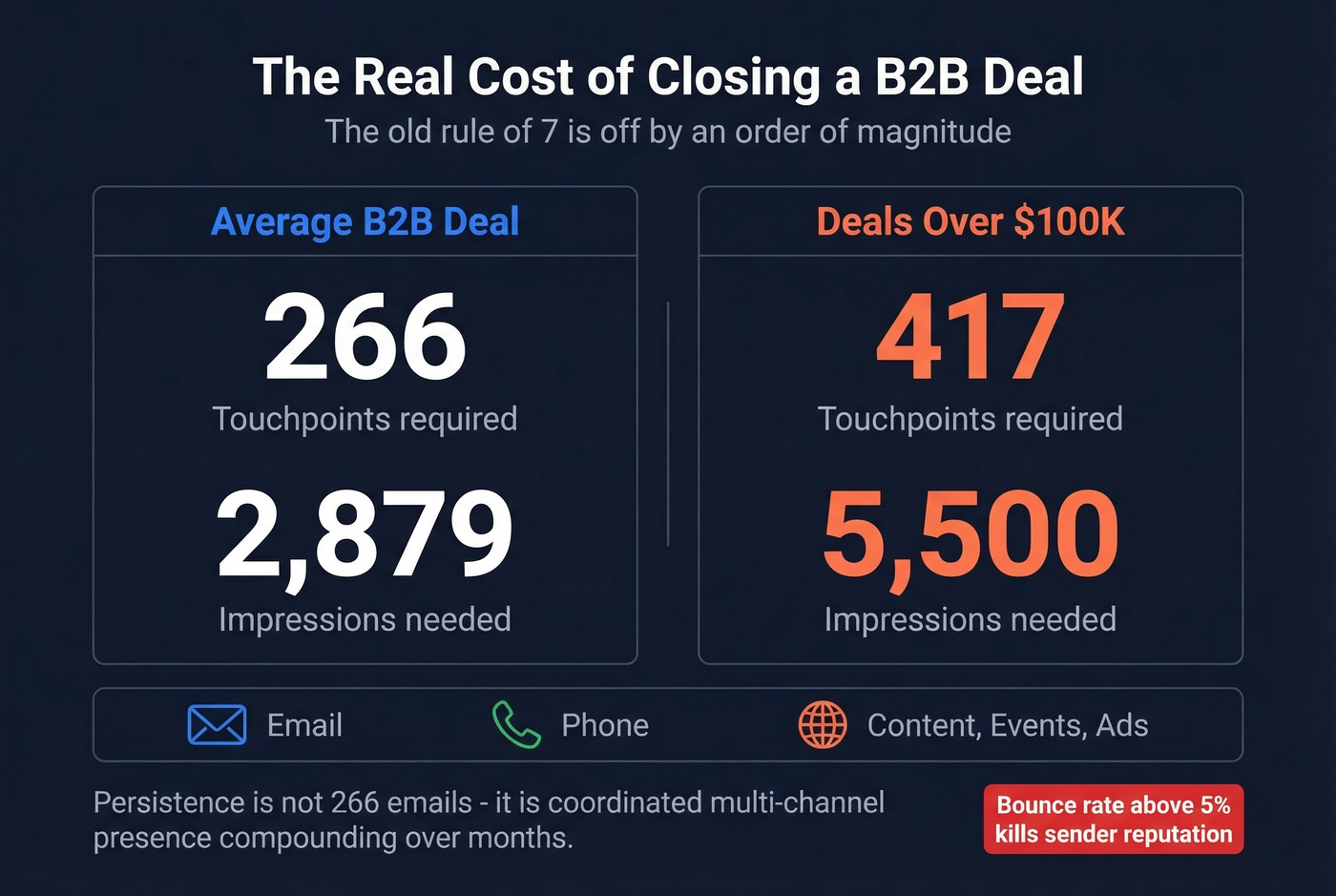
That doesn't mean sending 266 emails. It means a coordinated multi-channel presence - email, phone, content impressions, event touches, referral introductions, retargeting - compounding over weeks and months. But persistence fails if your emails bounce. A bounce rate above 5% actively damages your sender reputation, making every subsequent email less likely to land.
Let's be honest: most "persistence" problems are actually data problems. You're not giving up too early. You're sending follow-ups to addresses that don't exist.
Performance
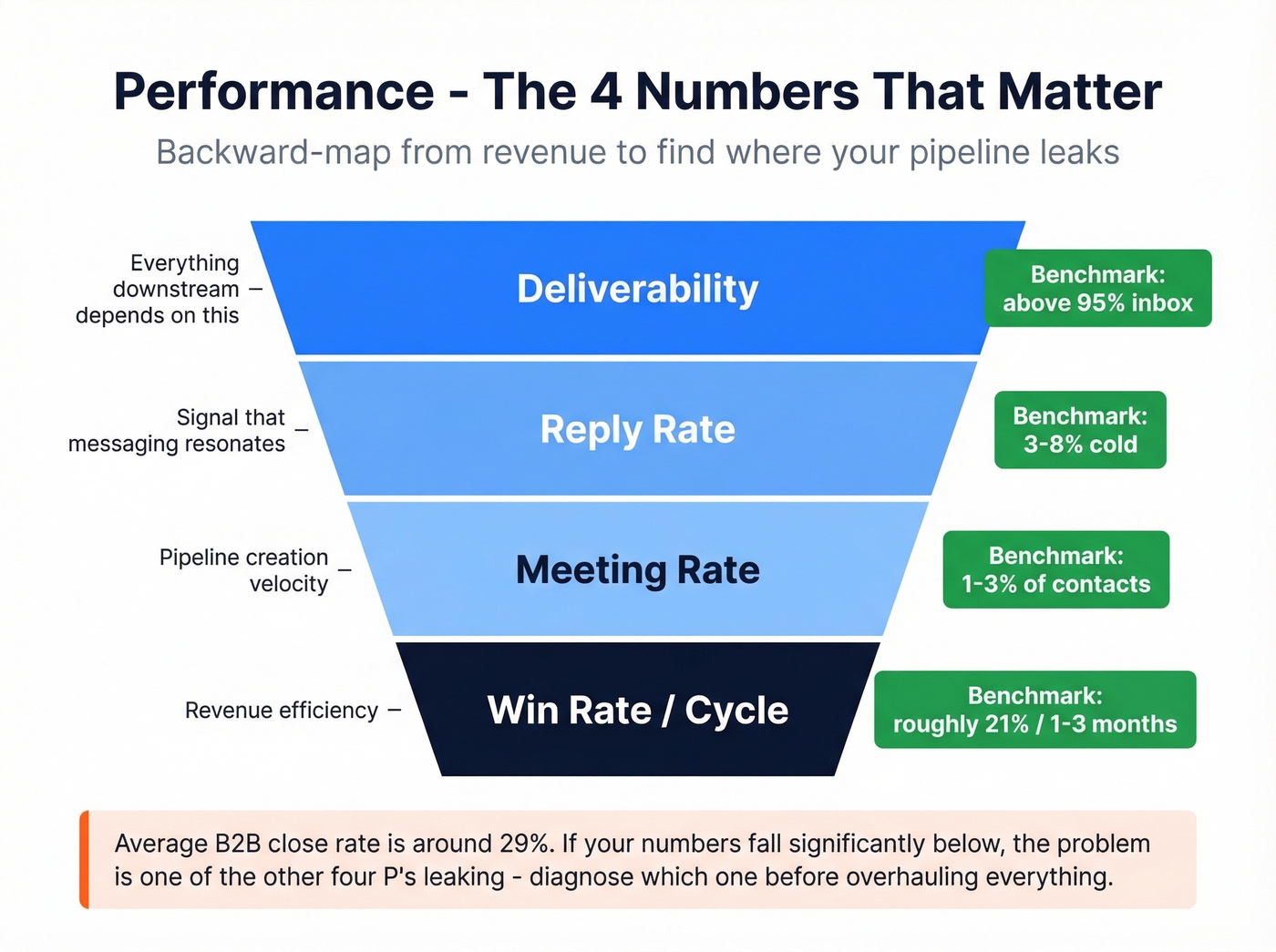
Backward-map from revenue and you'll land on four numbers that matter:
| Metric | Benchmark | Why It Matters |
|---|---|---|
| Deliverability | >95% inbox | Everything downstream depends on this |
| Reply rate | 3-8% (cold) | Signal that messaging resonates |
| Meeting rate | 1-3% of contacts | Pipeline creation velocity |
| Win rate / cycle | ~21% / 1-3 months | Revenue efficiency |
Average B2B close rate sits around 29%, with win rates closer to 21%. If your numbers fall significantly below those benchmarks, the problem isn't your framework - it's one of the other four P's leaking. Diagnose which one before you overhaul your entire process.
Frameworks Aren't Scripts
A rep on r/salestechniques put it perfectly after four years of switching frameworks: it "almost doesn't matter" which one you pick. What matters is verbiage, tone, and genuine curiosity. Question-based selling beats any rigid methodology.
The 5 P's of successful selling are guardrails, not a catechism. They remind you to check five things before you wonder why your pipeline is thin. The rep who asks great questions and follows up consistently will outsell the rep who memorizes a framework and recites it. Every time.
Skip this framework entirely if you're looking for a magic script. There isn't one. But if you want a five-point diagnostic that takes 60 seconds on a Friday afternoon and tells you exactly where your week broke down, this is it.
FAQ
Which version of the 5 P's is correct?
None hold a patent. Forrester's is most authoritative for B2B strategy. For daily execution, the synthesized set - Prospecting, Preparation, Personalization, Persistence, Performance - maps to what reps actually control week to week.
What's the most important P for new reps?
Preparation. You can't control list quality on day one, but you can show up to every call having done your homework. That 82% unprepared stat is your competitive advantage hiding in plain sight.
How do I stop persistence from becoming spam?
Vary the channel and the value with each touch, and verify your data so bounce rates stay under 5%. A 5-step email verification process - including catch-all handling and spam-trap removal - keeps deliverability above 95% so your follow-ups actually land in inboxes instead of getting flagged.
How do the 5 P's differ from SPIN or Challenger?
SPIN and Challenger are conversation methodologies - they govern what you say during a call. The 5 P's are a pipeline-health checklist covering everything before, during, and after the conversation. Most top performers use both: a methodology for meetings and the 5 P's as a weekly diagnostic.