

The Ideal Customer Profile Template That Actually Gets Used
Your SDR team prospected 500 accounts last quarter. 40 responded. 8 took meetings. 1 closed. That's not a sales problem - it's a targeting problem. The median B2B lead-to-customer conversion rate sits at 2.9%, and teams without clear ICP criteria waste 60-70% of outreach on accounts that were never going to buy. The fix isn't more activity. It's a sharper ideal customer profile template - one with teeth.
What You Need (Quick Version)
Most ICP templates fail because they're just a list of firmographic fields. The ones that actually get used have three things generic templates don't:
- A scoring rubric so reps know which accounts to pursue now vs. nurture vs. ignore. Jump to the 100-point model.
- Negative criteria - explicit disqualifiers that keep bad-fit accounts out of your pipeline. Jump to negative scoring.
- An activation workflow that connects your template to a real prospect list, because a Google Doc collecting dust isn't a strategy. Jump to activation.
Below you'll find a copy-paste ICP template, a 100-point scoring model, and filled-out examples for SaaS, professional services, and e-commerce.
What Is an Ideal Customer Profile?
An ICP describes the company you sell to - not the person. It's a set of firmographic, technographic, and behavioral attributes that define accounts most likely to become high-value customers. This distinction matters because B2B buying committees average five decision-makers. You can't build a single "avatar" for a five-person committee. You need a company-level profile first, then layer individual personas on top for messaging.
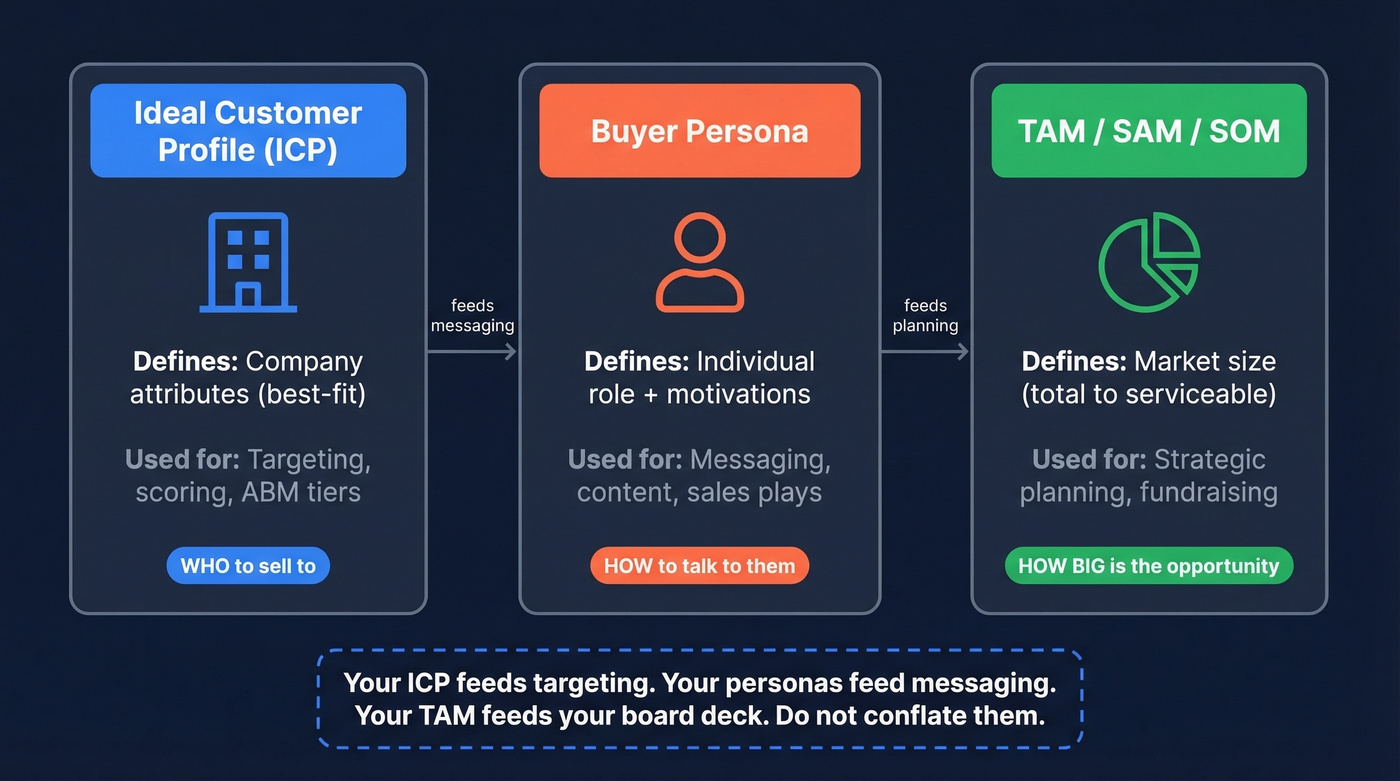
The consensus on r/sales is clear: teams that build B2C-style "avatar" templates - fears, dreams, what keeps them up at night - end up with what practitioners call "fairytale personas" that collect dust. Those psychographic details are messaging tools, not targeting tools.
| Concept | What It Defines | Primary Use |
|---|---|---|
| ICP | Company attributes (best-fit) | Targeting, scoring, ABM tiers |
| Buyer Persona | Individual role + motivations | Messaging, content, sales plays |
| TAM/SAM/SOM | Market size (total to serviceable) | Strategic planning, fundraising |
Your ICP feeds your targeting. Your personas feed your messaging. Your TAM/SAM/SOM feeds your board deck. Conflating them is one of the most common mistakes we see.
Why Your ICP Matters (With Numbers)
The biggest leak in most B2B funnels is the MQL-to-SQL handoff, where [conversion drops to roughly 15%](https://www.marqeu.com/mql-to-opportunity-conversion-benchmarks). That's the qualification gap, and it's almost always an ICP problem. Marketing generates leads that look good on paper but don't match the attributes that actually predict closed-won deals.
When ICP criteria are dialed in, the numbers shift dramatically. Tier A accounts convert at 1.5-2x higher win rates with 15-20% shorter sales cycles compared to Tier B. Sales and marketing alignment around a shared ICP drives 36% higher retention and 38% higher win rates. Those aren't marginal improvements - they're the difference between a team that hits quota and one that doesn't.
Here's the thing: without clear ICP criteria, teams waste 60-70% of outreach on wrong-fit prospects. You can't afford that when you're paying $80-120k per SDR fully loaded.
Copy-Paste ICP Template
You don't need 15 attributes. You need 5 that predict closed-won deals. Copy this into Google Sheets or your CRM - it's designed to work as-is. Fill in what you know and leave the rest blank until your data tells you it matters.
| Category | Field | Example |
|---|---|---|
| Firmographics | Industry | B2B SaaS, FinTech |
| Firmographics | Revenue range | $5M-$50M |
| Firmographics | Employee count | 50-500 |
| Firmographics | Geography | US, UK, DACH |
| Firmographics | Growth stage | Series A-C |
| Technographics | Current stack | Salesforce, HubSpot |
| Technographics | Infrastructure | Cloud-native, API-first |
| Behavioral | Content engagement | Pricing page visits, webinars |
| Behavioral | Product usage | Active trial, 3+ logins/week |
| Triggers | Funding event | Series B closed Q1 2026 |
| Triggers | Hiring surge | 5+ SDR openings |
| Triggers | Leadership change | New CRO in last 90 days |
| Triggers | Tech adoption | Just implemented Outreach |
| Buying Committee | Economic buyer | VP Sales, CRO |
| Buying Committee | Champion | Sales Ops Manager |
| Buying Committee | Technical evaluator | RevOps Lead |
| Buying Committee | End user | SDRs, AEs |
| Buying Committee | Blocker | IT Security, Procurement |
| Exclusions | Negative criteria | <20 employees, gov't |
The template above is your starting point. The scoring rubric below is what makes it operational.

Your ICP template defines the right accounts. Prospeo's 30+ search filters - including buyer intent, technographics, funding events, and headcount growth - let you turn those criteria into a scored prospect list in minutes, not days. 98% email accuracy means your Tier A outreach actually lands.
Stop scoring accounts you can't reach. Build the list now.
ICP Scoring Rubric (100-Point Model)
A template without scoring is just a description. Scoring turns your ideal customer profile template into a decision framework reps can actually use to prioritize accounts. The model below is adapted from Salesmotion's rubric framework, which recommends building from 50-100 closed-won deals. Their research shows 70-80% of wins share 3-5 common traits.
If you want to go deeper on scoring mechanics, see our guide to lead scoring.
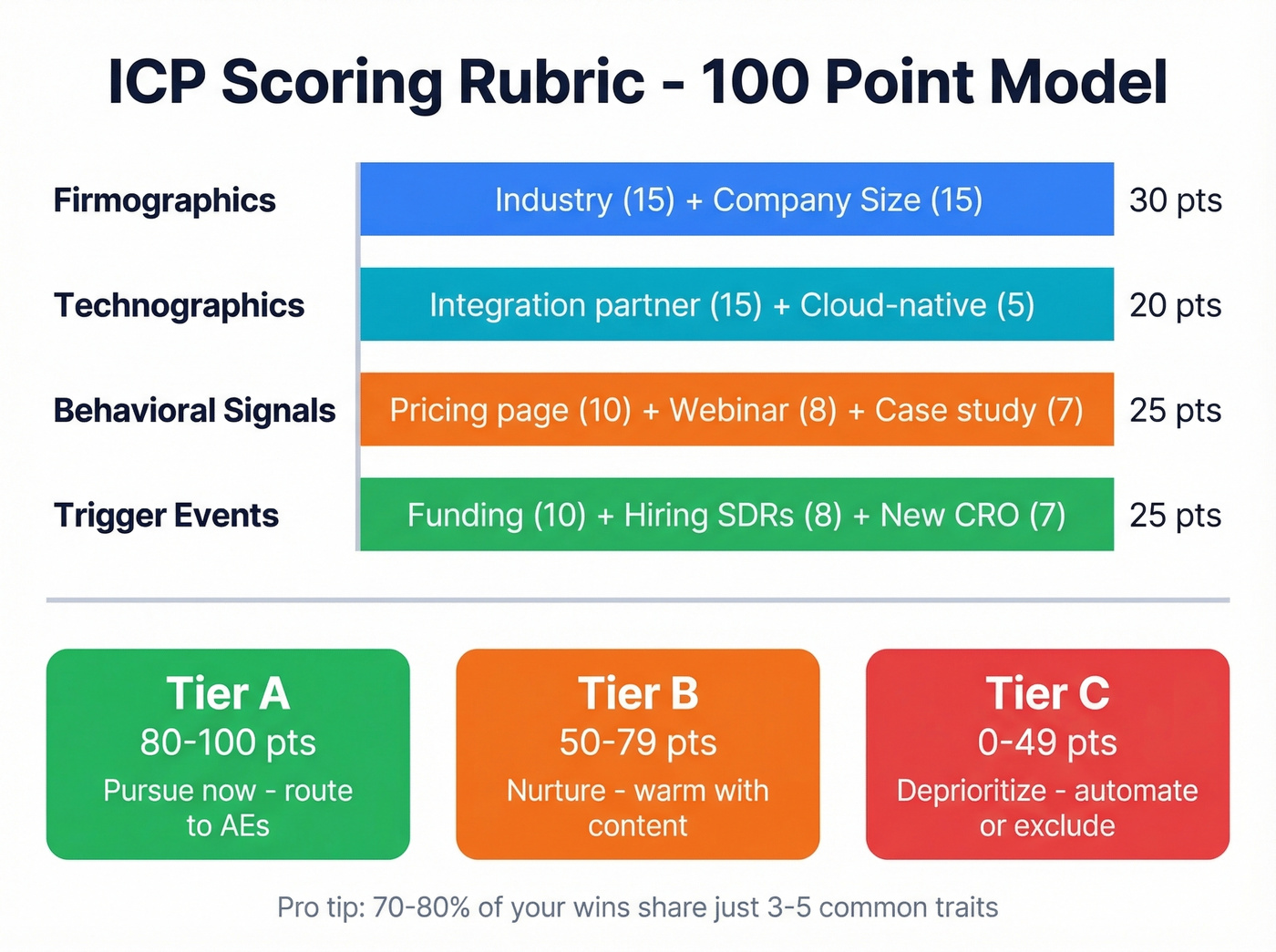
Point Allocations and Tier Thresholds
| Category | Max Points | Example Criteria | Example Score |
|---|---|---|---|
| Firmographics | 30 | Right industry (15), right size (15) | 25/30 |
| Technographics | 20 | Uses your integration partner (15), cloud-native (5) | 15/20 |
| Behavioral signals | 25 | Pricing page visit (10), webinar (8), case study (7) | 18/25 |
| Trigger events | 25 | Recent funding (10), hiring SDRs (8), new CRO (7) | 20/25 |
| Total | 100 | 78/100 |
Tier thresholds determine action:
- Tier A (80-100): Pursue now. Route to AEs immediately. These accounts get personalized outreach and multi-threaded engagement.
- Tier B (50-79): Nurture. Add to sequences, warm with content, revisit when trigger events fire.
- Tier C (0-49): Deprioritize. Don't waste rep time. Automate or exclude entirely.
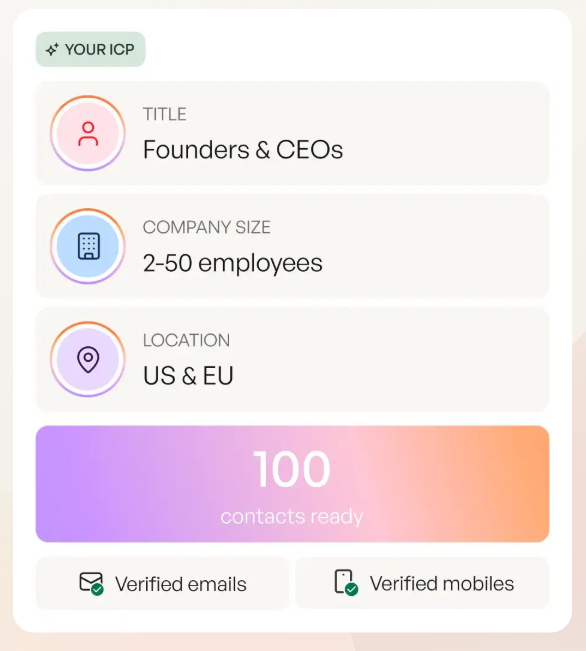
For more sophisticated teams, consider a weighted multiplier approach instead of flat points: strategic fit at 3x, authority signals at 2x, and behavioral engagement at 1x. This prevents a company that checks every firmographic box but shows zero engagement from scoring as Tier A.
Negative Scoring (Subtract Points)
Positive scoring tells you who to pursue. Negative scoring keeps bad-fit accounts from clogging your pipeline. Adapted from Monday.com's lead scoring framework, here's how subtraction works:
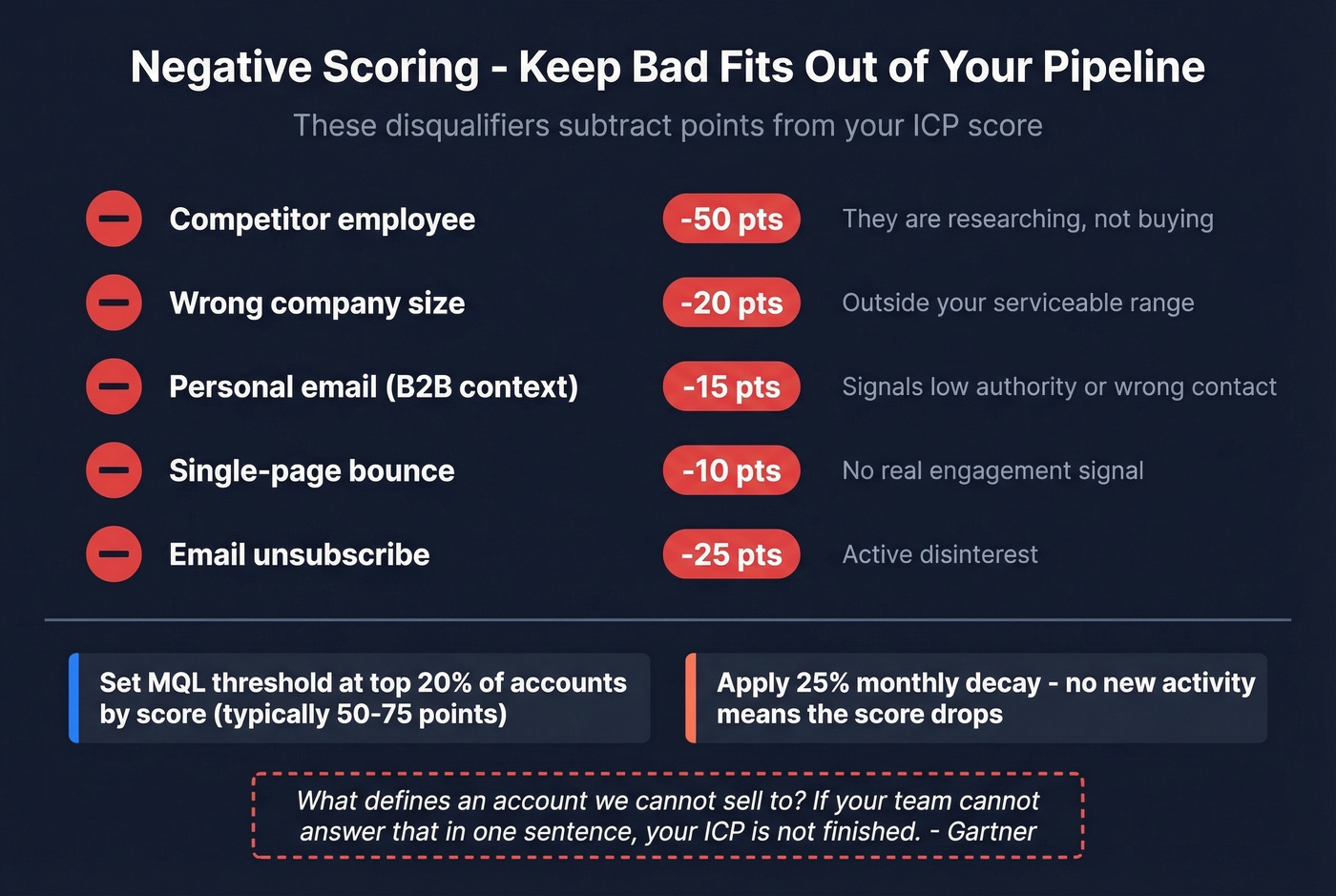
| Disqualifier | Point Deduction | Rationale |
|---|---|---|
| Competitor employee | -50 | They're researching, not buying |
| Wrong company size | -20 | Outside your serviceable range |
| Personal email (B2B context) | -15 | Signals low authority or wrong contact |
| Single-page bounce | -10 | No real engagement signal |
| Email unsubscribe | -25 | Active disinterest |
Set your MQL threshold to capture the top 20% of accounts by score - typically 50-75 points on a 100-point scale. Build in time-based decay: reduce scores by 25% monthly without new activity. An account that scored 85 six months ago and hasn't engaged since isn't a Tier A account anymore.
Gartner's disqualification prompt is worth taping to your monitor: "What defines an account we can't sell to?" If your team can't answer that in one sentence, your ICP isn't finished.
How to Build Your ICP in 5 Steps
1. Pull Your Top 20% from CRM
Stop building ICPs in workshops. Build them in your CRM. Open Salesforce or HubSpot, sort closed-won accounts by CLTV or ACV, and identify your top 20% - the customers who renewed, expanded, and didn't churn. Pull three data types: quantitative data from your CRM/ERP, qualitative data from sales and CS conversations, and predictive patterns from historical trends. Most teams skip the qualitative piece. Don't.
If you need a refresher on pipeline math, use our B2B sales funnel template to benchmark each stage.
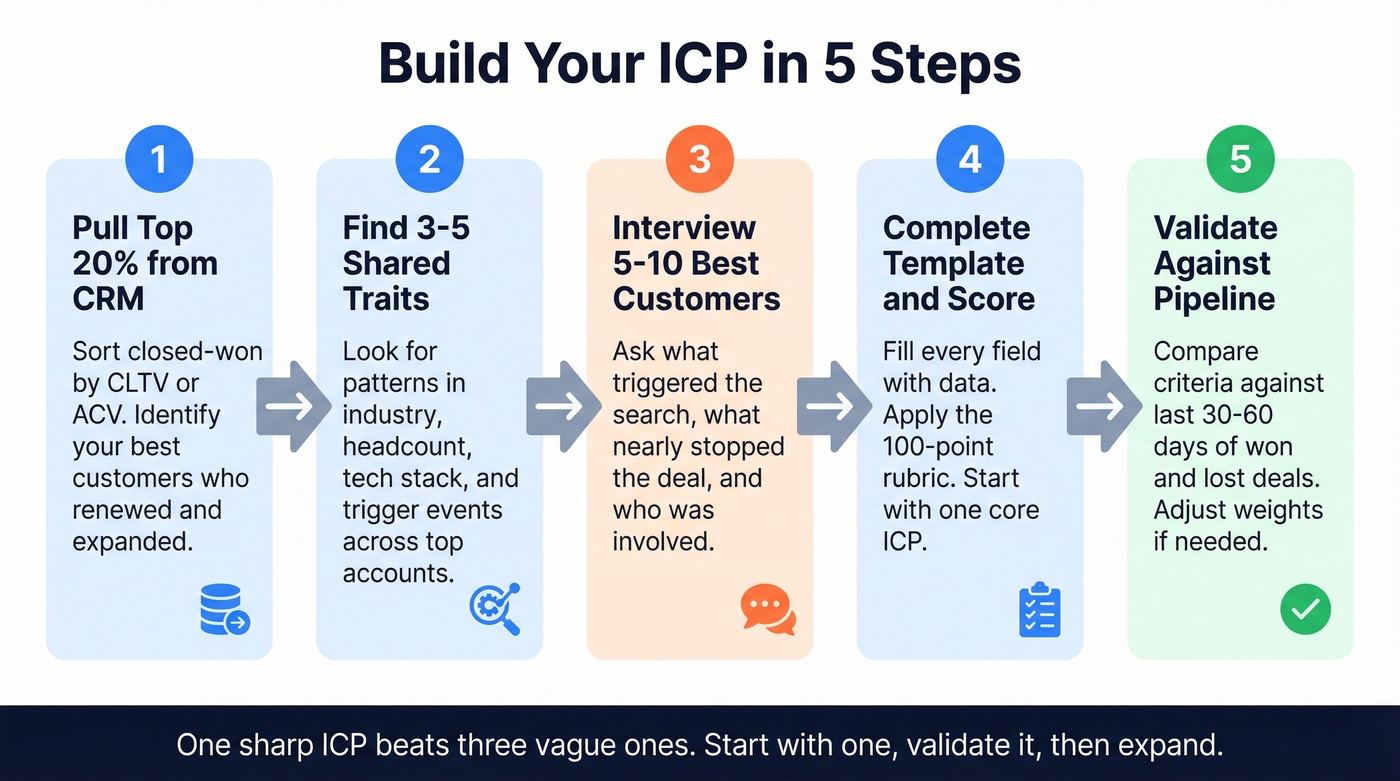
2. Find the 3-5 Shared Traits
Look across your top 20% for patterns. What industries keep showing up? What headcount range? What tech stack? What triggered the initial conversation? The 70-80% commonality stat is real - most of your best customers share a surprisingly small number of traits. Use BuiltWith for technographic research if your CRM doesn't capture stack data natively.
To operationalize those fields, it helps to standardize your firmographic filters and your firmographic and technographic data.
3. Interview 5-10 Best Customers
CRM data tells you what happened. Customer interviews tell you why. Ask these questions:
- What triggered the search for a solution like ours?
- What nearly stopped you from buying?
- Who else was involved in the decision?
- What would've happened if you'd done nothing?
- What does success look like six months in?
- What surprised you after buying?
We've found that five solid interviews reveal more actionable ICP data than a month of dashboard analysis. The last two questions are the ones most teams skip, and they surface the retention signals that separate Tier A accounts from Tier B.
4. Complete the Template and Score
Fill in every field you have data for and apply the scoring rubric. Before you score, run a quick readiness check on each account: Do they have budget allocated? Is there urgency or awareness of the problem? Are they willing to invest the time and effort to change? These qualification gates prevent you from scoring a company as Tier A just because the firmographics match while the buying intent doesn't exist.
Start with one core ICP. Resist the urge to build three on day one. One sharp profile beats three vague ones every time.
5. Validate Against Pipeline Data
Compare your ICP criteria against your last 30-60 days of won and lost deals. Do your Tier A accounts actually close at higher rates? If not, your weighting is off. Gaps in your CRM data will make your ICP look wrong even when the criteria are right - enrich records with missing firmographic and technographic data to confirm whether your criteria actually correlate with your best customers. We use Prospeo's enrichment API for this internally, and it fills gaps fast enough that you can validate the same week you build the profile.
If you're tightening qualification at this stage, our MEDDIC sales qualification guide can help you pressure-test “Tier A” assumptions.
From ICP to Prospect List
Every ICP article stops at "here's your template." Almost none of them show you how to actually find the accounts that match. That's the activation gap, and it's where most ICPs die.
Your ICP fields map directly to prospecting filters. Industry, headcount, tech stack, buying signals, growth stage - each attribute becomes a search parameter in a B2B data platform. Let's be honest: if your deal sizes are under $10k, you probably don't need ZoomInfo-level data. A self-serve platform with strong filters and verified emails will get you 90% of the way there at a fraction of the cost.
Skip this step if you're selling to fewer than 100 total addressable accounts - at that scale, manual research and warm intros beat any database. For everyone else, the workflow is straightforward: set your ICP filters, pull matching accounts with verified emails, and push them straight into your sequencer. Prospeo's B2B database covers 300M+ profiles with 30+ search filters including technographics, buyer intent across 15,000 Bombora topics, headcount growth, and funding data, all on a 7-day refresh cycle. The free tier gives you 75 emails to test your ICP against real data before committing a dollar.
If you're building lists at scale, you may also want a repeatable process for how to automate target account lists.

Filled-Out ICP Examples
Here's how the template and scoring model look in practice across three different business types:
| Field | SaaS | Professional Services | E-Commerce / DTC B2B |
|---|---|---|---|
| Industry | B2B SaaS | Management consulting | DTC brand, B2B wholesale |
| Revenue | $5M-$50M | $20M-$200M | $2M-$20M |
| Employees | 50-500 | 200-2,000 | 20-200 |
| Geography | North America | US, UK | US |
| Growth stage | Series A-C | Established, expanding | Seed-Series A |
| Tech stack | Salesforce + HubSpot | Legacy CRM (Dynamics) | Shopify Plus |
| Key trigger | Hiring 5+ SDRs + funding | CRM migration | Launched wholesale channel |
| Economic buyer | VP Sales / CRO | Managing Partner / COO | Founder / Head of Sales |
| Champion | Sales Ops Manager | Dir. of Business Dev | Operations Manager |
| Exclusion | <50 employees, bootstrapped | Gov't contracts only | Pure DTC, <$2M revenue |
| Score | 85 - Tier A | 72 - Tier B | 60 - Tier B |
Why the SaaS Profile Scores Highest
This is the classic mid-market SaaS profile. The hiring trigger combined with recent funding signals active investment in outbound - they need tools and data now. Every firmographic and technographic criterion aligns, and the behavioral signals are strong. When you see a Series B company posting five SDR openings the same week they announce a raise, that's a Tier A account. Drop everything and call them.
The Professional Services Nuance
Tier B because the sales cycle is longer and the tech stack signals slower adoption. Legacy CRM environments mean longer procurement cycles and more stakeholders. Worth nurturing - especially when a CRM migration trigger fires. That migration moment is your window: they're already rethinking their stack, and the pain of switching is already accepted.
Why E-Commerce Scores Lower
The wholesale expansion trigger makes these accounts worth a sequence - they're actively building their B2B motion. But deal sizes tend to be smaller and buying committees are less structured. A founder making the decision solo can close fast or ghost you forever. The lower score doesn't mean "ignore." It means "automate the first three touches and invest rep time only when they engage."
Common ICP Mistakes
Building from gut feeling instead of CRM data. I've watched teams spend two days in an offsite whiteboarding their "ideal customer" only to discover it doesn't match a single account in their top 20% by revenue. Start with closed-won data. Let the numbers tell you who your best customers are. The r/sales community calls this out constantly - ICPs built in executive offsites rarely survive contact with actual pipeline data.
Going too broad. "B2B companies with 100-700 employees" isn't an ICP - it's a census. Narrow until you can name 50 specific companies that match. If you can't, your criteria are too vague.
Confusing persona with ICP is the third classic mistake. An ICP is a company profile. A persona is an individual. Build the ICP first for targeting, then layer personas on top for messaging. Every time you catch yourself writing "fears" or "motivations" in your ICP doc, you've drifted into persona territory.
Skipping negative criteria is equally damaging. Without explicit disqualifiers, reps waste time on accounts that were never going to close. Define 3-5 hard exclusions and build them into your scoring model.
Letting the ICP go stale. Markets shift. Your profile from 18 months ago doesn't reflect your best customers today. Watch for drift signals: deals dragging longer than historical averages, increased discount pressure, churn accelerating, or sales and marketing fighting over what "qualified" means. Review quarterly. Adjust specific criteria incrementally rather than rewriting from scratch.
If you're seeing those drift signals, it can help to audit pipeline health and address common sales pipeline challenges.
You just defined firmographics, technographics, and trigger events. Prospeo tracks all three - plus intent data across 15,000 topics - so you can filter directly on the criteria in your scoring rubric. At $0.01 per email, activating your ICP costs less than the meeting your SDR just missed.
Every ICP field above is a filter in Prospeo. Try it free.
FAQ
How often should I update my ICP?
Review quarterly at minimum. Refresh immediately if you spot drift signals - deals taking longer than historical averages, increased discount pressure, or rising churn. Adjust specific criteria like size bands, tech stack requirements, or trigger events incrementally rather than rewriting from scratch.
What's the difference between an ICP and a buyer persona?
An ICP describes the company you sell to using firmographics, technographics, and buying triggers. A buyer persona describes the individual within that company - role, goals, and messaging preferences. Build the ICP first for account prioritization, then layer personas on top for outreach and content.
How many ICPs should I have?
Start with one. Most B2B companies need 2-3 maximum, segmented by company size, industry vertical, or use case. More than three usually means your criteria aren't specific enough. Each ICP should have its own scoring rubric and tier thresholds.
Can I build an ICP without CRM data?
Yes - interview your 5-10 best customers, analyze their company profiles manually, and look for shared traits. Then validate against your first 50-100 deals. A data-light ICP is better than none. Enrich sparse records with a tool like Prospeo to fill firmographic and technographic gaps faster.
How do I turn my ICP into a prospect list?
Map each ICP criterion to a search filter in a B2B data platform - industry, headcount, tech stack, intent signals, funding - then export verified contacts for immediate outreach. Test with a small batch of 50-75 contacts before scaling to make sure your scoring criteria hold up against real response data.