

Sales Ops Manager: Role, Salary & Skills (2026)
It's Monday morning. Your VP of Sales needs a forecast by Friday, the CRM has 14,000 contacts with no activity in 18 months, two reps are fighting over the same territory, and someone just Slacked you asking why the Outreach integration broke over the weekend. Welcome to Sales Operations.
The role exists because reps spend roughly 28% of their time actually selling. The other 72% is admin, data entry, tool wrestling, and process friction. A sales ops manager is the person who fixes that gap - or at least tries to, while fielding requests from every direction. It's the most misunderstood role in B2B, and one of the most impactful.
The Quick Version
What is it? The strategic role that owns sales processes, tech stack, data, and forecasting so reps can focus on revenue instead of Salesforce hygiene.
What does it pay? Median total comp sits at $115K/year, with a typical range of $91K-$146K. IT-sector roles pay the highest at ~$143K.
What skills do you need? CRM fluency (Salesforce or HubSpot), Excel or Google Sheets at an advanced level, basic SQL, a BI tool like Tableau or Power BI, and forecasting chops. You also need the soft skill nobody lists on job descriptions: the ability to translate messy data into decisions that executives actually act on. No MBA required.
What Does This Role Actually Involve?
The concept traces back to J. Patrick Kelly at Xerox in the 1970s, who realized sales teams needed a dedicated function handling the operational machinery behind quota attainment. The modern version has expanded dramatically - today it's a strategic leadership position that optimizes pipeline efficiency through processes, data, and technology, reducing friction so reps can do the one thing they're hired for: sell.
Here's what most job descriptions won't tell you: this is three jobs crammed into one headcount. You're a systems administrator, a data analyst, and a business strategist - simultaneously. The industry staffing benchmark is roughly one Sales Ops professional per 30 reps, which means you're often the only person doing this work until the team scales past 60-80 sellers.
That ratio matters. It explains why the role feels overwhelming at first, and why the best people in this seat are ruthless about prioritization. You can't do everything. You have to decide what moves the number.
The role also varies significantly by industry. In SaaS, you'll spend more time on renewal forecasting and churn analysis. In manufacturing, the focus shifts to forecast-to-production alignment and distributor channel management. E-commerce Sales Ops skews heavily toward automation and high-volume lead scoring. The core skills transfer, but the context changes everything.
Sales Ops Manager Responsibilities
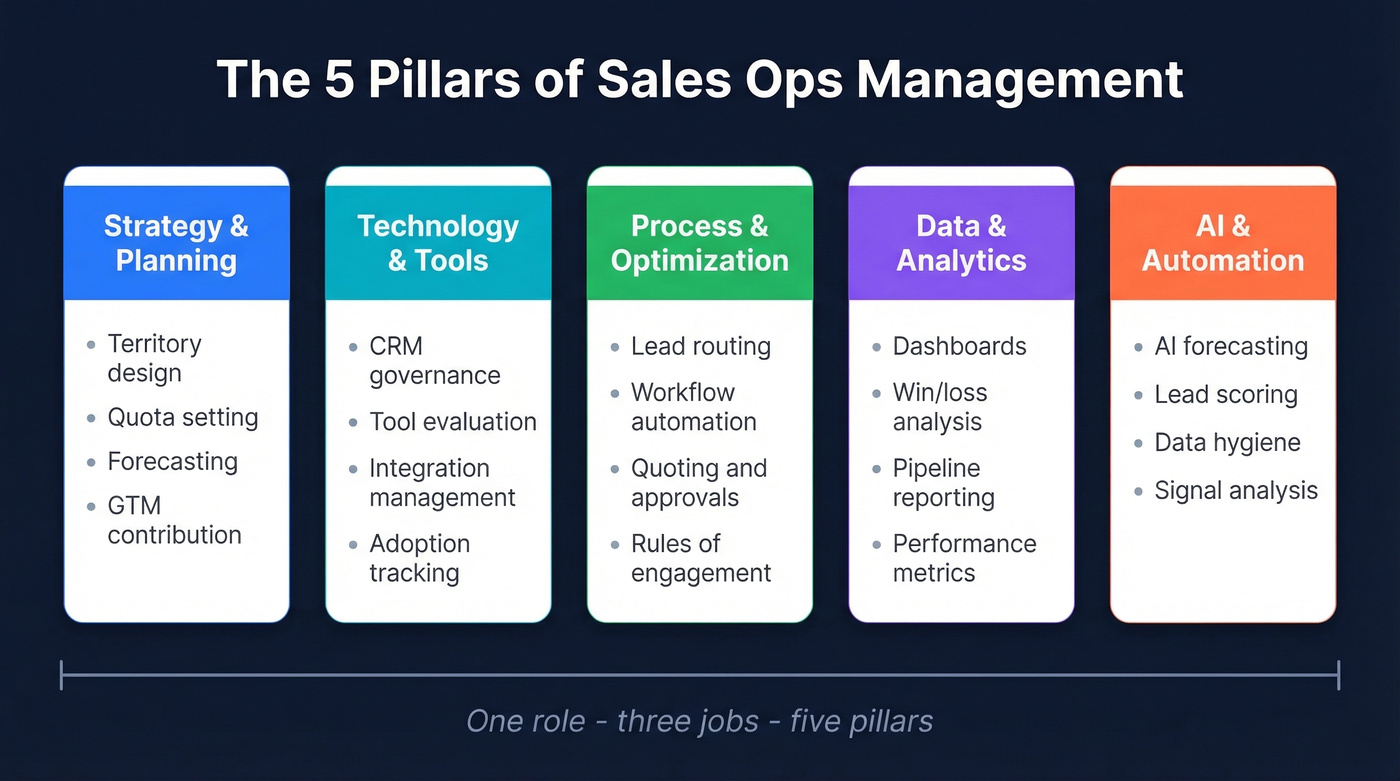
Most frameworks break Sales Ops into four pillars. This structure holds up whether you're at a 20-person startup or a 500-seat enterprise.
Strategy & Planning
This is where you earn your seat at the leadership table. Territory planning, quota setting, annual and quarterly forecasting, and GTM contribution all live here. You're the person who takes the board's revenue target and works backward into territories, quotas, and headcount models that are actually achievable. Bad territory design kills morale faster than almost anything else - and it's your job to prevent that.
Technology & Tools
The CRM is your single source of truth, and you're its guardian. Tool evaluation, implementation, integration management, and adoption tracking all fall under this pillar. A Highspot survey found that 82% of salespeople face challenges adopting new technologies due to lack of integration or training programs. Your job is to streamline the stack, not add to the bloat.
Process & Optimization
Lead routing rules, opportunity management workflows, quoting and approval processes, rules of engagement between teams - you design, document, and enforce all of it. The best sales ops managers think like process engineers: they map the current state before touching anything, identify bottlenecks, and build automation that eliminates manual steps without breaking the human judgment that complex deals require.
Data & Analytics
Dashboards, win/loss analysis, performance reporting, and pipeline health monitoring. If your dashboards only confirm what the VP already knows, you're building reports, not delivering insights.
AI in 2026: The Fifth Pillar
AI has fundamentally changed what a single person in this role can accomplish. AI-assisted forecasting tools now analyze deal signals - email sentiment, meeting frequency, stakeholder engagement - to produce probability-weighted forecasts that outperform gut-feel pipeline calls. Automated CRM hygiene catches duplicate records, flags stale contacts, and enriches profiles without manual intervention. AI-powered lead scoring models learn from your closed-won patterns and surface the opportunities most likely to convert.
This doesn't replace the operations leader. It amplifies them. The teams getting the most from AI are the ones where Sales Ops designed the workflows, validated the data inputs, and trained reps on how to interpret the outputs. Garbage in, garbage out still applies - AI just makes it happen faster.
| Pillar | Key Responsibilities | Primary Stakeholder |
|---|---|---|
| Strategy & Planning | Territory design, quota setting, forecasting | VP Sales, CRO |
| Technology & Tools | CRM governance, tool evaluation, integrations | Entire sales org |
| Process & Optimization | Lead routing, workflow automation, documentation | SDR/AE teams |
| Data & Analytics | Dashboards, win/loss analysis, pipeline reporting | Leadership, Finance |
| AI & Automation | AI-assisted forecasting, lead scoring, data hygiene | Sales Ops, Leadership |
A Typical Week
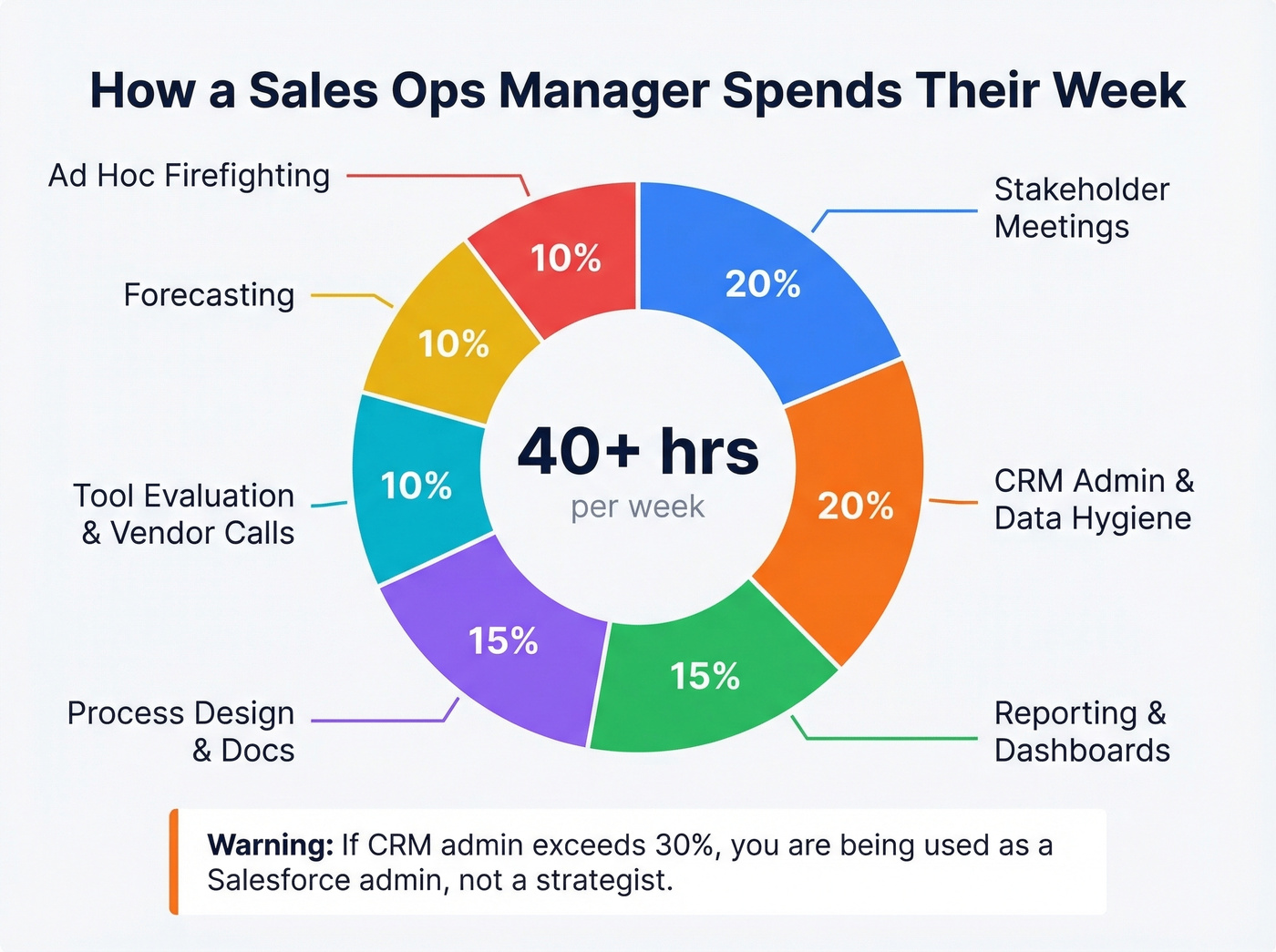
No two weeks look the same, but here's a realistic time allocation for a mid-career professional at a company with 30-80 reps.
| Activity | % of Week | Notes |
|---|---|---|
| Stakeholder meetings | 20% | 1:1s with VP Sales, cross-functional syncs |
| CRM admin & data hygiene | 20% | Field updates, dedup, enrichment runs |
| Reporting & dashboards | 15% | Weekly pipeline reviews, board prep |
| Process design & docs | 15% | Playbooks, workflow updates |
| Tool evaluation & vendor calls | 10% | Demos, renewals, integration scoping |
| Forecasting | 10% | Model updates, scenario planning |
| Ad hoc firefighting | 10% | Broken integrations, escalations, "quick questions" |
If CRM admin exceeds 30% of your week, you're being used as a Salesforce admin, not a strategist. That's a conversation worth having with your VP early. The breadth of sales operations manager responsibilities means you need to protect your time for high-leverage work.
Skills & Tech Stack
Skills That Actually Matter
The technical side is straightforward. You need deep CRM proficiency - Salesforce or HubSpot, ideally both. Advanced Excel or Google Sheets is non-negotiable; you'll build models, pivot tables, and VLOOKUP chains before breakfast. Basic SQL opens up direct database queries that save hours of waiting on analysts. And at least one BI tool - Tableau, Power BI, or Looker - lets you build dashboards that actually get used.
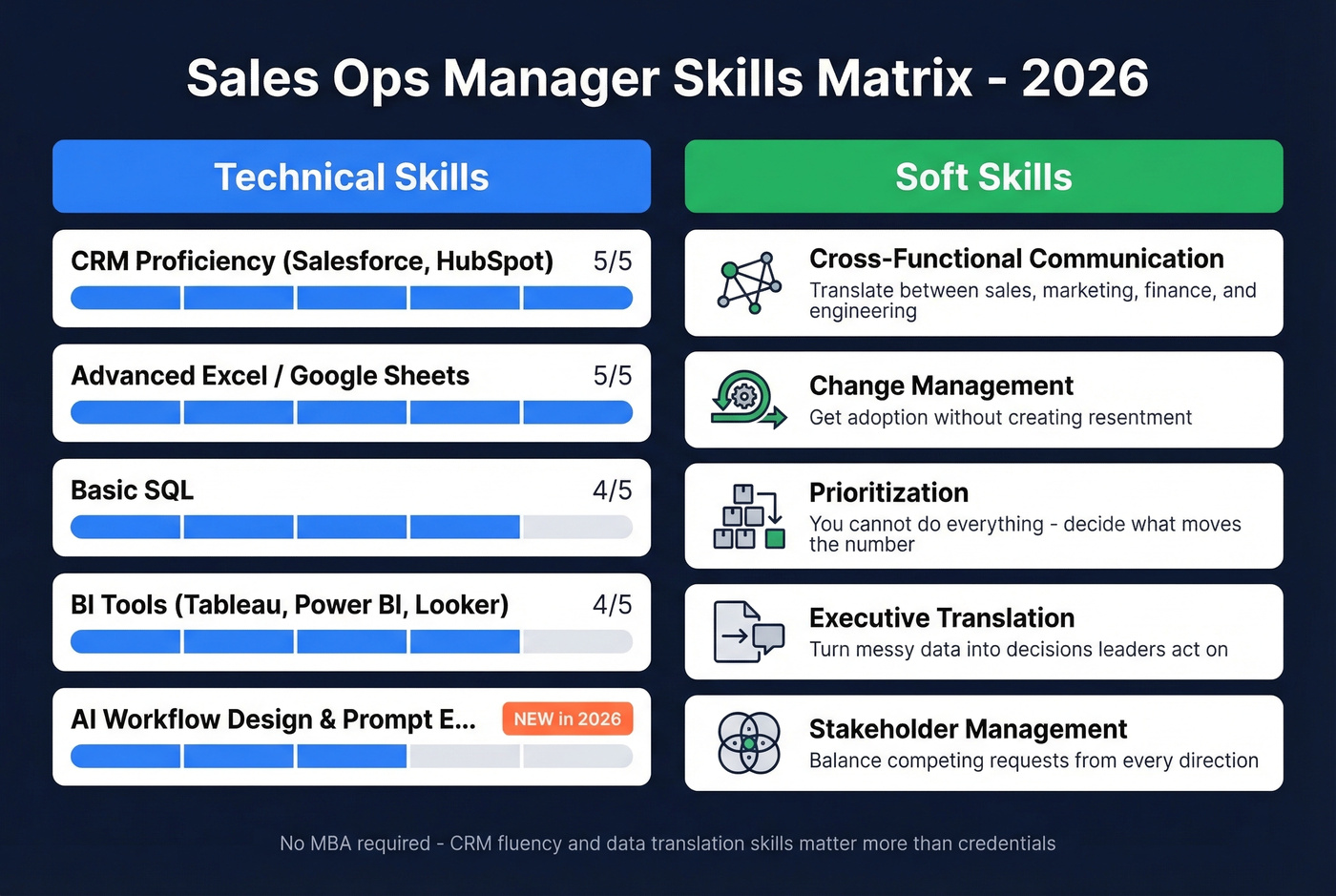
In 2026, add prompt engineering and AI workflow design to the list. You don't need to build models from scratch, but you need to know how to configure AI tools and validate their outputs.
The soft skills are harder to teach and round out the full set of sales operations manager skills that hiring teams evaluate. Cross-functional communication tops the list - you're constantly translating between sales, marketing, finance, and engineering, each of whom speaks a different language. Change management is the second critical skill. You'll implement new tools and processes that reps don't want. Getting adoption without creating resentment is an art form.
Let's be honest: you don't need an MBA. CRM fluency, Excel mastery, basic SQL, and the ability to translate data into decisions matter more than credentials. We've seen analysts with economics degrees outperform MBAs from top programs because they could actually build the models instead of just talking about them.
The Sales Ops Tech Stack
| Category | Tools | Notes |
|---|---|---|
| CRM | Salesforce, HubSpot | Non-negotiable foundation |
| BI & Analytics | Tableau, Power BI, Looker | Pick one and master it |
| Forecasting | Clari | Essential at scale; custom pricing |
| Engagement | Outreach, Salesloft | Rep-facing; Sales Ops configures |
| Automation | Zapier, Make | Glue between systems |
| CPQ / Deal Desk | DealHub, Salesforce CPQ | Needed at enterprise scale |
| Enablement | Highspot, Seismic | Content + training delivery |
Your outbound pipeline is only as good as your contact data. When you're the person responsible for data quality, having a verification layer that runs continuously matters more than having the biggest database. Prospeo verifies emails at 98% accuracy on a 7-day refresh cycle - compared to the 6-week industry average - and plugs directly into Salesforce or HubSpot. At ~$0.01 per email with a free tier, it's the most cost-effective way to keep your CRM clean without a $30K annual contract.

Spending 20% of your week on CRM data hygiene? Prospeo's enrichment engine returns 50+ data points per contact at a 92% match rate - with 98% email accuracy. Automate dedup, enrichment runs, and contact validation so you can focus on strategy, not Salesforce cleanup.
Reclaim your week. Automate the data work that's eating your calendar.
Key KPIs and Benchmarks
Your VP cares about three numbers: forecast accuracy, quota attainment, and pipeline velocity. Everything else feeds those three. But you need to track the inputs to move the outputs.
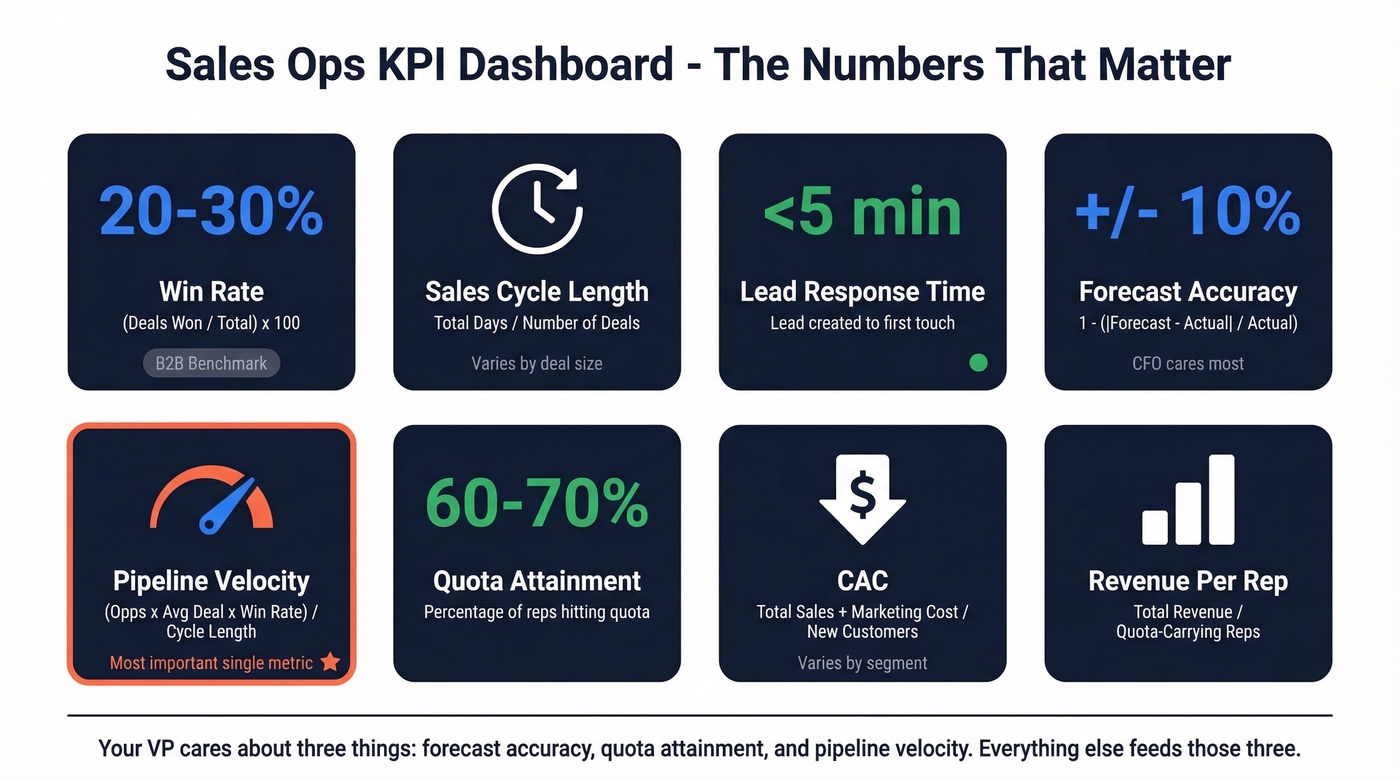
| KPI | Formula | Benchmark | Who Cares |
|---|---|---|---|
| Win Rate | (Deals Won / Total) x 100 | 20-30% B2B | VP Sales, CRO |
| Sales Cycle Length | Total Days / # of Deals | Varies by deal size | Sales Ops, VP Sales |
| Lead Response Time | Lead created to first touch | Under 5 minutes | SDR Manager, Marketing |
| Forecast Accuracy | 1 - (|Forecast - Actual| / Actual) | +/-10% | CFO, CRO |
| Pipeline Velocity | (# Opps x Avg Deal x Win Rate) / Cycle Length | Context-dependent | Sales Ops, VP Sales |
| Quota Attainment | Actual Revenue / Quota x 100 | 60-70% of reps hitting | VP Sales, Finance |
| CAC | Total Sales + Marketing Cost / New Customers | Varies by segment | Finance, CRO |
| Revenue Per Rep | Total Revenue / # of Quota-Carrying Reps | Context-dependent | VP Sales, Finance |
Pipeline velocity deserves special attention because it's the one metric that captures the entire funnel in a single number. When velocity drops, you can diagnose which input changed - fewer opportunities, smaller deals, lower win rates, or longer cycles. It's the fastest way to figure out where the machine is breaking.
Lead response time is the KPI most teams measure but few actually fix. The benchmark is under five minutes. Close that gap and you'll see conversion improvements that dwarf almost any other optimization you could make.
Forecast accuracy is the metric that determines how much trust the C-suite places in your function. The benchmark is +/-10% variance from actual. Consistently hitting that range earns you a seat at the planning table. Missing it repeatedly gets your forecasts replaced by the CFO's spreadsheet.
Salary & Compensation
National Benchmarks
Glassdoor puts the median total pay at $115K/year, with a typical range of $91K-$146K based on roughly 3,000 salary submissions. Base pay runs $70K-$107K, with additional comp - bonus plus commission - adding $21K-$40K on top.
PayScale reports a slightly lower average base of $95,935 across 912 profiles, with variable comp ranges of $2K-$19K in bonuses, $3K-$26K in commission, and profit sharing of $1K-$18K at some companies. The gap between the two sources mostly comes down to how they weight total comp versus base salary.
Here's the thing: if your company expects you to "own data quality" without any budget for data tools, that tells you everything about how they value this role. Compensation should reflect the breadth of what you're being asked to do. Expect 15-25% premiums in SF, NYC, and Boston metro areas compared to national medians.
Salary by Experience
| Experience Level | Avg Base Salary | Data Points |
|---|---|---|
| Entry-level (<1 yr) | ~$64K | 21 profiles |
| Early career (1-4 yrs) | ~$85K | 355 profiles |
Top-Paying Industries
| Industry | Median Total Pay |
|---|---|
| Information Technology | $143,097 |
| Pharma & Biotech | $130,776 |
| Manufacturing | $117,305 |
| Energy / Mining / Utilities | $116,164 |
| Telecommunications | $111,969 |
IT pays the most because the sales cycles are complex, the tech stacks are deep, and the companies can afford it. If you're optimizing for compensation, SaaS and enterprise tech are where the money is. Employment in sales management roles is projected to grow 5% through 2034, faster than average - so the demand side looks healthy.
Sales Ops vs. RevOps
This is the question that comes up in every interview and every org design conversation.
| Dimension | Sales Ops Manager | RevOps Manager |
|---|---|---|
| Scope | Sales function only | Sales + Marketing + CS |
| Typical ARR | $10-25M+ | $50-100M+ |
| KPIs | Quota attainment, win rate, cycle length | CAC, LTV, NRR, churn |
| Reports to | VP Sales / CRO | CRO / COO |
| Staffing ratio | ~1:30 reps | ~1:12 reps |
Gartner projected that 75% of the highest-growth companies would adopt a RevOps model by 2026 - and the shift is well underway. That doesn't mean Sales Ops disappears. It means Sales Ops becomes a specialization within a broader RevOps function.
When your Sales Ops team spends 68% of its time on non-sales functions - up from 39% in 2019 - that's a signal the scope has outgrown a sales-only org. Companies typically build Sales Ops around $10-25M ARR and evolve to RevOps at $50-100M+ when marketing, sales, and CS are stepping on each other's toes. The signal that it's time? You're spending more time resolving cross-functional conflicts than optimizing the sales process itself.
RevOps can drive up to a 30% reduction in deal slippage by creating unified handoff processes across the entire customer lifecycle. But here's my hot take: most companies under $30M ARR don't need a RevOps org chart. They need a great operations leader who talks to marketing and CS regularly. The title change doesn't fix misalignment - shared metrics and shared accountability do.
Career Path
The typical progression:
Sales Analyst / Ops Specialist -> Sales Ops Manager (2-4 years) -> Senior Manager / Director (3-5 years) -> VP Sales Operations -> CRO / COO
The analyst-to-manager jump usually takes 2-4 years and depends heavily on whether you're at a company where the role has visibility. A strong track record with CRM optimization, process improvement, or a major tool implementation accelerates the timeline significantly. Certifications like Salesforce Admin, HubSpot Revenue Operations, or Tableau Desktop Specialist won't get you hired on their own, but they signal competence and shorten the trust-building phase with hiring managers.
The lateral move is equally valuable. Many people in this role shift into RevOps leadership, GTM Strategy, or Chief of Staff positions - all of which use the same cross-functional muscle. As one r/SalesOperations poster described it, "figuring it out week by week" as the only Sales Ops person is the norm, not the exception. The breadth of exposure you're getting is exactly what prepares you for director-level roles.
Don't underestimate the CRO path. The best CROs we've worked with came up through operations, not quota-carrying roles. They understand the systems, the data, and the process in a way that pure sellers often don't.
Common Challenges (and Fixes)
Scope creep. This is the number one killer. You start as the "sales process person" and end up owning marketing attribution, CS renewals, and the CEO's board deck. The fix: define what you will and won't own in your first 30 days. Write it down. Get your VP to sign off. Revisit it quarterly.
Data quality decay. We've seen this play out repeatedly: the SDR team's bounce rate hits 35%. Marketing blames sales for not updating contacts. Sales blames marketing for sending bad leads. The real problem is that nobody's verified the CRM data since it was imported 18 months ago. When Snyk's 50 AEs were dealing with 35-40% bounce rates, switching to continuously verified data dropped that to under 5% and drove 180% more AE-sourced pipeline. The lesson: verification at the source prevents the blame cycle entirely.
Tech adoption resistance. You've spent three months configuring a new engagement platform. Reps ignore it and keep using spreadsheets. The fix isn't more training - it's understanding why they're resisting. Usually it's because the tool adds steps without removing any. Every new tool you implement should eliminate at least one manual task the rep currently hates.
Cross-functional misalignment. The marketing-sales blame cycle is as old as B2B itself. The fix is shared metrics and shared dashboards. When marketing and sales look at the same pipeline velocity number, the finger-pointing drops dramatically. Build a single source of truth and make both teams accountable to it.
Territory planning and lead routing only work when your contact data is fresh. Prospeo refreshes all 300M+ profiles every 7 days - not the 6-week industry average. Clean territories, accurate forecasts, and reps who trust the CRM start with data that doesn't decay.
Give your reps data they actually want to use - at $0.01 per email.
Interview Questions
If you're preparing for a sales ops manager interview, expect scenario-based questions that test both analytical thinking and stakeholder management.
1. How would you build a forecasting process with limited historical data? Good answers reference leading indicators - pipeline creation rate, stage conversion velocity - over trailing metrics. Bonus points for mentioning triangulation between bottom-up rep forecasts and top-down trend models.
2. You inherit a pipeline with declining quality. What do you do in your first 30 days?
Start with data: stage-by-stage conversion analysis, aging reports, and win/loss patterns. The best candidates diagnose before prescribing.
3. Walk me through evaluating and implementing a new CRM.
Look for a structured approach: requirements gathering, vendor scoring, migration planning, adoption metrics. Red flag: jumping straight to "I'd pick Salesforce."
4. Design a comp plan that aligns with company goals. Strong answers tie comp levers to specific behaviors - not just closed revenue, but pipeline generation, multi-threading, or expansion revenue depending on the company's stage.
5. How would you partner with Marketing on lead handoff SLAs? The answer should include shared definitions (MQL, SQL, SAL), response time commitments, and a feedback loop for lead quality. Mentioning a shared dashboard is a strong signal.
6. What does your first 90 days look like? Days 1-30: listen, audit, map current state. Days 31-60: identify the highest-leverage fix and start building. Days 61-90: ship the first improvement and measure impact. Anyone who says "I'd overhaul everything" in the first 90 days hasn't done this before.
7. How do you handle deal desk exceptions that bypass your pricing rules? This tests whether you can balance process discipline with commercial pragmatism. The best answers describe a tiered approval framework with clear escalation paths - not a rigid "no exceptions" policy, and not a free-for-all either.
8. Which KPIs would you present to the CFO versus the VP of Sales, and why? The CFO cares about CAC, revenue per rep, and forecast accuracy. The VP of Sales cares about quota attainment, pipeline velocity, and win rate. A strong candidate tailors the story to the audience without changing the underlying data.
FAQ
What degree do you need?
No specific degree is required. Most sales ops managers come from business, finance, or sales backgrounds. CRM proficiency, Excel/SQL skills, and analytical thinking matter far more than credentials - certifications like Salesforce Admin help, but real process-building experience is what gets you hired.
Is this role the same as RevOps?
No. Sales Ops focuses exclusively on the sales function - quota attainment, territory design, and pipeline management. RevOps aligns sales, marketing, and customer success across the full revenue lifecycle. Companies typically evolve from Sales Ops to RevOps around $50-100M ARR.
What tools should you learn first?
Start with your CRM (Salesforce or HubSpot), then master a BI tool like Tableau or Power BI. SQL is the third skill that separates good from great. For data quality, Prospeo's free tier (75 emails/month) lets you validate contact data without budget approval - useful when you're proving the value of clean data to leadership.
How long does it take to reach manager level?
Most reach the position after 2-4 years as a Sales Analyst or Ops Specialist. A strong track record with CRM optimization, process improvement, or a successful tool implementation accelerates the timeline. High-growth companies often promote faster out of necessity.
What's the difference between Sales Ops and Enablement?
Sales Ops owns processes, data, and technology infrastructure. Enablement owns content, training, and coaching. In smaller companies one person handles both - which is exactly why scope creep is the number one challenge. If you're doing both, make sure your title and comp reflect it.
The sales ops manager role is evolving fast in 2026. AI is compressing the data work. RevOps is expanding the scope. And the companies that treat this position as strategic - not administrative - are the ones pulling ahead. If you're in the seat right now, invest in the skills that won't automate away: stakeholder influence, process design, and the judgment to know which number actually matters this quarter.