

Sales Process Optimization: Benchmarks, Tools, and Frameworks That Work
Half your Stage 3 deals haven't had activity in three weeks. Your CRM says the pipeline is $2.4M, but your gut says it's closer to $900K. The forecast call is tomorrow.
This is what happens when a sales process exists on paper but not in practice - and why the median B2B conversion rate still sits at just 2.9%. Sales process optimization isn't a quarterly offsite project. It's the ongoing work of refining how deals actually move from first touch to closed-won, using real data, buyer behavior, and honest measurement. Gartner's 2026 CSO priorities make this concrete: build a sales-centric AI roadmap, transform GTM motions around buyer preferences, and give managers the clarity to coach. All three require a process that reflects reality, not a slide deck from 2022.
Most guides stop at methodology. They ignore the data foundation and pre-opportunity measurement that determine whether the methodology even works.
What You Actually Need
You don't need 10 optimization steps. You need three things. Everything else is refinement.
Accurate data foundation. Your process is only as good as the contacts, firmographics, and intent signals feeding it. Bad data means bad targeting, bounced emails, and wasted rep time.
Buyer-led process design. Stages defined by what the buyer does - not what your reps check off. Exit criteria based on buyer actions, not seller activities. This is the core difference between customer development and selling: one listens, the other pushes.
Pre-opportunity-through-close measurement. Most teams instrument the opportunity-to-close half of the funnel and ignore everything upstream. That's where the biggest leaks are.
Get these three right and the rest - qualification frameworks, AI tooling, automation - becomes a refinement layer, not a guessing game.
Why Most Sales Processes Break
The problem usually isn't that teams lack a process. It's that the process they have creates more friction than it removes.
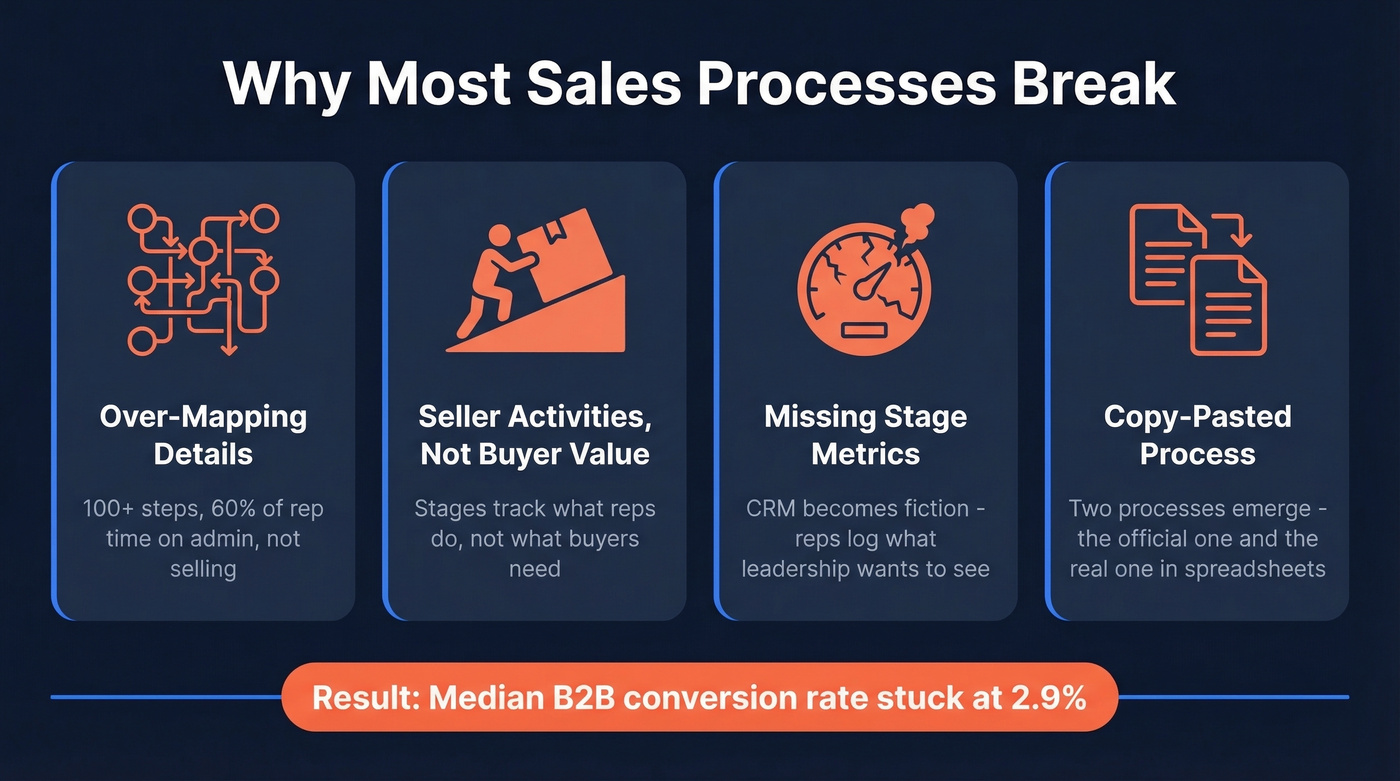
Over-mapping the details. One manufacturing company documented a 100+ step sales process that prescribed everything from call scripts to email formatting. Over 60% of seller time went to fulfillment activities instead of selling. A good process fits in 10-15 pages, max.
Building around seller activities instead of buyer value. When stages are defined by "rep sent proposal" or "demo completed," you're measuring your own motion, not the buyer's progress. The buyer doesn't care that your rep logged a call. They care whether their problem is getting solved.
Missing metrics at every stage. A process without measurement is just a suggestion. The CRM becomes fiction - reps enter what they think leadership wants to see, not what's actually happening.
Buying someone else's "ideal" process. Here's the thing: when the process doesn't reflect your team's reality, salespeople operate outside the system entirely. You end up with two processes - the official one in Salesforce and the real one in spreadsheets and Slack threads.
Funnel Benchmarks for B2B Sales
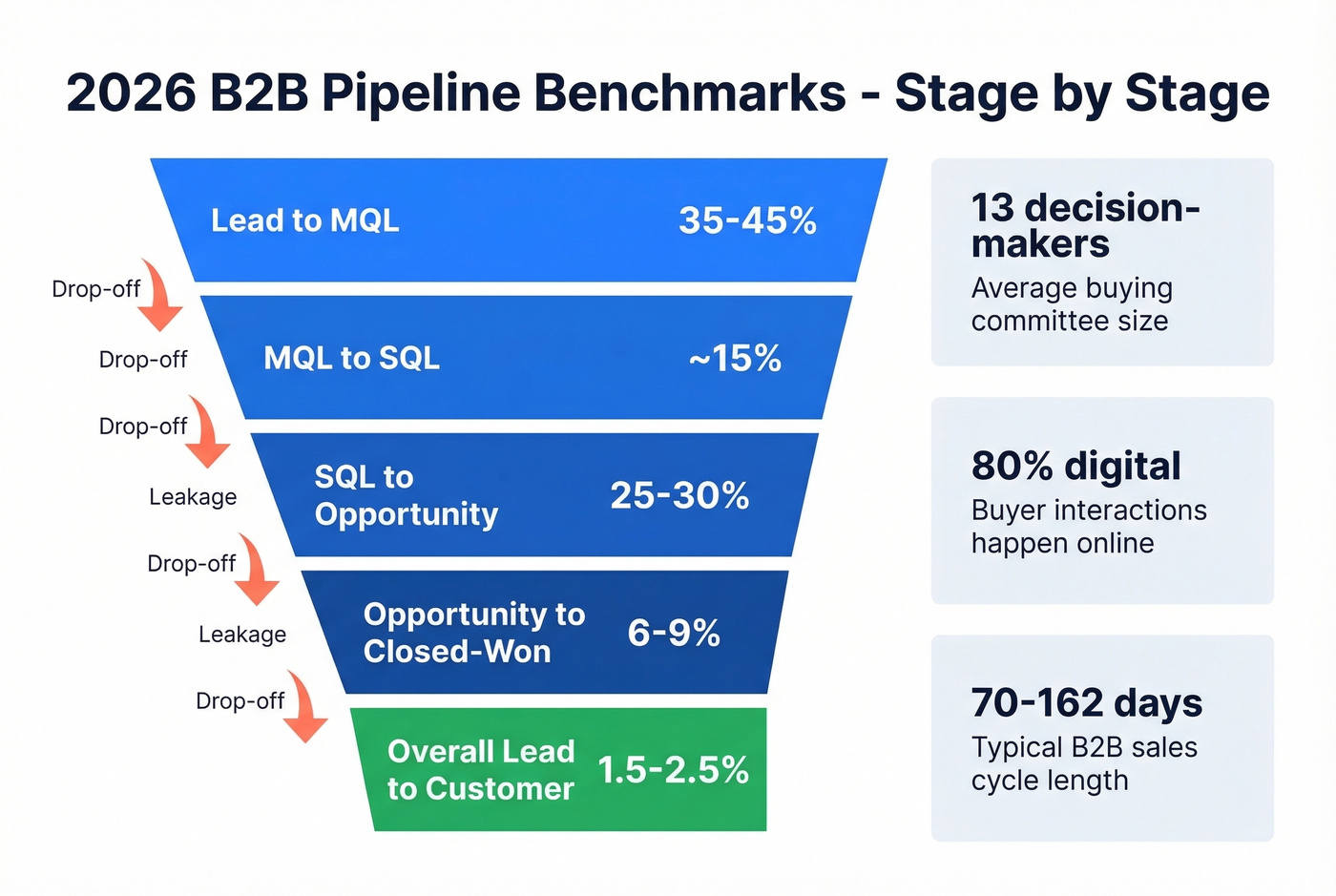
Before you optimize, you need baselines. We've pulled these stage-by-stage conversion rates from multiple industry sources to give you a diagnostic starting point.
General B2B Pipeline Benchmarks
| Stage | Conversion Rate |
|---|---|
| Lead to MQL | 35-45% |
| MQL to SQL | ~15% |
| SQL to Opportunity | 25-30% |
| Opportunity to Closed-Won | 6-9% |
| Overall Lead to Customer | 1.5-2.5% |
Industry-Specific Breakdowns
| Industry | Lead to MQL | MQL to SQL | SQL to Opp | SQL to Closed |
|---|---|---|---|---|
| B2B SaaS | 39% | 38% | 42% | 37% |
| Cybersecurity | 24% | 40% | 43% | 46% |
Average buying committees now include 13 decision-makers. 80% of buyer interactions happen digitally. B2B sales cycles run 70-162 days depending on deal size and industry. If your numbers are significantly below these baselines at any stage, that's your bottleneck - and that's where you start.

Your benchmarks mean nothing if reps are emailing dead addresses and missing decision-makers. Prospeo's 300M+ profiles with 98% email accuracy and intent data across 15,000 topics give your process the data foundation it actually needs - refreshed every 7 days, not 6 weeks.
Stop optimizing a funnel built on bad data.
The Optimization Framework
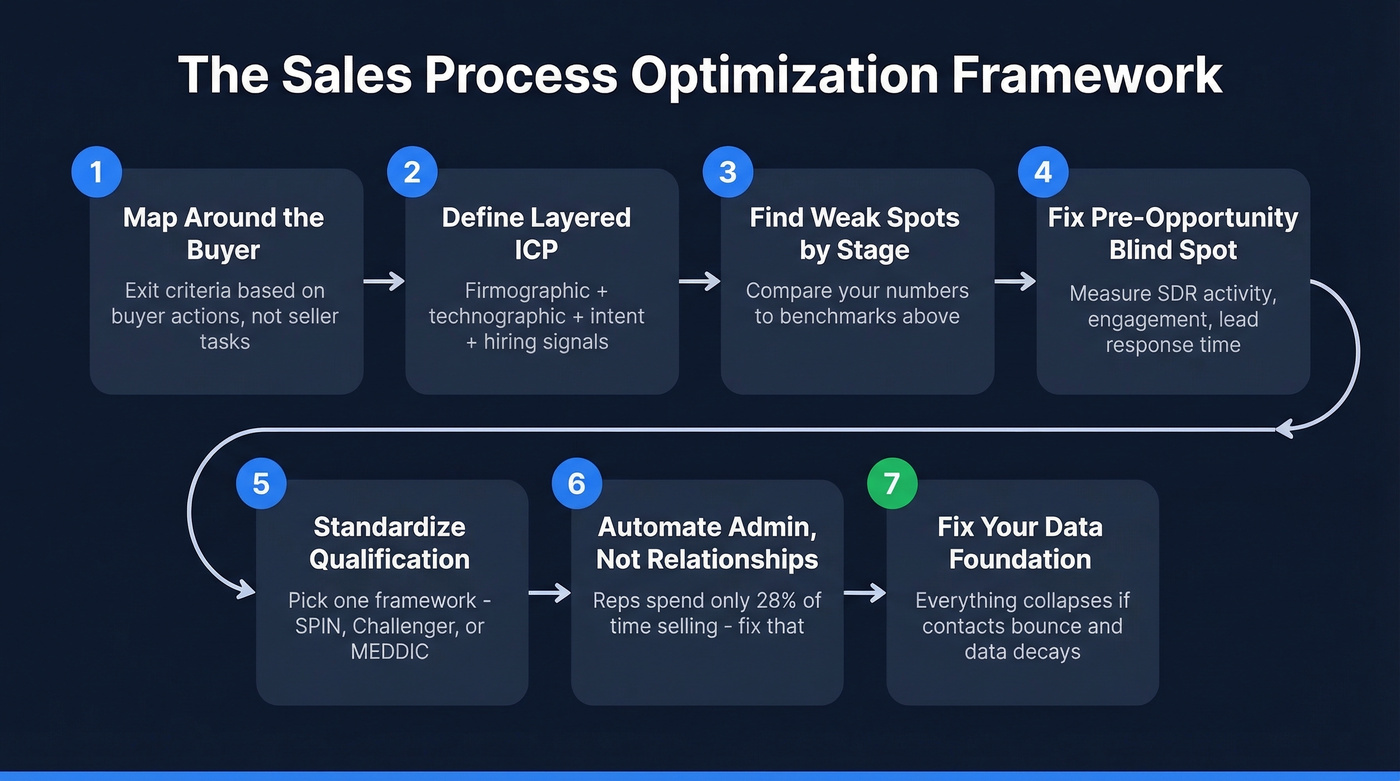
Map Your Process Around the Buyer
Redefine stages based on buyer actions, not seller activities. A stage like "Discovery" shouldn't advance because the rep booked a call - it should advance because the buyer articulated their problem and agreed on evaluation criteria. Every stage needs an exit criterion rooted in something the buyer did or confirmed. IMPACT's Assignment Selling approach takes this further: educate the buyer before calls so they arrive informed and the conversation focuses on fit, not features.
Define Your ICP With Layered Data
A one-dimensional ICP based on industry and company size isn't enough anymore. Layer firmographic data with technographic signals, intent data, and hiring patterns. If you're selling security tooling, knowing a company runs AWS and just posted three DevSecOps roles tells you more than knowing they're a 500-person SaaS company.
92% of B2B buyers enter the process with at least one vendor already in mind. Your ICP definition determines whether you're that vendor or the one they never find.
Identify Weak Spots Stage by Stage
Pull up the benchmark table above and compare your numbers. If your MQL-to-SQL conversion is 8% against a ~15% baseline, that's your problem - not the close rate your VP keeps obsessing over.
One team we spoke with discovered that 70% of their deals were dying within 48 hours after demos. The issue wasn't the demo itself; it was the lack of a structured follow-up sequence. They'd been trying to fix their close rate for months when the real leak was two stages earlier.
Fix the Pre-Opportunity Blind Spot
Most RevOps teams instrument the opportunity-to-close half of the funnel and barely glance at what happens upstream. SDR activity volume, account engagement scoring, lead response time - these are the biggest pipeline leaks, and they're chronically under-measured.
A SalesOps leader on Reddit nailed it: the market focuses on opportunity-to-close metrics while "very little" attention goes to the pre-opportunity phase. If you're only measuring from Stage 1 onward, you're optimizing half a funnel.
Standardize Qualification
Pick a framework and commit. SPIN Selling was built on research across 35,000+ sales calls - best for complex, consultative sales where discovery depth determines win rates. Challenger came from studying 6,000 reps across 90 companies and works when reps need to teach buyers something new. MEDDIC is the go-to for enterprise deals where multi-threading is non-negotiable.
The worst thing you can do is blend all three into a Frankenstein framework nobody follows.
Automate Admin, Not Relationships
Reps spend roughly 28% of their time actually selling. The rest goes to data entry, scheduling, internal updates, and CRM hygiene. Automate that stuff aggressively - lead scoring, follow-up scheduling, activity logging, data enrichment.
But keep the human where it matters. A 60-second Loom video referencing a prospect's specific situation outperforms a 10-email automated sequence every time. Automate the admin. Keep the relationships human.
Fix Your Data Foundation
Every optimization above collapses if your data is bad. We've seen it firsthand: a team sends 5,000 emails, 1,400 bounce, and their domain gets flagged. Now they can't reach anyone - not even the good contacts on their list. Data decay is the silent killer of pipeline health, and most teams don't realize how fast it happens.

Prospeo solves this at the foundation level with 300M+ professional profiles, 98% email accuracy, and a 7-day data refresh cycle compared to the 6-week industry average. It integrates natively with Salesforce, HubSpot, and engagement platforms like Outreach and Lemlist, so enrichment flows directly into your existing workflows. The proof point: Snyk's 50-person AE team was running a 35-40% bounce rate before switching. After, bounces dropped under 5%, AE-sourced pipeline jumped 180%, and they were generating 200+ new opportunities per month.
Instrument AI by Workflow Stage
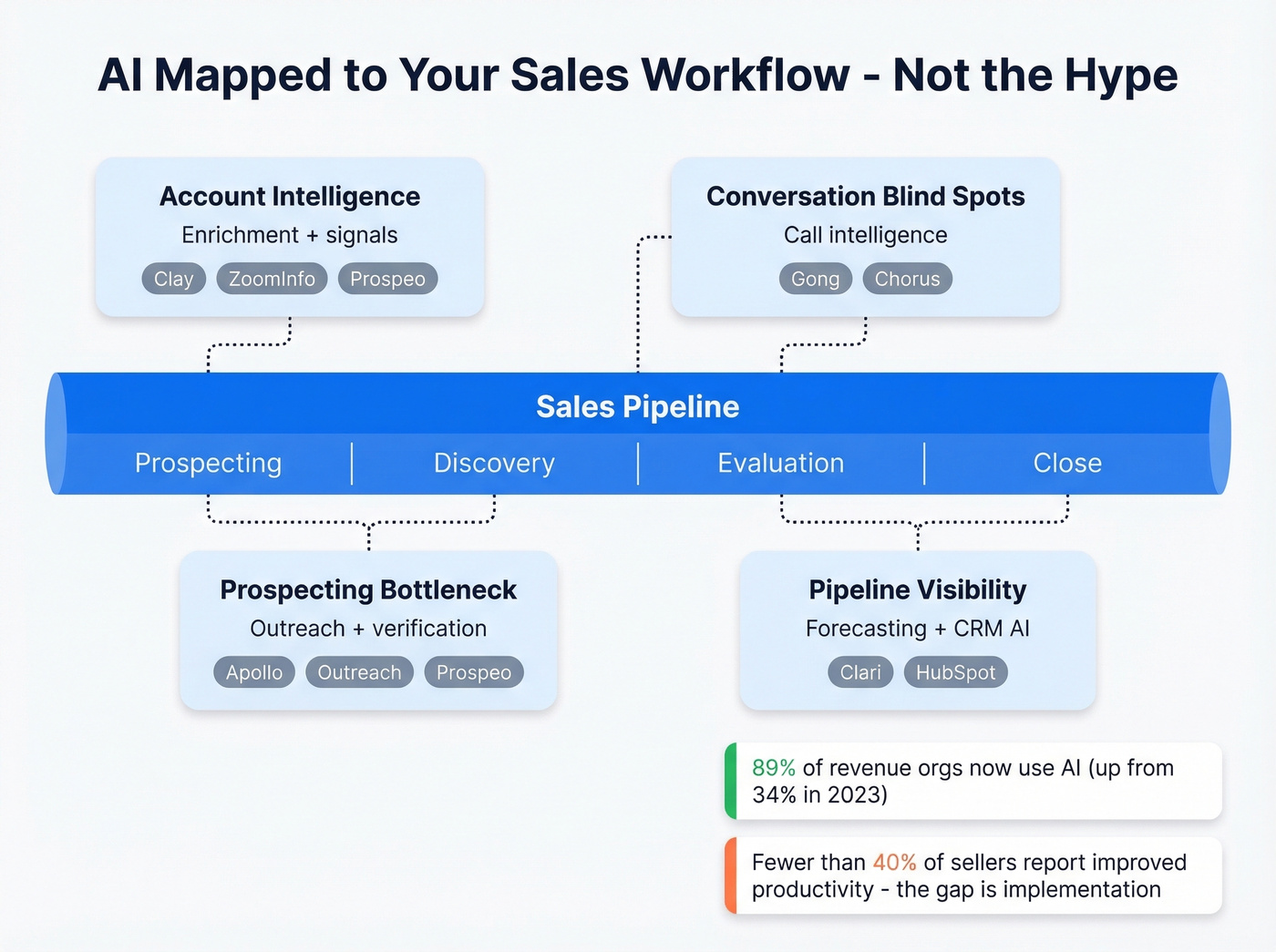
AI isn't a strategy - it's a set of tools mapped to specific workflow gaps.
| Workflow Gap | AI Use Case | Tool Examples |
|---|---|---|
| Account intelligence | Enrichment + signals | Clay, ZoomInfo |
| Conversation blind spots | Call intelligence | Gong, Chorus |
| Prospecting bottleneck | Outreach + verification | Apollo, Outreach |
| Pipeline visibility | Forecasting + CRM AI | Clari, HubSpot |
Here's the number that should get your attention: 89% of revenue organizations now use AI, up from 34% in 2023, and 83% of sales teams using AI saw revenue growth compared to 66% without it. By 2028, projections suggest 60% of B2B seller work will be executed through generative AI, with the productivity unlock across sales and marketing reaching $0.8T-$1.2T.
There's a catch, though. By that same 2028 timeline, AI agents will outnumber sellers 10:1 - yet fewer than 40% of sellers report improved productivity. The gap is implementation, not technology. Map the tool to the gap, not the hype.
Let's be honest: if your average deal size is under $10K and your team is under 20 reps, you probably don't need a $40K/year data platform or an enterprise AI stack. A CRM, a solid data provider, and a conversation intelligence tool will get you 80% of the value at 20% of the cost. Start there.
Case Studies With Numbers
Startup GTM automation (90-day transformation). A startup discovered 70% of their deals were dying within 48 hours after demos - the trigger for a full process overhaul. They implemented an automation stack at $350/month, got first workflows live in one week, and within 90 days saw close rates jump from 15% to 40%. An AI qualifier filtered out 60% of bad-fit leads, cutting screening from 8 hours/week to 30 minutes. Revenue hit $200K in Q4, a $150K increase in a single quarter.
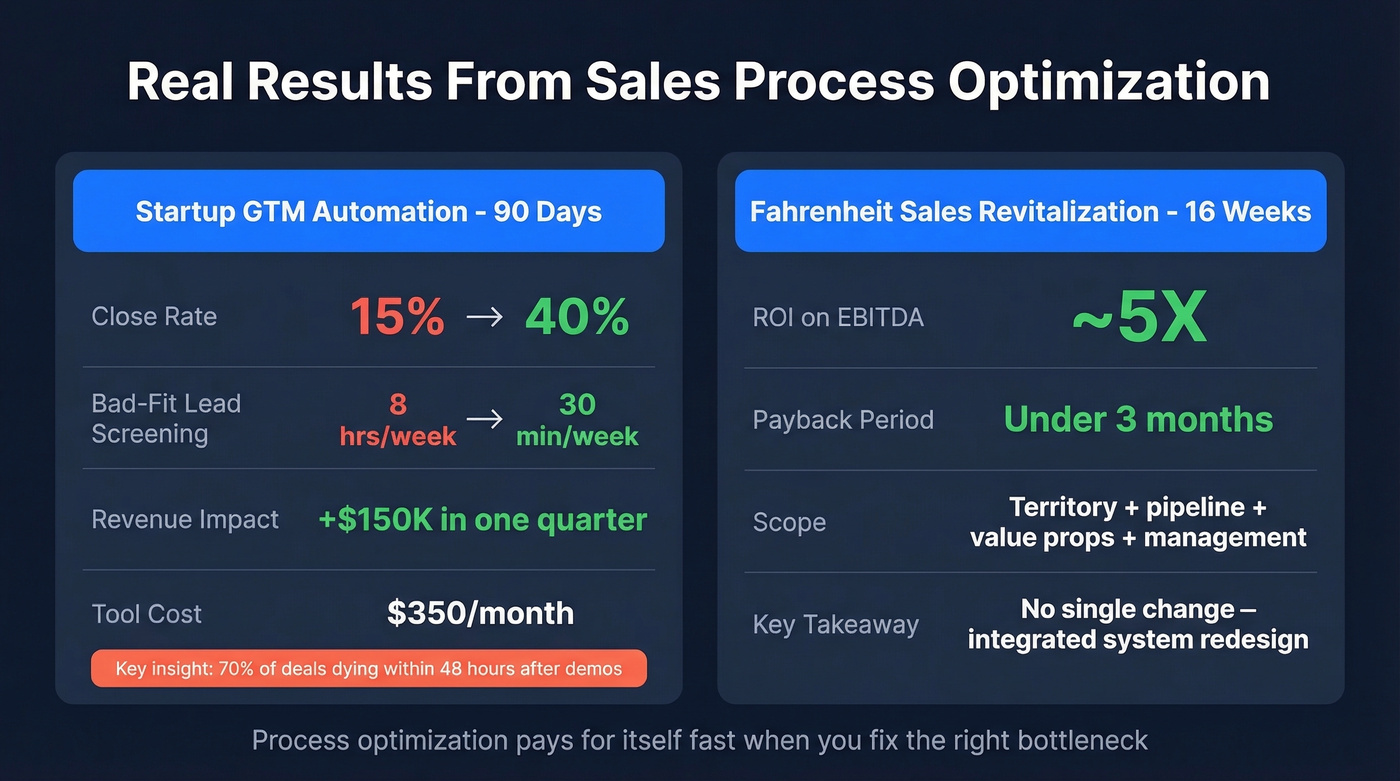
Fahrenheit sales revitalization (16 weeks). A mid-market company brought in Fahrenheit Advisors for a 16-week transformation covering territory restructuring, pipeline process buildout, new value propositions, and sales management realignment. The result: ~5X ROI on reported EBITDA, with project costs covered in under three months. The key wasn't any single change - it was integrating process, training, territory design, and reporting into one coherent system.
The Tool Stack
Priority order: CRM first, then data quality, then conversation intelligence, then engagement tooling.
| Category | Tool | Starting Price |
|---|---|---|
| Data & Enrichment | Prospeo | ~$0.01/email; free tier |
| Data & Enrichment | ZoomInfo | ~$15K-$40K+/yr |
| Data & Enrichment | Apollo | Free; paid from $49/mo |
| Data & Enrichment | Clay | From $134/mo |
| CRM | Salesforce | $75-$300/user/mo |
| CRM | HubSpot Sales Hub | Free; Professional $100/seat/mo |
| CRM | Pipedrive | From $14/mo |
| Conversation Intel | Gong | ~$1K-$3K/mo (small teams) |
| Sales Engagement | Outreach | $100+/mo/user |
| Sales Engagement | Salesloft | ~$100-$150/user/mo |
| Forecasting | Clari | ~$30K-$60K/yr (mid-market) |
| Workflow Automation | Zapier | Free; paid from ~$20/mo |
The contrast in data and enrichment is stark. ZoomInfo at $15K+/year gets you a broad platform with intent, chat, and workflow features - but many teams end up paying for modules they never activate. For teams where data quality matters more than platform breadth, 98% email accuracy and a 7-day refresh cycle at a fraction of the cost will outperform a bloated platform with stale records.
Layering firmographics, technographics, intent signals, and hiring patterns is exactly how you define an ICP that wins. Prospeo gives you 30+ filters - buyer intent, tech stack, headcount growth, funding, job changes - so your reps target the accounts already in-market. At $0.01 per email, fixing the pre-opportunity blind spot costs almost nothing.
Define your ICP with real signals, not guesswork.
What NOT to Do
Skip these five mistakes. Each one sounds reasonable and costs you pipeline.
Overemphasizing price over value. When reps lead with discounts instead of solving the buyer's problem, you train the market to negotiate harder. Compete on outcomes, not price sheets.
Failing to qualify leads before they hit the pipeline. Unqualified leads clog the funnel and inflate forecasts. If your reps are spending time on accounts that were never going to buy, that's a process failure, not a rep failure.
Over-automating relationships. Automating data entry saves hours. Automating discovery calls loses deals. Know the difference.
Copying a playbook that isn't yours. Your team, your market, your buyer - they're different. Engage your own reps in the design. Skip the "proven playbook" someone's selling on Twitter if it wasn't built for your deal cycle and buyer profile.
Ignoring the process once it's built. Markets shift, buyers change, and a process from six months ago is already stale. Build a quarterly review cadence or the process becomes fiction.
FAQ
What is sales process optimization?
It's the ongoing practice of refining how deals move from first touch to closed-won - using data, buyer feedback, and measurement to reduce friction, shorten cycles, and raise win rates. It's not a one-time project; markets shift, and your process needs to evolve with them.
How long does it take to see results?
Expect measurable changes within one quarter. One startup saw close rates jump from 15% to 40% within 90 days. A more comprehensive transformation took 16 weeks and delivered ~5X ROI on EBITDA.
What's the biggest mistake teams make?
Designing around seller activities instead of buyer actions. When stages reflect what reps do ("sent proposal," "booked demo") rather than what buyers confirm ("agreed on evaluation criteria," "introduced economic buyer"), the process creates friction instead of removing it.
What tools do you need to get started?
The minimum viable stack is a CRM like Salesforce or HubSpot, a data quality platform with verified contacts, and conversation intelligence like Gong. Add a sales engagement platform once your process and data foundation are solid. Start simple, instrument everything, and expand based on where the data shows gaps.
How do I connect my process to revenue targets?
Start by defining your ICP, mapping your buyer's journey, and setting stage-by-stage conversion goals based on the benchmarks above. Then align headcount, tooling, and enablement to the stages where your data shows the biggest gaps. That's how a process becomes a revenue plan.