

Your SDR team just ran a 2,000-contact sequence and 600 emails bounced. That's not a sequence problem - it's a data problem. And yet every guide on sequence management obsesses over step counts, subject lines, and A/B tests while ignoring the contact data feeding those sequences.
That's backwards.
"Sequence management" doesn't even mean the same thing to everyone reading this. Sales teams think outbound email cadences. Project managers think dependency mapping and critical paths. Pharma regulatory teams picture eCTD submission sequences numbered 0000, 0001, 0002 - each one updating prior filings with lifecycle operations like new, replace, delete, and append. Bioinformatics teams think sequence file metadata on local servers. PLC programmers think state-machine logic where a button press triggers a valve sequence.
We spend most of our time below on sales sequence management, because that's where the pain is sharpest and where most teams are leaving the most money on the table.
The Short Version
- Build a persona matrix before creating any sequence. Map buyer personas against touch intensity. Every cell gets its own sequence.
- Set a governance cadence. Monthly tweaks, quarterly reviews, full overhaul every six months. Sequences decay faster than you think.
- Verify your contact data before launching any sequence. A 30% bounce rate will tank your domain reputation before your copy even gets a chance to work.
Sales Sequence Management Explained
Sales sequence management is the discipline of designing, deploying, governing, and optimizing the touchpoint series your reps use to engage prospects. It's not "set up an email drip." It's an operating system for outbound.
Sequence vs. Cadence
These terms get used interchangeably, but they're different. A sales sequence is the specific series of timed touchpoints - Day 1 email, Day 3 call, Day 5 follow-up - aimed at a prospect or segment. A sales cadence is the broader timing philosophy governing when and how often those sequences fire. The cadence is strategy; the sequence is execution.
The Persona Matrix
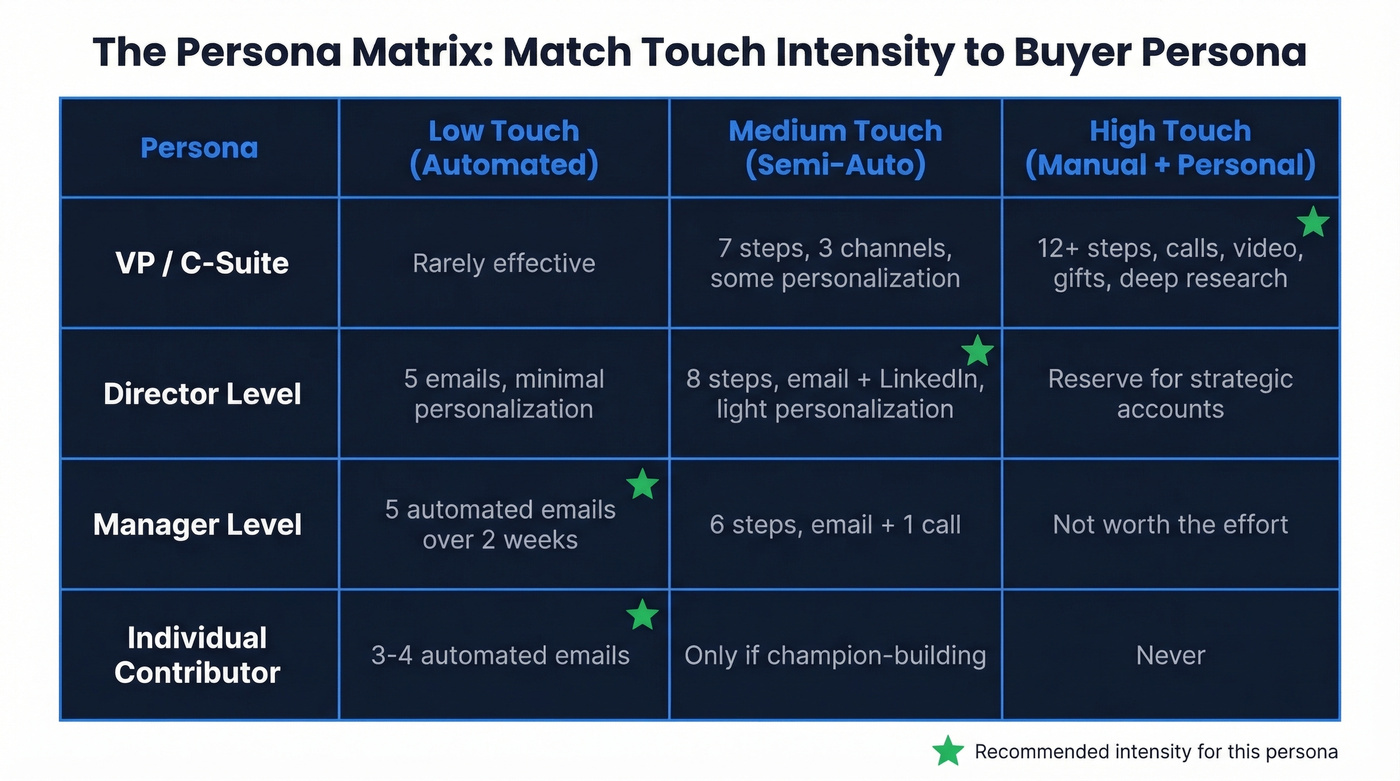
The best outbound teams don't build sequences ad hoc. They use a persona matrix: buyer personas on one axis, touch intensity on the other.
A high-touch sequence for a VP of Sales gets more personalization, more calls, more manual steps, and runs longer. A low-touch sequence for a mid-level manager might be five automated emails over two weeks. The persona matrix is the single highest-ROI change most outbound teams can make - it forces you to think about who you're reaching and how much effort each persona warrants before you write a single subject line. It's also the foundation of sequence standardization across your entire org.
Governance That Prevents Decay
Sequences rot. What worked in Q1 won't work in Q3.
The fix is a content committee - a small group of your top-performing reps plus enablement - that meets monthly for minor tweaks and quarterly for deeper reviews. Every six months, tear the whole thing down and rebuild.
One useful heuristic: if your last-step reply rate is still above 3%, the sequence is probably too short. Add another step before you start cutting. And watch for "Sequence Purgatory" - too many manual steps creating a backlog of untouched tasks. On Reddit, Mixmax users complain about spending more time managing sequence administration than actually selling. If your reps echo that sentiment, you've over-engineered your workflows.
Sequence Performance Benchmarks
Let's ground this in numbers. Outreach publishes customer-wide averages that serve as a solid baseline: 27.2% open rate, 2.9% reply rate, 2.8% bounce rate, and 1.1% opt-out rate.
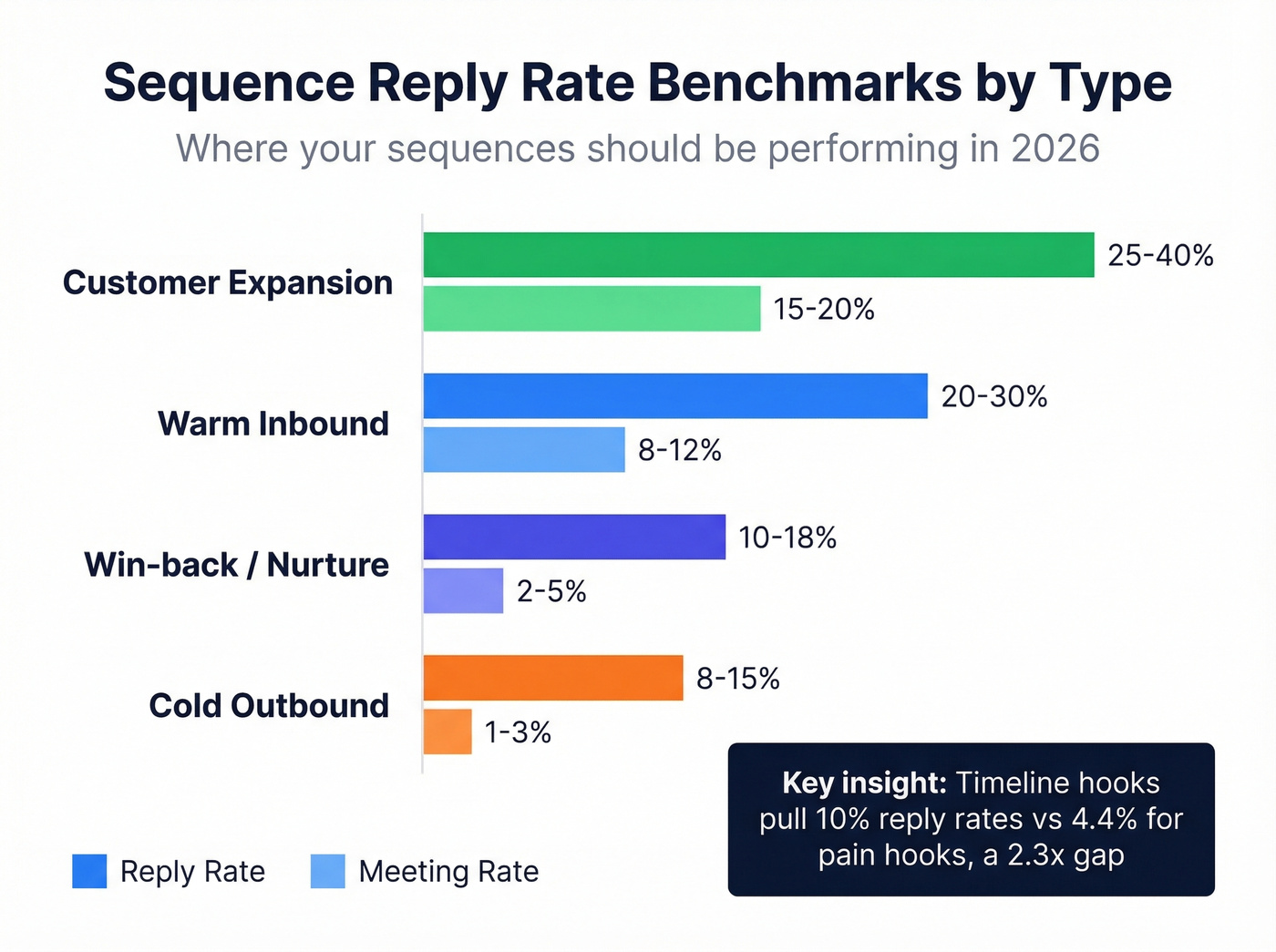
Averages hide the real story, though:
| Sequence Type | Reply Rate | Meeting Rate |
|---|---|---|
| Cold outbound | 8-15% | 1-3% |
| Warm inbound | 20-30% | 8-12% |
| Customer expansion | 25-40% | 15-20% |
| Win-back/nurture | 10-18% | 2-5% |
Two stats should change how you build sequences. First, timeline-based hooks pull a ~10% reply rate versus ~4.4% for problem hooks - a 2.3x gap. "Saw you just raised a Series B" crushes "Struggling with pipeline?" every time.
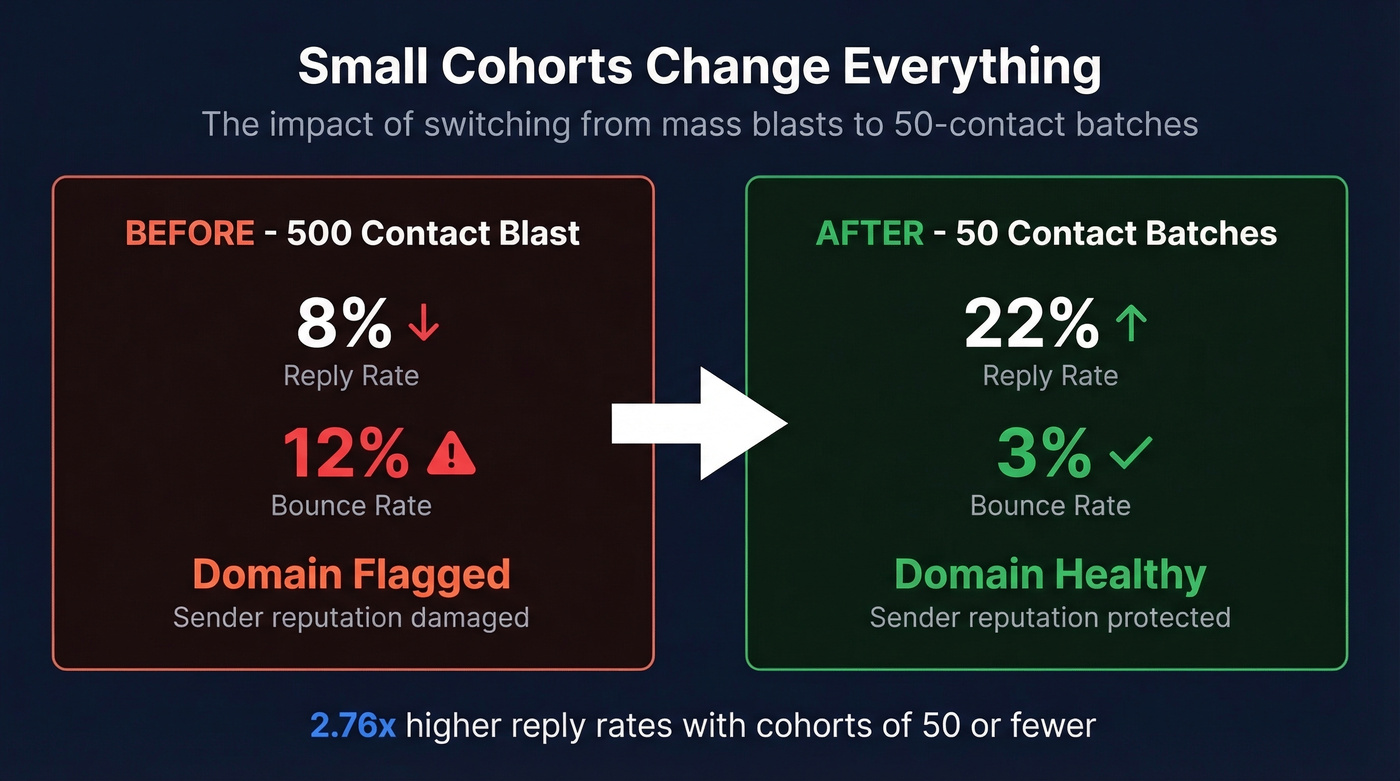
Second, keeping cohorts to 50 contacts or fewer lifts reply rates by 2.76x because smaller batches let you personalize more and catch bad data before it spreads.
The 3-7-7 follow-up cadence - named for the day gaps between touches at Day 0, Day 3, Day 10, and Day 17 - captures 93% of replies by Day 10, which means most of your sequence's value is front-loaded. Multi-channel sequences that blend email, phone, and social touches see 2x higher response rates than email-only cadences. If you're running single-channel sequences in 2026, you're leaving half your replies on the table.

Every sequence benchmark in this article assumes your emails actually land. With a 7-day data refresh cycle and 98% email accuracy, Prospeo eliminates the bounce-rate problem before your sequence even fires. Teams switching to verified data cut bounces from 35% to under 4% - and book 26% more meetings.
Fix your data before you fix your sequences.
Five Practices That Move Numbers
1. Use the persona matrix - and enforce it.
Don't let reps build sequences on the fly. Standardize by persona and touch intensity. In our experience, this alone eliminates half the inconsistency in most outbound programs. If you only implement one thing from this article, make it this.
2. Cap manual steps at three to four per sequence.
Here's what happens when you don't: reps fall behind on every task in their queue, prospects get stale touches days late, and your carefully designed sequence becomes fiction. Automate what you can. Reserve manual effort for high-value personas only.
3. Lead with timeline hooks, not pain points.
| Hook Type | Example | Avg. Reply Rate |
|---|---|---|
| Timeline/trigger | "Saw you just raised a Series B" | ~10% |
| Generic pain | "Struggling with pipeline?" | ~4.4% |
The data is clear. Reference a specific trigger or timing event. Generic pain-point openers are dead.
4. Keep cohorts small.
Before: 500-contact blast, 8% reply rate, 12% bounce rate, domain flagged. After: 50-contact batch, 22% reply rate, 3% bounce rate, domain healthy.
Fifty contacts or fewer per sequence batch. You'll personalize more, catch bad data faster, and iterate on messaging before burning through your entire TAM.
5. Verify contact data before every launch.
Look, if your bounce rate is above 10%, stop tweaking subject lines and fix your data first. We've seen teams cut bounce rates in half just by running verification before launch. One agency we know went from 35% bounces to under 3% across all client campaigns - zero domain flags - simply by verifying every list before it touched a sequence tool.
Prospeo runs real-time email verification with 98% accuracy on a 7-day refresh cycle, and teams switching from unverified lists routinely see bounce rates drop from 35%+ to under 4%.
How to Organize Sequences and Tools
The sequence platform market has stratified. Before picking a tool, you need to organize sequences by persona, channel, and funnel stage - otherwise you'll end up with dozens of overlapping cadences and no way to tell what's working.
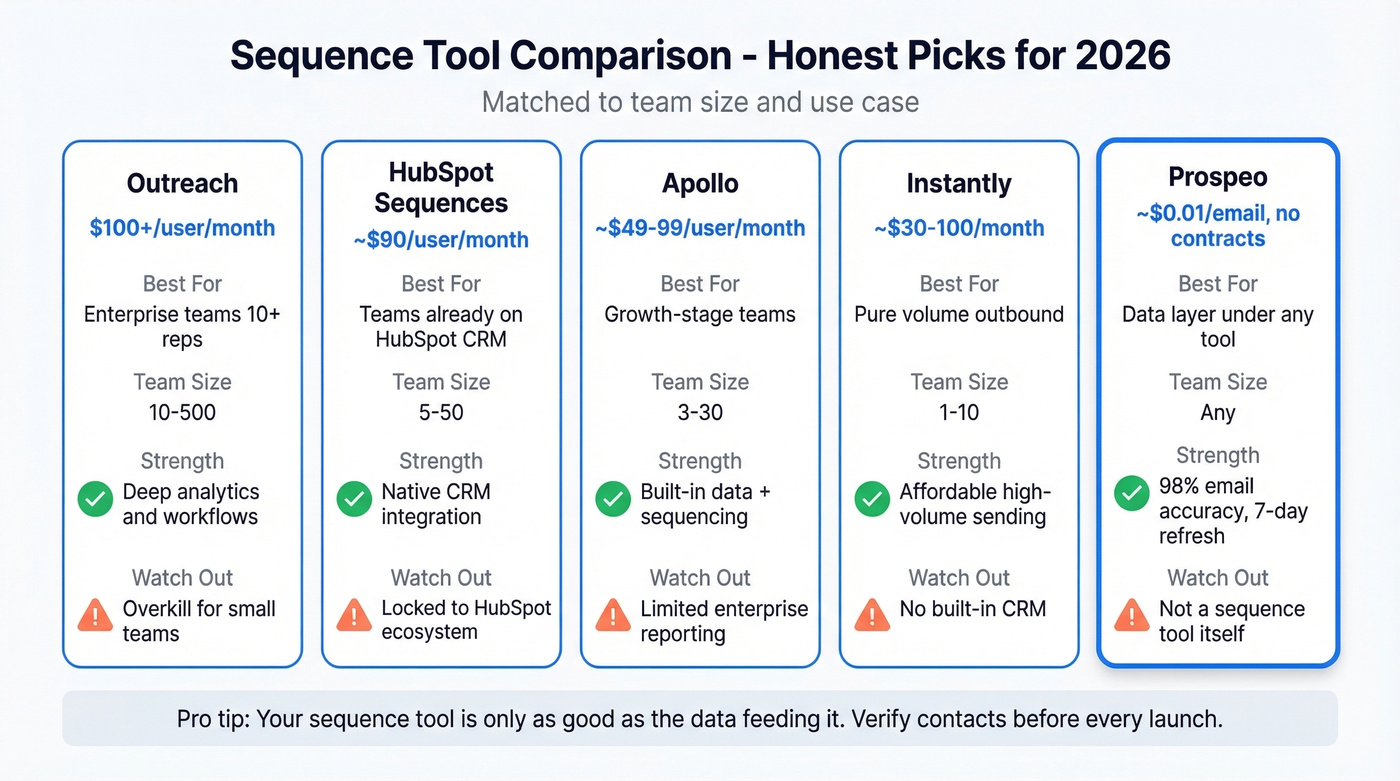
Here's our honest take on the platforms:
Outreach sits at the enterprise end with custom pricing; in practice, enterprise contracts often land around $100+/user/month on annual terms. It's powerful but overkill for teams under 10 reps. HubSpot Sequences comes with Sales Hub tiers; expect around $90/user/month for Pro-level seats depending on packaging and billing. Apollo offers a free tier and paid plans around $49-99/user/month with built-in sequencing - that's where I'd start for most growth-stage teams. For pure volume plays, Instantly and Smartlead typically run around $30-100/month based on sending volume, not seats.
None of these tools fix bad data. For the data layer underneath your sequences, data enrichment and verification matter more than your step count. Prospeo handles verified emails at ~$0.01/email with no contracts - a fraction of what enterprise data providers charge. Mobile numbers are credit-based at 10 credits per number. The free tier gives you 75 emails/month plus 100 Chrome extension credits/month to test before committing.
Skip Outreach if you're a team of five. Skip Apollo if you need deep enterprise reporting. And skip any tool that doesn't integrate with your CRM - manual CSV imports between your sequence tool and your CRM will break within a month.
If you're rebuilding your outbound stack, start with a clear view of your SDR tools and how they connect to your CRM.
Small cohorts and timeline hooks only work when you're reaching real inboxes. Prospeo's 300M+ verified profiles with 30+ filters - including job changes, funding events, and buyer intent - let you build hyper-targeted 50-contact batches with trigger data baked in. At $0.01 per email, bad data is no longer an excuse.
Build sequence-ready lists with verified contacts in minutes.
Sequence Management in Project Management
Outside of sales, sequence management means something completely different. In project management, sequencing activities means identifying and documenting the logical relationships between tasks using the Precedence Diagramming Method.
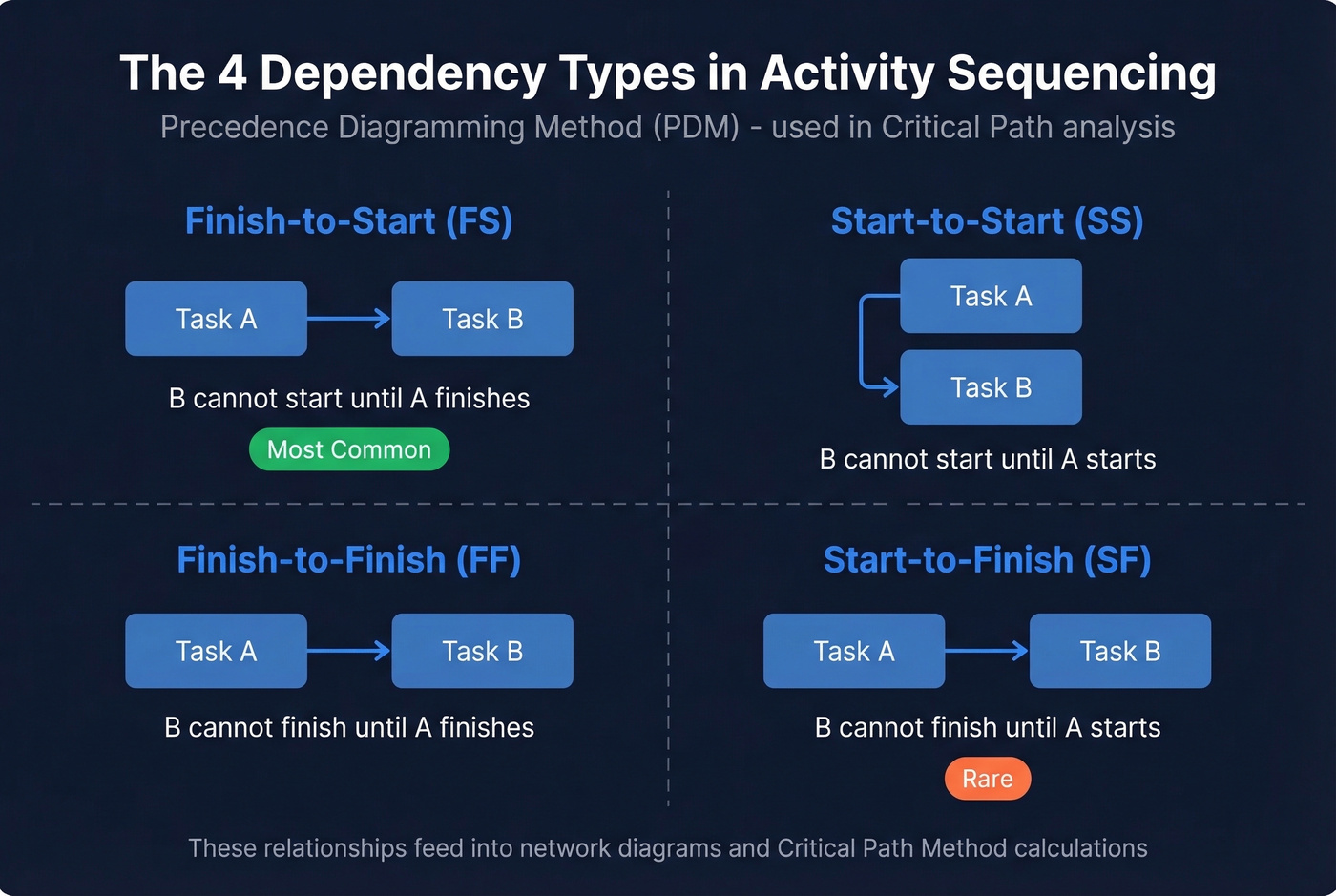
There are four dependency types: Finish-to-Start, Start-to-Start, Finish-to-Finish, and Start-to-Finish. Finish-to-Start is by far the most common - Task B can't start until Task A finishes. This feeds directly into the Critical Path Method and network diagrams that determine your project's minimum timeline. Tools like Microsoft Project and Primavera P6 handle this natively.
If you're studying for the PMP, note that PMBOK 6th edition simplified the Sequence Activities inputs compared to earlier editions - fewer mandatory inputs, same core logic.
Sequence Management FAQ
What's the difference between a sales sequence and a sales cadence?
A sequence is the specific series of timed touchpoints aimed at a prospect. A cadence is the broader timing philosophy governing when and how often those sequences fire. Cadence is strategy; sequence is execution.
How often should I update my sequences?
Minor tweaks monthly. Full overhaul every six months. If your last-step reply rate is above 3%, add another step before cutting anything. Building a regular review cycle is the core of good sequence organization - without it, outdated messaging quietly drags down your entire pipeline.
How do I keep sequences from overwhelming my reps?
Cap manual steps at three to four per sequence, batch your cohorts at 50 contacts or fewer, and use automation for low-value personas. When reps spend more time clicking through tasks than having conversations, your sequences need simplifying, not expanding.
How do I prevent bounces from killing my sequences?
Verify every contact before loading them into a sequence. Keep bounce rates under 5% - anything higher damages sender reputation and lands even great copy in spam.