

Marketing Enablement: What It Is, Why It's Underfunded, and How to Build It
Marketing enablement usually shows up when something breaks. Campaigns are shipping, but nobody trusts the data, nobody can find the "latest" deck, and new hires take months to become useful.
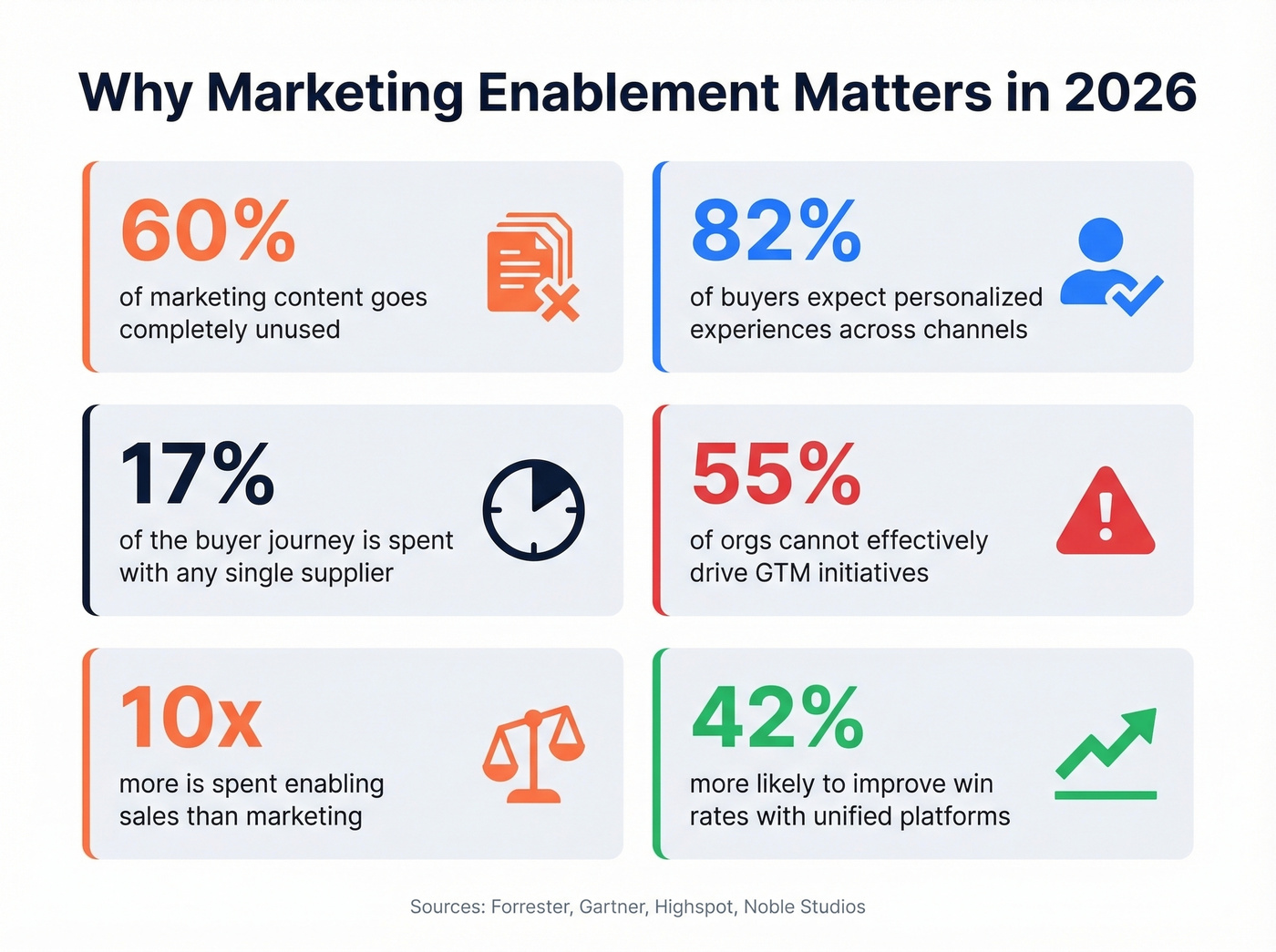
Here's the number that should make you pause: companies spend only about 10% as much enabling marketing as they do enabling sales. That's not a rounding error - it's a structural choice. And it creates predictable waste. Seismic's Value of Enablement research found 60% of the collateral marketing creates goes unused, which is a polite way of saying you're paying to produce assets that don't influence pipeline.
What It Actually Means
Marketing enablement is the system that makes marketing execution repeatable: how your team learns, how work gets done, how content gets governed, and how performance gets measured. The cleanest framing we've seen comes from MarketingProfs - it's an organizational capability, something that should keep working even when individuals leave.
That's why "tools and training" is too small a definition. Real enablement includes strategy and governance, career paths, content operations, data quality, and the guardrails that keep your stack from turning into a junk drawer.
Here's the thing: most teams already do enablement work. They just do it accidentally, in Slack threads, in undocumented SOPs, and in one heroic marketer's head. Then that person leaves and the org "mysteriously" slows down.
Working definition you can use internally: Marketing enablement is the capability that equips marketing teams with the strategy, processes, skills, content systems, and data quality required to execute GTM consistently and improve outcomes over time.
How It Differs From Sales Enablement
A lot of orgs underfund their marketing enablement program because they can't explain how it differs from sales enablement or RevOps. So it gets treated like "nice-to-have training," not an operating model.
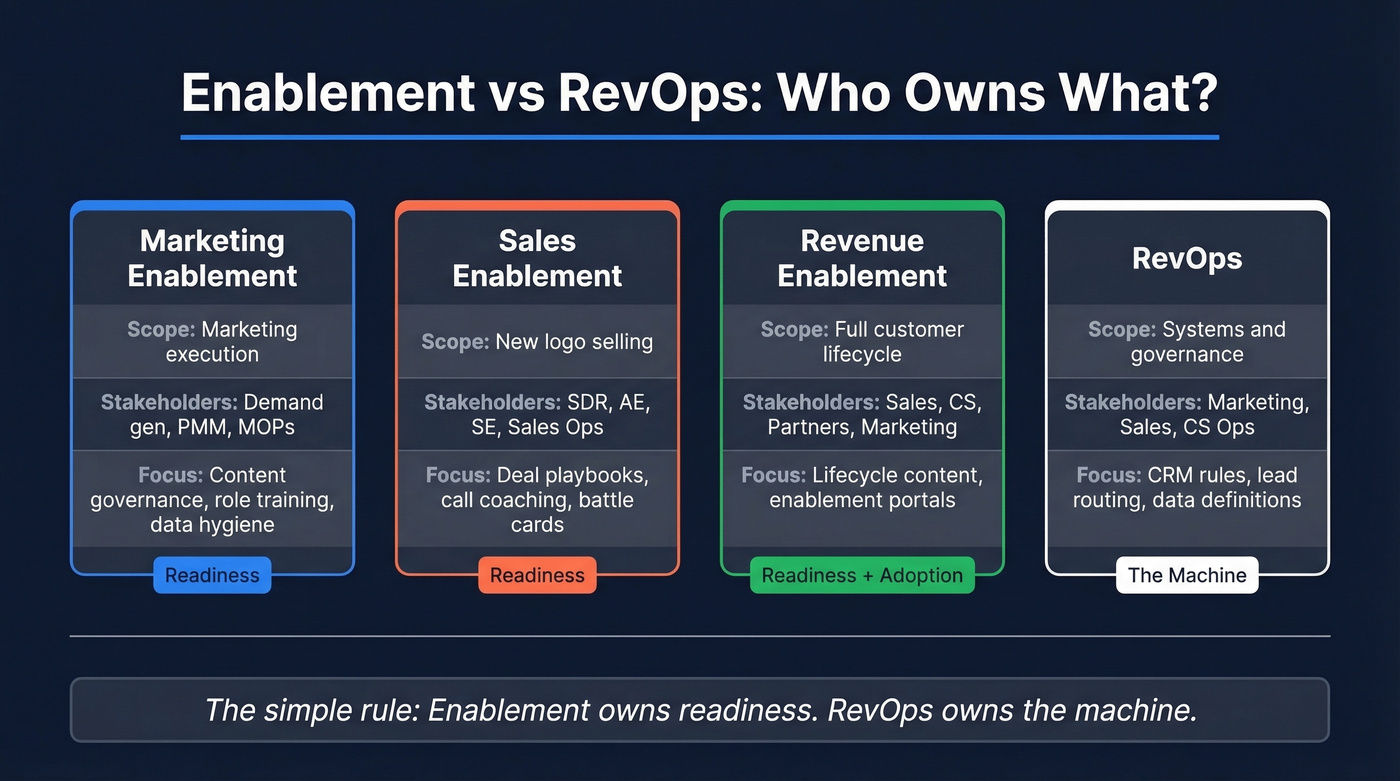
Enablix draws a practical distinction: sales enablement is typically oriented around new logos, while revenue enablement spans the full lifecycle - acquisition and expansion - across every revenue-facing team. Sales Enablement Collective draws the clean line between enablement and RevOps: enablement is readiness and resources, RevOps is systems, data, and process governance.
Here's a working map that holds up in real org design conversations:
| Function | Scope | Stakeholders | Example Activities |
|---|---|---|---|
| Marketing enablement | Marketing execution | Demand gen, PMM, MOPs | Content governance, role training, data hygiene |
| Sales enablement | New logo selling | SDR/AE, SE, Sales Ops | Deal playbooks, call coaching, battle cards |
| Revenue enablement | Full lifecycle | Sales, CS, Partners, Mktg | Lifecycle content, enablement portals |
| RevOps | Systems + governance | Mktg/Sales/CS Ops | CRM rules, lead routing, data definitions |
The simple rule: enablement owns readiness (skills, content usability, play adoption). RevOps owns the machine (systems, data definitions, process governance). When those blur, you get dashboards nobody trusts and "enablement" that's really just another tool rollout.
Why It Matters in 2026
Buyer expectations aren't a differentiator anymore - they're table stakes. Research summarized by Noble Studios shows 82% of buyers expect personalized experiences across marketing and sales, and the share consulting external influencers was projected to hit 50% by end of 2025. Your content and messaging can't just be "good" - it has to be consistent, findable, and tailored across channels and stakeholders you don't control.
Only 25% of B2B buyers find online demos useful. That means your "self-serve" content better be genuinely helpful, not just available.
Now layer on the execution gap. Highspot's State of Sales Enablement research found 55% of orgs can't effectively drive GTM initiatives, 29% still rely on disconnected GTM tools, and 90% are using or planning to use AI in GTM efforts. AI doesn't fix a messy operating model - it amplifies it. If your taxonomy is broken and your data is stale, AI just helps you ship the wrong thing faster.
A Gartner benchmark often cited in GTM planning is that buyers spend only 17% of their purchase journey with any single supplier. Your content does most of the selling. Enablement ensures it does it well. That unused collateral problem doesn't go away with more assets - it goes away when you build the enablement layer: governance, distribution, feedback loops, and measurement tied to pipeline.
Look, most marketing teams don't have a content problem. They have a content governance problem. We've seen teams with 400 assets and zero adoption, and teams with 30 assets driving 40% of pipeline. The difference is always enablement - never volume.

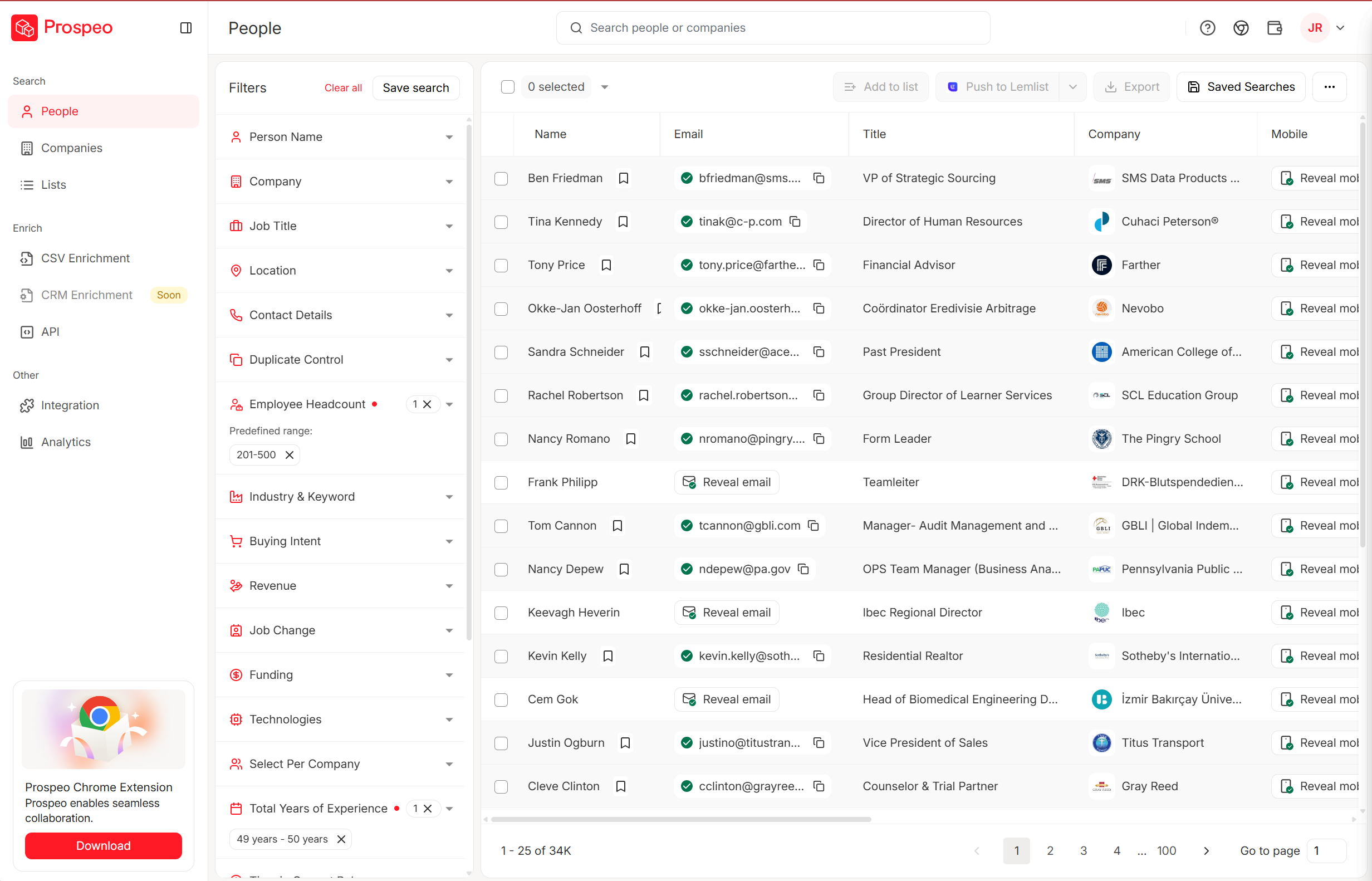
60% of marketing content goes unused because teams lack the data to target the right buyers. Prospeo's 300M+ profiles with 30+ filters - including buyer intent, technographics, and headcount growth - give your enablement program the foundation it needs. 98% email accuracy means your campaigns actually reach people.
Stop enabling your team with stale data. Start with the source of truth.
The Five Pillars of a Strong Framework
Strategy and Governance
Every enablement program needs rules of the road - what it exists to do, how decisions get made, and what's explicitly out of scope. Without a charter, enablement becomes a catch-all for "things nobody else wants to own."
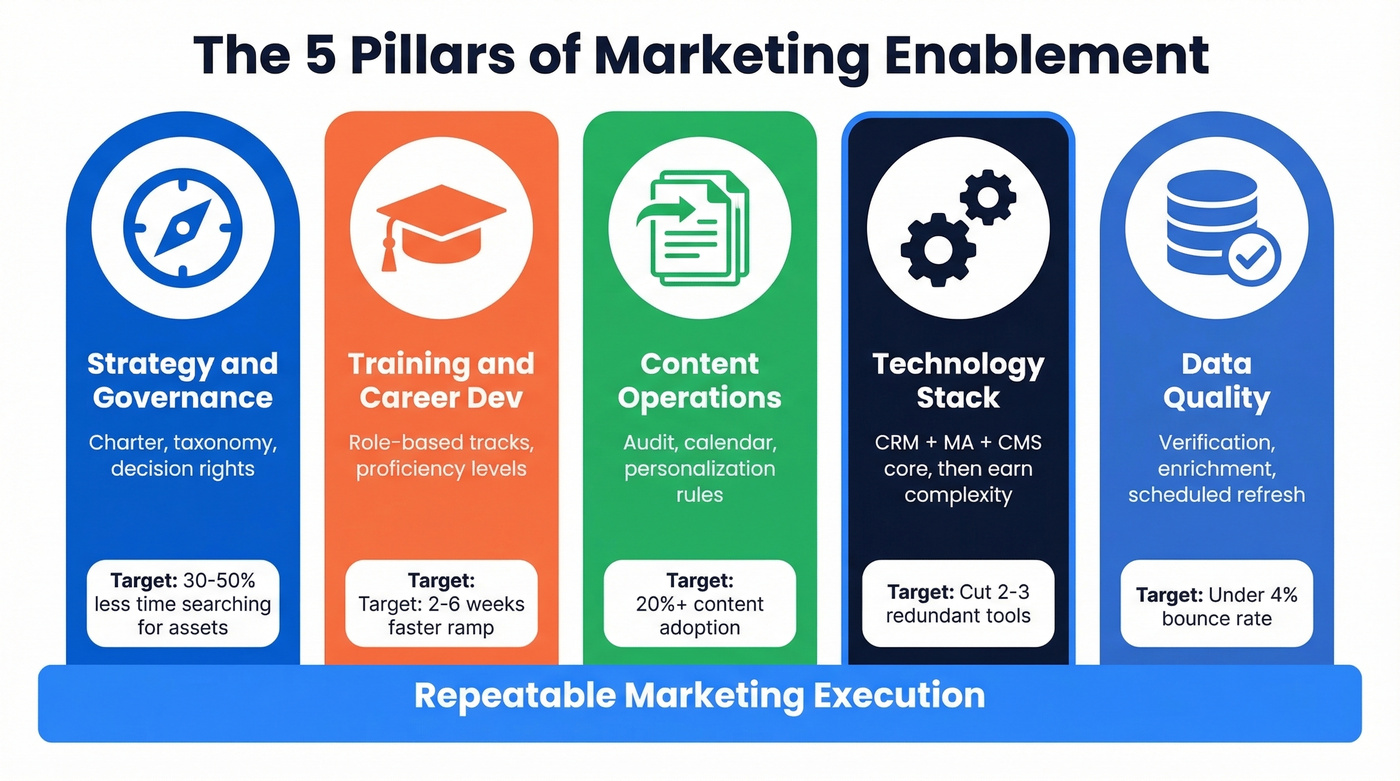
What this looks like in practice: an enablement charter covering mission, scope, KPIs, stakeholders, and exclusions. A governance cadence with monthly content council meetings, quarterly GTM retros, and clear approval paths. A single source of truth for naming conventions, ICP definitions, and campaign taxonomy.
Target: reduce time spent searching for "the right version" of an asset by 30-50%.
Training and Career Development
The most common complaint in enablement-focused communities isn't "we don't have tools." It's "nobody uses what we built." Training is where that gets fixed, but only if it's structured as a system rather than a one-off onboarding week.
The best programs we've encountered build training tracks by role - demand gen, PMM, lifecycle, MOPs - with proficiency levels that map to career progression. They bake value pairs into outcomes: personal readiness feeds operational excellence, engagement feeds business excellence, and career growth feeds leadership excellence. New hires get a "first 30 days" curriculum so they ship a campaign without reinventing your process. The consensus on r/sales and r/marketing is that structured onboarding beats "shadow someone for a week" every single time, and the data backs that up.
Target: cut new-hire ramp time by 2-6 weeks compared to unstructured onboarding.
Content Operations
Content ops is the operating system for content - from creation to governance to adoption. Start with a content audit that inventories assets, maps them to the buyer journey, and captures usage data. Then build a content calendar tied to GTM plays, not random "topics." Add personalization rules: what gets customized by segment, industry, stage, and persona.
Target: increase content adoption rate by 20%+ within two quarters.
Technology Stack
The consolidation trend is real: orgs are using 2 fewer tools on average than last year, and unified platform users are 42% more likely to improve win rates. Start with CRM + marketing automation + CMS as the core. Add enablement platforms only when you've earned the complexity.
Keep it boring. Pick the few tools you'll actually adopt, integrate them properly, and instrument everything: UTM governance, campaign object rules, and lifecycle stage definitions. Teams that buy Seismic before they've defined taxonomy always end up blaming the tool.
Target: reduce tool sprawl by 2-3 redundant platforms within 90 days.
Data Quality and Accuracy
This is the foundation that makes targeting, personalization, attribution, and deliverability actually work. Verify emails before outreach so sequences don't torch domain reputation. Enrich contact and account records so segmentation isn't guesswork. Refresh records on a schedule so job changes and role shifts don't silently break campaigns.
Target: bounce rate under 4%, enrichment match rate around 83%.
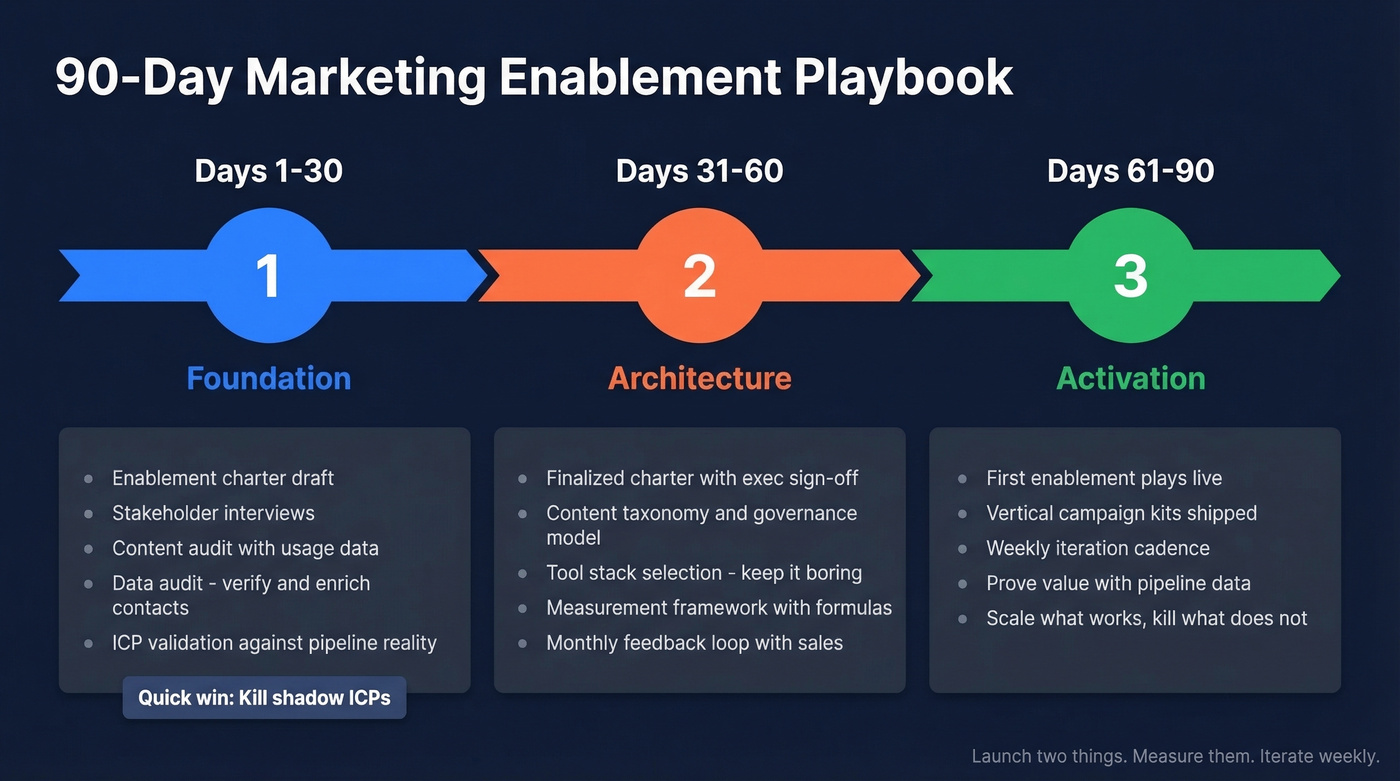
90-Day Marketing Enablement Playbook
Days 1-30: Foundation
This phase is about clarity and baselines. Start with strategy aligned to business goals and define metrics before you touch tools.
Deliverables:
- Enablement charter draft covering mission, scope, stakeholders, KPIs, and what's explicitly out of scope.
- Stakeholder interviews with CMO, demand gen, PMM, MOPs, sales leadership, and RevOps. Capture friction points and "where time goes to die."
- Content audit with inventory, usage data, and lifecycle mapping. Tag what's current, duplicative, missing, or dead.
- Data audit - run your existing contacts through verification and enrichment. Prospeo's enrichment API returns 50+ data points per contact with a 92% match rate, giving you cleaner, more complete records before a single campaign launches.
- ICP validation - confirm segments, personas, and disqualifiers using pipeline reality, not internal opinions.
The fastest win here is killing "shadow ICPs" - those unofficial segments that keep sneaking into campaigns because the data's messy and nobody owns the definition.
Days 31-60: Architecture
Now you codify how work happens: tools, content governance, and cross-functional alignment.
Deliverables:
- Finalized charter with exec sign-off and a quarterly review cadence.
- Content taxonomy + governance model covering naming conventions, lifecycle stages, persona tags, and ownership. Decide what gets archived and when.
- Tool stack selection - keep it boring. Pick the few tools you'll actually adopt, and integrate them properly.
- Measurement framework defining KPIs, formulas, and reporting owners. Agree on what "influence" means before the first dashboard gets built.
- Cross-functional cadence with sales - monthly feedback loop on content usefulness, objections, and competitive intel.
Employee engagement has flattened across many marketing orgs, and enablement is one of the few levers that improves both productivity and retention. We've watched teams try to "motivate" their way out of broken processes. It never sticks.
Days 61-90: Activation
This is where you ship enablement plays and prove value. Don't launch ten things. Launch two, measure them, and iterate weekly.
Deliverables:
- First enablement plays live - for example, a vertical campaign kit with verified contacts, messaging, landing page, and sales talk track.
- Team enablement through training sessions, SOPs, and office hours. Make adoption the product.
- Measurement dashboard instrumented with adoption, influence, and time-to-productivity tracked weekly.
- Optimization cadence - weekly retro on what shipped, what got used, and what drove pipeline movement.
Timeline expectations: foundational outputs land in weeks 2-4, leading indicators show up in weeks 4-8, and SQL movement shows up around weeks 6-10+ depending on your sales cycle.
How to Measure Enablement ROI
Most enablement programs die because measurement gets political. Sales Enablement Collective's Landscape Report found 49% of respondents disagree with leadership on what metrics they should be assessed on. Marketing enablement isn't immune - it's worse, because attribution arguments are easier to start and harder to finish.
Use a small set of KPIs with explicit formulas.
eNPS (team health): % Promoters (9-10) minus % Detractors (0-6). The simplest way to quantify whether enablement is making the team's day-to-day better. Formula adapted from Klipfolio.
Content adoption rate (asset usefulness): assets used by sales divided by total assets available. Track by asset type and by GTM play. If adoption doesn't move, your "enablement" is just content production.
Pipeline influence % (business impact): pipeline dollars touched by enablement content divided by total pipeline dollars. Define "touched" upfront - viewed in a deal room, attached to an opportunity, referenced in call notes, or clicked in tracked emails.
Time-to-productivity (speed): days from hire to first campaign launch. The metric execs understand instantly. If enablement is working, this number drops.
We've run bake-offs where the "best" enablement initiative wasn't the fanciest platform - it was the one that cut asset search time in half and reduced new-hire ramp by a month. Speed is ROI.
Tools and What They Cost
Tooling matters, but it's not the starting point. The frustrating part is how often teams buy an enterprise enablement platform before they've defined taxonomy, governance, or success metrics. Adoption predictably stalls, and the tool gets blamed.
| Tool | Category | Starting Price | Best For |
|---|---|---|---|
| Prospeo | Data quality + enrichment | Free tier; ~$0.01/email | Any team running outbound |
| Seismic | Enablement platform | ~$100K+/year | Global enterprise |
| Highspot | Enablement platform | ~$25K-$150K+/year | Mid-market to enterprise |
| Showpad | Enablement platform | ~$25K-$150K+/year | Content-heavy orgs |
| HubSpot Marketing Hub | Marketing automation | Free-~$3,600/mo+ | Full-funnel teams |
| Dock | Digital sales rooms | Free-$750/mo | Revenue teams |
For teams that want transparent pricing breakdowns, Dock's revenue enablement software overview is unusually detailed.
You don't need $100K to start. A CRM you actually use, a content system your team won't abandon, and a data platform that gives you verified contacts can get you 80% of the way there for under $500/month. Skip the enterprise enablement platform until you've proven the operating model works with simpler tools - otherwise you're just buying expensive shelfware.
If you're pressure-testing vendors, start with a quick scan of data enrichment services and email deliverability basics so you don't optimize the wrong layer.
You just read that AI amplifies a messy operating model. The same applies to your contact data. Prospeo refreshes every record on a 7-day cycle - 6x faster than the industry average - so your enrichment workflows, CRM hygiene, and campaign targeting never run on outdated information. At $0.01 per email, clean data costs less than one wasted campaign.
Enablement without data quality is just documentation. Fix the root cause.
FAQ
What's the difference between marketing enablement and sales enablement?
Marketing enablement equips the marketing team with strategy, training, content processes, and data quality to drive pipeline. Sales enablement equips sellers to execute plays and close deals. They're complementary - one improves what gets produced, the other improves how it's used in live deals. Mature orgs connect both through a shared content feedback loop.
Who should own the enablement function?
A senior marketing ops or enablement leader reporting to the CMO, with tight partnership from RevOps and sales enablement. In smaller orgs, the VP of Marketing owns it directly. One accountable owner is non-negotiable - otherwise it becomes everyone's side project and nobody's priority.
How do you measure enablement ROI?
Track four KPIs: content adoption rate, pipeline influence %, time-to-productivity for new hires, and eNPS. Sales Enablement Collective's report found 49% of teams can't agree with leadership on the right metrics - define formulas and owners before you launch.
What's a good free tool for the data quality pillar?
Prospeo's free tier includes 75 verified emails per month with 98% accuracy and 100 Chrome extension credits - enough to audit your existing contacts and run a small outbound test. For teams that need enrichment without enterprise pricing, it covers verification, 50+ data points per contact, and CRM integrations out of the box.