

Lead Enrichment: What It Is, What It Costs, and How to Do It Right
A RevOps lead we know exported 5,000 leads from their primary database last quarter. Ran them through a verifier before loading sequences. 1,600 bounced - that's a 32% bounce rate, enough to tank your sender domain fast.
B2B contact data decays at roughly 22.5% per year. If you're not running lead enrichment continuously, you're building pipeline on a foundation of rot.
What You Need (Quick Version)
- One enrichment source returning verified contact data with built-in verification
- One backup verifier if you pull from multiple databases
- CRM sync so enriched data flows to reps without manual CSV gymnastics (see CRM sync)
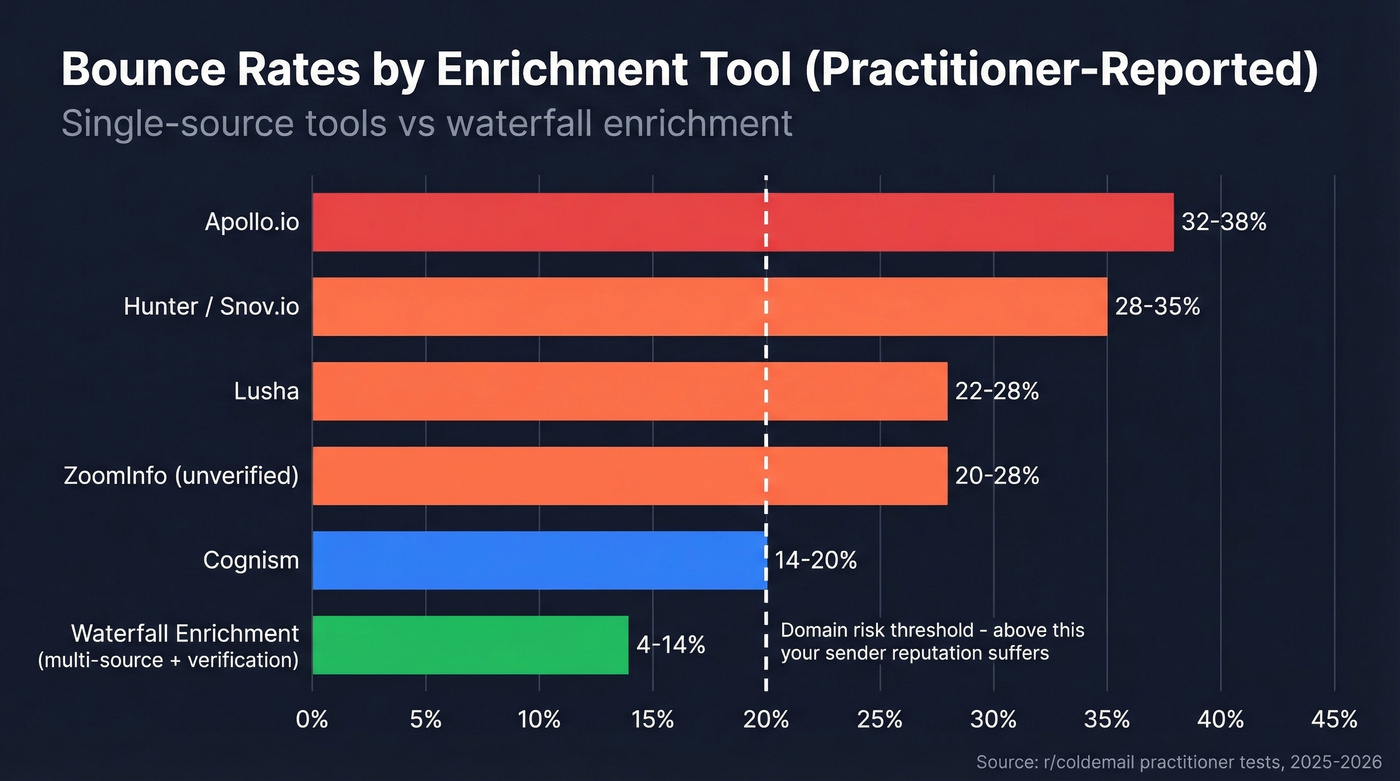
In practitioner tests, waterfall enrichment - querying multiple sources sequentially - drops bounce rates to 10-14% vs 30%+ from a single source. That's the difference between a healthy domain and a blacklisted one.
What Is Lead Enrichment?
Lead enrichment takes a sparse contact record - maybe a name, email, and company from a form fill - and appends the missing data that makes it actionable for sales. We're talking company size, annual revenue, tech stack, verified direct dial, department headcount, funding stage, intent signals (more on firmographics and technographics).
A raw inbound lead might give you "Sarah Chen, sarah@acme.com, Marketing." After enrichment, you know Acme is a 200-person SaaS company doing $35M ARR, running HubSpot and Salesforce, currently hiring three SDRs, and actively researching your product category. That context is the gap between a cold call and a relevant conversation.
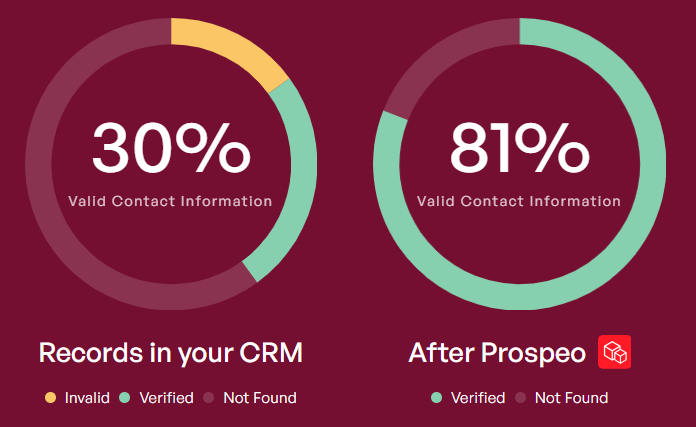
Why It Matters: The Numbers
The decay problem is worse than most teams realize. ZeroBounce's analysis of 11 billion+ emails verified in 2025 found at least 23% of email lists degrade annually. In tech and startup verticals, that number climbs to 25-40%. Over 9% of checked emails were catch-all addresses, meaning the real degradation is higher still.
We've sat in pipeline reviews where an SDR manager pulled up the week's call list and half the phone numbers were disconnected. That's not a prospecting problem. It's a data problem. Responding to a lead within five minutes maximizes your conversion odds, but speed means nothing if the number routes to someone who left six months ago.
Here's what practitioners reported for bounce rates by tool in one widely shared test: Apollo landed around 32-38%, Hunter and Snov.io around 28-35% with lots of guessed emails, and Lusha around 22-28%. The consensus in that r/coldemail thread is clear - no single database cuts it anymore.
If your average deal size is under $10K, you probably don't need a $30K/year ZoomInfo contract. A well-configured enrichment tool with built-in verification will outperform an expensive platform your team only uses at 20% capacity.
How the Enrichment Process Works
Most teams automate the entire sequence so it fires in under 60 seconds:
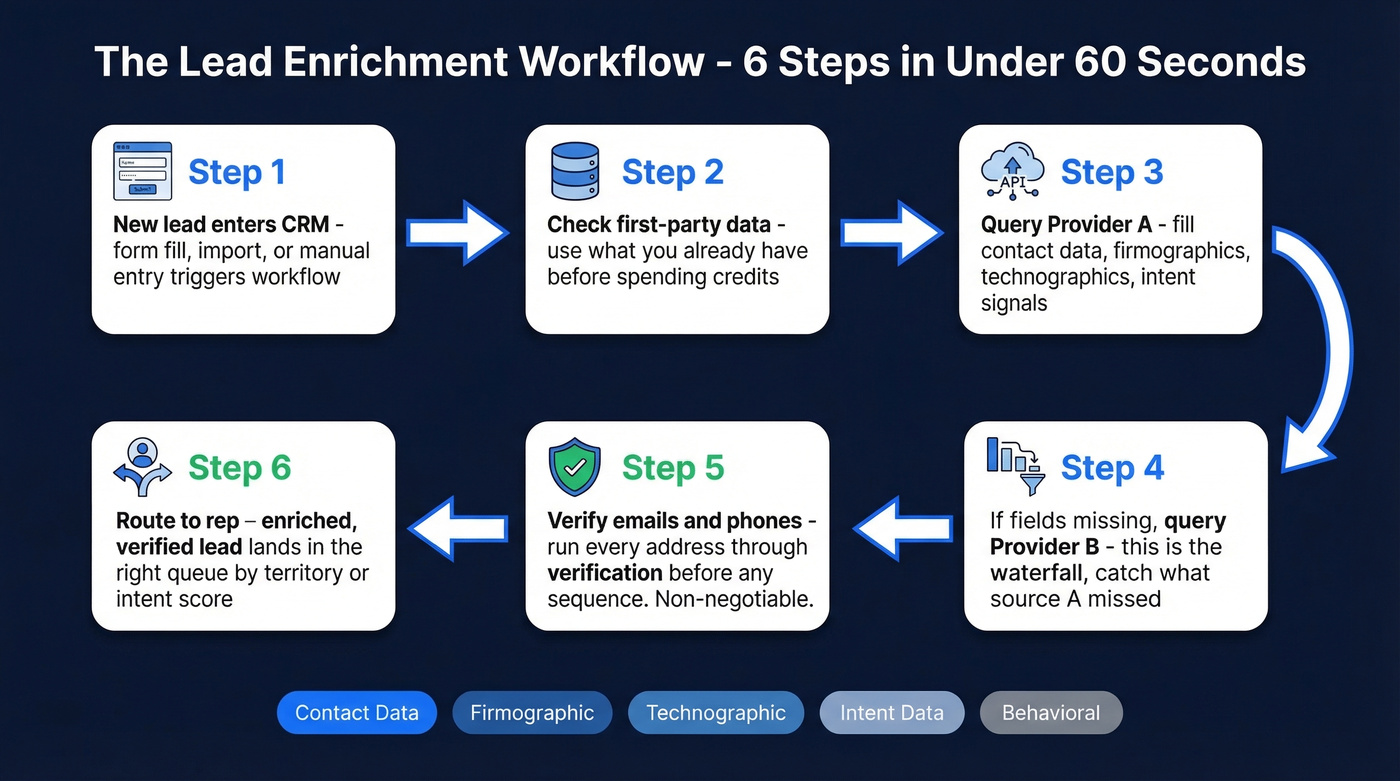
- New lead enters CRM - inbound form fill, imported list, or manual entry triggers the workflow.
- Check first-party data - pull whatever you already have before spending credits.
- Query enrichment provider A - the primary source fills contact data, firmographics, technographics, and intent signals.
- If fields are missing, query provider B - a secondary source catches what the first one missed. That's the waterfall.
- Verify emails and phones - run every email through verification before it touches a sequence. Non-negotiable (see email bounce rate).
- Route to rep - enriched, verified lead lands in the right rep's queue based on territory, segment, or intent score (related: lead scoring).
The data you're enriching falls into five buckets. Contact data covers emails, phones, and titles. Firmographic data includes revenue, headcount, and industry classification. Technographic data reveals which tools a company runs. Intent data tracks the topics they're actively researching. Behavioral data captures website visits and content engagement.

Stop enriching leads just to verify them separately. Prospeo's 5-step verification is built into every enrichment - 83% match rate, 50+ data points returned, 98% email accuracy. No waterfall duct-taping required.
Replace your 32% bounce rate with under 4%. Free tier included.
Waterfall Enrichment: Why One Source Fails
Waterfall enrichment means querying multiple data providers in sequence - if Provider A doesn't have the email, you try Provider B, then C. It's the single biggest improvement you can make to data quality.
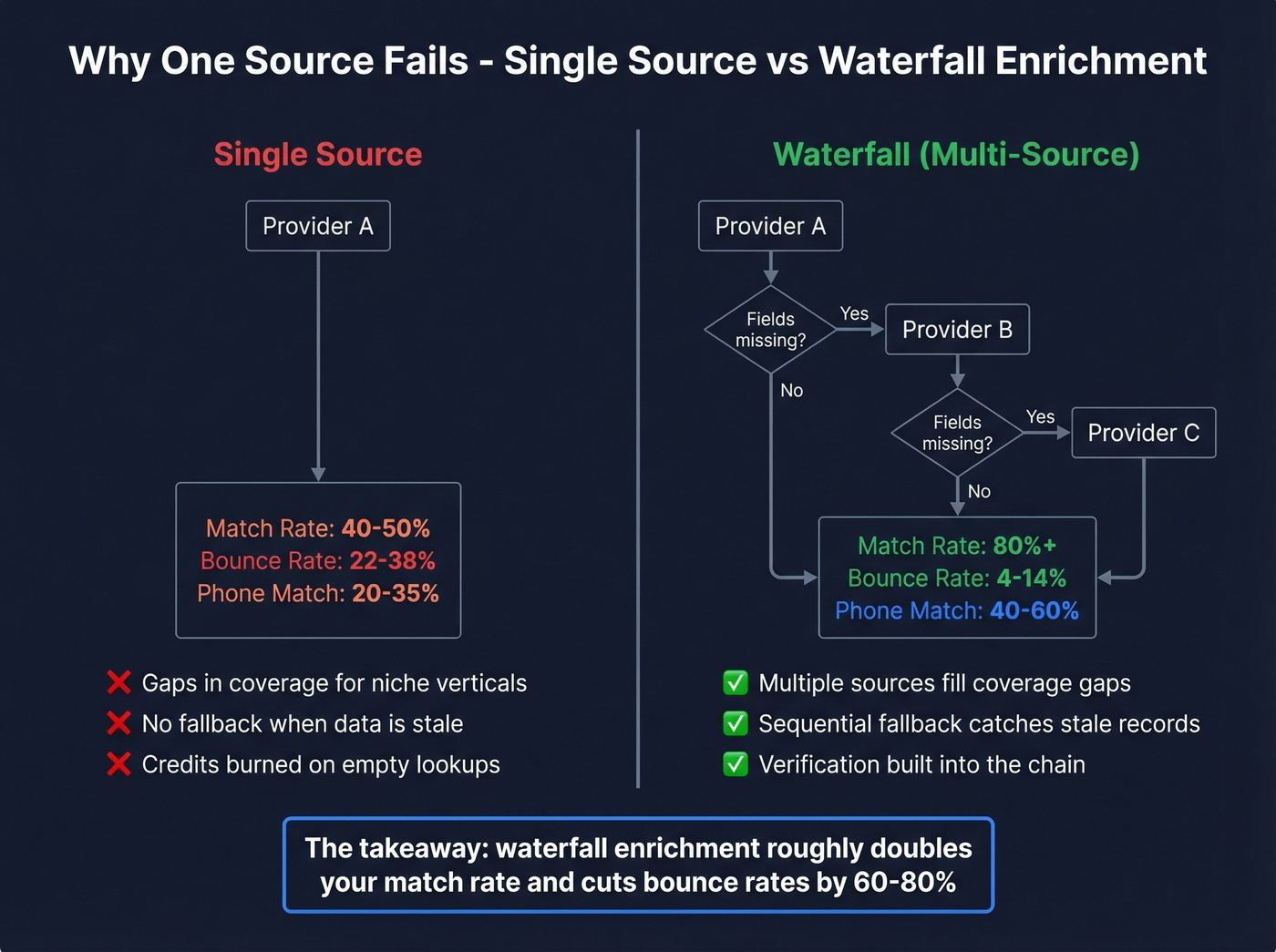
Single-source tools plateau around 40-50% match rates. A properly configured waterfall hits 80%+. Phone numbers are weaker - expect 40-60% match rates for direct dials even with multiple sources.
One pitfall worth flagging: some providers charge credits for every lookup, even when the email comes back unverified or empty. That burns budget fast. Look for providers where verification is baked into the enrichment process so you're not paying twice (see data enrichment services).
Tools and Pricing Compared
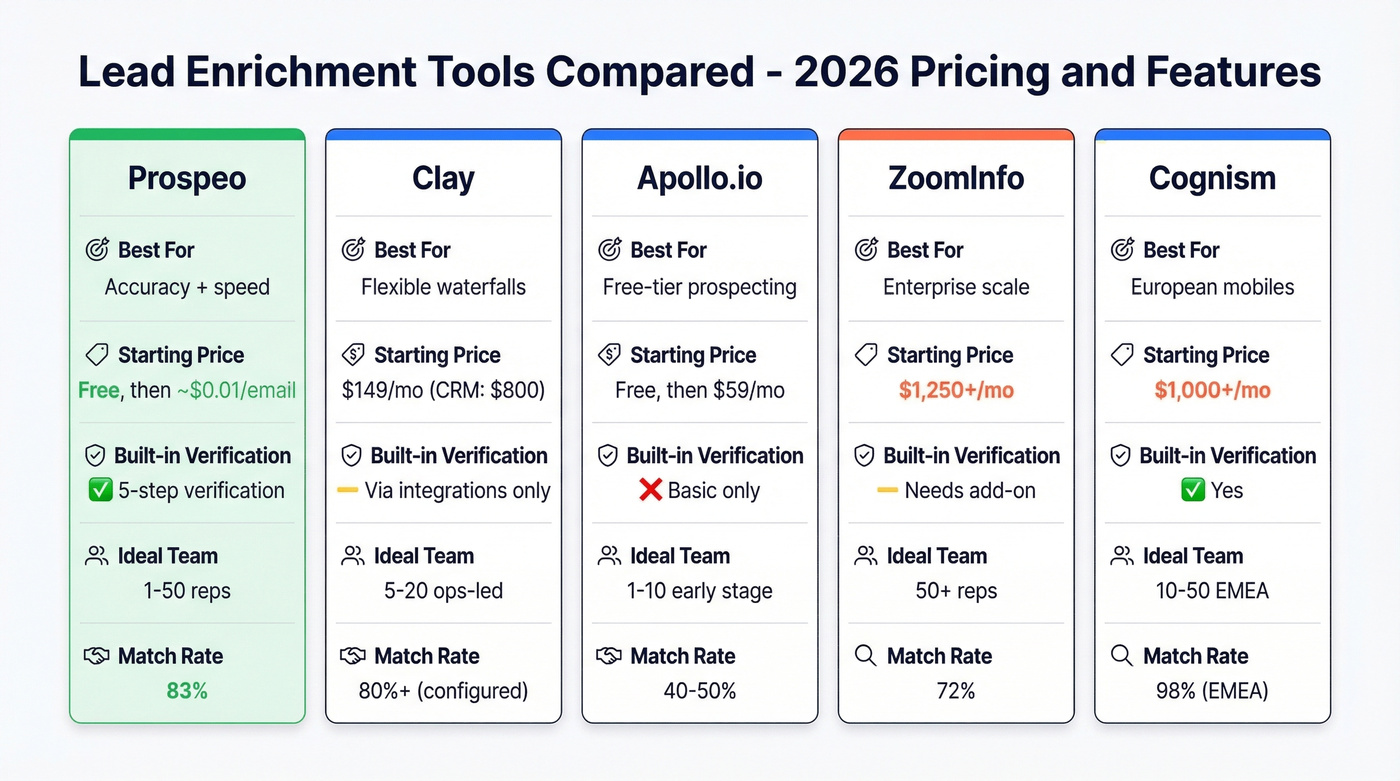
| Tool | Best For | Starting Price | Verification? | Ideal Team Size |
|---|---|---|---|---|
| Prospeo | Accuracy + speed | Free / ~$0.01/email | Yes, built-in | 1-50 reps |
| Clay | Flexible waterfalls | ~$149/mo (CRM: $800) | Via integrations | 5-20 ops-led |
| Apollo.io | Free-tier prospecting | Free / $59/mo | Basic | 1-10 early stage |
| ZoomInfo | Enterprise scale | ~$1,250+/mo | Needs add-on | 50+ reps |
| Cognism | European mobiles | ~$1,000+/mo | Yes | 10-50 EMEA-focused |
Prospeo
Use this if you want accurate data without building a complex waterfall from scratch. Prospeo covers 300M+ professional profiles with 98% email accuracy and an 83% enrichment match rate, returning 50+ data points per contact.
What makes it different: every email goes through a proprietary 5-step verification process with catch-all handling, spam-trap removal, and honeypot filtering - so you're not bolting on a separate verifier. The 7-day data refresh cycle is roughly six times faster than the industry average of six weeks. Pricing starts free at 75 emails/month, and paid plans run about $0.01 per email with no contracts. Native integrations with Salesforce, HubSpot, Smartlead, Instantly, Lemlist, Clay, Zapier, and Make mean enriched data flows straight into your stack (see email deliverability).
One of our customers, Meritt, went from a 35% bounce rate to under 4% after switching their enrichment workflow. Their pipeline tripled from $100K to $300K per week.
Meritt cut their bounce rate from 35% to under 4% and tripled pipeline to $300K/week - just by switching their enrichment source. Prospeo refreshes 300M+ profiles every 7 days, not every 6 weeks like the rest.
Enrich 75 leads free this month. No credit card, no contract.
Clay
Clay is the most flexible waterfall builder on the market. You can chain dozens of data providers, add conditional logic, and build enrichment workflows that rival custom code - without writing any. Teams that need granular customization will find Clay's flexibility hard to beat.
Use this if you have a dedicated ops person who'll invest 4-6 weeks learning the platform and you need maximum coverage across niche verticals.
Skip this if you want something that works out of the box. Basic email enrichment costs 2-3 credits per match, full profile enrichment runs 15-25 credits per prospect, and CRM integration requires the Scale plan at $800/month. That adds up quickly for teams without a RevOps specialist to maintain the workflows.
Apollo.io
Apollo has one of the largest free tiers in the space - genuinely useful for early-stage teams who need to start prospecting without a budget. The database covers 275M+ contacts, the UI is intuitive, and paid plans run $59-$149/user/month.
Here's the thing: Apollo's email accuracy has been slipping. Practitioners consistently report 32-38% bounce rates on exported lists. Apollo is really a lead source, not a verified data provider. Budget for a separate verifier if you go this route (see SDR tools).
ZoomInfo
The enterprise default. One of the largest databases, deep US coverage, broad feature set - intent data, chat, workflow automation. A 10-seat contract with intent and mobile numbers typically runs $15-40K/year.
Where ZoomInfo still wins: sheer US database depth. Where it loses: you're paying for modules you don't use, and the data still needs verification. Reddit's #1 complaint? Price - specifically, paying for features that never get turned on. For teams under 50 reps, the ROI math rarely works out.
Cognism
Strong pick for teams selling into Europe. Cognism's case-study metrics show a 98% match rate vs ZoomInfo's 72%, and a 22% call connect rate vs 14%. Pricing starts around $1,000+/month, quote-based. If your ICP is EMEA-heavy and direct dials matter, Cognism deserves a trial.
Quick Mentions
Breeze Intelligence (Clearbit) - now HubSpot-native. Credit packs run $30-$700/month. Best if you're already all-in on HubSpot. Limited outside that ecosystem.
Lusha - fast lookups, decent data, but credits deplete quickly. From ~$49/user/month. Good for individual reps doing one-off research, less suited for bulk enrichment.
FullEnrich - waterfall aggregator pulling from 20+ sources. Free tier covers 50 leads; paid plans start around $50-100/month. Worth watching for teams that want waterfall without Clay's complexity.
Five Mistakes That Kill Pipeline
1. Trusting a single source. Single-source bounce rates run 22-38% depending on the tool. Waterfall or verify separately. No shortcut.
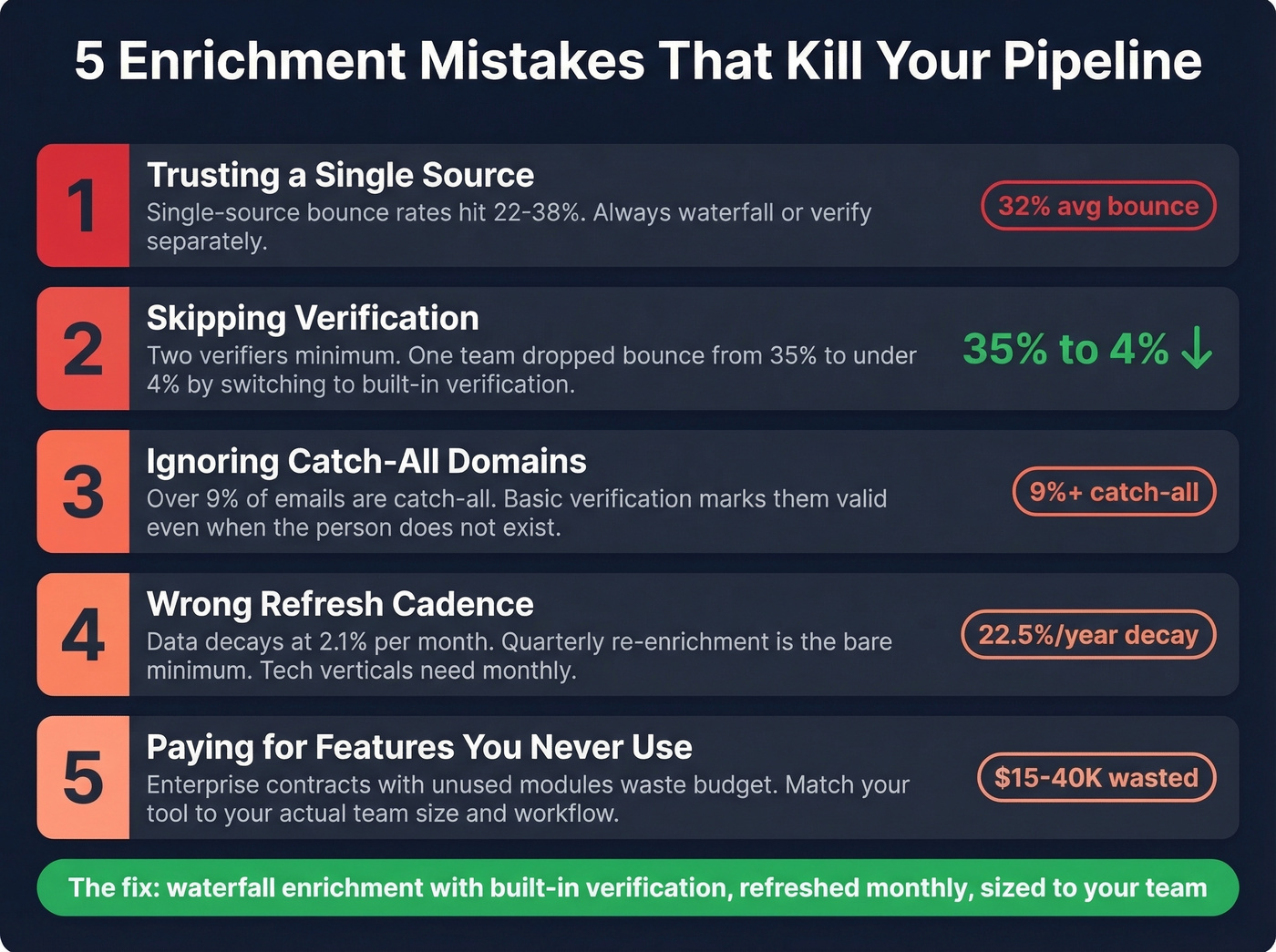
2. Skipping verification. The practitioner consensus on r/salesdevelopment is two verifiers minimum - tools like Kickbox or NeverBounce as a safety net. One team dropped bounce from 35% to under 4% by switching to enrichment with built-in verification rather than treating it as an afterthought.
3. Ignoring catch-all domains. Over 9% of emails are catch-all - they accept any address, so basic verification marks them "valid" even when the person doesn't exist. You need a provider that handles catch-all specifically.
4. Wrong refresh cadence. At 2.1% monthly decay, quarterly re-enrichment is the bare minimum. Tech and startup verticals need monthly. Let it slide and you're calling people who left six months ago.
5. Over-enriching. Appending 80 fields when reps use five isn't just wasteful - it's a GDPR risk. Data minimization isn't optional in the EU. Only enrich the fields your team will actually act on.
Real-World Enrichment Scenarios
Let's make this concrete with three common setups we've seen work well:
Inbound form fill: A marketing team captures name and email from a gated whitepaper. Enrichment appends company size, industry, and tech stack within seconds, letting the SDR personalize the follow-up before the lead goes cold (see sales follow-up templates). The difference between "Hi Sarah, saw you downloaded our guide" and "Hi Sarah, noticed Acme is running HubSpot with a 200-person team - we've helped similar SaaS companies cut their enrichment costs by 60%" is the difference between delete and reply.
Outbound list build: A sales ops team uploads a target account list with company names only. Discovery and enrichment tools match contacts at those accounts, fill in verified emails and direct dials, and route them to reps by territory. This is where waterfall enrichment shines - one source won't find contacts at every company, but chaining two or three gets you to 80%+ coverage.
CRM hygiene sweep: A RevOps team re-enriches their entire database quarterly, flagging contacts who've changed roles and updating stale phone numbers. This isn't glamorous work, but it's the reason some teams maintain 95%+ deliverability while others wonder why their sequences stopped converting.
Compliance: GDPR, CCPA, and Enrichment
Enrichment sits squarely in the crosshairs of privacy regulation. Five principles to follow: data minimization (only enrich fields you'll use), purpose limitation (document why you're enriching), accuracy (stale data violates GDPR), lawful basis (most B2B enrichment runs on legitimate interest, but document it), and opt-out enforcement globally.
GDPR penalties run up to €20 million. CCPA fines hit $7,988 per intentional violation as of 2026, and over 20 US states now have comprehensive privacy laws. If your enrichment feeds automated lead scoring or routing, GDPR Article 22 adds requirements for human review of automated decisions. Most teams aren't thinking about this until it's too late.
FAQ
How often should I re-enrich my CRM?
Quarterly at minimum. B2B data decays at roughly 2.1% per month - about a fifth of your database goes stale every year. High-turnover industries like tech and staffing need monthly refreshes to keep bounce rates under 5%.
What's the difference between lead enrichment and data enrichment?
Lead enrichment specifically appends missing contact and company fields to sales leads - emails, phones, firmographics, technographics. Data enrichment is the broader category covering any dataset. In B2B sales contexts, the terms are used interchangeably.
Is lead enrichment GDPR compliant?
It can be, if you have a lawful basis (typically legitimate interest), practice data minimization, maintain accuracy, and honor opt-out requests. Document your processing purpose before enriching.
How much does lead enrichment cost?
Self-serve tools start at $0.01 per email with free tiers available. Mid-market teams typically spend $150-$500/month. Enterprise platforms like ZoomInfo run $15-40K annually for a 10-seat contract with intent data and mobile numbers.
The 32% bounce rate from the opening of this article? That team fixed it in a week by adding verification to their enrichment workflow. The tools exist. The data is there. The only question is whether you'll keep sending to dead addresses or start enriching properly.