

Sales Follow-Up Templates: 10 Proven Emails + the Cadence That Makes Them Work
Belkins' analysis of 16.5 million cold emails found the first email averages an 8.4% reply rate. By the fifth, that number drops by more than half - and unsubscribe rates triple while spam complaints more than triple. Here's the thing most follow-up roundups won't tell you: the reason your follow-up emails fail isn't the copy. It's that you're emailing dead addresses, sending too many touches to the same channel, and giving up after two attempts.
TL;DR
Templates are 20% of the equation. You need a multi-channel cadence mixing email, phone, and social. Cap email follow-ups at 3 per prospect before switching channels. Manual emails outperform automated ones nearly 2:1 on reply rate. And verify your list first - top-performing teams run 0.5% bounce rates versus a 2.7% baseline.
Follow-Up Benchmarks Worth Knowing
Gong Engage's benchmarks show an enormous gap between baseline and top-quartile performance:
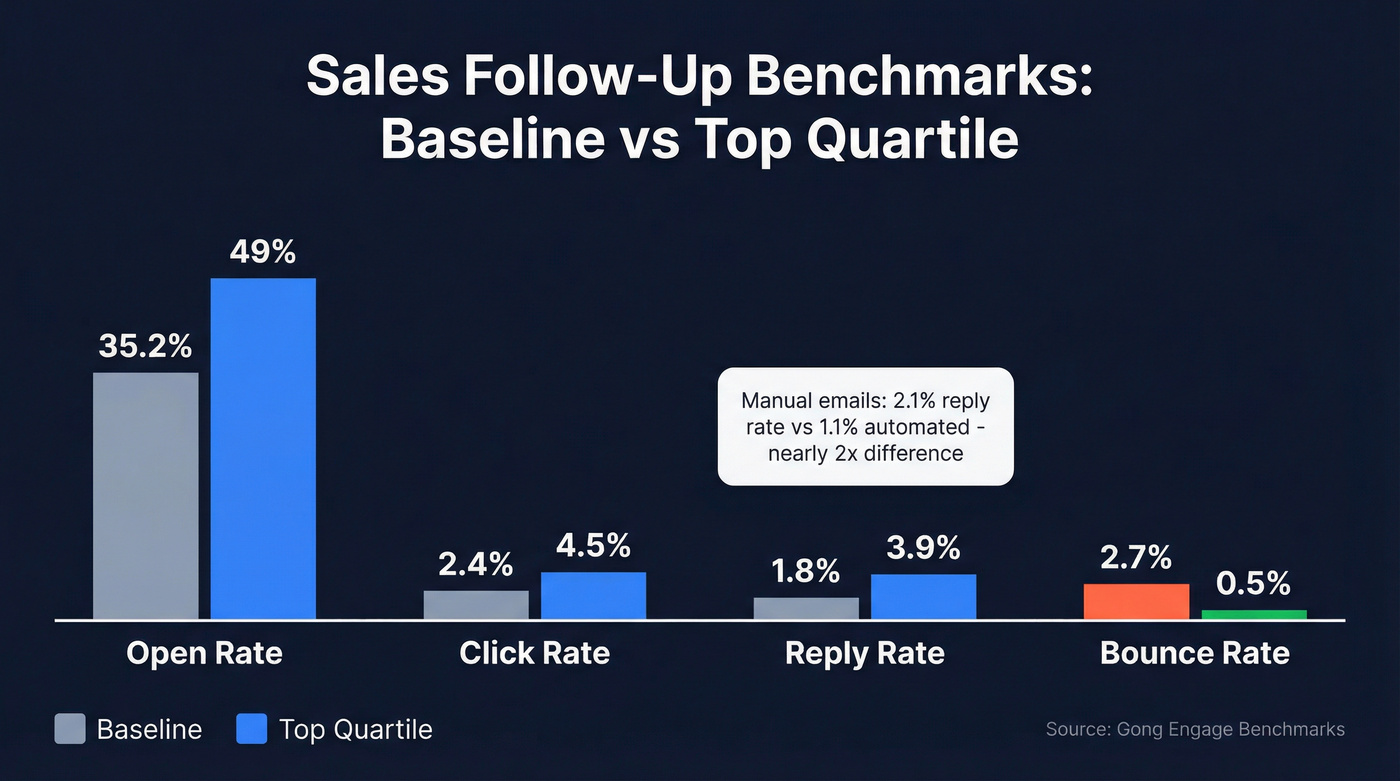
| Metric | Baseline | Top Quartile |
|---|---|---|
| Open rate | 35.2% | 49% |
| Click rate | 2.4% | 4.5% |
| Reply rate | 1.8% | 3.9% |
| Bounce rate | 2.7% | 0.5% |
Manual emails hit a 2.1% reply rate versus 1.1% for automated sends. If you're blasting templated sequences without personalization, you're leaving half your replies on the table.
One stat that surprised us: founders who receive follow-ups drop from a 6.64% reply rate on the first email to just 3.01% by the fourth. They're the fastest persona to tune out generic sequences, which makes sense - they get more cold outreach per day than almost anyone else in a company.
Build a Cadence, Not Just Emails
A single follow-up email isn't a strategy. Outreach's cadence research recommends 8-12 touches over 17-21 days across channels. RAIN Group data backs this up - meetings require roughly 8 touches on average. For inbound leads, speed matters even more: responding within 5 minutes makes you 21x more likely to qualify the lead than responding after 30 minutes.
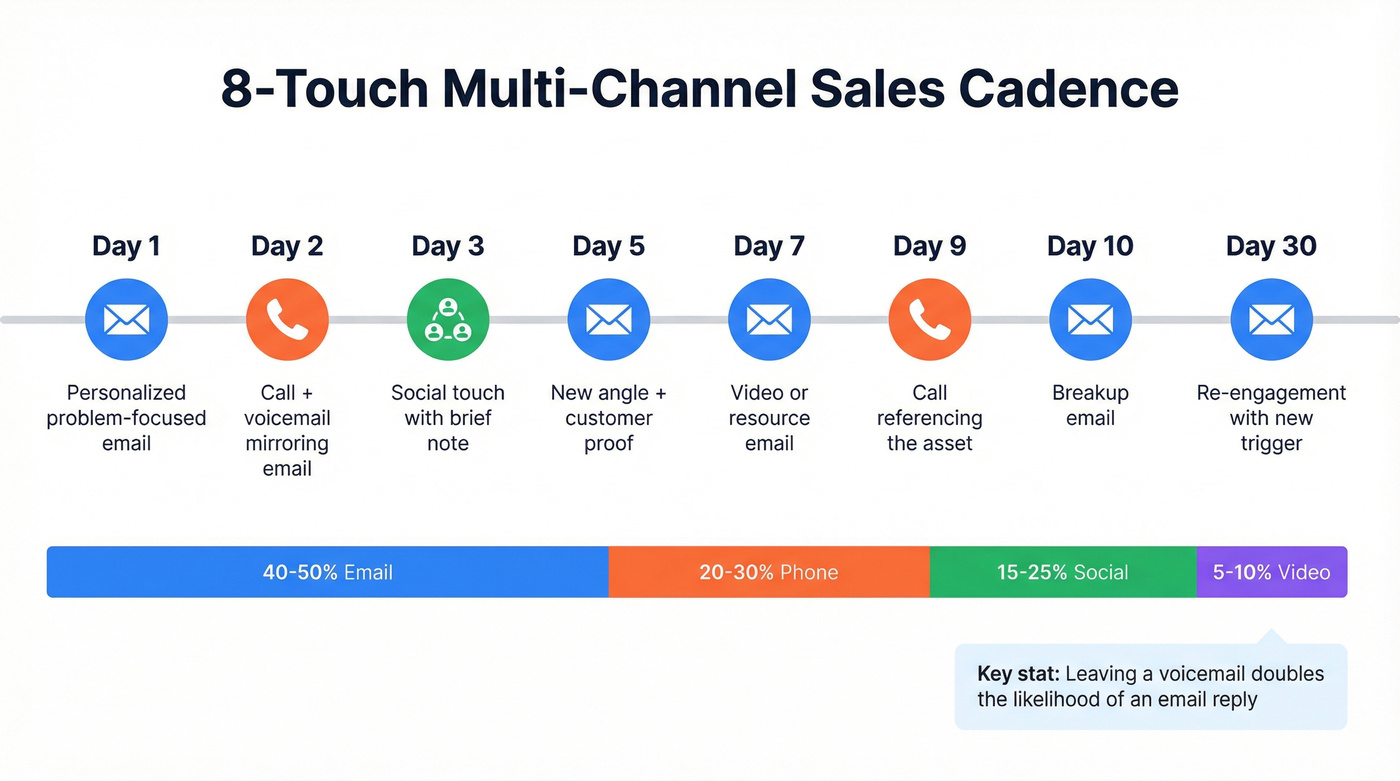
Here's a practical framework blending Outreach and Highspot's day-by-day cadence:
- Day 1 - Personalized, problem-focused email
- Day 2 - Call + voicemail that mirrors the email
- Day 3 - Social touch with a brief note
- Day 5 - Email with a new angle and customer proof
- Day 7 - Email with a video or resource
- Day 9 - Call referencing the asset you sent
- Day 10 - Breakup email
- Day 30 - Re-engagement with a new trigger
Channel distribution should run roughly 40-50% email, 20-30% phone, 15-25% social, and 5-10% video. Leaving a voicemail doubles the likelihood of an email reply. Multi-channel cadences only work when your contact data is accurate - verified emails and direct dials are table stakes.

Top-quartile teams run 0.5% bounce rates. Bottom performers hit 2.7%. The difference isn't luck - it's verified data. Prospeo's 5-step email verification delivers 98% accuracy so your carefully crafted follow-ups actually land in real inboxes.
Stop writing perfect follow-ups to dead email addresses.
10 Follow-Up Emails That Earn Replies
Every template below follows one rule: each touch adds new information. No "bumping this to the top of your inbox." Ask any experienced SDR what their most-replied-to follow-up looks like, and it's never the polished template - it's the short, plain-text message that reads like it was typed in 30 seconds.
Post-Demo
Subject: Next steps from our [Product] walkthrough
Hi [Name], you mentioned [specific pain point] - here's a 2-minute case study showing how [Similar Company] cut [metric] by [X%]. I've attached the mutual action plan. Does Thursday work to loop in [stakeholder]?
No-Response Sequence
These two work as a pair - a reliable chase when prospects go quiet. Send the first 2-3 days after initial outreach, the second 5-7 days later with a completely different angle.
Touch 1 - Subject: Quick thought on [their challenge]
Hi [Name], one thing I didn't mention - [specific data point relevant to their industry]. Worth a 10-minute call this week?
Touch 2 - Subject: [Competitor] just did something interesting
Hi [Name], noticed [Competitor] recently [launched X / expanded into Y]. Teams in your space are responding by [specific action]. Happy to share what we're seeing.
Trigger Event
Subject: Congrats on [funding round / new hire / expansion]
Hi [Name], saw the news about [trigger]. When companies hit this stage, [specific challenge] usually becomes urgent. We helped [Similar Company] navigate that - worth comparing notes?
Proposal Sent
Subject: One thing I'd adjust in the proposal
Hi [Name], after our call I realized the [specific section] understates the impact on [their KPI]. I've updated the ROI section with numbers closer to what [Similar Company] saw. Let me know if the budget range works.
Breakup Email
This is the one template where brevity isn't just preferred - it's the whole point. Three sentences max. The consensus on r/sales is that breakup emails often get the highest reply rate in a sequence, precisely because they remove pressure.
Subject: Should I close your file?
Hi [Name], I've reached out a few times and don't want to be a nuisance. If [original pain point] is still on your radar, I'm one reply away. Either way, here's a [resource] that might help.
Re-Engagement (Day 30)
Subject: Something new since we last spoke
Hi [Name], wanted to share something that wasn't available last time - [new feature / case study / industry report]. Thought you'd find it relevant given [their situation].
Only send this with genuinely new information. If you don't have anything new, skip it.
Post-Call Recap
Subject: Recap: [topic] + next steps
Hi [Name], quick summary: you're dealing with [problem], currently using [current solution], and need [outcome] by [timeline]. Next step: [specific action]. I'll send the [resource] by EOD tomorrow.
Value-Add
Subject: This might save your team 3 hours/week
Hi [Name], came across this [report / benchmark] and thought of your team. [One sentence on why it's relevant.] No strings - just thought it was worth sharing.
Competitor Mention
Subject: How [their company] compares to [competitor's approach]
Hi [Name], we just published a breakdown of how teams in [their industry] handle [challenge] differently than [Competitor]. The short version: [one surprising finding]. Happy to walk through the full analysis.
Bad vs. Better Rewrites
Let's be honest - most follow-up emails people send are just polite ways of saying "please respond." That doesn't work.
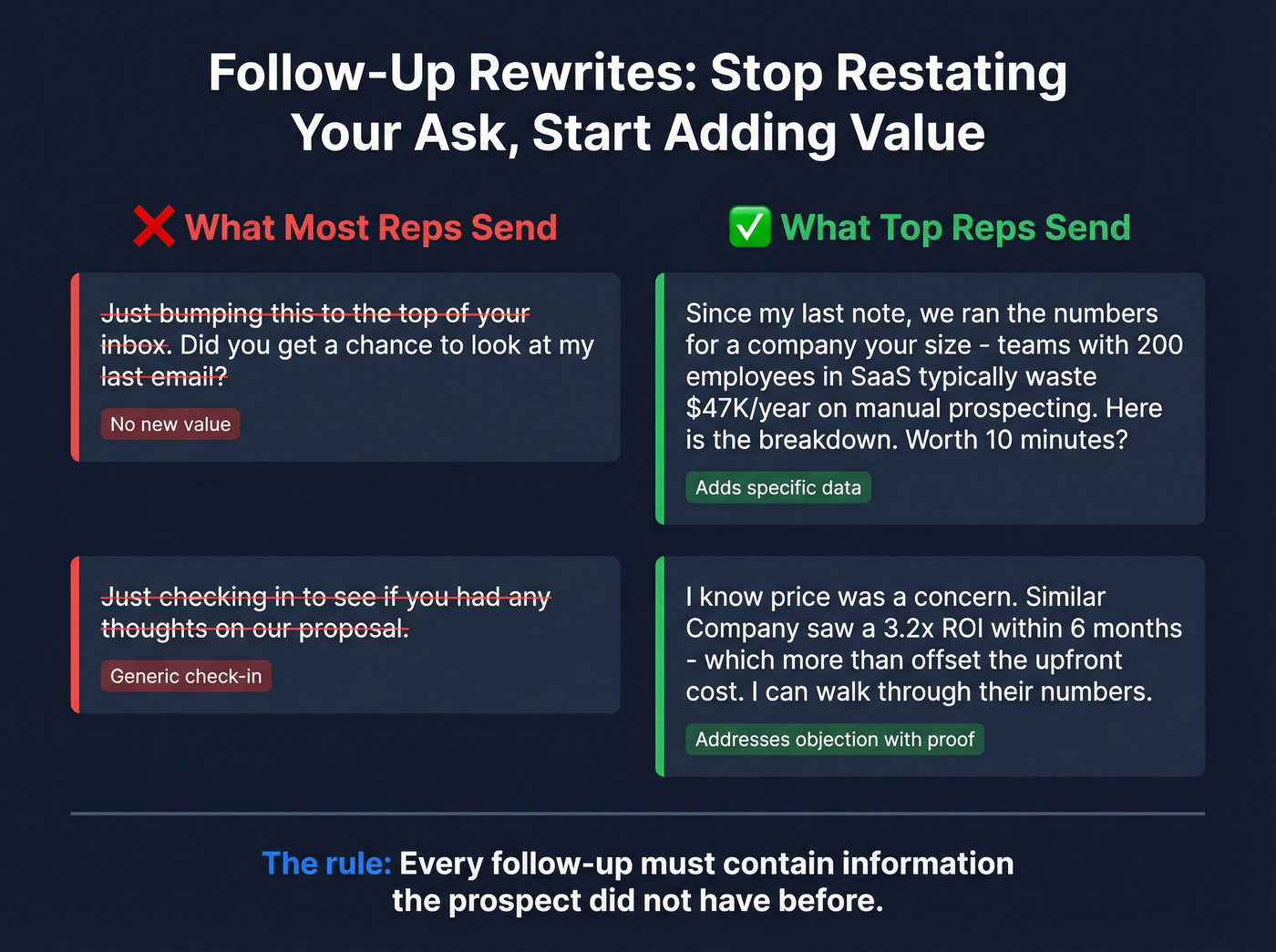
Bad: "Just bumping this to the top of your inbox. Did you get a chance to look at my last email?"
Better: "Since my last note, we ran the numbers for a company your size - teams with [X employees] in [their industry] typically waste $47K/year on [problem]. Here's the breakdown. Worth 10 minutes?"
Bad: "Just checking in to see if you had any thoughts on our proposal."
Better: "I know price was a concern. [Similar Company] saw a 3.2x ROI within 6 months - which more than offset the upfront cost. I can walk through their numbers."
The difference between follow-up emails that convert and the ones that get ignored almost always comes down to whether you're adding new information or just restating your ask.
Subject Lines That Get Opened
SalesHive's research shows personalized subject lines lift open rates by 29-50%. Keep them between 30-50 characters - anything longer gets truncated on mobile. Name the prospect's company or pain point, not "Quick question." Lowercase formatting like "re: our conversation about [topic]" reads like a real reply. Afternoons beat mornings for reply rates, so schedule accordingly.
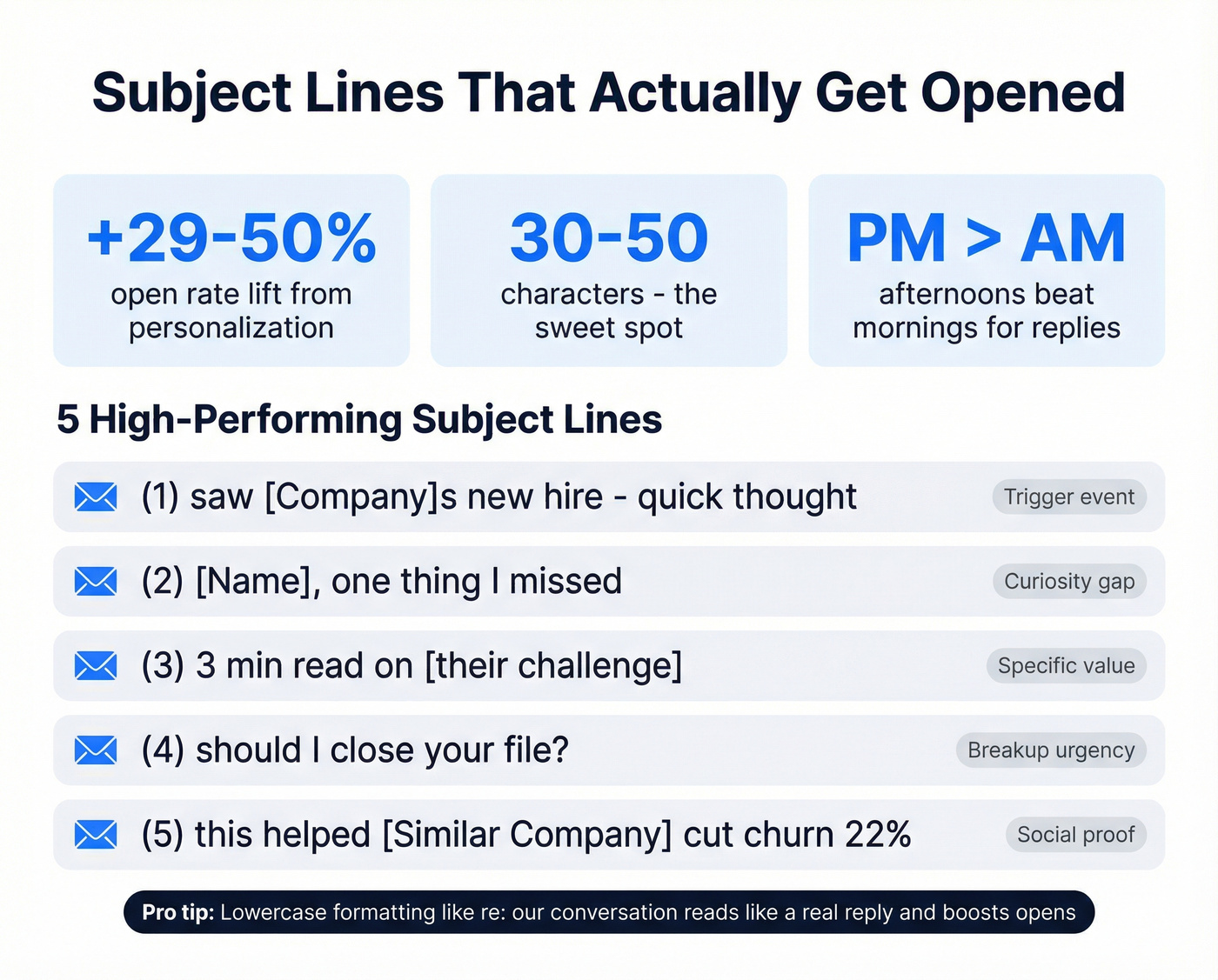
Strong examples:
- "saw [Company]'s new hire - quick thought"
- "[Name], one thing I missed"
- "3 min read on [their challenge]"
- "should I close your file?"
- "this helped [Similar Company] cut churn 22%"
Mistakes That Kill Follow-Ups
Too many emails to the same channel. Four-plus emails in a sequence more than triples spam complaint risk. After 3 emails, pick up the phone or send a social message.
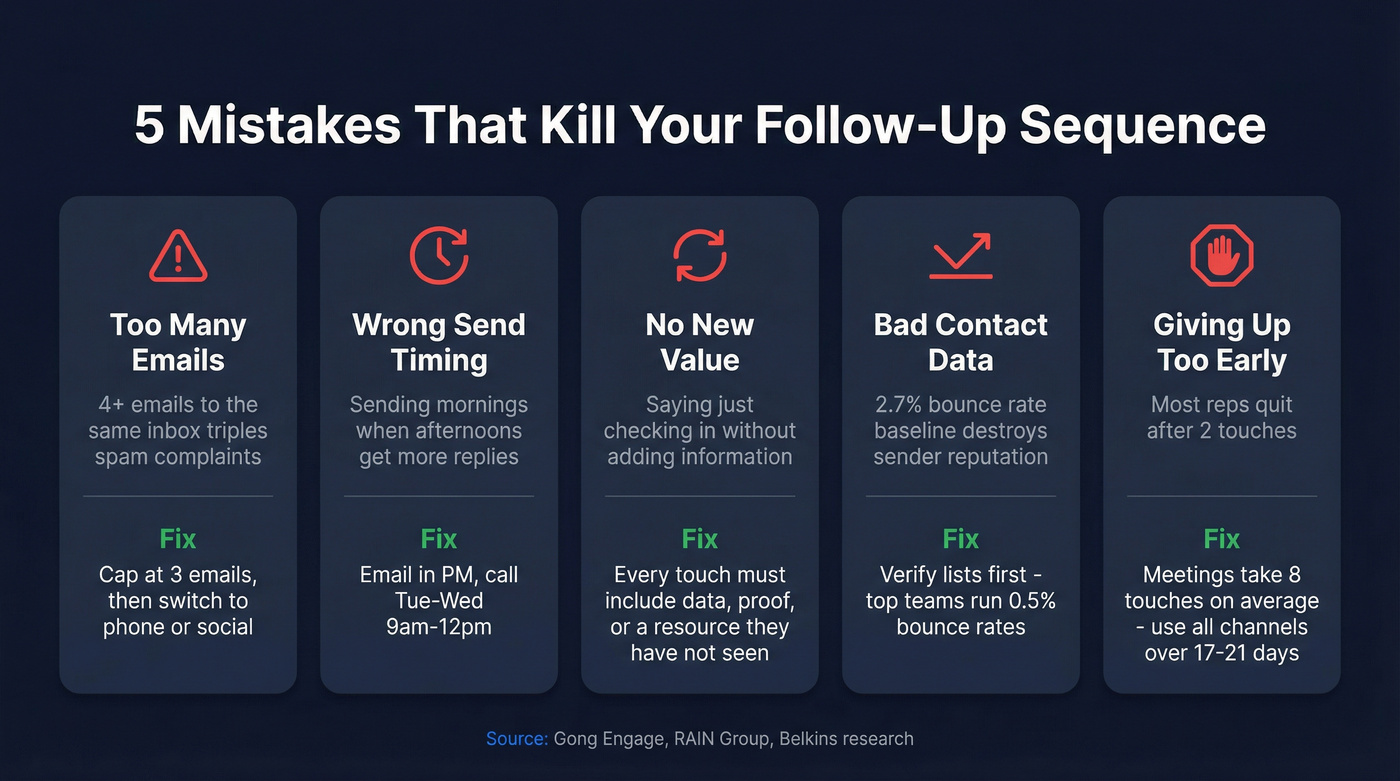
Wrong send timing. Afternoons outperform mornings for email replies. For calls, Tuesday and Wednesday mornings from 9am-12pm have the highest connect rates.
No new value per touch. If you can't articulate what's new in this email versus the last one, don't send it. Consider a checkpoint message at the midpoint of your cadence - a brief note that acknowledges the silence and offers a single, low-friction next step.
Bad contact data. Look, the best template in the world is worthless if it bounces. Top-performing teams run 0.5% bounce rates; the baseline is 2.7%. Before running any sequence, verify your list. We've seen teams using Prospeo's real-time verification cut bounce rates from 35-40% to under 5% - which means their sequences actually reach the inbox instead of getting flagged.
Giving up too early. RAIN Group's research shows meetings require an average of 8 touches. Most reps quit after 2. Use all 8-12 touches across channels before moving on. SMB prospects are actually more forgiving here - Belkins data shows their reply rates rebound from 8% on the second email back to 8.4% on the third, so don't write them off after one silence.
Multi-channel cadences need verified emails and direct dials. Prospeo gives you both - 143M+ verified emails and 125M+ mobile numbers with a 30% pickup rate. Your Day 2 call actually connects when you have the right number.
Every touch in your cadence deserves a real person on the other end.
FAQ
How many follow-up emails should I send?
Three emails max before switching to phone or social. The goal is 8 touches across channels over 17-21 days, not 8 emails to the same inbox. RAIN Group data confirms meetings require roughly 8 multi-channel touches on average.
What's the best time to send a follow-up email?
Afternoons consistently outperform mornings for email reply rates. For cold calls, Tuesday and Wednesday mornings from 9am-12pm have the highest connect rates. Schedule your cadence accordingly.
How do I stop follow-up emails from bouncing?
Verify your contact list before launching any sequence. Top-performing teams maintain under 0.5% bounce rates versus the 2.7% baseline - the gap between those two numbers is the difference between sequences that build pipeline and sequences that burn your domain.
Do sales follow-up templates actually work?
Templates work as frameworks, not scripts. The 10 templates above convert when you customize each touch with your prospect's pain points, industry data, and trigger events. Manual personalized emails earn nearly 2x the reply rate of automated sends - the template gives you structure, but the specifics earn the reply.