Direct Dial: What It Means, Why It Matters, and How to Find the Right Numbers
Your SDR team burned through 200 dials yesterday and connected with six people. Two were wrong numbers. That's not a prospecting problem - it's a data problem. Reps using a direct dial are 147% more likely to reach a decision-maker than those dialing main office lines, and up to 375% more efficient overall.
The short version: a direct dial phone number connects you straight to a specific person, bypassing switchboards and gatekeepers. In 2026, office extensions are increasingly unreliable thanks to remote work - verified mobile numbers are what actually get answered.
What Is a Direct Dial?
In B2B sales, a direct dial is a phone number assigned to a specific person at a company - one that lets you bypass the switchboard, the auto-attendant menu, and the gatekeeper entirely. You dial, it rings on their desk or softphone, and they pick up. It's any device - desk phone, softphone, or mobile - that receives calls on a number routed exclusively to one person.
In telecom, the term refers to Direct Inward Dialing (DID): a PBX/VoIP routing feature where a block of external phone numbers maps to internal extensions via SIP trunking. That's the infrastructure that makes sales-context direct dials possible in the first place.
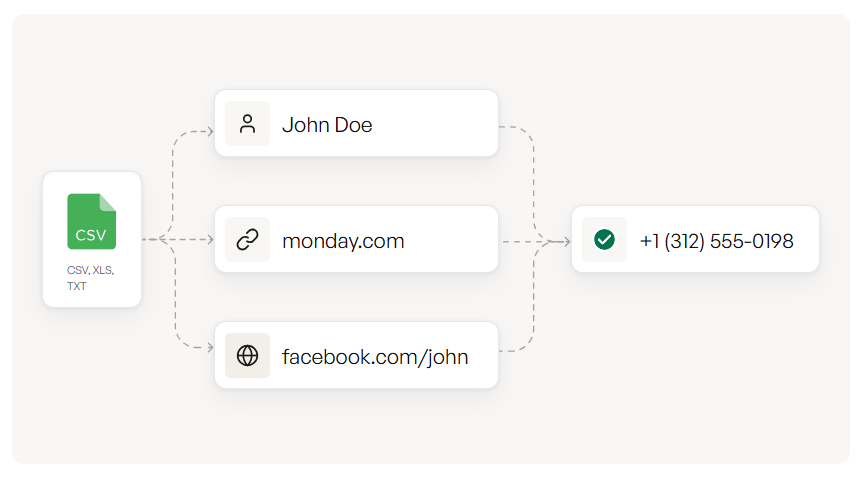
The efficiency difference is measurable. Dialing through a switchboard takes roughly 80 seconds per attempt - navigating menus, waiting on hold, explaining who you're trying to reach. A person-specific line cuts that to about 45 seconds. It takes around 20 dials to connect via switchboard versus 12 using a direct number.
Here's the thing: a number that rings an empty desk in a half-vacant office is worthless. "Direct dial" is a holdover from the office-phone era. What you actually want is a verified number that reaches a human - and in 2026, that usually means a mobile.
Direct Dial vs. Mobile vs. Switchboard
| Type | What It Is | Pros | Cons | Best For |
|---|---|---|---|---|
| Switchboard | Main company line | Always answered | Gatekeepers, hold times, 20+ dials to connect | Last resort |
| Direct Dial | Person-specific office line | Bypasses gatekeeper, ~12 dials to connect | Empty desks in remote/hybrid orgs | In-office prospects |
| Mobile | Personal cell number | Works anywhere, highest pickup rate | Harder to source, compliance considerations | Remote/hybrid prospects |
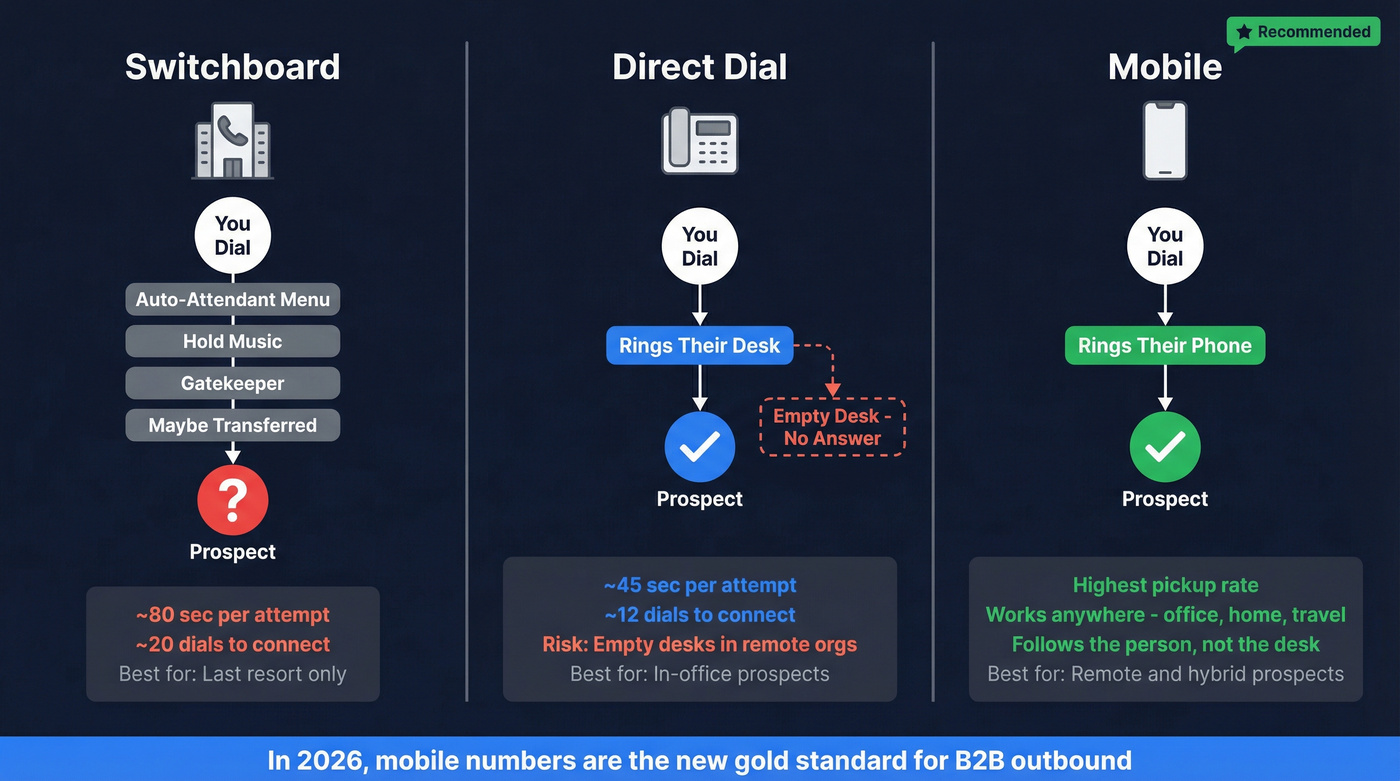
The remote work shift changed the math permanently. Before 2020, a direct dial phone number to someone's office extension was gold. Now, that extension might forward to voicemail on a desk nobody sits at. Mobile numbers are the new standard because they follow the person, not the office.
We've heard the same complaints from SDR teams for years: stale office numbers, wrong-person dials, and thin mobile coverage outside North America. The fix is using multiple data sources with real-time verification. As BetterContact's team puts it bluntly, mobile numbers provide more edge than office extensions in a hybrid world.
You need both in your data stack, but mobile is king.
Why Direct Dials Matter for Sales
The numbers paint a brutal picture of what happens without good phone data.
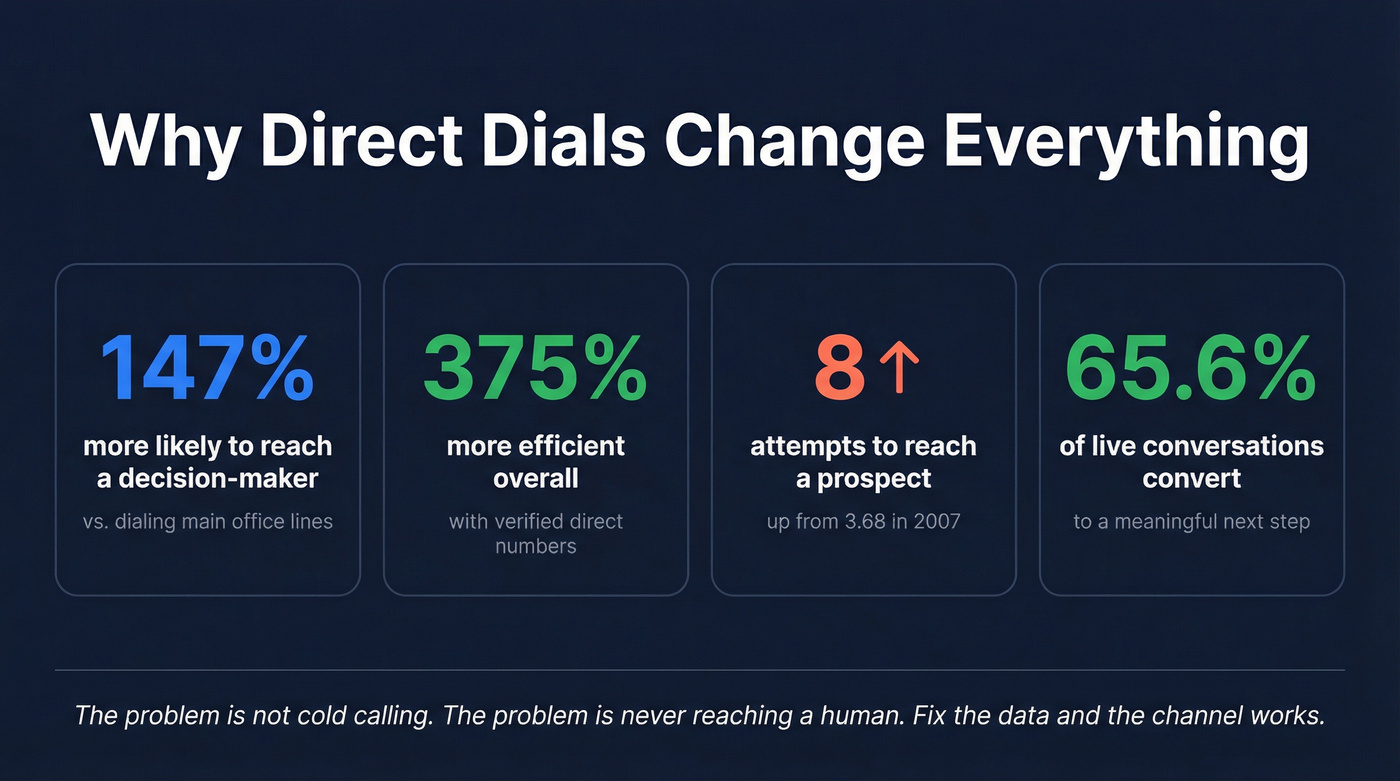
Cold calling success rates sit around 2.3% - and they're dropping. It now takes an average of 8 call attempts to reach a prospect, up from 3.68 in 2007. Only 28% of completed cold calls produce a productive outcome. Reps with verified direct numbers are up to 375% more efficient, and that 147% higher likelihood of reaching a decision-maker compounds across every single dial.
The problem isn't that cold calling doesn't work. Most reps spend 90% of their dial time never reaching a human. Once you actually get someone on the phone, roughly 65.6% of those conversations convert to a meaningful next step. Fix the data, and the channel becomes viable again.
Let's be honest: if your average deal size is under $10k, you probably don't need a $30k ZoomInfo contract. You need 500 verified mobile numbers and a rep who can hold a conversation. The ROI math on expensive data platforms only works when you're closing deals large enough to justify the spend.

Your reps don't have a calling problem - they have a data problem. Prospeo's 125M+ verified mobile numbers refresh every 7 days, not every 6 weeks. At $0.10 per mobile number, you get 30% pickup rates without the $30K contract.
Stop burning dials on empty desks. Get numbers that actually connect.
How to Find Direct Dial Phone Numbers
Six reliable methods, roughly ordered from most scalable to most manual.
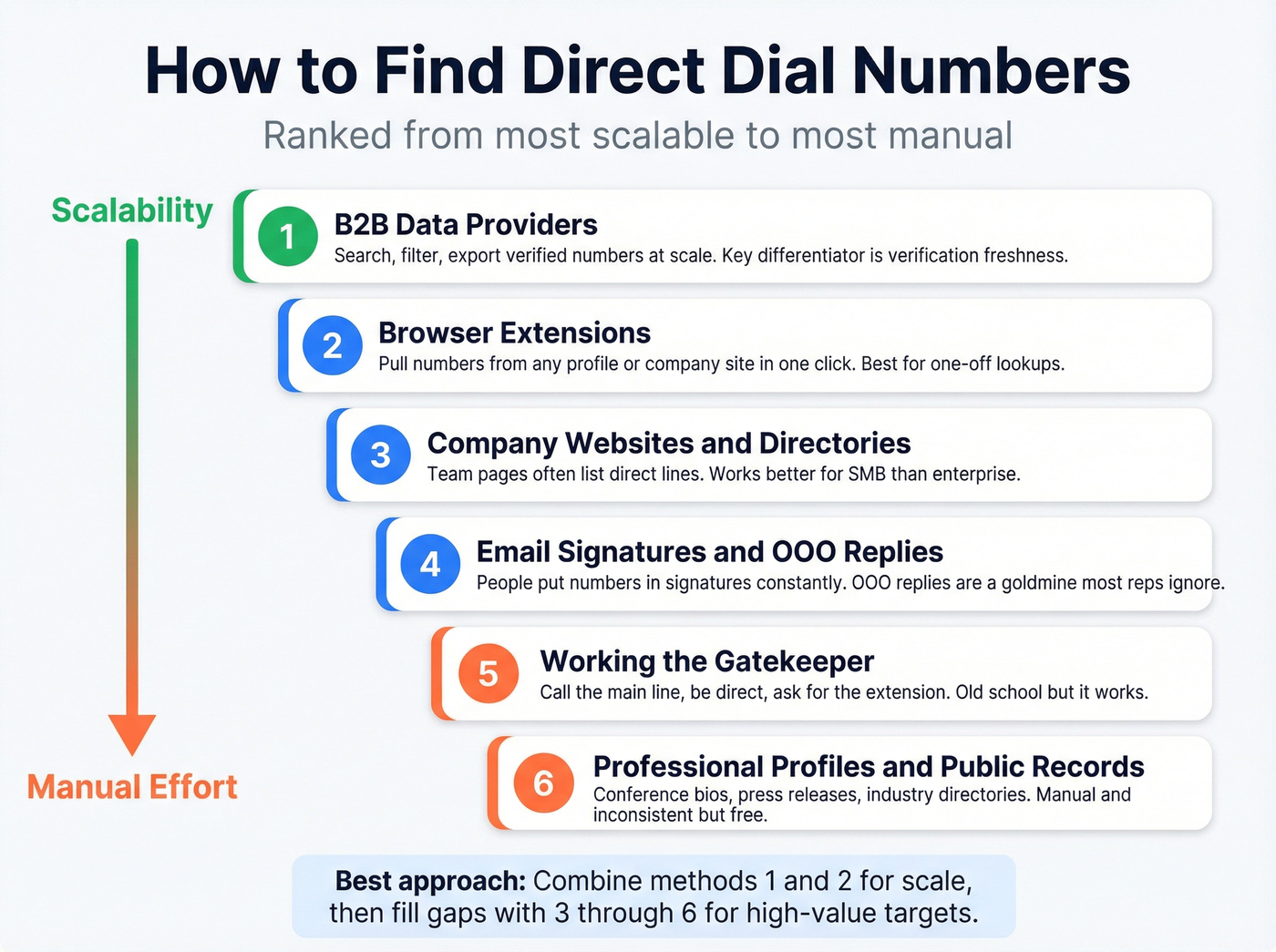
1. B2B data providers. The obvious starting point for any team doing outbound at scale. Providers like Prospeo, Apollo, and Cognism maintain databases of verified numbers you can search, filter, and export. The key differentiator isn't database size - it's verification freshness. A number valid six weeks ago might be disconnected today. Cognism claims teams can reduce dials-to-connect down to 1.55 with the right verified numbers. Even discounted, cutting from 8 attempts to 3-4 is a massive win for pipeline velocity.
2. Browser extensions. Chrome extensions let you pull verified phone numbers and emails from any professional profile or company website in one click - the fastest workflow for one-off lookups or enriching a prospect you're actively researching.
3. Company websites and directories. Smaller companies often publish person-specific lines on their team pages. Works better for SMB prospecting than enterprise. A Fortune 500 company isn't listing their VP of Engineering's number on the website.
4. Email signatures and out-of-office replies. People put their numbers in email signatures constantly. OOO auto-replies sometimes include mobile numbers or alternate contacts - a goldmine most reps ignore entirely.
5. Working the gatekeeper. Old school, but it works. Call the main line, be direct about who you're trying to reach, and ask for their extension. Junior receptionists often just transfer you or give you the number without a second thought. (If you need scripts, see get past the gatekeeper.)
6. Professional profiles and public records. Some professionals list phone numbers in conference speaker bios, press releases, and industry directories. Manual and inconsistent, but free.
The best teams combine methods 1 and 2 for scale, then fill gaps with 3-6 for high-value targets.
Best Tools for Finding Direct Dials in 2026
Here's what's worth your money right now.
Prospeo
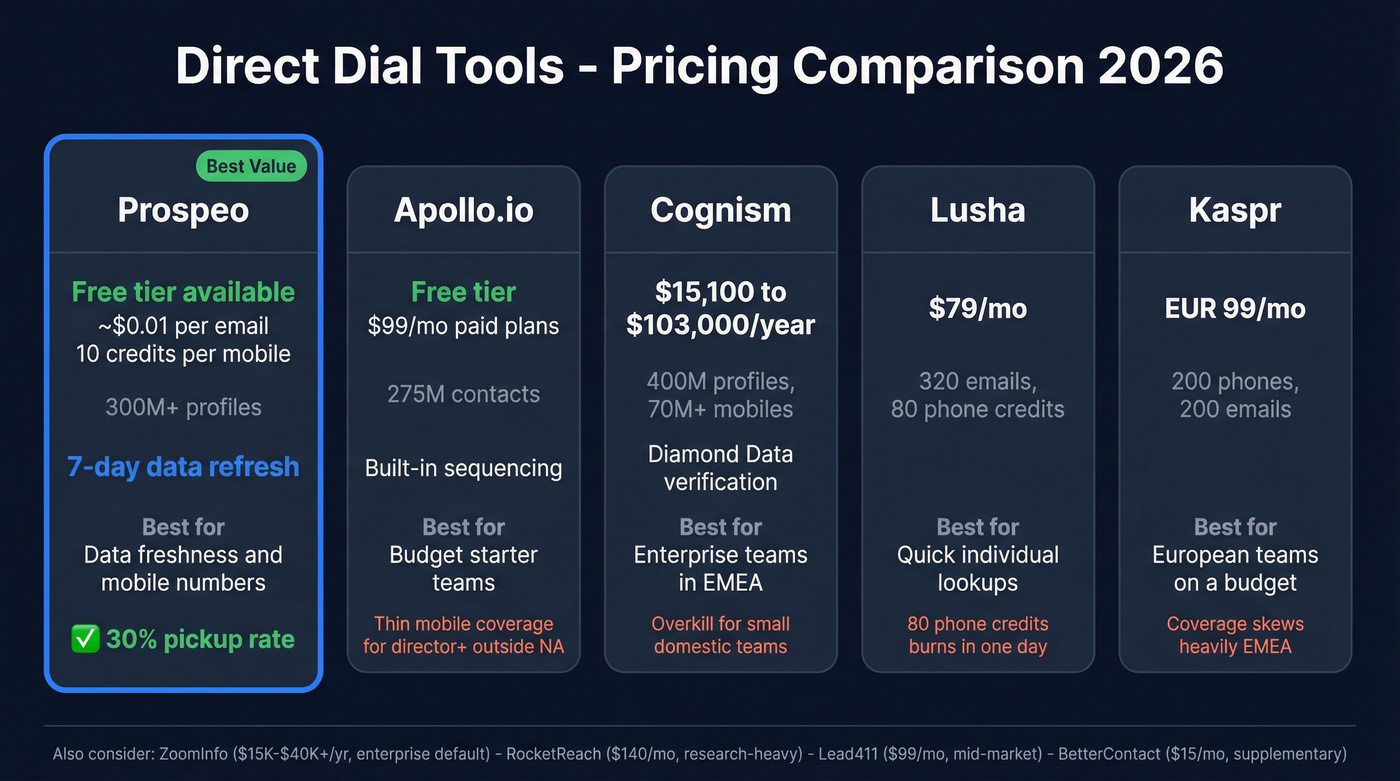
Prospeo's 125M+ verified mobile numbers with a 30% pickup rate across all regions make it the strongest option for teams that care about actually reaching people. The database covers 300M+ professional profiles, and every record refreshes on a 7-day cycle - compared to the 6-week industry average, that's a night-and-day difference in data freshness.
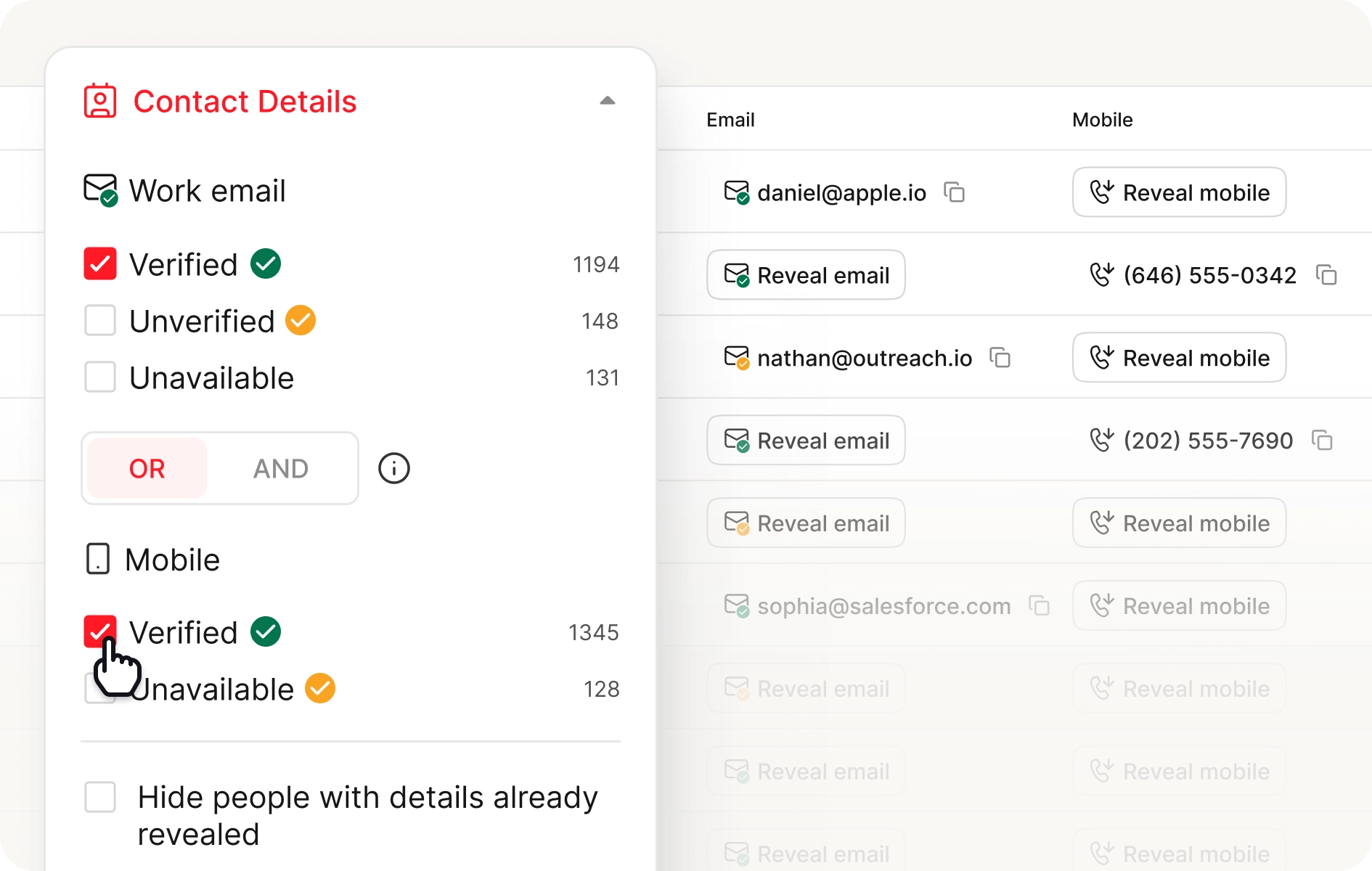
Pricing is straightforward: roughly $0.01 per email, 10 credits per mobile number, and you only pay when a number is found. There's a free tier with 75 emails and 100 Chrome extension credits per month so you can test before committing. No annual contracts, no "talk to sales" gates.
In our experience, the weekly data refresh is what separates Prospeo from the pack. If your current provider refreshes data every 4-6 weeks, you're dialing stale numbers - and stale numbers are the single biggest source of wasted rep time. Teams using Prospeo book 26% more meetings than those on ZoomInfo and 35% more than Apollo users, driven by 98% email accuracy and that weekly refresh keeping numbers current. (If you're diagnosing why lists go stale, start with B2B contact data decay.)
Apollo.io
Apollo is the obvious starting point for SMB teams with limited budget. The free tier gives you access to a 275M-contact database with basic search and limited exports. Paid plans start around $99/mo and scale with higher export limits.
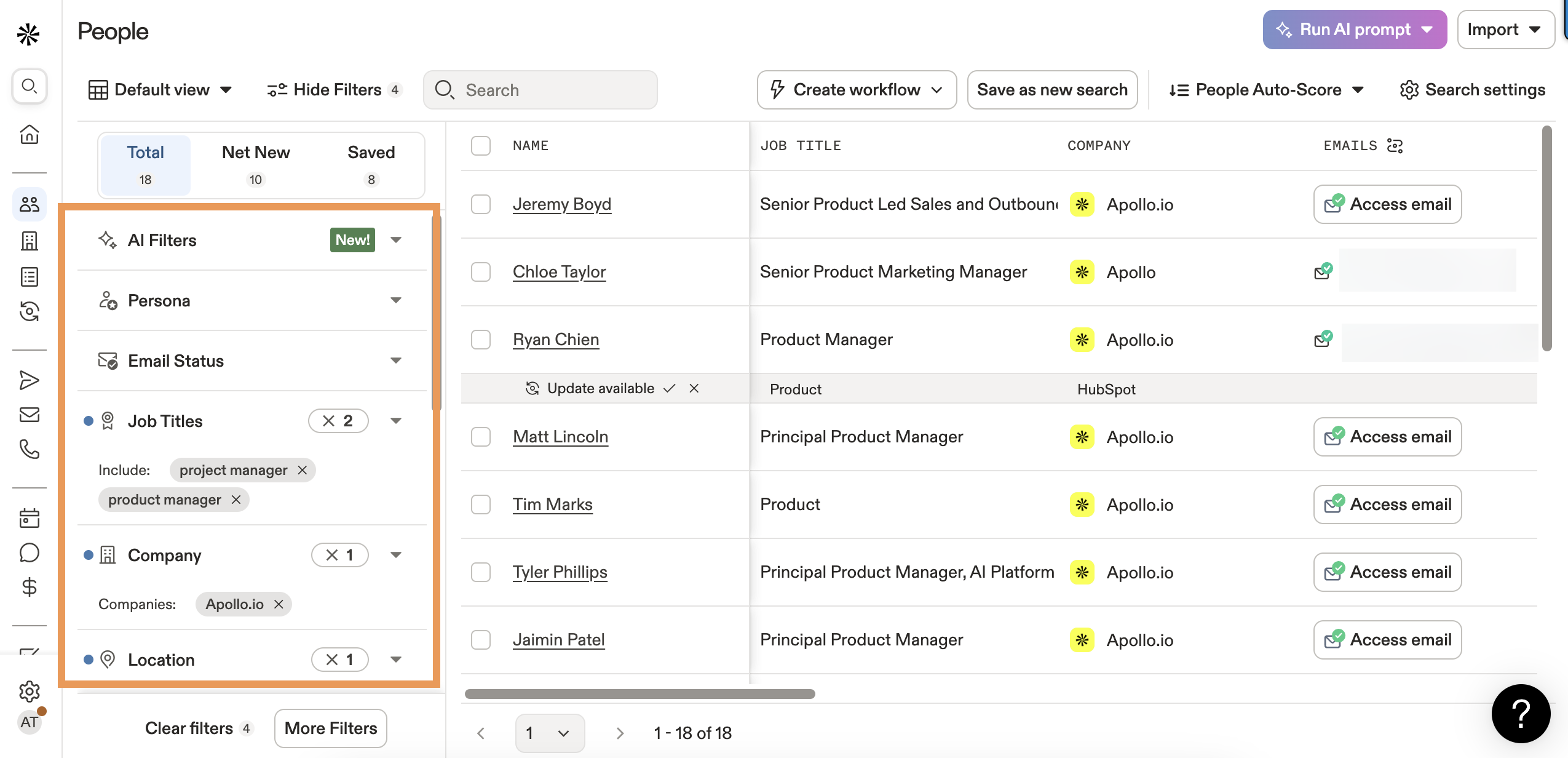
Use this if you're just getting started with outbound and need a free database with built-in sequencing. Skip this if you're scaling past 50 dials a day. We've seen Apollo's mobile coverage run noticeably thinner for director+ roles outside North America, and phone number freshness lags behind dedicated data platforms.
Cognism
Cognism is the go-to for enterprise teams prospecting into EMEA. Their database covers 400M B2B profiles with 70M+ mobile numbers, and their Diamond Data verification process is built for European mobile numbers where compliance matters. Their 2026 cold calling report claims an 11.3% success rate for Cognism users versus the 2.7% industry average - a gap that, even discounted, speaks to the value of verified mobiles.
Pricing runs $15,100-$103,000/year depending on seats and modules. Skip Cognism if you're a sub-20-person team selling domestically. You'll overpay for international coverage you don't need.
Lusha
Use this if you need quick phone lookups for individual prospects and don't mind paying per credit. Lusha's $79/mo plan gets you 320 emails and 80 phone credits.
Skip this if you're doing any kind of volume. Eighty phone credits per month means you'll burn through your allocation in a single day of serious prospecting.
Kaspr
Kaspr is a phone-focused tool at an accessible price point. At around EUR 99/mo for 200 phones and 200 direct emails, it's positioned for European teams that need mobile numbers without the Cognism price tag. Kaspr is strongest for Western European prospecting - US-focused teams should test before committing, as coverage skews heavily toward EMEA.
Other Notable Options
ZoomInfo is the enterprise default at $15,000-$40,000+/year. The database is massive and the workflow tools are deep, but a 10-seat contract with intent data and mobile numbers can run $40-60k/year. The #1 complaint on r/sales? Paying for modules you don't use. RocketReach runs $140/mo for 500 exports - solid for research-heavy roles, not built for high-volume outbound. Lead411 offers $99/mo with unlimited views and 200 exports, a decent mid-market option. BetterContact starts at $15/mo for 200 email credits or 20 phone credits - worth a look as a supplementary source for waterfall enrichment. (If you're building a stack, compare options in sales prospecting platforms.)
Pricing Comparison
| Tool | Starting Price | Phone Credits | Database Size | Best For |
|---|---|---|---|---|
| Prospeo | Free; ~$0.01/email | 10 credits/mobile | 300M+ profiles | Data freshness + mobiles |
| Apollo.io | Free; ~$99/mo paid | Included in exports | 275M contacts | Budget starter teams |
| Cognism | ~$15,100/year | Included in plan | 400M profiles | EMEA enterprise |
| Lusha | $79/mo | 80 phones/mo | Not public | Individual rep lookups |
| Kaspr | ~EUR 99/mo | 200 phones/mo | 500M+ verified records | European SMB teams |
| ZoomInfo | ~$15,000+/year | Included in plan | Massive | Enterprise all-in-one |
How to Use Direct Dials Effectively
Having good numbers is only half the equation.
Time your calls. Tuesday through Thursday, late morning (10-11:30 AM) and late afternoon (3:30-5 PM) in the prospect's time zone consistently outperform other windows. Monday mornings and Friday afternoons are dead zones - we've tested this across dozens of campaigns and the pattern holds every time. (For a full playbook, see outbound calling strategy.)
Build a real cadence. Plan 6-8 touches over 15-20 days, with 3-5 call attempts per prospect. Most conversations happen by the third attempt. If you're giving up after one dial, you're leaving pipeline on the table. Multichannel outreach drives results up to 287% higher than single-channel campaigns. (If you need templates, use a sales cadence.)
Use local presence dialing. This one's non-negotiable. 94% of recipients assume unidentified calls are spam. Prospects answer calls from local area codes 27.5% of the time versus 7% for toll-free numbers - that's a 400% lift just from caller ID. Most power dialers support this natively. (If you're evaluating dialers, start with dynamic dialer.)
Don't waste good data on bad execution. Every stale number you dial is a wasted rep-minute that compounds across your team. Once you connect, 65.6% of conversations convert to a next step. The bottleneck is reaching people, not convincing them. Fix the inputs and the outputs follow. (To audit the root cause, use a data quality scorecard.)
Going from 8 dials-to-connect down to 3-4 isn't magic - it's fresh data. Prospeo verifies 300M+ profiles on a 7-day refresh cycle and delivers mobile numbers with a 30% pickup rate across all regions. That's 3x the industry average.
Cut your dials-to-connect in half starting today.
FAQ
What are direct dials in B2B sales?
A direct dial is a phone number assigned to a specific individual at a company, letting callers reach that person without navigating a switchboard or gatekeeper. These include office extensions routed via DID infrastructure and verified mobile numbers. The goal is the same: connect with a decision-maker on the first ring.
Are direct dials legal for cold calling?
Yes, in most jurisdictions, but compliance rules apply. In the US, scrub against the National Do Not Call Registry and follow TCPA rules on consent and calling hours. In the EU, GDPR requires a legitimate interest basis for B2B calls. Always check DNC lists before dialing.
How many dials does it take to reach a prospect?
The industry average is 8 attempts per prospect. With verified mobile data from platforms like Prospeo or Cognism, teams report reducing this to 2-4 dials per connect. The gap is entirely a data quality problem - stale numbers and wrong-person dials account for most wasted effort.
What's a good connect rate?
A 3-10% live-answer rate is typical across the industry. Verified mobile numbers push this significantly higher. If you're below 3%, your data source is the problem, not your reps' technique.
Should I prioritize mobile numbers over office lines?
Mobile numbers win in a remote and hybrid world. Office extensions increasingly ring empty desks or forward to generic voicemail. Prioritize verified mobiles for any prospect who isn't consistently in-office - you want both in your data stack, but mobile wins every time.