The Remote Prospecting Playbook for 2026
Remote prospecting is how pipeline gets built now. 75% of B2B buyers prefer remote selling over in-person meetings, and [96% of prospects](https://blog.hubspot.com/sales/sales-statistics) research your company before they'll take a call. The reps who hit quota remotely aren't working harder - they're working with better inputs and tighter systems.
Whether you're figuring out how to reach prospects working from home or navigating budget cuts, the fundamentals don't change.
What Separates Reps Who Hit Number
Three things:
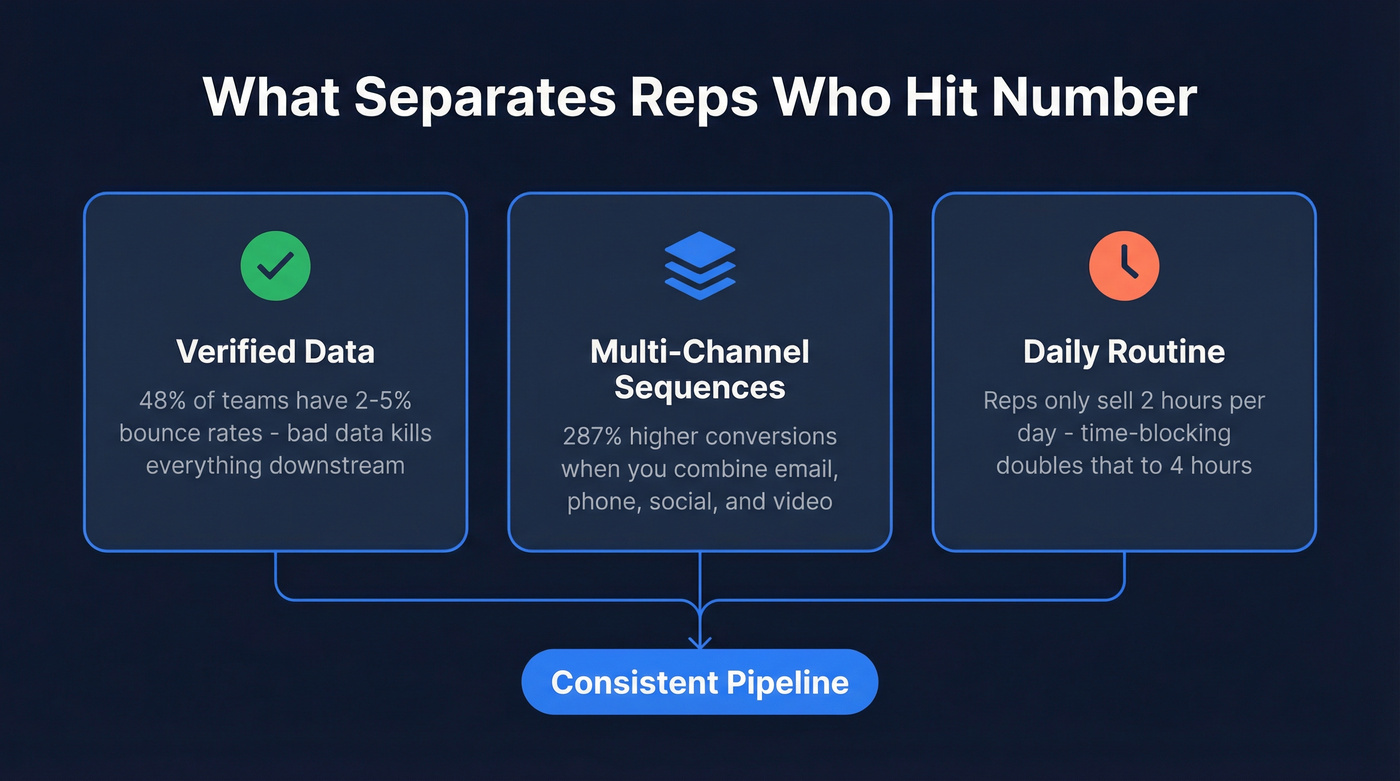
Verified data. Everything downstream - open rates, connect rates, pipeline - depends on whether your emails land and your phone numbers ring. A multi-channel sequence. Cold email alone is declining. 69% of senders say performance dropped year-over-year, so you need email, phone, social, and video working together. A daily routine. Sales reps spend only two hours a day actually selling. Time-blocking fixes this.
Let's break each one down.
Data Quality Is the Foundation
No sequence, no cadence, no AI engagement tool matters if your emails bounce and your phone numbers are disconnected. And the numbers are ugly - 48% of sales teams report bounce rates between 2-5%, and 15% exceed 6%. That's enough to tank your domain reputation in a week.

With a 7-day refresh cycle versus the six-week industry average, you're starting every sequence with contacts that actually exist. At roughly $0.01 per email, bad data costs more than good data ever will.
Target the Right Accounts
Every team with a data tool can build an ICP list. The separator is timing - knowing which accounts are ready to buy right now. Signal-based sellers close 9x faster, and contacting funded companies within 48 hours yields 400% higher conversion.
The framework: fit + timing + reachability. Fit is your ICP criteria. Timing comes from trigger events - funding rounds, leadership changes, tech stack shifts, hiring surges. Reachability is whether you can actually get to the decision-maker through inbox saturation, spam filters, unknown-number screening, and bad phone data.
Define 3-5 trigger events that align to your solution and set recency rules so reps aren't chasing stale signals. Intent data makes a powerful filter here, but treat it as a filter, not a verdict. Push intent-flagged accounts into a review bucket and look for a confirmatory signal: a pricing page visit, a repeat session, a job posting that matches your use case.
Here's the thing: [80% of the buying decision](https://www.demandgenreport.com/industry-news/80-of-b2b-buyers-initiate-first-contact-once-theyre-70-through-their-buying-journey/48394/) happens before a seller enters the picture. If you're not using intent and trigger signals to time your outreach, you're showing up after the decision is already half-made.
Build Your Multi-Channel Sequence
Single-channel outreach is dying. Combining email, social, and phone improves conversions by 287% compared to email alone. Here's a 14-day template we've used across multiple campaigns:
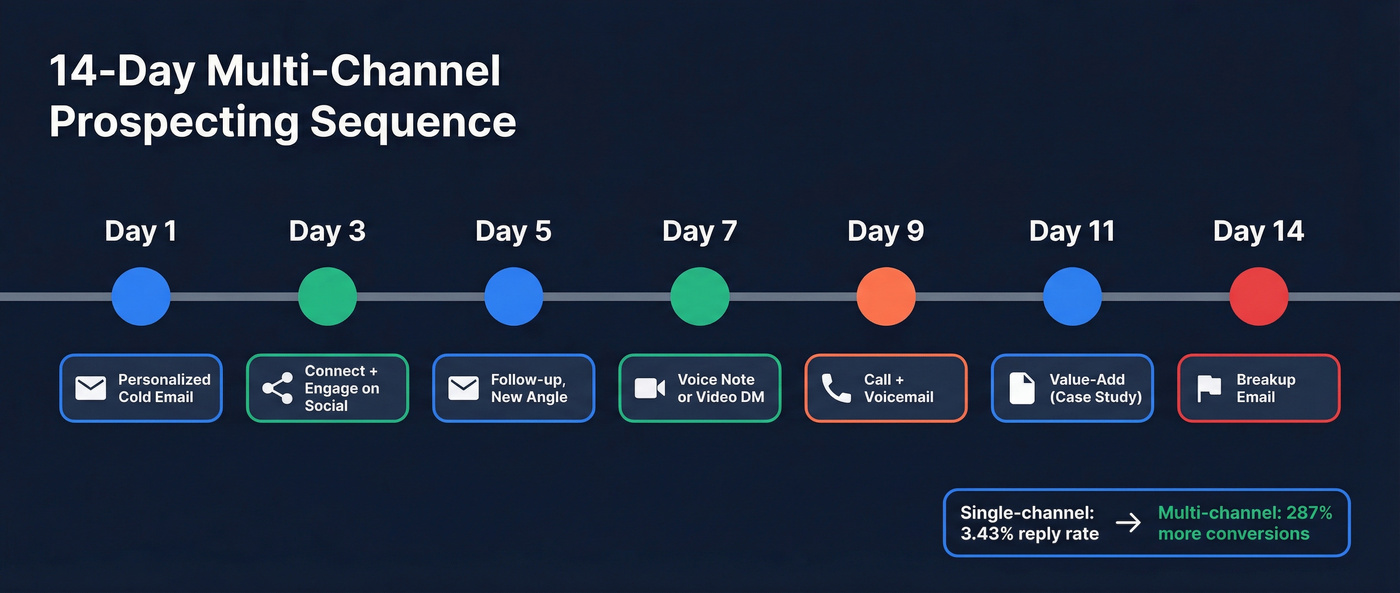
| Day | Channel | Action |
|---|---|---|
| 1 | Personalized cold email | |
| 3 | Social | Connect + engage with content |
| 5 | Follow-up with new angle | |
| 7 | Social | Voice note or video DM |
| 9 | Phone | Call + voicemail |
| 11 | Value-add (case study, insight) | |
| 14 | Breakup email |
The average cold email reply rate sits at 3.43%, which means the other channels need to do real work. Each touch should add context, not repeat the ask. And that breakup email on day 14? It's not a guilt trip. It's a pattern interrupt that often gets the highest reply rate of the entire sequence.

Your multi-channel sequence is only as good as the data feeding it. Prospeo delivers 98% email accuracy and 125M+ verified mobile numbers on a 7-day refresh cycle - so every touchpoint in your remote prospecting cadence actually reaches a real person.
Stop burning sequences on dead contacts. Verify before you send.
Engaging Prospects Virtually
Video in email outreach drives +16% open rates, +26% replies, and 4x higher click-through rates compared to text-only emails. When you're connecting with prospects working from home, video adds a human element that text can't replicate.
Keep it practical:
- Under 90 seconds. 60%+ of viewers finish videos under 60 seconds.
- Use a GIF thumbnail instead of a static image - it lifts click-through significantly.
- Lead with the insight, not the intro. Save your name and company for the end. Open with what you noticed about their business.
For the call itself, use the SNCD framework: open with Support (acknowledge their situation), surface the Need, drive to a Conclusion together, then back it with Data. It keeps remote conversations structured without sounding scripted. The consensus on r/sales is that reps who listen more than they pitch on video calls close at dramatically higher rates - and our experience backs that up.
Your Tool Stack
Teams buy too many tools when they need a tight workflow. A virtual selling stack has three layers:
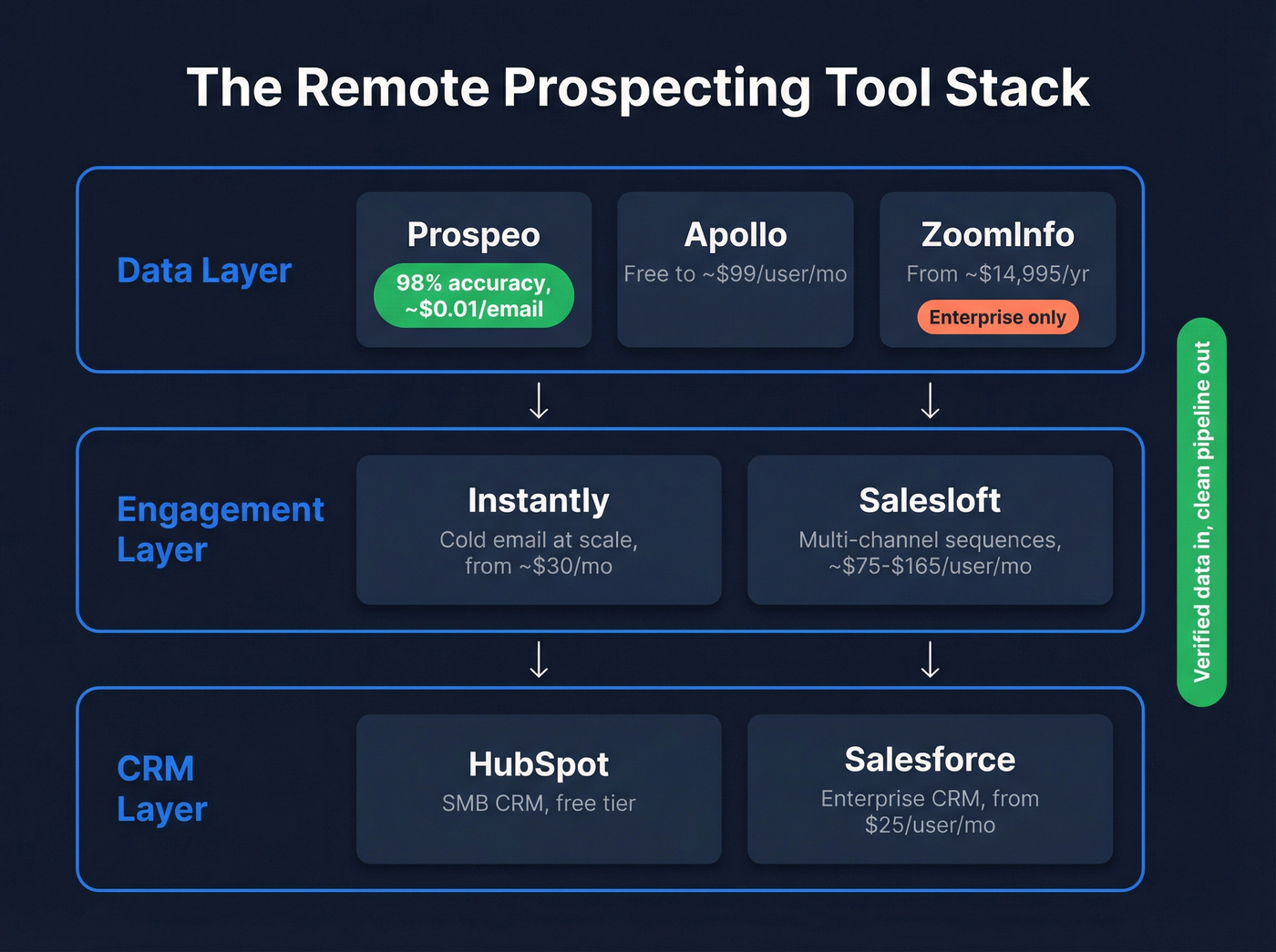
| Layer | Tool | Role | Pricing |
|---|---|---|---|
| Data | Prospeo | Verified email/mobile + intent | ~$0.01/email, free tier |
| Data | Apollo | Prospecting + sequencing | Free-~$99/user/mo |
| Data | ZoomInfo | Enterprise data + intent | From ~$14,995/yr |
| Engagement | Instantly | Cold email at scale | From ~$30/mo |
| Engagement | Salesloft | Multi-channel sequences | ~$75-$165/user/mo |
| CRM | HubSpot | SMB CRM | Free tier available |
| CRM | Salesforce | Enterprise CRM | From $25/user/mo |
Skip ZoomInfo if you're a team under 20 reps - the contract minimums don't make sense at that scale, and you'll get better email accuracy from Prospeo at a fraction of the cost. A 98% accuracy rate at the data layer means your engagement tools actually work: sequences land, your domain stays clean, and reps spend time selling instead of troubleshooting bounces.
The Daily Routine That Works
35-50% of sales go to the first responder. Speed matters, but speed without structure is chaos. Aim for 50-80 calls and 50-100 personalized emails per day.
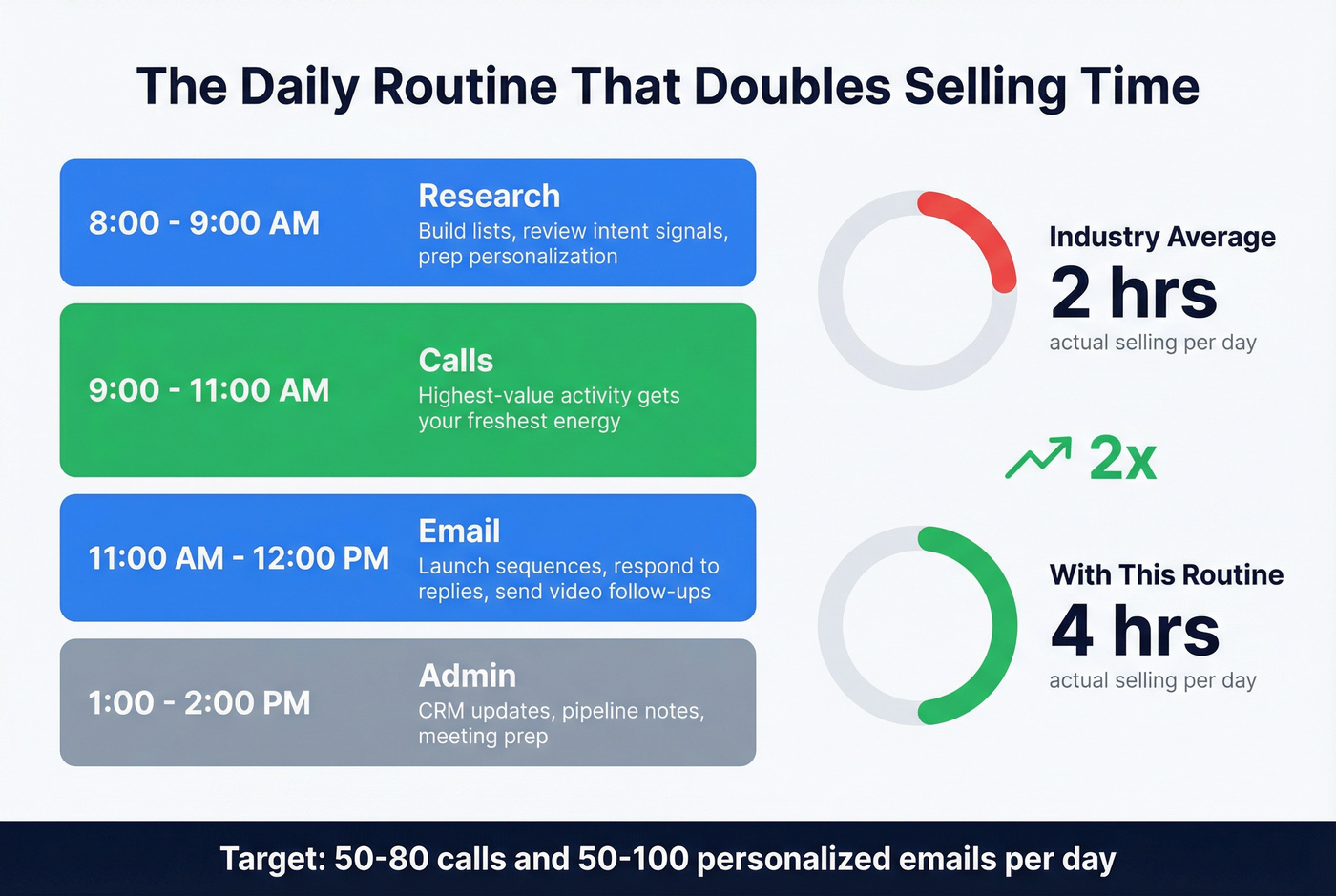
- 8:00-9:00 - Research. Build lists, review intent signals, prep personalization.
- 9:00-11:00 - Calls. Highest-value activity gets your freshest energy.
- 11:00-12:00 - Email. Launch sequences, respond to replies, send video follow-ups.
- 1:00-2:00 - Admin. CRM updates, pipeline notes, meeting prep.
Two hours of actual selling per day is the industry average. This routine pushes you to four.
Mistakes That Kill Your Pipeline
Sending to unverified lists. One bad send tanks your domain reputation for weeks. Verify before you sequence. Always. (If you're seeing bounces, start with an email validity check and fix the root cause.)
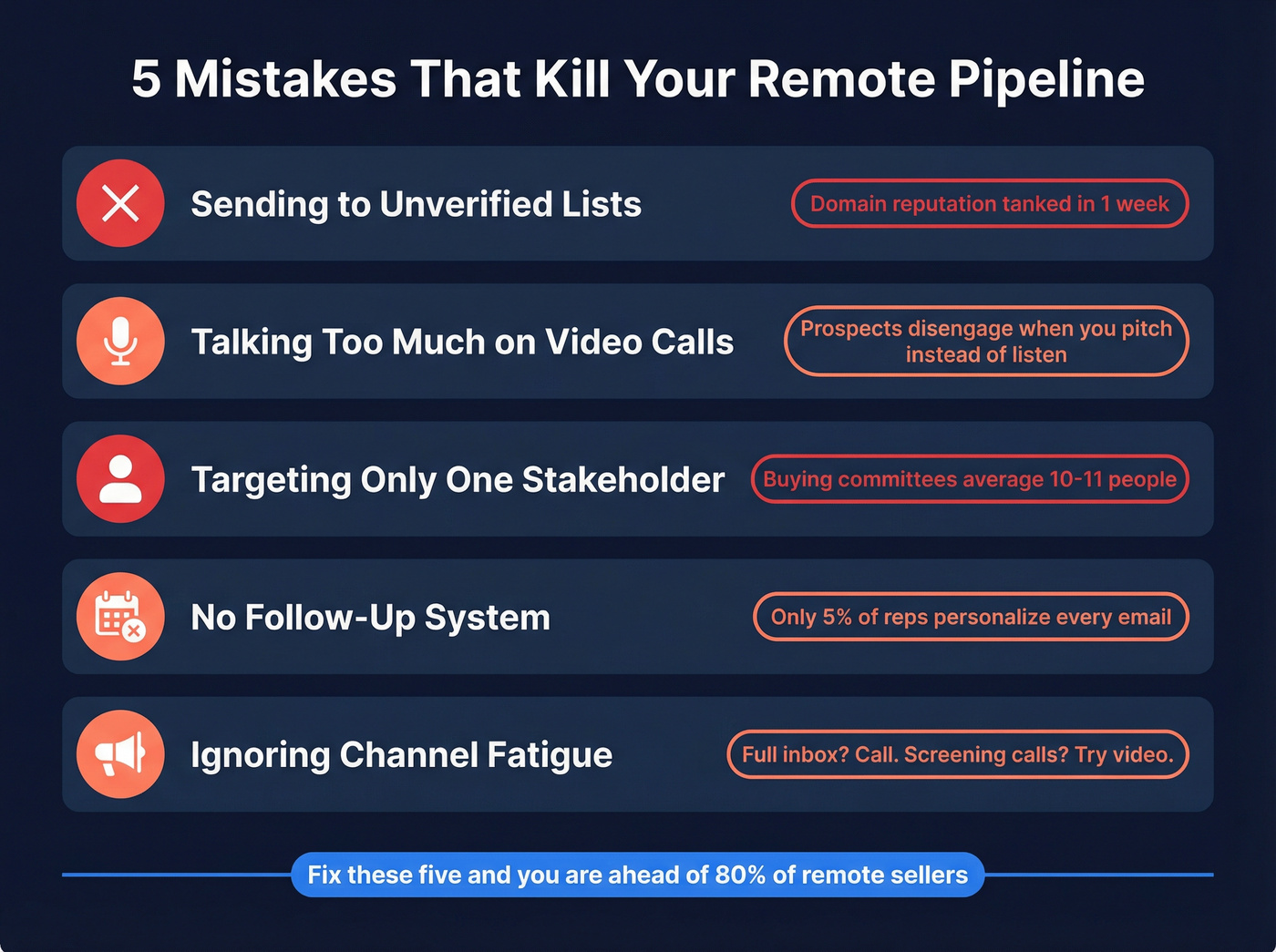
Talking too much on video calls. The temptation to fill silence over Zoom is real. I've caught myself doing it mid-call and had to physically lean back in my chair. Listen more than you pitch.
Targeting one stakeholder. Buying committees run 10-11 people on average. Multi-thread or lose to the rep who does.
No follow-up system. Only 5% of cold email senders personalize every email individually. Build a system or accept mediocre reply rates. Use a repeatable prospect follow up cadence.
Ignoring channel fatigue. If their inbox is full, call. If they screen calls, try video. Read the signals. During any major disruption, people are overwhelmed - meeting them on the right channel at the right moment matters even more.
Remote reps already lose most of their day to non-selling tasks. Bad data makes it worse. At ~$0.01 per email with 30+ filters for intent, technographics, and job changes, Prospeo gives you the fit + timing + reachability trifecta without the enterprise price tag.
Double your selling time by eliminating the data cleanup entirely.
FAQ
What's the difference between remote prospecting and cold calling?
Remote prospecting is a multi-channel approach combining email, phone, social, and video to engage buyers without meeting in person. Cold calling is one tactic within that system. Effective virtual sellers layer 3-4 channels across a 14-day sequence to hit the 287% conversion lift that multi-channel delivers.
How many touches does it take to book a meeting remotely?
Most sequences need 7-14 touches across multiple channels over two to three weeks. Multi-channel outreach outperforms single-channel by 287%, so spreading touches across email, phone, and social beats doubling down on one channel every time.
What's the most important tool for remote prospecting?
A verified data source. Without accurate emails and phone numbers, every engagement tool and sequence is wasted spend. For teams under $200/month in budget, Prospeo's free tier includes 75 credits - enough to test whether better data actually moves your numbers before committing.
How do you prospect remotely during major disruptions?
Lead with relevance - acknowledge the situation in your opener, lean on digital channels since in-person meetings disappear, and tighten signal-based targeting so you only reach accounts with active buying intent. Reps who adapted their approach during past disruptions saw stronger reply rates than those who kept running pre-crisis playbooks unchanged.