

C-Level Executives: Roles, Salaries, and How the C-Suite Is Changing in 2026
The average S&P 500 CEO earned $18.9 million in 2024 - a 7% raise while most of their employees got 3%. That single stat tells you everything about the leverage, accountability, and controversy packed into the c-level executive title. Whether you're building a career toward the corner office, selling into it, or just trying to understand how corporate power actually works, the C-suite is worth understanding deeply.
The Short Version
"C-level" means "Chief." Any executive whose title starts with "Chief" - CEO, CFO, CTO, CMO - sits at the top of the corporate hierarchy. VPs, directors, and managers don't qualify.
The core roles are CEO (strategy and vision), COO (daily operations), CFO (financial planning), CTO (technology), CMO (marketing and brand), CHRO (people and talent), and CIO (IT systems).
Compensation is staggering at the top. The average S&P 500 CEO earned $18.9M in total comp in 2024, creating a 285-to-1 CEO-to-worker pay ratio. Equity-based awards now make up over 65% of total executive compensation packages at Fortune 500 companies.
The C-suite is expanding fast. The number of Chief AI Officers has tripled in five years. Half of companies now have four or more C-level tech roles. Chief Sustainability Officer, Chief Revenue Officer, and Chief Ethics Officer are becoming standard.
What Is a C-Level Executive?
The "C" stands for "Chief." It's the highest-ranking officer in a specific functional domain - the person who owns the final decision and reports directly to the CEO or, in the CEO's case, to the board of directors. The meaning is straightforward: these are the chiefs who hold ultimate accountability for their area of the business.
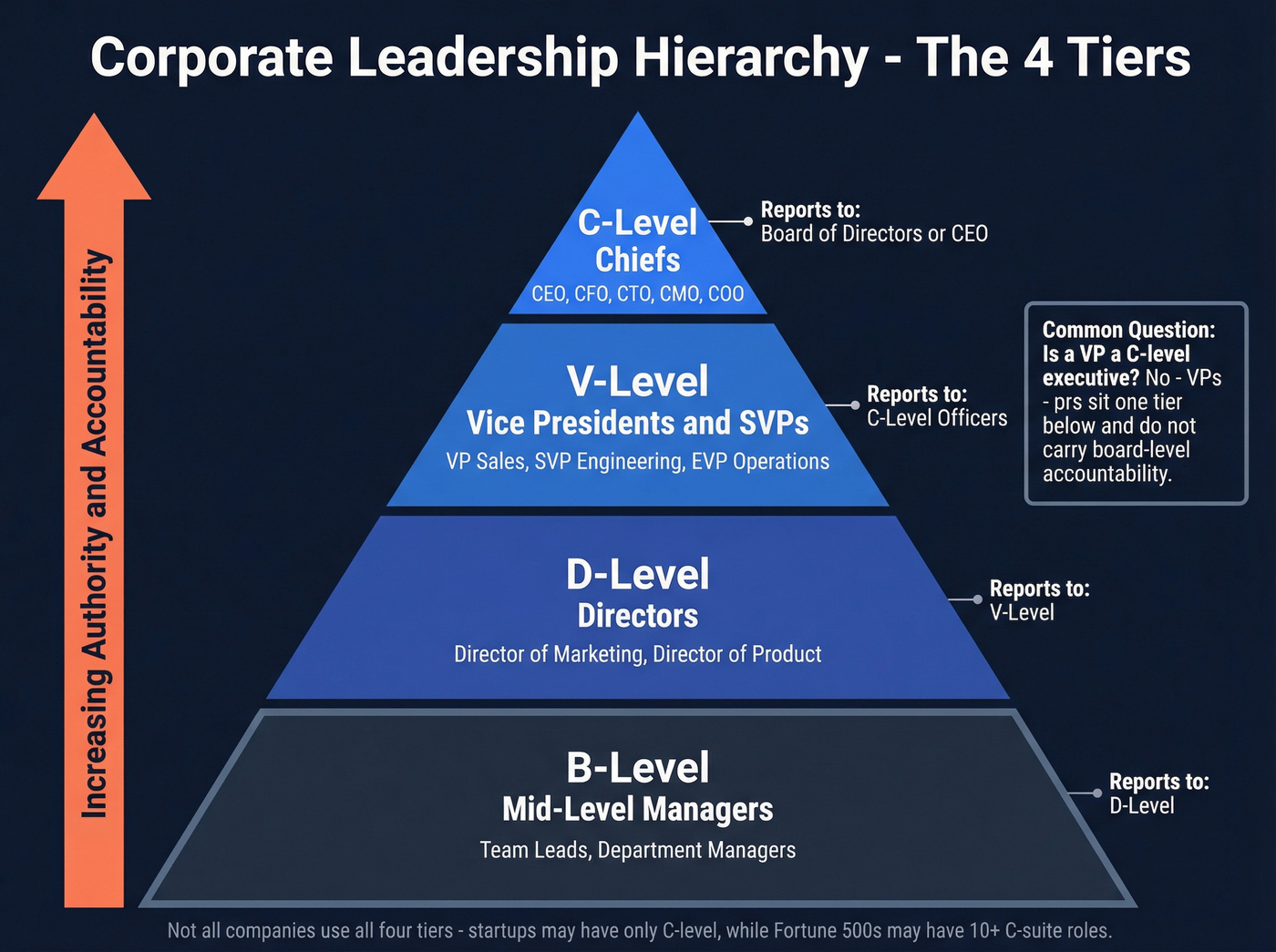
A common framework breaks corporate leadership into four tiers: C-level (Chiefs), V-level (VPs and SVPs), D-level (Directors), and B-level (mid-level managers). This hierarchy answers a question we hear constantly: Is a VP a C-level executive? No. VPs sit one tier below. They report to C-level officers and execute within their domain, but they don't carry the "Chief" designation or the board-level accountability that comes with it.
Not every company uses all four tiers cleanly. Startups might have a CEO and CTO with no VPs underneath. A Fortune 500 might have 10+ C-suite roles with dozens of SVPs below them. But the principle holds: the C-suite is the top of the pyramid.
Core C-Suite Roles and Responsibilities
| Role | Reports To | Primary Ownership | Typical Background |
|---|---|---|---|
| CEO | Board of Directors | Strategy, vision, culture | Operations, finance, founder |
| COO | CEO | Daily operations, execution | Operations, consulting |
| CFO | CEO | Financial planning, risk | Finance, accounting, banking |
| CTO | CEO | Technology strategy, product tech | Engineering, product |
| CMO | CEO | Brand, demand gen, market position | Marketing, growth |
| CHRO | CEO | Talent, culture, org design | HR, org psychology |
| CIO | CEO | IT systems, data infrastructure | IT, systems engineering |
| CLO | CEO | Legal, compliance, governance | Law, regulatory affairs |
| CISO | CEO or CIO | Cybersecurity, data protection | InfoSec, risk management |
CEO, COO, and CFO
These three form the executive core. The CEO sets the mission and long-term direction, makes the highest-stakes decisions, and serves as the company's external face. The COO translates that vision into execution - owning day-to-day operations, internal processes, and cross-team coordination. The CFO owns financial planning, reporting, compliance, and risk, evaluating whether the CEO's strategy is financially viable.
The hierarchy between COO and CFO isn't fixed. Indeed's comparison framework identifies two common models. In operations-first companies, the chain runs CEO to COO to CFO, with the COO as the clear #2. In finance-first organizations - common in banking, insurance, and PE-backed companies - it's CEO to CFO to COO, with the CFO holding more strategic authority. Knowing which model a company uses tells you a lot about where power actually sits.
CTO, CMO, CHRO, and CIO
The CTO owns technology strategy - not just the tech stack, but how technology creates competitive advantage. In enterprises, the CTO builds technology customers use; the CIO manages the technology employees use. In smaller organizations these roles merge, but in any company above a few hundred employees, the distinction matters. In tech-first companies, the CTO often carries more influence than the COO.
The CMO owns brand, demand generation, and market positioning. The CHRO has evolved from an administrative role into a strategic one - talent acquisition, retention, org design, and culture all sit here, and boards are paying attention because talent strategy is business strategy. The CISO, meanwhile, has become non-negotiable. Cybersecurity leadership now demands a seat at the executive table, full stop.
Emerging C-Suite Titles in 2026
The C-suite is getting crowded. Titles that didn't exist five years ago now appear in Fortune 500 boardrooms, and the expansion isn't slowing down.
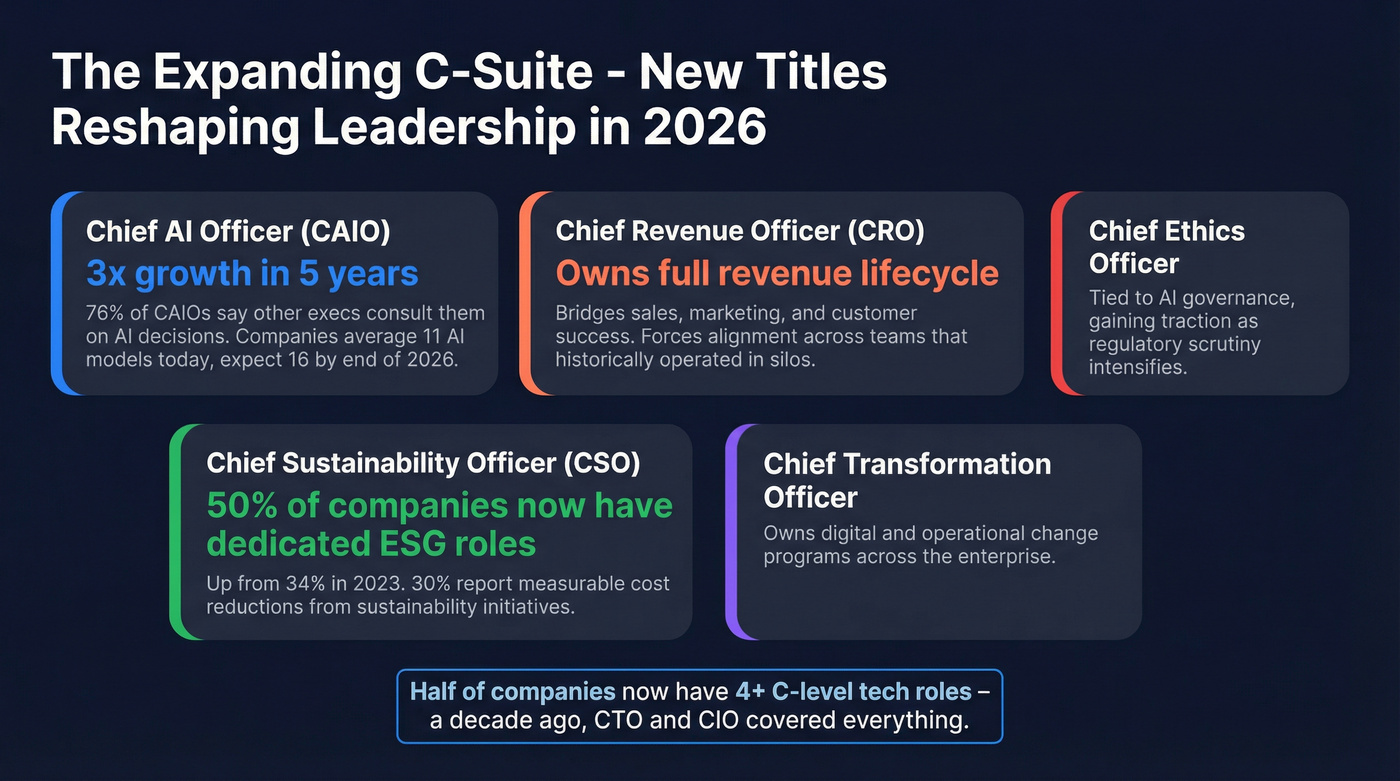
Chief AI Officer (CAIO) is one of the fastest-growing titles. The number of CAIOs has tripled in the past five years, and 76% of CAIOs say other executives consult them on AI-related decisions. Companies are using an average of 11 AI models today and expect to deploy 16 by the end of 2026. That's not a trend. That's a structural shift in how organizations think about technology leadership.
Chief Sustainability Officer (CSO) has gone from a nice-to-have to a board mandate. 50% of companies are now creating dedicated ESG/sustainability roles - up from 34% in 2023. The ROI is real: 30% report measurable cost reductions from sustainability initiatives, up from 12% in 2023.
Chief Revenue Officer (CRO) has emerged as the connective tissue between sales, marketing, and customer success. As go-to-market motions become more complex and product-led growth blurs traditional functional lines, the CRO owns the full revenue lifecycle from pipeline generation through expansion and renewal. In our experience talking to sales leaders, this is one of the most impactful additions to the modern C-suite because it forces alignment across teams that historically operated in silos.
Chief Transformation Officer and Chief Ethics Officer round out the emerging tier. The transformation role typically owns digital and operational change programs, while the ethics role - increasingly tied to AI governance - is gaining traction as regulatory scrutiny intensifies.
Deloitte's latest tech executive survey found that half of companies now have four or more C-level tech roles. A decade ago, CTO and CIO covered the entire technology leadership surface.

Reaching C-level executives starts with accurate contact data. Prospeo gives you verified emails and direct dials for 300M+ professionals - including the CEOs, CFOs, and CROs you're trying to reach. 98% email accuracy means your outreach actually lands.
Skip the gatekeepers. Connect directly with the C-suite.
C-Level Executive Salary Breakdown
Let's talk money.
| Role | Total Comp Range | Notes |
|---|---|---|
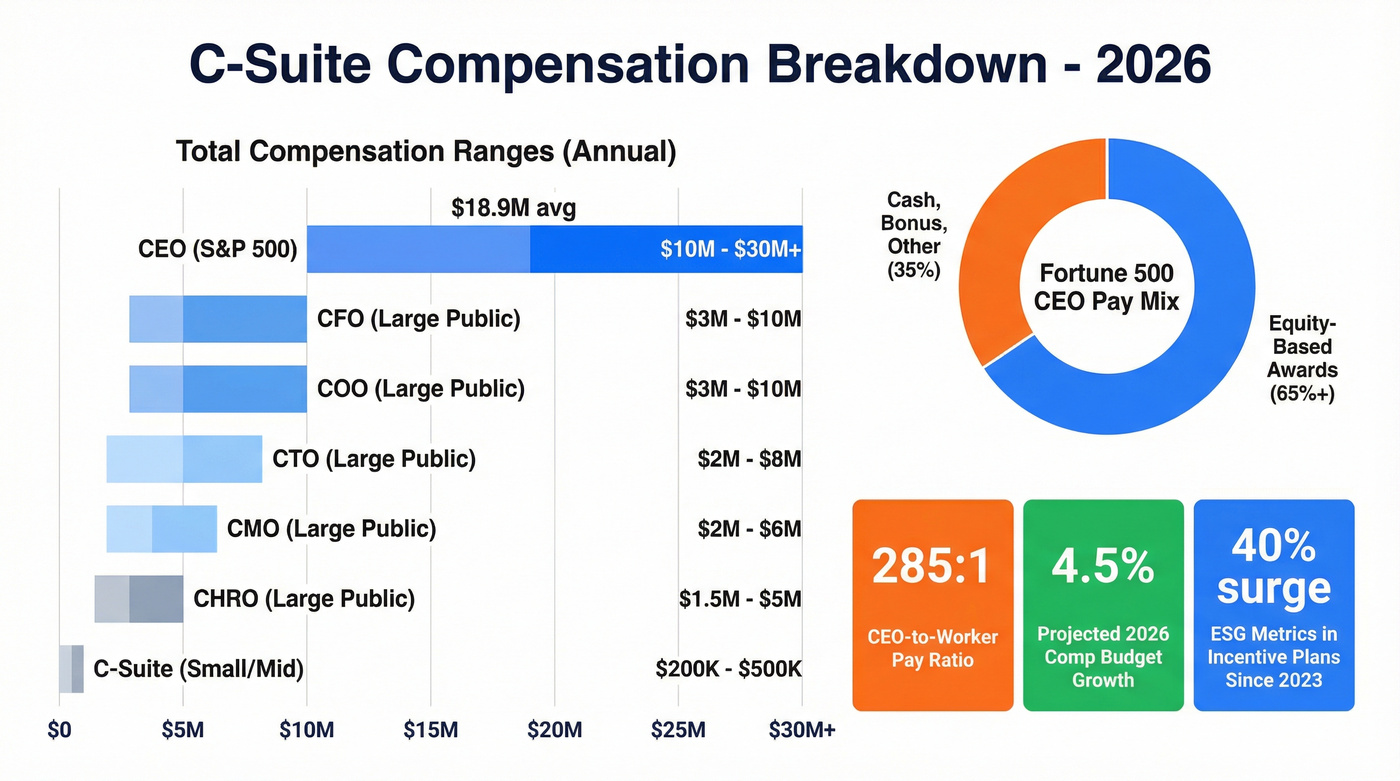
| CEO (S&P 500) | $10M-$30M+ | Avg $18.9M in 2024; 65%+ equity |
| CEO (mid-market) | $300K-$2M | Higher cash share, less equity |
| CFO (large public) | $3M-$10M | ~40-60% of CEO comp |
| COO (large public) | $3M-$10M | Varies heavily by industry |
| CTO (large public) | $2M-$8M | Higher in tech-first companies |
| CMO (large public) | $2M-$6M | Varies heavily by industry |
| CHRO (large public) | $1.5M-$5M | Increasingly strategic at board level |
| C-suite (small/mid) | $200K-$500K | Cash-heavy packages |
The headline number: S&P 500 CEOs averaged $18.9M in total compensation in 2024, up 7% year-over-year. The CEO-to-worker pay ratio hit 285-to-1. Whether that justifies the gap is a separate debate, but the market has clearly priced in the strategic leverage and accountability these roles carry - a chief executive's decisions affect thousands of employees, billions in market cap, and entire industry trajectories.
How that pay breaks down matters more than the headline number. Equity-based awards now constitute over 65% of total executive compensation packages at Fortune 500 companies. Most C-suite wealth is tied to stock performance, not salary, which means it's paper money until a liquidity event. For mid-market and private companies, the mix flips: cash represents a larger share, but total comp is dramatically lower.
Two trends we're watching for 2026: ESG metrics in incentive plans have surged 40% since 2023 among leading US corporations, and projected executive compensation budget growth sits at 4.5%.
C-Suite Demographics and Succession
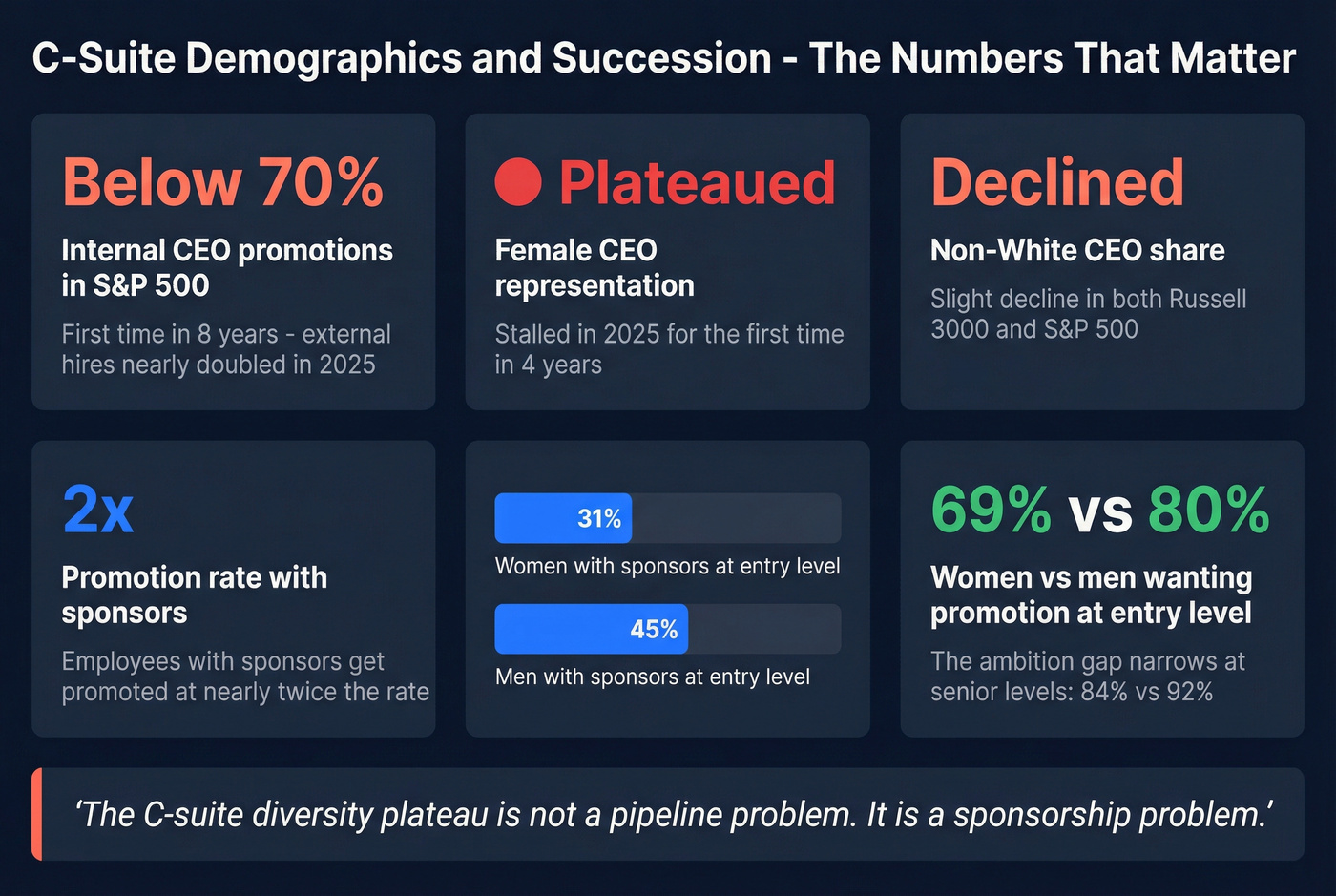
Here's a scenario that's becoming more common: you're a VP who just got passed over for the COO promotion, and the company hired externally. You're not alone. In the S&P 500, external hires nearly doubled in 2025, pushing internal promotions below 70% for the first time in eight years. Departing CEO tenure rebounded after a trough in 2024, but the message is clear - boards are increasingly looking outside for fresh leadership.
The typical C-suite officer is in their late 40s to mid-50s, though tech companies skew younger. It's not uncommon to see CTOs and CPOs in their late 30s at high-growth startups.
The diversity picture is more sobering. Female CEO representation plateaued in 2025 for the first time in four years, and the share of non-White CEOs declined slightly in both the Russell 3000 and S&P 500. Let's be honest: the C-suite diversity plateau isn't a pipeline problem. It's a sponsorship problem.
McKinsey's Women in the Workplace 2025 report makes this concrete. At entry level, 69% of women want a promotion versus 80% of men. At senior levels, the gap narrows but persists: 84% versus 92%. More critically, only 31% of entry-level women report having sponsors compared to 45% of men. Employees with sponsors get promoted at nearly twice the rate of those without. The ambition is there. The sponsorship infrastructure isn't.
How to Become a C-Level Executive
There are roughly 313,900 chief executives in the US. Getting into that group requires a combination of credentials, experience, and strategic positioning that most career advice articles gloss over.
On education: 46% of chief executives hold a master's degree, 32% hold a bachelor's, and 5% hold an associate degree. An MBA is helpful but not required - that 32% bachelor's figure should push back against the narrative that you need a graduate degree to reach the top.
The World Economic Forum's 2026 leadership analysis argues that C-suite success is shifting from functional optimization to enterprise-level sense-making under uncertainty. The two universal skills: curiosity and a nuanced understanding of performance across functions. CFOs need deeper customer understanding. CTOs need cross-org input. The walls between functions are dissolving.
On executive forums and Reddit threads about career progression, the most common advice from sitting C-suite leaders boils down to one thing: own a number before you try to own a title. The data backs that up. Here are the three highest-leverage career moves for aspiring senior leaders:
- Own a P&L. Nothing signals executive readiness like full accountability for revenue and cost. Lateral moves into GM or business unit leadership roles matter more than vertical promotions within a single function.
- Get a sponsor, not a mentor. Mentors give advice. Sponsors put their reputation on the line to advocate for your promotion. The McKinsey data is unambiguous - sponsorship doubles your promotion rate.
- Lead a cross-functional initiative. The C-suite requires managing across boundaries, not just within your domain. A transformation project, a new market entry, or an M&A integration demonstrates the enterprise thinking boards look for.
One contrarian take worth considering: the C-suite is simultaneously expanding and becoming less important. More companies are adding Chief titles, but real power is shifting to cross-functional leadership teams. The title matters less than the decision rights you actually hold. Skip the title obsession and focus on influence.

How to Reach C-Level Executives
Everything above is useful context if you're building a career. But if you're in sales, recruiting, or business development, you have a more immediate problem: how do you actually get in front of these people?
C-suite officers are the hardest contacts to reach. They have gatekeepers, overflowing inboxes, and a low tolerance for generic outreach. The data quality problem compounds this - the industry average data refresh cycle is about six weeks, and executives change roles more frequently than the data can keep up. We've seen sales teams try to book meetings with CFOs only to discover half the email addresses in their CRM bounce.
Personalization and relevance are table stakes. But they're worthless if the email never arrives. Prospeo covers 300M+ professional profiles with 98% email accuracy and refreshes data every 7 days, which is critical when targeting executives who change roles frequently. The Chrome extension pulls verified contact data from any company website or professional profile in one click, and you can filter by title, seniority, company size, and buyer intent across 30+ dimensions.
If your outreach to the C-suite is bouncing above 5%, the problem isn't your messaging. It's your data.
The C-suite is expanding fast - CAIOs, CROs, CSOs - and each new title is a new buyer to reach. Prospeo's 30+ search filters let you target executives by title, intent signals, company size, and tech stack. At $0.01 per verified email, reaching decision-makers costs less than a cup of coffee.
Find every chief in your target accounts before your competitors do.
FAQ
Is a VP a C-level executive?
No. VPs sit one tier below the C-suite and report to chief officers like the CEO, CFO, or CTO. Even Senior VPs and Executive VPs aren't C-level unless their title includes "Chief." The distinction carries real weight in board-level accountability and decision authority.
What's the difference between C-suite and executive team?
The C-suite is a subset of the broader executive team. The executive team may include SVPs, division presidents, and general managers who hold significant authority but don't carry a "Chief" title. All C-suite members are executives, but not all executives are C-suite.
How many C-level executives does a typical company have?
Fortune 500 companies typically have 7-12 C-level roles, and that number is growing. Startups may have just 2-4. Half of companies now have four or more C-level tech roles alone, per Deloitte's latest survey.
What's the highest C-level position?
The CEO. All other C-suite members report to the CEO, who in turn reports to the board of directors. In some structures, the Chairman of the Board sits above the CEO, but that's a board governance role, not an operating executive position.
How do you find direct contact info for C-level executives?
Use a verified B2B data platform to find direct emails and phone numbers. Look for 98%+ email accuracy and weekly data refreshes - executives change roles often, and stale data means bounced emails and wasted outreach. Filtering by title, seniority, and buyer intent helps you reach the right person at the right time.