Intent-Driven Sales Prospecting: The Practitioner's Guide for 2026
Your VP of Sales bought a $40K intent subscription six months ago. The dashboard looks impressive - surge scores, topic clusters, account-level heatmaps. And your SDRs are still cold-calling the same static list they built in January.
This isn't a hypothetical. It's the default outcome for most intent-driven sales prospecting programs, because roughly two-thirds of teams struggle to turn intent data into action. The gap isn't the data. It's the workflow between signal and outreach.
The Short Version
Intent data tells you which accounts are researching your category right now - but most teams fail to act on signals fast enough. You need three things: a signal capture method, a scoring model (we'll give you one below), and verified contact data to reach the right person within 24 hours.
Skip the $100K ABM platform if you're starting out. First-party signals plus a contact enrichment tool gets you 80% of the value at a fraction of the cost.
What Is Intent-Based Prospecting?
Traditional prospecting starts with a list. You filter by title, industry, headcount, maybe technographics. Then you blast sequences and hope timing works out. Intent-based prospecting flips this - instead of guessing who might be ready to buy, you identify accounts already researching your category and prioritize outreach to them.
The shift matters because roughly 67% of the buyer's journey now happens digitally before a prospect ever talks to sales. Buyers review about 11 pieces of content and conduct about 12 online searches before visiting a brand's website, according to Forrester research. By the time they fill out your demo form, they've already evaluated your competitors, read comparison posts, and formed an opinion. Prospecting with intent signals lets you enter that conversation while it's happening - not after the decision is half-made.
Why Signal-Based Outreach Works
The average B2B salesperson spends just 28% of their week actually selling. Intent data ensures that limited selling time goes to accounts already in-market - and the performance gap is massive.
Signal-personalized outreach pulls 15-25% reply rates versus the 3-5% cold email average. Intent-based campaigns see 220% higher click-through rates. That's not a marginal improvement. It's a different sport entirely.
Here's what surprised us: only about 25% of B2B companies actually use intent data, even though 81% of sales teams have implemented or are experimenting with AI in their prospecting workflows. That gap is your opening. Teams prospecting with buying signals report 43% larger deal sizes, and accounts with three or more active signals convert at 2.4x the rate of single-signal accounts.
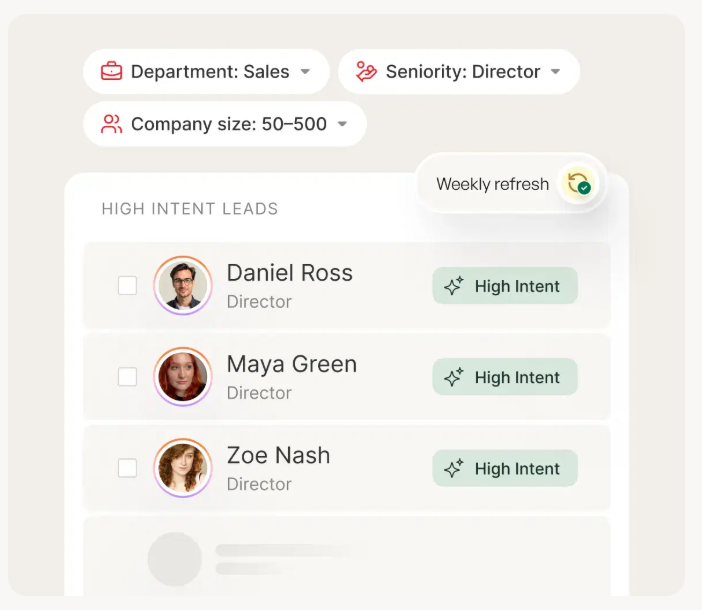
The global AI-in-sales market is projected to hit $8.3B by 2028 at a 23.8% CAGR. This isn't a trend. It's the new baseline for how outbound works.
Four Types of Intent Data
Not all intent signals are created equal. Before you buy anything, understand what you're actually getting.
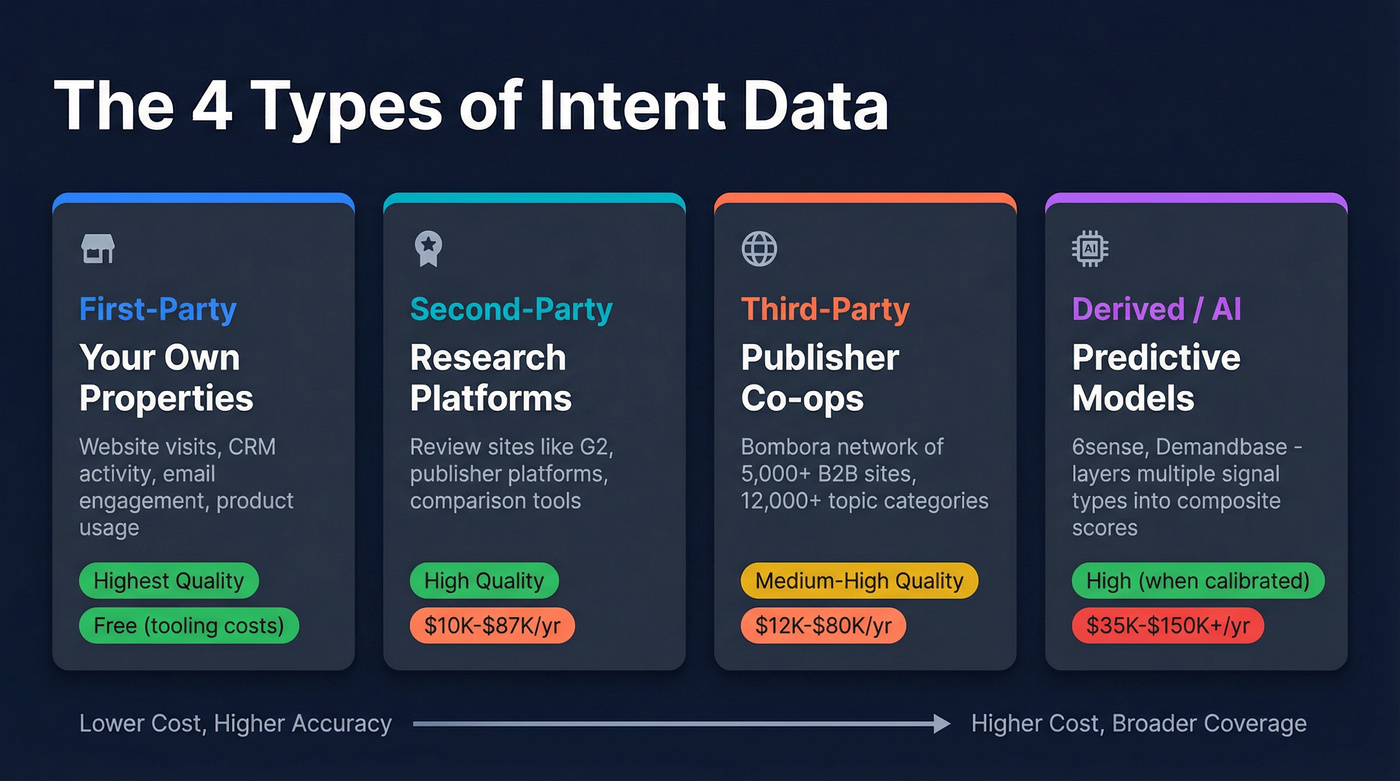
First-party intent comes from your own properties - website visits, email engagement, CRM activity, product usage data. It's the highest-quality signal you'll ever get because the prospect is interacting directly with your brand. It's also the lowest volume.
Second-party intent comes from platforms where buyers research solutions - review sites, publisher platforms, comparison tools. When a prospect is actively researching your competitors on G2 or TrustRadius, that's a second-party signal.
Third-party intent is the big-budget category. Bombora runs a co-op of 5,000+ B2B publisher sites spanning 12,000+ topic categories. When accounts across that network show elevated research activity around topics relevant to your product, you get a "surge" signal. Many providers license Bombora data, so you're often paying different prices for the same underlying signals.
Derived/AI-aggregated intent uses predictive models to combine multiple signal types and infer buying readiness. This is where platforms like 6sense and Demandbase play - layering first, second, and third-party data into composite scores.
| Type | Source Example | Signal Quality | Cost |
|---|---|---|---|
| First-party | Your website, CRM | Highest | Free (tooling costs) |
| Second-party | Review sites, publisher platforms | High | $10K-$87K/yr |
| Third-party | Bombora co-op | Medium-high | $12K-$80K/yr |
| Derived/AI | 6sense, Demandbase | High (when calibrated) | $35K-$150K+/yr |
Building an Intent Signal Hierarchy
Not every signal deserves the same response. We've watched teams treat a single blog visit the same as a pricing page hit - and then wonder why their program underperforms. Build a tiered response model.
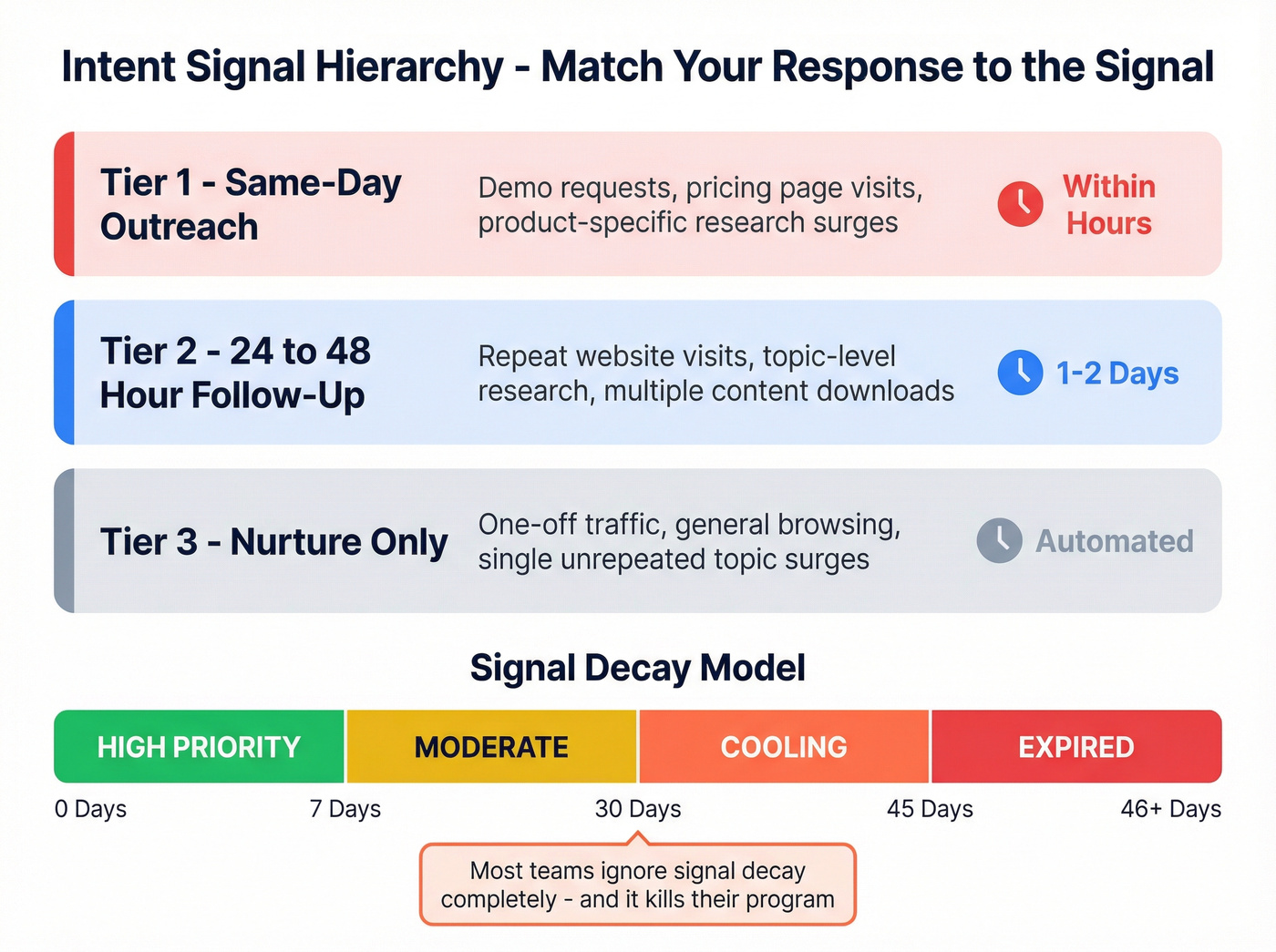
Tier 1 - Same-day outreach. Demo requests, pricing page visits, product-specific research surges. These accounts are actively evaluating. If you're not reaching out within hours, a competitor is.
Tier 2 - 24-48 hour follow-up. Repeat website engagement, topic-level research like "CRM migration" or "sales automation," multiple content downloads. These accounts are in research mode but haven't narrowed their shortlist yet.
Tier 3 - Nurture only. One-off traffic, general browsing, single-topic surges that don't repeat. Add them to a nurture sequence. Don't waste rep time on manual outreach.
A huge reason intent programs underperform isn't bad data - it's that weekly surge lists go stale before reps can act on them. The decay model matters just as much as the tier. A signal 0-7 days old is high priority. At 8-30 days, it's moderate. By 31-45 days, it's cooling fast. After 46 days, treat it as expired. Most teams ignore signal decay completely, and it kills their program.

Intent signals decay fast - Prospeo's 7-day data refresh means your contact data is as fresh as the buying signal that triggered it. Layer Bombora intent across 15,000 topics with 30+ filters, then enrich with 98% accurate emails and verified direct dials. At $0.01/email, you don't need a $100K ABM platform to act on intent.
Stop letting surge lists go stale before your reps can reach anyone.
Build Your Intent Scoring Model
Here's a scoring framework you can copy and adapt. The specific numbers matter less than having a system at all - most teams don't have one.
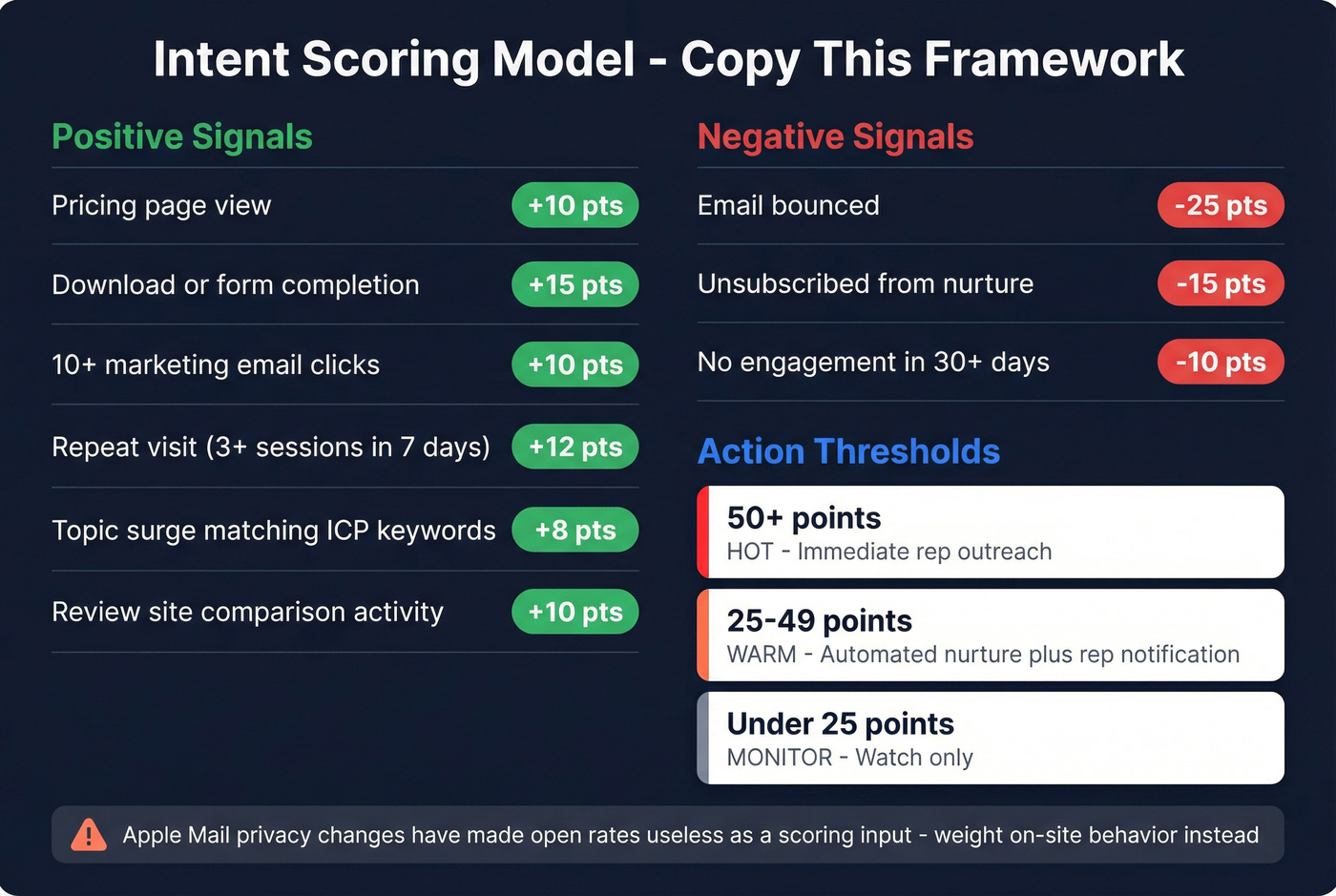
Positive signals:
- Pricing page view: +10 points
- Download or form completion: +15 points
- 10+ marketing email clicks: +10 points
- Repeat website visit (3+ sessions in 7 days): +12 points
- Topic surge matching your ICP keywords: +8 points
- Review site comparison activity: +10 points
Negative signals:
- Email bounced: -25 points
- Unsubscribed from nurture: -15 points
- No engagement in 30+ days: -10 points
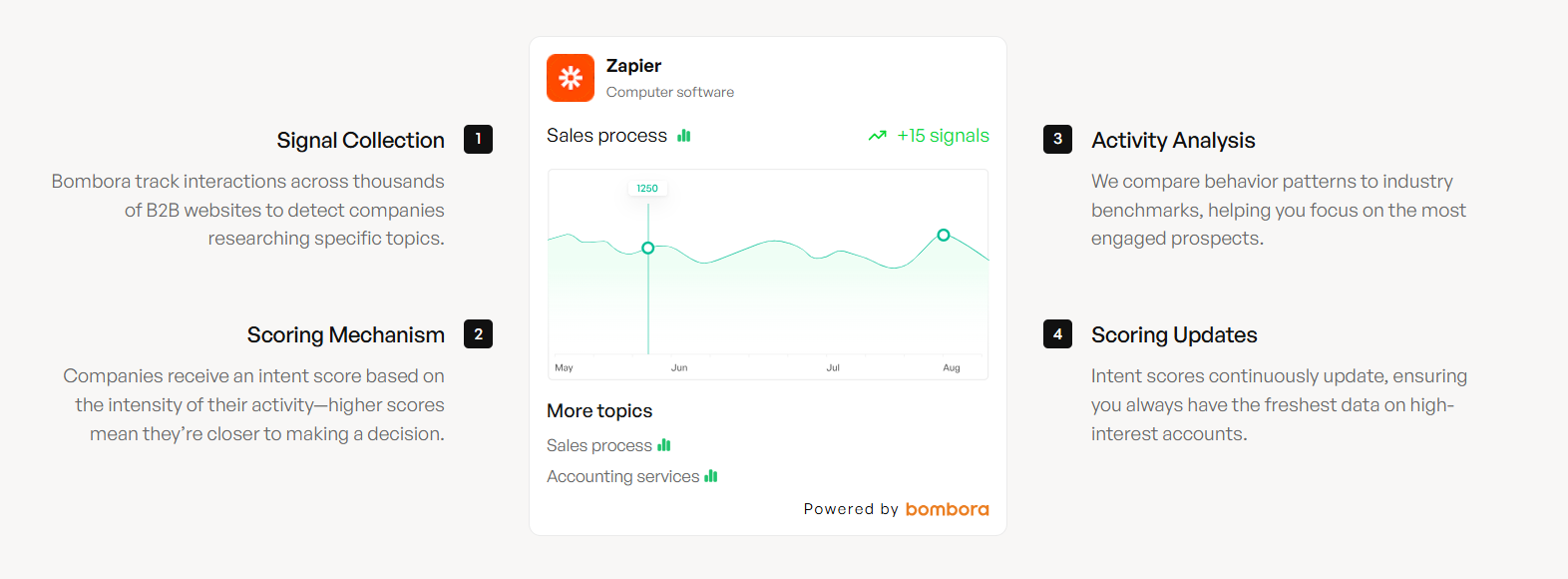
Thresholds: 50+ points = hot (immediate rep outreach). 25-49 = warm (automated nurture with rep notification). Under 25 = monitor only.
One thing to watch: Apple Mail privacy changes have made open rates essentially useless as a scoring input. Weight on-site behavior and deeper engagement actions instead. And review your scoring model monthly - what converts in Q1 won't necessarily convert in Q3.
Closing the Enrichment Gap
Here's where most intent programs die.
You've got a surge list of 48 accounts showing elevated research activity around your category. Great. Now what? Most intent providers deliver account-level data - "Acme Corp is surging on cloud security." They don't tell you which person at Acme Corp to email, and they definitely don't give you a verified email address. This is like buying a Ferrari and filling it with cooking oil.
Account-level intent is table stakes. Contact-level enrichment is what actually books meetings. And by the time you manually research 48 accounts - finding the right VP, guessing email formats, hoping they're still at the company - your competitors who automated this step have already landed in the inbox.
Prospeo collapses this workflow. It layers 15,000 Bombora intent topics on top of 300M+ professional profiles with 98% verified email accuracy and a 7-day data refresh cycle. It also includes 125M+ verified mobile numbers, so you can go from "this account is surging" to "here's the right person's verified email and mobile" in one platform, not three stitched-together tools. No annual contracts, no six-month implementation - self-serve, same day.
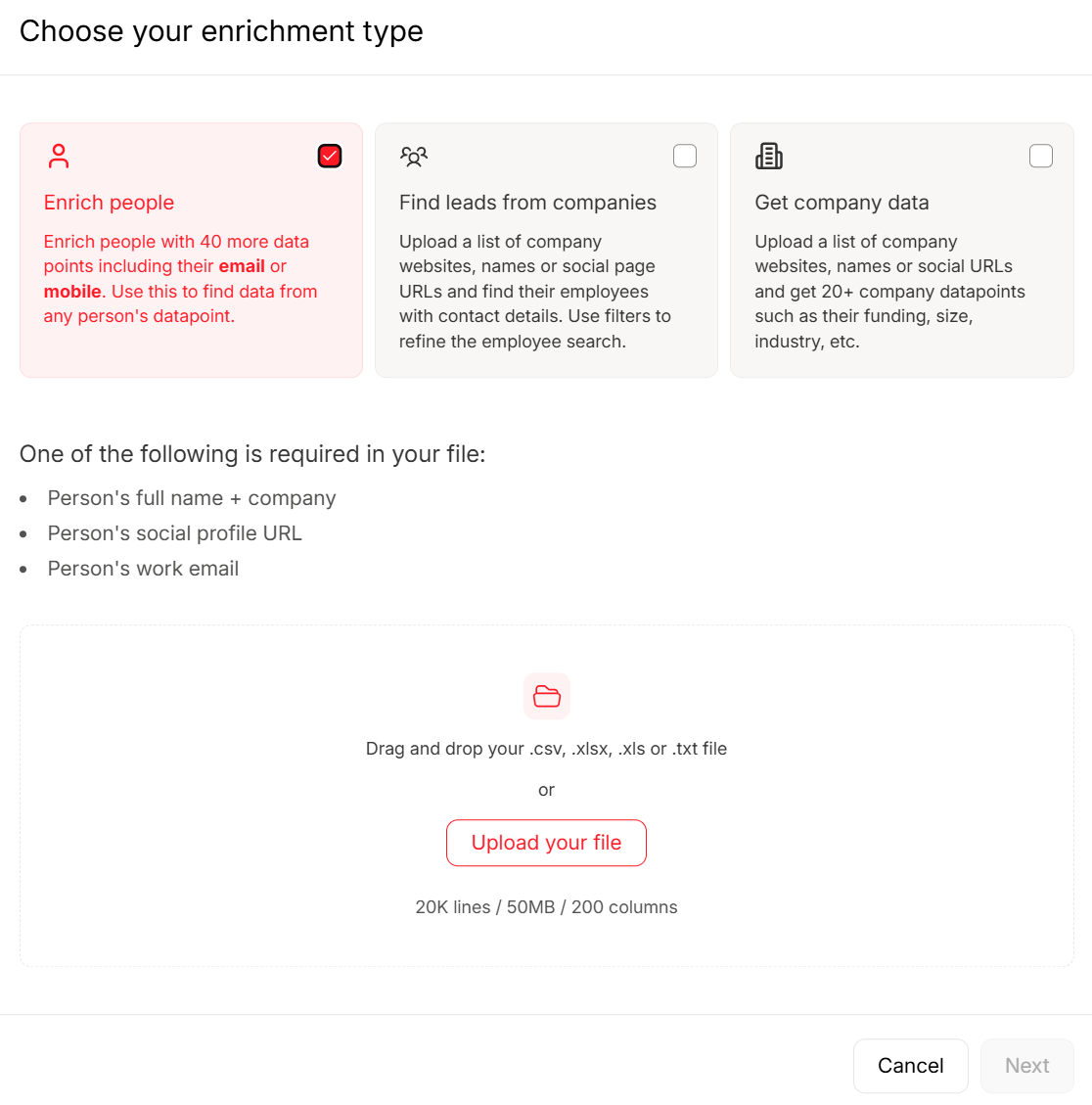
Your intent scoring model is useless if you can't reach the right buyer within 24 hours. Prospeo enriches intent-flagged accounts with verified emails (98% accuracy) and 125M+ mobile numbers (30% pickup rate) - returning 50+ data points per contact at a 92% match rate. That's how you close the gap between signal and outreach.
Enrich your surge list in minutes, not days. Start free with 75 verified emails.
Operationalizing B2B Prospecting Triggers
Having intent data and using intent data are two very different things. B2B prospecting triggers - job changes, funding rounds, tech installs, research surges - only create pipeline when you operationalize them into a repeatable workflow. Here's the five-step process we recommend.
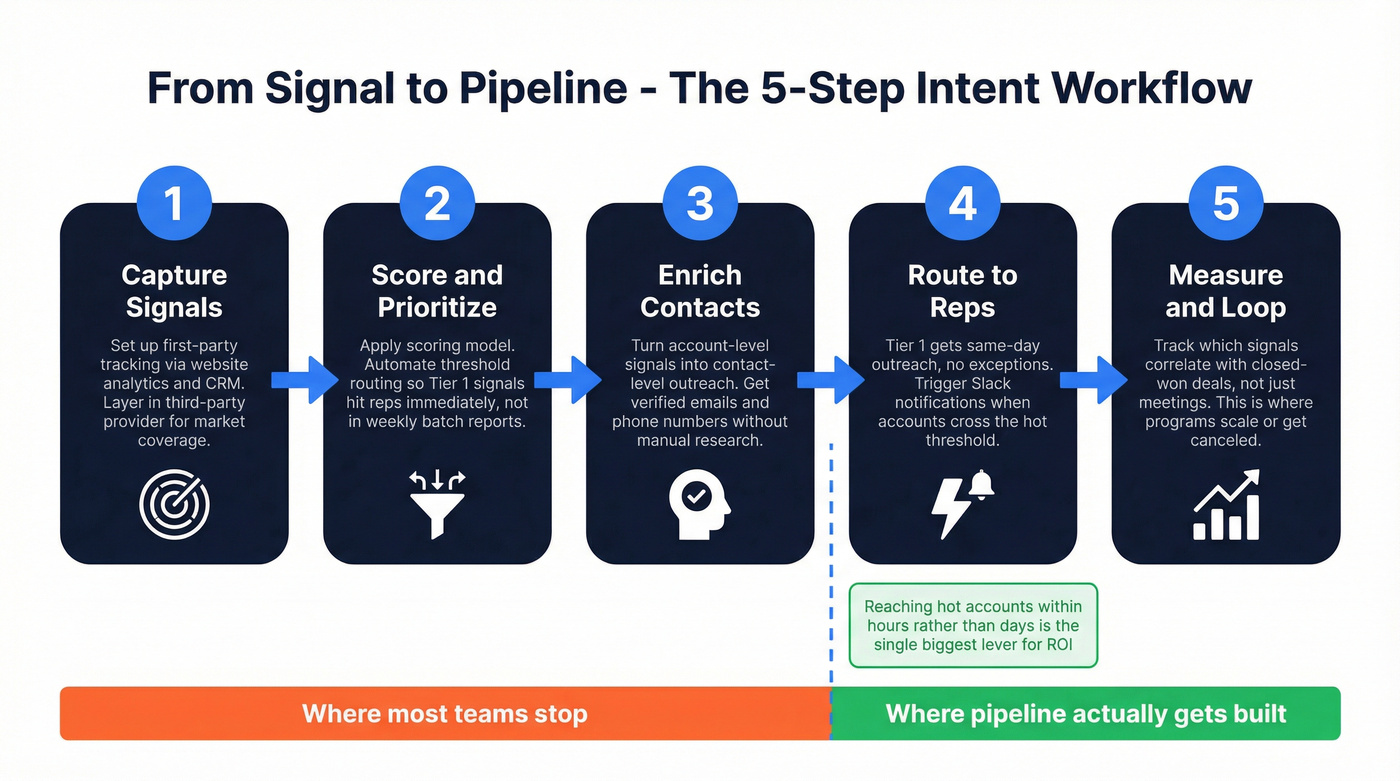
Step 1: Capture signals. Set up first-party tracking through your website analytics and CRM engagement scoring. Layer in a third-party provider for market-level coverage. Start with first-party and add third-party once you've proven the workflow.
Step 2: Score and prioritize. Apply the scoring model above. Automate the threshold routing so Tier 1 signals hit reps immediately, not in a weekly batch report nobody reads.
Step 3: Enrich with verified contacts. Turn account-level signals into contact-level outreach using enrichment tools with high match rates. Most of your surge list should come back with actionable email and phone data without manual research.
Step 4: Route to reps with an SLA. Tier 1 signals get same-day outreach. No exceptions. If your CRM can trigger a Slack notification when an account crosses the hot threshold, do it. Reaching hot accounts within hours rather than days is the single biggest lever for ROI.
Step 5: Measure and close the loop. Track which intent signals correlate with closed-won deals, not just meetings booked. In our experience, this feedback loop is where intent programs either scale or get canceled at renewal. It's the step everyone skips, and it's the one that matters most.
Intent-Triggered Outreach Templates
Every intent guide says "personalize your outreach." None show you the actual email. Teams using signal-personalized templates like these report 15-25% reply rates. Keep each under five sentences - the [brackets] are where your intent data plugs in.
Pricing Page Visit
Subject: Quick question about [your product category]
Hi [First Name],
Noticed your team at [Company] has been evaluating [product category] solutions. We help [similar companies] [specific outcome - e.g., "cut enrichment costs by 60% while improving data accuracy"]. Worth a 15-minute call this week to see if there's a fit?
Competitor Research Signal
Subject: [Competitor] vs. alternatives
Hi [First Name],
Teams evaluating [Competitor] usually care most about [key differentiator]. We built [your product] specifically for that gap. Happy to share a side-by-side comparison - no pitch, just data.
Topic Surge
Subject: [Intent topic] - quick resource
Hi [First Name],
Your team's been researching [intent topic]. We just published [specific resource] that covers [specific angle they'd care about]. If you're actively evaluating solutions, I can share what we're seeing work for [similar company type].
What Intent Data Costs in 2026
Let's be honest about pricing, because most vendors won't be.
| Provider | Annual Cost | Signal Source |
|---|---|---|
| Bombora | $12,250-$80,525 (median ~$25K) | 5,000+ publisher co-op |
| 6sense | $35,000-$150,000+ | Multi-source (Bombora, review sites, etc.) |
| Demandbase | $40,000-$120,000 | ABM + intent suite |
| ZoomInfo Intent | $7,200-$36,000 | Intent add-on module |
| G2 Buyer Intent | $10,000-$87,000+ | Review-site signals |
| TechTarget | $25,000+ | Publisher network |
| Prospeo | Free tier; paid ~$0.01/email | 15,000 Bombora topics + verified contacts |
The number on the contract isn't the number you'll spend. Budget 15-25% above the license cost for implementation, topic configuration, CRM integration, and optimization. A $40K Bombora contract typically costs $46K-$50K in year one. 6sense implementations run 3-6 months before you're fully operational - that's half a year of paying for a tool your team can't fully use yet.
When Intent Data Won't Help
Here's the thing nobody in the intent data space wants to say out loud: most teams don't need a $100K intent platform. They need to act faster on the signals they already have. If your reps aren't following up on inbound leads within 24 hours, buying Demandbase won't fix that. Intent data is a prioritization layer, not a strategy.
Intent data also genuinely fails in specific situations. Offline-heavy industries or deeply relationship-driven sales cycles won't generate enough digital exhaust for intent models to work. When deals close in days rather than months, the signal arrives after the decision is made. If your ICP is only 200 accounts, there won't be enough statistical signal to separate noise from intent.
The consensus on r/sales and r/salesoperations is pretty consistent: practitioners who complain loudest aren't saying intent data is broken. They're saying the gap between "surge alert" and "rep picks up the phone" is where deals die. Disciplined, real-time execution - not bigger budgets - separates teams that generate pipeline from those that generate dashboards.
You don't need a $100K ABM platform. You need signal capture, a scoring model, and verified contact data. Intent-driven sales prospecting works when the workflow between signal and outreach is measured in hours, not weeks. Start there.
FAQ
What's the difference between first-party and third-party intent data?
First-party intent comes from your own properties - website visits, email clicks, CRM activity. Third-party comes from external publisher networks like Bombora's 5,000+ site co-op. First-party is higher quality but lower volume; most teams need both for full-funnel coverage.
How fast should you act on an intent signal?
Tier 1 signals like pricing page visits and demo-related surges need same-day outreach - ideally within hours. After 7 days, signal value drops sharply. After 45 days, treat it as expired. Speed is the single biggest predictor of ROI from buying-signal programs.
Can you run intent-based prospecting without expensive tools?
Yes. Start with first-party signals from Google Analytics and your CRM, then build the scoring model from this guide. A free-tier enrichment tool gives you enough verified emails per month to test the workflow before scaling tool spend.
What are the highest-value sales prospecting signals?
Pricing page visits, competitor comparison research, and product-specific topic surges indicate active evaluation and convert at the highest rates. Repeat website engagement and multiple content downloads are strong secondary indicators. Job changes and funding events also serve as reliable B2B prospecting triggers that signal openness to new vendors.