How to Automate Prospect Research Without Wrecking Your Pipeline
You automated your email sequences last quarter. Open rates went up. Reply rates didn't. The problem isn't your copy - it's your data. Reps still spend 70% of their time on non-selling tasks, and most of that evaporates on manual research a well-built automation stack handles in seconds.
Here's the thing: 69% of reps miss quota, and the gap between top performers and everyone else keeps widening. Teams that automate their research layer properly see real numbers - 73% of professionals say AI helps them pull deeper insights from prospect data, and Deloitte found that companies automating research workflows saw a 20% increase in pipeline volume. Reps using AI effectively are 3.7x more likely to hit quota. Not because AI replaced them, but because it freed them to sell.
The fix isn't buying more tools. It's building a lean stack that automates research and enrichment before you automate outreach.
The Minimum Viable Stack
If you're short on time, here's what you actually need:
- CRM - HubSpot, Salesforce, or whatever your team already runs
- Sequencer - Instantly, Smartlead, Lemlist, or similar
Everything else - intent data, AI scoring, multi-channel orchestration - is optional until you're running 500+ prospects per week.
What Automated Prospect Research Actually Means
Let's be precise. This isn't outreach automation. It's the layer underneath - the work that happens before a rep ever writes a first line or clicks "send."
What gets automated: data collection, contact enrichment, email and phone verification, lead scoring, CRM routing, and list segmentation. These are repetitive, rules-based tasks that eat hours and produce better results when machines handle them. When applied at the account level, the same logic covers firmographic data, tech stack detection, and org-chart mapping - so reps walk into every conversation already informed.
What stays human: relationship judgment, creative messaging, deal strategy, and knowing when a prospect's "not now" actually means "try me in Q2."
The biggest lie in sales automation is that more tools equals more pipeline. We've seen it over and over. The best teams run three to four tools, not twelve. They've automated the research layer properly, so reps spend time on conversations instead of spreadsheets.
The End-to-End Research Workflow
A complete workflow has six steps. Most teams nail the first two and skip the third - which is exactly where pipelines break.
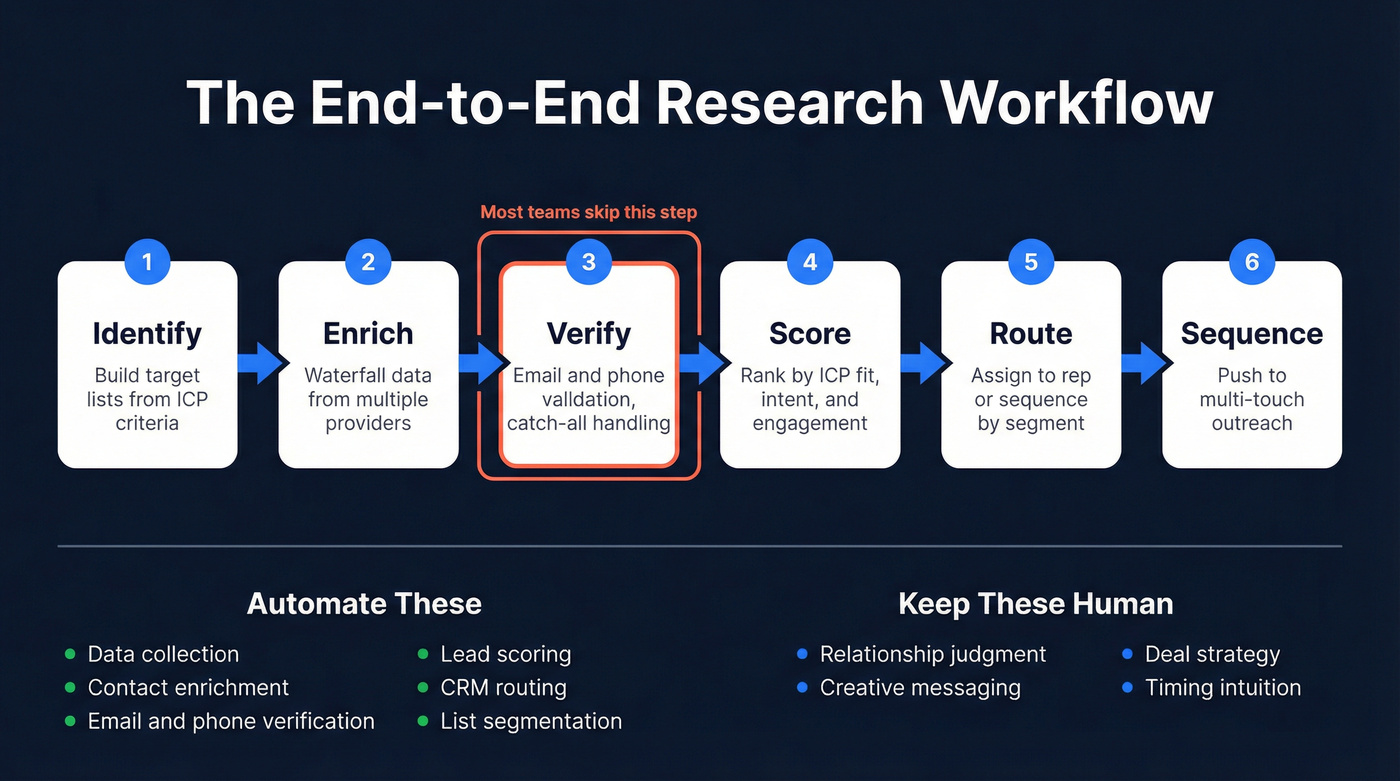
Identify and Enrich
Waterfall enrichment - running each record through multiple data sources until you get the highest-confidence match - is the standard now. Clay popularized this with 150+ data provider connections, but any stack that lets you layer providers works.
Verify
This is the step most teams skip. It's also the one that destroys deliverability.
You can have the best enrichment in the world, but if 8% of your emails bounce, your domain reputation tanks and every subsequent campaign suffers. The operational thresholds are unforgiving: keep your bounce rate under 2% and spam complaint rate under 0.01%. Exceed either, and you're looking at inbox placement problems that take weeks to recover from. Prospeo's 5-step verification - catch-all handling, spam-trap removal, honeypot filtering - is built specifically for this. Verification isn't optional. It's infrastructure.
Score, Route, and Sequence
Once your data is clean, score leads based on ICP fit, intent signals, and engagement history. Route them to the right rep or sequence based on territory, segment, or deal size. Push them into your sequencer for multi-touch outreach.
Scoring and routing should happen automatically via your CRM's workflow engine or a tool like Clay. If a rep manually decides where a lead goes, you haven't automated anything - you've just moved the bottleneck.

Your research automation stack is only as good as the data feeding it. Prospeo's 5-step verification delivers 98% email accuracy with catch-all handling, spam-trap removal, and honeypot filtering - refreshed every 7 days, not every 6 weeks.
Stop automating bad data. Start at $0.01 per verified lead.
10 Research Tasks to Automate Today
These tasks can be automated with AI prompts and basic enrichment tools, based on common workflows documented by practitioners:
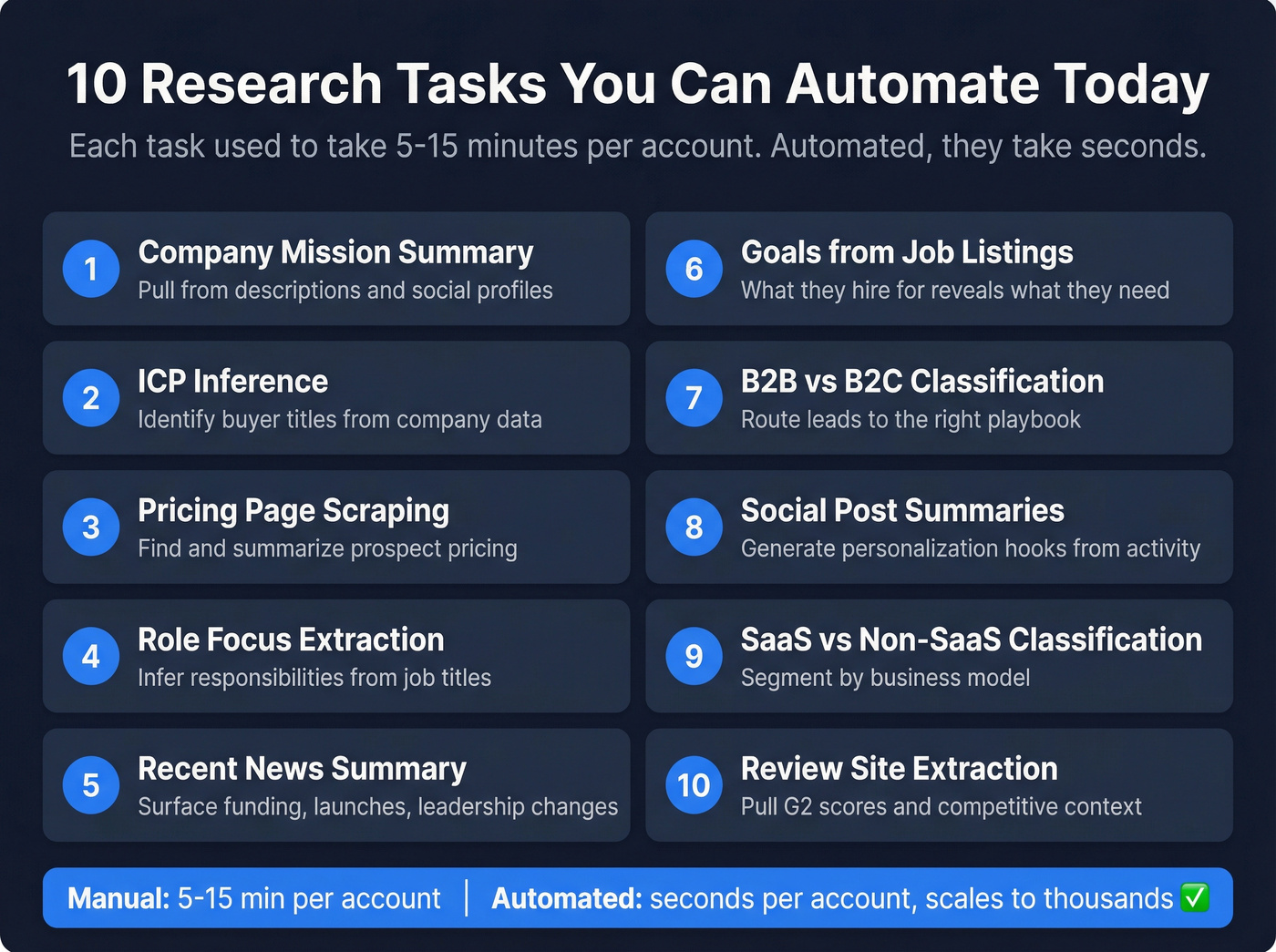
- Company mission summary - pull from company descriptions and social profiles
- ICP inference - identify likely buyer titles from company descriptions
- Pricing page scraping - find and summarize a prospect's pricing via web search
- Role focus extraction - infer responsibilities from job titles
- Recent news summarization - surface funding rounds, product launches, leadership changes
- Goals from job listings - what they're hiring for reveals what they're trying to solve
- B2B vs. B2C classification - route leads to the right playbook automatically
- Social post summaries - generate personalization hooks from recent activity
- SaaS vs. non-SaaS classification - segment by business model
- Review site extraction - pull G2 scores or Glassdoor ratings for competitive context
Each of these used to take a rep 5-15 minutes per account. Automated, they take seconds and scale to thousands of records. Taken together, they represent the core of sales research automation - removing the manual grunt work so reps focus on closing.
What the Stack Costs
Poor data quality costs companies an average of $15 million per year. The tools to prevent that are surprisingly affordable.
| Tool | Starting Price | Best For | Key Strength |
|---|---|---|---|
| Prospeo | Free; ~$0.01/lead | Verification & enrichment | 98% accuracy, 7-day refresh |
| Apollo | Free; from ~$49/user/mo | High-volume SMB outbound | Large DB + built-in sequences |
| Clay | From $149/mo | Technical RevOps workflows | 150+ data connections |
| ZoomInfo | $15,000+/yr | Enterprise teams | One of the largest NA databases |
| Cognism | $1,500-$25,000/yr | European data / mobiles | 120M+ verified EU contacts |
| Hunter.io | From $34/mo | Email finding (lightweight) | Simple domain search |
| Snov.io | From $30/mo | Email finding + sequences | Budget all-in-one |
| Lusha | From ~$15/mo | Quick enrichment | Chrome extension simplicity |
| Clearbit | From $45/mo | Firmographic enrichment | 100+ attributes, 250+ sources |
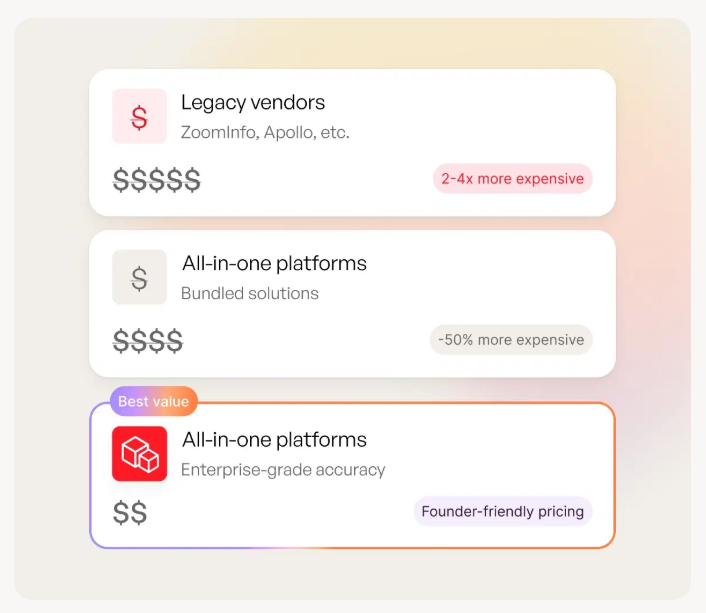
One thing worth evaluating when choosing AI-powered enrichment tools: can you verify the data yourself, or are you trusting a black box? The best tools let you audit match sources and confidence scores rather than just handing you a number. Verifiable AI beats opaque AI every time - especially when your domain reputation is on the line.
Stack by Team Size
Solo founder ($50-150/mo): A verification layer plus a sequencer like Instantly or Smartlead. That's it. You don't need a CRM until you're juggling more than 50 active conversations.
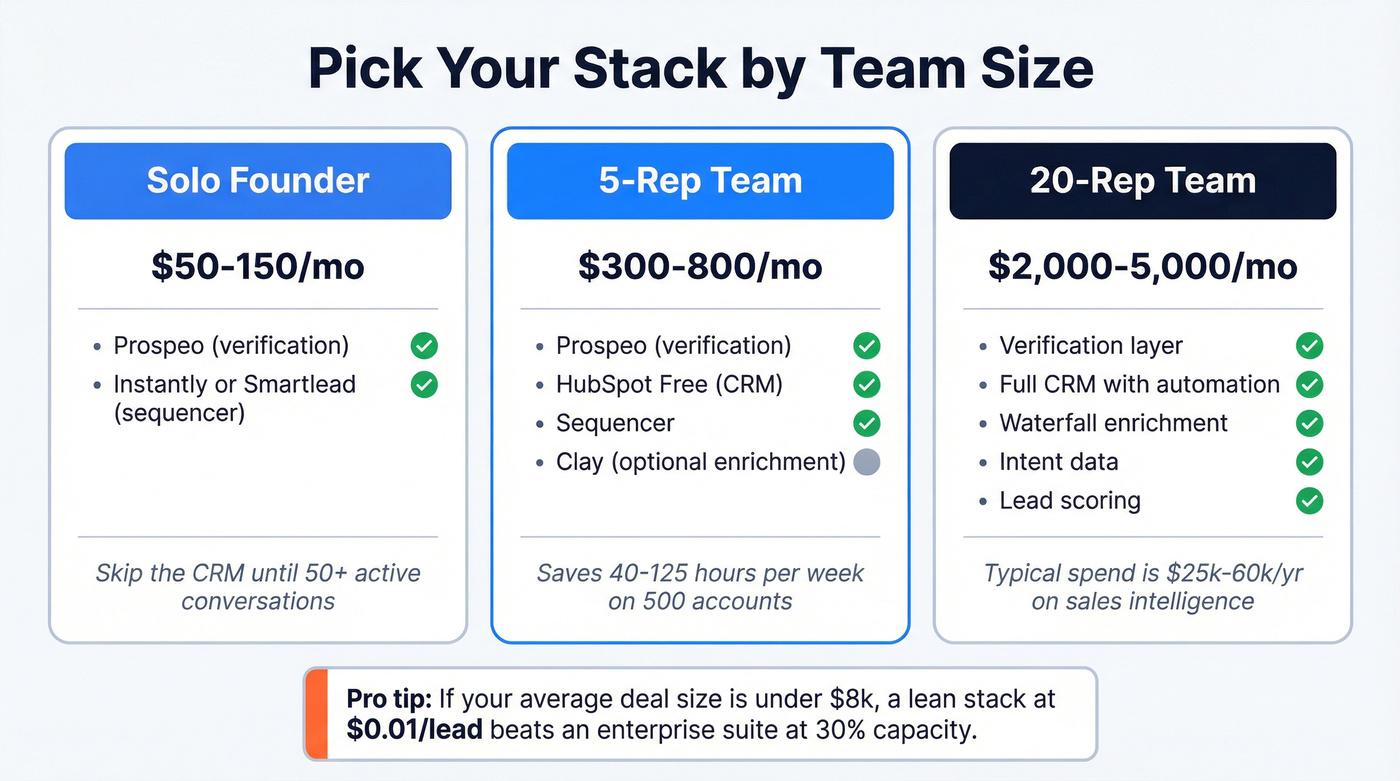
5-rep team ($300-800/mo): Verification + CRM (HubSpot's free tier works) + sequencer + optional Clay for enrichment. At five to fifteen minutes per account for basic research, if you're researching roughly 500 accounts per week, that's 40-125 hours of manual work that automation collapses into minutes.
20-rep team ($2,000-5,000/mo): Full stack with intent data, waterfall enrichment, lead scoring, and CRM automation. Most 20-person sales teams spend $25,000-$60,000 annually on sales intelligence. The question at this scale isn't whether to invest - it's whether every tool in the stack earns its keep.
Look, if your average deal size is under $8k, you probably don't need ZoomInfo-level data. A lean stack with strong verification at $0.01/lead will outperform an enterprise suite you're only using at 30% capacity.
Five Ways Automation Goes Wrong
Automation amplifies whatever you feed it. Feed it bad inputs, and you'll scale mistakes faster than any human could.
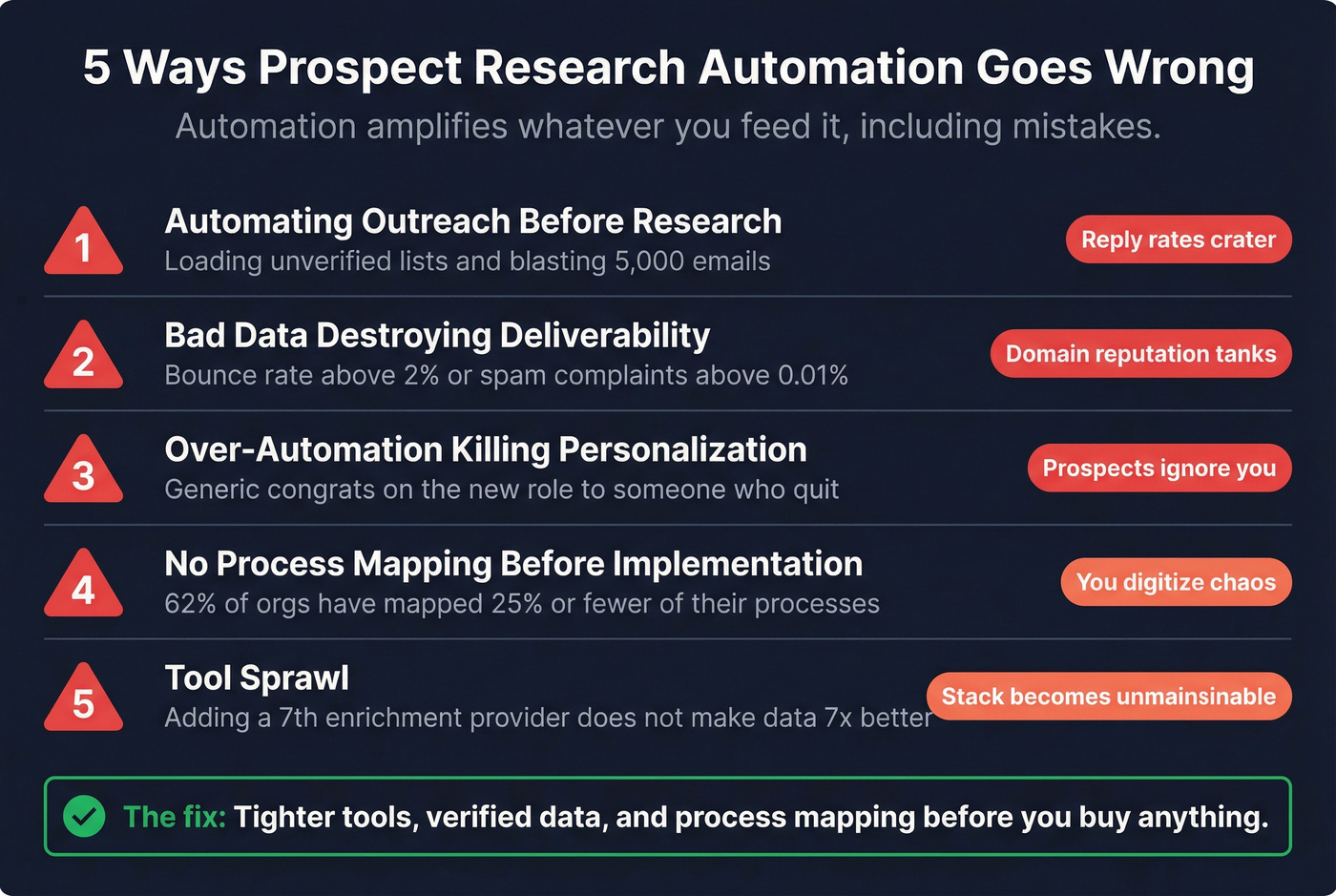
1. Automating outreach before research. The most common mistake we see. Teams buy a sequencer, load unverified lists, and blast 5,000 emails. Reply rates crater. Domain reputation tanks. Cold email works fine - bad data doesn't.
2. Bad data destroying deliverability. Bounce rate above 2% or spam complaints above 0.01%, and ESPs start throttling you. One bad import takes weeks to recover from. GDPR fines can hit EUR 20 million or 4% of global revenue.
3. Over-automation killing personalization. The consensus on r/sales is brutal about this: automated sequences sending "congrats on the new role!" to someone who just posted about quitting. Personalized B2B emails get 14% higher open rates - but only if the personalization is relevant.
4. No process mapping before implementation. 62% of organizations have mapped 25% or fewer of their processes. If you don't know your current workflow, you'll just digitize chaos.
5. Tool sprawl. Adding a seventh enrichment provider doesn't make your data seven times better. It makes your stack seven times harder to maintain. Tighter tools = better pipeline.
How to Implement in 4 Weeks
Week 1: Audit. Map your current research workflow. How many minutes per prospect? Where does data break between systems? If you can't answer these questions, you aren't ready to automate.
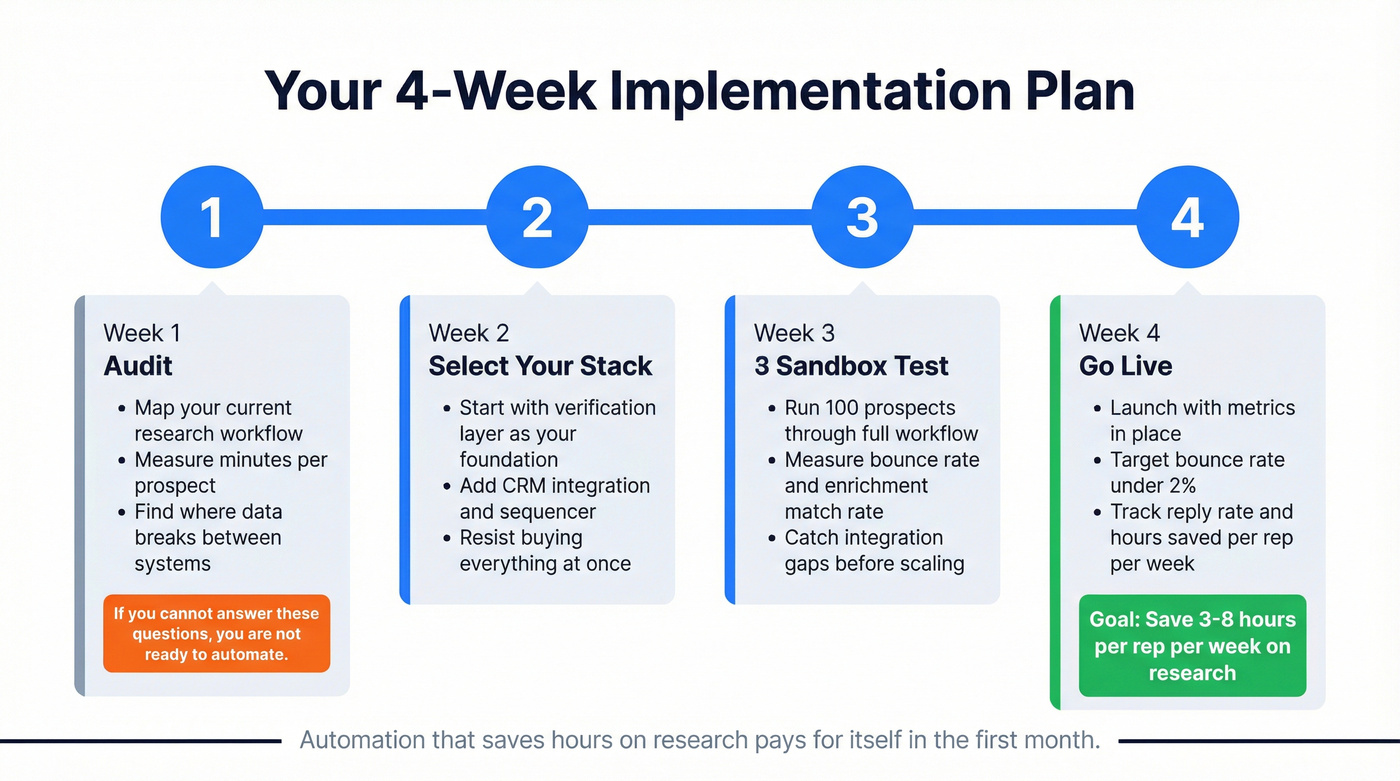
Week 2: Select your stack. Start with the verification layer - that's your foundation. Add a CRM integration and a sequencer. Resist buying everything at once.
Week 3: Sandbox test. Run 100 prospects through the full workflow. Measure bounce rate, enrichment match rate, and time saved per rep. In our experience, this is where teams catch integration gaps they didn't anticipate - better to find them now than at scale.
Week 4: Go live. Launch with metrics in place: bounce rate under 2%, reply rate, and hours saved per rep per week. Automation that saves 3-8 hours per rep weekly on research pays for itself in the first month. Snyk's team of 50 AEs saw AE-sourced pipeline jump 180% after automating their research layer - not by cutting reps, but by giving them back the hours they'd been burning on manual lookups.
Teams that automate research on Prospeo's verified data see bounce rates drop below 4% and pipelines jump 140%+. With 300M+ profiles, 30+ search filters, and native CRM integrations, your entire identify-enrich-verify workflow runs on one platform.
Build the lean research stack this guide recommends - in minutes.
FAQ
How long does it take to set up prospect research automation?
Most teams are fully operational in two to four weeks. Solo founders can start in a single day with a free verification tier and a sequencer - total cost under $50/month.
What's the minimum stack I need?
Three tools: a verified data source for emails and mobiles, a CRM for tracking, and a sequencer for outreach. Layer in intent data and AI scoring after you're consistently running 500+ prospects per week.
Does automating research replace SDRs?
No. It replaces the 70% of their time spent on data entry, list building, and manual lookups. Automated research handles the repetitive legwork; SDRs still own relationship judgment, creative messaging, and deal qualification. Snyk saw AE-sourced pipeline jump 180% after automating research - not by cutting reps, but by freeing them.
What's a good free tool to start with?
Prospeo's free plan includes 75 email credits and 100 Chrome extension credits per month with full verification - enough to test a real workflow. Apollo also offers a free tier with limited enrichment. Start with whichever matches your volume, then upgrade once you've validated bounce rates under 2%.
Skip this if...
You're running fewer than 20 prospects per week. At that volume, manual research is fine and you'll spend more time configuring tools than you'll save using them. Automation pays off when repetition becomes the bottleneck, not before.