Personalized Outbound Email: The Complete Playbook From Data to Send
You've spent two hours researching a prospect, crafted an opener that references their latest podcast appearance, nailed the value prop - and the email bounced. 95% of cold emails fail to generate replies, and a surprising chunk of that failure has nothing to do with copywriting. Personalized outbound email lives or dies on data quality, not clever subject lines. It's a data problem dressed up as a personalization problem.
Real personalization takes 10-15 minutes per prospect. For 100 prospects a week, that's 16-25 hours of research and writing. The math breaks unless you're strategic about where you spend that time and ruthless about the infrastructure underneath it.
The Short Version
Clean your data first. Around 17% of cold emails never reach the inbox, and no amount of personalization fixes a bounced email. Aim for signal-based personalization (Tier 4 or higher) - it drives 15-25% reply rates versus 1-3% for generic blasts. Keep emails to 6-8 sentences, lead with one focused email instead of a 5-step sequence, and never exceed 50 sends per day per inbox.
What Personalized Outreach Actually Means
Most guides define personalization as "using the prospect's name and company in the subject line." That's not personalization. That's a mail merge.
The 3-Part Test
A genuinely personalized outbound email passes three checks. First, it signals homework - you know something specific about the person or their company that isn't on the first line of their bio. Second, it shows you understand their likely situation, not just their job title. Third, it offers value relevant to that situation rather than a generic pitch you'd send to anyone in their industry.
If your email fails any of those three, it's not personalized. It's decorated.
Decoration vs. Real Personalization
Here's the trap most teams fall into. You insert {{first_name}}, {{company}}, maybe {{city}}, and call it a day. The email opens with "Hi Sarah, I noticed you're at Acme Corp in Austin" - and Sarah immediately knows it's automated because every SDR in her inbox opens the same way. Opens tick up slightly, but replies don't follow. The prospect sees through the veneer in under two seconds.
The Personalization Tier Framework
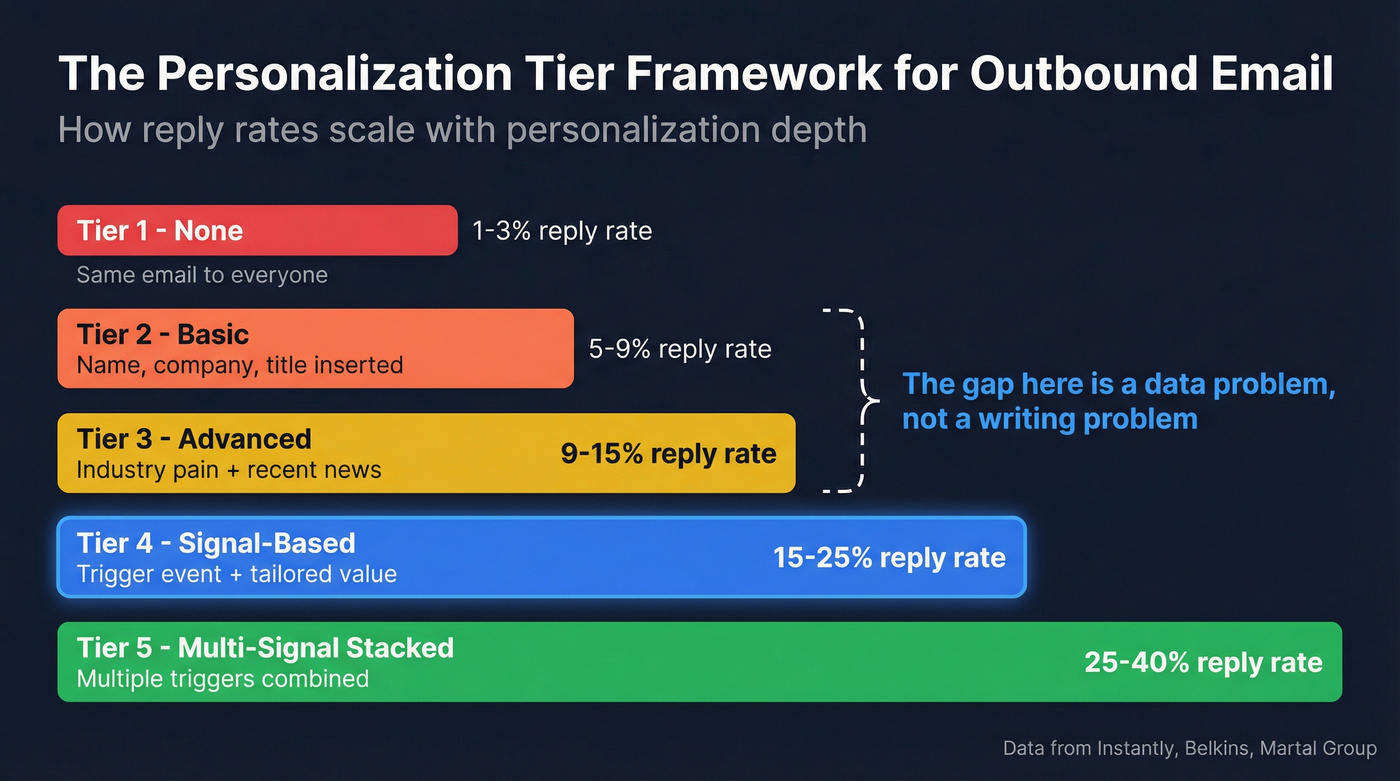
Not all personalization is created equal. Here's how reply rates shift as you move from generic to deeply researched outreach, based on aggregated data from Instantly, Belkins, and Martal Group:
| Tier | Level | What It Looks Like | Expected Reply Rate |
|---|---|---|---|
| 1 | None | Same email to everyone | 1-3% |
| 2 | Basic | Name, company, title inserted | 5-9% |
| 3 | Advanced | Industry pain + recent news | 9-15% |
| 4 | Signal-based | Trigger event + tailored value | 15-25% |
| 5 | Multi-signal stacked | Multiple triggers combined | 25-40% |
The jump from Tier 1 to Tier 2 is trivial - any sequencer handles it. The jump from Tier 2 to Tier 4 is where the real work lives, and it's where most teams stall. Tier 4 means you noticed they just raised a Series B, hired three SDRs last month, and are running Outreach but not a data provider. Tier 5 weaves all of that into a message that feels like it was written by someone who genuinely understands their business.
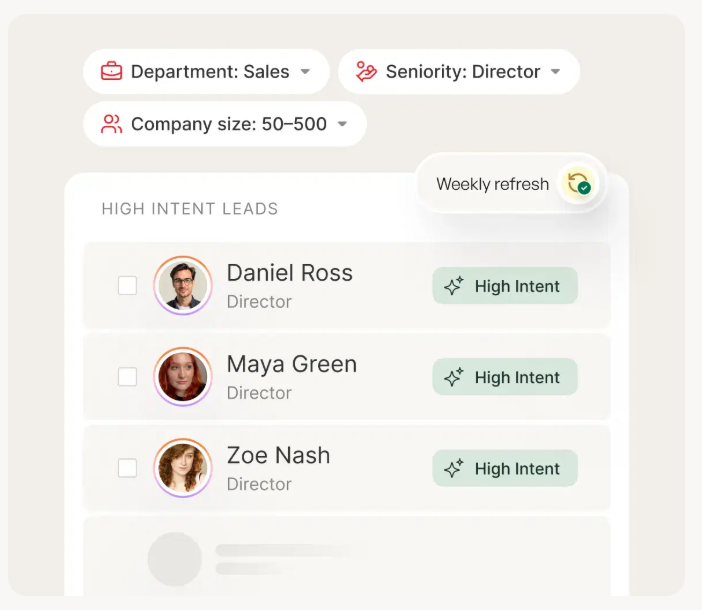
The gap between Tier 2 and Tier 4 isn't about writing talent. It's about data infrastructure - having the right intent signals in front of you before you start typing.
What 16.5 Million Emails Reveal
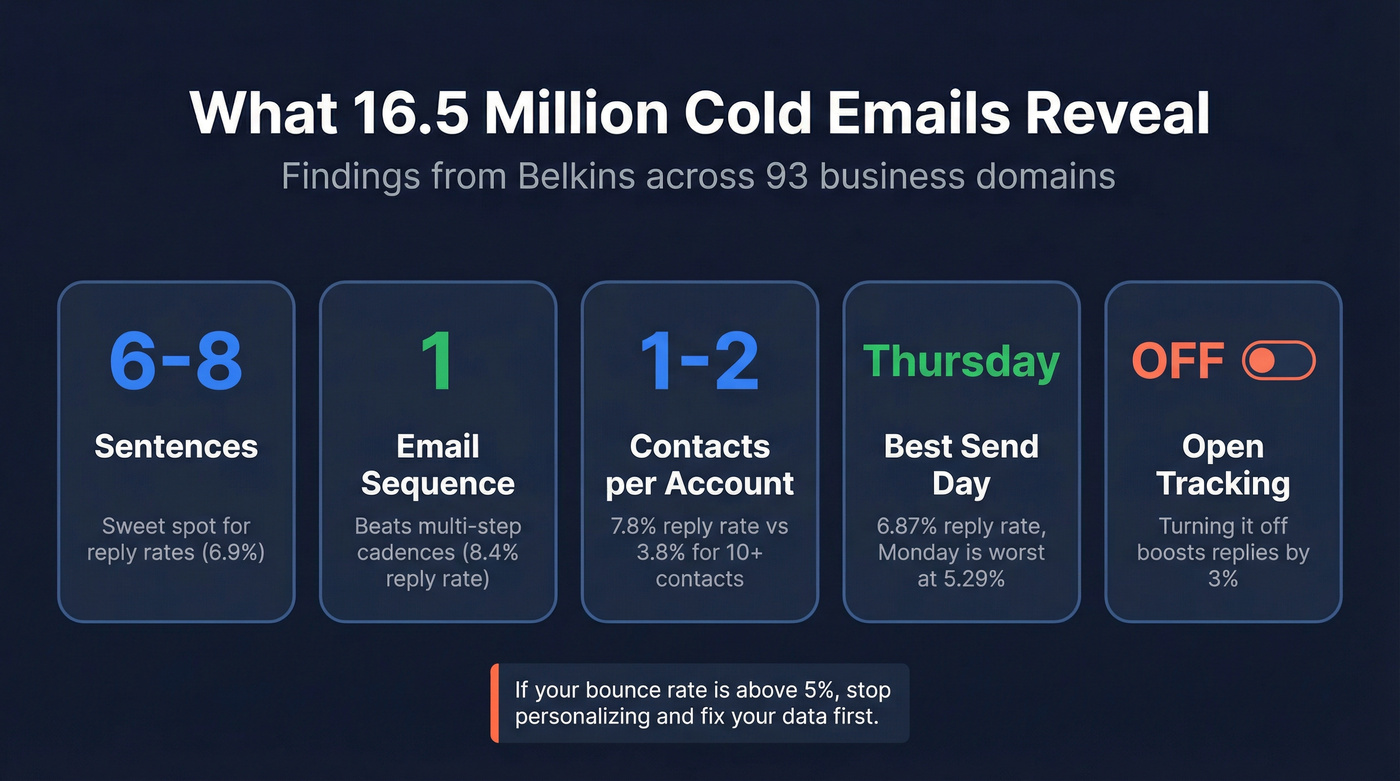
Belkins analyzed 16.5 million cold emails across 93 business domains. The findings challenge a lot of conventional outbound wisdom.
Keep It Short
Emails with 6-8 sentences hit a 6.9% reply rate and 42.67% open rate. Anything longer than 200 words saw diminishing returns. Your prospect isn't reading essays from strangers.
One Email Beats a Sequence
Here's the counterintuitive finding: 1-email sequences produced an 8.4% reply rate - the highest of any sequence length. Adding a third email dropped reply rates by up to 20%. The outbound industry has been conditioned to build 5-7 step sequences, but a single, well-researched email outperforms a cadence of mediocre follow-ups. Stop writing five mediocre touches and write one great one.
Target Fewer Contacts per Account
Contacting 1-2 people per company yielded a 7.8% reply rate. Emailing 10+ contacts at the same company dropped to 3.8%. Spray-and-pray within an account actively hurts you.
Thursday Wins, Evenings Surprise
Thursday was the best-performing day at 6.87% reply rate. Monday was the worst at 5.29%. The surprise: 8-11 PM was the peak reply window at 6.52%. Other studies point to Monday/Tuesday afternoons, but Belkins' 16.5M-email dataset is the largest available - Thursday and evening sends are the stronger bet.
Kill Your Open Tracking
Turning off open tracking pixels produced 3% higher response rates in Belkins' internal testing. Open pixels trigger spam filters. If you're optimizing for replies - and you should be - ditch the vanity metric entirely (and see does open tracking hurt cold email for the deliverability tradeoffs).
We'd go further: if your bounce rate is above 5%, stop personalizing and fix your data first. You're wasting hours on emails that never arrive.

The jump from Tier 2 to Tier 4 personalization isn't a writing problem - it's a data problem. Prospeo gives you the signals that fuel real personalization: buyer intent across 15,000 topics, job changes, funding events, headcount growth, and technographics - all through 30+ filters on 300M+ profiles refreshed every 7 days.
Stop researching manually. Start with the signals already in front of you.
Deliverability: The Step Everyone Skips
You've spent hours crafting the perfect personalized opener, only to discover your bounce rate is in double digits. That's not a copywriting problem. Roughly 17% of cold emails never reach the inbox. Every bounced email chips away at your sender reputation, making future emails - even the great ones - less likely to land.
Bad emails lead to bounces, bounces damage your domain, and damaged domains waste every hour you spent personalizing. Verify before you send (use this email deliverability checklist to audit the basics).

Authentication Non-Negotiables
SPF, DKIM, and DMARC aren't optional anymore. Microsoft began enforcing similar requirements in mid-2025. Gmail started rejecting non-compliant emails in late 2025. If your DNS records aren't configured, your emails aren't arriving (walk through SPF, DKIM, DMARC setup end-to-end).
The Warm-Up Schedule
Don't blast 50 emails from a fresh inbox on day one. Follow this ramp from SuperSend:
| Week | Daily Volume |
|---|---|
| 1-2 | 5-10 emails |
| 3-4 | 15-20 emails |
| 5-6 | 30-40 emails |
| 7+ | 50 max/inbox |
Three Mistakes That Kill Reply Rates
Projecting Assumptions
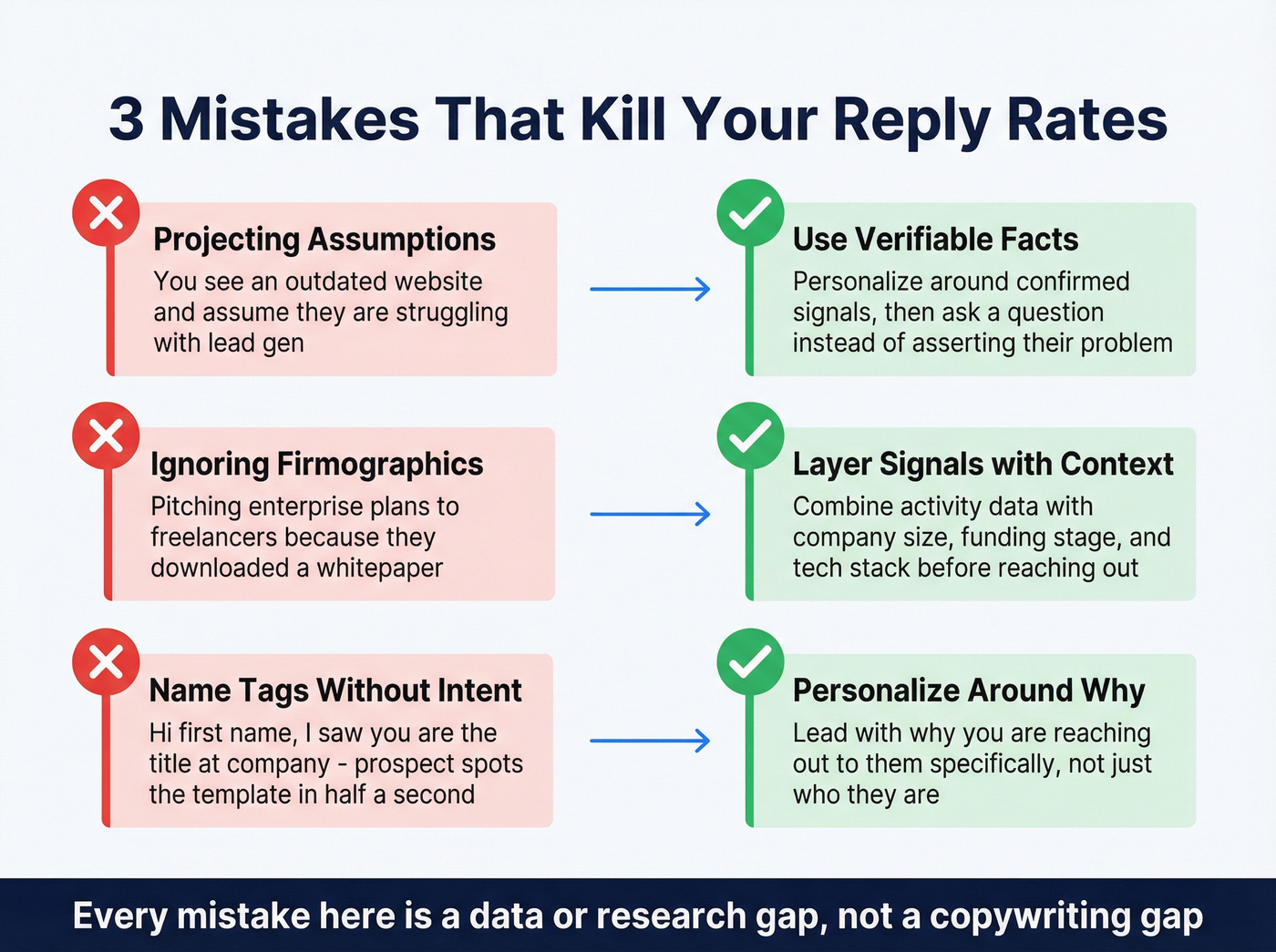
The most common personalization mistake is inferring pain from superficial signals. You see a company's website looks outdated and assume they're "struggling with lead gen." Maybe they just redesigned and the new site hasn't launched yet. Personalize using verifiable facts, then ask a direct question rather than asserting their problem.
Ignoring Firmographics
Look, behavioral data without firmographic context produces embarrassing mismatches. We've seen teams pitch enterprise plans to freelancers because the freelancer downloaded a whitepaper. Activity signals matter, but they need to be layered with company size, funding stage, and tech stack (here’s how to combine firmographic and technographic data without breaking targeting). A solo consultant who reads your blog post about team collaboration isn't a qualified lead for your 50-seat platform.
Name Tags Without Intent
"Hi {{first_name}}, I saw you're the {{title}} at {{company}}." The prospect opens it, recognizes the template in half a second, and closes it. If you're going to personalize, personalize around why you're reaching out to them specifically - not just who they are.
How to Scale Signal-Based Outreach
Scaling personalization isn't about writing faster. It's about building a system that puts the right signals in front of you so writing becomes the easy part.
Define Your ICP
Start narrow. The tighter your ICP, the more transferable your research becomes. If you're targeting VP-level marketing leaders at Series B SaaS companies with 50-200 employees, the pain points cluster. You research deeply once, then adapt per prospect rather than starting from scratch every time (use an account qualification lens to keep the ICP tight).
Source and Verify Contacts
This is where most personalization efforts quietly die. You build a beautiful target list, write signal-based emails, and 30% bounce because the data was stale. Run every list through verification before it touches your sending infrastructure (see email verification for outreach). Prospeo's free tier gives you 75 verified emails a month to test the impact on your bounce rates - backed by 98% accuracy and a 7-day data refresh cycle that keeps contacts current while competitors refresh every 4-6 weeks.
Identify High-Signal Triggers
Funding rounds, new executive hires, job postings that signal a problem you solve, technology changes visible through tools like Wappalyzer, content signals like podcast appearances or published articles - these are the raw materials for Tier 4+ personalization. Build a trigger library for your ICP so reps know exactly what to look for (a practical system: how to track sales triggers).
Build Message Frameworks
Frameworks, not templates. A template says "Hi {{name}}, congrats on the funding round." A framework says: open with the specific trigger, connect it to a likely challenge, bridge to your value, close with a low-friction ask. The words change every time. The structure stays consistent.
You read it above: if your bounce rate is above 5%, stop personalizing and fix your data first. Prospeo's 5-step verification with catch-all handling and spam-trap removal delivers 98% email accuracy at $0.01 per email. Teams using Prospeo cut bounce rates from 35%+ to under 4% - so every hour you spend personalizing actually reaches the inbox.
Every bounced email wastes your best copy. Verify before you send.
Generic vs. Signal-Based: An Annotated Example
Generic (Tier 2):
Hi Sarah,
I'm reaching out because I help companies like Acme Corp improve their outbound results. We work with SaaS companies to increase reply rates and book more meetings. Would you be open to a quick chat this week?
What's wrong: Name and company inserted, but nothing signals homework. "Companies like Acme Corp" could mean anything. This is decoration.
Signal-Based (Tier 4):
Hi Sarah,
Saw Acme just opened three SDR roles on your careers page - looks like you're scaling outbound. Most teams at that stage hit a wall around data quality: reps spend hours prospecting, then 20% of emails bounce. We helped a similar team cut bounce rates from 35% to under 4% and triple their pipeline. Worth a 15-minute look at how?
What changed: A specific, verifiable trigger (job postings). A pain point connected to that trigger. A concrete proof point. A low-friction ask with a time commitment. Every sentence earns its place.
Tools for Personalized Outbound Email
The right stack depends on where your bottleneck sits. Here's how the key tools map to each layer:
| Tool | Role | Starting Price | Best For |
|---|---|---|---|
| Prospeo | Data + verification | Free (75/mo); ~$0.01/email | Email accuracy + bounce prevention |
| Clay | Enrichment + signals | $134/mo (2K credits) | Multi-source enrichment |
| Instantly.ai | Sending + deliverability | $37/mo | Warm-up + inbox rotation |
| Apollo.io | Database + outreach | Free; Pro $49/user/mo | All-in-one for small teams |
| Smartlead | High-volume sending | $39/mo | Managing 10+ inboxes |
| Lavender.ai | Email coaching | $29/user/mo | Reps who need writing feedback |
| Autobound | AI personalization | Free; Pro $39/mo | AI-generated signal-based messages |
The core stack for most teams is three tools. Prospeo handles verified contact data with 98% email accuracy, 300M+ professional profiles, and native integrations into Instantly, Smartlead, Lemlist, and Clay. Clay pulls signals from dozens of sources and structures them for personalization. Pair those two and you've got a Tier 4 personalization engine without manual research.
For sending, Instantly.ai handles warm-up, inbox rotation, and deliverability monitoring. Smartlead is the better pick if you're managing 10+ sending inboxes at scale.
Skip these unless you need them. Apollo works as an all-in-one if you want database and sequencing in a single tool, though in our testing its email accuracy runs noticeably lower than dedicated verification tools (compare options in email checker tool). Lavender is worth the $29/mo only if your reps consistently struggle with email copy. Autobound auto-generates personalized messages from trigger signals - a recurring debate in r/coldemail is whether AI-generated personalization actually converts, and the data suggests it depends entirely on signal quality, not the AI itself.
Let's be honest about budget: if your average deal size is under $8k, you probably don't need a $134/mo enrichment tool. Start with verified data and strong frameworks. Add Clay when your pipeline justifies the spend.
FAQ
How many personalized emails can I send per day?
Max 50 per inbox after a 6-7 week warm-up ramp. Start at 5-10 per day and increase gradually. Exceeding this threshold risks domain reputation damage that takes weeks to recover from.
Does signal-based personalization actually improve reply rates?
Signal-based personalization drives 15-25% reply rates versus 1-3% for generic emails, based on aggregated data from studies covering 16.5M+ outbound messages. The lift is consistent across industries and company sizes.
How do I prevent bounces from ruining campaigns?
Verify every email address before sending. A 5-step verification process catches dead addresses, spam traps, and catch-all domains. Meritt cut bounce rates from 35% to under 4% and tripled pipeline after switching to verified data - that's the kind of difference clean contacts make.
What's the best free tool for outbound email verification?
Prospeo offers 75 free verified emails per month with 98% accuracy and catch-all domain handling. Apollo.io has a free tier but tests at roughly 79% email accuracy. For teams running real campaigns, even a small accuracy gap compounds into deliverability problems at scale.
The gap between a 3% reply rate and a 20% reply rate isn't about writing talent. It's about the data, signals, and infrastructure you build before you ever open a compose window. Personalized outbound email works when the foundation is solid - clean contacts, verified addresses, and real trigger signals. Fix that, and the words take care of themselves.