How to Get a Client to Respond When They Go Silent
You sent the proposal Tuesday. It's now the following Thursday. You've refreshed your inbox six times and started drafting a follow-up that somehow sounds both desperate and passive-aggressive.
Here's the thing: figuring out how to get a client to respond when they've gone silent isn't about writing better emails. It's about understanding why they're quiet in the first place. With 392.5 billion emails expected daily by 2026, your message isn't being ignored - it's being buried under a pile of other messages that all sound exactly like yours.
The Quick Version
- Recommended cadence: Day 1, Day 3, Day 7, Day 14, Breakup at Day 21
- Each follow-up gets shorter - not longer
- One clear question per email. Never two.
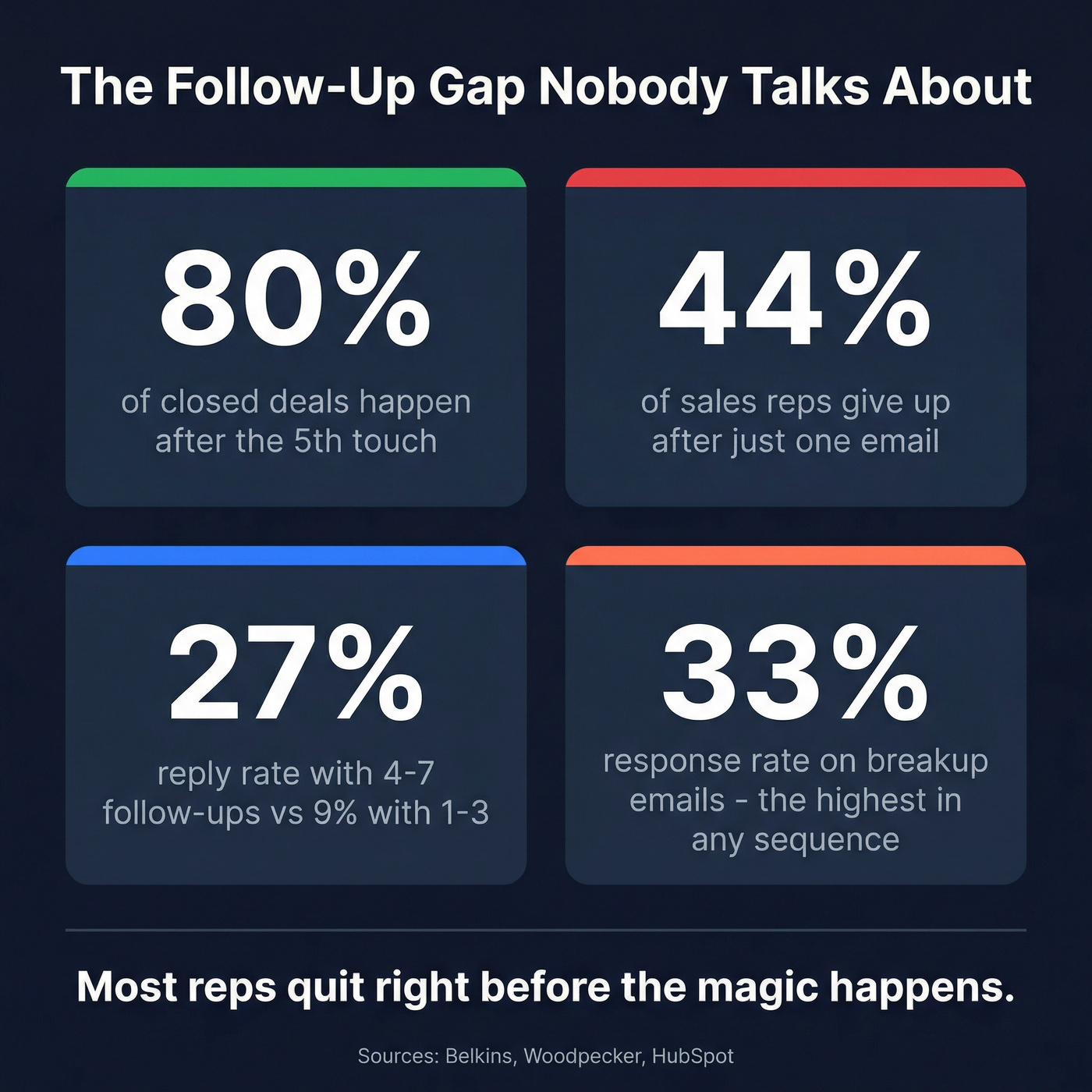
- Campaigns with 4-7 follow-ups hit a 27% reply rate vs. 9% for 1-3 emails (Woodpecker analyzed 20M emails to get that number)
- Breakup emails often generate the highest response rates in a sequence
Why Clients Go Silent
Eight times out of ten, your client isn't trying to be difficult. They're drowning. The silence usually falls into five buckets:
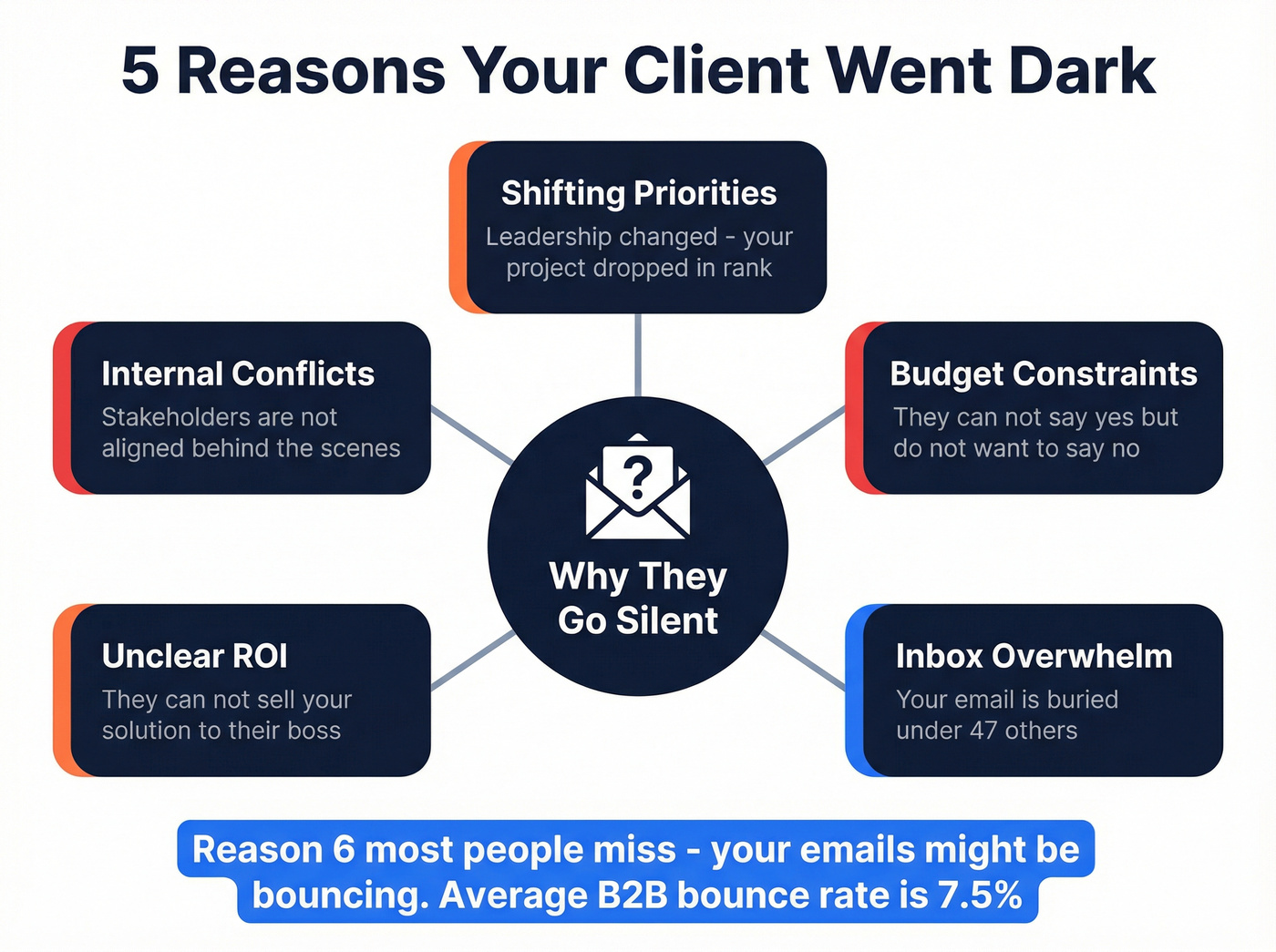
Shifting priorities after a leadership change. Budget constraints where they can't say yes but don't want to say no. Inbox overwhelm where your email sits under 47 others. Unclear ROI they can't articulate to their boss. Or internal conflicts where stakeholders aren't aligned and your contact doesn't want to admit it.
What most people miss is that your request creates work for them. Every "just checking in" email really says "please context-switch to my thing right now." That's why shorter, more specific follow-ups win - you're reducing the cognitive cost of replying.
There's a sixth reason most people overlook entirely: your emails might be bouncing. The average B2B cold email bounce rate runs around 7.5%. Before you draft follow-up #4, check whether your first three actually arrived. Prospeo verifies email addresses in real time with 98% accuracy, and the free tier covers 75 verifications a month. Two minutes of checking can save a week of wondering.
The Follow-Up Cadence That Works
Belkins analyzed 16.5M cold emails across 93 domains and mapped exactly how reply rates decline with each touch:
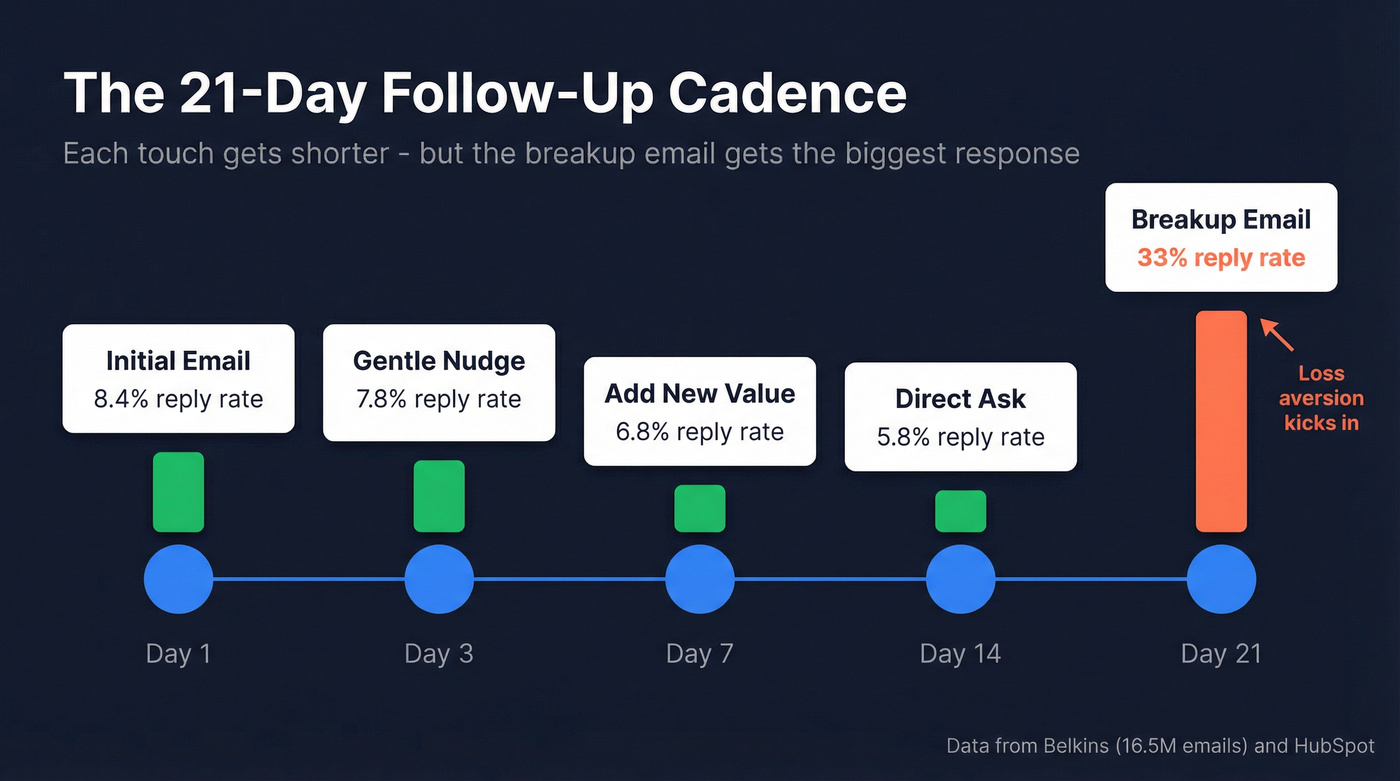
| Follow-Up # | Timing | Expected Reply Rate | Notes |
|---|---|---|---|
| Initial email | Day 1 | 8.4% | Best shot - make it count |
| Follow-up 1 | Day 3 | 7.8% | Gentle nudge |
| Follow-up 2 | Day 7 | 6.8% | Add new value or angle |
| Follow-up 3 | Day 14 | 5.8% | Direct ask |
| Follow-up 4 | Day 21 | 3.8% | Diminishing returns |
The breakup email is a separate play - covered below - with a 33% response rate per HubSpot data (HubSpot reports a 33% response rate](https://www.close.com/blog/the-breakup-email).
For most sequences, 4-5 emails is the practical ceiling. Belkins found that 4+ emails more than triples spam complaints and unsubscribe rates. That 27% reply rate from Woodpecker's data comes from campaigns with 4-7 follow-ups, but beyond that you're just adding risk. We've seen teams run 12-touch sequences thinking more is better. It isn't. You're training spam filters to hate you.
One nuance most cadence guides skip: enterprise contacts punish persistence faster than SMBs. If you're emailing a VP at a 1,000+ employee company, cap it at three or four touches.

Before you tweak your follow-up cadence, make sure your emails are actually arriving. A 7.5% average bounce rate means 1 in 13 messages never reaches your client's inbox. Prospeo's 5-step verification catches bad addresses in real time with 98% accuracy - so you stop wondering and start getting replies.
Stop following up with an inbox that never received your first email.
Templates That Actually Get Replies
Each follow-up should be shorter than the last. Your client doesn't need more information - they need less friction.
Gentle Nudge (Waiting for Feedback)
Subject: Quick follow-up on [project/proposal name]
Hi [Name], following up on the [deliverable] I sent on [date]. Did anything need clarification, or did I miss the mark somewhere? Happy to jump on a 10-minute call if that's easier than typing it out.
Value-Add (Waiting for Approval)
Subject: Thought this might help with [their specific challenge]
Hi [Name], while reviewing our [proposal/project], I came across [relevant insight or data point] that directly applies to [their goal]. Would it help to walk through how this changes the approach?
Direct Ask (Waiting for Information)
This one should be two sentences. No more.
Subject: Need one thing to keep moving
Hi [Name], we're at a standstill until I get [specific item]. Can you send it by [date], or let me know what's blocking it?
The Multiple-Choice Reply
When even a two-sentence email feels like too much work for your client, remove the typing entirely. We've tested this format dozens of times - it consistently outperforms open-ended asks because you're turning a writing task into a clicking task.
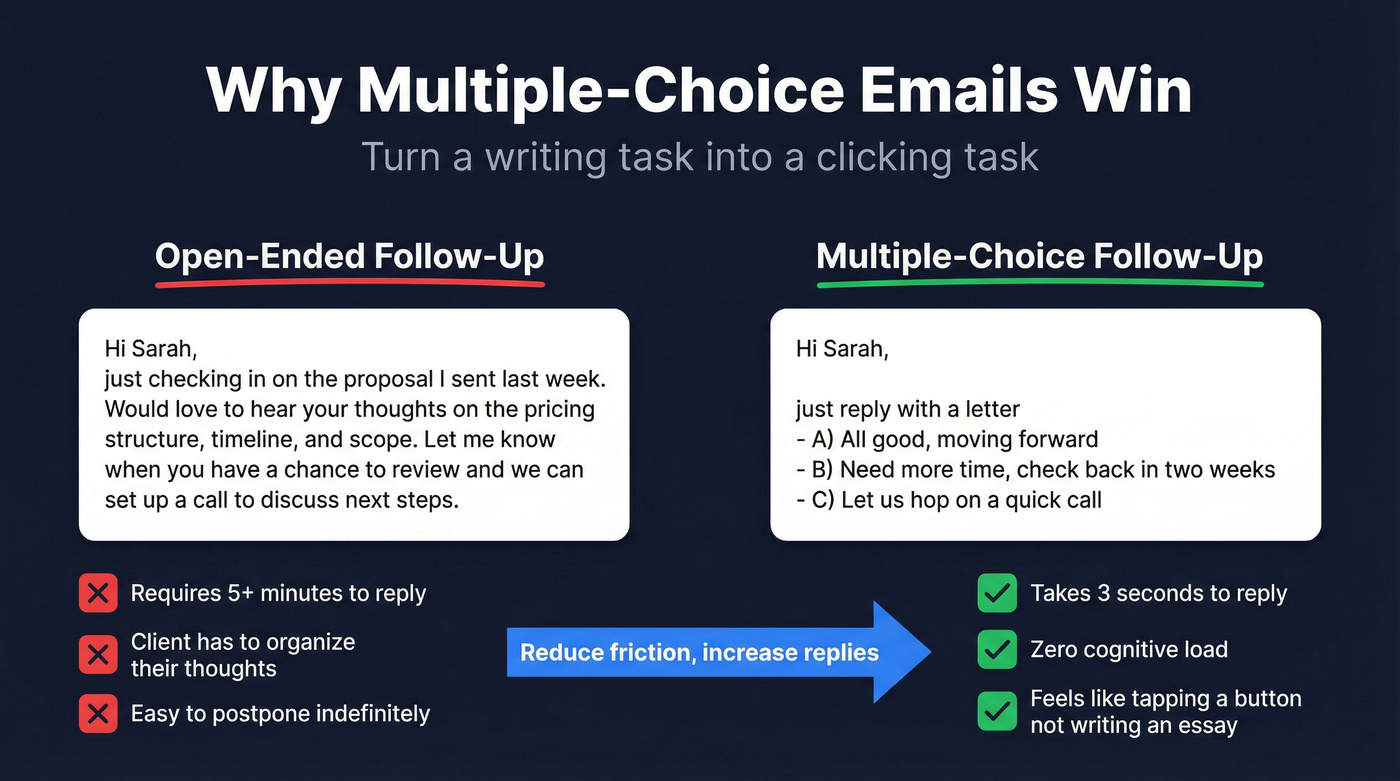
Subject: Quick - just hit reply with A, B, or C
Hi [Name], I know you're slammed. Just reply with a letter: A) All good - moving forward B) Need more time - check back in two weeks C) Let's hop on a quick call
That's it. No paragraph required.
Timing and Channel-Switching
Don't obsess over "perfect" send times. The best send times are the ones where you're not competing with every other automated sequence firing at 9:00 AM on a Tuesday. If you want a deeper benchmark view, see best send times and when to follow up.
Monday afternoons after 2PM work well - the morning rush has cleared and people are settling into their week. Friday mornings catch the "clear the decks" window before the weekend. Sunday evenings can work surprisingly well for executives doing Monday prep, though we'd only recommend this for warm contacts who already know your name.
One small trick: send at odd minutes. 10:07, not 10:00. 2:23, not 2:30. Round timestamps signal automation and get filtered more aggressively.
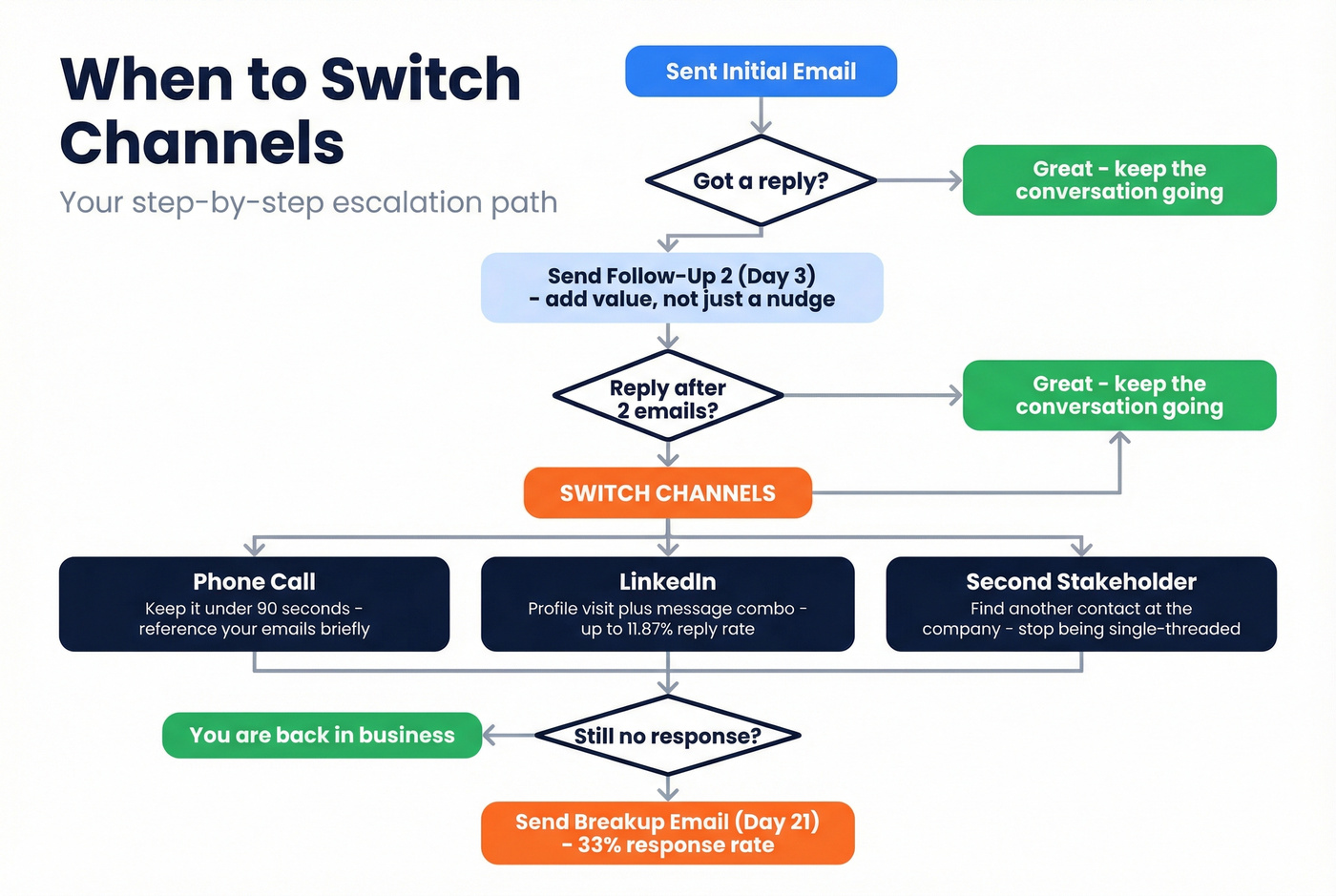
If two or three emails get zero response, switch channels entirely. A brief phone call or a comment on their recent social media post breaks the pattern and resets the dynamic. LinkedIn nurturing specifically can drive reply rates up to 11.87% with a message-plus-profile-visit combo, and 3-5 actions can push replies from 1% to over 5%. If you're building a repeatable system, borrow a proven follow-up strategy and sales cadence example.
Real talk: If your client has ghosted you for three weeks, the problem probably isn't your follow-up copy. It's that you're single-threaded into one contact. Find the second stakeholder. That's the real fix (here’s the full breakdown of multithreading in sales).
The Breakup Email
The breakup email is the most underused tool in client communication. It often generates the highest response rates in a follow-up sequence - HubSpot reports a 33% response rate. That's not a typo.
The psychology is straightforward: loss aversion. The moment you signal you're walking away, the client's brain reframes the relationship from "something I'll get to eventually" to "something I'm about to lose." Freelancers and sales reps on r/sales consistently report that the breakup email generates more replies than any other follow-up in their sequence. Even Tru Earth, a DTC brand using cold outreach, saw 10-15% response rates from breakup emails with prospects who'd never engaged before.
Keep it under five sentences. One CTA. No guilt trips. If you want more copy options, pull from these re-engagement email subject lines.
Subject options: "Is this goodbye?" / "Should I close your file?" / "Moving on"
Hi [Name], I've reached out a few times and haven't heard back, so I'm guessing the timing isn't right. I'll close out your file - no hard feelings. If things change, you know where to find me.
Prevent Ghosting Before It Starts
The best follow-up strategy is never needing one.
A prospect going dark is almost always preventable if you set the right expectations upfront. Set a communication charter at kickoff - agree on response-time expectations, preferred channels, and meeting cadence before work begins. Send "no-update updates" during quiet phases to keep the relationship warm. And identify all decision-makers early so your contact isn't silently waiting on someone you've never spoken to.
Let's be honest about the numbers: 80% of closed deals happen after the 5th touch, yet 44% of reps give up after one email. Build a system so you don't become one of them - starting with a deliverability-first outbound email campaign and a clean email deliverability checklist.
The article's real fix: stop being single-threaded into one silent contact. Prospeo's database of 300M+ profiles with 30+ filters lets you find the second stakeholder in seconds - complete with verified email and direct dial. At $0.01 per email, multi-threading a deal costs less than a cup of coffee.
Find the other decision-maker your silent contact won't introduce you to.
FAQ
How many follow-up emails is too many?
Four to five touches is the practical ceiling for most outreach sequences. Belkins' analysis of 16.5M emails shows that four or more emails more than triples spam complaints. For enterprise contacts at companies over 1,000 employees, cap it at three or four.
What's the best day to send a follow-up?
Monday afternoons after 2PM and Friday mornings consistently outperform the crowded Tuesday-Wednesday morning window. Send at odd minutes like 10:07 or 2:23 - round timestamps signal automation and get filtered more aggressively.
Should I call instead of emailing?
Yes - channel-switching works when email alone doesn't. If two or three emails get no response, a brief phone call breaks the pattern entirely. The consensus on r/sales is that a call after two unanswered emails feels persistent, not pushy, as long as you keep it under 90 seconds.
What if a prospect stopped responding mid-deal?
Resist the urge to send a longer email explaining your value. When a prospect goes dark mid-deal, something usually changed internally - budget got frozen, a stakeholder pushed back, or your contact lost political capital. Switch channels, try reaching a second contact at the company, and use the breakup email as your final touch.