

The Data-Backed SDR Follow-Up Strategy That Actually Gets Replies in 2026
"Send more emails" isn't a strategy - it's a prayer. A Belkins study of 16.5M cold emails found the highest reply rate was 8.4% from a single email, with every subsequent touch declining. Sending 4+ emails in a sequence more than triples unsubscribe and spam complaint rates.
The real game isn't sending more. It's sending smarter, across the right channels, with data that doesn't bounce.
Here's the short version: cap at 3 emails per sequence and supplement with calls and social touches. Fix your data before touching your sequencer - high bounce rates tank deliverability. And use the 14-day multichannel cadence below instead of a 12-email drip that trains prospects to ignore you.
Every Follow-Up Strategy Starts with Data
Here's a scenario we've seen play out dozens of times. A team builds a 2,000-contact list, loads it into Outreach or Smartlead, launches a sequence - and a huge chunk of emails bounce. Domain reputation craters. Deliverability drops across every campaign, not just the bad one.
Meritt was running exactly this playbook - 35% bounce rates, pipeline stuck at $100K/week. After switching to Prospeo's verified contact data, bounces dropped under 4% and pipeline tripled to $300K/week. If your bounce rate is above 5%, you don't have a follow-up problem. You have a data problem. Fix it first.

How Many Follow-Ups Should an SDR Actually Send?
The data looks contradictory until you reconcile it. That 16.5M-email dataset shows reply rates declining after the first email - and sending 4+ emails more than triples your spam complaint and unsubscribe rates. Meanwhile, a widely cited benchmark is that 80% of sales require at least five follow-up attempts. Outreach puts the [average at 5 touches](https://www.nimble.com/blog/how-many-touchpoints-does-it-take-to-close-a-sale/) to engage a prospect.
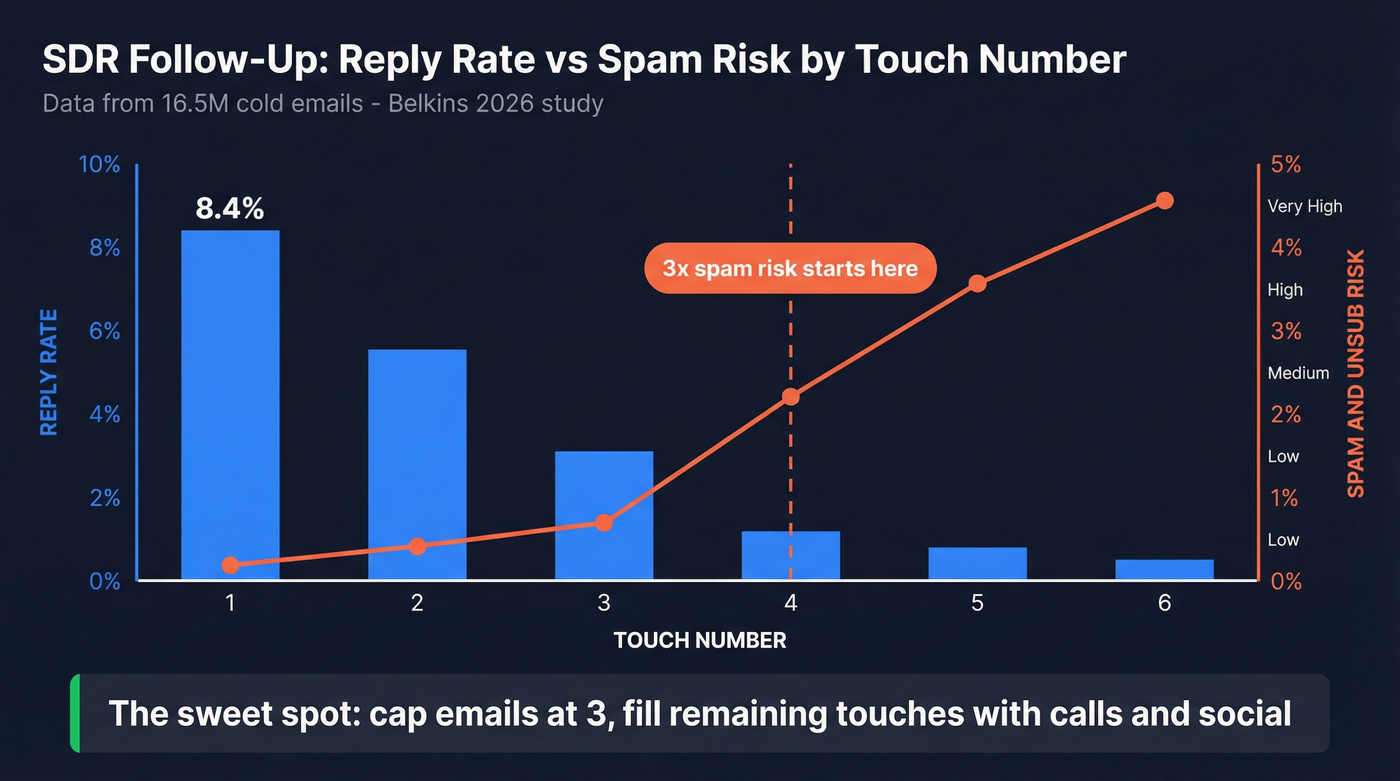
Five touches doesn't mean five emails. It means five touches across channels.
| Touch # | Email Reply Rate | Spam/Unsub Risk |
|---|---|---|
| 1 | 8.4% | Low |
| 2 | Declining | Low |
| 3 | Declining further | Rising |
| 4+ | Declining further | 3x baseline |
Cap emails at 3 per sequence. Fill the remaining touches with calls, social engagement, and voicemails. You hit the 5-9 touch threshold without burning your domain.
If you want more plug-and-play options, start with a proven sales cadence and then tailor it to your ICP.
The 14-Day Multichannel Cadence
This is the cadence we'd run for a mid-market outbound campaign. Three emails, two calls, two social touches. A LinkedIn message combined with a profile visit pulls an 11.87% reply rate - higher than any email follow-up in the dataset.
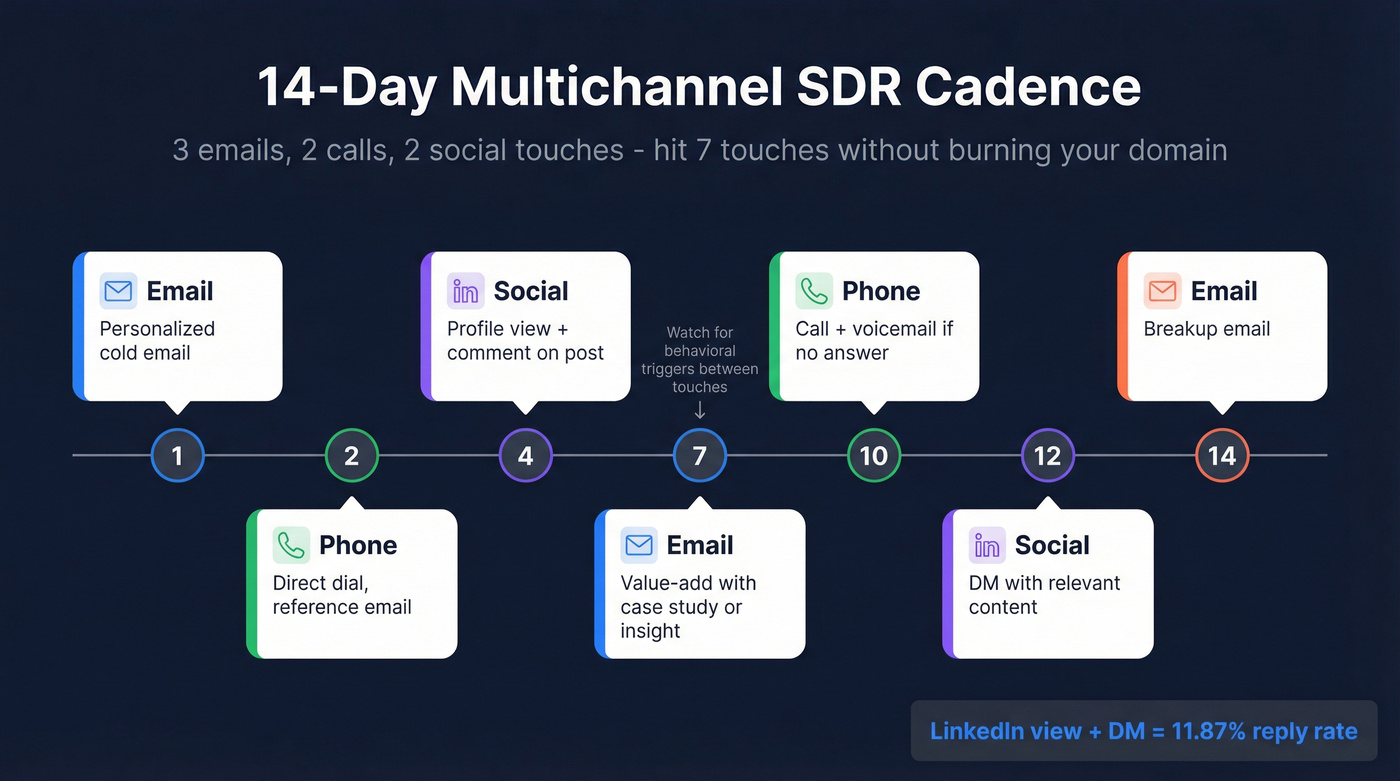
| Day | Channel | Action |
|---|---|---|
| 1 | Personalized cold email | |
| 2 | Phone | Direct dial, reference email |
| 4 | Social | Profile view + comment on post |
| 7 | Value-add (case study or insight) | |
| 10 | Phone | Call + voicemail if no answer |
| 12 | Social | DM with relevant content |
| 14 | Breakup email |
Let's be honest: most SDR teams would book more meetings by cutting their 8-email sequence in half and adding two phone calls. The obsession with email volume is a crutch for teams that don't want to pick up the phone.
If your team needs a refresher on why the phone still works, see the data-backed benefits of cold calling.
For the call steps to work, you need verified direct dials - not switchboard numbers that route to a receptionist. Prospeo's 125M+ verified mobiles with a 30% pickup rate make those Day 2 and Day 10 touches actually productive.
One thing the calendar-based cadence misses: behavioral triggers. If a prospect visits your pricing page, downloads a resource, or gets mentioned in a funding announcement, that's your cue to move up the next touch. Don't just follow the calendar - follow the signals.
To operationalize this, build a simple signal-based outbound workflow and keep your intent signals definitions consistent across teams.
Adjust by Segment
Not every prospect gets the same cadence.
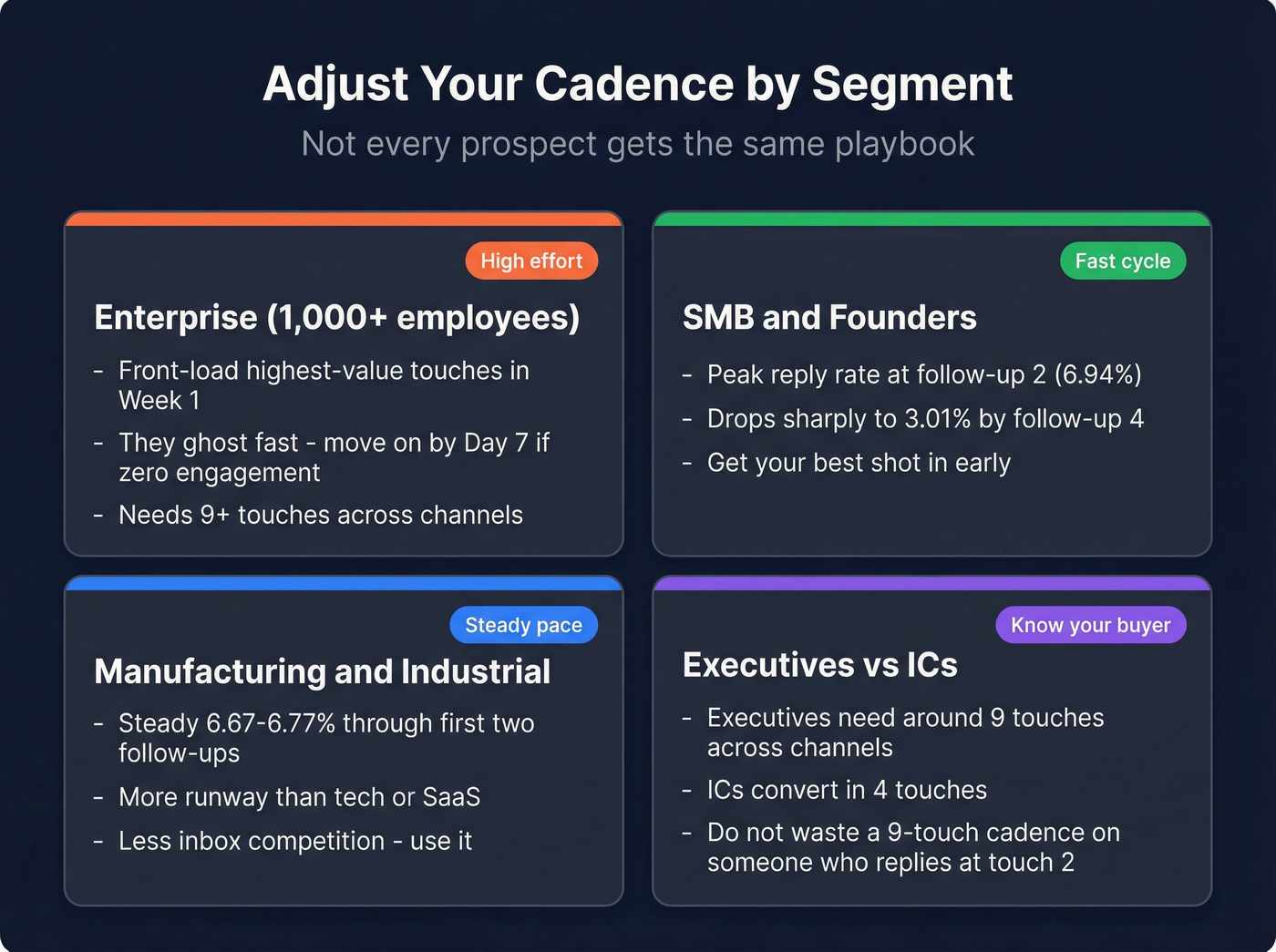
Enterprise (1,000+ employees): They ghost fast. Front-load your highest-value touches in the first week. If there's zero engagement by Day 7, compress or move on.
SMB / Founders: Founders peak at follow-up #2 with a 6.94% reply rate, then drop sharply to 3.01% by #4. Get your best shot in early.
Manufacturing / Industrial: These verticals hold steady at roughly 6.67-6.77% through the first two follow-ups, so you've got more runway here than in tech or SaaS where attention spans are shorter and inboxes are more crowded.
Executives vs ICs: Executives need around 9 touches across channels. ICs convert in 4. Don't waste a 9-touch cadence on someone who'll reply to touch 2 or never.
If you’re segmenting by engagement and actions (not just firmographics), use behavioral segmentation to keep the rules clean.

Every bounced email in your sequence damages your domain reputation across all campaigns. Prospeo's 5-step verification delivers 98% email accuracy and 125M+ verified mobile numbers with a 30% pickup rate - so your Day 2 calls actually reach a human.
Stop burning your domain. Start with data that connects.
Follow-Up Templates That Get Replies
Adapt these to your ICP and voice. Copying templates verbatim is how you end up sounding like every other SDR in someone's inbox. And remember: 69% of recipients decide to mark an email as spam based on the subject line alone.
For more examples, pull from these Outreach email templates and then rewrite them in your voice.
1. The Permission Ask
"Hey [Name], I sent something over last week about [specific problem]. Totally fine if the timing's off - would it be okay if I followed up next [day]?"
Low-pressure, gives the prospect control.
2. The One-Stroke Reply
Instead of writing a paragraph, reduce friction to a single keystroke:
"I know you're busy, so hit me back with a number: (1) Not interested, (2) Interested but bad timing, (3) Let's talk."
3. The Value-Add
"Saw your [specific post/announcement]. Thought you might find these two resources useful: [link 1], [link 2]. Worth a 15-min chat?"
4. The Pattern Interrupt
Skip this template if your brand voice is buttoned-up and corporate - it works best for teams that can pull off a conversational tone without sounding forced.
❌ "Hi [Name], just following up on my last email. Would love to connect when you have a moment."
✅ "I'll be honest - I'm a salesperson, and salespeople are the worst. But I genuinely think [specific insight about their business] is worth 10 minutes. If I'm wrong, I'll never email you again."
The second version works because it disarms the sales-skepticism reflex.
5. The Breakup
"This is my last email. If [problem you solve] isn't a priority right now, totally get it. If it becomes one, here's my calendar link: [link]."
Surprisingly high reply rates because it removes all pressure. The consensus on r/sales is that breakup emails are the single highest-converting touch in most sequences - which tells you something about how badly most SDRs handle the first four.
Mistakes That Kill Your Pipeline
Most follow-up failures aren't about cadence or copy. They're about laziness.
No research before follow-up. If your second email doesn't reference something specific about the prospect's company or recent activity, you're sending noise. Spend 90 seconds on their company page before hitting send. Use a lightweight pre call research checklist so reps don’t “wing it.”
"Just checking in" emails. Every touch needs to deliver value or ask a specific question. If you don't have something new to say, don't say anything.
Single-channel sequences. Email-only cadences leave massive reply rate on the table. The data is unambiguous - multichannel outperforms single-channel by a wide margin, and it's not close.
Giving up after one touch. 80% of sales require five or more follow-ups. One email and done isn't prospecting - it's hoping.
Loading unverified contacts into your sequencer. This one drives us crazy because it's so preventable. Every bounced email damages your sender reputation, and it compounds across campaigns. A 10% bounce rate today becomes a 30% inbox placement problem next month. If you’re troubleshooting, start with an email deliverability checklist and then fix the root cause.
Should You Automate Follow-Up with AI?
A fully loaded in-house SDR costs $140K-$150K/year when you factor in base salary, benefits, tools, and management overhead. An AI SDR platform runs $500-$2,000/month - Amplemarket starts around $50/user/month, Apollo at $49/user/month. AI platforms generate 40-60 qualified opportunities per month versus 15-20 from a human rep, and early adopters report 15-20% reply rate increases.
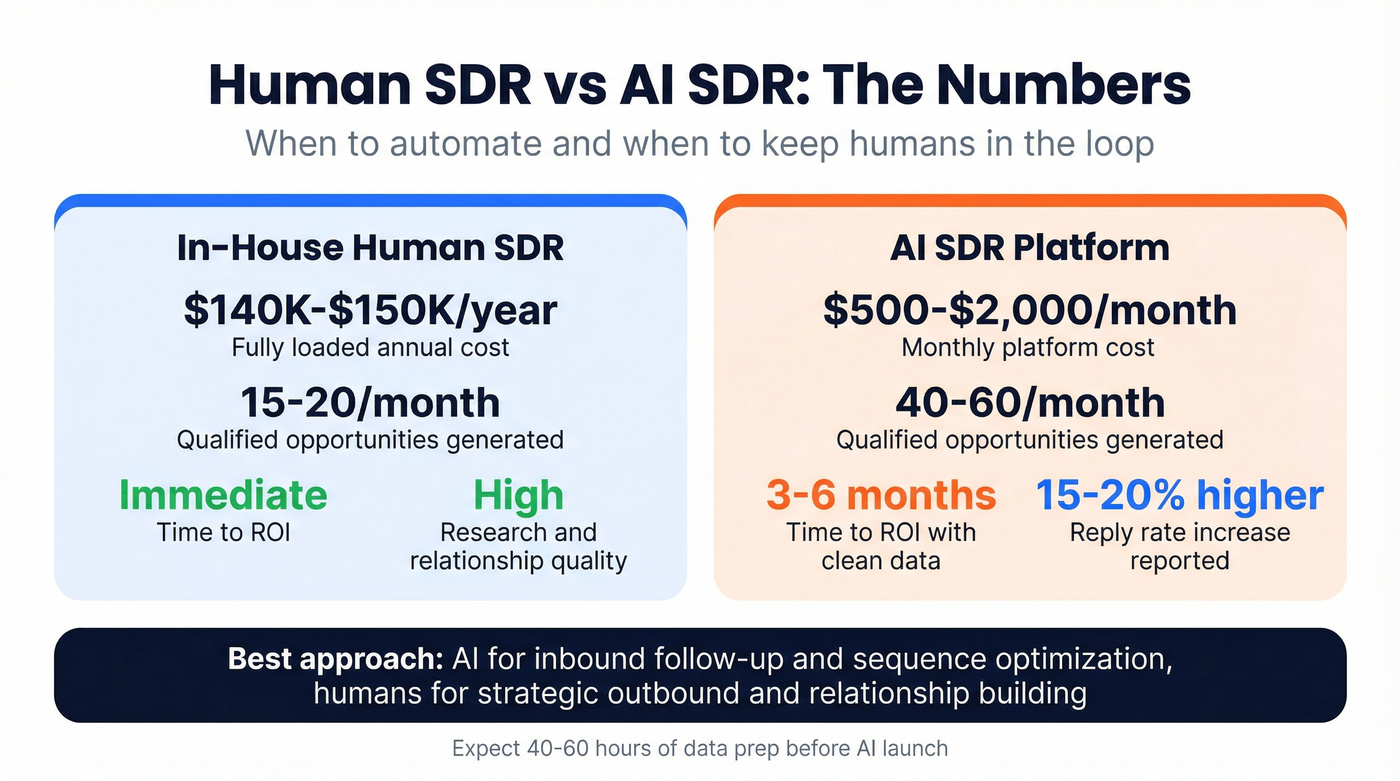
The catch: expect 40-60 hours of data prep before launch, and 3-6 months before ROI materializes with clean data.
If you’re evaluating vendors, compare the best AI tools for automating sales follow-ups and sanity-check the workflow against your current AI in sales cadences process.
Responding within 5 minutes makes you 100x more likely to connect - that's where AI inbound agents earn their keep. But AI won't fix lazy outbound. If your targeting is wrong or your data bounces, AI just automates the failure faster. Use it for inbound follow-up and sequence optimization. Keep humans on strategic outbound where research and relationship-building matter.
A multichannel cadence only works when you have real direct dials and emails that don't bounce. Meritt cut bounce rates from 35% to under 4% and tripled pipeline to $300K/week - same team, better data. Prospeo refreshes every record every 7 days, not the 6-week industry average.
Build your next sequence on contacts that are actually current.
FAQ
How long should an SDR wait between follow-ups?
Two to three business days between emails keeps you persistent without feeling pushy. Outreach recommends 3-5 days between email touches. Keep your total cadence window to 14 days and mix in calls and social touches between sends.
When should you stop following up?
After 7 touches with zero engagement - no opens, no clicks, no replies - move on. If they've opened but not replied, switch channels with a call or social DM before stopping entirely. Pushing past 4 emails dramatically increases spam complaints.
What tools do you need for an SDR follow-up stack?
Three essentials: a sequencer (Outreach, Salesloft, or Smartlead), a verified data source for clean emails and direct dials, and a CRM like HubSpot or Salesforce. Get those three right and your outbound cadence has a foundation that holds up. In our experience, the data layer is where most teams cut corners and pay for it later.
Does a multichannel cadence really outperform email-only?
Yes - significantly. LinkedIn profile views paired with a DM pull an 11.87% reply rate, higher than any email follow-up after the first send. Adding just two phone touches to a 3-email sequence lets you hit 7 total touches without the deliverability risk of a 7-email drip.