

Communication Skills in Sales: What the Data Says Actually Works
Only 18% of buyers believe salespeople show up well-prepared for conversations. That means four out of five prospects walk into your meeting expecting to be disappointed - and most reps prove them right within the first two minutes.
The gap between knowing and doing is where deals die. You've rehearsed the pitch, studied the deck, internalized the value prop. Then the prospect asks a question you didn't expect, and suddenly you're fumbling for words, sounding half as confident as you actually are, losing the thread of your thought mid-sentence. That's not a knowledge problem. It's a muscle memory problem - and it's where most advice on communication skills in sales completely fails you.
Every behavior in this guide is backed by data from millions of real sales calls. Measurable behaviors that separate top performers from everyone else, and a practice system to make them stick.
What You Need (Quick Version)
Stop reading listicles of 18 sales communication skills. Master three and practice weekly:
- Active listening - measurable via your talk-to-listen ratio. The target is 43% talking, 57% listening. Track it.
- Discovery questioning - 42% of reps struggle here. It's the single biggest skill gap with the highest ROI to close.
- Storytelling - stories are retained 22x better than facts alone. If you're leading with features, you're losing.
That's it. Three skills. Everything else in this guide supports those three.
You've probably seen the "7 C's of communication" framework - clarity, conciseness, and so on. Those are fine for general business writing. This guide focuses on the specific sales communication techniques that move deals, backed by data from millions of calls.
What the Data Says About Effective Sales Communication
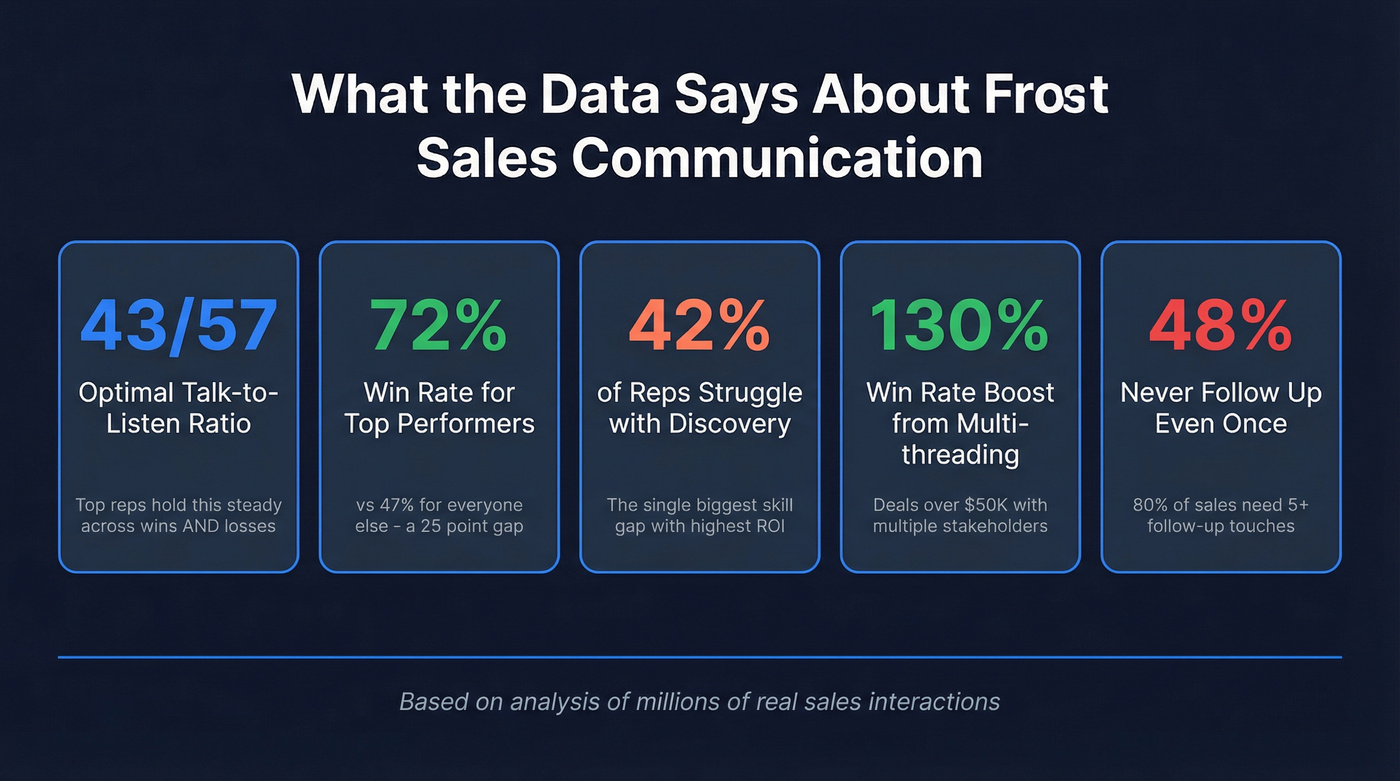
Analysis of tens of millions of sales interactions reveals a headline finding everyone knows: the optimal talk-to-listen ratio is 43% talking to 57% listening. Top reps let the prospect do most of the talking.
But here's the insight that matters more.
The biggest separator between high and low performers isn't how much they talk. It's how consistent they are. High performers maintain roughly the same talk-to-listen ratio whether they win or lose a deal. Low performers' talk time swings by 10 percentage points - from 54% in won deals to 64% in lost ones. That inconsistency reveals something fundamental: lower performers react to conversations. Top performers drive them.
A global study of over 1,000 sellers reinforces this with outcome data. Top-performing sellers win 72% of their deals versus 47% for everyone else - a 25-point gap that comes down to specific communication behaviors: top performers are 63% more likely to communicate a strong ROI case, 58% more likely to lead thorough needs discoveries, and 59% more likely to collaborate deeply with buyers across the buying process. Buyers are 2.7x more likely to trust trained sellers and 43% more likely to accept follow-up meetings from reps who demonstrate strong conversation skills.
Then there's the follow-up gap, which is honestly professional malpractice. 80% of successful sales require five or more follow-up touches. Yet 48% of salespeople never make a single follow-up attempt. 44% give up after one. That's not a communication skill problem. That's a discipline problem. (If you need a system, use this prospect follow up playbook.)
The most underrated communication skill isn't about what you say - it's about who you say it to. Multi-threading - bringing multiple stakeholders into the deal - boosts win rates by 130% in deals over $50K, based on analysis of 1.8 million opportunities. Closed-won deals have selling teams that are 67% larger than lost deals. Selling effectively isn't just about how you talk to one person. It's about how many of the right people you're talking to. If you're building this motion, follow an ABM multi-threading approach.
Most sales teams know these numbers exist. Almost none have changed their behavior because of them.

Multi-threading boosts win rates by 130% - but only if you can actually reach every stakeholder. Prospeo gives you 98% accurate emails and verified direct dials for decision-makers across 300M+ profiles, so your discovery calls happen with the right people.
Stop perfecting your pitch for prospects you can't reach.
The Skills That Actually Move Deals
Active Listening (Is a Behavior, Not a Trait)
Everyone says "be a better listener." Nobody tells you how to measure it.

The number: 43% talk, 57% listen. That's your benchmark. Not a vague aspiration. A measurable ratio you can track on every single call.
But the ratio alone isn't the insight. High performers hold that ratio steady across wins and losses. They don't panic-talk when a deal feels shaky. They don't over-explain when the prospect pushes back. They stay disciplined because they've practiced enough that the behavior is automatic, not effortful.
Here's a practical exercise: record your next five calls. Calculate your talk-to-listen ratio for each one. If you're above 50% talk time, you're over-indexing. If your ratio swings more than 5 points between calls, you're reacting instead of driving. Most reps who do this exercise are genuinely surprised - they think they're listening more than they are. This is one of the fastest ways to improve sales conversation skills without changing anything about your pitch. (Use a sales call checklist to keep the measurement consistent.)
The goal isn't silence. It's strategic restraint. Ask a question, then actually wait for the full answer. Don't jump in the moment you hear a keyword that triggers your pitch reflex.
A related behavior worth tracking: bringing in a sales engineer at the right moment boosts win rates by roughly 30%. That's active listening at the deal level - recognizing when the conversation needs a different voice, not just a different answer.
Sharpening Your Discovery Questions
Discovery is where 42% of reps struggle - the single largest skill gap identified in sales research. And it's the highest-leverage gap to close, because bad discovery poisons everything downstream: your demo is generic, your proposal misses the mark, and your champion can't sell internally because you never uncovered the real buying criteria.
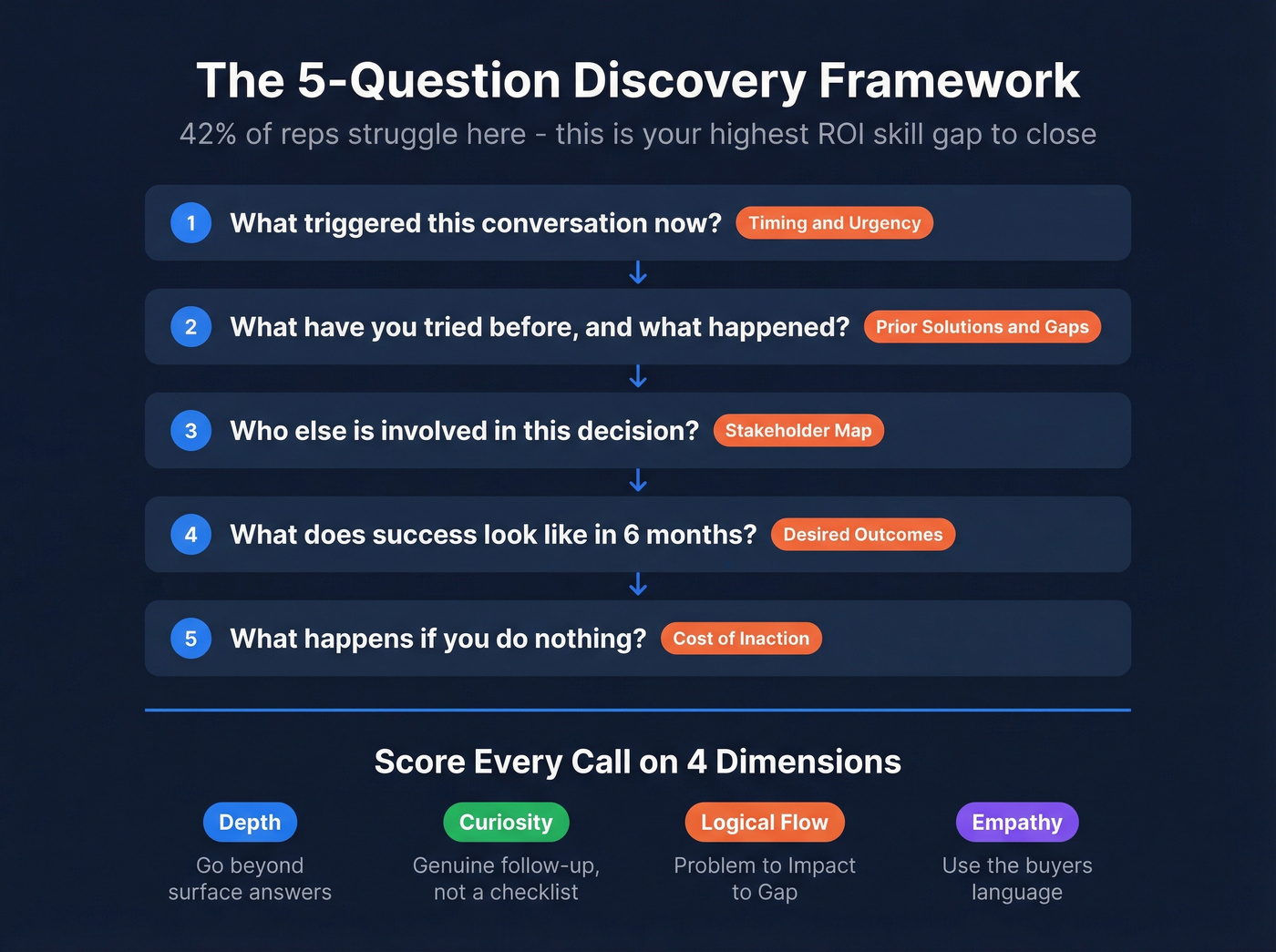
Before any first call, prepare a 5-question discovery checklist:
- What triggered this conversation now? (Timing and urgency)
- What have you tried before, and what happened? (Prior solutions and gaps)
- Who else is involved in this decision? (Stakeholder map)
- What does success look like in 6 months? (Desired outcomes)
- What happens if you do nothing? (Cost of inaction)
The Sandler principle underneath these questions is mutual commitment - discovery isn't an interrogation. It's a two-way conversation where both sides agree to be honest about fit. That means confirming the decision process before you ever send a proposal, and documenting the business case together rather than guessing at it. If you want a tighter structure, borrow these deal qualification questions.
One more discovery behavior worth building: mention the competitive landscape early. Bringing up competitors proactively in the first half of a deal increases your odds of winning by 32%. Since 2022, competitive mentions in deals have increased 57%. Your buyers are already comparing you. Own the conversation instead of avoiding it. (A simple way to operationalize this is with competitive intelligence for B2B sales.)
Score your discovery calls on four dimensions: depth (going beyond surface answers), curiosity (genuine follow-up versus running through a checklist), logical flow (Problem -> Impact -> Existing solution -> Gap), and empathy (using the buyer's language, not sales jargon). If you're scoring yourself on those four dimensions after every discovery call, you'll improve faster than 90% of your peers.
Answering Questions Without Fumbling
Here's the thing nobody talks about: most reps know how to ask questions. They've read the books, done the training. But when the prospect fires back with a tough question - about pricing, about competitors, about a feature gap - they freeze. They ramble. They sound less confident than they actually are.
This pain point comes up constantly in sales communities. "I know what I want to say, but I fumble when I actually speak." "I take too long to find the right words." "I lose the thread of my thought mid-sentence."
Phil M Jones nails the fix: build a "pantry of words." The principle is simple - the worst time to think of what to say is the moment you need to say it. For every recurring sales moment (pricing objection, competitor question, "we're happy with our current vendor"), you should have a pre-prepared response you've practiced until it's instinct. Not a script. Scripts make you sound robotic and kill your ability to adapt when the conversation goes sideways. What you want is a framework you can bend in the moment. (For the highest-frequency moments, keep an objection handling script library.)
His first-15-seconds approach is gold for openings: lead with a genuine compliment, sincere recognition, or a request for an opinion. These join the other person's story rather than forcing them into yours.
And yes - it's okay to pause before responding. A two-second pause signals thoughtfulness, not uncertainty. The reps who rush to fill silence are the ones who sound unsure.
Storytelling That Sticks
Stanford's research found that retention of information through story is 22 times stronger than facts alone.

Twenty-two times.
If you're leading with feature lists and ROI calculators, you're fighting human neuroscience.
The framework that converts in sales is SCRI - and it works because it mirrors how humans naturally process change:
- Situation: Where was the customer before? Paint the scene.
- Complication: What problem emerged? Frame it as an emotional barrier - frustration, risk, anxiety - not just a functional gap.
- Resolution: How did they solve it? (Your product is part of this, but the customer is the hero.)
- Impact: What changed? Dollarize it if you can.
The critical principle: the customer is the hero, not your product. Traditional pitches make the product the protagonist. Story-driven selling makes the prospect the protagonist and your solution the tool that helped them win. Among all sales communication techniques, storytelling is the one most reps underinvest in - even though the data overwhelmingly supports it.
Before you tell any story, use the COIN-OP model to understand your buyer: Challenges, Opportunities, Impacts, Needs, Outcomes, Priorities. If you don't know these six things about your prospect, you're not ready to tell a story - you're guessing at which story to tell.
Written and Digital Communication
Most initial sales touchpoints are now digital - 70-80% of first touches happen via email, messaging, or social before any live conversation occurs. And 71% of prospects prefer independent research over talking to a rep, which means your writing is doing the selling before you ever get on a call.
Cold email reply rates sit at 1-4% for most senders. Only 16% of teams crack reply rates above 5%. And 69% of cold email senders report performance declining year over year, thanks to spam filtering and AI-generated content fatigue. Here's a stat that should sting: only 5% of senders personalize every email individually. The other 95% are sending variations of the same template and wondering why nobody responds. If you're tightening your system, start with email outreach analytics so you can see what's actually moving.
Multi-channel communication changes the math. Cold calling nearly doubles email reply rates - from 1.81% to 3.44% - even if you don't connect live. Leave a voicemail and that number jumps to 5.87%. Top-quartile cold callers book 3x more meetings than average peers. (If you're rebuilding your call motion, use this B2B cold calling guide.)
The phone isn't dead. It's a force multiplier for your emails.
LinkedIn InMail pulls an 18-25% reply rate versus roughly 3% for cold email. That's not a small difference - it's an order of magnitude. Referencing a mutual connection doubles acceptance rates. Complimenting a specific post hits 35% response rates in some campaigns.
For email specifically, the subject line research is worth memorizing: four words or fewer, lowercase, priority-based language. Make it look like an internal message, not a marketing blast. (Keep a swipe file of cold email subject lines that get opened.)
Sales Voice Techniques and Nonverbal Communication
You've heard it: "93% of communication is nonverbal." It's in every sales training deck.
It's also wrong.
That stat comes from Albert Mehrabian's studies in the late 1960s, which specifically measured how people communicate feelings about likes and dislikes. Not all communication. Not sales conversations. Not email. Repeating this stat in 2026 makes you look uninformed, not sophisticated. In a world where the majority of sales communication is written, words matter enormously.
That said, nonverbal cues and vocal delivery do matter on video calls and in-person meetings. Only 26% of buyers say reps ask good questions over video, which suggests most reps aren't even making basic adjustments for the medium. Your tone, pacing, and inflection shape how your message lands just as much as the words themselves. And if you're selling across cultures, adjust your pacing, directness, and use of silence accordingly. What reads as "confident" in New York can read as "aggressive" in Tokyo.
Practical video tips that actually move the needle: look squarely into your camera when speaking (not at the prospect's face on screen - that reads as looking away). Watch them on screen when they talk, then re-engage the camera when you respond. Use relaxed, open hand gestures - people subconsciously prefer open palms. Lean forward slightly to signal engagement.
These aren't soft skills. They're trust signals.
How to Read Your Buyer in 60 Seconds
Adapting to buyer personality isn't "soft skills" - it's strategy. The same product needs completely different language for a CFO versus a VP of People.
The DISC framework gives you four buyer archetypes. You can identify which one you're dealing with in the first 60 seconds of a conversation:
| Type | How to Identify | Approach | What to Avoid | Example Phrase |
|---|---|---|---|---|
| Dominance (D) | ROI-focused, fast decisions | Be concise, lead with results | Over-explaining, long intros | "Here's the bottom line." |
| Influence (I) | Vision-focused, enthusiastic | Use storytelling, social proof | Overloading with details | "Imagine this at scale." |
| Steadiness (S) | Methodical, relationship-first | Build connection, show empathy | Rushing, being aggressive | "Here's how others handled this." |
| Conscientiousness (C) | Wants data, analyzes everything | Provide facts, comparisons | Being vague, lacking proof | "Here's the data." |
Quick diagnostic: Ask "What's the most important factor for you in making this decision?"
A D-type says "results" or "timeline." An I-type says "the vision" or "team excitement." An S-type says "making sure it works for everyone." A C-type says "the data" or "risk mitigation."
Carew International offers a complementary lens with their Power/Security/Affiliation model. Power customers want you to get to the point. Security customers need logic and structure before they'll commit. Affiliation customers need to feel a human connection before diving into data.
The practical application: before every meeting, spend 30 seconds reviewing what you know about the buyer's communication style. Adjust your opening, your pacing, and your proof points accordingly. Same product. Different delivery. Adapting your delivery to buyer personality improves close rates by 15-25% across the sales cycle - and it's one of the easiest levers to pull because it requires zero new information about your product. Whether you're refining b2b sales communication skills or selling to consumers, reading the room is non-negotiable. (If your team struggles with this, steal a few patterns from these buyer persona examples.)
Communication Mistakes That Kill Deals
Most communication failures aren't dramatic. They're quiet. The prospect doesn't hang up or send an angry email. They just... disengage. Stop responding. Go with a competitor who made them feel more understood.
Here are the seven mistakes that show up most consistently across thousands of analyzed sales conversations:
- Talking too much. Especially about your product. If you're above 50% talk time, you're pitching, not selling.
- Giving away information without getting engagement in return. Every piece of information you share should earn a question or commitment back. If you're monologuing for three minutes and the prospect hasn't spoken, you've lost them.
- Pitching features instead of solutions. Nobody cares that your platform has 47 integrations. They care that it'll save their ops team 10 hours a week. (If this is a recurring issue, fix your feature dumping habit.)
- Leading with price instead of value. Pricing conversations have gotten 62% longer since 2020. Buyers are more sophisticated - reps who rush to price before establishing value lose the negotiation before it starts.
- Making hollow promises. Overpromising on timelines, capabilities, or outcomes destroys trust faster than any competitor can.
- No intention of closing. Some reps are so focused on the presentation that they never actually ask for the next step. Every call needs a clear close - even if the close is just booking the next meeting.
- Not knowing how to handle objections. 47% of reps identify objection handling as their top skill gap. If you can't reframe an objection back to value and end with a clear next step, you're leaving deals on the table.
Diego Mangabeira - who's made 11,519 cold calls and closed $40M+ at enterprise - distills the meta-mistake perfectly: "I didn't need to sound smart. I needed to be curious. I needed to make it about them, not me."
His biggest tactical shift? Moving from opening with rapport to opening with relevance. Instead of "How's your day going?", he'd reference a funding round, a new initiative, or a role change. The result: 69.1% of his meetings converted to SQLs with a sub-18% no-show rate. That's what happens when you do the research and make the buyer journey about them from the first second.
Real talk: If your deals typically close under $15K, skip obsessing over all seven. Fix #1 (talk less) and #6 (always close for a next step), and you'll outperform most of your team. The rest matters more as deal complexity - and the number of stakeholders - increases.
How to Practice Until It's Instinct
Knowledge without practice is entertainment. You can read every framework in this guide and still fumble your next discovery call if you haven't drilled the behaviors until they're automatic.
Six roleplay exercises that cover the full sales conversation:
- Objection handling - practice reframing objections back to value without apologizing or immediately discounting
- Negotiation - simulate pricing conversations where the buyer pushes back hard
- Discovery - run through your 5-question checklist with a colleague playing a resistant buyer
- Competition - practice responding when a prospect says "we're also looking at [competitor]"
- Buyer personas - roleplay the same pitch for a D-type CFO, then an S-type VP of People
- Getting to power - practice navigating from a mid-level contact to the economic buyer
Score your discovery roleplays on four criteria: depth of questioning, genuine curiosity (not checklist-running), logical flow (Problem -> Impact -> Existing solution -> Gap), and empathy (using the buyer's language). Record the sessions. Review them. I've seen teams compress ramp time from months to weeks just by doing this consistently.
Work on three critical conversations at any given time - one personal, one as a leader, one that puts money in your pocket. That constraint forces focus. You can't improve 18 skills simultaneously. Pick three. Drill them weekly. Building sales rep communication skills is no different from building any other high-performance habit: it requires deliberate repetition, not passive consumption.
The ROI data backs this up: sales training delivers $4.53 for every dollar spent - a 353% return. Improving just one skill gap leads to a 17% boost in quota attainment within a single quarter.
Yet only 26% of reps receive weekly coaching. That's an absurd gap between what works and what teams actually do.
Make roleplay a weekly habit. Not monthly. Not quarterly. Weekly. The teams that do this consistently see measurable improvement in pipeline and win rates within 60-90 days.
AI Tools for Communication Coaching
The AI coaching market surpassed $62 billion in 2025 and is growing at 28.3% annually. The performance data is hard to ignore: teams using AI coaching tools see 24% higher win rates and 37% faster onboarding. Sellers who frequently use AI generate 77% more revenue, based on analysis of 7.1 million opportunities.
Here's the reality - 68% of new sales hires miss their first-year quotas. Traditional training methods fail 79% of organizations. AI doesn't replace the practice habits from the last section, but it makes practice dramatically more accessible.
| Tool | What It Does | Price | Best For |
|---|---|---|---|
| Gong | Call analysis, deal intelligence | ~$100+/user/mo | Teams wanting data on every call |
| Lavender | Real-time email coaching | $27/user/mo | SDR teams writing 20+ emails/day |
| ChatGPT | Roleplay, objection practice | Free / $20/mo (Plus) | Solo reps on a budget |
| Chorus.ai | Conversation intelligence | ~$100/user/mo | Mid-market teams in ZoomInfo ecosystem |
Gong is the gold standard for conversation intelligence - it'll show you your exact talk-to-listen ratio, flag deals at risk, and surface patterns across your entire team's calls. It's not cheap, but the data is unmatched.
Lavender is the best bang-for-buck tool if your team lives in email. At $27/user/month, it scores your emails in real time and suggests specific improvements. For high-volume SDR teams, it's worth a trial.
ChatGPT is the sleeper pick. Use it as a free roleplay partner: "You're a skeptical CFO at a 200-person SaaS company. I'm going to pitch you on our analytics platform. Push back hard." It's not perfect, but it's available at 11 PM when you're prepping for tomorrow's big call. Use it to test message clarity, A/B test email variations, and practice tough conversations before they happen.
AI won't replace communication skills. But sellers using AI are already crushing those who don't. The 77% revenue gap is only going to widen.
The Prerequisite Nobody Talks About - Reaching the Right Person
You can master every framework in this guide - perfect your talk-to-listen ratio, nail your SCRI stories, adapt to every DISC type - and none of it matters if your email bounces or you're calling a number that's been disconnected for six months.
70-80% of initial sales touchpoints are digital, and 96% of prospects research companies before engaging with a sales rep. That means your first written touch carries enormous weight. If it never arrives because your data is stale, you've wasted every word you wrote. Worse, bounced emails damage your domain reputation, which tanks deliverability for every future email you send. (If you want the mechanics, start with email deliverability and then lock down domain reputation.)

This is where tools like Prospeo fit. It's not a coaching tool or a conversation intelligence platform - it's the data layer that makes sure your communication actually reaches someone. The database covers 300M+ professional profiles with 98% email accuracy and a 7-day data refresh cycle. You can verify emails in bulk before any campaign launches, keeping bounce rates under 4%. (If you're evaluating vendors, compare email verifier websites and follow a clean email verification list SOP.)
Think of it this way: the cold email stats from earlier (1-4% reply rates, 69% YoY decline) get even worse when a chunk of your list is invalid. Clean data doesn't guarantee replies, but dirty data guarantees waste.
48% of reps never follow up because they lack reliable contact data. Prospeo's 7-day data refresh means the emails and mobiles you pull today still work next week - so your five-touch follow-up sequence actually lands.
Make every follow-up count with data that's never stale.
FAQ
What's the most important communication skill in sales?
Active listening - specifically maintaining a consistent talk-to-listen ratio of 43% talking to 57% listening. Top performers hold this ratio steady whether they win or lose, while low performers swing by 10+ percentage points between deals. Consistency signals control; inconsistency signals reactivity.
How do I stop fumbling my words on sales calls?
Build a "pantry of words" - pre-prepared responses for recurring moments like pricing objections, competitor questions, and discovery openers. Practice three critical conversations weekly until the language becomes instinct. Record yourself, review the tape, and drill the moments where you stumble. These skills improve fastest with deliberate repetition, not passive study.
Does adapting communication style really affect close rates?
Yes. Top performers win 72% of deals versus 47% for everyone else, driven by specific behaviors like thorough discovery and buyer-adapted delivery. Using frameworks like DISC to match your approach to the buyer's personality improves close rates by 15-25% - with zero new product knowledge required.
How can I improve my cold email reply rates?
Pair better writing with verified contact data and multi-channel outreach. Cold email averages 1-4% reply rates, but adding a cold call nearly doubles that to 3.44%, and a voicemail pushes it to 5.87%. Verify your list first - bounce rates above 4% damage your sender reputation and tank deliverability for every future campaign.
What are the best communication skills in sales to learn first?
Start with three: active listening (track your talk-to-listen ratio), discovery questioning (use a 5-question checklist on every first call), and storytelling (use the SCRI framework). These three have the highest ROI based on data from millions of sales calls. Master them before adding anything else.