

8 Buyer Persona Examples Built From Research, Not Imagination
A VP of Marketing came back from a conference last year, fired up about buyer personas. Two weeks later, the team had "Marketing Mary" - a 34-year-old who drinks oat milk lattes, listens to NPR, and has two golden retrievers. Nobody on the sales floor ever looked at it. Nobody changed a single email sequence. The persona lived in a Google Doc that collected dust until the next reorg.
That's the problem with most buyer persona examples you'll find online. Not that companies don't create them - 44% of marketers do. It's that most personas are fiction dressed up as strategy. They're built from assumptions, stuffed with irrelevant details, and disconnected from how people actually buy.
71% of companies exceeding revenue and lead goals have formally documented personas. The difference isn't whether you create one. It's whether you create one grounded in research that your team actually uses.
Why Buyer Personas Actually Matter (The Numbers)
"Personas are just a marketing exercise" is something I hear from sales leaders who've never seen a good one. The data says otherwise - and it's not close.

Thomson Reuters saw a 175% increase in marketing-attributed revenue, a 72% reduction in lead conversion time, and a 10% increase in leads sent to sales after implementing documented personas.
MarketingSherpa documented a case study showing a 900% increase in visit length, 171% increase in marketing-generated revenue, and 111% increase in email open rates from persona-driven campaigns. Intel's persona-driven campaigns surpassed benchmarks by 75% and were 48% more cost-efficient.
The pattern holds across industries:
- 73% higher conversion rates from persona-driven campaigns (Aberdeen Group)
- 93% of companies exceeding lead and revenue goals segment their database by persona
- Personalized emails drive 18x more revenue than broadcast emails
- Skytap saw a 124% increase in sales leads and 55% increase in organic search traffic after implementing personas
- Companies using personalization reduce marketing and sales costs by 10-20%
Here's the thing: 74% of buyers feel frustrated when website content isn't personalized. Your competitors who've figured out personas aren't just converting better - they're making your generic outreach look lazy by comparison.
And the negative case is just as stark. 70% of companies missing revenue goals don't account for the full buying committee with personas. They're sending the same message to the CTO and the end user, wondering why deals stall.
What Goes Into a Buyer Persona (And What Doesn't)
Let's kill the fluff. The Persona Institut puts it well: "The persona is 47 years old, light blond, drives a red convertible and has shoe size 45." None of that helps you sell anything. You don't need to know their favorite podcast, but you do need to know how they evaluate vendors during a breach.
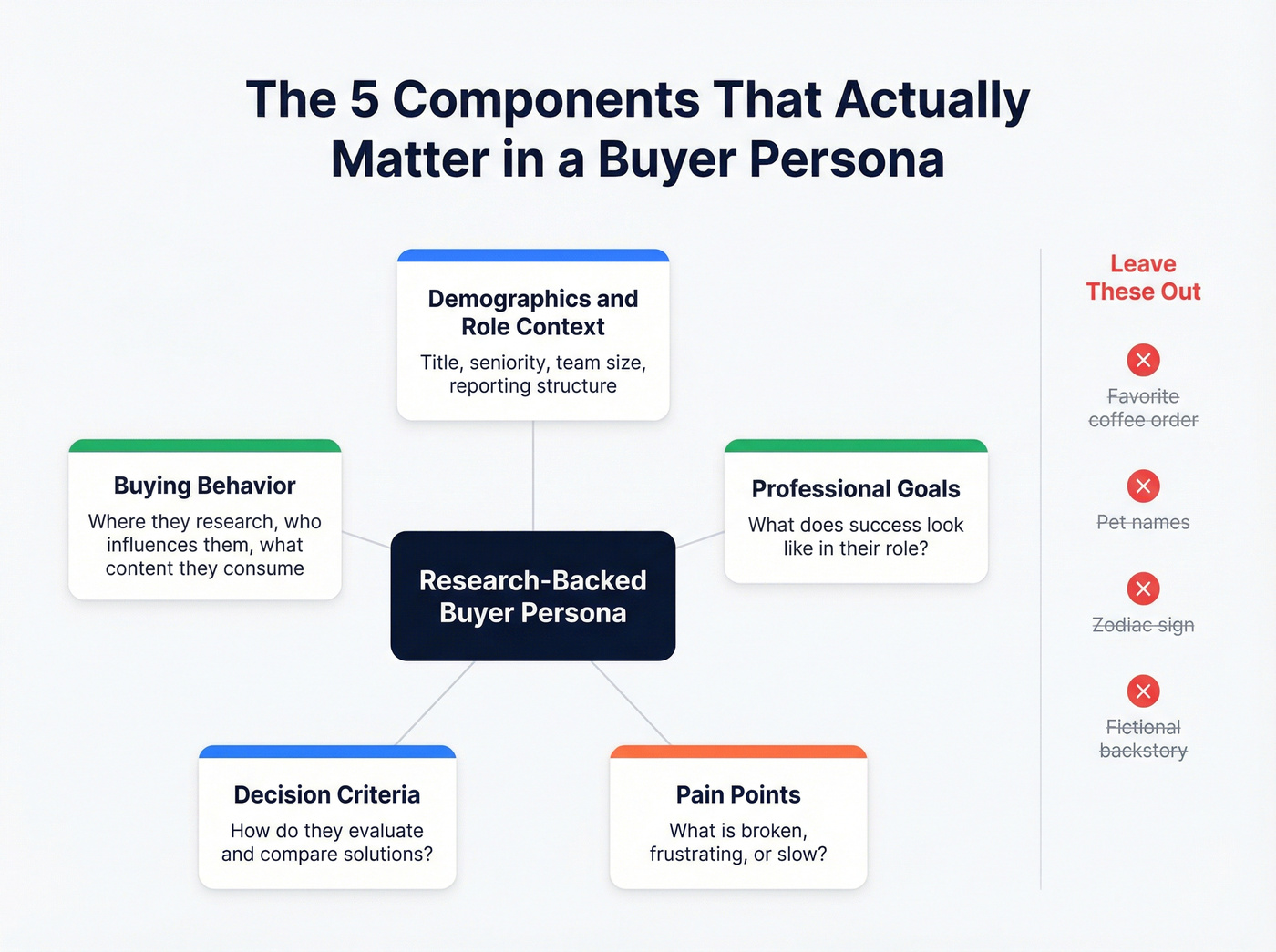
A buyer persona isn't an ICP. Your ICP describes the organization - industry, company size, revenue, tech stack. Your buyer persona describes the individual within that organization - their goals, pain points, decision criteria, and buying behavior. You need both, but they're different tools.
| Include This | Skip This |
|---|---|
| Buying triggers | Favorite coffee order |
| Decision criteria | Hobbies |
| Pain points | Pet names |
| Information sources | Shoe size |
| Success metrics | Hair color |
| Perceived barriers | Fictional backstory |
| Budget authority | Zodiac sign |
Five components matter. Everything else is decoration:
- Demographics & role context - title, seniority, team size, reporting structure
- Professional goals - what does success look like in their role?
- Pain points - what's broken, frustrating, or slow?
- Decision criteria - how do they evaluate and compare solutions?
- Buying behavior - where do they research, who influences them, what content do they consume?
If a detail doesn't change how you sell, market, or build product - leave it out.
A quick note on proto personas: some teams start with assumption-based "proto personas" before doing research. That's fine as a 30-minute brainstorm to generate hypotheses - but never mistake a proto persona for a finished one. The examples below are all research-grade.

Buyer personas only work when you can actually reach the people they describe. Prospeo's 30+ search filters - job title, seniority, department size, tech stack, buyer intent - let you turn every persona into a targeted list of verified contacts.
Turn persona research into pipeline. Start with 100 free credits.
8 Buyer Persona Examples You Can Actually Use
These aren't hypothetical. Each example is built from common research patterns across real B2B and B2C buying scenarios. Adapt the structure, swap in your own data, and you'll have something your team can use tomorrow.
B2B Buyer Persona Example 1 - SaaS Decision-Maker ("Operations Olivia")
| Attribute | Detail |
|---|---|
| Title | VP of Operations |
| Company | SaaS, 300-700 employees |
| Reports to | COO or CEO |
| Team size | 15-40 direct/indirect |
| KPIs | Cost reduction, on-time delivery |

Operations Olivia isn't evaluating your tool because she's bored. She's got a mandate from the C-suite to standardize processes across three departments that each built their own workflows during the startup phase. Her biggest fear isn't that your product doesn't work - it's that the rollout disrupts the team for two quarters and she takes the blame.
Strategic priorities: Standardize cross-department processes, reduce operational inefficiencies, and build reporting that the board actually trusts.
Core concerns: Workflow disruption during implementation, adoption resistance from teams who like their current tools, and proving ROI within 6 months (because that's when the next budget review hits).
Decision criteria: Proven ROI from similar-sized companies, native integrations with the existing stack (especially Salesforce and Slack), vendor reputation and support quality, and implementation timeline under 90 days.
How she researches: Peer recommendations first - she'll ask three other VPs of Ops before reading a single case study. Then G2 reviews, then vendor demos. In 2026, she's also using AI tools to summarize vendor comparison pages and asking in niche Slack communities. She doesn't read blog posts. She reads implementation guides.
Use this persona when: You're selling workflow, operations, or process tools to mid-market SaaS companies. Skip it when: Your buyer is a founder wearing the ops hat - that's a fundamentally different persona (see Example 4).
B2B Buyer Persona Example 2 - The Buying Committee Set
Your SDR team is sending the same cold email to CTOs and junior developers. That's not a targeting problem - it's a persona problem.

The average B2B buying committee involves 6-10 stakeholders, each with different priorities, fears, and content preferences. Here's what that looks like for a mid-market software purchase:
| Attribute | Champion | Economic Buyer | Technical Validator | End User |
|---|---|---|---|---|
| Title example | Director of RevOps | VP of Finance | Senior Engineer | Sales Rep |
| Primary goal | Solve the pain | Control costs | Ensure it works | Make my job easier |
| Top concern | Internal buy-in | Budget overrun | Integration risk | Learning curve |
| Preferred content | Case studies, ROI | Pricing, TCO analysis | API docs, security | Product demos, UX |
| Decision authority | Recommends | Approves budget | Vetoes on tech | Influences adoption |
The Champion is your internal seller. They found you, they believe in the solution, and they need ammunition to convince everyone else. Give them ROI calculators and customer stories from companies that look like theirs.
The Economic Buyer doesn't care about features. They care about total cost of ownership, payback period, and whether this replaces something they're already paying for.
The Technical Validator will kill your deal silently. If your API docs are thin or your security posture is unclear, they'll veto without ever joining a call. I've seen deals die three weeks after a "great demo" because nobody thought to send the security questionnaire proactively.
The End User has the least formal authority and the most practical influence. If they hate the UX during the pilot, adoption dies.
B2B Example 3 - Healthcare Administrator (Pro/Con Format)
| Attribute | Detail |
|---|---|
| Title | Director of Health IT |
| Organization | Regional hospital, 200-500 beds |
| Reports to | Chief Medical Officer |
| Budget cycle | Annual, Q4 planning |
| Top priority | HIPAA compliance, always |

This persona lives in a compliance-first world. Every technology decision runs through a filter of "will this create a regulatory risk?" before anyone asks "will this make us more efficient?"
What makes this buyer a great fit:
- Long sales cycles mean high contract values - once they commit, they stay for years
- Deeply informed about their needs (HIPAA, HL7, FHIR) - they'll self-qualify quickly
- Strong peer networks mean one happy customer generates warm referrals
- Budget decisions are institutional, not personal - less price sensitivity once approved
What makes this buyer difficult:
- Procurement processes are slow and bureaucratic - expect 6-12 month cycles
- Compliance requirements create hard disqualification criteria you can't negotiate around
- They don't respond to cold outreach - warm introductions through existing vendor relationships or conference connections (HIMSS, CHIME) work far better
- Limited IT staff bandwidth means implementation support is non-negotiable
Skip this persona if: You're selling a general-purpose tool without healthcare-specific compliance features. They'll disqualify you in the first conversation.
B2B Example 4 - Startup Founder / SMB Buyer
Meet the founder who's also the head of sales, marketing, and sometimes customer support. They don't have a buying committee - they are the buying committee.
Hot take: If your average deal size is under $15K, this is probably your most important persona. Most B2B companies over-invest in enterprise personas because the deals look sexier, while their actual revenue comes from hundreds of founders making fast decisions. Know your math before you pick your persona priority.
Demographics: Founder or co-founder, seed to Series A, 5-30 employees, wearing 4+ hats.
Goals: Find tools that deliver ROI within the first month, keep the tech stack lean, and avoid annual contracts that lock up cash.
Pain points: Information overload (too many tools, too many "best of" lists), limited budget for experimentation, and the fear of picking the wrong tool and wasting a month migrating away from it.
Decision process: Peer recommendations carry enormous weight. They'll check Reddit, ask in Slack communities, and trust a founder friend's recommendation over any case study you publish. In 2026, they're also running AI-powered comparisons and asking community-specific Discord channels. Free trials are non-negotiable - if they can't try it without talking to sales, they'll move on.
Use this persona when: You have a self-serve product with transparent pricing and fast time-to-value. Skip this persona when: Your product requires a 6-month implementation and a $50K annual commitment - this buyer will never convert, and chasing them wastes your SDR team's time.
B2C Example 1 - Eco-Conscious Millennial Shopper
This buyer wants to do the right thing but can't always afford to. The tension between "I want sustainable products" and "organic cotton costs 3x more" defines their purchasing behavior. While B2B examples focus on job titles and buying committees, customer personas in B2C center on lifestyle, values, and emotional triggers.
| Attribute | Detail |
|---|---|
| Age range | 28-38 |
| Income | $55K-$85K |
| Location | Urban/suburban |
| Values | Sustainability, ethical sourcing |
| Primary channel | Instagram, TikTok |
Goals: Build a lifestyle aligned with environmental values without going broke. Find brands they can trust and stick with long-term.
Pain points: Greenwashing makes it hard to identify genuinely sustainable brands. Affordable eco-friendly options are limited. They feel guilty about convenience purchases that conflict with their values.
Where they engage: Sustainability blogs, Instagram creators who review ethical brands, TikTok "haul" videos focused on eco-friendly products, and community forums like r/ZeroWaste.
Decision criteria: Transparent sourcing information, third-party certifications (B Corp, Fair Trade), reasonable pricing, and authentic brand storytelling - not corporate sustainability reports.
B2C Example 2 - First-Time Real Estate Buyer (Use-Case Format)
Information overload is this persona's defining challenge. They're drowning in advice from parents, coworkers, TikTok, and real estate agents - and they can't tell which advice applies to their market.
When to use this persona: You're a mortgage lender, real estate platform, home inspector, or financial advisor targeting first-time buyers. This persona also applies to insurance companies and home warranty providers marketing to new homeowners.
When to skip it: Your product targets experienced investors or commercial real estate buyers. The psychology is completely different - experienced buyers optimize for ROI, first-timers optimize for safety.
| Attribute | Detail |
|---|---|
| Age range | 27-35 |
| Household income | $80K-$130K |
| Buying timeline | 6-18 months |
| Primary fear | Making a mistake |
| Top channel | YouTube, local groups |
Goals: Buy a first home without overpaying or getting stuck with hidden problems. Understand the process well enough to feel confident, not just compliant.
Pain points: Confusing mortgage options, fear of hidden costs, distrust of agents who seem more interested in closing than advising, and analysis paralysis from too many Zillow listings.
Content that converts: YouTube walkthroughs of the buying process, local community Facebook groups where recent buyers share experiences, and calculators that show real monthly costs (not just the listing price). This persona trusts educational content over promotional content - lead with value, sell later.
Negative Buyer Persona - "Budget-Only Brian"
This is the persona you don't want. And if you've never built one, you're probably spending 20-30% of your marketing budget attracting people who'll never become good customers.
| Attribute | Detail |
|---|---|
| Title | Varies (often junior) |
| Budget | Below your minimum |
| Behavior | Compares 10+ vendors on price |
| Support needs | High (lots of questions) |
| Lifetime value | Low (churns in 1-3 months) |
| Expectation gap | Wants enterprise features at starter pricing |
Budget-Only Brian shops exclusively on price. He'll sign up for your free trial, use your support team extensively, negotiate hard for a discount, and churn the moment a competitor offers $5/month less. His lifetime value doesn't cover the cost of acquiring him.
Real talk: practitioners are actively searching for anti-persona templates and finding almost nothing. A Reddit thread from a B2B marketer - sole marketer at their company, CEO specifically requesting anti-personas - captures the gap perfectly. Everyone talks about who to target. Almost nobody documents who to avoid.
Common negative persona categories:
- Low lifetime value (one-time purchasers, heavy discount users)
- High support requirements (disproportionate ticket volume)
- Overly price-sensitive (will always leave for cheaper)
- Mismatched expectations (wants what you don't offer)
- Wrong ICP fit (too small, wrong industry, wrong use case)
How to build your negative persona (5 steps):
- Analyze existing customers for patterns in cancellations, refunds, and complaints
- Collect qualitative data from sales and support teams - they know who the bad fits are
- Identify shared characteristics (demographics, company size, buying behavior)
- Group negative customers into categories
- Validate against your CRM data, then update quarterly
The practical benefit is immediate: reduced ad spend on audiences that won't convert, higher conversion rates on the audiences that will, and fewer bad-fit customers clogging your support queue.
Advanced Example - The 5 Rings Persona (SaaS Purchase Scenario)
Every example above describes who the buyer is. Adelle Revella's 5 Rings of Buying Insight framework goes deeper - it describes how they buy. This is the difference between a persona that sits in a slide deck and one that changes how you sell.
Let's walk through it with a relatable scenario: a Director of RevOps evaluating a new sales engagement platform.
Ring 1 - Priority Initiatives (The Trigger): The company missed pipeline targets two quarters in a row. The CRO told the Director of RevOps to "fix outbound." That's the trigger. Without it, this buyer isn't in-market - no amount of cold email changes that.
Ring 2 - Success Factors (Expected Outcomes): She expects the new platform to increase meetings booked by 30%, reduce rep ramp time from 8 weeks to 4, and consolidate three tools into one. These aren't features - they're the outcomes she'll use to justify the purchase internally.
Ring 3 - Perceived Barriers (Fears): What if reps hate the new tool and adoption tanks? What if the migration from the current platform loses historical data? What if the vendor raises prices 40% at renewal? These barriers keep buyers in the status quo - and most sales teams never address them directly.
Ring 4 - Decision Criteria (Evaluation Capabilities): She's comparing three platforms on: native CRM integration quality, AI-powered sequence optimization, reporting granularity, and total cost of ownership over 3 years. Notice these are specific capabilities, not vague "ease of use" checkboxes.
Ring 5 - Buyer's Journey (The Behind-the-Scenes Story): She started researching 4 months before talking to any vendor. She read 13 pieces of content, attended a webinar, asked two peers for recommendations, and ran a pilot with her top 5 reps before bringing it to the CFO. B2B customers are typically 60% through the buying process before first sales contact - a stat that's held up since the Corporate Executive Board first published it, and that most sales teams still underestimate.
As one CMO told Adelle Revella after implementing this framework: "We didn't even know what the buying triggers were. Personas are like getting the answers before the test."
The 5 Rings approach takes more work - you need actual buyer interviews, not assumptions. But the payoff is a persona that tells your sales team exactly what to say, when to say it, and which objections to preempt.
How to Research Your Buyer Personas (Without a $25K Agency)
You can outsource persona research to an agency for $5K-$25K per persona. Or you can do it yourself in 2-4 weeks. Here's the DIY approach.
Step 1: Interview 8-15 actual customers per persona type. Not prospects. Not churned users. Current customers who recently went through the buying process. Ask them about their trigger event, their evaluation process, who else was involved, and what almost stopped them from buying. The B2B buying journey involves an average of 27 touchpoints and 13 pieces of content - your interviews should map that journey. In our experience, patterns crystallize around the 8th or 9th interview. That's when you stop hearing new information and start hearing confirmation.
Step 2: Mine your internal data. Pull CRM data on your best customers - closed-won deals with the highest LTV. Look for patterns in company size, industry, title, deal cycle length, and which content they engaged with. Use free tools like Google Analytics audience reports and social media audience insights to supplement. Your sales and support teams have qualitative gold: ask them "who's your favorite type of customer to work with?" and "who's the worst?" You'll get persona insights in 15 minutes.
Step 3: Analyze and code the data. Use a grounded theory approach - alternate between collecting data and coding it into themes. After 5 interviews, you'll start seeing patterns. After 10, you'll have enough to draft. After 15, you're validating. Tag each insight by theme (pain points, triggers, decision criteria) and look for clusters. The themes that appear in 70%+ of interviews become your persona's core attributes.
Step 4: Synthesize into a usable format. Not a 20-page PDF. A one-page profile card that fits on a poster. Include only what changes behavior: buying triggers, decision criteria, pain points, information sources, and the objections your sales team needs to handle.
Step 5: Validate with your team. Show the persona to 3-5 salespeople and ask: "Does this match the people you talk to?" If they say "that's exactly my best customer," you nailed it. If they shrug, go back to Step 1.
Here's what personas are NOT: they're not simple demographic profiles, not individual customer profiles, not static documents, and not assumptions. If yours reads like a dating profile, start over.
How to Use AI to Assist (Not Replace) Persona Research
AI can help with personas. But the Interaction Design Foundation's warning is worth repeating: AI creates made-up personas when it's not grounded in real research. Feed ChatGPT "create a buyer persona for my SaaS product" and you'll get a plausible-sounding fiction that confirms your existing assumptions. That's worse than no persona at all.
Where AI actually helps:
- Grouping and coding interview transcripts into themes
- Rewriting rough persona drafts into polished summaries
- Generating initial persona drafts to validate against real data (not to use as-is)
- Identifying patterns across large CRM datasets
Where AI misleads:
- Replacing customer interviews entirely
- Generating personas from scratch without research inputs
- "Validating" personas by asking AI if they seem reasonable (it'll always say yes)
If you want to use AI as a starting point, here's a prompt that produces better output than most templates:
You are a B2B buyer persona researcher. I'll provide details about my product,
target market, and customer data. Based on this information, create a detailed
buyer persona that includes:

- Name, role, and professional background
- 3-4 specific pain points (not generic)
- 3-4 fears about purchasing/switching
- Decision-making process (who else is involved, what content they consume,
  how long the cycle takes)
- Ideal future state (what does success look like 12 months post-purchase?)

Before generating, ask me 5 clarifying questions about my actual customers.
Do not assume. Adapt [for B2B](/s/customer-profiling-for-b2b-sales) context and include macroeconomic factors
affecting their buying behavior in 2026.
The key instruction is "ask me 5 clarifying questions." This forces the AI to gather context instead of hallucinating. Use the output as a draft to validate against real customer interviews - never as the final product.
7 Buyer Persona Mistakes That Waste Your Time
1. Letting AI generate your personas without research. AI-generated personas feel real because they're coherent. But coherence isn't accuracy. A persona that sounds right but doesn't match your actual buyers will send your marketing in the wrong direction with high confidence.
2. Basing personas on assumptions. "You are not your customers." This is the foundational mistake. You think your buyers care about features because you care about features. Your buyers care about not getting fired for picking the wrong vendor.
3. Creating too many personas. Alan Cooper - the guy who invented personas for software design - built the PalmPilot's UX around a single persona. That single-minded focus is why it succeeded. Start with one. Add a second only if the buying behavior is fundamentally different. Cap at 3 persona types for most teams. If you have 12, you effectively have zero.
4. Including irrelevant details. Remember shoe size 45? Every detail in your persona should change how you sell, market, or build. If knowing your buyer drives a red convertible doesn't change your email copy, cut it.
5. Never updating personas. Roughly two-thirds of companies create personas once and never revisit them. Companies that updated personas within the last six months were significantly more likely to exceed lead and revenue goals. Markets shift. Buyer expectations evolve. Review annually at minimum - quarterly if you're in a fast-moving market.
6. Siloing personas in one department. Marketing builds the persona. Sales never sees it. Product doesn't know it exists. Each department "cooks its own soup" with different assumptions about who the customer is. Sales-facing versions should be just as accessible to your SDR team as the marketing versions are to your demand gen team - same research, different emphasis on objection handling and talk tracks.
7. Not bringing personas to life. A persona emailed as a PDF attachment gets opened once and forgotten. Print posters. Run workshops. Create a Slack channel where people share customer quotes that validate (or challenge) the persona. The goal is to make the persona a living reference, not a deliverable.
Avoid those seven mistakes and you'll have a solid persona. But there's an eighth mistake almost every guide makes: stopping there.
From Persona to Prospect List - The Step Everyone Skips
You've built a research-backed persona. Now what?
It sits in a slide deck. Your SDR team glances at it during onboarding and never opens it again. The persona describes "VP of Operations at a mid-market SaaS company researching workflow automation" - but nobody's actually gone and found those people.
This is the execution gap. Personas are strategy documents. Prospect lists are execution documents. The bridge between them is a B2B data platform that lets you search by the exact attributes in your persona.

Prospeo lets you take every attribute from your persona - job title, seniority, company size, industry, tech stack, buyer intent topics - and turn it into a search query. With 300M+ professional profiles and 30+ search filters, "VP of Operations at a 300-700 employee SaaS company" isn't an abstract description anymore. It's a list of real people with 98% verified emails. And the intent data layer (15,000 Bombora topics) lets you filter for prospects who are actively researching the problem your product solves - the difference between cold outreach and warm outreach.
Your persona shouldn't live in a slide deck. It should live in your sequencer, attached to real people who match it.
Sending the same email to the CTO and the end user kills deals. Prospeo lets you map the entire buying committee - 300M+ profiles with 98% verified emails - so every stakeholder gets the right message.
Stop guessing who's on the buying committee. Find them all at $0.01 per email.
FAQ
What is a buyer persona example?
A buyer persona example is a semi-fictional profile of your ideal customer built from real research - interviews, CRM data, and behavioral patterns. "Operations Olivia" (B2B Example 1 above) profiles a VP of Operations at a mid-market SaaS company, including her buying triggers, decision criteria, and preferred content formats. A useful example gives your team enough detail to change their messaging, not just nod along.
How many buyer personas should I create?
Start with one primary persona and add a second only when the buying behavior is fundamentally different - not just a different job title, but a different evaluation process and set of priorities. Most companies need 3-5 max. Alan Cooper built the PalmPilot around a single persona; that focus is the whole point.
What's the difference between a buyer persona and an ideal customer profile?
An ICP describes the organization - industry, company size, revenue, tech stack. A buyer persona describes the individual within that organization - their goals, pain points, decision criteria, and buying behavior. You need both for effective B2B targeting. The ICP tells you which companies to pursue; the persona tells you what to say when you get there.
How do I turn a buyer persona into an actual prospect list?
Use a B2B data platform that supports the same attributes your persona contains - job title, seniority, company size, industry, and tech stack. Prospeo's 30+ search filters and 15,000 intent topics let you translate persona attributes directly into search criteria, returning verified contacts at 98% email accuracy instead of abstract descriptions.
How often should I update my buyer personas?
At minimum, annually. Companies that refreshed personas within the last six months were significantly more likely to exceed lead and revenue goals. Market conditions, buyer expectations, and competitive dynamics shift constantly - your personas should reflect current reality, not the market you sold into two years ago.