

Authority Building Email: How to Earn Trust (With Templates That Work)
Your cold email doesn't fail because it's "not persuasive enough." It fails because the reader doesn't believe you.
An authority building email fixes that by doing two jobs at once: it proves you're worth attention (real proof, fast) and it earns inbox trust (deliverability + compliance). The templates are the easy part. The hard part is not burning your domain while you "test messaging."
What you need (quick version)
- Pick one lane: sales credibility, PR pitch, or link outreach
- Put proof in the first 2 lines: 3-4 logos (or equivalent) + one metric
- Make the ask tiny: yes/no, "send the 1-pager," or 12-15 minutes
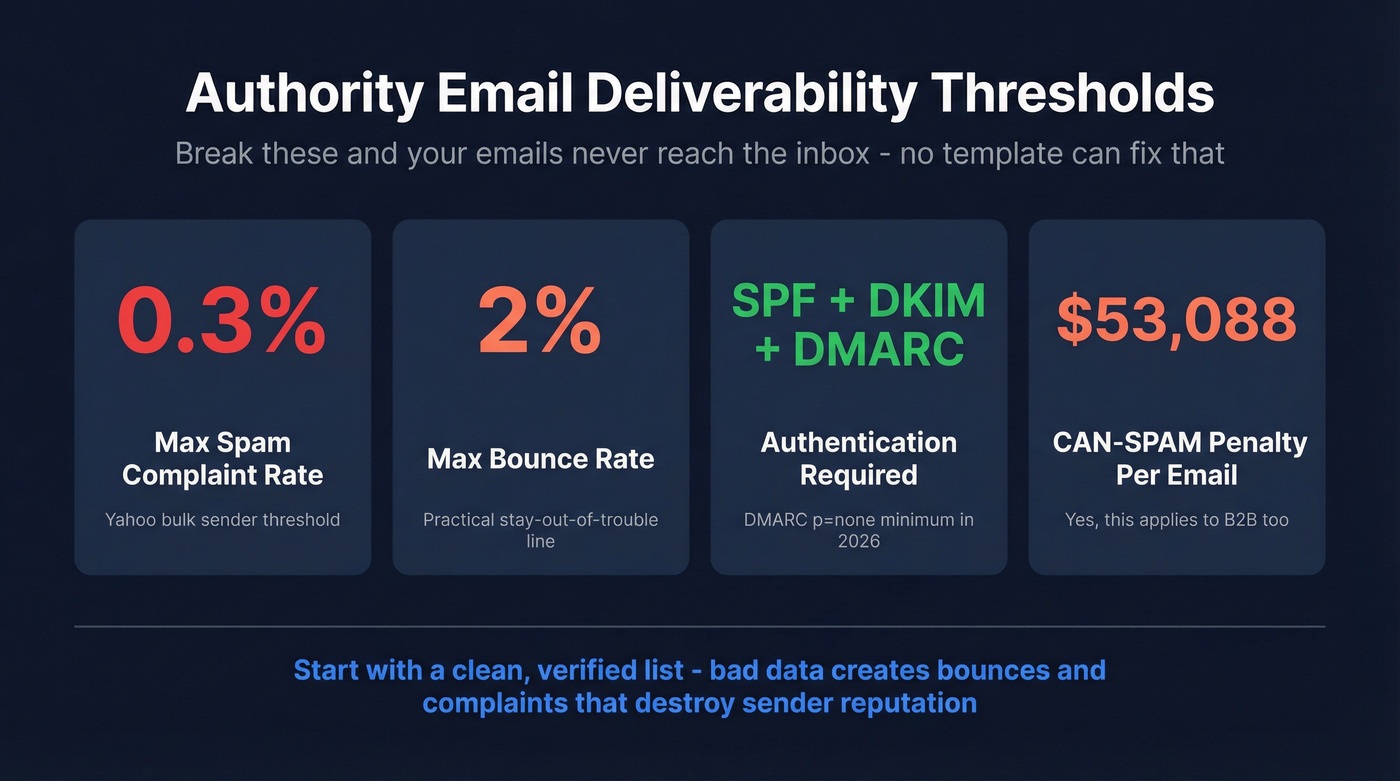
- For bulk sending in 2026: SPF + DKIM + DMARC (p=none minimum) - if DMARC isn't passing/aligned, you're playing with fire
- Keep spam complaints under 0.3% (Yahoo's bulk-sender threshold)
- Keep bounces under 2% (practical "stay out of trouble" line)
- Add one-click unsubscribe (List-Unsubscribe) and honor opt-outs fast
- CAN-SPAM applies to B2B; penalties run up to $53,088 per violating email
- Fastest authority lever: start with a clean list and verify before sending - bad data creates bounces/complaints, and nothing kills authority faster than spam placement
Why this query is confusing (and what marketers mean by "authority-building email")
"Authority-building email" gets used as a catch-all phrase, which is why most advice feels mushy.
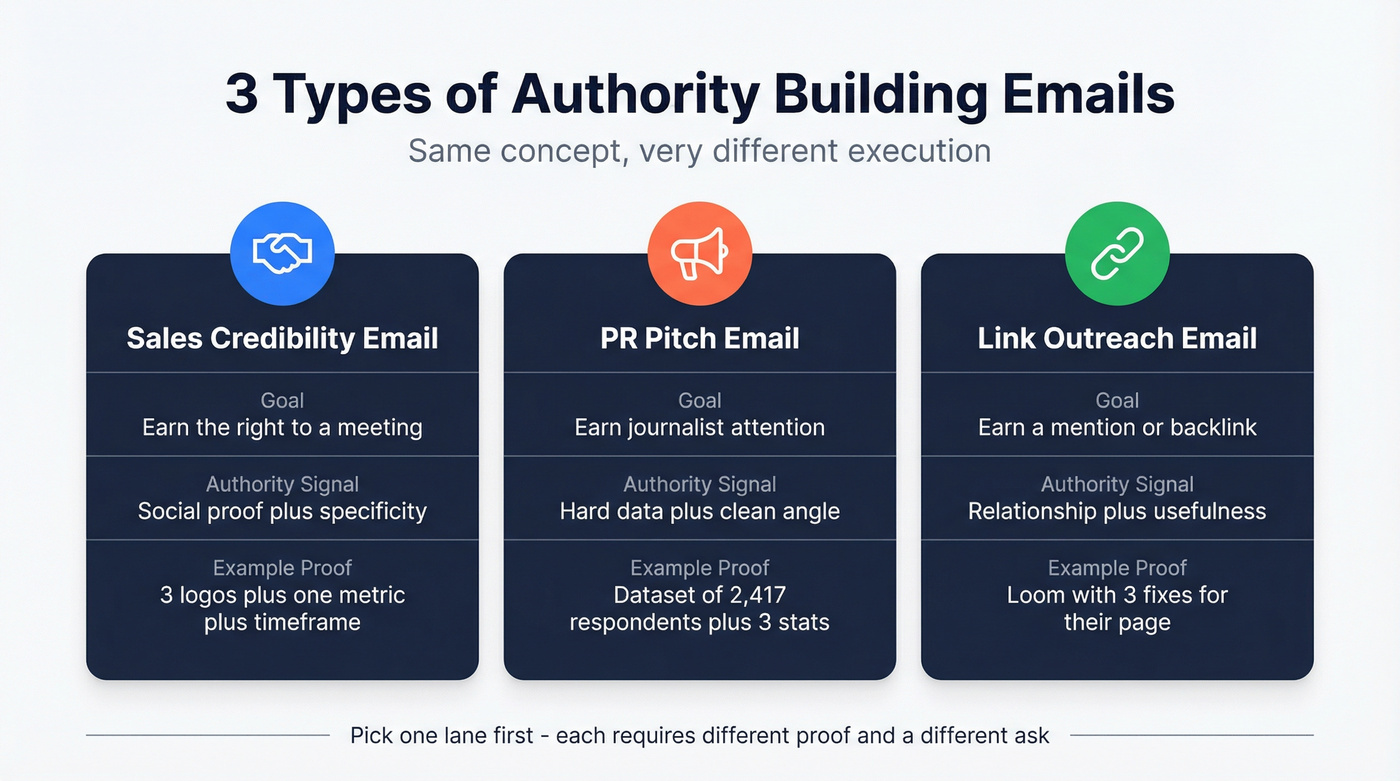
In practice, people mean one of three things:
- Sales credibility email: earn the right to a meeting when the buyer doesn't know you. Authority here is social proof + specificity, not hype.
- PR pitch: earn attention from a journalist/editor who's trained to ignore fluff. Authority here is data, a clean angle, and being publishable fast.
- Link outreach: earn a mention or backlink without sounding like every other template in their inbox. Authority here is relationship + usefulness, not "Dear Sir, I love your blog."
One more 2026 reality: authority signals now feed both Google and AI answers. If your outreach earns citations/mentions on pages that AI systems pull from, you're not just "building links," you're building visibility, and that compounds in a way most teams still underestimate.
What an authority email is (and isn't)
Use this if:
- You're selling something that requires trust (higher consideration, longer cycle, more stakeholders).
- You've got at least one real proof point: a customer name, a result, a dataset, a credible credential, or a specific observation.
- You can make a low-friction ask (a quick yes/no, a 10-15 minute chat, a "who owns this?" redirect).
Skip this if:
- You're trying to "sound like a thought leader" with adjectives and zero evidence.
- Your proof is generic ("innovative," "best-in-class," "award-winning") and you can't attach it to a measurable outcome.
- You're blasting a broad list and hoping personalization tokens save you.
Hard stance: no proof stack? Don't cold email yet.
Go earn one measurable result first: run a small pilot, ship a mini case study, publish a dataset, or get one customer outcome you can state in a single line. Then do outreach. Cold email without proof is just noise with tracking pixels.
Here's the thing: this approach fails when it tries to sound authoritative instead of proving authority with one metric + one proof point. I've seen teams rewrite copy for weeks when the real issue was simpler and more painful: they had no proof stack and no targeting discipline, so every "improvement" was just rearranging words on a losing hand.

You just read that bounces above 2% kill deliverability and authority. Every template above is useless if your emails never reach the inbox. Prospeo's 5-step verification and 7-day data refresh keep bounce rates under 4% - ask Meritt, who dropped from 35% to under 4% overnight.
Clean your list before you send a single authority email.
The Authority Proof Stack (the 5 blocks that create instant credibility)
This is the fastest structure we've used for getting a skeptical reader to think: "Okay, this might be real."

Logos (3-4)
- Pick names your recipient recognizes or respects.
- No logos? Use credible substitutes: "ex-Role at Company," "used by 15,000+ teams," "dataset of 2,500 respondents," or "backed by X."
One metric/result
- One number. One outcome. One timeframe.
- Examples: "Cut bounce rate from 35% to under 4% in 30 days" or "Added 18 SQLs/month from the same spend."
Specificity
- Mention the exact use case, segment, or workflow.
- "Outbound to IT directors in manufacturing" beats "helping businesses grow."
Relevance
- Tie your proof to their world: role, industry, motion, or current priority.
- Relevance beats personalization. A perfect first line can't rescue an irrelevant offer.
Low-friction CTA
- A small next step: "Worth a 12-minute sanity check?" or "Should I send the 1-page breakdown?"
- Avoid "Can we hop on a call?" as your first ask. It's high-friction and screams template.
Proof Stack examples (3 you can steal)
Sales (credibility): "Worked with {{Logo1}} + {{Logo2}} -> +18 SQLs/month in 45 days by fixing {{specific workflow}}."
PR (publishable): "New dataset: 2,417 respondents -> 3 stats that change how {{beat}} thinks about {{topic}} (charts ready to drop in)."
Link outreach (useful): "I recorded a 2-minute Loom with 3 fixes for {{page_url}} + a replacement resource that matches your dead link 1:1."
Authority building email templates (sales + PR + link building)
These are written to paste into your sequencer today. Keep them short. Keep the proof tight. And don't perform authority - show it.
Authority-building referral email (sales)
Blunt works. Proof, result, ask. The subject line does the heavy lifting.
Subject: Want [metric]?
Examples:
- Want 22% more demos?
- Want to cut bounces under 2%?
Email: Hi {{first_name}} - quick one.
We help {{ICP}} tackle {{pain}}. Recently we worked with {{Logo1}}, {{Logo2}}, and {{Logo3}} and got {{specific result metric}} in {{timeframe}}.
If you're working on {{relevant initiative}} this quarter, open to a quick 15 minutes {{day}} or {{day}}? {{calendar_link}}
-- {{name}} {{title}} | {{company}} {{physical_address_or_footer}}
Annotation (don't skip):
- Logos: 3-4 max. More looks like you're compensating.
- Metric: one number, not a case study.
- CTA: "15 minutes" + two options beats "when are you free?"
PAS credibility email (Problem -> quantified agitation -> solution)
PAS works when you quantify the agitation. If you can't quantify it, you don't have a real angle yet.
Subject line options:
- Question about {{company}}'s {{priority}}
- Tired of {{specific messy outcome}}?
Email: Hi {{first_name}} - I noticed {{specific observation tied to role/industry}}.
Problem: When {{problem}}, teams usually end up with {{bad outcome}}. Agitation (quantified): That shows up as {{metric impact}} (ex: "15% fewer qualified replies" / "2-3 weeks of pipeline slip" / "bounce rates creeping past 2%"). Solution: We fix it by {{one-sentence mechanism}}. For {{relevant customer/logo}}, that translated into {{one metric}} in {{timeframe}}.
Worth a quick yes/no: should I send the 3-step playbook we use for {{use case}}?
-- {{name}}
Annotation:
- Put a number on the pain. This is where most cold emails die.
- The CTA is "send the playbook," not "book a demo." You're earning trust.
Data-led journalist pitch (digital PR)
This format wins because it's publishable fast: clear angle, hard stats, and assets that drop into a draft.
Subject: New data: {{one surprising stat}} about {{topic/beat}}
Hi {{first_name}} - reaching out because you covered {{specific recent article/topic}}.
We just published a new dataset on {{topic}} ({{sample size}} respondents / {{time window}}). Three takeaways that stood out:
- {{takeaway #1 with stat}}
- {{takeaway #2 with stat}}
- {{takeaway #3 with stat}}
Full report + charts/tables: {{link_to_report}} If helpful, I can also offer:
- an expert quote on {{angle}}
- raw cuts by {{segment}} (industry/company size/region)
- images you can drop in (charts + embed code)
Want me to send a 3-sentence write-up you can paste into a draft?
-- {{name}} {{title}}, {{company}} {{phone}}
Press release (for reference) {{paste press release text here}}
Annotation:
- Keep the pitch short. The press release goes below the signature so it doesn't hijack the email.
- "3 takeaways" is the cheat code. It makes the story scannable and publishable.
Relationship-first link outreach (help first, ask later)
Look, if your "link building" strategy is mostly guest post buying, you're not building authority - you're renting it. And the rent keeps going up.
This email works because it gives asymmetric value first, and it reads like a real person who actually looked at the page.
Subject: Quick idea for {{site_name}}'s {{page/topic}}
Hey {{first_name}} - I liked your point about {{specific tip from their post}}. We tried that with {{context}} and saw {{micro-result}}.
I recorded a 2-minute Loom with 3 quick improvements I'd make to {{page_url}} (purely optional): {{loom_link}}
If you want, I can also share a small list of {{resources/data/examples}} we've used to support that section.
Either way, solid piece - thanks for publishing it.
-- {{name}}
Broken link outreach (tight 2-part script)
Most broken-link emails fail because they're performative ("I stumbled upon..."). Be direct.
Subject: Broken link on {{page_title}} (quick heads up)
Part 1 - the heads up (send this): Hi {{first_name}} - your page came up while I was updating a resource list on {{topic}}: {{page_url}}.
The link to {{broken_resource_name}} is returning a 404: {{broken_url}}.
-- {{name}}
Part 2 - the replacement (only if they reply "thanks" or "what's a replacement?"): If you want a clean 1:1 replacement, this is the closest match I've found: {{your_url}}. If it's not a fit, no worries.
Annotation:
- Only pitch your URL if it's truly 1:1. If they'd need to rewrite their paragraph, you've already lost.
- Target pages that look maintained (recent updates, active site). Nobody's fixing a 2013 archive post.
Follow-ups that add value (mini decision tree)
Follow-ups work when they add something new. Here's the simplest decision tree that keeps you out of "bump" hell:
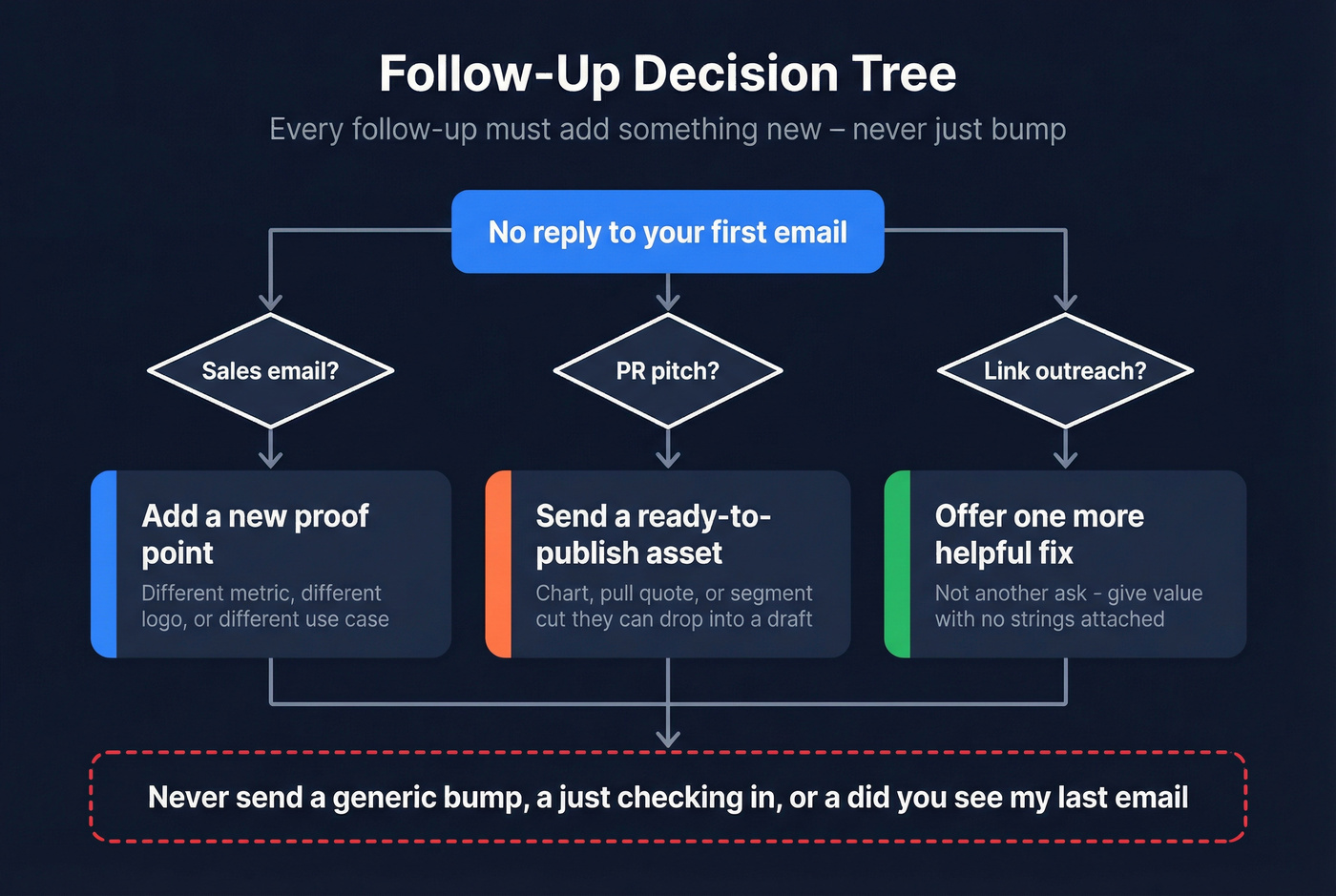
- If it's sales: follow up with a new proof point (different metric, different logo, different use case).
- If it's PR: follow up with a ready-to-publish asset (chart, pull quote, segment cut).
- If it's link outreach: follow up with one more helpful fix (not another ask).
Follow-up (new angle):
Subject: Re: {{original_subject}}
Quick add: we cut the data by {{segment}} and the biggest outlier was {{surprising finding}} ({{stat}}). Want the chart + 2-sentence summary you can quote?
Follow-up (new asset):
Subject: Re: {{original_subject}}
Made this easier to use: here's a one-page brief + 3 charts sized for web (no login): {{link}}. If you're not the right person for {{topic}}, who should I send it to?
Targeting & segmentation (relevance beats personalization)
If you take one lesson from this whole topic, take this: relevance beats personalization.
Segmentation isn't "Hi {{first_name}}." It's deciding who should never receive the email in the first place.
What people hate (and they're right)
- Sales recipients hate: "Circling back" from a stranger who never earned the first email. If you can't name a real outcome, don't send it.
- Journalists hate: irrelevant pitches that ignore their beat and force them to do work (no stats, no assets, no angle).
- Site owners hate: fake flattery + immediate link asks. If you want a link, lead with usefulness.
Quick segmentation table
| Use case | Who to target | Proof to include | CTA |
|---|---|---|---|
| Sales | Role owner | Logos + 1 metric | 12-15 min or "send the 1-pager" |
| PR | Beat writer/editor | 3 takeaways + dataset | Quote/interview or "send paste-ready blurb" |
| Link | Page owner/editor | Loom/help + 1:1 resource | "Want the replacement?" |
Practical targeting bullets
- Sales: segment by trigger + role. "Hiring SDRs" and "new RevOps leader" are different emails.
- PR: segment by beat/topic and format preference (news vs data vs commentary).
- Link outreach: segment by page type (resource list vs stats page vs blog post) and by site quality (real traffic, real updates). Use an SEO tool to filter out sites that look big but have no organic footprint.
Deliverability rules you can't ignore (Yahoo + modern inbox standards)
Authority doesn't live in your copy. It lives in inbox placement.
Yahoo's bulk-sender requirements (enforced starting Feb 2024 and still a baseline in 2026) are the floor for serious sender behavior, and the thresholds are tight enough that sloppy list building gets punished fast.
The non-negotiables
Authenticate for bulk sending
- All senders: authenticate with SPF or DKIM (minimum)
- Bulk senders: implement SPF + DKIM and publish DMARC with at least p=none (DMARC must pass)
- Ensure DMARC alignment on the From domain
- If DMARC isn't passing/aligned, you're playing with fire - providers treat that as "untrusted sender," not "minor misconfig"
Keep spam complaints under 0.3%
- Yahoo's explicit threshold is <0.3%
- Relevance is your complaint prevention system
One-click unsubscribe for bulk
- Implement List-Unsubscribe header
- Support one-click unsubscribe (RFC 8058 "Post" method)
- Also include a visible unsubscribe link in the email body
Honor unsubscribes fast
- Yahoo expects unsubscribes honored within 2 days
- CAN-SPAM gives you 10 business days; inbox providers expect faster
List quality is deliverability
- Keep bounces under 2%
- Don't send to old, scraped, or unverified addresses
- Suppress non-engagers and obvious role accounts that never reply (unless you've got a specific reason)
Monitoring (the part teams skip, then panic about)
If you send cold email at any real volume, you need a dashboard mindset.
Use Postmaster tools where available (Google Postmaster Tools for Gmail; Microsoft SNDS where applicable) to watch reputation trends, and track complaints/unsubscribes per segment, not just overall, because one bad segment can poison the whole domain. Maintain suppression lists (unsubscribes, hard bounces, complainers) and sync them into every sending tool you use, then run a simple seed test (a few inboxes across Gmail/Yahoo/Microsoft) when you change domains, ramp volume, or swap templates so you catch obvious spam placement before it scales.
We've run deliverability fix projects where the copy was fine, the offer was fine, and the whole program still failed because the list was dirty. Clean data is boring. Clean data wins.

Numbers to run by (2026)
- Spam complaints: <0.3%
- Bounces: <2%
- Unsub processing: <=2 days (provider standard)
- DMARC: at least p=none (and passing/aligned)
For the official Yahoo requirements, use Yahoo's sender best practices.
Compliance basics (CAN-SPAM + EU legitimate interest)
You can write the best authority email on earth and still get yourself in trouble if you ignore the basics.
CAN-SPAM (US)
- CAN-SPAM applies to all commercial messages, including B2B.
- Penalties run up to $53,088 per violating email.
- Requirements you actually need to operationalize:
- Accurate header info (From/To/Reply-To)
- Non-deceptive subject lines
- Don't mislead about what the email is
- Include a valid physical postal address
- Clear opt-out/unsubscribe mechanism
- Honor opt-outs within 10 business days
FTC reference: CAN-SPAM compliance guide.
EU/UK: legitimate interest (operational view)
In the EU/UK, B2B outreach is commonly sent under legitimate interest when it's role-relevant, transparent, and opt-out is easy.
Good relevance: "You manage procurement for cloud security tools - we have benchmark data on renewal pricing." Bad relevance: "You work at a company - want to see our product?"
If you can't explain "why you" in one plain sentence, you don't have legitimate-interest-grade relevance. Fix targeting before you touch copy.
Build a clean list before you send (verification + hygiene + workflow)
If you want authority from the first send, start here. Bad data creates bounces. Bounces hurt reputation. Reputation kills inbox placement. And once you're in spam, your email becomes a self-own.
The operational targets to build around:
- Bounces <2%
- Spam complaints <0.3%
A practical workflow that holds up in production
- Define your segment before you pull contacts
Pick one: "VP Marketing at B2B SaaS, 50-500 employees, hiring demand gen" beats "marketing leaders." If you need help tightening this, start with an Ideal Customer definition, then validate it with real outreach.
Build from a source that prioritizes accuracy and freshness Prospeo (the B2B data platform built for accuracy) is built for this exact problem: you get 300M+ professional profiles, 143M+ verified emails with 98% accuracy, and a 7-day refresh cycle, so you're not paying to email yesterday's org chart.
Verify before you send (not after you bounce) Verify emails in real time, then only send to verified addresses. This is how you keep bounce rates under control without playing whack-a-mole mid-campaign. If you want the full SOP, use an email verification workflow that your whole team follows.
Export only verified contacts into your sequencer/CRM Push clean records into your outbound tool, then suppress:
- prior unsubscribes
- prior complainers
- hard bounces
- obvious role accounts that never engage (unless you've got a reason)
- Hygiene loop every week
- Remove hard bounces immediately
- Pause segments with rising complaints
- Refresh/enrich stale records on a cadence (weekly is ideal when you're scaling). This is also where B2B contact data decay quietly kills performance if you ignore it.
A quick scenario (because this is where teams mess up)
A founder we worked with pulled 2,000 contacts from a mixed source, sent a "pretty good" email, and got crushed: bounces spiked, replies went quiet, and Gmail started dumping everything into spam. The fix wasn't a rewrite. It was rebuilding the list, verifying it, and cutting two segments that looked fine on paper but hated the offer in practice.
That's authority-building in the real world: you earn the right to be in the inbox before you earn the right to ask for time.
Authority emails need the right proof stack AND the right person. Prospeo's 30+ filters let you target by job title, intent signals, and technographics so your logos and metrics land with someone who actually cares. 300M+ profiles at $0.01/email - no contracts.
Stop blasting broad lists. Target the exact buyer who'll believe your proof.
Before you send 100 emails (send-ready authority checklist)
This is the "don't embarrass yourself" gate. If you can't pass this list, don't scale.
Warm up like an adult
- Start at 5-10 emails/day
- Ramp over 4-6 weeks (use a real automated email warmup plan, not vibes)
- Increase volume only when replies/unsubs/complaints stay stable
Confirm authentication (bulk-sender standard)
- SPF, DKIM, DMARC (p=none minimum) - and DMARC must be passing/aligned (see SPF DKIM & DMARC setup details)
- Tracking domain set up cleanly (don't mix reputations)
Proof stack present
- 3-4 logos (or equivalent proof)
- 1 metric/result
- 1 relevance line tied to their world
CTA is low-friction
- "Should I send X?" beats "Book a demo" (more examples in this Sales CTA guide)
Unsubscribe is easy
- Visible link + List-Unsubscribe header
- Process unsub fast (<=2 days is the provider expectation)
Seed check (simple, effective)
- Send to a small seed list across Gmail/Yahoo/Microsoft and confirm you're landing in Primary/Inbox, not Promotions/Spam (here’s a full seed list guide)
Stop conditions (don't negotiate with the numbers)
- Bounce rate crosses 2% -> stop and fix list quality (common hard-bounce errors like 550 Recipient Rejected are usually a symptom, not the root cause)
- Complaints trend toward 0.3% -> stop and tighten targeting/offer
- Sudden open collapse across providers -> assume spam placement and investigate before sending another batch (start with domain reputation)
FAQ
What makes an email "authority-building" instead of just confident?
An authority-building email proves credibility with one concrete metric and one proof point (logos, dataset, credential), then makes a small, relevant ask. A "confident" email just uses strong language. If the reader can't verify why you're credible in 10 seconds, it's not authority - it's posture.
How many proof points should I include in a cold email?
Use 2-3 proof points max: typically 3-4 logos plus one metric/result is enough. More than that turns into a credibility dump and makes the email feel like a pitch deck. If you need five paragraphs to prove you're legit, you're targeting the wrong people or missing a clear result.
What deliverability thresholds matter most for cold outreach in 2026?
Keep spam complaints under 0.3% and bounces under 2%, because those two numbers track directly with inbox placement and provider enforcement. Authenticate with SPF + DKIM + DMARC (p=none minimum, passing/aligned), and include one-click unsubscribe with List-Unsubscribe plus fast opt-out handling.
Is authority-building cold email legal for B2B?
It's legal in the US when it follows CAN-SPAM: accurate headers, non-deceptive subject lines, a physical address, a working opt-out, and honoring opt-outs within 10 business days. In the EU/UK, B2B outreach is commonly sent under legitimate interest when it's role-relevant, transparent, and opt-out is easy.
What's a good free tool to reduce bounces before sending?
Prospeo's free tier includes 75 email credits/month plus 100 extension credits, and it verifies addresses so you can export only verified contacts before you launch. If you're sending any volume, aim for bounces under 2% and treat verification as mandatory, not a nice-to-have.
Authority building email isn't a writing trick. It's a system: proof + relevance + inbox trust. Nail those three, and the templates start working like they're supposed to.