

Clay Data Enrichment: What It Costs, How It Works, and How to Stop Burning Credits
You built a beautiful 8-provider waterfall in Clay. Emails, phones, company data, technographics - the whole stack. Then you checked your credit balance: 3,000 credits gone on 200 contacts, half of which weren't even ICP.
That's the Clay data enrichment experience in a nutshell - incredibly powerful, surprisingly expensive if you don't know what you're doing.
The short version:
- Clay is an enrichment orchestration layer, not a data provider. Your results depend entirely on which providers you plug in and how you sequence them.
- Most teams overspend by 20-30% because they enrich before filtering. Filter first, batch-test, then scale.
What Is Clay's Enrichment Layer?
Clay isn't a database. It's an orchestration layer that sits on top of 100+ data providers and lets you build sequential enrichment workflows - waterfalls - that pull from multiple sources until they find what you need. Think of it as a programmable spreadsheet where every column can trigger an API call.
The platform hit $100M ARR in late 2025, up 263% year-over-year, and was valued at $3.1B after its Series C led by CapitalG. For context, ZoomInfo pulls ~$1.2B in annual revenue and Apollo sits at ~$150M ARR - Clay's growth rate dwarfs both. Teams are moving away from single-vendor databases toward multi-source enrichment stacks where they control the data pipeline, and the numbers reflect that shift. OpenAI doubled their enrichment coverage from the low 40% range to the high 80% range after switching to Clay - the kind of result that's possible when you chain the right providers together.
We've spent a lot of time inside Clay, and the enthusiasm is warranted. It's rated around 4.8-4.9/5 on G2 for good reason: no single provider has the best data for every contact. A phone number provider that's great for US tech companies might be terrible for EMEA manufacturing. By letting you chain providers with fallback logic, Clay gives you coverage no single database can match. The tradeoff is complexity - and credits.
How Waterfall Enrichment Works
Instead of hitting one provider and accepting whatever it returns, you build a sequence:

- A primary lookup runs first
- A fallback fires if the primary returns nothing
- Conditional "only run if" rules prevent unnecessary lookups
- Claygent - Clay's agentic web researcher - handles unstructured tasks that traditional APIs can't, like researching case studies, technology stacks, or SOC-II compliance details
If a provider in the waterfall can't find the data, you don't get charged credits for that failed lookup. But "failed" is defined narrowly. A provider that returns a bad email still costs credits - you just don't know it's bad until you verify downstream.
Most production waterfalls use a handful of providers. The "100+" is a marketplace stat, not a workflow reality.
What Clay Costs in 2026
Here's the pricing breakdown with the math that actually matters - cost per credit and cost per enriched contact.
If you want a deeper breakdown of plans, credits, and real-world math, see our Clay pricing guide.
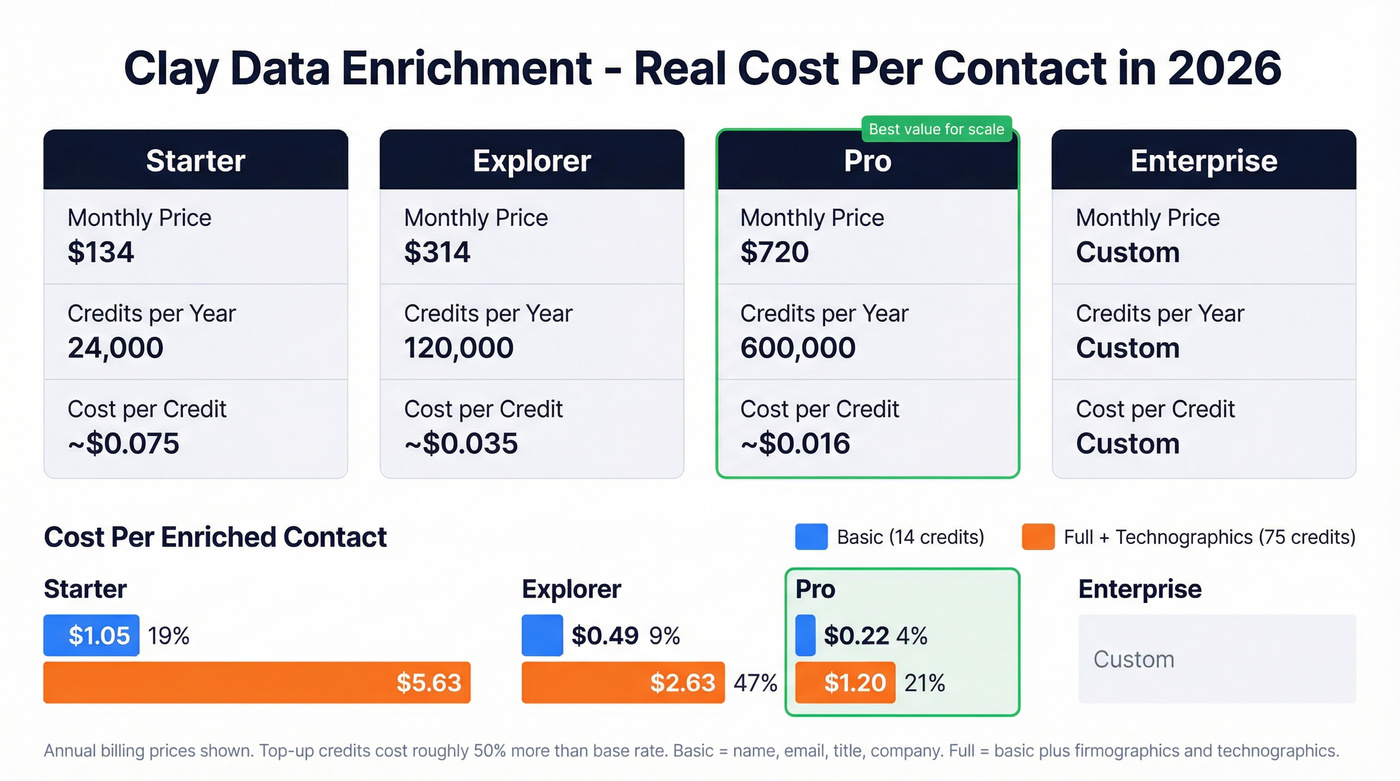
| Plan | Monthly Price | Credits/Year | ~Cost/Credit | ~Cost per Basic Contact (14 cr) |
|---|---|---|---|---|
| Free | $0 | 1,200 | - | - |
| Starter | $134/mo | 24,000 | ~$0.075 | ~$1.05 |
| Explorer | $314/mo | 120,000 | ~$0.035 | ~$0.49 |
| Pro | $720/mo | 600,000 | ~$0.016 | ~$0.22 |
| Enterprise | Custom | Custom | Custom | Custom |
These are annual billing prices, which include a 10% discount and all credits upfront. Monthly billing runs higher.
A "basic contact enrichment" - name, email, title, company - runs about 14 credits. Full contact plus company enrichment with technographics costs around 75 credits. On the Starter plan, that full enrichment runs you roughly $5.63 per lead. On Pro, it drops to about $1.20. Top-up credits are priced higher than your base plan rate, often ~50% more, and rollover is capped at up to 2x your monthly allocation.
Here's the thing: if your enrichment budget is under $300/month, Clay's credit economics don't work. You'll spend more time optimizing credits than actually prospecting. Go with a standalone data provider and skip the orchestration overhead entirely.
The Hidden Credit Burn
Clay's pricing page shows total credits per plan but doesn't list per-action credit costs. You discover the real cost only after building workflows and watching your balance drop.
Typical waste runs 20-30% of total credits spent. Email finding has a 25-35% failure rate across most providers, and phone enrichment fails 30-40% of the time. A provider that returns an unverified email still costs you credits, and then you need more credits to verify it. It compounds fast.
This is also why data quality and verification discipline matter more than "more providers."

That 20-30% credit waste? Most of it comes from unverified emails eating credits twice - once to find, once to verify. Prospeo's 5-step verification with catch-all handling and spam-trap removal eliminates the downstream verification step entirely. 98% email accuracy, 92% API match rate, $0.01 per email.
Plug Prospeo into your Clay waterfall and stop paying for bad data.
Workflows That Save Credits
Filter Before You Enrich
This is the single highest-ROI move. Before spending a single credit, build disqualification columns that flag non-ICP leads. Use lookup tables to catch duplicates, block existing customers, and filter out bad domains. Set up "only run if" conditions on every enrichment step. In our experience, teams cut credit spend by 20-30% just by adding a few disqualification columns before their first enrichment step.
If you want a more structured approach, pair this with an account qualification checklist and a simple lead scoring system.
The Three-Table Architecture
Start with a Raw table for imported leads with pre-enrichment filters and ICP scoring columns. Leads that pass filtering move to an Enriched table where you track status, failure reason, credits spent, and source provider for every record. Only leads with verified emails graduate to the Verified table - your clean output.
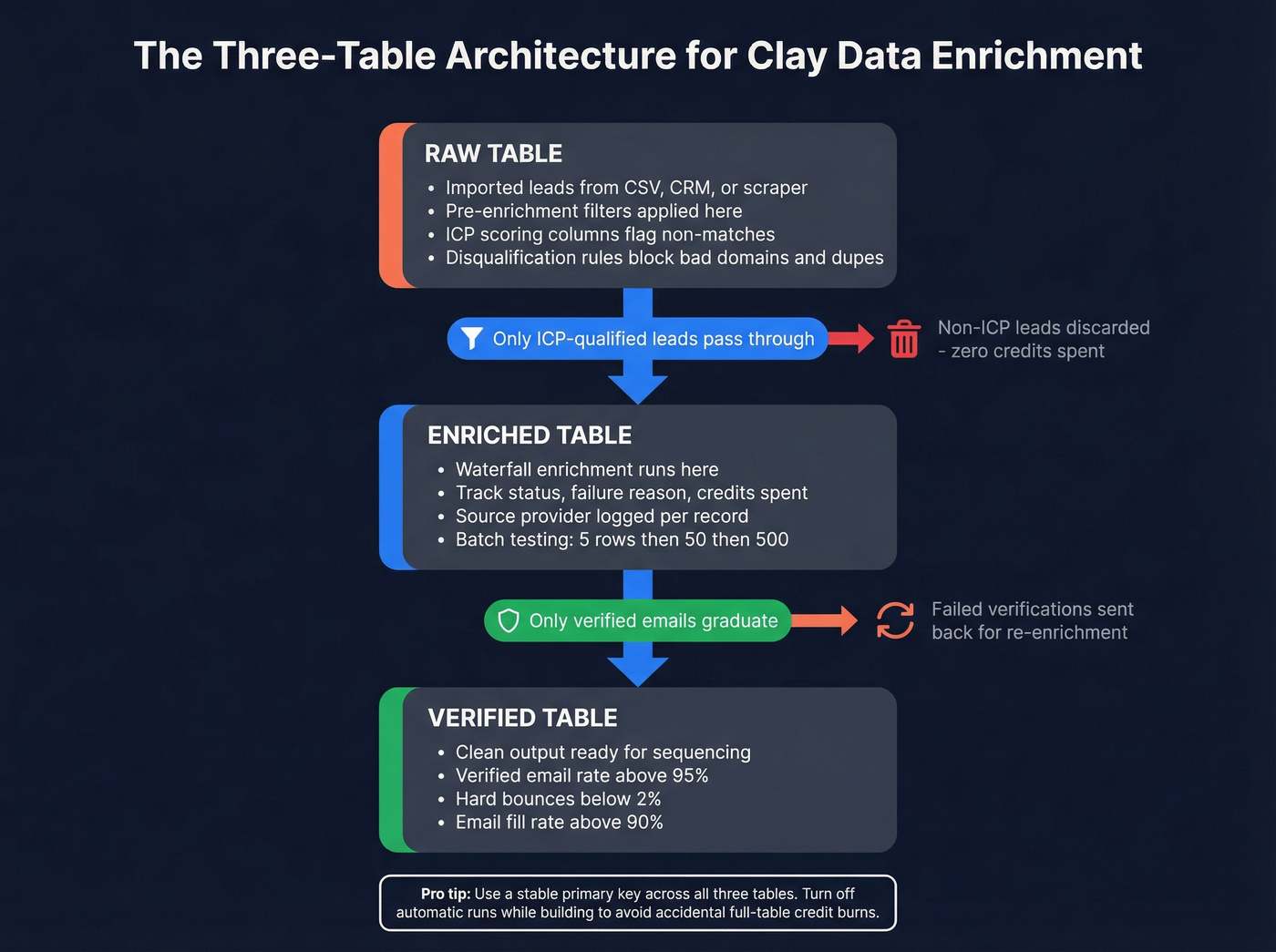
Use a stable primary key across all three tables. Test in batches: 5 rows first to debug, then 50 to validate, then 500 to scale. Set pilot targets: verified email rate >95%, hard bounces <2%, and email fill rate >90%.
Turn off automatic table runs while building. One accidental full-table run on a 10,000-row import can burn your entire monthly allocation in minutes. We've seen it happen more than once.
If you're cleaning an existing database, this workflow pairs well with a CRM hygiene process.
Use BYOK to Slash Costs
BYOK is the single biggest cost lever in Clay. Instead of paying Clay's per-credit rates, you connect your own provider APIs and pay those providers directly - often at a fraction of the cost.
This is especially useful for data enrichment for cold email, where bad records quickly turn into deliverability problems.

For email enrichment, Prospeo is the provider we'd start with. Enriching 1,000 contacts through Clay's native credit economics can cost roughly $149 in common Starter-plan scenarios. Running those same contacts through Prospeo's API costs about $39 - with 98% email accuracy and a 92% API match rate. The native Clay integration makes setup straightforward, and Prospeo's 5-step verification process, which includes catch-all handling, spam-trap removal, and honeypot filtering, means you skip the downstream verification step that eats even more credits with other providers.
The same logic applies to AI costs. Connect your own OpenAI or Anthropic API key and cut AI processing costs by up to 90% versus Clay's built-in AI credits.
Email Verification Benchmarks
Finding an email is only half the battle. A Hunter benchmark tested 15 email verifiers on 3,000 real business emails. Top performers: Hunter at 70% overall accuracy, Clearout at 68.37%, Kickbox at 67.53%, and ZeroBounce at 60.70%. Hunter ran this benchmark, so their dataset may slightly favor their own tool - but the methodology is transparent and the relative rankings are directionally useful.
If you're comparing tools, start with our breakdown of the best email checker tool options and the email ID validator benchmarks.

Those numbers are lower than you'd expect. The catch-all problem makes it worse: 15-28% of B2B domains are configured as catch-all, meaning they accept any email address regardless of whether the mailbox exists. Most verifiers return "unknown" for these domains, which tanks accuracy scores and leaves you guessing on exactly the contacts that matter most. This is where providers with proprietary catch-all handling - like Prospeo, which includes it in their standard verification - offer a real edge over generic verifiers.
Five High-Impact Use Cases
TAM exploration - import target companies, enrich with firmographics and technographics, and map your total addressable market before building any outreach sequences.
CRM cleanup - B2B data decays at 25-30% annually. Run your existing CRM contacts through a Clay waterfall quarterly to keep emails, titles, and firmographics fresh and protect deliverability. The consensus on r/sales is that most teams underestimate how quickly their CRM rots - quarterly enrichment passes aren't optional if you care about reply rates.
If you want the underlying benchmarks and KPIs, see our guide to B2B contact data decay.
Product-led activation - enrich free-tier signups with company size, funding stage, and tech stack to identify which self-serve users deserve a sales touch. Teams running this play see higher conversion from free to paid when routing is based on clean firmographic signals.
Churn prevention - monitor existing accounts for signals like leadership changes, layoffs, or technology shifts that predict churn before the renewal conversation.
Partner and influencer discovery - use Claygent to scrape industry publications, podcast guest lists, and conference speakers to build targeted partnership lists at scale.
When to Build vs. When to Buy
Use Clay if you're running complex, multi-provider enrichment workflows at scale, you have a GTM engineer to build and maintain waterfalls, and your volume justifies the learning curve. Clay data automation shines when you need conditional logic, multi-step sequences, and provider fallbacks that no single tool can replicate out of the box.
If you're evaluating alternatives, compare options in our sales prospecting platform roundup.
Skip Clay if you need verified contact data without the orchestration overhead. Clay's maintenance burden is real - workflows break when providers change their APIs, conditional logic needs constant tuning, and debugging a 6-step waterfall that's returning bad data is nobody's idea of a good afternoon. As Clay becomes operationalized, teams often spend real engineering time maintaining workflows instead of shipping campaigns.
Let's be honest: you don't need 75 providers. You need 3-4 good ones and a verification step. For teams that just need verified emails and phones without building waterfalls, a standalone platform with built-in verification gets you there faster and cheaper.
You read the math: 1,000 contacts through Clay's native credits costs ~$149. The same 1,000 through Prospeo's BYOK integration costs ~$39 - with higher accuracy and no extra verification step. Data refreshed every 7 days, not 6 weeks. 143M+ verified emails ready to query.
Cut your Clay enrichment costs by 75% without sacrificing accuracy.
FAQ
How much does Clay data enrichment cost per lead?
Basic enrichment (name, email, title, company) costs about 14 credits - roughly $1.05 on Starter, $0.22 on Pro. Full enrichment with firmographics runs ~75 credits: $5.63 on Starter, $1.20 on Pro. Using BYOK with a provider like Prospeo drops email costs to ~$0.01/lead.
Is Clay's free plan enough to test?
The 1,200 yearly credits enrich roughly 85 basic contacts. That's enough to validate your waterfall logic and test provider sequencing, but it won't support production workloads or meaningful A/B testing across providers.
Can I use my own API keys inside Clay?
Yes. Clay supports BYOK for providers like Prospeo, Hunter, and People Data Labs. Connecting your own API keys typically saves 70-80% versus Clay's built-in credit system, especially for high-volume email enrichment where per-credit costs compound fast.
What's the biggest mistake teams make with Clay enrichment?
Enriching entire lists without filtering first. Add disqualification columns and ICP filters before running any waterfall - otherwise you'll burn 20-30% of credits on leads you'd never contact. Batch-test with 5-50 rows before scaling to thousands.