


Clay Pricing in 2026: What You'll Actually Pay
You signed up for Clay's free trial, built a gorgeous enrichment workflow, ran it on 500 leads - and burned through your 1,000 trial credits before lunch. Now you're staring at the pricing page trying to figure out what this thing actually costs at scale. The problem: Clay shows you credit allotments but doesn't spell out per-action costs. That's what this breakdown fixes.
One quick note: we're talking about Clay.com - the GTM platform - not Clay.earth, the social app. Different companies, very different price tags.
30-Second Verdict
- Best value if you're going all-in on Clay: Pro plan ($720/mo annual) - per-credit cost drops to ~$0.014 vs ~$0.067 on Starter. That's a 5x difference per credit.
- Best plan to test Clay seriously: Explorer ($314/mo annual) - a solid middle tier for running real workflows without committing to Pro.
Clay's 2026 Plans at a Glance
Clay runs five plans, and the pricing page lists unlimited users on every tier. Annual billing saves 10% and delivers all credits upfront. All prices below reflect annual billing rates; monthly billing costs roughly 10% more.
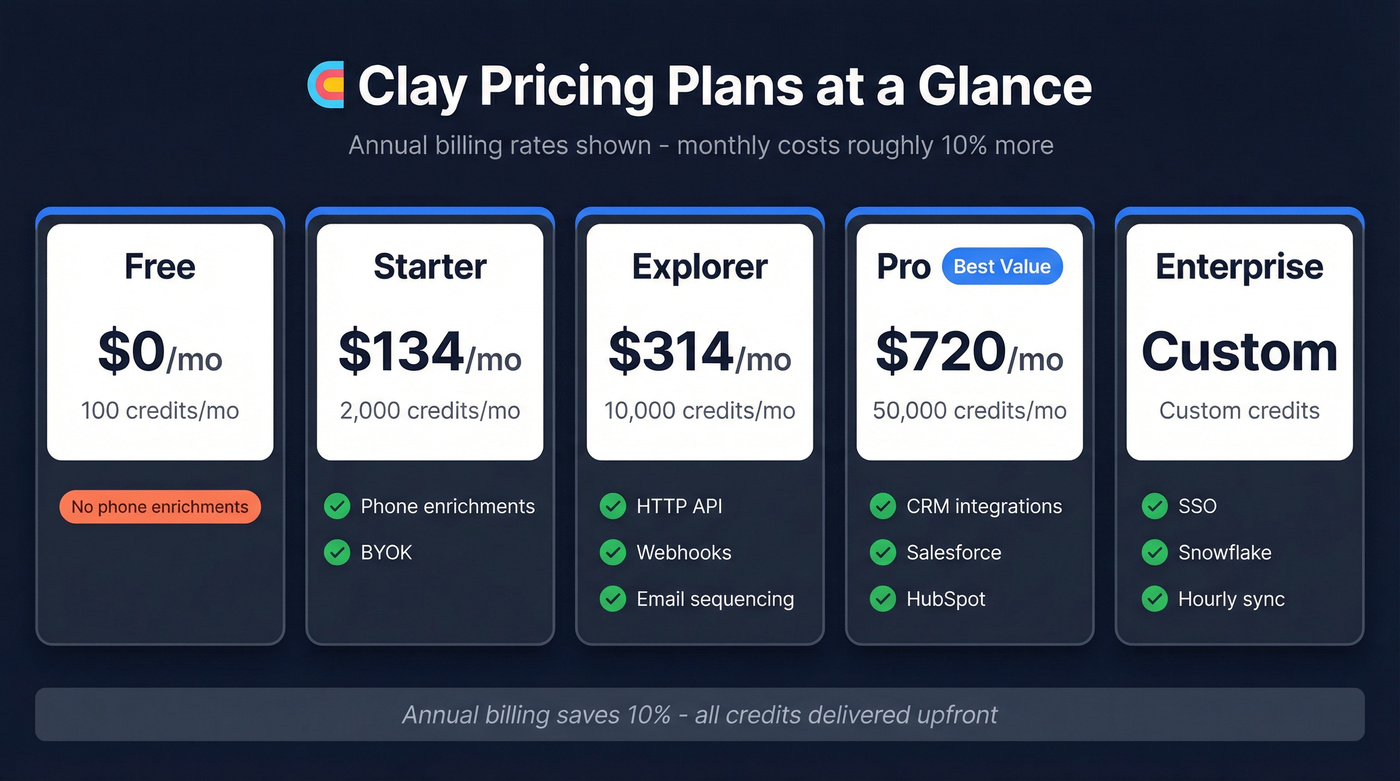
| Plan | Monthly Price | Annual Price | Credits/Year | Credits/Month | Key Feature Unlocks |
|---|---|---|---|---|---|
| Free | $0 | $0 | 1,200 | 100 | No phone number enrichments |
| Starter | $134/mo | ~$1,608/yr | 24,000 | 2,000 | Phone enrichments, BYOK |
| Explorer | $314/mo | ~$3,768/yr | 120,000 | 10,000 | HTTP API, webhooks, email sequencing integrations |
| Pro | $720/mo | ~$8,640/yr | 600,000 | 50,000 | CRM integrations (Salesforce, HubSpot) |
| Enterprise | Custom | Custom | Custom | Custom | SSO, Snowflake, sources sync hourly, 40 action columns |
The 14-day Pro trial gives you 1,000 credits with major Pro features available - including webhooks, CRM integrations, email sequencers, and the HTTP API - except phone number enrichments, which require a paid plan. That's enough to build and test a workflow, but nowhere near enough to evaluate cost at production volume.
Credit Tiers Clay Doesn't Advertise
Each paid plan has multiple credit tiers you can upgrade into. The pricing page only shows the base tier. The full picture lives in Clay's billing docs.
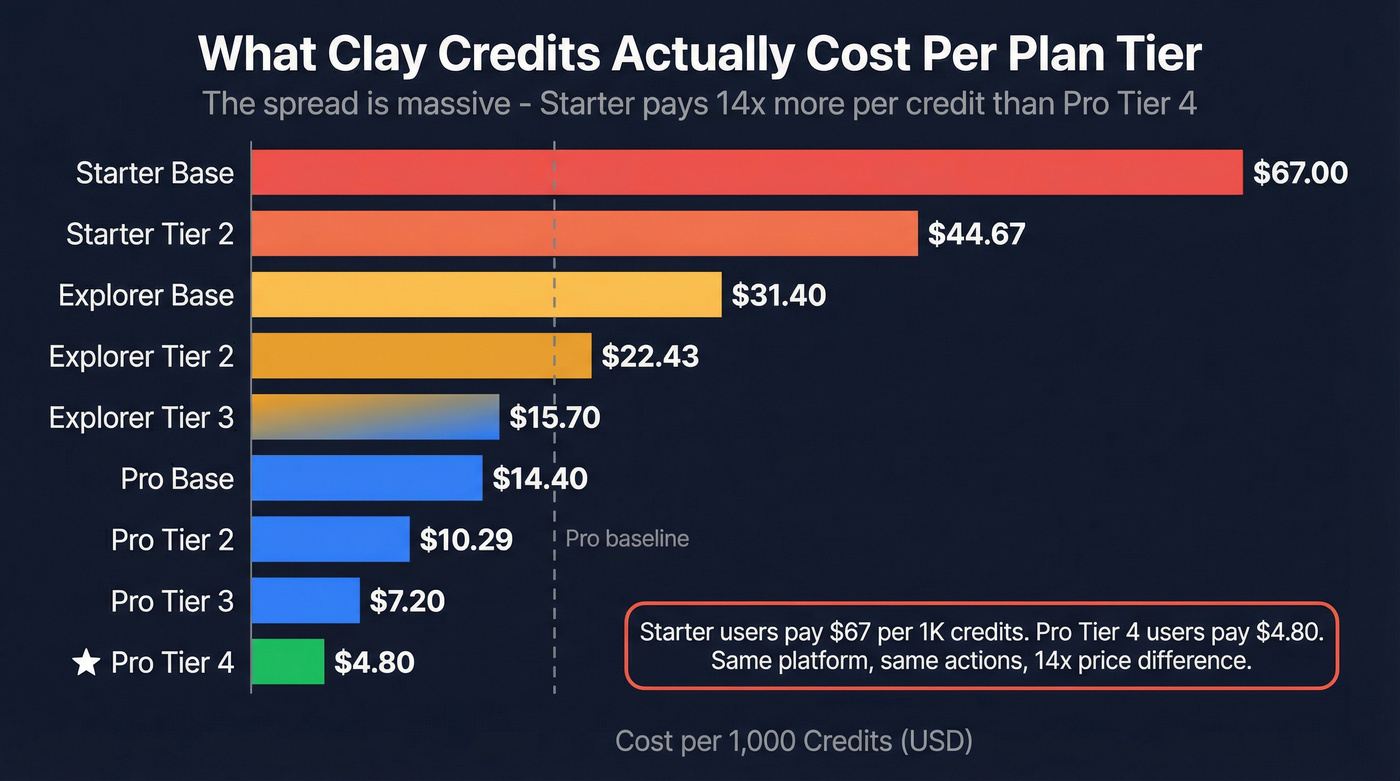
Per-credit costs below are calculated from plan price divided by credit allotment - Clay doesn't publish these figures directly.
| Plan | Credit Tier | Credits/Month | Credits/Year | Cost per 1K Credits |
|---|---|---|---|---|
| Starter | Base | 2,000 | 24,000 | $67.00 |
| Starter | Tier 2 | 3,000 | 36,000 | ~$44.67 |
| Explorer | Base | 10,000 | 120,000 | $31.40 |
| Explorer | Tier 2 | 14,000 | 168,000 | ~$22.43 |
| Explorer | Tier 3 | 20,000 | 240,000 | ~$15.70 |
| Pro | Base | 50,000 | 600,000 | $14.40 |
| Pro | Tier 2 | 70,000 | 840,000 | ~$10.29 |
| Pro | Tier 3 | 100,000 | 1,200,000 | ~$7.20 |
| Pro | Tier 4 | 150,000 | 1,800,000 | ~$4.80 |
The spread is massive. A Starter user pays $67 per thousand credits. A Pro user on Tier 4 pays $4.80. That's Clay's own "Pro is up to 7x cheaper than Starter" claim in action, and the economics only work if you're buying enough volume to reach the lower tiers.
What a Credit Actually Buys
Here's the thing: the pricing page dances around this question entirely.
Clay's general rule is that "the vast majority of actions are either free, or cost 1-2 credits." Prospecting, formatting, cleaning, and data shaping are free. You only burn credits when Clay pays a data provider on your behalf.
| Action | Provider | Credits | Notes |
|---|---|---|---|
| Find email | DropContact / Datagma / Hunter.io | 2 | Provider-dependent |
| Find email | People Data Labs | 5 | Higher coverage, higher cost |
| Find mobile | Base providers | 2 | Cheapest option |
| Find mobile | People Data Labs | 5 | Mid-range |
| Find mobile | Selligence | 13 | Premium coverage |
| Find mobile | ContactOut | 15 | Premium coverage |
| Find mobile | Datagma | 25 | Most expensive option |
| AI prompt | OpenAI (BYOK) | 0 | Bring your own API key |
| CRM connections | External (Pro+) | 0 | Free on Pro |
| Prospecting | - | 0 | Prospecting is free |
The mobile number range catches people off guard. A 2-credit mobile lookup vs. a 25-credit one is a 12.5x cost difference for the same type of data. Your provider selection inside Clay workflows directly controls your burn rate.
Let's be honest: Clay is a workflow automation platform that most teams accidentally use as an expensive email lookup tool. If email finding eats more than half your credits, you're paying for a Ferrari to drive to the mailbox. Pull email lookups into a dedicated tool and spend your Clay credits on the multi-step enrichment and AI personalization that actually justifies the platform cost. (If you're evaluating options, start with these sales prospecting platforms and cold email marketing tools.)
What 5,000 Leads/Month Costs
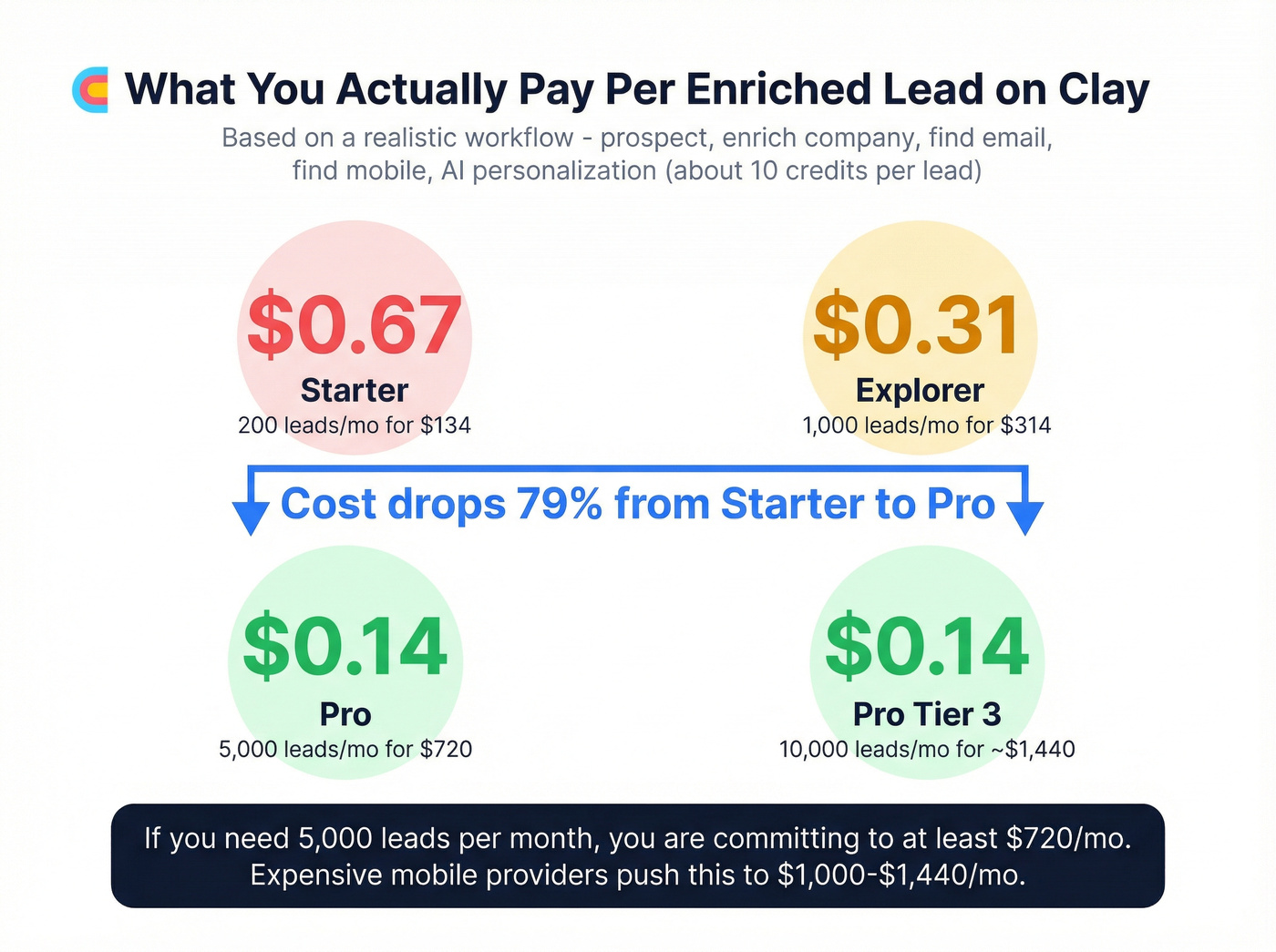
We modeled a realistic workflow: prospect, enrich company, find email, find mobile, AI personalization. Using mid-range providers, that's roughly 8-12 credits per lead. We'll use 10 credits per lead as the baseline.
| Plan | Credits/Month | Leads Enriched | Monthly Cost | Cost per Lead |
|---|---|---|---|---|
| Free | 100 | ~10 | $0 | $0 (but useless) |
| Starter | 2,000 | ~200 | $134 | $0.67 |
| Explorer | 10,000 | ~1,000 | $314 | $0.31 |
| Pro | 50,000 | ~5,000 | $720 | $0.14 |
| Pro Tier 3 | 100,000 | ~10,000 | ~$1,440 | ~$0.14 |
Pro is where the economics actually make sense. At $0.14 per enriched lead, you're getting multi-provider waterfall enrichment, AI personalization, and workflow automation bundled together. That's genuinely competitive.
But look at Starter: 200 leads per month for $134. That's $0.67 per lead for a workflow that finds an email and a phone number. At that volume, you're paying a premium for Clay's workflow engine while barely using it.
For teams that need 5,000 enriched leads per month, you're committing to at least $720/mo. If your workflow uses expensive mobile providers, you'll need Pro Tier 2 or Tier 3 - pushing costs to roughly ~$1,008-$1,440/mo before top-ups. Clay also caps prospecting at 2,500-5,000 results on Pro (Enterprise bumps this to 10,000+), so factor that into your volume planning.

You just saw that Clay charges 2-25 credits per enrichment action - and credits cost $4.80 to $67 per thousand depending on your plan. Prospeo delivers 98% accurate emails at ~$0.01 each with no credit tiers, no top-up markups, and no credits wasted on failed lookups. 143M+ verified emails, 125M+ verified mobiles, 92% API match rate - all on a 7-day refresh cycle.
Stop burning Clay credits on email lookups. Get the data direct.
Hidden Costs and Gotchas
Top-up credit markup. Buying additional credits outside your plan costs roughly 50% more than your plan rate. On Explorer, your plan rate is ~$0.0314 per credit, and top-ups run around ~$0.053 per credit. Clay doesn't publish top-up pricing anywhere - the kind of billing surprise that makes finance teams lose trust fast. If you're trying to forecast spend, this is exactly the kind of thing that blows up your cost of sales tech stack.
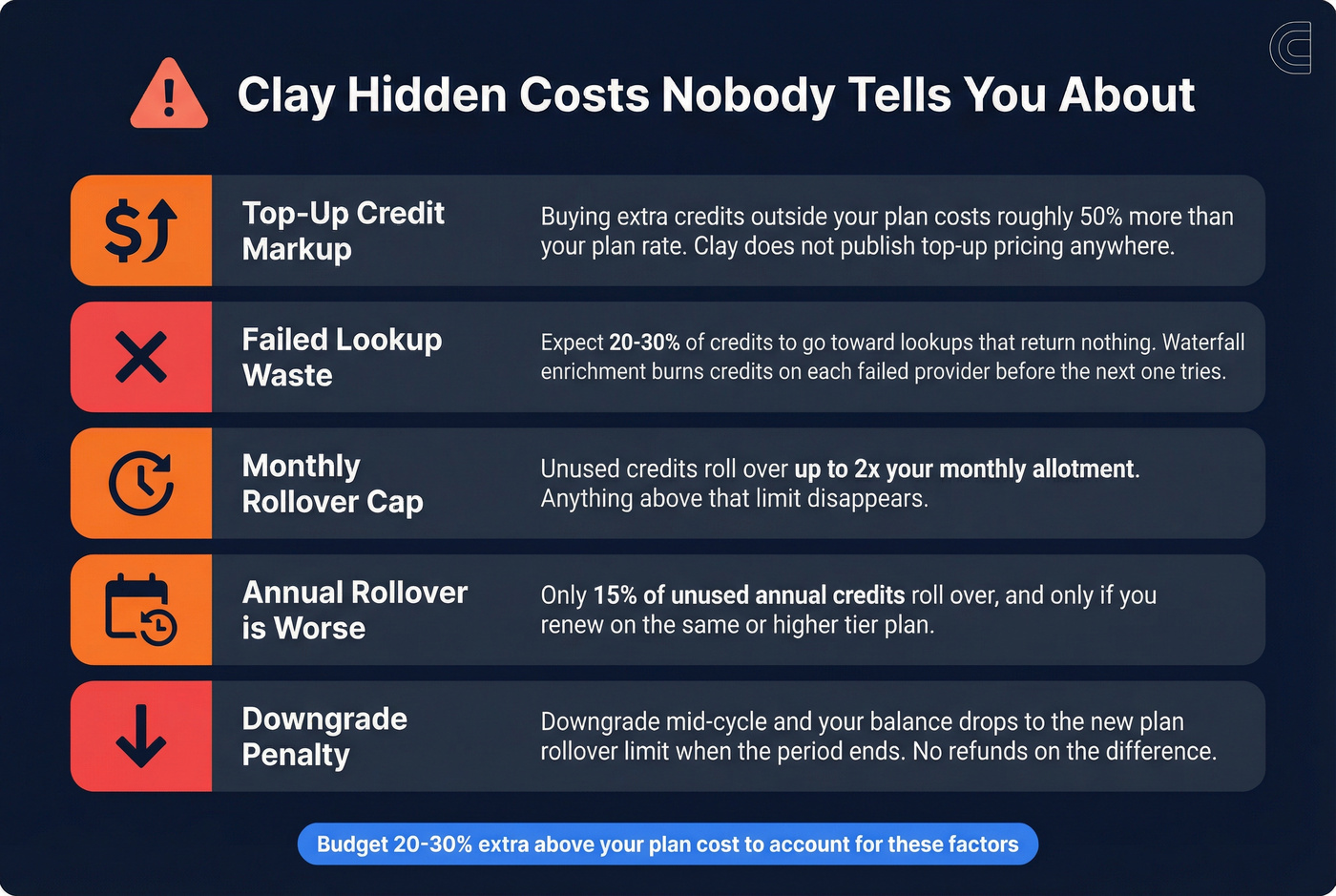
Failed lookup waste. Not every enrichment attempt returns data. In our testing, expect 20-30% of credits to go toward lookups that come back empty. When you're running waterfall enrichment across multiple providers, the first provider can fail and burn credits before the second one succeeds. Budget for this.
Monthly rollover cap. Unused credits roll over, but only up to 2x your monthly allotment. On a 50,000/mo Pro plan, you can bank up to 100,000 credits. Anything above that disappears.
Annual rollover is worse. On annual plans, only 15% of unused credits roll over - and only if you renew on the same or higher-tier plan. Downgrade, and you lose the excess.
Downgrade behavior. If you downgrade mid-cycle, you can use your remaining credits until the billing period ends. After that, your balance drops to the new plan's rollover limit. No refunds on the difference.
How to Control Your Spend
Clay's built-in cost controls are decent - if you know they exist.
Pre-run credit estimates. Before running any column, Clay shows the estimated credit cost including downstream dependent columns. Always check this before hitting run.
Expensive-run warnings. Automatic alerts trigger when a run would cost more than 10% of your monthly allotment (minimum 500 credits) or exceeds 50,000 credits total.
Auto-run toggle. When importing data, downstream actions can fire automatically. Toggle auto-run off before importing to avoid surprise credit burns. We learned this one the hard way during an early workflow test - imported 2,000 rows and watched credits evaporate in real time.
Bring Your Own Key (BYOK). Connect your own API keys - OpenAI is the most common - and those actions cost zero Clay credits. This is the single most effective way to reduce credit burn on AI-heavy workflows. (If you're building this into outbound, pair it with AI personalized email sequences.)
Credit usage dashboard. Workspace-level and table-level views with CSV export. Historical data goes back to November 5th, 2025.
Enterprise Tier: What Teams Pay
Clay's Enterprise tier is quote-based, but Vendr benchmarks put the median enterprise contract at ~$30,400/year, with outliers reaching $154,000. Per-credit cost at enterprise volume drops to roughly $0.008-$0.012.
Enterprise unlocks SSO, Snowflake integration, sources syncing hourly, 40 action columns per table, unlimited rows via API, dedicated Slack support, and credit reporting analytics.
We've seen teams land Enterprise deals in the $25K-$40K range for moderate credit volumes. If you're negotiating, those Vendr benchmarks give you real ammunition. Ask for additional credits rather than price discounts - Clay is more likely to increase your allotment than reduce the sticker price. And don't accept the first number.
The jump from Pro Tier 4 (~$2,160/mo at 150K credits) to Enterprise usually makes sense once you need SSO or Snowflake, or when your credit volume exceeds what Pro Tier 4 offers.
Is Clay Worth the Cost?
Use Clay if you're running complex multi-provider enrichment workflows that feed into CRM automations and email sequences. Clay's workflow builder is genuinely powerful - the ability to chain 150+ providers with conditional logic and AI personalization in a single table is something no other tool replicates well. At Pro-tier volumes, the per-credit economics are competitive. Factor in a few weeks of ramp time, though. Clay's workflow builder has a real learning curve, and that affects your time-to-value.
Skip Clay if you mainly need verified emails and direct dials to fill your outbound sequences. That's a $720/month solution to a $39/month problem. If that's your situation, you'll get more leverage from a dedicated email verification and email finder with CRM integration stack.

Most clay pricing guides are written by competitors trying to scare you. The truth: Clay is expensive if you use it wrong, and cost-effective if you use it right. The frustrating part is that Clay makes it nearly impossible to know which camp you'll fall into before you commit. The 14-day Pro trial with 1,000 credits gives you enough to build a workflow - but not enough to understand your actual credit burn at production volume. GTM teams on r/sales consistently flag credit unpredictability as Clay's biggest operational headache, and they're right.
Clay's mobile lookups range from 2 to 25 credits per number - and 20-30% come back empty. Prospeo gives you access to 125M+ verified mobile numbers with a 30% pickup rate. No waterfall credit drain, no provider roulette. Save your Clay credits for the AI workflows that actually need them.
Pull your contact data from Prospeo. Spend Clay credits on what Clay does best.
How Clay Compares
| Tool | Starting Price | Data Model | Best For |
|---|---|---|---|
| Clay | $134/mo | Credit-based workflow | Complex enrichment workflows |
| Prospeo | $39/mo | Per-contact, transparent | Verified emails and mobiles at scale |
| Apollo | ~$49-$99/user/mo | Contact database + outreach | Simpler prospecting + sequences |
| ZoomInfo | ~$15K-$40K/yr | Pre-built database | Enterprise budgets, US data depth |
Apollo is the obvious comparison for teams that don't need Clay's workflow complexity. At $49-$99/user/month, you get a contact database, built-in sequencing, and a simpler pricing model. The tradeoff: Apollo doesn't offer Clay's multi-provider waterfall enrichment or conditional workflow logic. If you're deciding between stacks, use a B2B sales stack lens, not just tool-by-tool pricing.
ZoomInfo is the enterprise incumbent, typically running ~$15K-$40K/year+ depending on seats and modules. Deeper US database, broader feature set, but a completely different buying motion - annual contracts, sales-led pricing, and feature bundles you don't need.
For most teams reading this, Clay Pro paired with a standalone data tool will be the right answer - rarely both at full price.
Common Questions About Clay Pricing
Does Clay have a free plan?
Yes. The Free plan includes 1,200 credits/year (100/month) with unlimited users. Phone number enrichments aren't available on Free. The 14-day Pro trial adds 1,000 credits with major Pro features - useful for testing workflows, not for evaluating real-world credit burn.
Do Clay credits roll over?
On monthly plans, unused credits roll over up to 2x your monthly allotment. On annual plans, only 15% carries forward - and only if you renew on the same or higher-tier plan. Downgrading forfeits excess credits after the current billing cycle ends.
What's the cheapest plan with CRM integrations?
Pro at $720/mo on annual billing. CRM integrations with Salesforce and HubSpot are gated behind Pro. Starter and Explorer don't include native CRM connections, which catches a lot of teams off guard during evaluation.
Can I use my own API keys in Clay?
Yes. Connecting your own API key (OpenAI is the most common) means that action costs zero Clay credits. This is the single most effective way to reduce credit burn, especially for AI-heavy personalization workflows.
What's a cheaper alternative for just email lookups?
You don't need a workflow automation platform for verified contact data. Prospeo's email finder runs ~$0.01/email with 98% accuracy across 143M+ verified addresses, includes a free tier (75 emails/month), and integrates natively with Clay, HubSpot, and Salesforce. For teams whose primary need is emails and direct dials, that's the more cost-effective path - and you can always pipe the data back into Clay for workflow automation.