Objection Handling Framework: 7 Methods, Real Scripts, and Data from 67,149 Sales Calls
Your SDR just gave a 15% discount on the spot - again - because a prospect said "it's too expensive" and they panicked. That's not a pricing problem. That's a training problem. 60% of buyers reject an offer four times before saying yes, yet 48% of reps never follow up after the first objection. You don't need twelve techniques. You need one objection handling framework, a handful of scripts, and better prospect data.
The Short Version
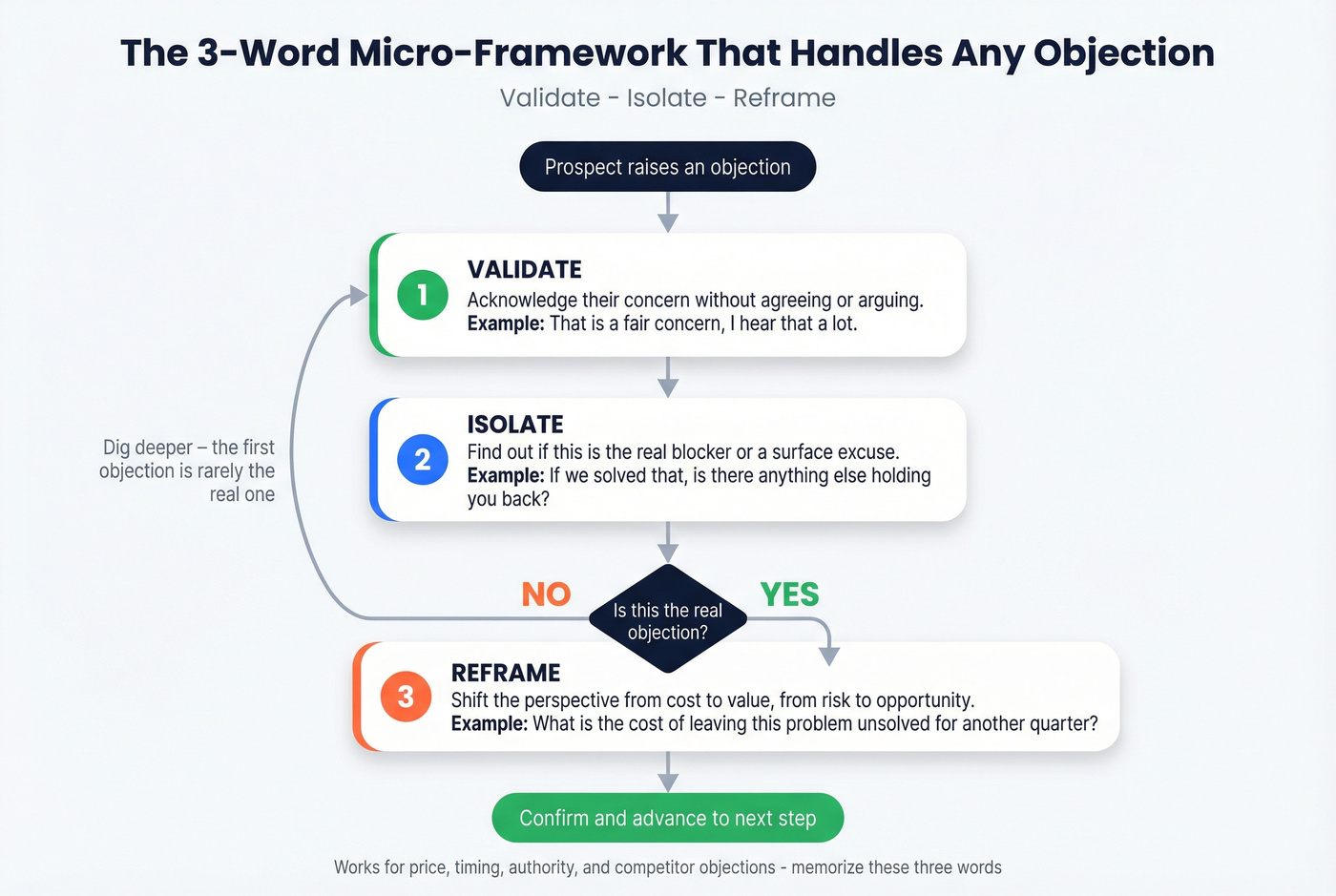
Default to LAARC for most sales motions. It's structured enough to teach, flexible enough for real conversations. When you blank mid-call, fall back on three words: Validate, Isolate, Reframe. That micro-framework works in almost any live objection moment.
But here's what we've seen over and over again: most objections stem from talking to the wrong person. Fix your data before you fix your scripts. If your CRM is full of stale contacts and wrong titles, no framework saves you.
What Is Objection Handling?
An objection isn't a rejection. It's a buying signal wrapped in hesitation. Highspot frames it well: when a prospect pushes back, they're telling you they're engaged enough to articulate a concern. The silent ones - the ones who ghost - those are the real losses.
80% of successful sales require five or more follow-up touches. Reps who treat the first "no" as final are leaving the vast majority of revenue on the table. This isn't about winning arguments. It's about understanding what's actually behind the hesitation and addressing that - not the surface-level excuse.
Four Types of Sales Objections
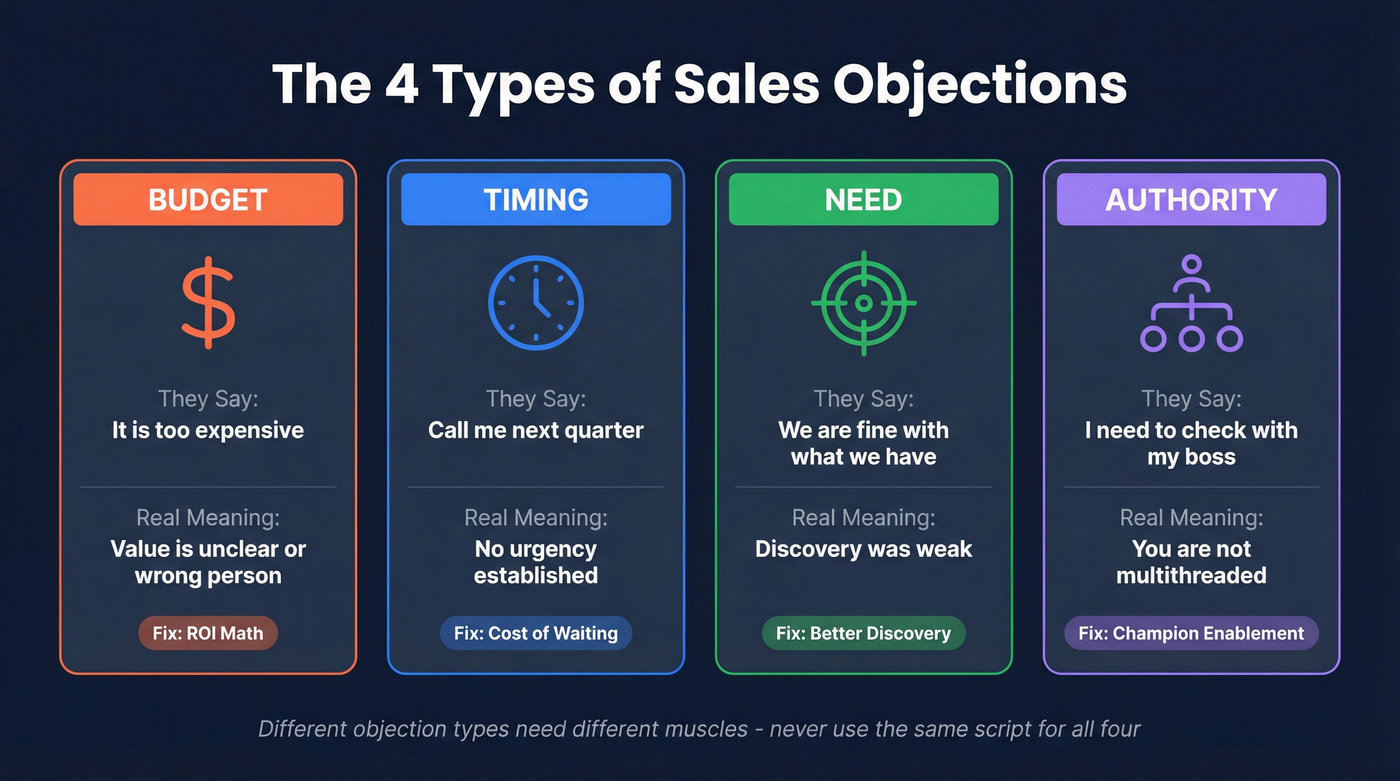
Almost every objection you'll hear falls into one of four buckets. Understanding which category you're dealing with determines which script you pull.
| Category | What They Say | What They Mean |
|---|---|---|
| Budget | "It's too expensive" / "We don't have budget" | Value isn't clear, or you're not talking to the budget holder |
| Timing | "Call me next quarter" / "Now's not a good time" | No urgency established, or a real competing priority |
| Need | "We're fine with what we have" / "I don't see the fit" | Discovery was weak, or you're pitching the wrong problem |
| Authority | "I need to run this by my boss" / "I'm not the decision-maker" | You're not multithreaded, or your champion isn't armed |
The mistake most reps make is treating all four the same way. A budget objection requires ROI math. A timing objection requires urgency framing. An authority objection requires champion enablement. Different muscles entirely.
7 Frameworks Compared
| Framework | Steps | Best For | Complexity |
|---|---|---|---|
| ARC | Acknowledge, Respond, Close | Fast transactional deals | Low |
| LAARC | Listen, Acknowledge, Assess, Respond, Confirm | Consultative / enterprise | Medium |
| LAIR | Listen, Acknowledge, Identify, Reverse | Mid-market discovery | Medium |
| LACE | Listen, Accept, Commit, Explicit Action | Deals needing clear next steps | Medium |
| FFF | Feel, Felt, Found | New SDR training (first month only) | Low |
| SOLVE | Support, Obtain, Listen, Validate, Explain | CS / support-led sales | High |
| ARR | Address, Reframe, Redirect | Competitive displacement | Medium |
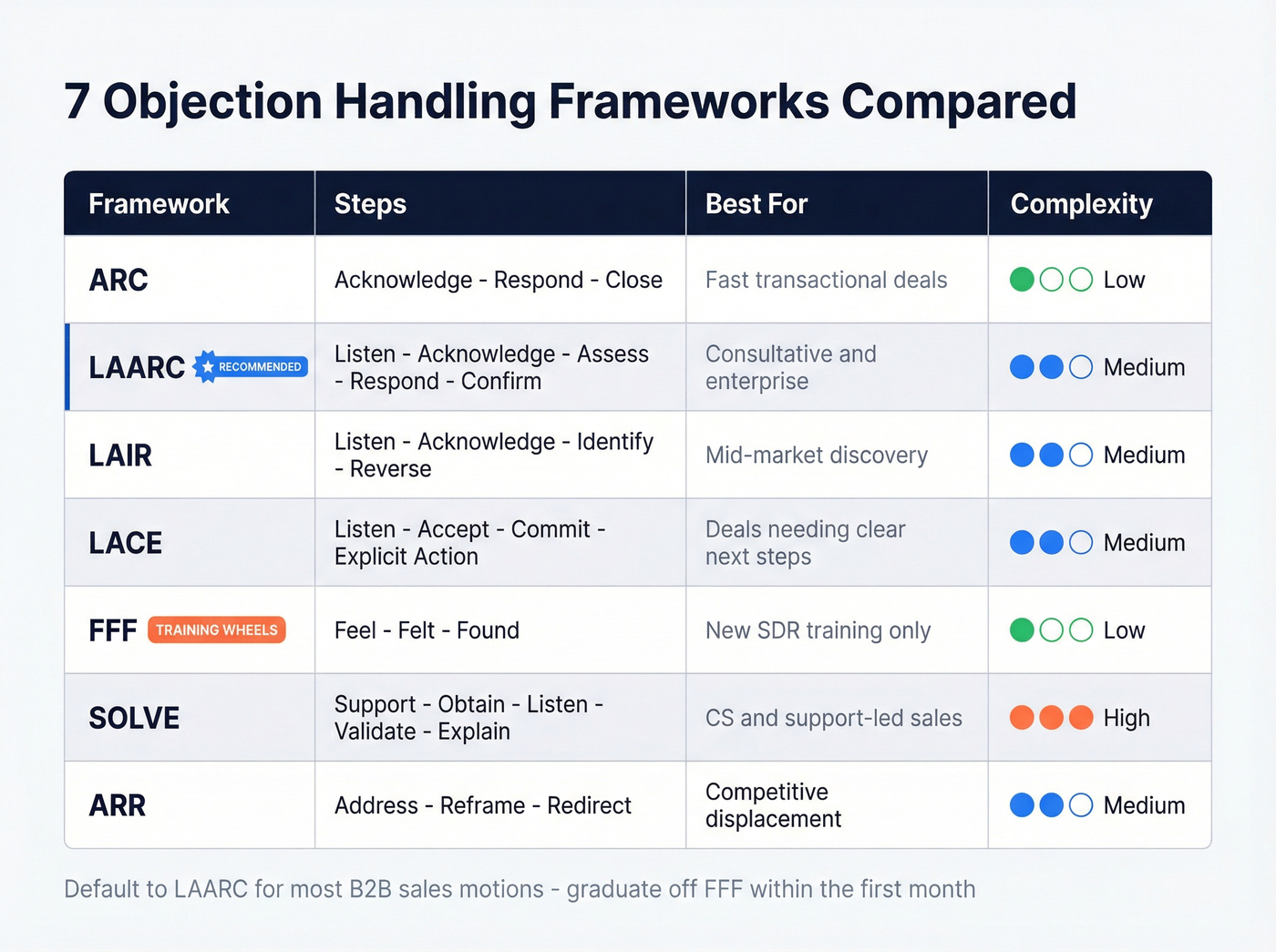
Framework breakdowns draw from NetHunt's comparison and Klue's competitive selling guide. You'll notice many of these models share common DNA - listen first, respond second - but the nuances matter depending on your deal complexity.
Which Model Should You Use?
LAARC is the safest default for most B2B sales teams. It mirrors LAER's listen/acknowledge/respond structure and adds deeper assessment plus a confirmation step. Those extra steps force reps to actually understand the objection before responding, which is where most handling breaks down.
Here's the thing: FFF (Feel-Felt-Found) is training wheels. It works on day one for brand-new SDRs because it's dead simple. But experienced buyers recognize the pattern quickly. Graduate your reps off FFF within the first month.
For competitive deals where a prospect says "we're looking at [Competitor]," use ARR. Address the claim if it's false, reframe if it's partially true, redirect if it's fully true. It keeps you from getting defensive while steering the conversation back to your strengths.
If your average deal closes under $10K, you probably don't need a five-step process at all. ARC plus good discovery will get you 80% of the way there. Save LAARC for the deals where a blown objection actually costs you real money.

You just read it: authority objections stall deals because reps aren't multithreaded. Prospeo gives you 30+ filters to find every decision-maker and influencer in the buying committee - with 98% verified emails and 125M+ direct dials. Stop arming champions with decks. Start reaching the budget holder directly.
Kill authority objections before they happen. Find every buyer in the room.
What Top Reps Actually Do
Frameworks are useful scaffolding. But what separates great reps from average ones is behavior, not methodology. Gong analyzed 67,149 sales meetings and the findings are specific enough to act on.
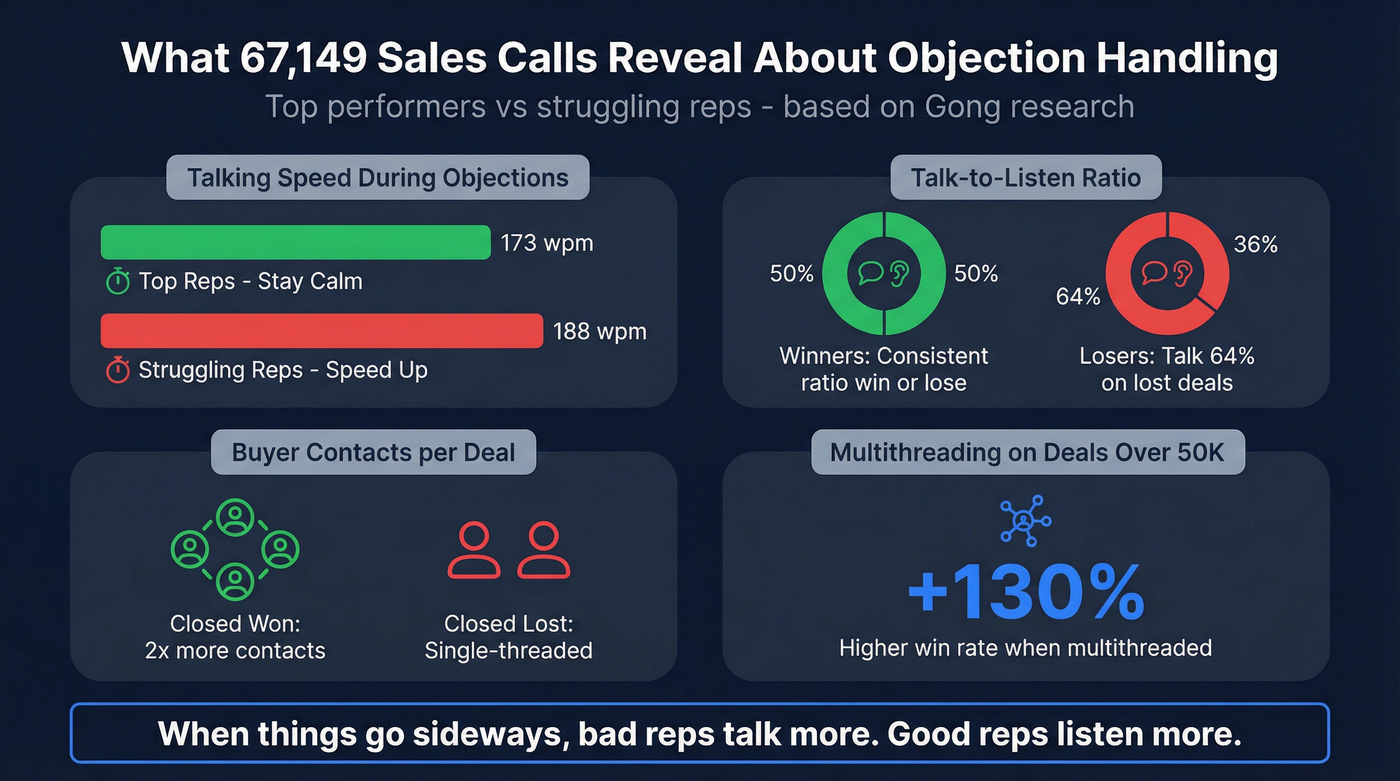
Top performers pause after hearing an objection. Low performers interrupt and pounce. The average talking speed across sales calls is 173 words per minute. When struggling reps hit an objection, they speed up to 188 wpm - a subtle but measurable tell that they're nervous and rushing. Winning reps maintain their pace or slow down slightly.
Mirroring - repeating the prospect's last few words with an upward inflection - is one of the most effective techniques for overcoming objections. It prompts elaboration without feeling like an interrogation. And critically, don't ask "why." "Why do you feel that way?" triggers defensiveness. "What's driving that concern?" gets you the same information without the confrontation.
A 2026 analysis of 1.8M opportunities adds another layer. High performers keep a consistent talk-to-listen ratio whether they win or lose. Low performers' talk time swings by 10 percentage points - from 54% in won deals to 64% in lost deals. When things go sideways, bad reps talk more. Good reps listen more.
Multithreading matters enormously. Closed-won deals have 2x as many buyer contacts as closed-lost. On deals over $50K, multithreading boosts win rates by 130%. It reduces late-stage authority stalls because the decision-maker is already engaged.
Scripts for Every Objection Type
Every script below follows the Validate, Isolate, Reframe micro-framework. Memorize those three words and you can handle anything - even objections you've never heard before.
Price Objections
Start with isolation: "If price wasn't an issue, is this the solution you'd choose to solve [Problem]?" If they say yes, you've confirmed the objection is purely financial - now you can reframe around ROI and cost of inaction. If they hesitate, price isn't the real objection. Dig deeper.
Never lead with a discount. Discounting immediately tells the prospect your price was inflated to begin with, and it trains them to push harder next time. I've watched teams destroy their margins for a full quarter because one rep set a discounting precedent in week one. Lead with value math instead: "What's the cost of this problem going unsolved for another quarter?"
Timing Objections
"What changes between now and next quarter that makes this a better time?" This question forces the prospect to articulate whether the delay is real or just inertia.
Outreach's analysis shows deals closed within 50 days have a 47% win rate. After 50 days, that drops to 20% or lower. Time kills deals. Quantify what waiting costs them: "Every month this problem persists, you're losing roughly [X] in [revenue/productivity/churn]."
Authority Objections
Your champion needs ammunition. Ask: "What questions do you think they'll throw at you that we haven't covered yet?" Then help them prepare. Offer a one-pager or executive summary they can forward - something concise enough that a CFO will actually read it.
The real fix is prevention. If you're consistently hearing "I need to check with my boss," you're not multithreaded enough. Engage the decision-maker early. Bring in your own executive for a peer-to-peer conversation.
Competitor Objections
Use the ARR method. When the prospect says "We're evaluating [Competitor] and they have [Feature]," don't trash the competitor. Compliment them, then identify the gap: "They're solid at [X]. How are you currently handling [Gap that your product solves]?"
If the competitive claim is false, address it directly with evidence. If it's partially true, reframe the context. If it's fully true, redirect to where you win. Getting defensive makes you look insecure - and experienced buyers read that instantly.
Brush-Offs
"Send me an email." Don't just comply. "Happy to - what specifically would be most useful to cover so it doesn't end up in the noise?" This either gets you a real conversation or at least a targeted follow-up.
"We tried something like this before and it didn't work." Validate the experience, then isolate what went wrong: "That's fair. What specifically didn't work - the implementation, the results, or something else?" Nine times out of ten, the previous failure was a different product solving a different problem.
"This looks too complex for our team." Reframe complexity as capability: "That's a fair concern. Most of our customers felt the same way during the demo. What they found was that onboarding took [X days], and after that, their team was faster than with their old process. What part specifically felt complex?"
Six Mistakes That Kill Deals
What's the biggest obstacle to overcoming objections? In most cases, it's the rep's own instincts - reacting before understanding.
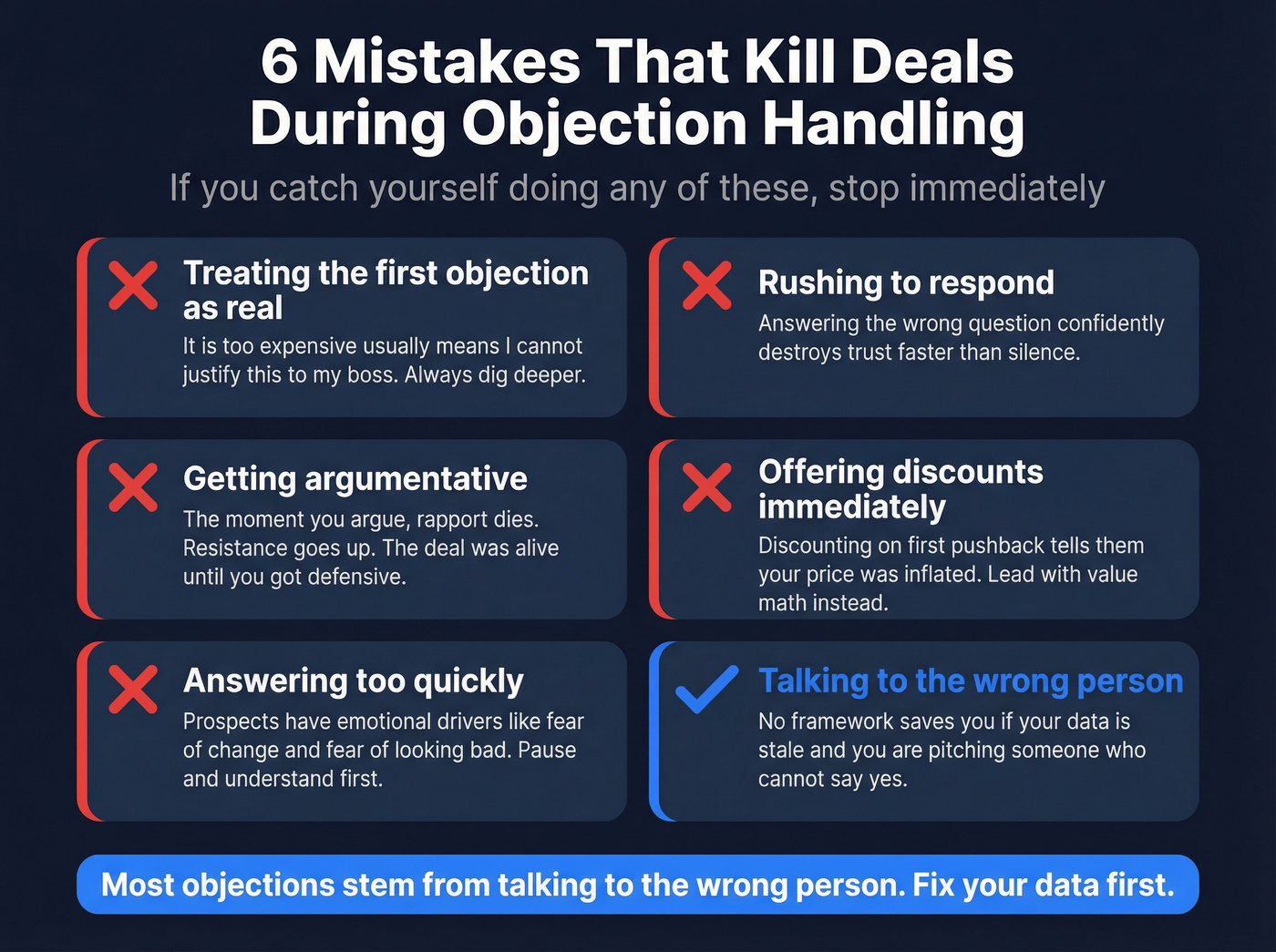
Treating the first objection as the real one. The first thing a prospect says is rarely the actual blocker. "It's too expensive" often means "I can't justify this to my boss." Dig with clarifying questions before responding.
Rushing without understanding root cause. A price objection might actually be a durability concern, a fit concern, or a risk concern. If you answer the wrong question confidently, you've lost trust.
Getting argumentative. The moment you argue, you've turned a conversation into a confrontation. Resistance increases. Rapport dies. I've listened to hundreds of recorded calls where the deal was alive until the rep got defensive about a single feature comparison.
Offering discounts immediately. Reps who discount on first pushback devalue the product and compress margins. Lead with value, always.
Answering too quickly. Prospects have emotional drivers - fear of change, fear of making the wrong decision, fear of looking bad internally. If you jump to a logical answer without acknowledging the emotion, you miss the real objection entirely.
Jumping straight into problem-solving mode. Before you solve, understand. "Compared to what?" for price objections. "What would make this the right time?" for timing objections. HubSpot's breakdown of these anti-patterns is worth bookmarking for your team.
Preventing Objections Entirely
The best objection handling framework is the one you never need to use. Better discovery calls reduce objections dramatically because you've already addressed concerns before they calcify. Structured handling typically improves win rates by 5-15% when paired with coaching and call review - but prevention is what actually moves the number.
Multithreading is the single biggest prevention tool. When you've engaged multiple stakeholders early, authority objections evaporate and budget concerns get surfaced in week one instead of week eight. Team selling amplifies this - in enterprise deals, bringing in a sales engineer can increase win rates up to 30%.
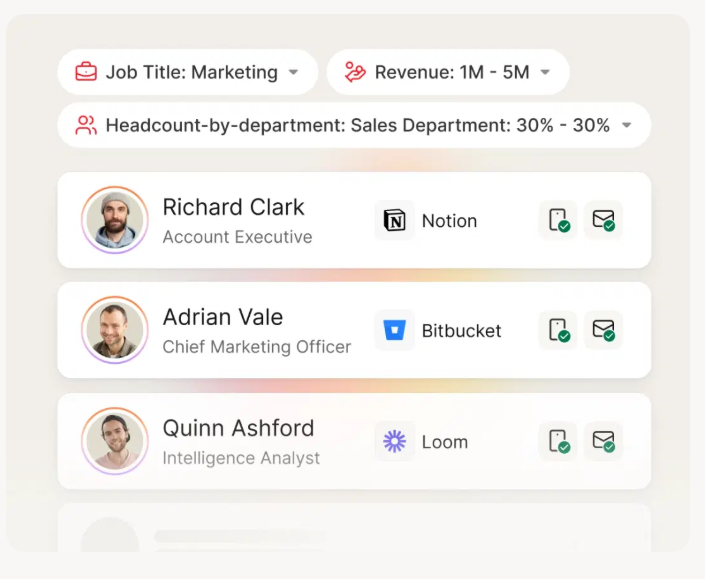
Let's be honest about a prevention angle most sales leaders overlook: data quality. Stale CRM data means reps are calling the wrong people at the wrong companies with the wrong titles. That generates brush-offs, not objections - and no framework fixes a conversation that should never have happened. When Snyk rolled out Prospeo across 50 AEs, their bounce rate dropped from 35-40% to under 5%, and AE-sourced pipeline jumped 180%. Fewer wrong-fit conversations means fewer "not interested" brush-offs in the first place.
Training Your Team
Role-playing is one of the highest-ROI training activities for handling objections. Structure it: one rep plays the prospect with a specific objection card, the other handles it live, a third observes and gives feedback. Rotate roles. Do this weekly, not quarterly.
Build a team-specific objection library by reviewing 5-10 recorded calls. Most teams hear the same objections repeatedly - document them, write scripts for each, and drill until the responses feel automatic rather than scripted. Some teams organize their library using acronyms like LAARC or ARR as shorthand, which makes it faster for reps to recall the right approach mid-call.
AI coaching tools are accelerating all of this. An analysis of 7.1M opportunities found sellers who frequently use AI generate 77% more revenue. Outreach's coaching assistant Kaia closes deals 11 days faster on average. These tools don't replace frameworks - they reinforce them in real time by flagging objection patterns and suggesting responses mid-call. Skip these if your team is under five reps, though. The ROI doesn't justify the cost until you've got enough call volume to train the models.
No framework saves a deal built on stale data. If your CRM is full of wrong titles and dead emails, you're objection-handling ghosts. Prospeo refreshes 300M+ profiles every 7 days - not every 6 weeks - so your reps reach real buyers with real problems. Bounce rates drop under 4%. Pipeline triples.
Fix the data problem before you fix the script problem.
FAQ
What's the best objection handling framework for beginners?
LAARC is the best starting framework - structured enough to teach, flexible enough for real conversations. FFF (Feel-Felt-Found) works for day-one SDRs who need something dead simple, but experienced buyers recognize the pattern quickly. Graduate to LAARC within the first month.
How many times should you handle an objection before moving on?
At least four. 60% of buyers reject an offer four times before saying yes, and 80% of successful sales require five or more follow-ups. 48% of reps never follow up at all. Persistence paired with genuine curiosity about the root concern separates closers from order-takers.
Can you prevent objections instead of just handling them?
Yes - and prevention is higher leverage. Better discovery surfaces concerns early. Multithreading reduces late-stage authority stalls. Accurate prospect data ensures reps reach decision-makers who match the ICP, cutting "not interested" brush-offs before they start.
What's the difference between LAARC and LAER?
LAER (Listen-Acknowledge-Explore-Respond) is the older model. LAARC adds deeper assessment plus a "Confirm" step, which prevents premature closes - you verify the objection is actually resolved before moving forward. That extra step catches deals where the prospect nodded politely but still had a lingering concern.
Do objection handling tips change for inbound vs. outbound?
The core strategies stay the same, but context shifts. Inbound leads have already expressed interest, so you'll encounter fewer need-based objections and more budget or timing concerns. Outbound prospects haven't raised their hand, so brush-offs are more common - which is why verified prospecting data matters even more for outbound motions.