Sales Execution: The Practitioner's Guide to Closing the Strategy Gap
A RevOps lead we know ran the numbers last quarter: his team had 3.5x pipeline coverage, activity metrics were green across the board, and they still missed quota by 18%. The pipeline was an illusion - stuffed with unqualified deals, stale contacts, and opportunities that hadn't moved in 60 days. That's not a strategy problem. That's a sales execution gap hiding in plain sight.
67% of well-formulated strategies fail due to poor execution. Not bad ideas - bad follow-through.
The Short Version
Your execution problem is almost certainly a measurement or data quality problem, not a strategy problem. Build around three pillars: a qualification framework like BANT or MEDDIC, a KPI system tied to pipeline stages, and verified contact data. If your reps are busy but missing quota, skip straight to the diagnostic checklist in Section 5.
What Is Sales Execution?
Sales execution is the daily system of activities, processes, and measurements that converts strategy into revenue. Strategy defines where to play and how to win. Execution is the machine that actually does the winning - the calls made, the deals qualified, the follow-ups sent, the forecasts reviewed.
The distinction matters because most organizations treat strategy as the hard part. It's not. Pfeffer and Sutton's "Knowing-Doing Gap" framework captures this perfectly: companies confuse discussion with action. They produce slide decks, hold offsites, build elaborate playbooks - and then nothing changes on the ground.
Real sales process execution means reps know exactly who to call, what to say, when to follow up, and how to qualify - every single day. It means leadership has visibility into what's working and what's stalling. And it means the data feeding the machine is actually accurate.
Why Execution Breaks Down
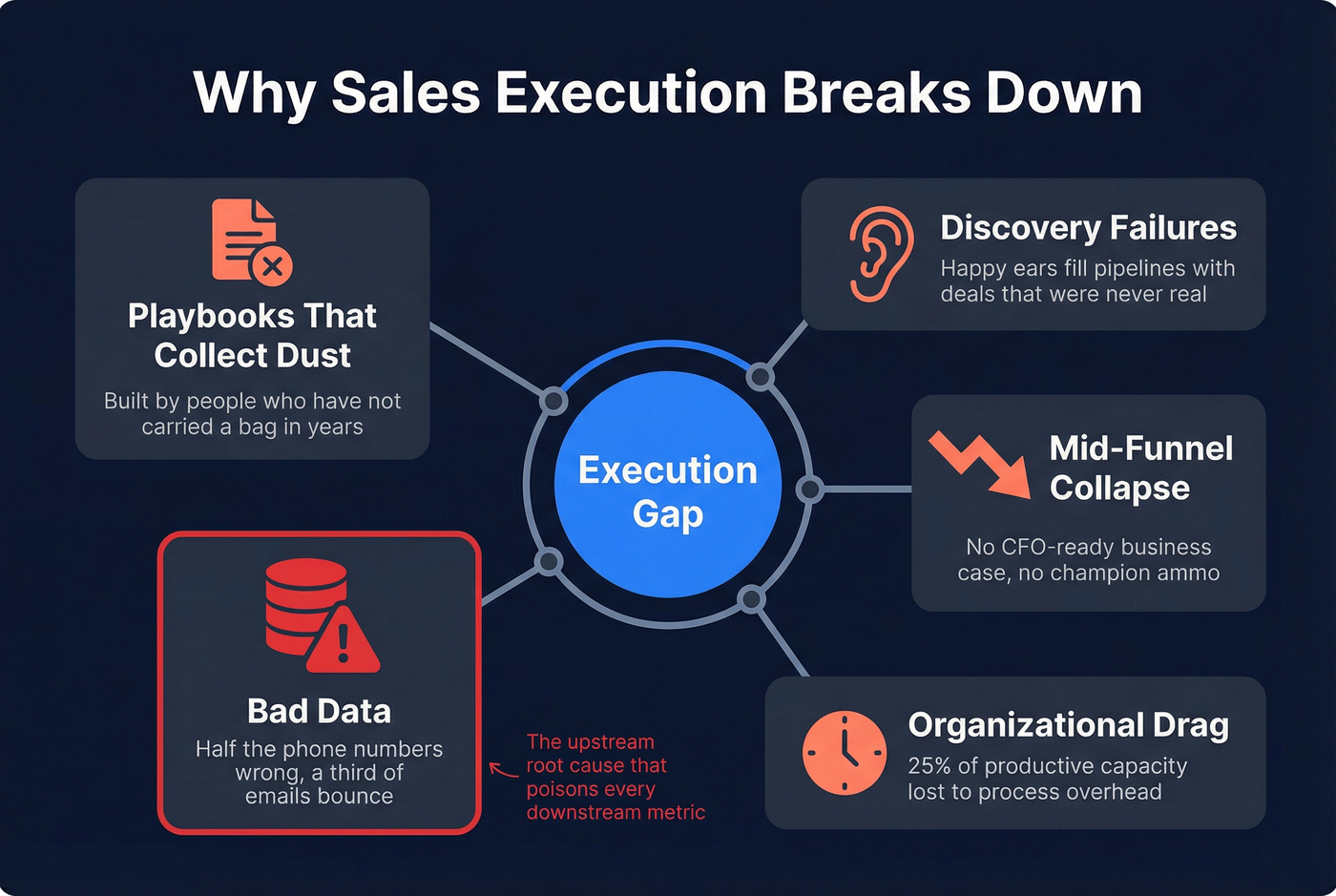
Playbooks That Collect Dust
Most sales teams don't lack knowledge. They lack systems that translate knowledge into consistent behavior. Teams build beautiful playbooks that sit in a shared drive untouched, run quarterly training sessions that don't change daily habits, and leadership thinks the problem is solved because a document exists. It's not. The consensus across sales communities on Reddit is blunt: the playbook was built by someone who hasn't carried a bag in five years.
Discovery Failures
Reps don't disqualify early enough. The "happy ears" problem is real - a prospect says something vaguely positive, and the rep hears a buying signal. Question banks don't fix this because reps don't know how to pivot based on answers. They run through discovery like a checklist instead of a conversation, and the result is a pipeline full of deals that were never real. Here's the part most teams miss: the biggest competitor isn't another vendor. It's "do nothing." Reps who can't quantify the cost of inaction lose to the status quo more than they lose to competitors.
Mid-Funnel Collapse
A rep runs a strong discovery call, gets genuine interest, and then sends a generic follow-up email. No CFO-ready business case. No champion-forwardable summary. No quantified ROI. The deal stalls because the buyer doesn't have the internal ammunition to push it through their own organization.
Real enablement is the systematic removal of friction in live deals - not another training module.
Organizational Drag
Bain research shows the average company loses more than 25% of productive capacity to organizational drag - process overhead like internal emails, approval chains, and meetings about meetings. A single failed strategic initiative can cost EUR200K-500K in direct costs before counting opportunity costs. For sales teams, this translates directly into fewer selling hours. If your reps spend more time in Slack threads and CRM data entry than on the phone, you've got a drag problem.
Bad Data
Picture this: a rep makes 2,000 dials in a month and books one qualified meeting. Leadership assumes it's a skills issue. But half those phone numbers were wrong. A third of the emails bounced. The rep wasn't bad - the data was. Bad contact data is the upstream root cause that poisons every downstream metric. Activity numbers look fine. Connect rates tell the real story.

How to Build a Sales Execution Strategy
Here's the five-step framework we use. Each step builds on the one before it - skip one and the whole system wobbles.
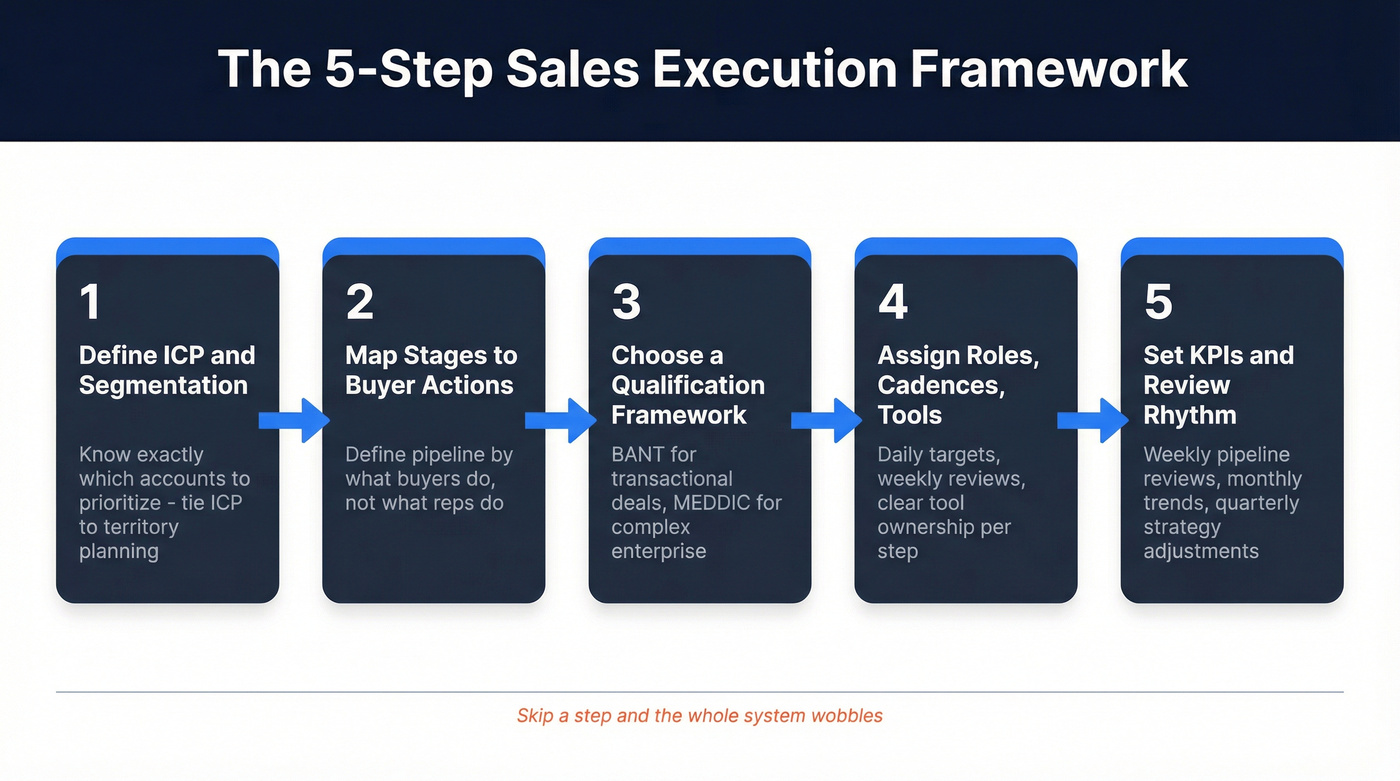
Step 1: Define Your ICP and Segmentation. Segmentation is the first execution decision, not a marketing exercise. If reps don't know which accounts to prioritize, they'll spray activity across the entire TAM and wonder why nothing converts. Tie your ICP definition directly to territory and account planning - who owns which accounts, what's the expected deal size, and what's the engagement model for each tier.
Step 2: Map Pipeline Stages to Buyer Actions. Stop defining pipeline stages by what reps do. Define them by what buyers do. "Demo completed" is a rep action. "Stakeholders aligned on evaluation criteria" is a buyer action. When stages reflect buyer behavior, your pipeline becomes a genuine forecast tool instead of a vanity dashboard.
Step 3: Choose a Qualification Framework. BANT works for transactional sales with shorter cycles - think sub-$15k deals where budget and timeline are the primary gates. MEDDIC is built for complex enterprise deals where you need to map the decision process, identify economic buyers, and quantify the pain. The framework you choose isn't the point. Consistent application is.
Step 4: Assign Roles, Cadences, and Tools. Every rep should know their daily activity targets, their weekly pipeline review cadence, and which tools they're expected to use for each step. One team we studied implemented a dedicated quick-quote team for simple parts and repair deals - it reduced quote time by 50% and doubled their win rate on those deals. Role specialization isn't just for enterprise orgs.
Step 5: Set KPIs and a Review Rhythm. Weekly pipeline reviews catch problems early. Monthly business reviews identify trends. Quarterly planning adjusts strategy. Tie every KPI to a specific pipeline stage so reviews have teeth - not "how are things going?" but "why did stage 2 conversion drop 8 points this month?"

Bad data is the silent execution killer. When half your phone numbers are wrong and a third of emails bounce, no framework saves you. Prospeo delivers 98% email accuracy and 125M+ verified mobiles - refreshed every 7 days, not every 6 weeks.
Stop blaming reps for what bad data broke.
KPIs and Measurement
Execution-to-KPI Mapping
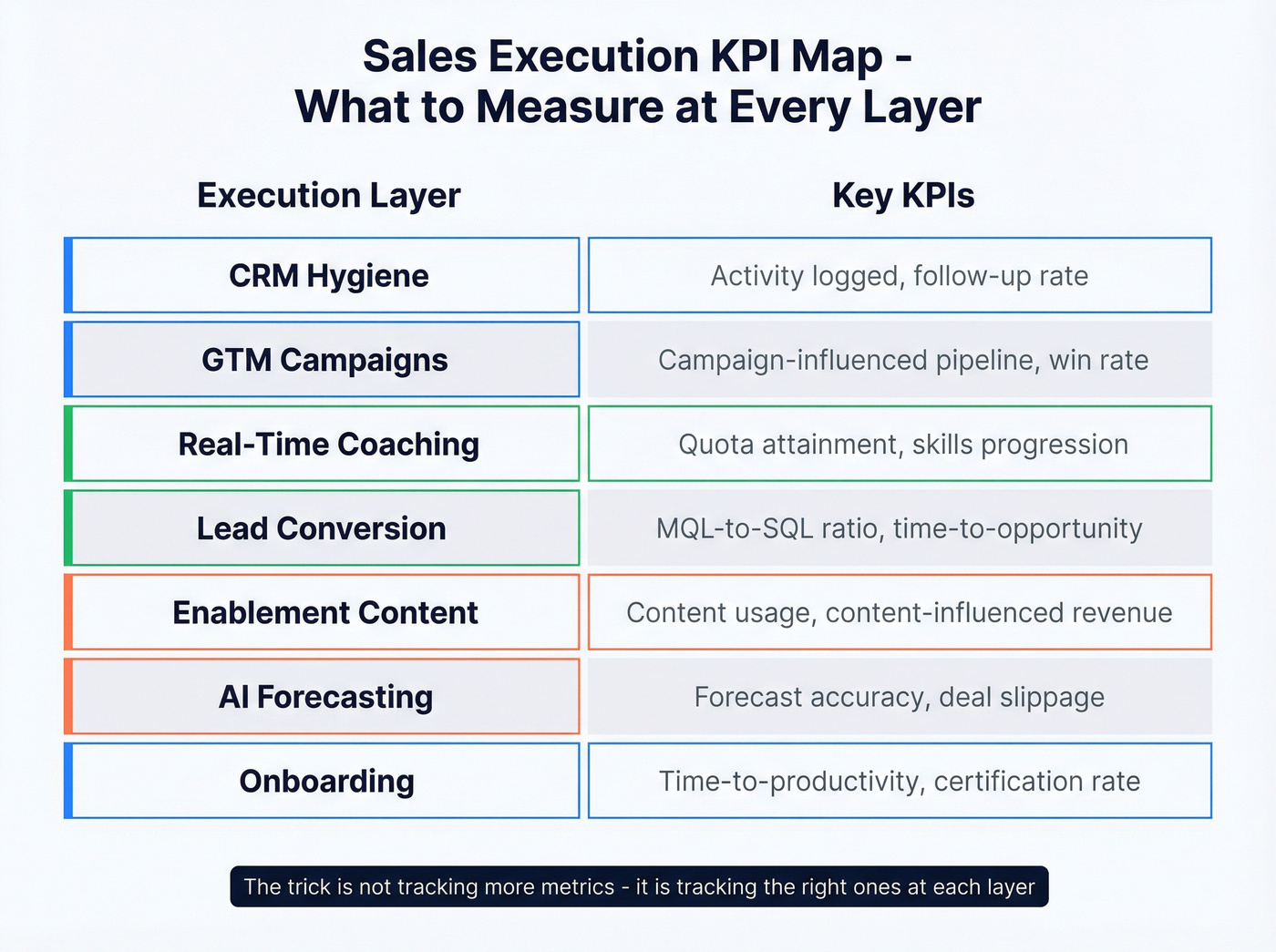
The trick isn't tracking more metrics - it's tracking the right ones at each execution layer. Here's how execution components map to measurable KPIs:
| Execution Layer | Key KPIs |
|---|---|
| CRM hygiene | Activity logged, follow-up rate |
| GTM campaigns | Campaign-influenced pipeline, win rate |
| Real-time coaching | Quota attainment, skills progression |
| Lead conversion | MQL-to-SQL ratio, time-to-opportunity |
| Enablement content | Content usage, content-influenced revenue |
| AI forecasting | Forecast accuracy, deal slippage |
| Onboarding | Time-to-productivity, certification rate |
Pipeline Coverage
The standard heuristic says you need 3x-4x pipeline coverage to hit quota. Here's the thing: a 4x pipeline of unqualified garbage is worse than 2x of qualified deals. Always pair coverage ratios with stage conversion data and deal velocity. If your pipeline is 4x but stage 2-to-3 conversion is 15%, you don't have coverage - you have a graveyard.
Forecast Accuracy Formulas
Three formulas every sales leader should know:
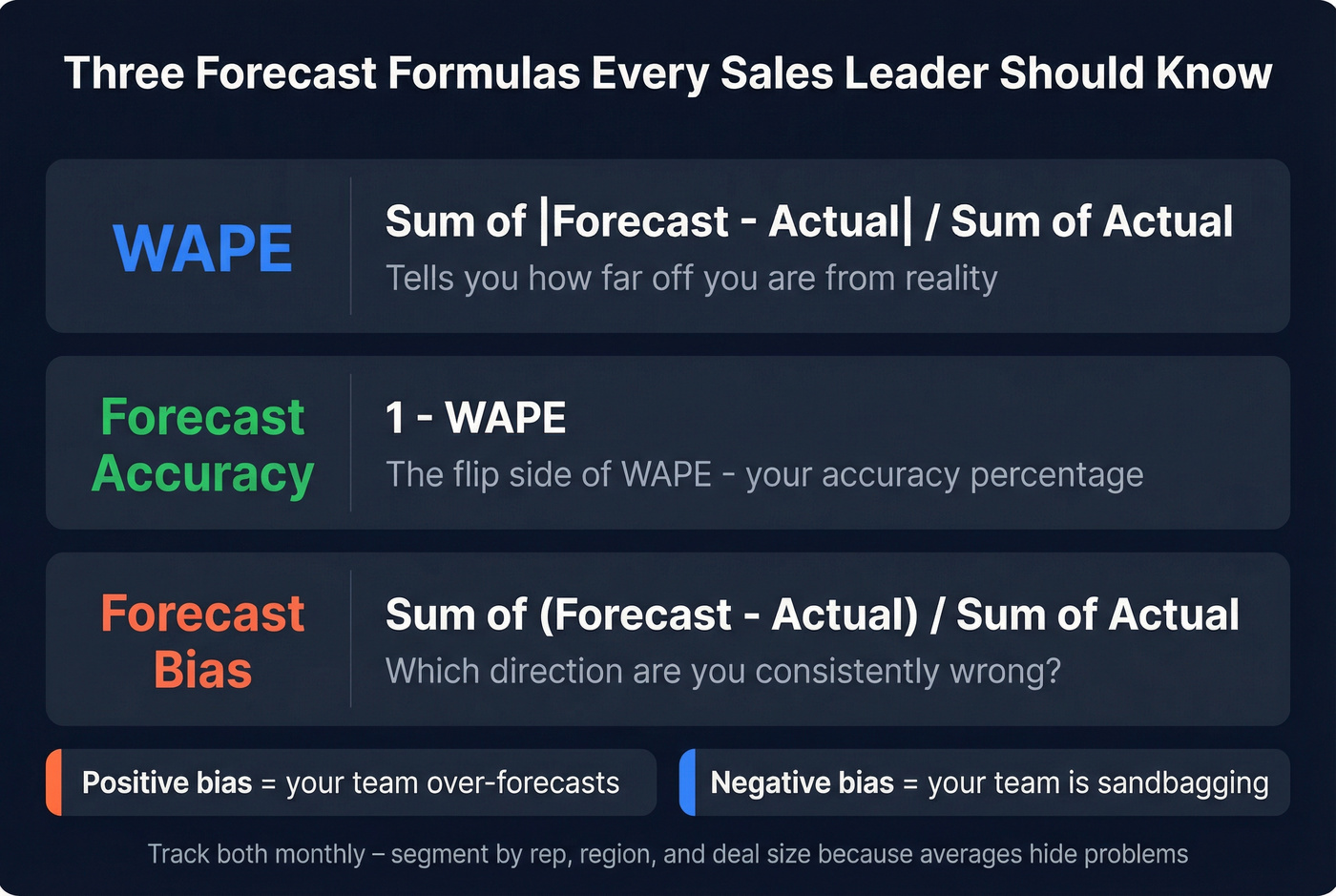
- WAPE = Sum of |Forecast - Actual| / Sum of Actual
- Forecast Accuracy = 1 - WAPE
- Forecast Bias = Sum of (Forecast - Actual) / Sum of Actual
WAPE tells you how far off you are. Bias tells you which direction you're consistently wrong. Positive bias means your team over-forecasts; negative means they're sandbagging. Track both monthly and segment the data by rep, region, and deal size - averages hide problems.
Quota Equity
69% of sellers say their targets are inequitable. 60% say quotas don't reflect territory potential. When reps believe the game is rigged, execution suffers - not because they can't do the work, but because they stop trying. Quota setting isn't a finance exercise. It's an execution lever. Get it wrong and your best reps leave.
Common Mistakes That Kill Deals
Rep-Level Mistakes
Run through this checklist. If your team is doing three or more of these, you've got a systemic execution problem:
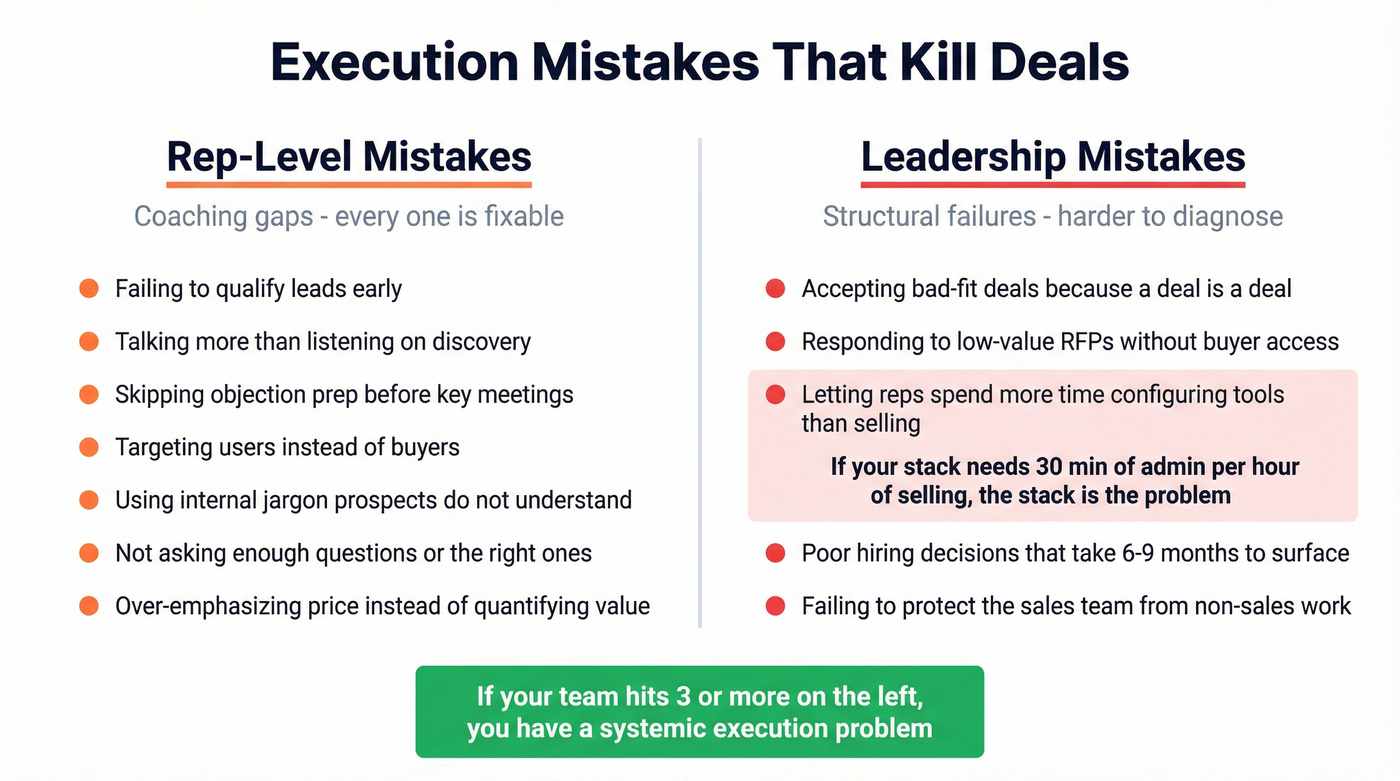
- Failing to qualify leads early (no BANT/MEDDIC discipline)
- Talking more than listening on discovery calls
- Skipping objection preparation before key meetings
- Targeting users instead of buyers
- Using internal jargon the prospect doesn't understand
- Not asking enough questions - or the right ones
- Over-emphasizing price instead of quantifying value
These aren't character flaws. They're coaching gaps. Every one is fixable with structured deal reviews and call coaching - if leadership actually prioritizes it.
Leadership Mistakes
Leadership execution failures are harder to diagnose because they're structural:
- Accepting bad-fit deals because "a deal is a deal"
- Responding to low-value RFPs without buyer access
- Letting reps spend more time configuring tools than selling
- Poor hiring decisions that take 6-9 months to surface
- Failing to protect the sales team from non-sales work
That third bullet deserves emphasis. If your tech stack requires 30 minutes of admin per hour of selling, the stack is the problem. We've seen teams cut their tool count from nine platforms to four and immediately recover 5+ selling hours per rep per week.
The Right Tech Stack
Let's be honest: most teams over-invest in tools and under-invest in data quality. A $150/user/mo engagement platform sending sequences to wrong email addresses is just an expensive way to burn your domain reputation. Fix the foundation first.
CRM: Pick One Your Team Will Use
Salesforce runs roughly $25-$330/user/mo depending on edition. HubSpot offers a free tier, with paid Sales Hub plans starting around $20/user/mo and scaling into the hundreds. Pick the one your team will actually use. A perfectly configured Salesforce instance that reps avoid is worth less than a basic HubSpot setup they log into daily.
Data Quality
This is where we've seen the biggest ROI per dollar spent across the teams we work with. Prospeo covers 300M+ professional profiles with 143M+ verified emails and 125M+ verified mobile numbers, all on a 7-day refresh cycle - the industry average is six weeks, which means most databases are serving stale data by default.
The proof is in the numbers: Snyk's 50-person AE team was running 35-40% bounce rates before switching. After implementing Prospeo, bounces dropped below 5%, and AE-sourced pipeline jumped 180% with 200+ new opportunities per month. Pricing starts free at 75 emails/month, scales at roughly $0.01/email, and requires no contracts.

Engagement Platforms
Skip this if your team is under five reps - a well-built CRM sequence will do. For larger teams, Outreach is the feature-rich option with advanced sequencing and deal management at ~$100-200/user/mo. SalesLoft is more user-friendly with better flexibility for budget-conscious teams in a similar range. Neither publishes pricing, which is frustrating, but those ranges are consistent with what teams report.
Coaching and Conversation Intelligence
Gong at ~$100-200/user/mo gives you call recording, deal intelligence, and pipeline analytics. Mindtickle is custom-priced, often landing around ~$30-100/user/mo depending on modules and seat count. The real value isn't the recordings - it's showing you where deals actually break down versus where reps think they break down. If you can only afford one, start with Gong.
Analytics and Forecasting
Tableau runs ~$15-$75/user/mo depending on license tier, and Power BI Pro is around ~$10/user/mo. Native CRM forecasting covers the basics. Tie whatever you use back to the WAPE and bias formulas above - a dashboard that doesn't measure forecast accuracy is just decoration.
The three-layer minimum: a CRM your team will use, verified contact data from Prospeo, and a sequencing tool. Everything else is a nice-to-have until those three are working.
You just mapped pipeline stages, chose a qualification framework, and set KPIs. Now feed the machine with data that actually connects. Prospeo's 300M+ profiles with 30+ filters - including buyer intent and job changes - let reps reach the right person on the first try.
Close the execution gap starting at $0.01 per verified email.
Execution in 2026: Where AI Fits
Adoption Reality
The hype outpaces the reality. 19% of B2B sales orgs are implementing GenAI use cases, and another 23% are experimenting. That means the majority haven't started. But teams that blend personalization with GenAI are 1.7x more likely to grow market share, and the gap between early adopters and everyone else is widening fast.
AI Coaching vs. Human Coaching
A neuroscience study by Dr. Carmen Simon found that sellers receiving feedback from an AI coach remembered 50% more information after 48 hours than those receiving human feedback. The structured, written format drove better retention. The operating model that makes sense: let AI coach the deal - surface risks, suggest next steps, flag missing stakeholders. Let your manager coach the rep - motivation, career development, emotional intelligence.
EQ Metrics and AI-Closed Deals
Gartner predicts AI will close 70% of sales cycles by 2028 by automating prospecting, qualification, and negotiation. By 2031, 35% of sales orgs will introduce EQ-related productivity metrics - measuring stakeholder alignment and objection resolution effectiveness instead of raw activity.
Activity KPIs become misleading when AI inflates them. If AI sends 500 personalized emails a day, "emails sent" stops meaning anything. The shift to outcome metrics is overdue, and teams that cling to activity dashboards will be measuring the wrong things within two years.
FAQ
What's the difference between sales execution and sales strategy?
Strategy defines where to play and how to win. Execution is the daily system that turns strategy into revenue - calls, qualification, follow-ups, and pipeline management. The 67% failure rate exists because most teams treat strategy as the hard part when the real gap is between what leadership plans and what reps actually do.
What is a sales execution platform?
A sales execution platform automates outbound activities - emails, calls, social touches - within structured workflows. Outreach and SalesLoft are the two dominant options, sitting between your CRM and daily rep activity. Pair one with verified data to avoid burning sequences on bad contacts.
How do you measure it effectively?
Track pipeline coverage at 3x-4x, stage-by-stage conversion rates, forecast accuracy via WAPE, deal velocity, and activity benchmarks. Pair leading indicators with lagging indicators - neither tells the full story alone. Excellence shows up when these metrics move together in the right direction over consecutive quarters.
What's the fastest way to improve?
Start with data quality. If your reps are dialing wrong numbers or emailing bounced addresses, no amount of coaching fixes that. Snyk cut bounce rates from 35-40% to under 5% and saw AE-sourced pipeline jump 180% - fix the inputs and every downstream metric improves.