How to Build a Sales Process Blueprint Reps Actually Follow
Up to 70% of B2B sales reps missed quota last year. Not because they can't sell - because they're winging it. 55% of companies have lost revenue because they lack a defined sales process. A sales process blueprint fixes that, but only if it's short enough to memorize and specific enough to enforce. Here's how to build one in 2026 that actually sticks.
What You Need (Quick Version)
A solid blueprint is five stages, each with exit criteria and a timebox. Keep it to 10-15 pages max. Pair it with the right qualification framework for your deal size, track four benchmarks, and review quarterly. That's the whole thing.
Why Most Sales Processes Fail
90% of organizations with a formal, guided sales process rank among the highest-performing. And yet 81% of sales and marketing teams never review or update their process. That's the gap - not building one, but maintaining one.
Teams build elaborate 100-page playbooks, launch them with fanfare, and watch adoption crater within weeks. Reps revert to gut feel. Managers forecast off vibes. Pipeline becomes fiction. By 2026, 65% of B2B sales organizations will outpace gut-instinct teams by using data-driven strategies](https://martal.ca/sales-kpis-lb/) - the rest will keep guessing and keep losing.
Here's the thing: a blueprint doesn't need to be exhaustive. It needs to be usable. The Alexander Group recommends a high-level document that's usually no more than 10-15 pages. Anything longer and you've written a manual nobody reads.
The 5 Stages Every Blueprint Needs
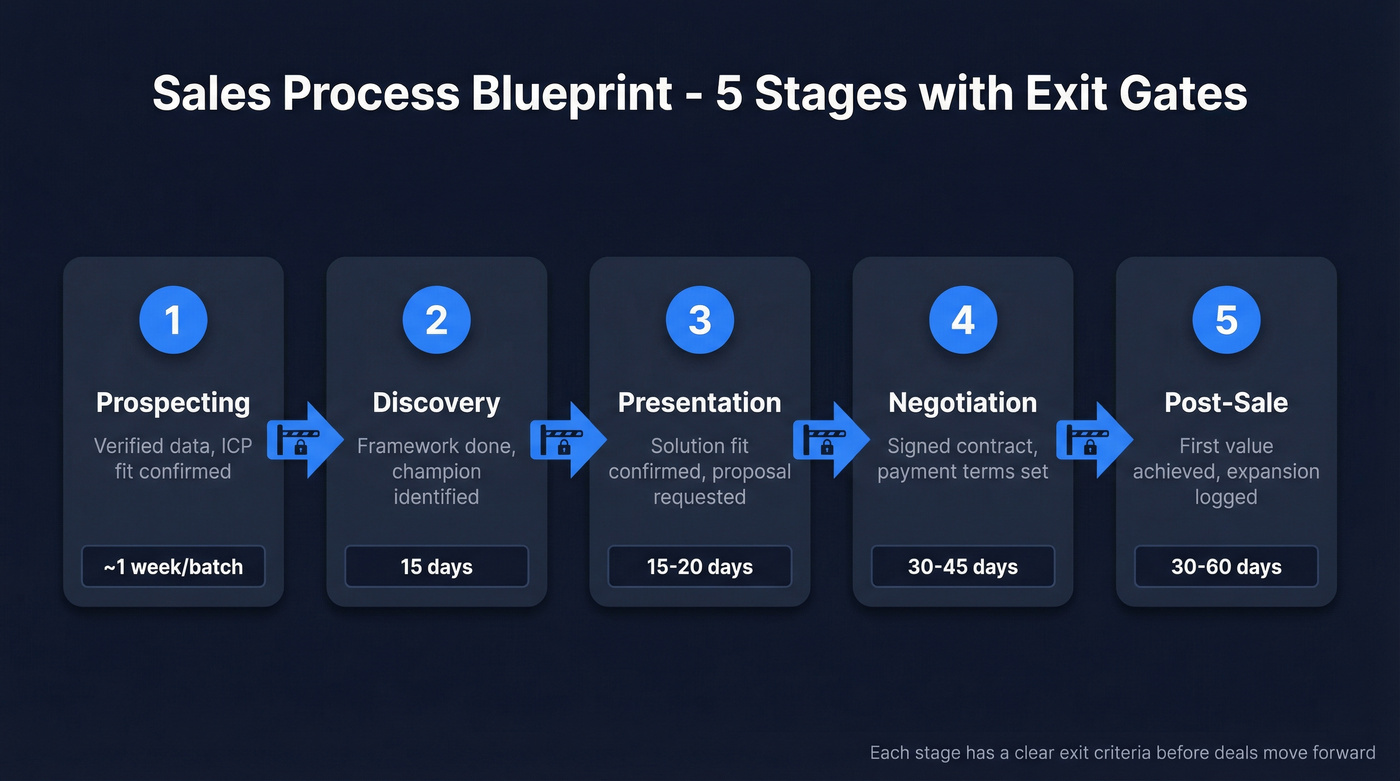
Every B2B deal follows a predictable arc. The specifics vary by industry, but the structure doesn't. Here are the five stages your blueprint needs, each with a clear exit gate.
Stage 1: Prospecting & Lead Identification
Nothing moves without clean data. Build a targeted list of accounts and contacts matching your ICP, then verify the data is actually usable before anyone sends a single email.
This is where most blueprints quietly break. If reps prospect with stale emails and disconnected numbers, every downstream stage suffers. We've seen it firsthand - teams that skip verification end up with 20%+ bounce rates, which tanks sender reputation and poisons the entire outbound motion. Prospeo's B2B database with 300M+ profiles and 98% email accuracy on a 7-day refresh cycle solves this, so lists stay accurate between build day and launch day.
Exit criteria: verified contact data for at least two stakeholders per account, ICP fit confirmed. Timebox: ~1 week per batch.

Stage 2: Discovery & Qualification
You've got a meeting. Now figure out if this deal is real. Discovery isn't a demo - it's a diagnostic. 77% of B2B customers say their latest purchase was extremely complex or difficult, and modern deals involve 6-10 decision-makers. If you don't map the buying committee here, you'll lose the deal in Stage 4.
Exit criteria: qualification framework completed, champion identified, next step confirmed. Timebox: 15 days.
Stage 3: Presentation & Demo
58% of sales meetings aren't valuable to buyers. That stat should haunt every rep who runs a generic demo. Connect your solution to the specific pain uncovered in discovery - don't walk through a feature tour. The best demos we've watched feel like conversations, not presentations; the rep references what the prospect said in discovery and shows exactly how the product addresses it.
Exit criteria: buyer confirms solution fit, technical stakeholders have seen the product, proposal requested. Timebox: 15-20 days.
Stage 4: Negotiation & Close
Pricing, legal, procurement, security reviews - this is where deals stall or die. The key action isn't "closing harder." It's removing friction. Have your MSA ready. Know your discount authority. Align with the champion on internal timelines.
Exit criteria: signed contract and payment terms confirmed. Timebox: 30-45 days.
Stage 5: Post-Sale & Expansion
The blueprint doesn't end at the signature. Boosting retention rates by just 5% increases profits by 25-95%. Cover onboarding handoff, first-value milestones, and expansion triggers like usage thresholds, contract anniversaries, and new team hires.
Exit criteria: customer achieves first measurable outcome, expansion opportunity logged in CRM.
| Stage | Exit Criteria | Timebox | Key Action |
|---|---|---|---|
| Prospecting | Verified data, ICP fit | ~1 week/batch | Build & verify lists |
| Discovery | Framework done, champion ID'd | 15 days | Map buying committee |
| Presentation | Solution fit confirmed | 15-20 days | Custom demo to pain |
| Negotiation | Signed contract | 30-45 days | Remove procurement friction |
| Post-Sale | First value achieved | 30-60 days | Onboarding + expansion log |
Pick Your Qualification Framework
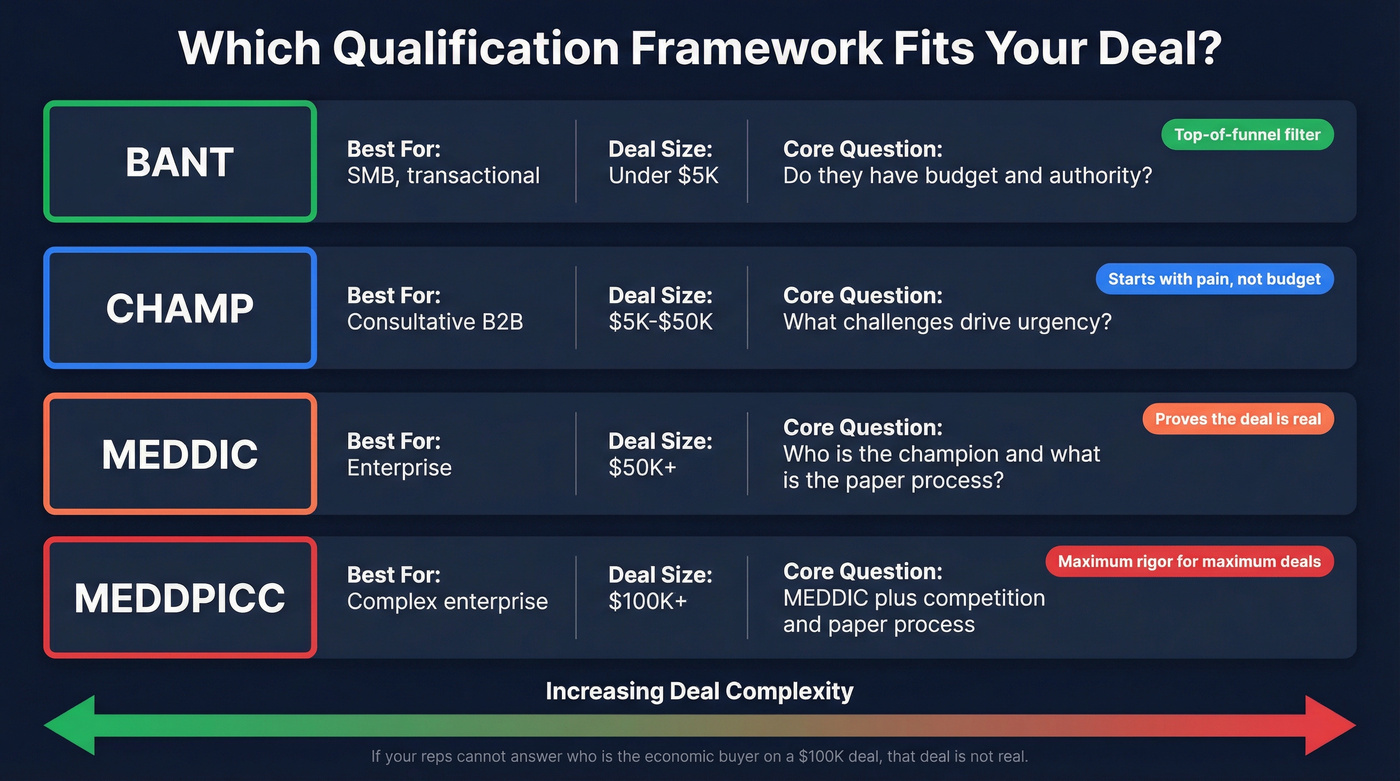
Not every deal needs the same rigor. A $500/month SaaS sale doesn't need MEDDPICC. An enterprise deal absolutely does.
| Framework | Best For | Deal Size | Core Question |
|---|---|---|---|
| BANT | SMB, transactional | Under $5K | Do they have budget and authority? |
| CHAMP | Consultative B2B | $5K-$50K | What challenges drive urgency? |
| MEDDIC | Enterprise | $50K+ | Who's the champion and what's the paper process? |
| MEDDPICC | Complex enterprise | $100K+ | MEDDIC + competition + paper process |
BANT works as a top-of-funnel pre-filter but it's too shallow for complex deals. CHAMP flips the script by starting with challenges instead of budget - better for consultative sales where the buyer doesn't know their budget yet. MEDDIC and MEDDPICC are heavyweight frameworks that force reps to prove a deal is real before it consumes resources. Let's be honest: if your reps can't answer "who's the economic buyer?" on a $100K deal, that deal isn't real.
To go deeper on frameworks and scoring, use a qualification framework that matches your deal complexity.

Your blueprint is only as strong as Stage 1. If reps prospect with bad data, every exit criteria downstream becomes fiction. Prospeo gives you 300M+ profiles with 98% email accuracy on a 7-day refresh cycle - so lists stay valid from build day to launch day.
Stop letting stale data sabotage your entire sales process.
Match Methodology to Deal Economics
Your sales methodology is the "how" - the approach reps use at each stage. Teams that align methodology to economics see a 15% lift in win rates and 21% increase in quota attainment.
| Methodology | ACV | Cycle Length | Deals/AE |
|---|---|---|---|
| Transactional | Under $1K | Days | 20+/month |
| Solution Selling | ~$5K | ~30 days | 5-10/month |
| Consultative | $20-100K | 6-18 months | 1-3/quarter |
| Provocative/Challenger | ~$250K | 6-9 months | 1-2/quarter |
If your average contract value sits below five figures, you probably don't need a complex multi-stage framework at all. A simple two-stage qualify-and-close motion will outperform a five-stage process that slows reps down on deals that should close in a week. Save the rigor for deals that justify it.
If you’re building this for SaaS, compare against a proven SaaS sales process and typical SaaS sales cycle benchmarks.
Benchmarks That Prove It's Working
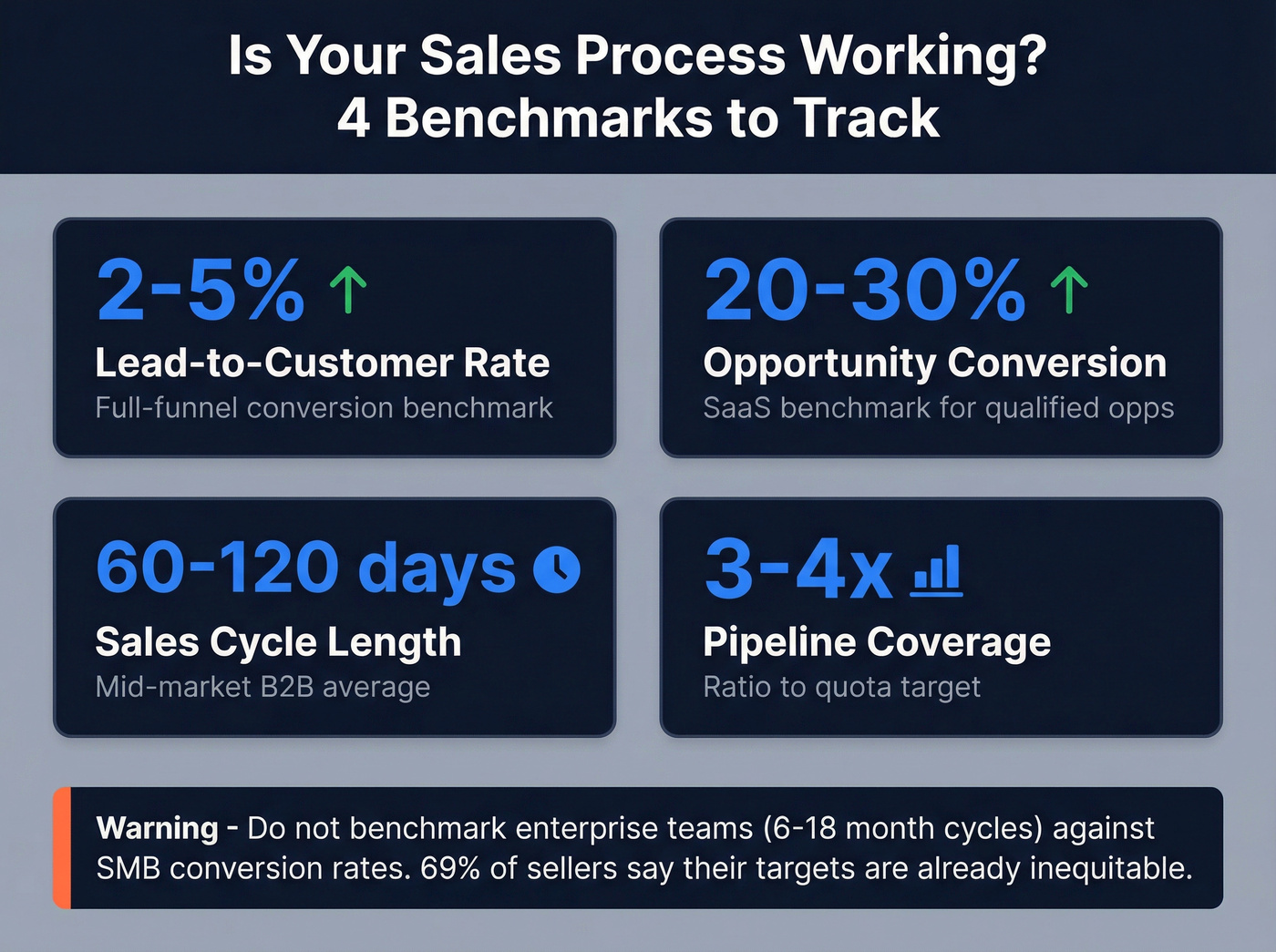
Track these four metrics. If they're in range, your blueprint is doing its job.
| Metric | Healthy Range | Context |
|---|---|---|
| Lead-to-customer | 2-5% | Full-funnel conversion |
| Opportunity conversion | 20-30% | SaaS benchmark |
| Cycle length | 60-120 days | Mid-market B2B |
| Pipeline coverage | 3-4x | Quota target |
Enterprise cycles run 6-18 months; SMB cycles run 1-6 months. Don't benchmark your enterprise team against SMB conversion rates - that's how you create impossible quotas and burn out your best people. 69% of sellers already say their targets are inequitable, and mismatched benchmarks are a big reason why.
If your pipeline still feels “fictional,” diagnose the usual sales pipeline challenges and tighten deal forecast accuracy.
Five Blueprint Killers
These patterns murder sales processes in the wild. Check yours against this list.
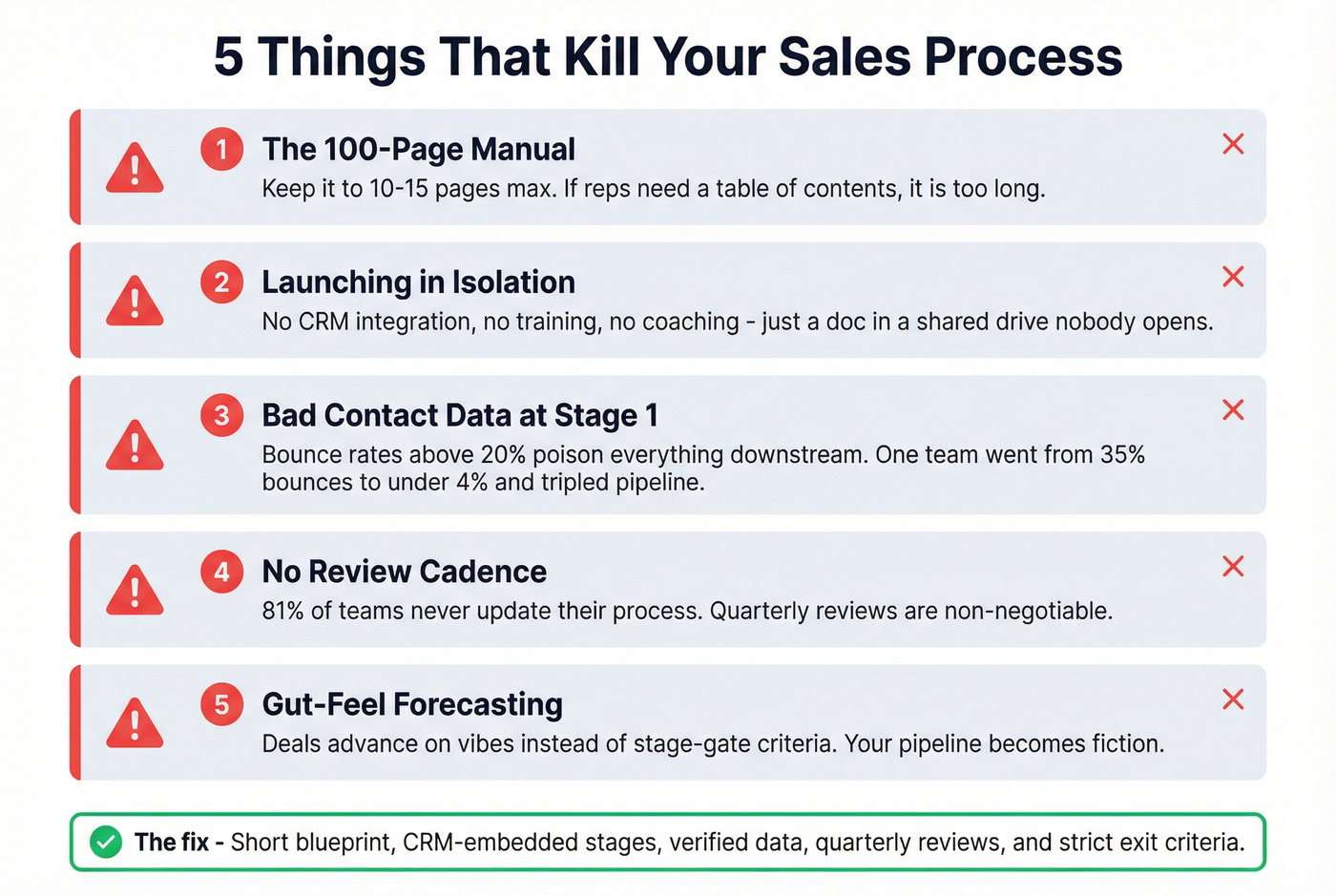
- Over-operationalizing into a 100-page manual. Keep it to 10-15 pages. If reps need a table of contents, it's too long.
- Launching in isolation. A process without CRM integration, training, coaching, and marketing alignment is just a document sitting in a shared drive.
- Bad contact data breaking Stage 1. If your prospecting lists bounce at 20%+, nothing downstream works. Meritt saw their bounce rate drop from 35% to under 4% after switching to verified data - and pipeline tripled from $100K to $300K per week.
- No review cadence. 81% of teams never update their process. Quarterly reviews, non-negotiable. Put them on the calendar now.
- Gut-feel forecasting. If deals advance based on "I think they're interested" instead of stage-gate criteria, your pipeline is fiction. Full stop.
If Stage 1 is breaking, fix the root cause: B2B contact data decay and poor prospect data accuracy. If bounces are the symptom, start with hard bounce prevention.
Turn It Into a Living Playbook
Look - if your blueprint lives in a PDF, it's already dead. Static playbooks sit in shared drives and rot.
Embed your stage definitions, exit criteria, and qualification frameworks directly into your CRM's deal stages. When a rep tries to move an opportunity forward, the system should ask: "Did you confirm budget authority? Is the champion documented?" That friction is intentional. It turns your sales process blueprint into an operating rhythm - the consistent framework that stays constant even as execution varies across teams and channels. That's how it becomes a habit, not a shelf decoration.
Skip this approach if your team is under five reps and you're still iterating on ICP. In that case, a shared doc with weekly standups will do more than a CRM-embedded workflow you'll rebuild in three months anyway.
If you want the CRM side to run itself, build an automated sales process and keep your pipeline clean with strong CRM hygiene.
Mapping buying committees in discovery requires reaching the right stakeholders - not bouncing off dead emails. Prospeo verifies contacts for 6-10 decision-makers per account at $0.01/email, with 125M+ direct dials that actually pick up.
Reach every stakeholder in the buying committee on the first attempt.
FAQ
How many stages should a sales process have?
Five to seven stages cover most B2B motions. Start with five - prospecting, discovery, presentation, negotiation, and post-sale. Add a stage only when pipeline data shows deals consistently stalling between two existing ones.
What's the difference between a sales process and a methodology?
The process defines the stages a deal moves through; the methodology is the approach reps use at each stage - SPIN, Challenger, Sandler. You need both, and they should be matched to your average deal size and cycle length.
How often should you review your blueprint?
Quarterly at minimum, tied to pipeline data. If conversion drops between two stages for two consecutive quarters, that's your signal to investigate and revise exit criteria or enablement for that transition.
What tools help execute a sales process blueprint?
A CRM for stage tracking, a verified data platform for prospecting accuracy, and call recording software for coaching. Start with those three before adding anything else. In our experience, teams that nail data quality at the top of the funnel see the biggest downstream impact on every other metric.