The SaaS Sales Process: A Practitioner's Guide to Every Stage
If you've ever sat through a 45-minute demo with someone who was never going to buy, your SaaS sales process has a qualification problem. And if 69% of B2B sales reps are missing quota, the problem isn't effort - it's structure. Here's how to build a process that actually converts, stage by stage, with the frameworks and benchmarks that separate functional teams from chaotic ones.
What Is the SaaS Sales Process?
It's the repeatable sequence of stages a rep moves a prospect through - from first touch to closed deal to expansion revenue. The distinction from traditional software sales matters more than most teams acknowledge. SaaS runs on subscriptions, which means the initial close isn't the finish line; it's the starting line. If a customer churns in month three, you didn't really sell anything.
The global SaaS market was $157B in 2020 and is expected to reach $307B by 2026. That growth has attracted every GTM playbook imaginable - PLG, sales-led, hybrid, community-led - but the underlying process stages remain remarkably consistent across all of them.
One clarification that trips people up: your sales cycle and your sales funnel aren't the same thing. The cycle is the rep's view, the stages you control from prospecting through close. The funnel is the broader buyer journey, including marketing touches that happen before a rep ever gets involved. You need to understand both, but this guide focuses on the cycle - the part you can actually fix. (If you want the clean definitions, see sales funnel vs pipeline.)
The Short Version
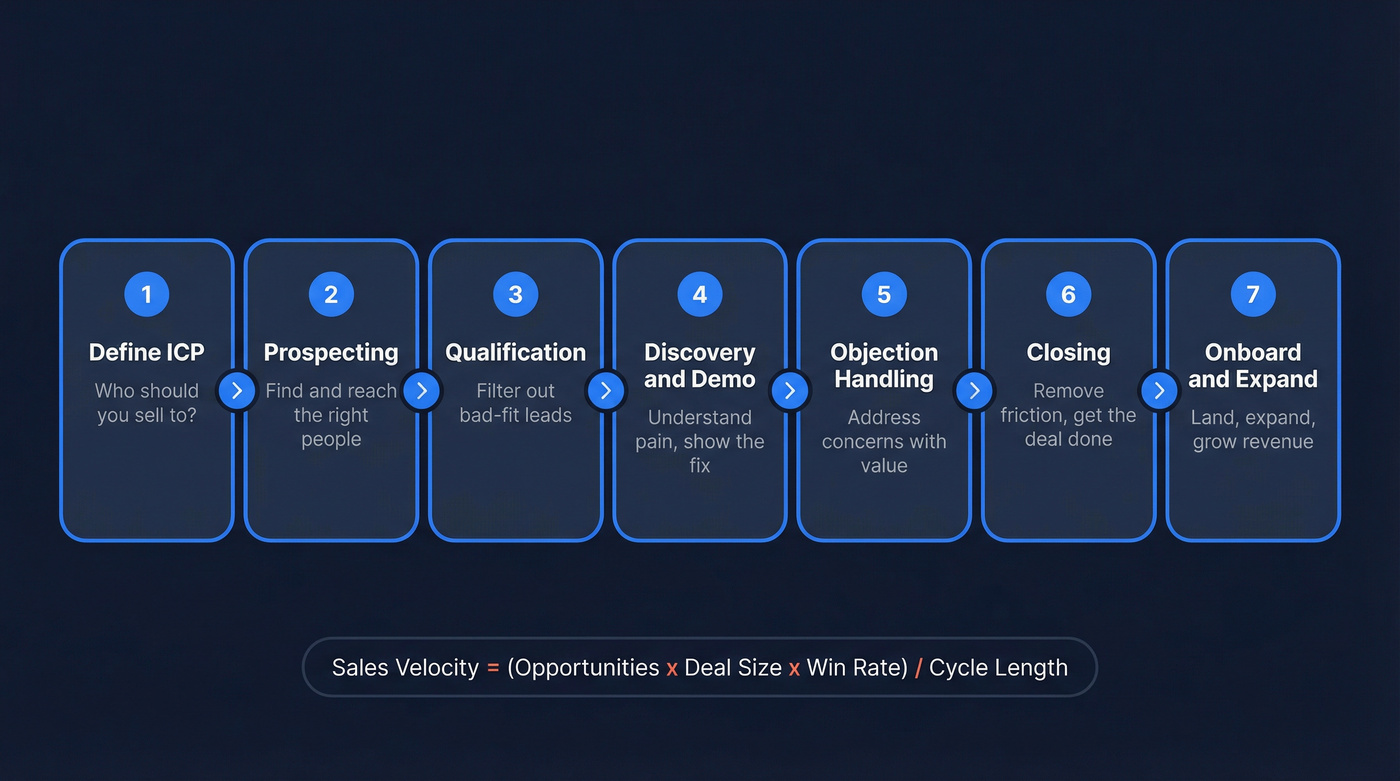
Seven stages, compressed: define your ICP, prospect, qualify, discover and demo, handle objections, close, then onboard and expand. Every SaaS selling motion follows some version of this arc. The specifics change by deal size and motion, but the skeleton doesn't.
The single biggest mistake? Qualification gets treated as a rubber stamp, not a filter. Reps qualify everyone who shows up to a demo because pipeline numbers feel good. Then half those "opportunities" die in stage 3 and nobody understands why forecast accuracy is garbage. That 69% quota miss rate isn't a coincidence - it's the downstream consequence of sloppy qualification.
The one metric that ties everything together is sales velocity: (Opportunities x Deal Size x Win Rate) / Cycle Length. It tells you how much revenue your process generates per unit of time. If velocity is flat or declining, something's broken.
If you only fix one thing: stop optimizing the process as a monolith. Measure each stage independently. Find the bottleneck - the stage with the worst conversion or the longest dwell time - and fix that. Then move to the next one. A 15% improvement in your worst stage will outperform a 3% improvement across all seven.
The 7 Stages of SaaS Sales
Stage 1: Define Your ICP
Your Ideal Customer Profile isn't a persona doc that lives in a Google Drive folder nobody opens. It's a targeting filter that determines who gets into your pipeline and who doesn't. A good ICP includes firmographic criteria like industry, headcount, revenue, and tech stack. It specifies the buyer role - title, department, seniority. And it captures pain signals: hiring patterns, funding events, tech adoption. (If you need a tighter system, use an account qualification scorecard.)
The common mistake is making the ICP too broad. "Mid-market SaaS companies" isn't an ICP - it's a market. "Series B-C SaaS companies with 100-500 employees, selling to enterprise, using Salesforce, with a VP of Sales or CRO as the buyer" is an ICP. The tighter your definition, the higher your conversion rates downstream.
Stage 2: Prospecting and Lead Generation
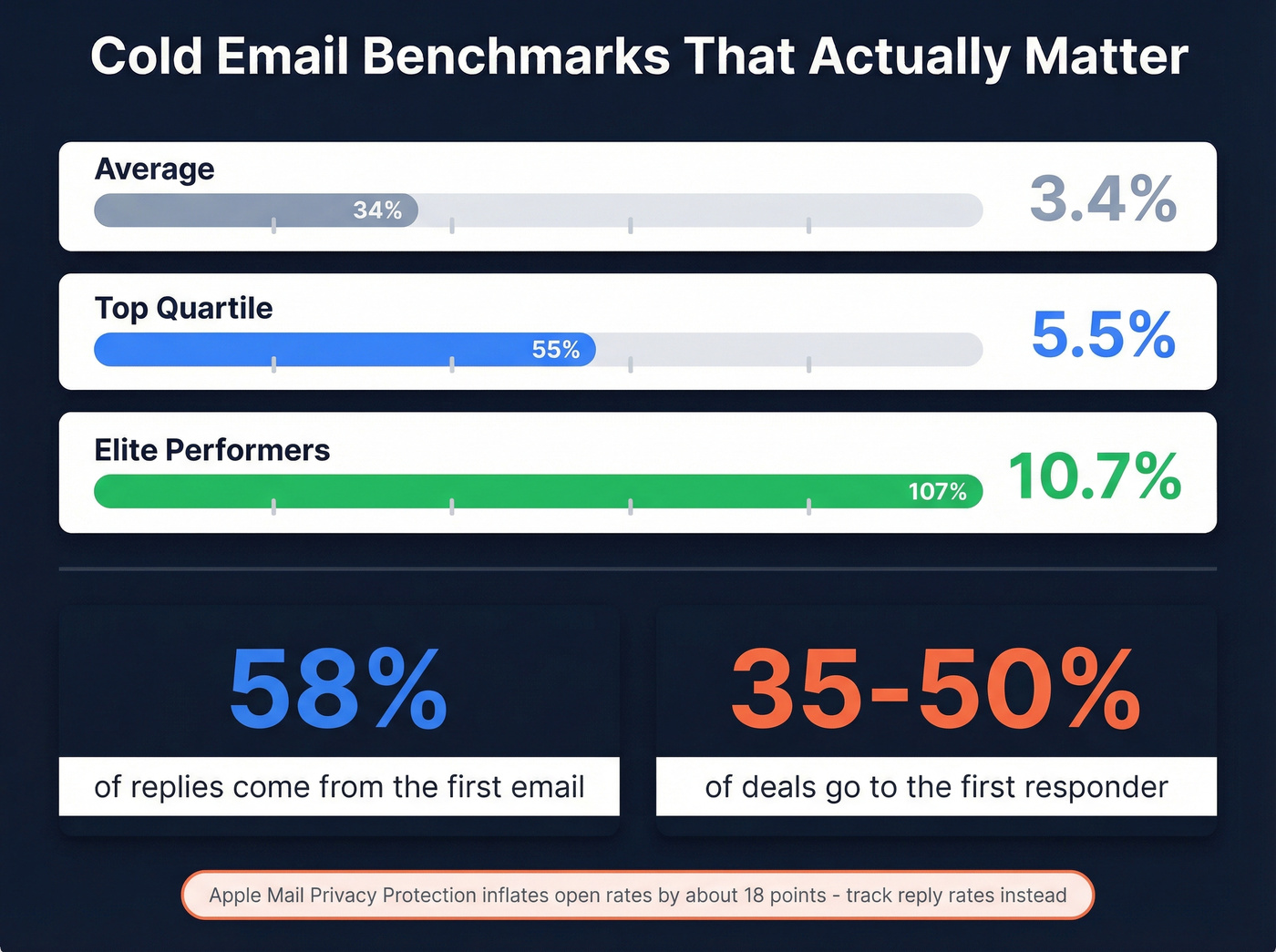
This is where most processes leak. Cold email reply rates average 3.4%, with top quartile at 5.5% and elite performers hitting 10.7%. The gap between average and elite is almost entirely explained by two things: targeting accuracy and data quality. (For a deeper playbook, see cold email tactics.)
Here's the thing - none of your downstream stages matter if you're emailing the wrong people or bouncing off invalid addresses. We've seen teams run beautifully crafted sequences that bounce at 35-40% because their data provider refreshes contacts every 4-6 weeks. That's not a messaging problem. That's a plumbing problem. (If you're diagnosing this, start with B2B contact data decay and prospect data accuracy.) When Snyk's 50-person AE team switched to Prospeo, their bounce rate dropped from 35-40% to under 5%, and AE-sourced pipeline jumped 180%, generating 200+ new opportunities per month.

One more benchmark worth internalizing: 58% of replies come from the first email. Follow-ups matter, but your first touch carries the majority of the weight. Make it count.
A caveat on open rates: Apple Mail Privacy Protection inflates them by roughly 18 percentage points. Track reply rates instead - they're the only honest signal of whether your messaging and targeting are working. (More on this in best email open tracker.)
Stage 3: Qualification
This is where 80% of teams are weakest. Qualification isn't "did they agree to a demo?" It's "should we spend 30-60 minutes of a senior AE's time on this account?" Those are very different questions.
The deliverable from this stage is a scored opportunity with a clear next step - or a disqualification. Both outcomes are wins. We'll break down the frameworks in the next section, but the principle is simple: qualification should remove more prospects than it advances. If your qualification-to-demo conversion is above 80%, you're not qualifying - you're scheduling. (If you want a broader menu of models, use a lead qualification framework.)
Stage 4: Discovery and Demo
Discovery and demo are often collapsed into one meeting, but they serve different purposes. Discovery is about understanding the prospect's situation, pain, and decision process. The demo is about mapping your product to their specific problems. When you skip discovery and jump straight to a feature walkthrough, you're guessing at what matters. (Use these discovery call tips to tighten the conversation.)
The common mistake: running the same demo for every prospect. Your demo should change based on what you learned in discovery. If the buyer cares about reporting, show reporting. If they care about integrations, show integrations. A generic product tour signals that you didn't listen.
One tactic that consistently outperforms: record a custom 3-minute Loom after discovery summarizing what you heard. It proves you listened and gives the champion something to share internally with stakeholders who weren't on the call. This single habit separates reps who multi-thread from reps who pray their single contact pushes the deal through.
Stage 5: Objection Handling
Objections aren't blockers - they're buying signals wrapped in uncertainty. The three most common in SaaS are price ("it's too expensive"), timing ("we're not ready yet"), and competition ("we're also looking at X"). Each requires a different response, but they all share one root cause: insufficient value articulation in earlier stages. (If you want a cleaner taxonomy, see types of objections.)
If you're hearing the same objections repeatedly, the fix isn't better rebuttals. It's better discovery and qualification upstream.
Stage 6: Closing
In SaaS, closing is less about a dramatic "ask for the business" moment and more about removing friction from the final steps. That means aligning on contract terms, getting procurement and legal involved early rather than springing them as a surprise at the end, and making the signature process painless.
Lead response time matters here too. 35-50% of deals go to the first responder, and conversion is 8-21x higher when response time is under five minutes. Speed kills - in a good way.
Stage 7: Onboarding and Expansion
The close isn't the end. In SaaS, the real revenue comes from expansion - upsells, cross-sells, and seat growth. Land-and-expand is the dominant enterprise motion for a reason: it's easier to grow a $20K deal to $100K than to close a $100K deal from scratch. (If you need examples, use these upsell email examples.)
Kohezion's CEO puts their typical sales cycle at 80 days to closure. But the expansion cycle after that initial close? Often faster and higher-value, because trust is already established. Build onboarding with expansion in mind from day one.
How to Qualify SaaS Leads
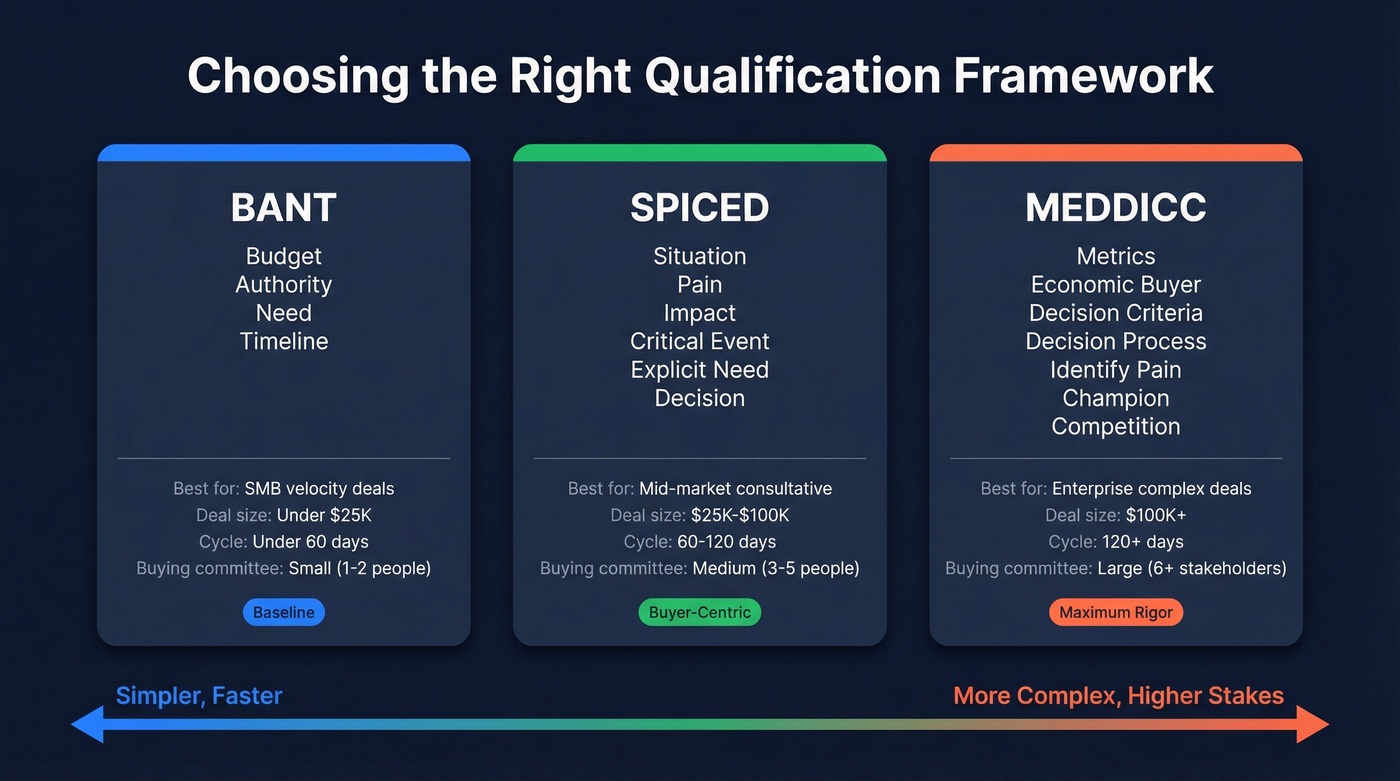
Three frameworks matter. Everything else is a variation.
| Framework | Stands For | Best For | Deal Size | Cycle Fit |
|---|---|---|---|---|
| BANT | Budget, Authority, Need, Timeline | SMB velocity | <$25K | <60 days |
| SPICED | Situation, Pain, Impact, Critical Event, Explicit Need, Decision | Mid-market consultative | $25K-$100K | 60-120 days |
| MEDDICC | Metrics, Economic Buyer, Decision Criteria, Decision Process, Identify Pain, Champion, Competition | Enterprise | $100K+ | 120+ days |
BANT is the baseline. It works for transactional deals where the decision is fast and the buying committee is small. But it falls apart in enterprise because "do you have budget?" is a useless question when procurement controls a centralized pool.
SPICED flips the lens to the buyer's world. Instead of asking "do you have authority?", you're mapping the decision process, surfacing the explicit need behind the stated pain, and identifying critical events that create urgency. It's more consultative and works well for mid-market deals where the buyer needs to feel understood, not interrogated.
MEDDICC is the enterprise standard for a reason. It forces rigor around the economic buyer, the champion, and the competitive landscape. The progression from MEDDIC to MEDDICC to MEDDPICC to MEDDPICCR maps directly to deal complexity - each letter adds a layer of scrutiny. Enterprise teams often face 30-50% forecast variance without MEDDIC; well-implemented teams report under 10%.
Let's be honest about the cost, though. MEDDICC training runs $100K-$500K through firms like Force Management or Winning by Design. And even after that investment, adherence decays 40-50% within six months without reinforcement. The consensus on r/sales is that the framework isn't the hard part - the discipline is. If you can't afford formal training, start with a MEDDICC scorecard in your CRM and enforce it in deal reviews. That alone gets you 60% of the value.

Stage 2 is where most SaaS pipelines leak - bad data means bounced emails, burned domains, and wasted rep time. Prospeo's 7-day data refresh and 98% email accuracy cut bounce rates from 35%+ to under 5%. Snyk's 50 AEs saw AE-sourced pipeline jump 180% after switching.
Stop bleeding pipeline at the prospecting stage.
Three SaaS Sales Models
| Model | ACV Range | Cycle Length | Examples | Sales Involvement |
|---|---|---|---|---|
| Self-Serve | <$5K | Days to weeks | Mailchimp, Semrush | None to minimal |
| Transactional | $5K-$50K | 30-90 days | Stripe, HubSpot | SDR + AE |
| Enterprise | $50K+ | 90-180+ days | ADP, Microsoft 365 | Full team |
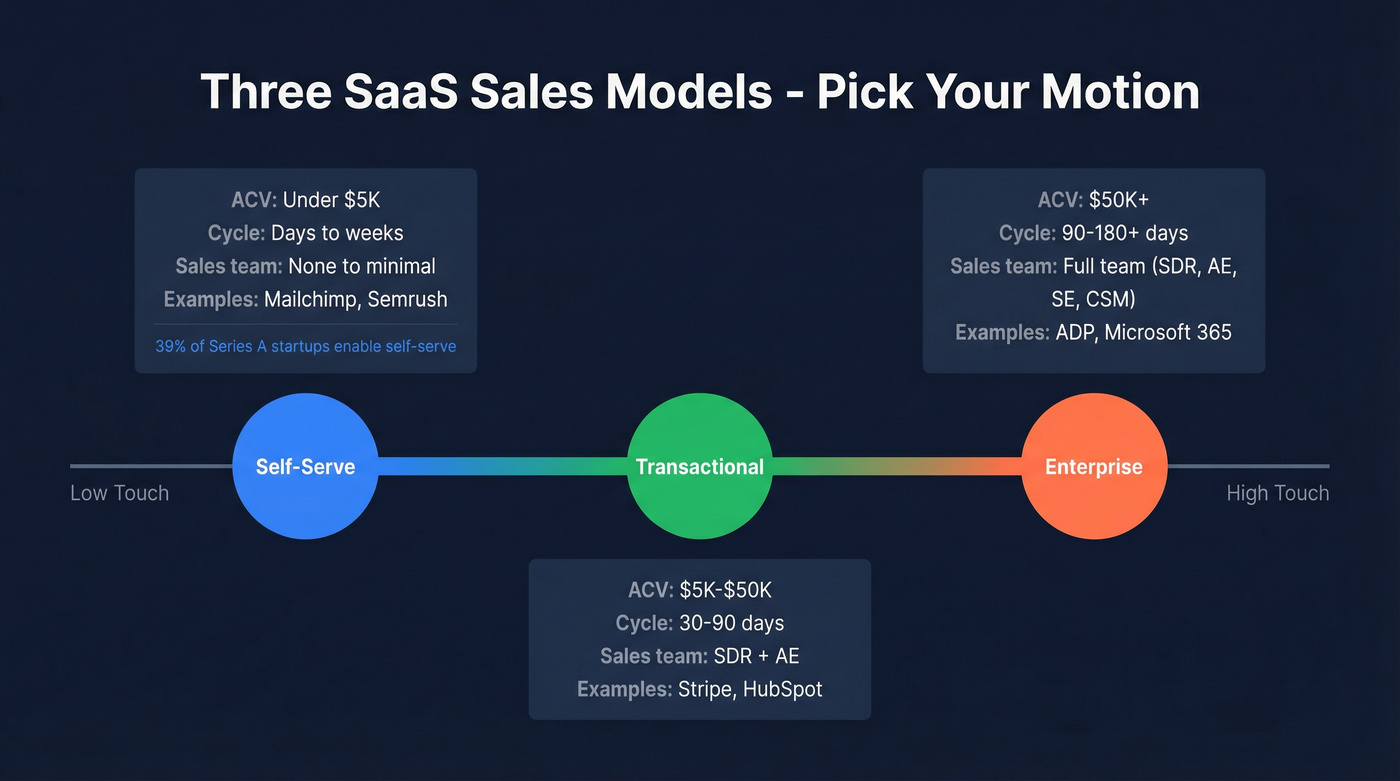
39% of Series A startups in a 474-company dataset enable self-serve, and 25% offer a free tier. In DevTools specifically, 50% are PLG. But PLG doesn't replace sales - it replaces bad leads. The best PLG companies still have sales teams; they just focus those teams on expansion and enterprise, not on convincing someone to try the product.
The "ready for self-serve" signals are practical: median time-to-value under 30 minutes, activation-to-paid conversion stabilizing across cohorts, and support tickets shifting from "how do I?" to deeper capability questions. For teams running a hybrid motion, track marginal CAC by channel - PLG acquisition should be meaningfully cheaper than sales-led, or you're subsidizing a freemium funnel with AE time.
Our take: start sales-led. Always. Add self-serve when time-to-value drops below 30 minutes and you have enough usage data to know what activation looks like. Going PLG too early - before you understand your buyer - is how startups waste six months building a freemium funnel nobody converts through. If your average deal is under $8K and your product is intuitive, you'll get to PLG eventually. But you need to understand your buyer first, and sales conversations are the fastest way to do that.
Cycle Benchmarks by ACV
| ACV Tier | Typical Cycle Length | Segment |
|---|---|---|
| <$5K | ~40 days | SMB / Self-serve |
| $5K-$25K | 30-60 days | SMB / Transactional |
| $25K-$100K | 60-120 days | Mid-market |
| >$100K | ~170 days | Enterprise |
These benchmarks come from HubSpot data cited by Atlassian and align with Claap's operational benchmarks. The spread is wide because cycle length is driven by more than just deal size - number of stakeholders, procurement complexity, and competitive dynamics all play a role.
Two factors that consistently shorten cycles: strong champion engagement (they're selling internally for you) and early legal/procurement involvement so there are no surprises at the finish line. Two that extend them: committee-driven decisions without a clear economic buyer, and "nice to have" positioning that lacks urgency.
Enterprise SaaS Sales - What Changes
You just lost a $200K deal because your champion left the company and you had no other contacts. Single-threaded. One relationship. Gone.
This is the defining risk of enterprise sales. Gartner puts the average enterprise deal at 7-10 stakeholders. UserGems analyzed 500 opportunities and found that single-threaded deals win at roughly 5%, while deals with 5+ contacts win at ~30% - a 6x improvement. Multi-threading isn't optional in enterprise. It's survival. (If you want the mechanics, see what is multithreading in sales.)
Three things change fundamentally at the enterprise level.
Mutual Action Plans become essential - and they need to be shared early, not introduced at the contract stage. A MAP aligns both sides on timeline, deliverables, and decision milestones. It turns a vague "we'll circle back next quarter" into a concrete sequence of steps with owners and dates.
Signal-based prioritization replaces spray-and-pray prospecting. You're looking for tech installs, job changes, funding rounds, and hiring patterns that indicate buying intent. Intent data platforms tracking thousands of topics let teams layer buyer intent with job role and company growth signals to prioritize accounts that are actually in-market. (If you want the operating model, use signal-based outbound.)
The procurement/security/legal tail adds 30-90 days that most reps don't plan for. Build it into your timeline from the start.
Know when to walk away. No executive alignment after two meetings, procurement ghosting for 4+ weeks, or a champion who has enthusiasm but no organizational power and you can't reach anyone who does - these are dead deals wearing opportunity costumes. Skip them.
The Metrics Dashboard
69% of B2B sales reps miss quota. That's not a motivation problem - it's a measurement problem. If you don't know which stage is leaking, you can't fix the process.
| Metric | Formula / Definition | Benchmark | Context |
|---|---|---|---|
| Sales Velocity | (Opps x Deal Size x Win Rate) / Cycle | Target +10% QoQ | Core health metric |
| Pipeline Coverage | Pipeline / Quota | 3-5x | 4-5x if win rate <25% |
| Win Rate | Closed-Won / Total Opps | 20-30% avg, 35-40% best | By stage and segment |
| Meeting-to-Opp | Opps Created / Meetings | 25-40% | Qualification quality |
| CAC | Total S&M Spend / New Customers | Varies by ACV | Track by channel |
| LTV | Avg Revenue x Avg Lifespan | LTV:CAC > 3:1 | Include expansion |
| NRR | (Start MRR + Expansion - Churn) / Start MRR | >100% healthy, >120% elite | The real SaaS metric |
Sales velocity is the metric that ties everything together. It's not a vanity number - it tells you exactly how much revenue your process generates per unit of time. If velocity is declining, decompose it: are you generating fewer opportunities? Smaller deals? Lower win rates? Longer cycles? Each diagnosis points to a different fix.
The mistake most teams make is optimizing the wrong lever. If your win rate is 35% but your pipeline coverage is 2x, you don't have a closing problem - you have a top-of-funnel problem. Measure each stage independently. Fix the bottleneck. Move on.
Building Your Tech Stack
| Stage | Category | Tool | Price Range |
|---|---|---|---|
| Prospecting | B2B Data | Prospeo | Free tier; ~$0.01/email |
| CRM | Pipeline Mgmt | HubSpot / Salesforce | HubSpot: free tier; paid from ~$20-$100+/user/mo. Salesforce: ~$25-$330/user/mo |
| Sequencing | Outreach | Outreach / Salesloft | ~$100-$200+/user/mo |
| Conversation | Intelligence | Gong | ~$1,200-$2,400+/user/year |
| Intent | Buyer Signals | Bombora | $25K-$50K+/year |
Data quality is the foundation - bad emails mean bounced sequences, flagged domains, and fictional pipeline. We've tested dozens of providers over the years, and the pattern is consistent: teams that invest in verified data outperform teams that chase volume. (If you need a checklist, start with email deliverability checklist.) Prospeo covers 300M+ profiles with 143M+ verified emails and a 7-day refresh cycle, which is why bounce rates drop so dramatically when teams switch over.
For CRM, HubSpot's free tier is the obvious starting point for early-stage teams. Salesforce makes sense once you need custom objects, advanced reporting, or enterprise integrations. Gong and similar conversation intelligence tools pay for themselves quickly if you're running a team of 5+ reps - the coaching insights alone justify the spend. Use this as a checklist when evaluating your stack: verified data source, CRM, sequencer, conversation intelligence, and intent signals cover the essentials. (If you're building from scratch, use this B2B sales stack blueprint.)
Sales velocity depends on filling your pipeline with qualified, reachable buyers. Prospeo gives you 300M+ profiles with 30+ filters - buyer intent, tech stack, funding, headcount growth - so your ICP isn't a doc in Google Drive, it's a live search that returns verified contacts.
Turn your ICP definition into a pipeline in minutes, not weeks.
FAQ
How long is a typical SaaS sales cycle?
Deals under $5K close in roughly 40 days. Mid-market contracts ($25K-$100K) take 60-120 days, and enterprise deals over $100K average around 170 days. The biggest variable beyond deal size is the number of stakeholders involved in the buying decision.
What's the difference between PLG and sales-led?
PLG lets users adopt the product without talking to sales - think free trials or freemium tiers. Sales-led means a rep drives the process from first touch. Most companies that scale run a hybrid: PLG for acquisition, sales for expansion and enterprise.
Which qualification framework should I use?
MEDDICC for enterprise deals over $100K with complex buying committees. SPICED for mid-market consultative sales where understanding the buyer's situation drives the deal. BANT for SMB velocity plays where speed matters more than depth.
What stages should I audit first?
Start with qualification and discovery - they have the highest impact on win rate and cycle length. If meeting-to-opportunity conversion is below 25%, qualification is too loose. If deals stall after the demo, discovery isn't surfacing the right pain. Fix these before touching anything downstream.
What's a good free tool for SaaS prospecting data?
Prospeo's free tier gives you 75 verified emails per month with 98% accuracy and a 7-day data refresh cycle. Most free tiers from competitors cap at 25 searches or skip verification entirely. Pair it with HubSpot's free CRM and you've got a functional outbound stack at zero cost.